mermaidcamp
Keeping current in wellness, in and out of the water
You can scroll the shelf using ← and → keys
You can scroll the shelf using ← and → keys

Richard Sears
Richard Sears was born in Holland because his father was exiled from England. We know a lot about the life of Richard Sears because of the fine record keeping of Plymouth Colony and the Massechusetts Bay Company. There are many facts recorded:
MIGRATION: 1633FIRST RESIDENCE: PlymouthREMOVES: Marblehead by 1637, Yarmouth by 1639OCCUPATION: Husbandman.FREEMAN: Oath of fidelity at Yarmouth, 1639 [PCR 8:185]. Propounded for freemanship, 3 June 1652 [PCR 3:7]. Admitted a freeman, 7 June 1653 [PCR 3:31]. On the 1658 and 29 May 1670 lists of freemen from Yarmouth [PCR 5:274, 8:200].EDUCATION: His inventory included “1 Great Bible and other books” valued at £1 3s.OFFICES: Deputy (from Yarmouth), 3 June 1662 [PCR 4:14]. Grand jury, 7 June 1652 [PCR 3:9]. Tax collector, 1 March 1658/9 [PCR3:155]. Yarmouth constable, 6 June 1660 [PCR 3:188]. In Yarmouth section of 1643 Plymouth Colony list of men able to bear arms [8:194].ESTATE: Assessed 9s. in Plymouth tax list of 25 March 1633 [PCR 1:11]; omitted from list of 27 March 1634. On 1 January 1637/8 “Richard Seeres” was included in a Salem rate list for the “inhabitants of Marblehead” [STR 1:63]. On 14 November 1638 “Rich[ard] Sears” was granted four acres at Marblehead “where he had planted formerly” [STR 1:74]. On 23 November 1664 “Allis Bradford the widow of William Bradford” sold to “Richard Sares” of Yarmouth, husbandman, two tracts of twenty acres each “at a place commonly called … Sasuet,” one of which had been the lot of William Bradford deceased and the other of which had been the lot of Experience Mitchell [MD 34: 23, citing PCLR 3:18]. In his will, dated 10 May 1667, with a codicil dated 3 February 1675/6, and proved 5 March 1675/6, “Richard Sares of Yarmouth” bequeathed to “Sylas Sares my younger son … all my land, that is all the upland upon the Neck where his house stands in which he now dwells … after mine and my wife’s decease,” provided that “my son-in-law Zachery Paddock” shall have the house where he dwells and two acres within the above tract “during the life of Deborah his now wife”; also to “the said Sylas Sares” a tract of meadow and half of “my land called Robins as is undivided”; to “my elder son Paule Sares all the rest and remains of my lands whatsoever”; to “Dorothy my wife” all lands and goods during her natural life, she to be sole executrix, and “do entreat my brother Thacher with his two sons as friends in trust” as overseers; to “my son-in-law Zachery Paddock” two acres from land called Robins before it is divided between Silas and Paul Sears, and this two acres, along with the two acres mentioned above, to go to Ichabod Paddock, son of Zachary, at the death of Zachary’s wife; witnessed by Anthony Thacher and Anthony Frey; in the codicil, dated 3 February 1675/6, Richard Sears bequeathed to “my eldest son Paul Sares … the house which I now live in” and various moveables; witnessed by John Thacher and Judah Thacher; on 5 March 1675/6 deposed that he and his brother witnessed the codicil, and that when “my uncle signed this appendix,” he asked him [John Thacher] to redraw the will and “to leave out of the new draft the legacy of land that is given to Ichabod Paddock, for saith he I have answered it in another way,” but Thacher never did produce this new draft [PCPR 3:2:53-54]. The inventory of the estate of “Richard Sares,” taken 8 October 1676 and presented at court on 15 November 1676 by “Dorethy Sares the relict of Richard Sares and Paul Sares his eldest son,” was untotalled and included “his house and lands,” valued at £220 [PCPR 3:2:55; PCR 5:213].BIRTH: About 1595 based on age at death.DEATH: Yarmouth 5 September [1676] “age 81y 4m” [YarVR 126].MARRIAGE: By 1637 Dorothy Jones. She was born about 1603, daughter of George and Agnes (_____) Jones of Dinder, Somerset [TAG 58:244-46]. “Cady [i.e., Goody] Seares was buried the 19th of March [16]78[/9]” at Yarmouth [YarVR 125].CHILDREN:
| i PAUL, b. about 1637 (d. Yarmouth 20 February 1707/8 in 70th year [gravestone]); m. by 1659 Deborah (eldest child aged thirteen on 3 July 1672 [YarVR 1], said to be daughter of George Willard. |
| ii DEBORAH, b. about 1639 (d. Yarmouth 17 August 1732 “within about one month of 93 years of age” [YarVR 155]); m. by 1661 Zachariah Paddock (eldest child aged seventeen on 2 February 1678 [YarVR 6]). |
| iii SILAS, b. say 1641; m. by about 1665 Anna, probably daughter of James Bursell of Yarmouth [PCR 5:212]. |
ASSOCIATIONS: Dorothy (Jones) Sears, wife of Richard, was sister of Richard Jones of Dorchester and of Elizabeth (Jones) Thacher, wife of Anthony Thacher of Yarmouth [TAG 58:244-46].COMMENTS: Although the earliest record of Richard Sears in Marblehead is in 1637, he may have moved there as early as 1634, since he is in the 1633 Plymouth tax list, but not in the list of 1634. On 2 October 1650, with a large number of other men, “Richard Seares” brought an action against William Nickerson for slander [PCR 7:50].BIBLIOGRAPHIC NOTE: Various publications of the middle of the nineteenth century set forth an English pedigree for Richard Sears, and partly on the basis of this pedigree assigned to Richard Sears a son Knyvett Sears. In 1886 Samuel Pearce May carefully examined and analyzed this pedigree, and found it to have no merit; he further demonstrated that the proposed son Knyvett did not exist [NEHGR 40:261-68]. Four years later May published a genealogy of the family [The Descendants of Richard Sares (Sears) of Yarmouth, Mass., 1638-1888 (Albany 1890)]. In 1948 Donald Lines Jacobus prepared a brief account of the family of Richard Sears [Brainerd Anc 257-58].
It is possible to see in the above bibliographic note how shaky recorded information can be. We are relying on both the accuracy of the recording agency/person and the lack of any evidence to the contrary. I am always happy that the founding of our nation was a business venture, ad therefore created factual records of various kinds. This is why the ancestry detective has a fun and never ending game of fact finding. The entire study highlights human inaccuracy, and a constant desire to edit/spin history hiding the dark side and featuring the best of the family history. The detective notices bogus sources as well as plain old human ignorance and error. Some of my other ancestors are in the above story as well, so I can double check what I know about them. The jigsaw puzzle of history is so fascinating when it is personal.
Richard Sears (1590 – 1676) We can find his grave:

Richard Sears, 10th Great Grandfather
is my 10th great grandfather
Silas Sears (1638 – 1697)
Son of Richard
Silas Sears (1661 – 1732)
Son of Silas
Sarah Sears (1697 – 1785)
Daughter of Silas
Sarah Hamblin (1721 – 1814)
Daughter of Sarah
Mercy Hazen (1747 – 1819)
Daughter of Sarah
Martha Mead (1784 – 1860)
Daughter of Mercy
Abner Morse (1808 – 1838)
Son of Martha
Daniel Rowland Morse (1838 – 1910)
Son of Abner
Jason A Morse (1862 – 1932)
Son of Daniel Rowland
Ernest Abner Morse (1890 – 1965)
Son of Jason A
Richard Arden Morse (1920 – 2004)
Son of Ernest Abner
Pamela Morse
I am the daughter of Richard Arden
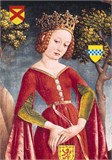
Marjorie Bruce
At the end of June 1306 the 9-year-old princess, together with her mother and other women-folk of The Bruce’s family, were sent for safety to Kildrummy Castle (Aberdeenshire), escorted by Nigel Bruce and the Earl of Atholl. It was intended that they would then take refuge in Orkney until times were easier, but the English army was already at Aberdeen and the royal ladies moved on to Tain, north of Inverness, still hoping for a boat. Here they were captured in the sanctuary of St. Duthac and sent to Edward of England, then at Lanercost Priory in Cumberland. They were separated from each other and Marjorie was sent to a convent, where she remained until her release 8 years later.
She was not yet eighteen at the time of the battle of Bannockburn , 24 June 1314. One of the heroes of that great victory over the English was her second cousin once removed, Walter Stewart, 6th Lord High Steward, some four years her senior, whom she married in the following year. It was from that Stewart cousinship that the typically Stewart name of Marjorie first came into the family of Bruce, Robert the Bruce’s mother and maternal grandmother both bearing that name. This last-named Marjorie had been the second of the three daughters of Walter, 3rd High Steward.
Part of the wedding dowry which Marjorie Bruce brought to her husband was the castle and Barony of Bathgate in Midlothian, which it was intended would become their private family residence; but this was not to be.
Whether through rashness, fearlessness or ignorance of the possible consequences, Princess Marjorie went out riding near Paisley while heavily pregnant. Her horse, taking fright at something, reared up, Marjorie was thrown violently to the ground and immediately went into premature labour. Her only child, the future Robert II, was delivered at the roadside by Caesarean section (the first authentic record of such an operation being performed since the birth of the eponymous Julius Caesar). The beautiful Marjorie died within a few hours, aged only about 19 years and 3 months, on 2 March 1316. Her last words are reported to have been ‘He’s a laddie; I ken he’s a laddie; he will be king’. Her improbable dying prophecy eventually came true, but not for another fifty-five years.
I notice that this story mentions her mother, but it must refer to the second wife of her father, since Isabell was already dead. Still, much of it is probably accurate. Convent for 8 years is pretty harsh, but it was common then. I think it is interesting that she had the first recorded C section since C himself. You can go to the place where she supposedly fell off the horse, so it must be a big deal in the history of Scotland.
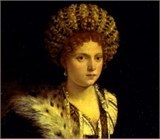
Isabell Mar, 23rd great grandmother
My 23rd great grandmother had a short life, as did her daughter Marjorie Bruce. She was married to Robert the Bruce of Scotland. We know a lot about her:
Isabella of Mar (c. 1277 – December 1296) was the first wife of Robert Bruce. She was the daughter of Domhnall I, Earl of Mar and a woman named Helen (or Ellen) b. 1246 d. 1295, who had previously been the wife of Maol Choluim II, Earl of Fife. Isabella was a wealthy young woman at the time of her arranged marriage to the Earl of Carrick, Robert Bruce. Her father was one of the seven guardians of Scotland who believed Robert Bruce to be the rightful King of Scotland. Despite the risks, he could see the advantage of the two families joining in marriage and bearing an heir to the throne. Mar was the first to sign over the estates of his family to the Bruce. Isabella was married to Robert at the age of 18 and legend has it that they were much in love. Shortly after their marriage Isabella became pregnant. She had a healthy pregnancy but she died soon after giving birth to a daughter, Marjorie Bruce in 1296. Robert married his second wife, Elizabeth de Burgh, six years later. Isabella’s daughter Princess Marjorie (d. 1316) married Walter Stewart, 6th High Steward of Scotland, and their son became Robert II of Scotland. From him descend the monarchs of the House of Stewart and the later royal families of the United Kingdom[edit]SourcesFelix Skene, editor, Book of Pluscarden, 1877John of Fordun
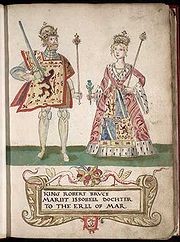
Robert and Isabell rule
Scotland is certainly not for the squeamish, but imagine it in 1278. I want to go someday.
Historical enemies, sagas of war, and the tragic impact violent thoughts have on society today are harsh reminders of human disorder. We can not look back to find a perfect time in history or a completely noble story of our ancestors’ survival. The mixed bag has always existed, known and unknown, true and false. When evil rocks the world we are all quick to isolate culprits and round up perps in our own minds. It does not matter which demon we blame, even if we never mention it out loud. The very act of deciding who is to blame will be a process to eliminate knowledge of one’s own part in building a more hateful world. The question of the moment is “Who started this?”, but we all know intuitively the answer to that eternal question.
The prostitute archetype in each of our dramas will test and be tested to discover ethics and limits. The question will be answered in this lifetime about how blind you are to others in order to enhance your own comfort. This story will star your prostitute archetype. Your storyboard will be repeated in different costumes and sets until the line has been firmly established between your soul and what you are willing to do for physical comfort. You may find it is an opera one time and a comedy the next, but if you look back you can identify the segments like vignettes on the Twilight Zone. You created and produced these stories to find your limits. Your own unconscious mind has written, directed, and been in charge of casting the stars. There are sometimes entire decades of reruns. I feel that our nation has been rerunning an unfortunate version of our best selves with less than admirable results.

Jenkins COA
My 10th great grandfather, John Jenkins sailed at age 26 on the “Defence” of London, from London the last of July 1635 and arrived at Boston October 8, 1635 with about 100 other passengers, according to Edward Bostock, master. That is a seriously long voyage.
John Jenkins (1609 – 1684)
What is normally found in the search for family history is probate records, documents, bibles, and census records. Every once in a while you come across a written piece about your ancestor. This one is not designated to a specific publication. It is unusual because it gives you a picture of his physical presence as well as his philosophy. I love the Longfellow at the end.
John was a man of about 5 ft. 10 in. in height, slim build and weighing about 155 lbs. His face was widest at the eyebrows and became narrower at the chin. His forehead was moderately high. He had a long, slender neck. Mentally, he was a conservative. One who took time to think over a plan or proposition before coming to a decision. He had a great, retentive memory and was a Liberal in religion. He was a Liberal when it took raw courage to proclaim it. His voice was pitched higher than the average person and did not carry far.
He was a student in the very limited area of his time and what he read, he understood. This conclusion must be sound because of the very large number of his descendants who have made outstanding records as students and as teachers. And the many who became competant in the legal and medical professions. He must have been very capable and worth while pioneer: one of that class of persons whom Longfellow had in mind when he wrote, “And departing, leave behind us,…Footprints on the sand of time.”
This gives us the history of the celebration of Christmas.


I have had several of you ask me about how true are the wreath decorations of Colonial Williamsburg. So true to form, I did some research to confirm their authenticity. In my research I came across some interesting information on customs and traditions of Christmas within the colonial period.

During the colonial period in Virginia, the Christmas season followed a four week period of Advent. Most Virginians were devout Anglicans and they would have observed a period of fasting, prayers and reflection. They would have read daily from the Book of Common Prayer. Fasting would have been only one full meal, which generally would have been meatless during the day. After the four weeks, they would end with a Christmas meal and the start of the Christmas season.
Did you know that most of New England didn’t celebrate Christmas during the colonial period? Christmas was outlawed in most of New…
View original post 585 more words
I was a born farmer, entitled to play with everything on my grandparent’s farm. While my parents pitched in to help, I was given free reign of the place. My grandparents, Olga and Ernest Morse lived and farmed in Lincoln, Arkansas at the end of their lives after careers in teaching (my grandmother had a masters in education) and oil well drilling ( my grandfather drilled for oil before the rotary bit was invented). I did not know them before they had the farm, so I always think of them as farmers.

Pam and flowers 1953

Pam and the Fam on the farm
Here is my look in 1960, on Christmas at my grandparents’ farm in Arkansas…very American Gothic in my opinion:

A girl and her farm

Christmas 1960 Pam & Father
I met my cousin Mary in Tulsa a couple of years ago to trace the heritage of our mutual great grandmother. We did not remember that we had met in 1964 at her grandfather’s house in Iowa. Our grandfathers were brothers who followed different paths. They both did migrant labor as very young boys, traveling to work picking corn in Iowa and beyond.

Cousins in Iowa 1964
Uncle Ed sent this postcard to his brother Ernie telling him about Emma.

Uncle Ed goes to harvest
Ed sealed the deal when he married the farmer’s daughter in Council Bluffs, Iowa
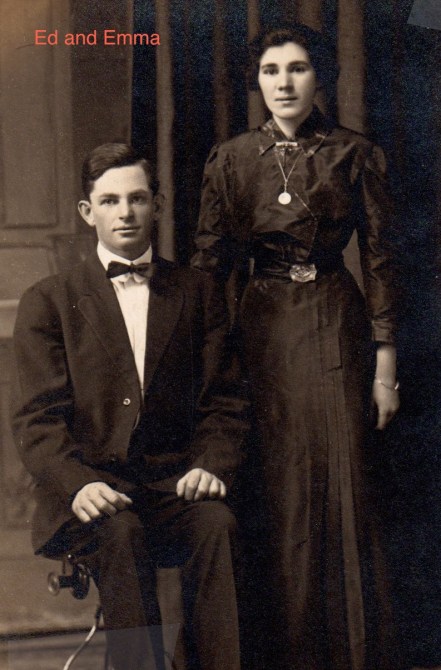
Married the farmer’s daughter
My grandfather returned to the Cherokee Strip to marry Olga Scott and drill oil wells, creating two different paths for the future.

Ernest Morse
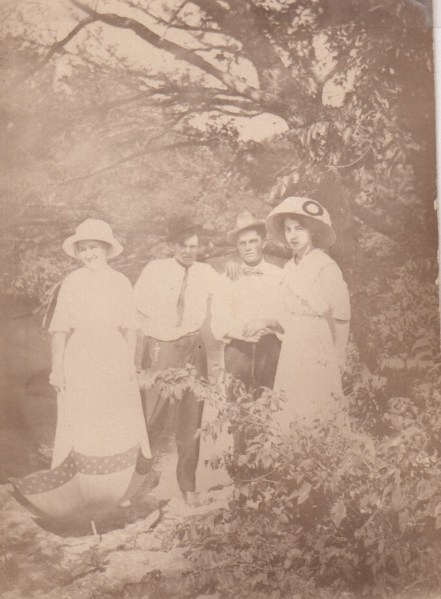
My grandparents on a double date
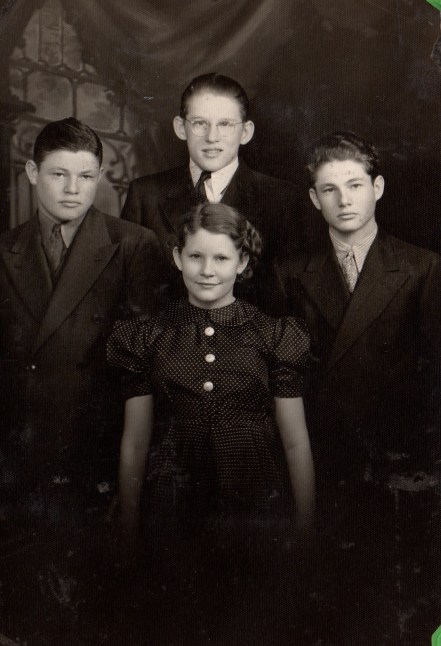
My dad and siblings 1933
 sunken treasure of dreams
Studying one’s ancestry one learns history once and for all. Any abstracts become clear when you chart your own pedigree. Any dates memorized come to life when you find out what your own ancestors were doing at those times. I am always a big proponent of being present in the moment, but historical knowledge helps me appreciate the present. The belief in intuition is enhanced when the timeless soul is given room to move. Calendars and clocks are maps of time that match the heavens in a very precise way. The full meaning of the heavens is impossible to capture in a clock. If you can view your life from a higher place time is less relevant than it appears to be in your rear view mirror. Meditation is the path to truth beyond time.
I am all the way a navigator. I have flown many miles in private planes navigating from the air, do very well with driving, or public transportation. Reading maps and finding different kinds of maps has always been a fascination for me. Historical maps and charts of the heavens are of particular interest. I am learning with precision how to navigate backwards by means of the family tree. My study of Sacred Contracts teaches me to align with time in a much broader spiritual sense.
Memory and dreams reconstruct time as well as facts. Often by repeating a story that is highly revised and edited for the ego’s best light we create a strong reality that never existed or has a chance of being true in real time. Our poetic dreamy visions of ourselves and others are the pageant we produce in order to learn our life lessons. Each one of us produces and directs the archetypal dramas in which we live. We act in the dramas of others, as do they in ours, but we only witness tiny segments of other people’s story. In dreams we only see faces we have seen in our waking lives. In dreams we deconstruct and revise the archetypes and their roles in our own big picture.
Looking at the symbolic as well as the scientific meaning of the past I see above and below are forever linked just as the past and the future. They have no meaning without their partners, like the border crossers and the migra. Our lessons are repeated in time, but are not done in a logical worldly sequence. If we believe in divine order it would be wise to honor and make some contact with it. In this way we can avoid swimming against the current , struggling to arrive in a place we have already been. Deep meaning is found by reading the treasure maps in our dreams.

signatures on marriage contract
We know a lot about the life of my 12th great grandfather who arrived in Boston harbor to begin his new Puritan life in 1630. He was censured by the Puritans for defending a woman who held Bible studies in her home for both men and women. He had to retract his support for Anne Hutchinson under threat of having his gun taken from him. His brief touch with feminist sentiments and freewheeling seditious non conformity and Antinomianism were censured by his Puritan piers. The crazy religious infighting that created Rhode Island and Maine is not a well known part of the story of our founding fathers. Here is the story of one of my ancestors who arrived very early on the shores of North America:
BIRTH William was born circa 1581 in Bermondsey, Surrey, England[1], as based upon his date of marriage. DEATH & BURIAL He died in Woburn, Middlesex co., MA on 1 March 1645/6; he was 64[2,3]. MIGRATION & RESIDENCE William and his family migrated to New England by 1630[1], where he was admitted as an inhabitant of Charlestown, Suffolk co., MA that year[3,6,7]. “William Learned and Goodith his wife” were admitted to the church at Charlestown, Suffolk co., MA on 6d:10m(December):1632[1,6]. He made Freeman there on 14 May 1634[1,4]. William and his family remained in Charlestown for roughly a decade — he is on the lists of Charlestown residents of 9 January 1633/4 and January 1635/6[3,8]. Then, they removed to Woburn, Middlesex co., MA in 1640[1]. In Charlestown, William acquired and divested a great deal of real estate. In 1635, he was allotted two shares of hayground, which was subsequently increased to three[1,12], and he surrendered 5 acres on the Mystic Side[1,11]. On 13 January 1636/7 the Charlestown selectmen “agreed to allow Goodman Learned a portion of marsh by his house agreed upon by Goodman Richeson & Goodman W[illia]m Baker for his haylot by Mr. Gibbon’s which he yieldeth up to the town”[1,17]. In 1637, he had a 10-acre lot (number 7 on the Mystic Side)[6], and another 5 acres of land on the Mystic Side[1,13]. In addition, “W[illia]m Lernett” had 3.75 cow commons that year[1,14]. In the Mystic Side allotments of 23 April 1638 he received portions of 15, 40 and 5 acres[1,15]. Thus, in the 1638 Charlestown Book Of Possessions, “William Lernett” had 7 parcels of land: three acres of arable land and meadow, along with a dwelling house next to the “Olde Meeting House”; four acres arable land in the East Field; 3.75 cow commons; two acres of meadow in the Mystic Marshes; five acres of woods in the Mystic Field; fifteen acres of woods in the Mystic Field next to the Common; and forty acres of land in the Rock Field[6,9,10]. The 3.75 cow commons were further noted in an inventory of 20 December 1638[1,16]. TOWN SERVICE & EDUCATION William signed the petition on 10 February 1634/5 which established the office of the Selectman in Charlestown, Suffolk co., MA[3,20]. He himself served as Selectman in 1636[1,19]. On 26 April 1638, William was named to the Charlestown committee “to consider of some things tending towards a body of laws &c”. Anderson uses this as evidence of his higher education level[1,18]. LEGAL MENTION On 16 November 1637 “Will[iam] Larnet acknowledged his fault in subscribing the seditious writing [in favor of Rev. John Wheelwright], & desiring his name to [be] crossed out, it was yielded his, & crossed”[3,5]. The case of the Reverend John Wheelwright involved the Antinomian movement of the 1630s in the Boston Area. Bucking church authority was a part of Wheelwright’s nature, it would seem. Whilst a preacher in England, he was censured for non-conformity for his embrasure of Puritan sentiments. After arriving in Boston, Suffolk co., MA in 1636, he was soon suspected of following the Antinomian tenets proposed by his sister-in-law, Mrs. Anne Hutchinson. Thus, he was censured again, this time by the Puritan government under Governor John Winthrop after delivering a sermon at Mount Wollaston (now Quincy), Norfolk co., MA, disfranchised and banished. Unlike most Antinomian banishees, he went north to Maine instead of south to Rhode Island. Ever the contrarian… Wheelwright was forgiven in the 1650s when the hysteria over Antinomianism wore off. MARRIAGE #1 On 22 April 1606 when William was 25, he first married Goodith GILMAN, in St. Olave, Southwark, Surrey, England[2,3,21,22,23,24,25,26,27,28,29,30,31,32,33,34,35,36]. Goodith died sometime after 1632 in Charlestown, Suffolk co., MA[3]. It is worth noting that “Goodith” is neither a corruption of “Goodwife” nor “Judith”, as has been proposed in several books, but her given name in its own right[3]. MARRIAGE #2 After 1632 when William was 51, he second married Jane [surname not known], in Charlestown, Suffolk co., MA[2,22,37,38]. This marriage is also in the Malden, Middlesex co., MA vital records (they lived in the section of that town which later became Woburn, Middlesex co., MA) with the bride’s name given as “Sarah”. This name change stayed with her, either as a chronic mistake or as a preferred name of hers, for when Jane died on 24 January 1660/1 in Woburn, Middlesex co., MA[3,39,40] she was listed as “Sarah [sic] Learned widow”. In March of 1660/1, the “inventory of the estate of the widow Jane Learned deceased in Malden” was taken. Administration was granted to Ralph Shepard on 2 April 1661[3,39,40].
This is how I am related to him:
William Learned (1590 – 1645)
is my 12th great grandfather
Sarah Learned (1604 – 1652)
Daughter of William
Mary Ewer (1637 – 1693)
Daughter of Sarah
Mehitable Jenkins (1655 – 1684)
Daughter of Mary
Isaac Hamblin (1676 – 1710)
Son of Mehitable
Eleazer Hamblin (1699 – 1771)
Son of Isaac
Sarah Hamblin (1721 – 1814)
Daughter of Eleazer
Mercy Hazen (1747 – 1819)
Daughter of Sarah
Martha Mead (1784 – 1860)
Daughter of Mercy
Abner Morse (1808 – 1838)
Son of Martha
Daniel Rowland Morse (1838 – 1910)
Son of Abner
Jason A Morse (1862 – 1932)
Son of Daniel Rowland
Ernest Abner Morse (1890 – 1965)
Son of Jason A
Richard Arden Morse (1920 – 2004)
Son of Ernest Abner
Pamela Morse
I am the daughter of Richard Arden

London COA
We see that my 8th great grandfather was in the tobacco business, owning land in Virginia starting in 1635. Sadly I have found no portraits of him. From the following data we can make a sketch of his life. He was born in London.
RECORDS AND LAND TRANSACTIONS FOR CHRISTOPHER LEWIS
1635 Christopher Lewis is a headright for a patent of John Upton for 1650 acres on Pagan Point Creek, Isle of Wight County and mentioned again in same land in another patent for 1500 acres adj. Ambrose Bennett (Isle of Wight Deed Book, P. 25, 69, 99)
4 July 1649 400 acres in James City County (Later Surry County) at Blackwater on eastern-most branch pointing up to Chippoakes Creek. (Nugent, p. 183) (Laond Office Patent Book 2, 1643-1651; p. 176)
5 Dec 1651 Christopher Lewis to John Guttridge (Virginia Magazine of History, Vol 5, p. 405)
26 July 1652 750 acres in Isle of Wight one mile to the southwest of Henry White’s Plantation (Cavaliers and Pioneers, Nell Nugent, Vol 1, p. 261)
30 Sept 1652 200 acres to John Burgess (Virginia Magazine of History and Biography Vol 5, p. 404)
2 Apr 1660 On a jury to investigate the death of a man (Surry County Book !, 1652-1672, p. 150)
1 Mar 1661/62 Between Christopher Lewis and Bartholomew Owen, 200 acres on the west side of Gray’s Creek named Great Level (Surry County Records 1652-84, p. 39)
25 Mar 1662 Christopher Lewis and wife Jane to William Foreman for 60 acres of land part of a dividend bought of Christopher Lawson (Lewis, p. 54) (Surry County Book 1, 1652-72, p. 186)
2 June 1662 John Hux to Christopher Lewis, a mare (Lewis, p. 54)
6 May 1662 Bartholomew Owen of Gray’s Creek, Southwarke Parish to Christopher Lewis, certain livestock. (Lewis p. 53) (Surry County Book 1, 1652-72, p. 187)
3 Jan 1665/6 Gyles Linscott of Warrencock, Surry sells to Christopher Lewis, winecooper, certain livestock (Lewis, p. 54)
31 June 1667 Christopher Lewis makes bond with Christopher Lawson for a debt that Thomas Andrews shall have of Anthony Rossey (Lewis, p. 54)
1668 Roger Williams to pay Christopher Lewis £1730 tobacco by court order (Lewis, p. 54)
1674 Bequeathes to the church warden of Southwark Parish “a silver flagon of two quarts measure” to William Thompson minister “1500 lbs of tobacco” and “desires to be buried in ye chancel of ye church and to have a tombstone over me and a funeral sermon” preached for which his executors are to pay. (Surry County Book 2, 1671-1678; pp. 34, and 36)

Virginia Colony
10 Aug 1676 Mr. Edward, Clerk, is to record a gift from Christopher Lewis, ded’d to Katherine Owen, daughter of Bartholomew Owen (Surry County Record Book II, (March 1671-July 6, 1684, p. 119)
Sources: Lewis Patriarchs of Early Virginia and Maryland; Robert J.C.K. Lewis, 3rd volume, Heritage Books; Westminster Maryland, 1998.
Christopher Lewis died in Virginia in Sept, 1673. His will mentions paying the minister for the funeral services 1500 lbs of tobacco, not to be paid until 1675. He made clear where he wished to be buried, and that he wanted tombstone and sermon in the exchange. They used British Pound Sterling but It sounds like tobacco was the currency most used.
 mermaidcamp