mermaidcamp
Keeping current in wellness, in and out of the water
You can scroll the shelf using ← and → keys
You can scroll the shelf using ← and → keys

Jacquetta de Luxembourg
Jacquetta of Luxembourg was born in 1415 in St Pol, Artois, France. Jacquetta Woodville was the daughter of Pierre of Luxembourg, Count of St. Pol (d. 1433), and Marguerite de Baux of Andria. Her uncle, Louis de Luxembourg, was bishop of Thérouanne and chancellor of France during the time that John, Duke of Bedford, was serving as Regent of France for the government of the youthful Henry VI. Another uncle, Jean de Luxembourg, is known for having held Joan of Arc in captivity before she was handed over to the English.
On 22 April 1433 at age 17, Jacquetta married John of Lancaster, 1st Duke of Bedford at Therouenne. The Duke was the third son of King Henry IV of England and Mary de Bohun, and thus the grandson of John of Gaunt, Duke of Lancaster, himself the third son of Edward III.
Jacquetta was a fourth cousin, twice removed of Sigismund of Luxembourg, the reigning Holy Roman Emperor, and King of Bohemia and Hungary.
The marriage was childless and the Duke died on 15 September 1435 at Rouen. In Philippa Gregory’s novel The White Queen Jacquetta is referred to as ‘Jaquetta Rivers’ but in fact and as was customary at the time, after her second marriage Jacquetta retained the title of her first husband and was always known as the Duchess of Bedford, this being a higher title to that of countess.
Sir Richard Woodville, son of Sir Richard Wydevill who had served as the late Duke’s chamberlain, was commissioned by Henry VI of England to bring the young widow to England. During the journey, the couple fell in love and married in secret (before 23 March 1437), without seeking the king’s permission. The marriage was long and very fruitful: Jacquetta and Richard had fourteen children, including the future Queen Consort Elizabeth Woodville. She lost her first-born son Lewis to a fever when he was 12 years old.
Sir Richard and Jacquetta Woodville were the parents of the following known children: Elizabeth Woodville, Queen of England, Lewis Woodville, Anne Woodville, Viscountess Bourchier, Anthony Woodville, 2nd Earl Rivers, Mary Woodville, Countess of Pembroke, Jacquetta Woodville, Lady Strange, Sir John Woodville, Richard Woodville, 3rd Earl Rivers, Martha Woodville, Lady Bromley, Eleanor Woodville, Lady Grey, Lionel Woodville, Bishop of Salisbury, Margaret Woodville, Countess of Arundel, Sir Edward Woodville and Catherine Woodville, Duchess of Buckingham and Bedford.
Through her daughter, Queen Elizabeth, Jacquetta was the maternal grandmother of Elizabeth of York, Queen and wife of Henry VII. As such, she is an ancestress of all subsequent English and British monarchs, including Elizabeth II, and seven other present-day European monarchs.
Jacquetta died on 30 May 1472 in Grafton, Northamptonshire, England. She was 57 years old.
Jacquette deLuxembourg (1416 – 1472)
17th great-grandmother
Margaret Woodville (1455 – 1491)
Daughter of Jacquette deLuxembourg
Thomas Audley (1503 – 1544)
Son of Margaret Woodville
Margaret Audley (1545 – 1564)
Daughter of Thomas Audley
Margaret Howard (1561 – 1591)
Daughter of Margaret Audley
Lady Ann Dorset (1552 – 1680)
Daughter of Margaret Howard
Robert Lewis (1574 – 1656)
Son of Lady Ann Dorset
Robert Lewis (1607 – 1644)
Son of Robert Lewis
Ann Lewis (1631 – 1686)
Daughter of Robert Lewis
Joshua Morse (1669 – 1753)
Son of Ann Lewis
Joseph Morse (1692 – 1756)
Son of Joshua Morse
Joseph Morse (1721 – 1776)
Son of Joseph Morse
Joseph Morse III (1756 – 1835)
Son of Joseph Morse
John Henry Morse (1775 – 1864)
Son of Joseph Morse III
Abner Morse (1808 – 1838)
Son of John Henry Morse
Daniel Rowland Morse (1838 – 1910)
Son of Abner Morse
Jason A Morse (1862 – 1932)
Son of Daniel Rowland Morse
Ernest Abner Morse (1890 – 1965)
Son of Jason A Morse
Richard Arden Morse (1920 – 2004)
Son of Ernest Abner Morse
Pamela Morse
I am the daughter of Richard Arden Morse
The Duke of Bedford, a younger brother of Henry V, was widowed from Anne of Burgundy in 1432. At Thérouanne on April 20, 1433, just five months after the death of his first wife, the forty-three-year-old John married the seventeen-year-old Jacquetta of Luxembourg. In honor of the occasion, Bedford presented the Church of Notre Dame in Thérouanne with a peal of bells. Not for the last time when Jacquetta was concerned, the match was a controversial one, the offended party being Philip, Duke of Burgundy, Bedford’s former brother-in-law. Not only had the Duke of Bedford (whose first marriage was childless) remarried in unseemly haste, he had married Jacquetta, one of his vassals, without Burgundy’s permission. Bedford was to remain estranged from Burgundy for the rest of Bedford’s short life.
Jacquetta first came to England in June 1433 in the company of her husband. George Smith notes that the citizens of Coventry presented her with fifty marks and a cup of silver and over-gilt. The Duke and Duchess of Bedford made a grand entry into London, a city where Jacquetta was to find favor in later life.
Bedford and Jacquetta returned to France in July 1434. Though Bedford was only in his forties, his health was failing, possibly from the stress of dealing with difficulties in both England and France. He died on September 14, 1435 at Rouen Castle. His marriage to young Jacquetta had been childless, though Bedford had sired two out-of-wedlock children earlier in life and Jacquetta’s second marriage would produce a dozen children who lived to adulthood.
By all accounts, Bedford had had great affection for his first wife, Anne of Burgundy. What he and the much younger Jacquetta felt about each other is unknown, but Bedford certainly tried to take good care of his young bride upon his death. He left Jacquetta a life interest in all of his lands in England, France, and Normandy, except for one estate that went to his bastard son, Richard. (Henry VI held the remainder interest.) Partly because of the requirements of English inheritance law, partly because of the claims of Bedford’s brother Humphrey, partly because of English losses in France and Normandy, Jacquetta received only some of what her husband had left to her.
On February 6, 1436, Jacquetta was granted dower in England, Jersey, Guernsey, and Calais. The grant was conditioned on Jacquetta’s not marrying without royal license—a condition that Jacquetta soon broke, and spectacularly so. She married one Richard Woodville, the son of her husband’s chamberlain. Richard had been knighted by Henry VI ten years earlier, having been in royal service in France since 1433. From Northampshire gentry, he was hardly Jacquetta’s social equal. The unsanctioned match infuriated Jacquetta’s Luxembourg relations, and Henry VI fined her 1,000 pounds. The couple paid the fine before March 23, 1437, apparently with funds gained from the grant of certain lands to Cardinal Beaufort.
Despite their controversial marriage, Jacquetta and her husband found favor in the court of Henry VI. When the king married Margaret of Anjou, Jacquetta and Richard Woodville were among those who escorted her to England. Jacquetta often received New Year’s presents from the queen, and in 1457 she and Woodville are named as being present with the queen at a Corpus Christi pageant. Jacquetta’s chief occupation during this time, however, was bearing children: twelve survived to adulthood, with Elizabeth, probably the eldest, being born around 1437 and Katherine, probably the youngest, being born around 1458.
In 1459, Richard Woodville, who had taken the side of Lancaster against the Duke of York, was captured at Sandwich and taken to Calais, where according to William Paston he was “rated” by the Earls of Salisbury, Warwick, and March for his low birth. According to Gregory’s Chronicle, Jacquetta was captured along with her husband; thus, she may have been a witness to this humiliating scene. If she was, she must have enjoyed the irony five years later when the Earl of March, who had become King Edward IV, made her and her low-born husband’s daughter Elizabeth his queen.
Jacquetta performed a service for the city of London in February 1461 when its aldermen, fearing devastation at the hands of Margaret of Anjou’s forces, sent a delegation to the queen, in the words of the Great Chronicle, to “entreat for grace for the City.” The delegation included “divers Clerks and Curates” and three women: the widowed Duchess of Buckingham, whose grandson would marry Jacquetta’s youngest daughter; Lady Scales, whose son-in-law was Jacquetta’s son Anthony; and Jacquetta herself. All had ties with Margaret of Anjou. The delegation returned with the news that no pillaging would take place but that the king and queen would punish evildoers, after which a second delegation, again including the three ladies, was sent to Barnet. Ultimately, it was Yorkist troops who entered the city, while Margaret withdrew to the north.
Edward IV became king soon after these events, on March 4, 1461. Jacquetta and her family, who had been supporters of the House of Lancaster, soon made their peace with the new reign. Jacquetta’s husband Richard Woodville eventually became one of the young king’s councilors. Sometime in 1464, however, a much stronger tie was forged: Jacquetta and Richard’s daughter Elizabeth married Edward IV.
The royal marriage is usually supposed to have taken place at Grafton on May 4, 1464, although there is some evidence that it could have taken place as late as September 1464, shortly before Edward IV announced it to his councilors. Whatever the date of the ceremony, Jacquetta is described by the chronicler Fabian in 1516 as having had a prominent role in the secret marriage. She is said to have been one of the witnesses to the marriage, after which Elizabeth over a four-day period “nightly to [Edward’s] bed was brought in so secret manner that almost none but her mother was of counsel.”
Following Edward IV’s announcement of his marriage, he arranged for a grand coronation for his bride, which took place on May 26, 1465. Jacquetta was prominent among the ladies who followed Elizabeth in the procession. At the banquet following the ceremony, she sat at the middle table on the left hand of the queen.
Also present for the festivities was Jacquetta’s youngest brother, Jacques de Luxembourg, representing Philip, Duke of Burgundy. The current Wikipedia entry on Elizabeth Woodville claims, without giving a source, that Jacquetta’s relations appeared for the coronation “carrying shields painted with the figure of Melusine, a ‘water-witch’ (actually a medieval version of the old pagan goddess) described variously as a mermaid or possibly as a female figure depicted as a snake from the waist down, but with the face clearly that of the young Queen. This immediately caused whispers of witchcraft to circulate throughout the Abbey, as it was indeed the intention of the Luxembourgers to suggest an accusation of witchcraft thereby.” This story probably comes from historical fiction, not history. Such an incident is not mentioned in any contemporary source that I have seen, nor is it discussed by Elizabeth Woodville’s modern biographers or by historians hostile to the Woodvilles like Paul Murray Kendall, who could certainly be counted upon to make the most of such an episode. Jacquetta’s relations would hardly gain from implying that either Jacquetta or Elizabeth was involved with witchcraft, especially as her older relations had seen the consequences of such allegations firsthand when Joan of Arc was burned at the stake.
Elizabeth Woodville gave birth to her first royal child, Elizabeth, on February 11, 1466. Jacquetta was one of the baby’s godmothers, the other being the king’s mother, Cecily of York. Cecily had been none too happy about her son’s marriage; how the two new grandmothers got along on this occasion is sadly not recorded.
Following childbirth, it was customary for a medieval woman to seclude herself for a period, after which she would attend church for a ceremony of purification. A celebration often followed. At the banquet following Elizabeth Woodville’s “churching,” a Bohemian observer noted that Jacquetta knelt before her daughter, being bidden at times to rise. This has been taken as proof of Elizabeth Woodville’s insufferable haughtiness—even her own mother had to kneel before her!—but there is no indication that Jacquetta found this demeaning or that this highly formal occasion was typical of the daily interaction between mother and daughter. For all we know—and we don’t—Jacquetta might have insisted that her daughter observe all the formalities of what was her first churching as queen.
Perhaps the most damaging incident associated with Jacquetta is one which occurred in 1468: the arrest of Thomas Cook for treason. The original story has been distorted to suggest that the treason charges against Cook were concocted to allow Jacquetta to lay her hands on an expensive tapestry that Cook had refused to sell her, but reality, as usual, is more complicated. According to the Great Chronicle, Jacquetta did indeed dislike Cook for his refusal to sell her the arras, but Cook’s arrest was only one of many in a time when Edward IV genuinely feared that Lancastrian plots were afoot, and he was implicated by one John Hawkins, a Lancastrian agent. Cook’s house was searched and agents of Jacquetta’s husband Richard Woodville (who had been created Earl Rivers and made the treasurer of England) seized Cook’s goods, including the infamous tapestry. Ultimately, Cook was convicted by a jury of misprision. As Anne F. Sutton and Livia Visser-Fuchs note, Fabian never says in the Great Chronicle that Jacquetta actually acquired the coveted arras; rather, he implies that it was used to set off Cook’s fine for misprision. Fabian also does not state that Cook was innocent of the charges on which he was convicted, only that Jacquetta and her husband (and the king) were displeased by the verdict. Whatever the fate of the arras, Cook was not ruined by the episode, but was still a wealthy man when he died ten years later. He was back in Edward IV’s good graces at the time, having been pardoned for his Lancastrian activities in 1472 and appointed to a royal commission in 1475.
The year after the Cook incident, 1469, was without doubt the worst in Jacquetta’s life. Richard Neville, Earl of Warwick, known as the “Kingmaker” for his role in helping Edward IV to the throne, had become disaffected from the crown for a number of reasons, including the rise of the Woodvilles, Edward IV’s growing independence from him, and differences over foreign policy. Meanwhile, the honeymoon Edward IV had enjoyed with his subjects was ending, thanks to taxation, growing lawlessness, and the diehard Lancastrians still within and without England. Warwick joined forces with Edward IV’s younger brother George, Duke of Clarence, and the two men issued a manifesto blaming the Woodvilles and other royal favorites for the country’s ills. Jacquetta, her husband, and her sons Anthony and John were among those accused of “deceitful, covetous rule.” In the upheaval that followed, Edward IV was briefly taken prisoner by Warwick. Jacquetta’s husband, Earl Rivers, and one of her sons, John, were seized by Warwick’s troops and murdered. (According to Michael Hicks, who cites a King’s Bench record, Jacquetta later brought proceedings against 34 men in connection with her husband’s murder, but he does not report the outcome.)
Jacquetta had risked her reputation and her livelihood to marry Richard Woodville over thirty years before. Her agony at his violent death, coupled with that of one of her sons, can only be imagined. Her son Anthony’s life was in danger as well. It was then that Thomas Wake, a follower of Warwick’s, accused her of witchcraft.
Wake brought to Warwick Castle a lead image “made like a man of arms . . . broken in the middle and made fast with a wire,“ and alleged that Jacquetta had fashioned it to use for witchcraft and sorcery. He claimed that John Daunger, a parish clerk in Northampton, could attest that Jacquetta had made two other images, one for the king and one for the queen.
As an accused witch, Jacquetta faced imprisonment at best, burning at the stake at worst. With this accusation coming on top of the deaths of her husband and son, she must have been devastated, but Jacquetta was not a woman who was easily cowed. According to Cora Scofield, who cites the London Journal, the Duchess of Bedford appealed to the mayor and aldermen of London, who remembered the service Jacquetta had done for the city by interceding with Margaret of Anjou in 1461. They agreed to intercede on Jacquetta’s behalf with the king’s council, which at the time was essentially Warwick’s council, as Edward IV was still a prisoner in the North.
By October 1469, Edward IV was once again at liberty, Warwick having found that his own popularity was not so great as to allow him to govern through an imprisoned king. As a result, the witchcraft charges against Jacquetta fell apart. Neither Thomas Wake nor John Daunger, summoned before men appointed by Edward IV who could be counted upon to be friendly toward the king’s mother-in-law, produced any images, and Daunger, who stated that “he heard no witchcraft of the lady of Bedford,” refused to say that there were any images of the king and queen. As a result, Jacquetta was cleared by the king’s great council of the charges on January 19, 1470. For good measure, she obtained letters of exemplification from the king in February 1470, taking the opportunity to have it recorded as well that she was a believer “on God according to the truth of Holy Church.” (See the link below for the text of the document exonerating Jacquetta.)
Other than the accusations of her enemies, there is no reason to disbelieve Jacquetta. It should be noted that Jacquetta did own a copy of an “ancestral romance” entitled Mélusine, featuring a legendary figure who was associated both with the houses of Luxembourg and Lusignan, but as noted by Anne Sutton and Livia Visser-Fuchs, the romance was a popular one at the time, and copies were found among the inventories of other high-born ladies.
Edward IV’s recovery of his throne was brief, and when he was forced to flee England in late September 1470 to avoid capture by Warwick, a heavily pregnant Elizabeth Woodville went into sanctuary, accompanied by her daughters and Jacquetta. With Henry VI restored to the throne, neither Warwick nor his followers attempted to revive the allegations of witchcraft against Jacquetta, although the government admittedly had more pressing concerns. Indeed, Warwick had been a member of the great council that recommended that letters of exemplification be made to Jacquetta.
His enemies vanquished at Barnet and Tewkesbury, Edward IV regained his throne in May 1471. With Warwick killed at Barnet, the king the proud father of a son born to his queen while in sanctuary, and Jacquetta’s son Anthony carrying on his father’s title, Jacquetta must have felt at peace, but she did not have long to enjoy it. She died on May 30, 1472. I have not found any mention of her will or her funeral, though the latter must surely have been conducted with all due ceremony.
In 1484, Richard III in Titulus Regius, the document spelling out to Parliament his claim to the throne, revived the old accusations of witchcraft against Jacquetta. He—or, more accurately, those presenting the petition, which certainly had to have had his wholehearted approval—stated that the marriage between Edward IV and Elizabeth Woodville was invalid because, among other reasons, it was made “by sorcerie and wichecrafte, committed by the said Elizabeth and her moder, Jaquett Duchess of Bedford, as the common opinion of the people and the publique voice and fame is through all this land.” The drafters of the petition added that if the case required it, the allegations of witchcraft would be proved sufficiently “in tyme and place convenient.” No such proof was ever offered by Richard III or his government, and Elizabeth was hardly in a position to defy the king and attempt to clear her and her deceased mother’s names. Sadly, the unproven charges, elaborated upon in lurid detail by historical fiction writers and even by some nonfiction writers, continue to blacken both women’s reputations today.
Sir Richard Woodville, son of Sir Richard Wydevill who had served as the late Duke’s chamberlain, was commissioned by Henry VI of England to bring the
young widow to England. During the rough journey, the couple fell in love and married in secret (before March 23, 1436/1437), without seeking the king’s
permission. Enraged, Henry VI refused to see them but was mollified by the payment of a fine.
By the mid-1440s, the Woodvilles were in ascendancy. Queen Consort Margaret of Anjou influenced her husband Henry VI to create Richard Woodville 1st
Earl Rivers in 1448. Jacquetta was related to both the Queen and the King. Her sister, Isabelle de Saint Pol, married the brother of Queen Margaret, while
Jacquetta was herself the erstwhile widow of the uncle of Henry VI.
As royalty, she outranked all ladies at Court with the exception of the Queen herself. As a personal favourite and close relative of the Queen, she also enjoyed
special privileges and influence at court. Happily married to the love of her life, Jacquetta bore Richard sixteen children, among them Elizabeth Woodville who
was to become the wife of King Edward IV of England, and mother of Elizabeth of York (in her turn mother of King Henry VIII, thus making Jacquetta his
great-grandmother).
Jacquetta weathered two accusations of witchcraft during her second marriage, once by the mob that illegally beheaded her second husband and once when a little leaden figure of a man of arms “about the size of a thumb” bound up in wire was discovered among her personal effects. She was cleared of slanderous charges of witchcraft brought against her by Thomas Wake. Evidence consisted of a figure of knight made of leaden, broken on the middle and bound with wire, which he asserted she had fashioned. Brought forth John Daunger, parish clerk of Northhamptonshire to testify she had made 2 other such figures, one of King Ed IV and one of Elizabeth Woodville his queen. Clerk refused to testify any such thing and charges dismissed. Scandal was revived in 1483 when Richard III tried to show there had never been any valid marriage between Edward and Elizabeth, that it was result of love magic perpetrated Elizabeth and her mother. Her husband, Richard Wyddeville (Woodville) was excuted by beheading in 1469 for treason.
She was acquitted by her son-in-law, King Edward IV. However, these instances were recalled and cited after her death when Richard III ordered Parliament in 1483 to attaint her daughter, the widowed Queen Elizabeth Woodville, for witchcraft.
Wars of the Roses
The death of her son-in-law Sir John Grey (Elizabeth’s husband) in the Second Battle of St Albans (February 22, 1461) against King Edward IV brought out the
strong calculating and manipulative mind in Jacquetta. Following her mother’s directives, in 1464, Elizabeth (with her two minor sons) accosted Edward (out
on a hunt) at Whittlebury Forest near the family home and pleaded with the King to return the confiscated estates of her husband to her sons. Thoroughly
bewitched by her beauty, Edward offered to make her his mistress, but she held out for marriage. A desperate Edward married Elizabeth in secret, but the
marriage was not disclosed as it would mean difficulty for the House of York. Once it became common knowledge, however, the alliance displeased Richard
Neville, 16th Earl of Warwick, the King’s most trusted ally, and his friends.
With Elizabeth as Queen of England, Jacquetta managed to find rich and influential spouses for all her children and helped her grandchildren achieve high
posts. She arranged for her 20-year-old son, John Woodville, to marry the widowed and very rich dowager Duchess of Norfolk, Catherine Neville. The bride
was at least forty years older than the groom at the time of the wedding. The marriage caused a furore and earned the Woodvilles considerable unpopularity.
Catherine Neville’s son, John de Mowbray, 3rd Duke of Norfolk, especially, turned against the Queen and her family and vowed vengeance against the Yorkist
allies for the slur on his family honour.
Sadly, the Woodvilles’ luck soon ran out. The Lancastrian side (on which the Woodvilles found themselves) was the losing side in the War of the Roses. In
1466, Richard Woodville was captured by Warwick and executed subsequently in 1469. A broken hearted Jacquetta survived her beloved husband by six years
and died in 1472, at about 56 years of age.
Jacquetta was as influential in death as she was in life. She is credited with being the ancestress of most present day European monarchs.
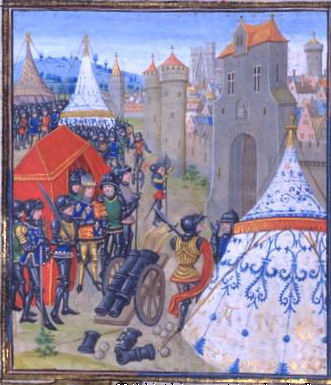
Siege of Rheims
My 20th great-grandfather was the 7th Earl of Oxford, hereditary Chamberlain of England. He was son and heir to Sir Alphonese de Vere and Joan Foliot, grandson of Sir Robert de Vere and Alice de Sanford, Sir Jordan Foliot and Margery Newmarch. He was husband of Maud de Badlesmere, daughter of Bartholomew Badlesmere and Margaret de Clare, widow of Robert FitzPayne. They were married before 27 March 1336 and had four sons and three daughters. John was a captain in King Edward III’s army, and as such participated in the Battle of Crécy and the Battle of Poitiers.
John de Vere, 7th Earl of Oxford (c. 12 March 1312 – 24 January 1360) was the nephew and heir of Robert de Vere, 6th Earl of Oxford. He succeeded as Earl of Oxford in 1331, after his uncle died without issue. John de Vere was a trusted captain of Edward III in the king’s wars in Scotland and France, and took part in both the Battle of Crécy and the Battle of Poitiers. He died campaigning in France in 1360. Throughout his career he was closely associated with William de Bohun, 1st Earl of Northampton, who was his brother-in-law.

Hedingham Castle in Essex, John de Vere’s main residence
John de Vere was the only son of Alfonso de Vere, and Jane, daughter of Sir Richard Foliot. Alfonso was a younger son of Robert de Vere, 5th Earl of Oxford, and brother of Robert de Vere, 6th Earl of Oxford. When the younger Earl Robert’s son died without issue in 1329, the earl obtained licence from the king to entail his estates on his nephew, John. It was in this way that John de Vere, when his uncle died 17 April 1331, became Earl of Oxford. He had made homage and received livery by 17 May.
In 1336 he married Maud, who was the second of the four daughters of Bartholomew de Badlesmere, 1st Baron Badlesmere, of Badlesmere in Kent and Margaret de Clare. Maud was a co-heiress of her brother Giles de Badlesmere, 2nd Baron Badlesmere. When Giles died in 1338, this brought a significant part of the Badlesmere inheritance into de Vere’s hands. The marriage also forged a strong bond with William Bohun, Earl of Northampton, who had married Badlesmere’s third daughter, Elizabeth de Badlesmere and thus became Oxford’s brother-in-law.The two campaigned together, sat on the same commissions and died the same year.
De Vere’s military career began with service on Edward III’s Scottish campaigns, in the 1330s Second War of Scottish Independence. He took part in the Roxburgh campaign of 1334–5, and in the summer campaign of 1335. Later in the decade, England’s military efforts turned towards France, with the beginning of the Hundred Years’ War. In March 1340, de Vere served in Flanders, and was therefore out of the country during Edward’s disputes with Archbishop John de Stratford. Oxford was not forced to take sides in the conflict, and has been described as a “political neutral”.
After a period in England, de Vere returned to the Continent in 1342, where he served with Northampton, who had been made lieutenant of Brittany. They both took part in the Battle of Morlaix that year. The next year the two earls were sent to Scotland to relieve Lochmaben Castle, and in 1345 they were again campaigning in Brittany. Tradition has it that, returning to England, their ships were forced ashore by bad weather, and the party was robbed of their possessions by the locals. In the summer of 1346 de Vere was campaigning with the king in Normandy, and took part in the Battle of Crécy. According to the chronicler Froissart, de Vere was fighting with the Black Prince, and was among the captains who sent a request to Edward III for reinforcements when the king famously answered ‘Let the boy win his spurs’. Oxford was also at the Siege of Calais, but reportedly fell ill in 1348, and did not take part in any major campaigning until 1355.
In 1355 he was again in the company of the Black Prince, and took part in the prince’s great raid in Languedoc. 19 September 1356, at the Battle of Poitiers, Oxford was in command of the vanguard together with the earl of Warwick. de Vere’s attack on the flank of the French cavalry, with a group of archers, did much to secure the English victory. His last campaign was Edward III’s Rheims campaign in 1359–60. Here he died, probably during the raid into Burgundy, on 23 or 24 January 1360. He was buried in the de Vere family’s burial place Colne Priory in Essex.
Maud de Vere died in 1366. The couple had four sons and two daughters. The eldest son, John, married the daughter of Hugh Courtenay, Earl of Devon, but died before his father, in 1350. Also another son, Robert, died in his father’s lifetime. The oldest remaining son was then Thomas, born around 1336–7, who succeeded his father in 1360. Thomas’s son Robert succeeded at his father’s death, but with Robert’s forfeiture in 1392, the earldom was given to Robert’s uncle Aubrey – the seventh earl’s fourth son. The eldest daughter, Margaret, married three times, while of the second, Matilda, little is known.
John de Vere, in the family tradition of the “fighting de Veres”, was active in almost all major military engagements in the years from 1340 to 1360. On the Roxburgh campaign he brought a retinue of twenty-eight men-at-arms and twelve mounted archers. In Brittany in 1342, the retinue had grown to forty men-at-arms, one banneret, nine knights, twenty-nine esquires, and thirty mounted archers. His retinue was of a diverse composition, and also included foreign mercenaries.[10] At one point, in the Battle of Poitiers, John Hawkwood, who was later to make his fortune as a condottiero in Italy, also served with de Vere. Yet in spite of this, de Vere never distinguished himself particularly as a military commander. Neither did he receive a great amount of royal patronage, and was never made a member of the Order of the Garter. This was largely a consequence of the de Vere family’s relatively modest resources among the English peerage. As an example can be mentioned that in the late 1340, £349 were owed to Oxford in arrears for his services, yet at the same time the king owed Northampton two debts of £782 and £1237. This obstacle of resources and status John de Vere was unable to overcome either by marriage or warfare.
from John de Vere, 7th Earl of Oxford
From Wikipedia, the free encyclopedia
John de Vere (1311 – 1359)
20th great-grandfather
Margaret De Vere (1340 – 1398)
daughter of John de Vere
Margaret De Lovaine (1372 – 1408)
daughter of Margaret De Vere
Thomas St Clair (1394 – 1434)
son of Margaret De Lovaine
Edith StClair (1425 – 1472)
daughter of Thomas St Clair
Alice Harcourt (1450 – 1526)
daughter of Edith StClair
Elizabeth Bessiles (1465 – 1511)
daughter of Alice Harcourt
Anne Fettiplace (1496 – 1567)
daughter of Elizabeth Bessiles
Mary Purefoy (1533 – 1579)
daughter of Anne Fettiplace
Susanna Thorne (1559 – 1586)
daughter of Mary Purefoy
Gov Thomas Dudley (1576 – 1653)
son of Susanna Thorne
Anne Dudley (1612 – 1672)
daughter of Gov Thomas Dudley
John Bradstreet (1652 – 1718)
son of Anne Dudley
Mercy Bradstreet (1689 – 1725)
daughter of John Bradstreet
Caleb Hazen (1720 – 1777)
son of Mercy Bradstreet
Mercy Hazen (1747 – 1819)
daughter of Caleb Hazen
Martha Mead (1784 – 1860)
daughter of Mercy Hazen
Abner Morse (1808 – 1838)
son of Martha Mead
Daniel Rowland Morse (1838 – 1910)
son of Abner Morse
Jason A Morse (1862 – 1932)
son of Daniel Rowland Morse
Ernest Abner Morse (1890 – 1965)
son of Jason A Morse
Richard Arden Morse (1920 – 2004)
son of Ernest Abner Morse
Pamela Morse
You are the daughter of Richard Arden Morse
John de Vere, 7th Earl of Oxford and 8th Great Chamberlain, born in 1313, became one of the most famous “Fighting Earls of Oxford,” renowned for bravery, gallantry, and chivalry as one of Edward III’s greatest generals, serving in Scotland, France, Flanders, Brittany and Gascony.
John was the son and heir of Sir Alfonso de Vere (d. 1328) [younger brother of Robert de Vere, EO6] by his wife Jane, daughter of Sir Richard Foliot. John succeeded his uncle, who left no issue, in April 1331. John EO7 actively participated in the wars of King Edward III’s, fighting in the Scottish campaigns of 1333 and 1335, in support of Edward Baliol. When war broke out with France in 1339, EO7 accompanied King Edward III to Flanders, and, in 1342 joined the first Breton campaign of William de Bohun, earl of Northampton. EO7 had, in his war party, 40 men-at-arms, one banneret, nine knights, 29 esquires, and 30 mounted archers, with an allowance of 56 sacks of wool as wages. On one occasion, when EO7 was returning from fighting on the continent, his ship was driven off course and wrecked on the shores of Connaught where some ‘barbarous people’ robbed the party of all of their possessions. [A similar encounter with pirates happened 200+ years later to the 17th Earl of Oxford upon his return from Italy and France in 1576). John de Vere, EO7, was a commander at the battles of Crecy, where he fought with a contingent of 160 men, including three bannerets and 27 knights. In October 1355, EO7 returned to France, joining the Black Prince in his famous raid into the Languedoc. EO7 shared the command of the first division at Poitiers with the Earl of Warwick, where he organized a crucial maneuver that saved the English archers from being downtrodden by the enemy’s cavalry.
“Yet all courage had been thrown away to no purpose, had it not been seconded by the extraordinary Gallantry of the English Archers, under the earl of Oxford, who behaved themselves that day with wonderful Constancy, Alacrity and Resolution ”
John de Vere, EO7, was killed during the siege of Rheims on January 24, 1360, during the British invasion of Burgundy. His corpse was brought back to England and interred in the family crypts at Colne Priory.
John’s will, dated November 1, 1359, contained bequests to Colne church and to the chapel (called the New Abbey) at Hedingham. EO7 also left instructions to his executors to pay out 400 marks sterling that had been accumulated by his ancestors in aid of the Holy Land.
John EO7 had married, in 1336, Maud Badlesmere [b. 1310, widow of Robert Fitzpayne], second sister and coheir of Giles, lord Badlesmere (d. 1338) of Badlesmere in Kent. The couple had had four sons and one daughter, Margaret or Maud. The sons were Thomas (1337-1371), the 8th Earl of Oxford, Aubrey, who became 10th EO in 1393, and John and Robert, who predeceased their father.
By EO7’s marriage, the title of Lord Badlesmere was added to the honorific employed by all later Earls of Oxford. His son Thomas succeeded him.
By Robert Brazil © copyright 2003

Beatrice de Savoy Countess de Provence (1205 – 1267)
23rd great-grandmother
She was born as the second child of Thomas I and Beatrice de Geneve. She married Raimond Berenger de Provence in 1219. After two miscarriages she bore him a son and four daughters. Her son died young. The two elder daughters were married to reigning kings while the husbands of the younger two later rose to that rank. She was buried at the chapel in the Chateau de Menuet near Les Échelles. Her mausoleum was desecrated during the revolution and only her skull could be saved. It was deposited in her brother Bonifaces grave.
Beatrice of Savoy was Countess of Provence from December 1220 – 19 August 1245
Her spouse was Ramon Berenguer IV, Count of Provence. Their children were:
Margaret, Queen of France
Eleanor, Queen of England
Sanchia, Queen of Germany
Beatrice, Queen of Sicily
Raymond of Provence
She was from the House of Savoy (by birth) and House of Aragon (by marriage)
Beatrice of Savoy was the daughter of Thomas I of Savoy and Margaret of Geneva. She was Countess consort of Provence by her marriage to Ramon Berenguer IV, Count of Provence.
Her paternal grandparents were Humbert III, Count of Savoy, and Beatrice of Viennois. Her maternal grandparents were William I, Count of Geneva and Beatrice de Faucigny. Beatrice of Savoy’s mother, Margaret was betrothed to Philip II of France. While Margaret was travelling to France for her wedding, she was captured by Beatrice’s father, Thomas. He took her back to Savoy and married her himself. Thomas’ excuse was that Philip II was already married, which was true.
Beatrice was the tenth of fourteen children born to her parents. Her siblings included: Amadeus IV, Count of Savoy; Thomas II of Piedmont; Peter II, Count of Savoy; Philip I, Count of Savoy; Boniface of Savoy, Archbishop of Canterbury; Avita the Countess of Devon; and Margherita of Savoy wife of Hartmann I of Kyburg.
Beatrice betrothed on 5 June 1219 to Ramon Berenguer IV, Count of Provence; they married in December 1220. She was a shrewd and politically astute woman, whose beauty was likened to that of a second Niobe by Matthew Paris. Ramon and Beatrice of Savoy had four daughters, who all lived to adulthood, and married kings. Their only son, Raymond died in early infancy.[2]
Margaret, Queen of France (1221–1295), wife of Louis IX of France
Eleanor, Queen of England (1223–1291), wife of Henry III of England
Sanchia, Queen of Germany (1228–1261), wife of Richard, Earl of Cornwall
Beatrice, Queen of Sicily (1231–1267), wife of Charles I of Sicily
Raymond of Provence, died young
At the English court[edit]
In 1242, Beatrice’s brother Peter was sent to Provence by Henry III to negotiate the marriage of Sanchia to Richard. Another brother, Philip, escorted Beatrice and Sanchia to the English court in Gascony, arriving in May 1243. There they joined Henry, Eleanor, and their baby, Beatrice of England. Henry was very happy at this occasion and gave many gifts to the various relatives.
In November 1243, Beatrice and Sanchia travelled to England for the wedding. This wedding did much to strengthen the bond between Richard and Henry III. She further strengthened the unity of the English royal family by convincing Henry III to help pay the debts of his sister Eleanor and her husband Simon de Montfort, who had often been at odds with Henry.[5] In January 1244, Beatrice negotiated a loan for her husband from Henry of four thousand marks, offering the king five Provençal castles as collateral.
When Ramon Berenguer died on 19 August 1245, he left Provence to his youngest daughter, and his widow was granted the usufruct of the county of Provence for her lifetime. Beatrice’s daughter and namesake then became one of the most attractive heiresses in medieval Europe. Frederick II, Holy Roman Emperor sent a fleet and James I of Aragonsent an army to seize her, so Beatrice placed herself and her daughter in a safe fortress in Aix, secured the trust of its people then sent to the Pope for his protection. The Pope was also a target for Frederick’s military incursions in France. In Cluny during December 1245, a secret discussion, between Pope Innocent IV, Louis IX of France, his mother Blanche of Castile, and his brother Charles of Anjou, took place. It was decided that in return for Louis IX supporting the Pope militarily, the Pope would allow Charles of Anjou, youngest brother to the French King, to marry Beatrice of Provence. Mother and daughter were satisfied with this selection.[7] But Provence was to never go to France outright through Charles. It was agreed that if Charles and Beatrice had children, the county would go to them; if there was no issue, then the county would go to Sanchia of Provence. If Sanchia died without an heir, Provence would go to the King of Aragon.
Henry protested the selection, arguing that he had not yet received the full dowry for Eleanor nor his brother for Sanchia. He also still had the castles in Provence against the loan he had made to the former count.
When Charles took over the administration of Provence in 1246, he did not respect Beatrice’s rights within the county. She sought the aid of Barral of Baux and the Pope in protecting her rights within the area. The citizens of Marseille,Avignon, and Arles joined this resistance to Capetian control. In 1248, Charles began to seek peace with her so that he could join his brother’s crusade. A temporary truce was reached to allow this.
In 1248, she travelled back to England with her brother Thomas, to see their family there.
In 1254, as Louis was returning from his crusade by way of Provence, Beatrice petitioned him for a more permanent resolution of the dispute with Charles. The French queen Margaret joined the petition, noting that Charles had not respected her dowry either. Beatrice travelled with them back to Paris. As the year progressed, Henry and his wife were invited to travel to Paris, and eventually all four daughters joined their mother there for Christmas.[11]
The generally good relationship among the four sisters did much to improve the relationship of the French and English kings. It brought about the Treaty of Paris in 1259, where differences were resolved.[12] Beatrice and all her four daughters participated in the talks.[13] While the family was still gathered, Louis IX finally persuaded Beatrice to surrender her claims and control in Provence in exchange for a sizable pension to be paid to her. Charles also paid back the loan henry had made to the previous count, clearing his claims in the county.[14]
In 1262, Beatrice was part of the family discussion to try again to bring peace between Henry and Simon de Montfort. When Henry was captured in 1264, Beatrice’s brother Peter II, Count of Savoy took his army to join the efforts to free the king. He left Beatrice in charge of Savoy while he was gone.
Beatrice outlived her third daughter Sanchia and came close to outliving her youngest daughter Beatrice, who died months after her mother (Beatrice the elder died in January, Beatrice the younger died in September). Beatrice of Savoy died on 4 January 1267.
Beatrice de Savoy Countess de Provence (1205 – 1267)
23rd great-grandmother
Eleanor Berenger (1223 – 1291)
daughter of Beatrice 1205 de SavoyCountess de Provence
Edward I “the Longshanks” Plantagenet (1239 – 1307)
son of Eleanor Berenger
Elizabeth of Rhuddlan Princess of England Plantagenet (1282 – 1316)
daughter of Edward I “the Longshanks” Plantagenet
William Earl of Northampton De Bohun (1312 – 1360)
son of Elizabeth of Rhuddlan Princess of England Plantagenet
Lady Elizabeth Countess Arundel Countess DeBohun (1350 – 1385)
daughter of William Earl of Northampton De Bohun
Elizabeth Duchess Norfolk Fitzalan (1366 – 1425)
daughter of Lady Elizabeth Countess Arundel Countess DeBohun
Lady Joan De Goushill Baroness Stanley (1402 – 1459)
daughter of Elizabeth Duchess Norfolk Fitzalan
Countess Elizabeth Sefton Stanley (1429 – 1459)
daughter of Lady Joan De Goushill Baroness Stanley
Thomas Sir 8th Earl of Sefton Molyneux (1445 – 1483)
son of Countess Elizabeth Sefton Stanley
Lawrence Castellan of Liverpool Mollenaux (1490 – 1550)
son of Thomas Sir 8th Earl of Sefton Molyneux
John Mollenax (1542 – 1583)
son of Lawrence Castellan of Liverpool Mollenaux
Mary Mollenax (1559 – 1598)
daughter of John Mollenax
Gabriell Francis Holland (1596 – 1660)
son of Mary Mollenax
John Holland (1628 – 1710)
son of Gabriell Francis Holland
Mary Elizabeth Holland (1620 – 1681)
daughter of John Holland
Richard Dearden (1645 – 1747)
son of Mary Elizabeth Holland
George Dearden (1705 – 1749)
son of Richard Dearden
George Darden (1734 – 1807)
son of George Dearden
David Darden (1770 – 1820)
son of George Darden
Minerva Truly Darden (1806 – 1837)
daughter of David Darden
Sarah E Hughes (1829 – 1911)
daughter of Minerva Truly Darden
Lucinda Jane Armer (1847 – 1939)
daughter of Sarah E Hughes
George Harvey Taylor (1884 – 1941)
son of Lucinda Jane Armer
Ruby Lee Taylor (1922 – 2008)
daughter of George Harvey Taylor
Pamela Morse
I am the daughter of Ruby Lee Taylor

Marriage of Henry I of England (1068-1135) to Princess (Eadgyth) Matilda of Scotland. Engraving c1880.
My 27th great-grandmother was Princess of Alba/Albany. She was christened Edith, but adopted the name Matilda upon her marriage to Henry. It was thought the Norman barons might not respect a queen with a Saxon name.
The marriage to Henry represented the union of Norman & Saxon royal lines.
She was crowned Queen Consort 11/14 Nov 1100 at Westminster Abbey.
Henry married Matilda (daughter of Margaret) to appease his Saxon subjects. She is interred at Westminster Abbey, London, England (or Winchester).
Christened Edith, but adopted the name Matilda upon her marriage to Henry I. It was thought the Norman barons might not respect a queen with aSaxon name. The marriage to Henry represented the union of the Norman &Saxon royal lines. She is also known by the diminutive of that name – Maud (which had been the name of Henry’s mother). She was the sister of Edgar, King of Scotland 1098-1107.
Edith – Margaret (Matilda) of Scotland, born in 1080 and died in 1118, married Henry I. Beauclerc, King of England, son of William I The Conqueror (ruler from 1066 to 1087) and his wife, Matilda of Flanders,who died in 1083… Matilda was educated at Wilton and Romsey Abbey where she said that her aunt, Christina, forced her to wear a black veil. She threw it on the ground whenever left alone, in spite of beatings. When her mother died she came to England to Edgar Atheling, her uncle. She was a sister of King David of Scotland; she was a correspondent of Anselm and Hildebert, Bishop of Le Mans, who wrote poetry about her. She was asymbol of the union of Saxon and Norman. She was Henry’s Queen for seventeen years and six months, and died in her prime like most of herfamily. Henry and Matilda had a son and a daughter.

Matilda Princess of Scotland
Matilda of Scotland (born Edith; c. 1080 – 1 May 1118) was the first wife and queen consort of Henry I of England. Matilda was born around 1080 in Dunfermline, the daughter of Malcolm III of Scotland and Saint Margaret. She was christened Edith, and Robert Curthose stood as godfather at her christening. Queen Matilda was also present at the font and may have been her godmother.When she was about six years old, Matilda (or Edith as she was then probably still called) and her sister Mary were sent to Romsey, where their aunt Cristina was abbess. During her stay at Romsey and Wilton, the Scottish princess was much sought-after as a bride; refusing proposals from William de Warenne, 2nd Earl of Surrey, and Alan Rufus, Lord of Richmond. Hermann of Tournai even claims that William II Rufus considered marrying her.She had left the monastery by 1093, when Anselm, Archbishop of Canterbury, wrote to the Bishop of Salisbury ordering that the daughter of the king of Scotland be returned to the monastery that she had left. After the death of William II Rufus in August 1100, his brother, Henry, soon seized the royal treasury and crown. His next task was to marry and Henry’s choice was Matilda. Because Matilda had spent most of her life in a convent, there was some controversy over whether she was a nun and thus ineligible for marriage. Henry sought permission for the marriage from Archbishop Anselm of Canterbury, who returned to England in September 1100 after a long exile. Professing himself unwilling to decide so weighty a matter on his own, Anselm called a council of bishops in order to determine the legality of the proposed marriage. Matilda testified that she had never taken holy vows, insisting that her parents had sent her and her sister to England for educational purposes, and her aunt Cristina had veiled her to protect her “from the lust of the Normans.” Matilda claimed she had pulled the veil off and stamped on it, and her aunt beat and scolded her for it. The council concluded that Matilda was not a nun, never had been and her parents had not intended that she become one, giving their permission for the marriage. Matilda and Henry seem to have known one another for some time before their marriage — William of Malmesbury states that Henry had “long been attached” to her, and Orderic Vitalis says that Henry had “long adored” Edith’s character.Her mother was the sister of Edgar the Ætheling, proclaimed but uncrowned King of England after Harold, and through her, Matilda was descended from Edmund Ironside and thus from the ancient royal family of Wessex, which in the 10th century, became the royal family of a united England. This was very important as Henry wanted to make himself more popular with the English people and Matilda represented the old English dynasty. In their children, the Norman and English dynasties would be united. Another benefit was that England and Scotland became politically closer; three of her brothers became kings of Scotland and were unusually friendly to England during this period.After Matilda and Henry were married on 11 November 1100 at Westminster Abbey by Archbishop Anselm of Canterbury, she was crowned as “Matilda”, a fashionable Norman name. She gave birth to a daughter, Matilda, in February 1102, and a son, William, in November 1103.As queen, she maintained her court primarily at Westminster, but accompanied her husband on his travels around England, and, circa 1106–1107, probably visited Normandy with him. She also served in a vice-regal capacity when Henry was away. Her court was filled with musicians and poets; she commissioned a monk, probably Thurgot, to write a biography of her mother, Saint Margaret. She was an active queen and, like her mother, was renowned for her devotion to religion and the poor. William of Malmesbury describes her as attending church barefoot at Lent, and washing the feet and kissing the hands of the sick. She also administered extensive dower properties and was known as a patron of the arts, especially music.After Matilda died on 1 May 1118 at Westminster Palace, she was buried at Westminster Abbey. The death of her only adult son and Henry’s failure to produce a legitimate son from his second marriage led to the succession crisis of The Anarchy.After her death, she was remembered by her subjects as “Matilda the Good Queen” and “Matilda of Blessed Memory”, and for a time sainthood was sought for her, though she was never canonized.Matilda and Henry had four children:
Matilda of England (c. February 1102 – 10 September 1167), Holy Roman Empress, Countess consort of Anjou, called Lady of the English
William Adelin, (5 August 1103 – 25 November 1120), sometimes called Duke of Normandy, who married Matilda (d.1154), daughter of Fulk V, Count of Anjou.
Euphemia, died young.
Richard, died young.
She is known to have been given the name “Edith” (the Old English Eadgyth, meaning “Fortune-Battle”) at birth, and was baptized under that name. She is known to have been crowned under a name favored by the Normans, “Matilda” (from the Germanic Mahthilda, meaning “Might-Battle”), and was referred to as such throughout her husband’s reign. It is unclear, however, when her name was changed, or why. Accordingly, her later name is used in this article. Historians generally refer to her as “Matilda of Scotland”; in popular usage, she is referred to equally as “Matilda” or “Edith”. References
Chibnall, Marjorie. The Empress Matilda: Queen Consort, Queen Mother, and Lady of the English, 1992
Hollister, Warren C. Henry I, 2001
Parsons, John Carmi. Medieval Mothering, 1996
Parsons, John Carmi. Medieval Queenship, 1997
Huneycutt, Lois L. “Matilda of Scotland: A Study in Medieval Queenship”.” 2004.
Matilda Princess of Scotland (1079 – 1118)
27th great-grandmother
Matilda, Empress of England Beauclerc (1102 – 1167)
daughter of Matilda Princess of Scotland
Henry II “Curtmantel” PLANTAGENET, “King of England” (1133 – 1189)
son of Matilda, Empress of England Beauclerc
Eleanor Spain Plantagenet (1162 – 1214)
daughter of Henry II “Curtmantel” PLANTAGENET, “King of England”
Berenguela CASTILE LEON (1181 – 1244)
daughter of Eleanor Spain Plantagenet
Saint Ferdinand Castile amp Leon (1199 – 1252)
son of Berenguela CASTILE LEON
Alfonso X Wise Castile Leon amp Galicia (1221 – 1284)
son of Saint Ferdinand Castile amp Leon
Sancho Brave Castile Leon (1258 – 1295)
son of Alfonso X Wise Castile Leon amp Galicia
Beatrice Sanchez Infanta Castile (1293 – 1359)
daughter of Sancho Brave Castile Leon
Peter I Portugal Cruel Algarve (1320 – 1367)
son of Beatrice Sanchez Infanta Castile
John I DePinto (1358 – 1433)
son of Peter I Portugal Cruel Algarve
Beatrix DePinto (1403 – 1447)
daughter of John I DePinto
John Fettiplace (1427 – 1464)
son of Beatrix DePinto
Richard Fettiplace (1460 – 1511)
son of John Fettiplace
Anne Fettiplace (1496 – 1567)
daughter of Richard Fettiplace
Mary Purefoy (1533 – 1579)
daughter of Anne Fettiplace
Susanna Thorne (1559 – 1586)
daughter of Mary Purefoy
Gov Thomas Dudley (1576 – 1653)
son of Susanna Thorne
Anne Dudley (1612 – 1672)
daughter of Gov Thomas Dudley
John Bradstreet (1652 – 1718)
son of Anne Dudley
Mercy Bradstreet (1689 – 1725)
daughter of John Bradstreet
Caleb Hazen (1720 – 1777)
son of Mercy Bradstreet
Mercy Hazen (1747 – 1819)
daughter of Caleb Hazen
Martha Mead (1784 – 1860)
daughter of Mercy Hazen
Abner Morse (1808 – 1838)
son of Martha Mead
Daniel Rowland Morse (1838 – 1910)
son of Abner Morse
Jason A Morse (1862 – 1932)
son of Daniel Rowland Morse
Ernest Abner Morse (1890 – 1965)
son of Jason A Morse
Richard Arden Morse (1920 – 2004)
son of Ernest Abner Morse
Pamela Morse
I am the daughter of Richard Arden Morse

Elizabeth’s pedigree
Both of my parents appear to descend from the Plantagenets of England. The princess daughters of Edward I, Joan and Elizabeth, are my 22nd and 21st great-grandmothers. I have found double ancestry before in my tree in the past. I am not so concerned about inbreeding since this happened to my parents’ families in the 1200’s and they did not marry until 1942.
Princess Joan was born in Syria while her parents were on a crusade to the holy land. Elizabeth was born in Wales. There is a 10 year difference in their ages. Joan and Elizabeth both married twice. After her first husband died young Joan married a commoner, my ancestor, who would be killed in battle.
Princess Elizabeth Plantagenet of England
Youngest Daughter of Edward I
Not much is written about Elizabeth. In medieval times, unless she became queen, a woman had little hope of being remembered in history. Rich or poor, most women faded into obscurity upon their death, never to be thought of again. So, what can be drawn from the known tidbits of Elizabeth’s life as a princess?
All little girls at one time or another dream of being a princess -no matter which country, culture, language, or religion; around the world, this is a universal fantasy for very young girls. Oddly enough however, the fantasy has nothing to do with the realities of medieval life, which was arguably coarse, unpaved, and uncomfortable for several hundred years. Rather, in a little girl’s mind, being a princess would mean spendiing money like it was going out of style, buying lavish wardrobes, dating all the good looking guys who always hang around the king in those ‘not particularly accurate’ movies about the middle ages -not to mention that we’d have a maid, meaning we’d never have to do household chores again. But, the lives of medieval noble women in actuality were far from idyllic.
A Princess’s Life
Elizabeth Plantagenet was born in August of 1282 at Rhuddlan Castle in North Wales. Her father, King Edward I, was on a millitary campaign in Wales, and Queen Eleanor had accompanied him, as was her custom.
Like moons locked in orbit around a domineering star, generally their fathers or husbands, there was no escape for medieval noble women. Their lives were often planned years in advance.
Frankly, it was the men in Elizabeth’s life who shaped her as a person. Fist, her father Edward, whom she loved dearly. Like all the other possessions belonging to her father, as a princess, Elizabeth was a tool in the making of Edward’s foreign policy.
But then, a Princess was not consulted with regard to her feelings on the matter. After all, in her father’s eyes, it was none of her business who she married. She was simply expected to do as the king requested.
Elizabeth Plantagenet was first married to John I, Count of Holland, in 1297.
After his death, she married Humphrey de Bohun on Nov. 14th, 1302. Although never done in continental royalty, a few daughters of the English Plantagenet Kings did marry commoners, such as in the case of Elizabeth. This fact is what permits any of the commoners of today to have a royal line of descent. Elizabeth had 6 sons and 4 daughters with Humphrey de Bohun, which included the twins William and Edward.
Elizabeth is reported to have been the most strong-headed of her sisters. She could be stuborn, confrontational, and openly argumentative, qualities that are traditionally discouraged in a princess. But, Elizabeth also knew how to get at least some of what she wanted in life -through superficial charm and flattery.
In fact, when Elizabeth and her other sisters wanted something, they used to gang up on their father the king, complimenting him, capitalizing on topics they knew to be ego boosters for him, turning him into malleable taffy, all the better to wrap him around their fingers. Poor Edward was a sucker for a beautiful girl, batting her eyes, fawning over him, making him feel like a pampered man. But, the decisions he made concerning his daughters’ futures were sober, carefully thought out ones. He was determined to have them married to his choice of men, for his reasons only -personal feelings notwithstanding.
Husband #1 -John I, Count of Holland
John I (1284-1299) was count of Holland and son of Count Floris V. After a campaign in 1287-1288 Cloris finally defeated the Frisians. In the meantime he had received Zeeland-bewester-Schelde (the area that controls access to the Scheldt river) as a loan from the Holy Roman King in 1287, but the local nobility sided with the count of Flanders who invaded in 1290. Floris arranged a meeting with count Guy of Flanders, but he was taken prisoner and was forced to abandon his claims and then set free.
Floris immediately wanted to resume war, but King Edward I of England, who had an interest in access to the great rivers for wool and other English goods, convinced Floris to stop hostilities with Flanders. Then Edward I moved his trade in wool from Dordrecht in Holland to Mechelen in Flanders and, in 1296. he prohibited all English trade on Holland and conspired with count Guy of Flanders to have Floris kidnapped and taken to France.The humiliated lords Gijsbrecht IV of Amstel and Hendrik of Woerden enter the scene again as part of the conspiracy.
Together with Gerard of Velzen they capture Count Floris during a hunting party. The news of his capture spreads quickly and the small group of knights is stopped by an angry mob of local peasants. In panic Gerard of Velzen kills the count, and the knights flee. Gerard of Velzen is later captured and killed in Leiden.
Having rid himself of both these irritants, Edward then arranges Elizabeth’s marriage to the dead man’s son John. In many ways, Edward I outdid his predescessors by developing his own dispicable brand of viciousness.
Elizabeth was the most strong willed of her sisters and was not afraid to argue with her father. Nonetheless, whether or not she agreed with the decision, she did as she was asked and married John, Count of Holland. And he wasn’t that bad of a catch for her. John inherited the county in 1296 after Edward practically arranged for the murder of his father. In the following year, he married Princess Elizabeth. At the wedding, Edward I threw her coronet into the fire, apparently unhappy at some aspect of wedding planning.
The marriage was not to last as John died soon afterwards in 1299, only fifteen years-old. With his death without descendents, Elizabeth was free to marry again.
Husband #2 -Earl Humphrey VIII of Hereford-Essex
The marriage of Humphrey VII to Elizabeth Plantagenet, daughter of Edward I was the very pinnacle of the DeBohun dynastic rise to power. Sir Humphrey was a favorite of Edward’s. Like the Claypools to follow, the DeBohun’s were Social climbers. They were among the people who sought their fortune by getting as close as they possibly could to the sovreign on the throne at any given time. Indeed, many fortunes were made and lost in just this way throughout the centuries in England.
Although he may have loved her, Humphrey was more concerned with how his marriage improved his social standing and the extent to which it could improve his landholdings and profits. This worked out great when Edward I was king. Unfortunately, when Edward II -Elizabeth’s brother- took the helm, Humphrey suddenly had some stiff competition in the way of Piers Gaveston and the Despencers. (The Claypooles also share a line with the Despencers.)
Needless to say Sir Humphrey did a great deal of complaining. Although he was married to Edward II’s sister and carried the sceptre with the cross at his coronation, Humphrey was to die, a proclaimed traitor, from the thrust of a Welshman’s lance at the battle of Boroughbridge. This would be the ignoble end of Elizabeth’s second and final husband.
Brotherly Influence -Edward II and His Sister Elizabeth
Close to the same age, Elizabeth had a strong sibling relationship with her brother Edward, later to be the ill-fated King Edward II. Elizabeth Plantagenet died c. May 5, 1316, and was buried at Walden Priory in Essex. King Edward I was born on June 17th, 1239, the son of King Henry III and Eleanor of Provence. He acceded to the throne on Nov. 16th, 1272. During Edward’s long reign, he became the outstanding English king of the middle ages.
He married Eleanor, daughter of King Ferdinand III of Castile and Leon, at Las Huelgas in 1254. Edward and Eleanor had 14 children, with Elizabeth being the 12th, and the future Edward II the 13th. Eleanor of Castile died in 1290; and after her funeral procession from Lincolnshire marked by the famous Eleanor Crosses, she was buried in London at Westminster Abbey. Edward I later married Margaret of France as his second wife in 1299. While on a military campaign against the Scots, Edward I died July 7th, 1307, at the border site of Burgh-on-the-Sands near Carlisle. He also was buried at Westminster Abbey. The tombs of Edward and Eleanor can be visited at the Abbey to the present day.
Edward II was more than just an ineffectual king, he was a jerk and people simply didn’t like him. England suffered under many ineffectual leaders in the middle ages, but a monarch who committed what his subjects viewed as ‘abominible acts’ was something the English couldn’t stomach. Without the hearts and minds of the people, such a monarch is doomed, no matter how good or bad a sovreign he or she may be. Elizabeth was on her brother’s side for quite a while. However, Edward’s behavior eventually got completely out of hand, and her continued support for him made things increasingly awkward for her, considering her marriage into the DeBohun family. So, what exactly did Edward do that was so terrible?
Was it that he was a murderer? No. While murder is a heinous thing, his subjects did not consider it an ‘abominible act’ for a king to commit. Instead, what Edward did was thought to be a sin against nature and God -Edward II was openly homosexual. Not that there hadn’t been gay princes and kings in the past -Richard I was notoriously attracted to same sex relationships. It’s the idea that he was not discreet about it. He didn’t do what princes of the past had done -marry and keep any extracurricular relationships, whether they be with men or women, out of the public eye. Edward pushed the bounds of decency, even at formal events when the eyes of the world were upon him.
At his own coronation in 1324, Edward horrified the nobility and visitiing French royalty with he blatently flirted with Piers Gaveston, completely ignoring his wife, Queen Isabella. Not that his preferring the company of a man his own age to that of his twelve-year-old spouse was so strange, but he wasn’t just conversing with him. Edward was treating Gaveston as if he were talking to the opposite sex.
It was extremely embarrassing for his family members present. Such behavior dangerously flauted social convention of the day, which was heavily influenced by the Church and its draconian notions of propriety and sin. Elizabeth, who had been on her brother’s side, was placed in an awkward postion. She loved Edward her brother, but she was also married to one of the chief plaintiffs where Gaveston and the Despencers were concerned. That, coupled with the openess with which Edward displayed his sexuality, made the world nervous and ultimately forced her to withdraw her support as well. [Above and Left: Edward II, King of England]
Like many kings before him, Edward II’s reign was perverted by the counsel of evil favorites. Favorites were, in any case, a considerable threat to magnates’, such as Sir Humphrey, possibilities of bettering themselves, or of even surviving. Those magnates rich and important enough to frequent the court were always haunted by the fear that their power, based on a quasi-monopoly of royal favor and patronage, might be eroded by the arrival of newcomers or monopolized by one or two individuals.
This meant not only the loss of land grants but of possibilities of finding the best marriages for themselves and their children. And these favorites -are they gracious to others in their new found fortune? -Hardly. Favorites tend to not only absorb a lot of royal wealth, but also develop a hostility or contemptuous attitude toward the nobility. This portrait of ugliness is a perfect depiction of Piers Gaveston and the Despencers.
The Plantagenet Bloodline
Although the women of the king’s household never were allowed to wield any actual power per se over the kingdom, oddly enough, because of wars, assassinations, and sometimes just general bad luck, it was the women who were the ones, more often than not, to carry on the family bloodline. In the case of Edward and his sister Elizabeth, it was Elizabeth who would become the great progenetor of subsequent generations of noble children through her marriage to Humphrey DeBohun.
Edward, was eventually imprisoned at Kenilworth Castle, and a parliament met at Westminster in January 1327, which chose his son to be king as Edward III. It was thought prudent to compel the captive king to resign the crown, and on January 20 Edward was forced to renounce his office before a committee of the estates.
The government of Isabella, Edward’s wife, and Mortimer, a former baronial exile, was so precarious that they dared not leave the deposed king alive. On April 3 he was secretly removed from Kenilworth and entrusted to the custody of two dependants of Mortimer. After various wanderings he was imprisoned at Berkeley Castle in Gloucestershire. Every indignity was inflicted upon him, and he was systematically ill-treated in the hope that he would die of disease. When his strong constitution seemed likely to prevail he was secretly put to death on September 21. The popular legend is that his murder was by a red-hot poker thrust up his anus through a hollow tube, considered by his captors as an appropriate punishment for his homosexuality, which would show no outward signs of violence. It was announced that he had died a natural death, and he was buried in St Peter’s Abbey at Gloucester, now the cathedral, where his son afterwards erected a magnificent tomb.
Elizabeth, on the other hand, went on to bear her husband, Humphrey, several children, one of which was William DeBohun, 1st Earl of Northampton, who in turn had a daughter named Elizabeth DeBohun, who married Richard Fitalan KG, 11th/4th Earl of Arundel, Earl of Surry, English nobleman, naval and miltary commander. Richard was the grandson of Baron Hugh Despencer, fierce rival of Humphrey DeBohun, who was his wife’s grandfather. In this way, marriage and money held powerful sway over family aliances and enmities. Quite often the need to increase fortunes and landholdings led natural enemies to eventually join households, pursuant to building an exponentially more powerful noble house than the two ever could have been as separate entities.
My paternal line looks like this:
Joan Plantagenet (1272 – 1307)
22nd great-grandmother
Lady Margaret De Clare Baroness Audley (1292 – 1342)
daughter of Joan Plantagenet
Lady Alice De Audley Baroness Neville (1315 – 1373)
daughter of Lady Margaret De Clare Baroness Audley
Sir John ‘3rd Baron de Raby’ Neville, Admiral of the Kings Fleet (1341 – 1388)
son of Lady Alice De Audley Baroness Neville
Thomas De Neville (1362 – 1406)
son of Sir John ‘3rd Baron de Raby’ Neville, Admiral of the Kings Fleet
Maude de Neville (1392 – 1421)
daughter of Thomas De Neville
John Talbot (1413 – 1460)
son of Maude de Neville
Isabel Talbot (1444 – 1531)
daughter of John Talbot
Sir Richard Ashton (1460 – 1549)
son of Isabel Talbot
Sir Christopher Ashton (1493 – 1519)
son of Sir Richard Ashton
Lady Elizabeth Ashton (1524 – 1588)
daughter of Sir Christopher Ashton
Capt Roger Dudley (1535 – 1585)
son of Lady Elizabeth Ashton
Gov Thomas Dudley (1576 – 1653)
son of Capt Roger Dudley
Anne Dudley (1612 – 1672)
daughter of Gov Thomas Dudley
John Bradstreet (1652 – 1718)
son of Anne Dudley
Mercy Bradstreet (1689 – 1725)
daughter of John Bradstreet
Caleb Hazen (1720 – 1777)
son of Mercy Bradstreet
Mercy Hazen (1747 – 1819)
daughter of Caleb Hazen
Martha Mead (1784 – 1860)
daughter of Mercy Hazen
Abner Morse (1808 – 1838)
son of Martha Mead
Daniel Rowland Morse (1838 – 1910)
son of Abner Morse
Jason A Morse (1862 – 1932)
son of Daniel Rowland Morse
Ernest Abner Morse (1890 – 1965)
son of Jason A Morse
Richard Arden Morse (1920 – 2004)
son of Ernest Abner Morse
Pamela Morse
I am the daughter of Richard Arden Morse
The maternal line is:
Elizabeth of Rhuddlan Princess of England Plantagenet (1282 – 1316)
20th great-grandmother
William Earl of Northampton De Bohun (1312 – 1360)
son of Elizabeth of Rhuddlan Princess of England Plantagenet
Lady Elizabeth Countess Arundel Countess DeBohun (1350 – 1385)
daughter of William Earl of Northampton De Bohun
Elizabeth Duchess Norfolk Fitzalan (1366 – 1425)
daughter of Lady Elizabeth Countess Arundel Countess DeBohun
Lady Joan De Goushill Baroness Stanley (1402 – 1459)
daughter of Elizabeth Duchess Norfolk Fitzalan
Countess Elizabeth Sefton Stanley (1429 – 1459)
daughter of Lady Joan De Goushill Baroness Stanley
Thomas Sir 8th Earl of Sefton Molyneux (1445 – 1483)
son of Countess Elizabeth Sefton Stanley
Lawrence Castellan of Liverpool Mollenaux (1490 – 1550)
son of Thomas Sir 8th Earl of Sefton Molyneux
John Mollenax (1542 – 1583)
son of Lawrence Castellan of Liverpool Mollenaux
Mary Mollenax (1559 – 1598)
daughter of John Mollenax
Gabriell Francis Holland (1596 – 1660)
son of Mary Mollenax
John Holland (1628 – 1710)
son of Gabriell Francis Holland
Mary Elizabeth Holland (1620 – 1681)
daughter of John Holland
Richard Dearden (1645 – 1747)
son of Mary Elizabeth Holland
George Dearden (1705 – 1749)
son of Richard Dearden
George Darden (1734 – 1807)
son of George Dearden
David Darden (1770 – 1820)
son of George Darden
Minerva Truly Darden (1806 – 1837)
daughter of David Darden
Sarah E Hughes (1829 – 1911)
daughter of Minerva Truly Darden
Lucinda Jane Armer (1847 – 1939)
daughter of Sarah E Hughes
George Harvey Taylor (1884 – 1941)
son of Lucinda Jane Armer
Ruby Lee Taylor (1922 – 2008)
daughter of George Harvey Taylor
Pamela Morse
I am the daughter of Ruby Lee Taylor
Both families landed in America in the 1600’s.

effigy and grave
My 20th great grandfather was born c. 1276, at Pleshey Castle, Essex, England
He died on Mar. 16, 1322, in the battle of Boroughbridge, in Yorkshire, England. He is buried at Friars Preachers Church, York, Yorkshire, England.
4th Earl of Hereford. Born the son of Humphrey de Bohun, 3rd Earl of Hereford and Maud de Fiennes at Pleshy Castle in Essex. In November 1302 he married King Edward I’s daughter, Elizabeth Plantagenet, with whom he had at least eleven children. He held the office of Lord High Constable. He took part in the king’s Scottish campaigns in the early 1300s. After the flight of Robert Bruce, de Bohun received many of Bruce’s confiscated properties. At the battle of Bannockburn in 1314, he charged the Bruce, and his nephew Henry de Bohun was killed, but he was taken and held for ransom. He was eventually exchanged for Bruce’s wife and daughter. He numbered among the peers who opposed Edward II’s excesses and banished the royal favorite, Piers Gaveston. In 1316 he successfully led the suppression of the revolt of Llywelyn Bren. By 1322, however, he fell in with Lancaster’s rebellion against Edward II, and as the rebels approached Boroughbridge in Yorkshire, de Bohun led an attempt to storm the bridge held by royal pike men. The Earl, however, was run through by pike men secreted beneath the bridge and died in the field, his gruesome death breaking the advance, and spelling failure for the rebels. (bio by: Iola)
Humphrey VIII Earl Hereford amp DeBohun (1276 – 1322)
20th great-grandfather
William Earl of Northampton De Bohun (1312 – 1360)
son of Humphrey VIII Earl Hereford amp DeBohun
Lady Elizabeth Countess Arundel Countess DeBohun (1350 – 1385)
daughter of William Earl of Northampton De Bohun
Elizabeth Duchess Norfolk Fitzalan (1366 – 1425)
daughter of Lady Elizabeth Countess Arundel Countess DeBohun
Lady Joan De Goushill Baroness Stanley (1402 – 1459)
daughter of Elizabeth Duchess Norfolk Fitzalan
Countess Elizabeth Sefton Stanley (1429 – 1459)
daughter of Lady Joan De Goushill Baroness Stanley
Thomas Sir 8th Earl of Sefton Molyneux (1445 – 1483)
son of Countess Elizabeth Sefton Stanley
Lawrence Castellan of Liverpool Mollenaux (1490 – 1550)
son of Thomas Sir 8th Earl of Sefton Molyneux
John Mollenax (1542 – 1583)
son of Lawrence Castellan of Liverpool Mollenaux
Mary Mollenax (1559 – 1598)
daughter of John Mollenax
Gabriell Francis Holland (1596 – 1660)
son of Mary Mollenax
John Holland (1628 – 1710)
son of Gabriell Francis Holland
Mary Elizabeth Holland (1620 – 1681)
daughter of John Holland
Richard Dearden (1645 – 1747)
son of Mary Elizabeth Holland
George Dearden (1705 – 1749)
son of Richard Dearden
George Darden (1734 – 1807)
son of George Dearden
David Darden (1770 – 1820)
son of George Darden
Minerva Truly Darden (1806 – 1837)
daughter of David Darden
Sarah E Hughes (1829 – 1911)
daughter of Minerva Truly Darden
Lucinda Jane Armer (1847 – 1939)
daughter of Sarah E Hughes
George Harvey Taylor (1884 – 1941)
son of Lucinda Jane Armer
Ruby Lee Taylor (1922 – 2008)
daughter of George Harvey Taylor
Pamela Morse
Name: HUMPHREY VIII de Bohn
Given Name: HUMPHREY VIII de
Surname: Bohn
Suffix: Earl Of Hereford & Essex
Birth: 1275-1276 in Pleshey Castle, Essex, England
Death: 16 Mar 1321-1322 in Boroughbridge, Yorkshire, Eng
Burial: Aft 16 Mar 1321-1322 Friars Preachers Church, York, Yorkshire, England 1 1
Event: Alt. Birth 1275 Pleshey Castle, Essex, England
Event: Alt. Death 16 Mar 1321-1322 Boroughbridge, Yorkshire, England
Event: Killed Try To Force Boroughbridge, Yorkshire Death
Humphrey de Bohun VIII, born c1276, slain at Boroughbridge 16 Mar 1321/2,Earl of Hereford and Essex, Lord High Constable of England; married 14Nov 1302, Elizabeth Plantagenet, born Aug 1282, died 5 May 1316, daughterof King Edward I of England and Eleanor of Castile. [Magna Charta Sureties]
Humphrey de Bohun,Earl of Hereford, Earl of Essex, and Lord HighConstable. In the 30th Edward I[1302-3], this nobleman gave and granted unto the king, by a formal conversance, the inheritances of al his landsand lordships, as also of his earldoms of Hereford and Essex, and the constableship of England, which, upon his marriage with Elizabeth Plantagenet, widow of John, Earl of Holland, and dau. of the king, were regranted to him and entailed upon his issue lawfully begotten by thatlady; in default thereof, and from and after the death of himself and wife, then the lordship of Plessets and certain other lordships in Essexand elsewhere, together with the constableship, should remain wholly tothe king and his heirs forever.
In the 34th of the same reign he had a grant similarly entailed of the whole territory of Annandale, in Scotland. After this his lordship was in the wars of Scotland and was taken prisoner in the 7th Edward II(1313-14), at the disastrous battle (to the English) of Stryvelin. But he was exchanged for the wife of Robert Bruce, who had long been captive in England. From this period we find him constantly engaged in the service of the crown until the14th year of the king’s reign [1321-22], when Edward learning that the earl was raising forces in the marches of Wales against Hugh de Spencer the younger, sent him a peremptory command to forbear, which his lordship not only refused obeying but forthwith joined Thomas,Earl of Lancaster, in the great insurrection then incited by that nobleman for the redress of certain grievances and the banishment of the Spencers.In his proceeding, however, he eventually lost his life, being run through the body by a soldier at the battle of Boroughbridge, in Yorkshire, where his party received so signal a defeat on 16 March, 1321.
The earl had issue five surviving sons and two surviving daus., viz.,John, Humphrey, Edward, William, Humphrey, Alianore, and Margaret. The earl was s. by his eldest son, Sir John de Bohun, K.B. [Sir Bernard Burke, Dormant and Extinct Peerages, Burke’s Peerage, London, 1883, p.57, Bohun, Earls of Hereford, Earls of Essex, Earls of Northampton, and High Constables of England]
21st century
The moat, all that remains of Pleshey Castle
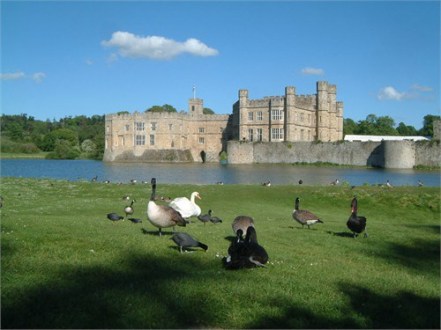
Badlesmere Castle
My 19th great-grandmother was born in the castle above, located in Kent, England, in 1313. She died in London in 1356 and is buried in the Black Friars Churchyard.
Baroness Elizabeth de Badlesmere de Mortimer de Bohun
Wife and widow of Sir Edmund de Mortimer, son of Sir Roger de Mortimer and Joan de Geneville. They were married 27 June 1316 in the chapel at the manor of Ernwood in Kinlet, Shropshire and had two sons; Sir Roger and John. Sir Edmund would die at Stanton Lacy in early 1332.
Secondly, wife of Sir William de Bohun, son of Sir Humphrey de Bohun and Elizabeth of England, the daughter of King Edward I. They were married by papal dispensation dated 13 Nov 1335, being related in the 4th degree, and had one son, Sir Humphrey, Earl of Hereford and Essex, and one daughter, Elizabeth, who married Sir Richard de Arundel.
Elizabeth died testate 08 June 1355, buried at Black Friars, London.
Inscription:
Church destroyed in the Great Fire of London. Graves predating 1660 did not survive. AKA St. Ann’s Black Friars.
Elizabeth Countess of Northampton 3rd Baroness of Badlesmere De Badlesmere (1313 – 1356)
19th great-grandmother
Lady Elizabeth Countess Arundel Countess DeBohun (1350 – 1385)
daughter of Elizabeth Countess of Northampton 3rd Baroness of Badlesmere De Badlesmere
Elizabeth Duchess Norfolk Fitzalan (1366 – 1425)
daughter of Lady Elizabeth Countess Arundel Countess DeBohun
Lady Joan De Goushill Baroness Stanley (1402 – 1459)
daughter of Elizabeth Duchess Norfolk Fitzalan
Countess Elizabeth Sefton Stanley (1429 – 1459)
daughter of Lady Joan De Goushill Baroness Stanley
Thomas Sir 8th Earl of Sefton Molyneux (1445 – 1483)
son of Countess Elizabeth Sefton Stanley
Lawrence Castellan of Liverpool Mollenaux (1490 – 1550)
son of Thomas Sir 8th Earl of Sefton Molyneux
John Mollenax (1542 – 1583)
son of Lawrence Castellan of Liverpool Mollenaux
Mary Mollenax (1559 – 1598)
daughter of John Mollenax
Gabriell Francis Holland (1596 – 1660)
son of Mary Mollenax
John Holland (1628 – 1710)
son of Gabriell Francis Holland
Mary Elizabeth Holland (1620 – 1681)
daughter of John Holland
Richard Dearden (1645 – 1747)
son of Mary Elizabeth Holland
George Dearden (1705 – 1749)
son of Richard Dearden
George Darden (1734 – 1807)
son of George Dearden
David Darden (1770 – 1820)
son of George Darden
Minerva Truly Darden (1806 – 1837)
daughter of David Darden
Sarah E Hughes (1829 – 1911)
daughter of Minerva Truly Darden
Lucinda Jane Armer (1847 – 1939)
daughter of Sarah E Hughes
George Harvey Taylor (1884 – 1941)
son of Lucinda Jane Armer
Ruby Lee Taylor (1922 – 2008)
daughter of George Harvey Taylor
Pamela Morse
I am the daughter of Ruby Lee Taylor

Fulk III, Count of Anjou
My 30th great-grandfather was an extreme personality. He was a crusader and founder of religious orders. He was also a completely furious nut with little restraint. He left his mark on history.
Fulk III The Black Count of Anjou ( – 1040)
is my 30th great grandfather
Ermengarde Blanche D Anjou Countess Gastinois (1018 – 1076)
daughter of Fulk III The Black Count Anjou of
Fulk Le Rechin Rude Anjou (1043 – 1109)
son of Ermengarde Blanche D Anjou Countess Gastinois
FULK V The Younger King of Jerusalem ANJOU * (1092 – 1143)
son of Fulk Le Rechin Rude Anjou
Sibilla Anjou (1105 – 1165)
daughter of FULK V The Younger King of Jerusalem ANJOU *
Marguerite De LORRAINE (1135 – 1194)
daughter of Sibilla Anjou
Isabelle De Hainault (1170 – 1190)
daughter of Marguerite De LORRAINE
Louis VIII France (1187 – 1226)
son of Isabelle De Hainault
Charles I King of Jerusalem and Naples (1227 – 1285)
son of Louis VIII France
Charles NAPLES (1254 – 1309)
son of Charles I King of Jerusalem and Naples
Marguerite Sicily Naples (1273 – 1299)
daughter of Charles NAPLES
Jeanne DeVALOIS (1294 – 1342)
daughter of Marguerite Sicily Naples
Philippa deHainault (1311 – 1369)
daughter of Jeanne DeVALOIS
John of Gaunt – Duke of Lancaster – Plantagenet (1340 – 1399)
son of Philippa deHainault
Elizabeth Plantagenet (1363 – 1425)
daughter of John of Gaunt – Duke of Lancaster – Plantagenet
John Holland (1395 – 1447)
son of Elizabeth Plantagenet
Henry Holland (1430 – 1475)
son of John Holland
Henry Holland (1485 – 1561)
son of Henry Holland
Henry Holland (1527 – 1561)
son of Henry Holland
John Holland (1556 – 1628)
son of Henry Holland
Gabriell Francis Holland (1596 – 1660)
son of John Holland
John Holland (1628 – 1710)
son of Gabriell Francis Holland
Mary Elizabeth Holland (1620 – 1681)
daughter of John Holland
Richard Dearden (1645 – 1747)
son of Mary Elizabeth Holland
George Dearden (1705 – 1749)
son of Richard Dearden
George Darden (1734 – 1807)
son of George Dearden
David Darden (1770 – 1820)
son of George Darden
Minerva Truly Darden (1806 – 1837)
daughter of David Darden
Sarah E Hughes (1829 – 1911)
daughter of Minerva Truly Darden
Lucinda Jane Armer (1847 – 1939)
daughter of Sarah E Hughes
George Harvey Taylor (1884 – 1941)
son of Lucinda Jane Armer
Ruby Lee Taylor (1922 – 2008)
daughter of George Harvey Taylor
Pamela Morse
I am the daughter of Ruby Lee Taylor
Fulk III, Count of Anjou
Foulques III “the Black” Count of Anjou (d’Anjou), Comte de AnjouFulk III “the Black”, born circa 966, was the son of Geoffrey Grisegonelle “Greymantle” or “Grey Tunic”. He one of the most remarkable figures of his period and the most powerful member of the dynasty. Fulk ruled Anjou for 53 years. He was both cruel and devotional, and had a violent and pious temperament. He was partial to acts of extreme cruelty and penitence. A temperamental, passionate and unbalanced character, his most heinous act was having his first wife (and cousin), Elisabeth of Vendôme, burned at the stake in her wedding dress, after discovering her with a goatherder in December 999. Fulk came into conflict with the Counts of Rennes, he conquered and slew Conan I of Rennes at the Battle of Conquereuil on 27 June 992. He then extended his power over the Counties of Maine and Touraine. He died at Metz, while on pilgrimage. Fulk was an old man when he decided to make what might be his last pilgrimage, as penance for his sins. The first night he stayed at the abbey of St. Maur-sur-Loire, where he learned more about the life of St. Maur. Fulk became overcome with passion and devotion in the Holy Lands. Previously Fulk was known as “the Black.” Fulk died in Metz while returning from his last pilgrimage. He is buried in the chapel of his monastery at Beaulieu. By his first wife Elisabeth, he left one daughter, Adela. By his second wife (1001), Hildegard of Sundgau, he had two children, Geoffrey Martel, who was his successor, and Ermengard. A writer said of Fulk III that “he was a plunderer, murderer, robber, and swearer of false oaths, a truly terrifying character of fiendish cruelty, founded not one but two large abbeys. This Fulk was filled with unbridled passion, a temper directed to extremes. Whenever he had the slightest difference with a neighbor he rushed upon his lands, ravaging, pillaging, raping, and killing. Nothing could stop him, least of all the commandments of God.” Fulk III (972 – 21 June 1040), called Nerra (that is, le Noir, “the Black”) after his death, was Count of Anjou from 21 July 987 to his death. He was the son of Geoffrey Greymantle and Adelaide of Vermandois. Fulk Nerra’s castle keep at LochesFulk III was the founder of Angevin power. He was only fifteen when he succeeded his father, and had a violent but also pious temperament, was partial to acts of extreme cruelty as well as penitence. In his most notorious act, he had his first wife (and cousin) Elisabeth of Vendôme burned at the stake in her wedding dress, after he discovered her in adultery with a goatherd in December 999. On the other hand, he made four pilgrimages to the Holy Land in 1002, 1008, and 1038 and, in 1007, built the great abbey at Beaulieu-lès-Loches. As a result, historiography has this to say about him: “ Fulk of Anjou, plunderer, murderer, robber, and swearer of false oaths, a truly terrifying character of fiendish cruelty, founded not one but two large abbeys. This Fulk was filled with unbridled passion, a temper directed to extremes. Whenever he had the slightest difference with a neighbor he rushed upon his lands, ravaging, pillaging, raping, and killing; nothing could stop him, least of all the commandments of God.[1]Fulk fought against the claims of the counts of Rennes, defeating and killing Conan I of Rennes at the Battle of Conquereuil on 27 June 992. He then extended his power over the Counties of Maine and Touraine.Fulk’s enterprises came up against the no less determined and violent ambitions of Odo II of Blois, against whom he made an alliance with the Capetians. On 6 July 1016, he defeated Odo at the Battle of Pontlevoy. In 1025, after capturing and burning the city of Saumur, Fulk reportedly cried, “Saint Florentius, let yourself be burned. I will build you a better home in Angers.” However, when the transportation of the saint’s relics to Angers proved difficult, Fulk declared that Florentius was a rustic lout unfit for the city, and sent the relics back to Saumur.Fulk also commissioned many buildings, primarily for defensive purposes. While fighting against the Bretons and Blesevins, protecting his territory from Vendôme to Angers and from there to Montrichard, he had more than a hundred castles, donjons, and abbeys constructed, including those at Château-Gontier, Loches (a stone keep), and Montbazon. He built the donjon at Langeais (990), one of the first stone castles. These numerous pious foundations, however, followed many acts of violence against the church.Fulk died in Metz while returning from his last pilgrimage. He is buried in the chapel of his monastery at Beaulieu. By his first wife, Elisabeth, he left one daughter, Adela. By his second wife (1001), Hildegard of Sundgau, he had two children, Geoffrey Martel, his successor, and Ermengarde, through whom he was an ancestor of Geoffrey Plantagenet and the Plantagenet kings of England. http://en.wikipedia.org/wiki/Fulk_III,_Count_of_AnjouHe was born on 21 Jun 967 in Anjou, France. He died on 21 Jun 1040 in Metz, France.115 He was buried on 21 Jun 1040 in , Beaulieu-Lès-Loches, 37.16 He was also known as Le Noir The Black. Known as a terrifying character of fiendish cruelty. Plunderer, murderer, robber, and swearer of false oaths. Made 3 or 4 pilgrimages to Jerusalem to atone for his sins . When taken w/ remorse he abandoned himself to incredible penances. Buried at Abbey de St. Pier re de Beaulieu, France.” Not all founders [of monasteries] were known for their kindness. Fulk of Anjou, plunderer, murderer, robber, and swearer of false oaths, a truly terrifying character of fiendish cruelty, founded not one but two large abbeys. This Fulk was filled with unbridled passion, a temper directed to extremes. Whenever he had the slightest difference with a neighbor he rushed upon his lands, rav aging, pillaging, raping, and killing; nothing could stop him, least of all the commandments of God. This appalling man had countless crimes upon his conscience, but when seized with a fit of remorse he abandoned himself to incredible penances. Thus the very tomb of St. Martin, whose monks he had ill-treated, saw him prostrate, with bare feet and in penitent’s dress; and four times during his life he went to Jerusalem as a devout pilgrim, treading half-naked the sorrowful road of the passion while two of his servants flogged him until the blood flowed, crying, “Lord, receive thy perjured Fulk!” ” — Richard Erdoe s, *AD 1000: Living on the Brink of Apocalypse*, 1988 (reprint 1995) p 121 _FA2Parents: Count Of Anjou Geoffroi Ier Grisegonelle D’ANJOU and Countess Anjou Adelaide De VERMANDOIS. Parents: Count Of Anjou Geoffroi Ier Grisegonelle D’ANJOU and Adelaide De Chalon DE VERMANDOIS. Parents: Count Of Anjou Geoffroi Ier Grisegonelle D’ANJOU and Of Vermandois ADELAIDE.Spouse: Hildegarde Of Lotharingia. Count Of Fulk III The BLACK and Hildegarde Of Lotharingia were married after 1000 in , , Anjou, France.115,263 Children were: Comtesse Ermengarde D’ANJOU.Spouse: HILDEGARDE. Count Of Fulk III The BLACK and HILDEGARDE were married. Children were: 1st Baron Of Kendal Ivo Fitzrichard TAILLEBOIS DE REUMAR, Ermengarde Ou Blanche D’ANJOU.Children were: Comtesse Ermengarde D’ANJOU.Spouse: Elizabeth De VENDOME. Count Of Fulk III The BLACK and Elizabeth De VENDOME were married before 989 in , , , France. Children were: Adele De ANJOU.Spouse: Hildegarde De ANJOU. Count Of Fulk III The BLACK and Hildegarde De ANJOU were married in 1000 in Anjou, France.15,20,314,707 Children were: Geoffrey Of Anjou MARTEL, Elizabeth De ANJOU, Geoffroy II De ANJOU, Comtesse Ermengarde D’ANJOU. http://freepages.genealogy.rootsweb.ancestry.com/~lzrslong/b351.htm#P187727 ——————–
Geoffrey’s successor Fulk III Nerra [d.1040], one of the most remarkable figures of his period and the most powerful member of the dynasty, ruled from 987 to 1040. He finally drove his encroaching neighbours back beyond the frontiers of Anjou and built strongly fortified castles along the border of his territory. Fulk’s son Geoffrey II ‘Martel’ (1040-60) pursued the policy of expansion begun by his father and annexed the Vendômois and a part of Maine to Anjou. Because he left no sons, his two nephews, Geoffrey III the Bearded [le Barbu] and Fulk IV ‘the Rude’ [le Réchin], shared the succession. However, they soon came into armed conflict, and Fulk defeated Geoffrey in 1068. Nevertheless, he had to give up most of the lands that Fulk III Nerra had acquired to defend his fief against the claims of the Duke of Normandy. ——————– Fulk III (972 – 21 June 1040), called Nerra (that is, le Noir, “the Black”) after his death, was Count of Anjou from 21 July 987 to his death. He was the son of Geoffrey Greymantle and Adelaide of Vermandois.Fulk III was the founder of Angevin power. He was only fifteen when he succeeded his father, and had a violent but also pious temperament, was partial to acts of extreme cruelty as well as penitence. In his most notorious act, he had his first wife (and cousin) Elisabeth of Vendôme burned at the stake in her wedding dress, after he discovered her in adultery with a goatherd in December 999. On the other hand, he made four pilgrimages to the Holy Land in 1002, 1008, and 1038 and, in 1007, built the great abbey at Beaulieu-lès-Loches. As a result, historiography has this to say about him: “ Fulk of Anjou, plunderer, murderer, robber, and swearer of false oaths, a truly terrifying character of fiendish cruelty, founded not one but two large abbeys. This Fulk was filled with unbridled passion, a temper directed to extremes. Whenever he had the slightest difference with a neighbor he rushed upon his lands, ravaging, pillaging, raping, and killing; nothing could stop him, least of all the commandments of God.[1] . . . un des batailleurs les plus agités du Moyen Âge.[2] ” Fulk fought against the claims of the counts of Rennes, defeating and killing Conan I of Rennes at the Battle of Conquereuil on 27 June 992. He then extended his power over the Counties of Maine and Touraine. Fulk’s enterprises came up against the no less determined and violent ambitions of Odo II of Blois, against whom he made an alliance with the Capetians. On 6 July 1016, he defeated Odo at the Battle of Pontlevoy. In 1025, after capturing and burning the city of Saumur, Fulk reportedly cried, “Saint Florentius, let yourself be burned. I will build you a better home in Angers.” However, when the transportation of the saint’s relics to Angers proved difficult, Fulk declared that Florentius was a rustic lout unfit for the city, and sent the relics back to Saumur. Fulk also commissioned many buildings, primarily for defensive purposes. While fighting against the Bretons and Blesevins, protecting his territory from Vendôme to Angers and from there to Montrichard, he had more than a hundred castles, donjons, and abbeys constructed, including those at Château-Gontier, Loches (a stone keep), and Montbazon. He built the donjon at Langeais (990), one of the first stone castles. These numerous pious foundations, however, followed many acts of violence against the church. Fulk died in Metz while returning from his last pilgrimage. He is buried in the chapel of his monastery at Beaulieu. By his first wife, Elisabeth, he left one daughter, Adela. By his second wife (1001), Hildegard of Sundgau, he had two children, Geoffrey Martel, his successor, and Ermengarde, through whom he was an ancestor of Geoffrey Plantagenet and the Plantagenet kings of England.——————– Fulk III (972 – 21 June 1040), called Nerra (that is, le Noir, “the Black”) after his death, was Count of Anjou from 21 July 987 to his death. He was the son of Geoffrey Greymantle and Adelaide of Vermandois . . . un des batailleurs les plus agités du Moyen Âge.Fulk died in Metz while returning from his last pilgrimage. He is buried in the chapel of his monastery at Beaulieu. By his first wife Elisabeth, he left one daughter, Adela. By his second wife , Hildegard of Sundgau, he had two children, Geoffrey Martel, his successor, and Ermengard. ——————– From Wikipedia, the free encyclopediaFulk died in Metz while returning from his last pilgrimage. He is buried in the chapel of his monastery at Beaulieu. By his first wife, Elisabeth, he left one daughter, Adela. By his second wife (1001), Hildegard of Sundgau, he had two children, Geoffrey Martel, his successor, and Ermengarde, through whom he was an ancestor of Geoffrey Plantagenet and the Plantagenet kings of England.[edit] Notes 1. ^ Erdoes. 2. ^ Achille Luchaire.[edit] Sources * Bachrach, Bernard S. Fulk Nerra, the Neo-Roman Consul, 987-1040: a Political Biography of the Angevin Count. University of California Press, 1993. * Erdoes, Richard. AD 1000: Living on the Brink of Apocalypse, 1988 * Fichtenau, Henry. Living in the Tenth Century, 1991.——————– http://en.wikipedia.org/wiki/Fulk_the_Black ——————– Fulk III, Count of Anjou From Wikipedia, the free encyclopediaBachrach, Bernard S. Fulk Nerra, the Neo-Roman Consul, 987-1040: a Political Biography of the Angevin Count. University of California Press, 1993. Erdoes, Richard. AD 1000: Living on the Brink of Apocalypse, 1988 Fichtenau, Henry. Living in the Tenth Century, 1991.THE ORDER OF SAINT JOHN:”Pilgrimage to sites regarded as holy is as old as mankind” (Riley-Smith, 3). Surviving accounts of journeys to Jerusalem date from the year 333. After Jerusalem fell to the Muslims, in 638, there were fewer visitors because of the uncertainy of safety. By the time of the first millenium, in the year 1000, people tried to again make these pilgrimages to the Holy Lands. This was most likely because of the omens about the world ending with the return of the anti-Christ and the return of their Savior to oust the Devil.Early in the 11th century (in the 1030s) many more people were making pilgrimages to the holy city of Jerusalem. By this period in time, Count Fulk III (972-June 21, 1040) of Anjou was taking his last pilgrimage.Fulk had ruled Anjou for fifty-three (53) years. Fulk was both cruel and devotional. He had a violent and pious temperament. He was partial to acts of extreme cruelty and penitence. His most heinous act was having his first wife (and cousin), Elisabeth of Vendôme, burned at the stake in her wedding dress, after discovering her with a goatherder in December 999.Fulk was an old man when he decided to make what might be his last pilgrimage, as penance for his sins. The first night he stayed at the abbey of St. Maur-sur-Loire, where he learned more about the life of St. Maur. Fulk became overcome with passion and devotion in the Holy Lands. Previously Fulk was known as “the Black.” Fulk died in Metz while returning from his last pilgrimage. He is buried in the chapel of his monastery at Beaulieu. By his first wife Elisabeth, he left one daughter, Adela. By his second wife (1001), Hildegard of Sundgau, he had two children, Geoffrey Martel, who was his successor, and Ermengard.A writer said of Fulk III:Fulk of Anjou [was] plunderer, murderer, robber, and swearer of false oaths, a truly terrifying character of fiendish cruelty, founded not one but two large abbeys. This Fulk was filled with unbridled passion, a temper directed to extremes. Whenever he had the slightest difference with a neighbor he rushed upon his lands, ravaging, pillaging, raping, and killing; nothing could stop him, least of all the commandments of God (un des batailleurs les plus agités du Moyen Âge and Wikipedia.The First Crusade began in the 1090s. Pilgrimages led some Italian merchants to obtain, from the city’s Muslim rulers, the right to maintain a Roman Catholic Church there. In connection with this church, a hospital was established for the pilgrims who contracted various diseases on their journey. When the Crusaders took Jerusalem, the master of the hospital was Gerard de Martignes (d. 1120), from Provencial France. Blessed Gerard, as founder, acquired territory and revenues for his order throughout the Kingdom of Jerusalem and beyond. The pilgrim’s hospital was dedicated to St. John the Baptist and founded around 1070 as part of a Benedictine monastery.Gerard was director of the Hospital of Notre Dame in the Holy City sometime before the Crusaders conquered Jerusalem in 1099. At first, Gerard directed the Hospital under the authority of the Abbot of St. Mary. Later he and his companions left and created a special congregation, adopted a Rule, took vows and were accredited by the Popes. The first papal bull, in their favor, is dated 15 February 1113 and refers to “Gerard, Founder and Governor of the Hospital at Jerusalem and his Legitimate Successors”. This document was adminstered by Pope Paschal II (1099-1118). A sub-order was called “The Canons of the Holy Sepulchre.” They were responsible for guarding the tomb of Christ. Each knight of the Hospitallers was allowed his own four horses and two esquires, while a sergeant had two horses and, from 1302, a sergeant was also allowed one squire. Blessed Gerard’s skull is precerved in the convent of St. Ursula, in Vallette, Malta.Valletta is the capital city of Malta, and is built on the northern half of the Sciberras peninsula, which separates the Grand Harbour from Marsamxett Harbour. Valletta was conceived by Grand Master Jean de la Valette, of the Knights of Saint John. When the knights agreed to make Malta their headquarters, they realized that they needed a defensible city to protect the island against the Turkish hordes. The Turks had already been driven them out of Rhodes, and the they followed them to Malta.At the Grand Master’s request, the Pope sent his own architect, Francesco Laperelli, to plan this city. Laparelli was the great Michelangelo’s assistant. Laparelli arrived in Malta on December 28th, 1565. His plans, for the city, were drawn up within three days. On March 28th, 1565, Valette was officially born. Their new city was christened “Valletta” after the Grand Master Jean de la Valette.Towards the end of 1568, a Maltese architectural engineer, Gerolamo Cassar, took charge of the building of the city. Grand Master Laparelli left for active service in Crete, and died. The body of Jean de la Valette was entombed in the church, called Our Lady of Victory, until St. John’s Co-Cathedral was built. St. John the Baptist is the Patron Saint of the Order. St. John’s was the Order’s church and was accorded the status of Co-Cathedral in 1882 along with the Cathedral at Mdina.Then The Order of the Knights Templar was established in 1119-1120. In 1128, the Order of the Knights Templar is recognized by the Catholic Church. These two Orders were united in the same cause, which was to protect and heal the Christians as they made their pilgrimage to the Holy Lands. Somewhere around 1135-1154, the Hospitallers were made independent of local religious authorities (The Muslims).Pilgrimages were an important part of religious life in the Middle Ages. Out of devotion or penance, men and women made their way to the various shrines of Europe to pay homage to the saints or holy places. The most popular destinations were Santiago de Compostela in Spain, to Rome, and to Jerusalem. Trips to Jerusalem were dangerous, since Jerusalem had been in Muslim hands since the seventh century. In 1016, Caliph Hakin began to persecute Christians, and he tore down the Church of the Holy Sepulchre. Hakim declared himself divine in the same year, and even began to kill his own subjects. Most thought him a madman.In 1095, the Emperor of Bzyantium, Alexius I, Comnenus (1081-1118), asked the Roman Pope to send Christian knights to help him to reconquer eastern Turkey. Eastern Turkey was lost at the Battle of Manzikert in 1071. Thus began the war on God’s behalf.The main “Soldiers of God” were the Hospitallers and the Knights Templars. However, for some reason of dispute, by the thirteenth century, the Templars and Hospitallers were fighting each other in Acre.The Order was also called the “Knights of Malta” and then became the “Knights of Rhodes.” The “Sovereign Military and Hospitaller Order of St. John of Jerusalem,” followed the rule of St. Augustine. After the fall of Acre, in 1291, the Order transferred to Cyprus, then to Rhodes (in 1310), and in 1530 to Malta after being driven out of Rhodes by the forces of Sulieman, “The Magnificent,” in 1530. Note that Sulieman is “Solomon” in English. Sulieman was the sultan of the Ottoman Empire from 1520-1566. The Hospitallers were a major military force in the Meditteranean until they were defeated by Napoleon in 1789. The Order was given protection by Russian Emperor Paul I (1796-1801), and by 1834 it moved its headquarters to Rome with the help of Pope Leo XIII.http://www.ffish.com/family_tree/Descendants_Charlemagne/D1.htm#90http://www.celtic-casimir.com/webtree/2/25579.htm
Fulk III castle keep at Loches

Ermengarde Blanche D Anjou Countess Gastinois
My 29th great-grandmother, Ermengarde of Anjou (c. 1018 – 18 March 1076), daughter of Count Fulk III of Anjou and Hildegarde of Sundgau, was born in Angers and was murdered at the Church of Fleurey-sur-Ouche, Côte-d’Or.
Ermengarde-Blanche of Anjou was a French noblewoman who was first Countess of Chateau-Landon and secondly Duchess of Burgundy. She is also called Hermangarde in some sources. Ermengarde-Blanch was the heiress of the countship of Anjou and is an ancestress of the House of Plantagenet.
Ermengarde-Blanc he was the daughter of Count Fulk III of Anjou and Hildegarde. She was involved in two marriage alliances that greatly benefited her father and brother as counts of Anjou. She was first contracted to marry Geoffrey II, Count of Gâtinais, called Ferréol , who was also lord of Château-Landon. It was important marriage to return Château-Landon to the counts of Anjou. It took between twelve and eighteen months to arrange the marriage. Meanwhile Fulk paid a great deal of attention to Château-Landon. He and his wife, Hildegarde, founded the abbey of Le Ronceray. Originally a church dedicated to St. Mary, Hildegard was very active in its rebuilding into an abbey. They gave the abbey many gifts including the forest of Lattay. They gave more gifts to this abbey than any other church or religious house. Her two sons of this marriage, Geoffrey III and Fulk both became counts of Anjou after her brother Geoffrey II Martel. Among her descendants are the Plantagenet (or Angevin) kings of England.
After her husband Geoffrey died Ermengarde-Blanche married Robert I Capet, Duke of Burgundy. Robert was the son of King Robert II of France. Because both Ermengarde and her second husband Robert Capet were both descendants of Ingelger, they were related by blood. This was found in charts prepared at the monastery of Saint-Aubin at Angers between 1048 and 1052. The ancestral charts show how closely the Angevin and Capet families were related. The charts were probably created over concerns of who Ermengarde and Robert’s daughter Hildegarde could or could not marry. Ermengarde-Blanche died at Fleury-sur-Ouche on 18 March 1076. Robert died three days later at the same place on 21 March 1076.
Ermengarde Blanche D Anjou Countess Gastinois (1018 – 1076)
is my 29th great grandmother
Fulk Le Rechin Rude Anjou (1043 – 1109)
son of Ermengarde Blanche D Anjou Countess Gastinois
FULK V The Younger King of Jerusalem ANJOU * (1092 – 1143)
son of Fulk Le Rechin Rude Anjou
Sibilla Anjou (1105 – 1165)
daughter of FULK V The Younger King of Jerusalem ANJOU *
Marguerite De LORRAINE (1135 – 1194)
daughter of Sibilla Anjou
Isabelle De Hainault (1170 – 1190)
daughter of Marguerite De LORRAINE
Louis VIII France (1187 – 1226)
son of Isabelle De Hainault
Charles I King of Jerusalem and Naples (1227 – 1285)
son of Louis VIII France
Charles NAPLES (1254 – 1309)
son of Charles I King of Jerusalem and Naples
Marguerite Sicily Naples (1273 – 1299)
daughter of Charles NAPLES
Jeanne DeVALOIS (1294 – 1342)
daughter of Marguerite Sicily Naples
Philippa deHainault (1311 – 1369)
daughter of Jeanne DeVALOIS
John of Gaunt – Duke of Lancaster – Plantagenet (1340 – 1399)
son of Philippa deHainault
Elizabeth Plantagenet (1363 – 1425)
daughter of John of Gaunt – Duke of Lancaster – Plantagenet
John Holland (1395 – 1447)
son of Elizabeth Plantagenet
Henry Holland (1430 – 1475)
son of John Holland
Henry Holland (1485 – 1561)
son of Henry Holland
Henry Holland (1527 – 1561)
son of Henry Holland
John Holland (1556 – 1628)
son of Henry Holland
Gabriell Francis Holland (1596 – 1660)
son of John Holland
John Holland (1628 – 1710)
son of Gabriell Francis Holland
Mary Elizabeth Holland (1620 – 1681)
daughter of John Holland
Richard Dearden (1645 – 1747)
son of Mary Elizabeth Holland
George Dearden (1705 – 1749)
son of Richard Dearden
George Darden (1734 – 1807)
son of George Dearden
David Darden (1770 – 1820)
son of George Darden
Minerva Truly Darden (1806 – 1837)
daughter of David Darden
Sarah E Hughes (1829 – 1911)
daughter of Minerva Truly Darden
Lucinda Jane Armer (1847 – 1939)
daughter of Sarah E Hughes
George Harvey Taylor (1884 – 1941)
son of Lucinda Jane Armer
Ruby Lee Taylor (1922 – 2008)
daughter of George Harvey Taylor
Pamela Morse
I am the daughter of Ruby Lee Taylor

Anjou Coat of Arms

Lady Elizabeth Fitzalan, Duchess of Norfolk
Elizabeth Fitzalan as well as her sister Joan are both my ancestors, on maternal and paternal sides of my family. Elizabeth is my mother’s ancestor. She had a remarkable life, outliving 4 husbands. She is probably buried in an alabaster tomb in the church in village of Hoveringham, England with my 17th great-grandfather who died in battle. She married him without a license, which angered the king.
I am lucky that Bruce Morrison is her descendant also. He has devoted time and study to give us many details about her life. Here is his research:
FOREWORD: The early 15th century alabaster tomb and effigies of Sir Robert Goushill and his wife Elizabeth Fitz-Alan Duchess of Norfolk are found at the parish church of the village of Hoveringham in Nottinghamshire, England. The tomb is located just to the right as you enter the church. The original medieval St. Michael church at Hoveringham was razed in 1865, and the present plain, small brick church was erected in it’s place. The above copyright photographs were taken during a visit to Hoveringham in 1991 by Bruce Morrison of Lexington, Kentucky, a descendant of Robert Goushill and Elizabeth Fitz-Alan. (I do not have Bruce’s photos)
THE TOMB & EFFIGIES: The effigies show effects of earlier vandalism and mutilation incurred during earlier centuries. The right arms of both effigies are broken and missing–they originally were holding hands. Some damage also occured when the monumemt was relocated when the present church was erected. The figures are of alabaster with Sir Robert Goushill shown wearing a camail and hawberk and plate armor on his arms and legs. His feet rest upon the figure of a dog, and his collar shows the badge of his Lancastrian loyalty. He wears a Bacinet on his head with a wreath which rests on a crowned Saracen’s head. The Saracen’s head was derived from the Goushill family crest. The Goushill of Hoveringham coat of arms was a barry of six or and gules with a canton ermine. The figure of Elizabeth Fitz-Alan is shown wearing a peeress gown with a coronet on her head emblematic of her rank as a duchess. The tomb was created after Sir Robert Goushill’s tragic death in 1403, probably by the design of his widow Elizabeth Fitz-Alan who lived to 1425. It is likely that she was also buried in the tomb, but no definitive proof or evidence exists. Robert Thoroton’s description of the tomb in the 17th century states that about the fair tomb were the arms of Leek, Longford, Babington, Chaworth impaling Caltofts, Remptons, and divers others. These are long lost as well as the tomb of Sir Nicholas Goushill, the son of Sir Thomas Goushill, who died in 1393. This stone was in the south isle of the original St. Michael Church. The lower base portion of the Goushill Fitz-Alan tomb is decorated by a series of shields on all sides which were probably the location of the large number of now lost coats of arms described in Thoroton’s History.
ROBERT GOUSHILL: Sir Robet Goushill was knighted by King Henry IV at the battle of Shrewsbury on July 21,1403. At the Battle of Shrewsbury the loyalist forces of Henry IV were opposed by the rebel army of Henry Percy (Hotspur). The army of King Henry IV won the day with the killing of Hotspur during the conflict. Casulties on both sides were high with estimates of 3000 killed or wounded on each side. Sir Robert Goushill was knighted the day of the battle for his gallantry, but was badly wounded in the side. Found lying wounded by his servant on the eve of the battle, Goushill asked that his armor be removed and a note sent to his wife Elizabeth in case of his death. The servant then stabbed and murdered Sir Robert Goushill and made off with his purse and ring. Another wounded man lying nearby recognized the servant, and he was later caught and hanged for the crime. The arms of Sir Robert Goushill would be placed in the Shrewsbury Battlefield Church by King Henry IV.
Robert Goushill was the son and heir of Sir Nicholas Goushill of Hoveringham. The date of his birth is unknown, but can be estimated to be circa 1360-1365. Likewise, the name of his mother also remains unknown. The Goushill family had held extensive lands in Nottinghamshire and Derbyshire since the 13th century. Walter Goushill, an early ancestor in the direct line, gained a number of these considerable holdings for the Goushills through his marriage to Maud (Matilda) Hathersage, the co-heiress of Mathew Hathersage in Derbyshire. (The early pedigree of the Goushill family of Hoveringham can be found in the History of Nottinghamshire by Dr. Robert Thoroton). In the calendar of patent rolls of Richard II on March 12, 1386, the King orders the arrest of Sir Nicholas Goushill the elder and his son Robert Goushill to answer the suit brought by William Birkes accusing the Goushills of threatning him with the loss of life and limb that he dare go about his business. On July 16, 1385, Sir Nicholas Goushill received the King’s pardon. During 1387, Nicholas Goushill knight of Hoveringham and his son Robert Goushill are found in the chancery records to owe a debt of 22 pounds to Robert Wells of London. The next mention of Robert Goushill occurs in 1390 when he receives the King’s pardon for alleged outlawry and other felonies through the supplication of Thomas Mowbray. Thomas Mowbray was at that time Earl of Nottingham and later would become the Duke of Norfolk. This evidences that Robert Goushill was already a supporter of Thomas Mowbray of whom he would be an employee of for the next decade. Elizabeth Fitz-Alan, the future wife of Robert Goushill, had been the wife of Mowbray since 1384.
During the 1390’s, Robert Goushill would be in the retinue of Thomas Mowbray, Earl of Nottingham, Marshal of England, and Duke of Norfolk, serving as Mowbray’s esquire and attorney. When Thomas Mowbray received his ducal elevation in 1397, he gave to his esquire Robert Goushill a 20 pound annuity for life from his manor at Willington. This grant was confirmed by Henry IV in November of 1399. In 1398, after the Duke of Norfolk was banished by Richard II, Robert Goushill was appointed one of the attorneys for Mowbray. At the coronation of King Edward IV on October 13, 1399, Robert Goushill would make a plea for the return of the banished Duke of Norfolk as Earl Marshall, not knowing Mowbray had already died of the plague in Venice, Italy on September 22, 1399. In the mid 1390’s, Robert Goushill had married as a first wife Joan Bracebrugge, who was the widow of Sir Ralph Bracebrugge of Kingsbury, Warwickshire. Joan (maiden name unknown) had married Ralph Bracebrugge in 1380 and his death occured in August, 1395. The marriage of Robert Goushill and Joan Bracebrugge likely was in 1396, and Joan would die early in the year 1400. (IPM Henry IV, 1-6). In 1397 Richard II appointed Sir William Bagot and Robert Goushill to seize into his hands the goods and chattels of Thomas the late Earl of Warwick. (Goushill served as Warwickshire sheriff in 1396/97). After Richard II was deposed, the new King Henry IV made a grant on Feb. 23, 1400 to his kinswoman Elizabeth, the wife of the late Duke of Norfolk, of the remaining goods of the late Duke as well as clearing the debts that the Duke had owed to the deposed Richard II. Others to share in the remaining goods of the deceased Duke of Norfolk included Robert Goushill.
Robert Goushill would marry the widowed Elizabeth Fitz-Alan, Duchess of Norfolk, in the latter part of 1400 or early 1401 without license. On August 19, 1401, King Henry IV seized the lands of Elizabeth, late widow of Thomas Mowbray, for marrying Robert Goushill without license. On September 28, 1401, Henry IV would pardon Robert Goushill esquire and Elizabeth, late wife of Thomas, duke of Norfolk, for their trespass for inter-marrying without license and that they shall have restitution of all lands assigned to her in dower with the issues from the time of their marriage. Joan Goushill, the 1st daughter of Robert and Elizabeth, would be born in 1401, and a 2nd daughter Elizabeth Goushill would be born in 1402. Many present day descendants of these two daughters trace their ancestry to the Plantagenet Kings of England through Joan Goushill who married Sir Thomas Stanley, 1st Baron Stanley, and Elizabeth Goushill who married Sir Robert Wingfield of Letheringham, Suffolk. (My own descent is through the Goushill-Wingfield marriage). A 3rd daughter named Joyce is now credited to Robert and Elizabeth. She was found in a 1407 lawsuit being named after older daughters Joan and Elizabeth. As she is not named in Robert Goushill’s Inq. Post Mortum of 1403, she would certainly seem to have been born after Robert Goushill’s death. No futher trace of Joyce Goushill has been found. After the tragic death of Sir Robert Goushill at the battle of Shrewsbury on July 21, 1403, his Inquisition Post Mortum was held August 6, 1403. His heirs are given as his daughters Joan and Elizabeth, aged two years and one year respectively. A final thought regarding the pedigree of the Goushill family of Hoveringham as given by Thoroton: the pedigree lists the Sir Nicholas Goushill dying in 1393 as the grandfather of Robert Goushill and Robert’s father as another Nicholas Goushill. This 2nd Nicholas Goushill listed in the pedigree was very likely confused with the Sir Nicholas Goushill of Barlborough, Derbyshire who was also at the battle of Shrewsbury. He was certainly a relative and contemporary of Robert Goushill and either brother or first cousin, but not his father. The first 1380’s records that mention Robert Goushill appear with Sir Nicholas Goushill the ELDER given as the father of Robert Goushill. I believe the evidence stongly suggests that the father of Robert Goushill was the Sir Nicholas Goushill who died in 1393 and was buried at St. Michael’s church Hoveringham.
ELIZABETH FITZ-ALAN: Elizabeth was the eldest daughter of Richard Fitz-Alan the 11th Earl of Arundel and his wife Elizabeth de Bohun. Both the Fitz-Alan and Bohun family lines were among the highest in the peerage of medieval England. Elizabeth Fitz-Alan had a double line of direct descent from the Plantagenet Kings of England. Through her mother’s Bohun line she was a direct descendant of King Edward I and Eleanor of Castile, and through her Fitz-Alan ancestry a direct descendant of King Henry III and Eleanor of Provence. She was also related by cousinship to both King Henry IV and to his first wife Mary Bohun. Elizabeth was born before 1372, (in 1415 she was given as aged 40 or more), and a best estimate would be closer to 1367. By December of 1378 she would be married to her first husband William de Montagu, son of the Earl of Salisbury. This marriage for Elizabeth would certainly have been in her childhood. William de Montagu was killed in a tilting match at Windsor in 1382. Elizabeth Fitz-Alan would marry as her 2nd husband Thomas Mowbray, the Earl of Nottingham and later the Duke of Norfolk, in July of 1384. This marriage would last for 15 years until Thomas Mowbray’s death in Venice on September 22, 1399. Elizabeth would have 2 sons and 2 daughters during her marriage with Thomas Mowbray. The sons were Thomas Mowbray 1385-1405 and John Mowbray 1390-1432, (both of these sons would assume the title Earl of Nottingham), the 2 daughters were Margaret who married Sir Robert Howard, and Isabel who married Henry Ferrers. In 1397 Thomas Mowbray was among those who accused and condemed Elizabeth’s father Richard Fitz-Alan, the Earl of Arundel. Richard Fitz-Alan was found guilty of treason and be-headed at Cheapside on September 21, 1397. One apocryphal rumor even had Thomas Mowbray as the actual executioner of his father-in-law Richard Fitz-Alan. The now twice widowed Duchess of Norfolk would next marry Sir Robert Goushill as previously discussed in length. After the death of Sir Robert Goushill at Shrewsbury in 1403, she would marry Sir Gerald Usflete of Yorkshire as her fourth husband before April 18, 1411. Sir Gerald Usflete was the steward of the Duchy of Lancaster in Lincolnshire. Elizabeth Fitz-Alan would become a co-heiress of her brother Thomas, Earl of Arundel and Surrey, in 1415. (Thomas had died sans progeny on October 13, 1415, and his sisters had become his heirs). Sir Gerald Usflete died by Feb. 1420/21, having written his will on September 13, 1420. No children were born to Elizabeth Fitz-Alan and Gerald Usflete.
Bruce Morrison is a professor emeritus of the University of Kentucky and lives in Lexington, Ky. He and his wife Barbara have been engaged in genealogical research since 1985, and have published a number of genealogy and biographical web sites in recent years. The photographs of the Hoveringham tomb were taken in May of 1991 during one of several genealogy related trips to Europe between 1985 and 2008. It is hoped that this site will be of interest to all of the many Goushill-Fitz-Alan descendants.
•Bruce & Barbara Morrison
•3488 Elmendorf Way
•Lexington, Ky. USA 40517
•859-272-4192
•© 2008
Elizabeth Duchess Norfolk Fitzalan (1366 – 1425)
is my 17th great grandmother
Lady Joan De Goushill Baroness Stanley (1402 – 1459)
daughter of Elizabeth Duchess Norfolk Fitzalan
Countess Elizabeth Sefton Stanley (1429 – 1459)
daughter of Lady Joan De Goushill Baroness Stanley
Thomas Sir 8th Earl of Sefton Molyneux (1445 – 1483)
son of Countess Elizabeth Sefton Stanley
Lawrence Castellan of Liverpool Mollenaux (1490 – 1550)
son of Thomas Sir 8th Earl of Sefton Molyneux
John Mollenax (1542 – 1583)
son of Lawrence Castellan of Liverpool Mollenaux
Mary Mollenax (1559 – 1598)
daughter of John Mollenax
Gabriell Francis Holland (1596 – 1660)
son of Mary Mollenax
John Holland (1628 – 1710)
son of Gabriell Francis Holland
Mary Elizabeth Holland (1620 – 1681)
daughter of John Holland
Richard Dearden (1645 – 1747)
son of Mary Elizabeth Holland
George Dearden (1705 – 1749)
son of Richard Dearden
George Darden (1734 – 1807)
son of George Dearden
David Darden (1770 – 1820)
son of George Darden
Minerva Truly Darden (1806 – 1837)
daughter of David Darden
Sarah E Hughes (1829 – 1911)
daughter of Minerva Truly Darden
Lucinda Jane Armer (1847 – 1939)
daughter of Sarah E Hughes
George Harvey Taylor (1884 – 1941)
son of Lucinda Jane Armer
Ruby Lee Taylor (1922 – 2008)
daughter of George Harvey Taylor
Pamela Morse
I am the daughter of Ruby Lee Taylor
 mermaidcamp