mermaidcamp
Keeping current in wellness, in and out of the water
You can scroll the shelf using ← and → keys
You can scroll the shelf using ← and → keys

ROW80
I have managed to slip out of my creativity rut, just a bit. I admire the way so many writers in this program work on several books or projects at once. I rarely start a post that I do not finish in a day, so this longer attention span on a written piece is intriguing. I heard an interview on PBS radio with a professor of creative writing. He shall remain nameless, in part because I do not remember his name. He described two distinct ways of working on a story. He starts by just grinding out the words, and later in the day he edits them. He says the later session in which he edits can be relaxing and easy. I see this advice as a basic guide for me to expand my ability to tackle different subjects and new kinds of forms. I not only need to just do it, as they say at Nike. I also need to just edit it. I have written poetry this week that is not all about soul and butterflies, so that is a start. I spun a little story into a poem about real life. This is something I might try with matching prose and poetry posts. Starting with beheading was just too tricky, but I did relate to my grandmother’s craft work and extreme busy-ness with a short tribute. I still reserve judgement because I have not been doing this for very long.
Two goals are eluding me, but I think I can find ways to accomplish them. I want to be loyal to my dream journal by writing before I get out of bed, or even stir. This worked well for a while, but during the last week my dog, who has end of life issues, needed me to let her out during the night 4 or 5 times, including first thing in the morning. I can keep a little bit of the memory while I walk down the stairs and give her the relief she needs, but it is difficult. I have tried to capture specific words and colors from dreams to inspire the poems. I am sad about the kidney failure of my darling dog, so a certain sorrow takes over as soon as I think about how often she needs to go and how much water she is drinking. She has had a good life, and is not in pain, but this is a shadow covering the early morning dream memory. Maybe I need to write about my dog. I have also failed to physically visit the U of A Poetry Center. I keep planning to dedicate Friday to Venus, to revere all things of beauty and love. I think sitting around the Poetry Center reading is a total dedication to beauty, but my daily routine has not capitulated enough to allow this to occur. I will overcome, although maybe not on a Friday. I know that once I establish a habit, a ritual, I will enjoy it. I do love the podcasts and the apps that read to me in the comfort of my home, but I believe the pilgrimage to the poets’ place will change my perspective. I am not taking these failures too much to heart because the whole point was to write poems, and I am doing that. Onward and upward..
I am chiming in one day later than some because yesterday I made a stunning discovery in my family tree. I do think that since many of my real family members have been the subjects of fiction and even operas and poems, I should look more closely at making stories based on fact, or even on imagination. These characters are already alive in my thoughts and dreams and do some predictable stuff. I enjoy all the time I spend learning about the family facts and the supporting evidence. I notice that fiction writers develop their characters out of thin air, perhaps with a culture or time in history in mind. I can start with facts and the skeleton of what is known to make my stories real. I can also write about my dog and stop whining about my precious dream journal. Soon enough she will be only in my dreams. Now is my chance to see her in real life and help her with her dreams.

Artemisia the wonder hound
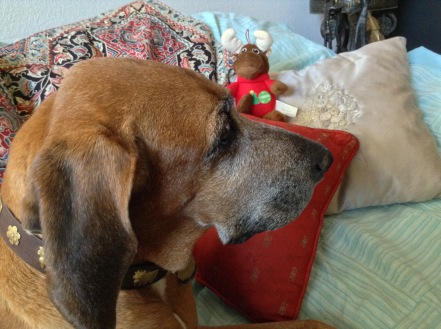
Artemisia the wonder hound
Today our teleporting cloaks will be hung in the cloak room of the spacious light filled Museum of Modern Art in New York City. I want to go to this cafe for our weekend chat because it is the perfect place to ponder modernism. After some time with the art let us gather to talk over coffee and a snack. I like to stay at museums much longer than most people. Taking a break for social time and tasty treats gives me a second wind to examine more of the collections. Surrounded by what is considered to be modern art we are also surrounded by the city of New York. The stately gothic St Patrick’s Cathedral is right around the corner, a few blocks down Fifth Avenue. In the museum light is abundant, structure is open. The design of the building brings us into connection with nature and the sculpture garden patio. In St. Patrick’s the light is all filtered through ornate, colorful stained glass. It has a very blue feeling from the window placement. The gothic ceiling implies lofty access, but we are enclosed and encircled by religion. Heaven is a formula to be achieved by following ritual. It is a beautiful eternal ritual.
I invited you to meet me here today because I wonder if you have some of the same questions I have about history, philosophy, art, and communication. While I study my family tree and the poets in it I have noticed that I enjoy their works much better when I hear them. Reading the old English style, along with the heavy religious tone, is not my cup of tea. The sound of the words as they are spoken, however, reveals to me the art and skill of these poetic ancestors. When they wrote, 1500s and 1600s, I think most poetry would be read aloud or recited more that individuals reading from books. Literacy was limited. These poets were lucky enough to read and write because of their social status. The views, the philosophy, the relationship with God which they explain in writing are a wonderful way to really know them. I keep thinking about the fact that when they were alive they were modern, progressive, and Mistress Bradstreet was something of a feminist, for publishing poetry. Bibles, priests and vicars were the order of the day. Reading and writing were not for everyone. It was a walk on the wild side, especially for a Pilgrim woman.
After our visit I plan to spend a long time with Gustav Klimt, an Austrian artist I love. I have visited Vienna to see many of his works in person. His use of gold and highly decorative style is recognizable by those who don’t know his name. His images are popular. A painting of his patron, Adele Bloch-Baeur II, is on display now at the MoMa. I have not seen this one. I saved it for after the break because I look forward to a close inspection, and deeply serious interaction. I hope to write an ekphrastic poem about her life, her fortune, and her painting that was stolen by Nazis. You can join me if you like. I do want to hear about your week and projects you are creating. Do you ever link what you do now with centuries past in order to define modern for yourself? Modern when this museum was constructed is already different from modern today. Do you think of yourself as modern, gentle reader?

#Weekendcoffeeshare


You probably know about the doomsday preppers, who build bunkers and buy machine guns and prepare to survive Armageddon. This has no interest to me. However, the other popular group of preppers, the ones who prepare food ahead of time to make sure they have healthy meals ready when they want them, are very attractive. I started following this idea in 2015 as a way to branch out of my food habits and try new dishes. I had a bad habit of making too much of one dish and tiring of it before we finished it. This was such a waste of time, energy and money. The remedy is simple. Make exactly the amount you need for each meal, or deal with any excess on the spot. I have not started a good freezer regimen, but I have managed to come out even with prepared food. This was one of the benefits, but not the only one. I decided to make at least two different dishes from each basic staple I cook.
I created a calendar in order to finish all my meal preparation in 4 days in order to leave the kitchen clean and undisturbed for 3 days a week. This is such a great change because it means a lot less clean up for the same amount of food. I make a big specific mess, clear it out, and enjoy the meals in the fridge ready to heat or add dressing. I think I can move toward 4 days out of the kitchen if I concentrate. Most of my fellow preppers do a whole week in one day, so surely I can pick up my pace on this. It does not take that much time, but it does require planning and strategy. The time off feels like I have hired a chef to make all my favorites. The fact that I am the chef does not intrude on this fabulous feeling when I waltz into the clean kitchen to find dinner. There is no drudgery involved because the prep days are very creative with research and invention. The magic chef days are wonderful because I reap the harvest of time as well as the pristine kitchen.
I have been a vegetarian for 65 years, so I am not planning to implement any new phase. I am fine as a lacto-ovo vegetarian eater. I have no desire to be gluten free or vegan, but I do really appreciate all the available recipes in those categories. I go very light on wheat, eggs and dairy, so many treats I enjoy are raw, vegan, and gluten free. I also happen to have a kosher home, but I go to no extra effort. This week we came into a giant harvest of cherry tomatoes. I am drying them, roasting them, marinating them, and next I plan to make a salad dressing from some of the roasted ones. I also saw a good looking focaccia recipe with cherry tomatoes and olives on top..That will be a new way to use them. If you have interest in trying these methods or learning about the food prep movement, find everything you might want to know on Pinterest. Happy prepping, gentle readers.

dried cherry tomatoes
ROW80
My adventure into poetry continues, and the plot thickens. I learn about the lives of poets from my podcasts and reading. I am highly encouraged by the diversity found in the population. Any and every kind of person has written poetry in the past, and the platform only expands now. There were people who worked in mundane industry who took up writing after retirement and found smashing success. There are prisoners, idealists, and students working diligently to create verse and other written art forms. Many of my fellow writers involved in #ROW80 have years of experience and much more instruction under their belts as poets. This feels like a good place to learn from those who have already mastered and shared words carefully placed and edited, intended to express something beyond what the reader can see. I notice that I might be better instructed by poems that do not suit my fancy than by those I instantly like. I also notice my subject matter is similar every time I work on my poetry. I am like Claude Monet and the water lilies, just can’t stop.
I see merit in making series or building on a theme, but in a couple of weeks of daily poetic practice I seemed to be pleasantly slipping into a rut. My drawings are mostly stylized butterflies, and the poems related dream images and psyche flying around the world bringing messages to daytime consciousness. I did say I was not entering this practice to be self critical, but I did need to nudge myself to move beyond the butterflies and tell some kind of poetic story. All the poems I hear and read show contrast and variety, while mine are running flat in a straight line, going nowhere. I aspire to be like Monty Python and Dorothy Parker, yet my current offerings look like rorschach tests with brief captions in explanation of my personality. I do hope we can improve on that.
I made an attempt to write a witty little ditty about the execution of my famous poet ancestor as a story. This truly haunted my dreams and daily life for a couple of days after I learned about the incident in history. We know details of his life and death because he was an aristocrat. We even have several portraits of him. Reading his work and imagining his last 6 days in the Tower of London in January freaked me out to the bone. I skipped a day of poetry writing because I could not come up with any angle from which to create this story. I know I dreamed about him, and developed sympathy for his plight, but nothing carried over into my writing. I found that my boundaries restrict my creative muse. My desire to capture emotions was not as great as my will to make a statement and be done. I finally wrote a short poem with him in mind, but it was not the big leap I wanted to take. I have decided to keep Henry Howard with me as my ancestral muse. I will confer with him before and after I write. I think that by reading more of his work and keeping his memory alive in my dreams I have a chance of expanding beyond my comfort zone as it is now.
I am grateful to all the writers in the #ROW80 challenge for showing me that all of us have similar issues, both helpful and obstructive to our process. The support and sharing within the group is a great incentive to keep the faith. Thanks to all who check in on Sundays and Wednesdays on this adventure of ours. I appreciate knowing we are in this as a team. I have high hopes for all of us.
ROW80
The Round of Words in 80 Days challenge is a wonderful new experience for me. I joined last week by setting goals I intend to accomplish during the following 80 days. By joining this group I am entering a zone designed to support and entertain writers looking to learn new skills as well as improve on old ones. In the few and far between workshops I have taken in creative writing I did learn from my fellow students in many ways. First, it is comforting to see that many share the exact same creative obstacles and follies. Once we see that writing has certain difficult passages we feel less isolated. It cheers us up to find out others get stuck around the same places that we do. Many of the participants have much more experience and education, which does reflect in the way they put their words together to express themselves. It matters little how large your vocabulary is, or how much you know about crafting dialog for a story if you are out of ideas. We all have to go to the well of creativity and draw water to keep our writing alive. In #ROW80 we share this mutual idea of renewing our source of inspiration. The group is much more powerful than the sum of its parts.
My new devotion to write, read and immerse myself in poetry stems from my ancestry. I have some famous poets in my family tree. This, more than any other accomplishment of my ancestors, has made me think about my own creative legacy. I don’t care to be famous, but think it is very cool to read the handwritten poems of my famous 9th great-grandmother. They are the work of a religious Pilgrim in America, not exactly my cup of tea. I still treasure the poems because they have a life of their own, staying in publication for hundreds of years. I can hear her “voice” because she recorded it (as best she could in the 1600s). She inspires me to refine, discover, and expand my own poetic voice.
I have done the ground work I agreed to do by publishing a poem daily. This is starting to be natural. Usually I do the drawing and poem first thing in the morning, which makes me feel good. I don’t get too critical of the work, I just make an attempt to prime the pump and get a constant flow of words. I will be happy when I become more fluent and need to edit with more thought and specificity. For the present I am pleased just to keep that daily beat. I stay with the images as well as the words while I do my daily routine. I think pondering the colors and the words I have used works to inspire the next day’s creation.
My goal to expose myself to the work of poets with whom I am not familiar is made incredibly easy by the fabulous podcasts and poetry apps available at little or no cost. I have also downloaded a couple of apps that help you create poems, and even record your work. There are many good options to read and to hear. These are a just a few of the new resources for poets and poetry fans:
I am using these and a few other mobile apps to make it easy to find and lean about poets. I particularly like the translated work because the reading is done first in English, followed by the poem in the language in which it was written. I like to hear the sounds and the cadence of the original language after I know what it means. I have been pleasantly surprised by how easy and fun it is to discover poets and enjoy a variety of styles. I like the funny subjects the best.
I skipped the reading last week at the U of A Poetry Center. The schedule arrived in the mail for all the readings, events, classes and workshops to be presented in the spring semester. There is a series called the Poetics and Politics of Water which is very interesting to me. I have marked my calendar to be ready to attend all four parts of this collaboration with the American Indian Studies Program. I am also looking forward to an exhibition of photos from Afghanistan to accompany a presentation on oral folk poetry of the women of the Pashtun tribe, living on the border of Pakistan and Afghanistan. There is tremendous technical excellence built into all the work done at the Poetry Center. I cherish to the academic and aesthetic rewards of living very close to this special institution. It is my hope that with the inspiration of my dead poet ancestors and the living poets right around the corner I will be staking a claim to an identity as a writer. A lot can happen in 80 days!!

cocktail that wants to be a poem
People walk through the doors of your expectations. This has been my belief for most of my life, and has proven to be a valid one. I have high standards, but notice how I am much more likely to apply them to others than to myself. I do set goals and make commitments, but not usually in a public way. This is why the #ROW80 challenge is perfect for me. I have set myself an expectation of working more creatively and do a daily bit to achieve that goal. I want to practice being more poetic in all aspects of life, so the drawing, photography and poetry are intended to build on themselves . I expect to become more observant in all aspects of my habitual life. There are already a few good results:
The addition of the art has made this exercise natural and easy for me. I have written poetry before, and even looked for art to use as inspiration. Making the art myself is a new and interesting way to tie my attention to a written project. Usually I write the prose, then add the visuals. Starting with color and form is a good way for me to see action and hue within the emotional tone I want to set. I have not attempted to draw anything realistic. My best work is not representational, but based on geometry and color. I am not afraid to try, and am considering going to the botanical garden and trying to do a depiction of the cactus section. Words to go with the cactus poem have been rattling around in my brain as a think about the idea. Although I do publish my work, the purpose of this venture outside my normal writing style is completely personal. I am not seeking adulation or followers. I am curious to see if my writing practice can expand and include more comedy, enlightenment, and beauty. So far, so good!! Now, for the poetry of others:
In general the poetic life is off to a fine start here. I have also started a food preparation calendar, which I think of as an extension of poetic thinking. I want my home life, my cuisine, and my fitness regime to reflect creativity and artful planning. The food preparation trip is actually a very good foundation because it concentrates kitchen time and frees me to wander off into the world of visual art and poetry. I have had some funny thoughts about food and drink poems I want to write. I think a cocktail series could be pretty funny. Asking “What would Dorothy Parker say?” is a fabulous prompt I am using. In my heart of hearts I want the ROW80 to turn me into a glib, sophisticated observer of the details of living. I don’t think that is too much to expect in 80 days.

cornbread that wants to be a poem

PA and Penn State Teach Fracking
My grandfathers both worked in the oil business, so my parents were very much in favor of petroleum as the way of the future. My father went to Oklahoma University and Penn State to study petroleum engineering. He later got his PHD at Texas A&M in computers (industrial engineering). He was a big deal in the oil business before and after his professional career. After serving as president of the World Petroleum Congress in the 60’s he went on a lecture tour he referred to as the extinguished (distinguished) lecture circuit. He was speculative and relied too much on his own beliefs when investing. This worked out well for them in the glory days of petroleum. They rode the wave of high dividends and capital gains. Their investments did very well.
At the end of his life my dad was seriously demented as well as invested in some wild speculative oil fields in Texas and New Mexico. I had always considered my parents’ finances to be a private matter, but I started to be concerned that they could be left broke as a result of my father’s wildcat mentality. Indeed, when I discovered how far he had gone into these non liquid investments I saw they could brake the bank any day. The first thing I tried was to legally sell all my father’s holdings in these oil fields for $10 to my erstwhile husband, who had persuaded my dad to go deeper into this stuff. When he refused to buy them I knew there was big trouble. I actually left the unmentionable one when I discovered how awful my parents position was in terms of risk. He was willing to financially abuse my parents, which was not a huge surprise, but it was the very last surprise I was willing to have. I went about getting my parents’ assets in trust, which required that my father own the oil folly on his own so none of us could inherit it. It was a legal hassle and expense, but it was accomplished. The week before my father died his lawyer had convinced the partners in Texas to let him off the legal hook. They signed documents to free him, and he instantly died. The documents had not yet been recorded in Texas when he expired. The drama was heavy, but the ending was the best I could have desired. My mom still had plenty of money to live and none of us had an obligation to spend big, risk everything in the oil business. Whew!!
My mom had a happy and easy end to her life. She died at home on Jan. 4, 2008. On that day oil hit $100 a barrel. We figured this was the sign for which she had waited because my parents had always wanted $100 oil. They believed that the price might fluctuate, but it would always go up, no matter what. They invested their lives, careers, and life savings into the big petroleum idea. We just celebrated my mother’s death day, and noticed that on Jan 4, 2015 oil had reached $50 a barrel. During the last 7 years the US has developed the ability to produce oil at around $50 a barrel. It costs the Saudis around $12 to produce a barrel. All price wars are intended to eliminate competition for the market. The Saudis say they can go $30 if they feel like it, and the whole world will have to follow. The benefits of this global price war go chiefly to the Chinese government. Hold back on those selfies with the low gas prices. There are consequences not yet discovered, and they are not all good.

Globe
There is no way to separate the effect the body has on the mind or the mind on the body. This intricate interaction is centered around self image, accurate or not. We may not see ourselves as we are. In fact, the yoga sutras begin by addressing this subject:
1.1 Now, instruction in Union.
1.2. Union is restraining the thought-streams natural to the mind.
1.3. Then the seer dwells in his own nature.
1.4. Otherwise he is of the same form as the thought-streams.
1.5. The thought-streams are five-fold, painful and not painful.
1.6. Right knowledge, wrong knowledge, fancy, sleep and memory.
This was written in Sanskrit and has been translated in many ways since Patanjali wrote it. This translation is by BonGiovanni. We learn by reading this ancient text how the mind works. It is very specific and detailed. Meditation is offered as remedy for confusion and lack of clarity of purpose. Westerners have flocked to yoga as the perfect fitness activity, enjoying all kinds of variations on yogic teachings. Here in the western hemisphere we have trouble integrating mind and body, consciousness with soul and spirit. We want to have landmarks and rewards for success as we progress. Yoga as a strictly physical practice, even if you include pramayama, or breath control, does not align with the purpose, which is to control the mind. If we are successful yogis we will not only dwell in our own nature, but we will be free of identifying with thought streams. This requires constant and uninterrupted practice. Thought streams arise from ourselves, from the opinions of others, from cultural belief, and from circumstances. To acknowledge them and let them go is a powerful and uplifting act. You are not your thought streams!! This idea is the basis of meditative practice. Learning to execute the perfect tree pose takes full concentration. Presumably there is no attention left for thought streams while you balance on one leg and stay aligned. Asana is not the only way to bring the mind into focus by using the body:
The easiest (and therefore perhaps the most difficult) breathing practice I know is just a simple counting of breath. Count to ten, marking each inhale and each exhale with a mental number. This seems so simple that you will be surprised how often you can’t make it to ten without the mind drifting off onto some thought form. When you observe the interruption, simply start again with a silent number one on the next breath. Don’t struggle with the thought; just let it go. Resume counting and breathing. Do you have a practice to focus the mind and keep it focused? Do tell.

winter writing challenge
I just read in a fellow blogger’s post about the ROW80 challenge. I have just started a practice to improve my writing by creating poetry and art. I had not planed to commit to a daily routine, but I am finding that starting the creative day by drawing, editing photos, and making visual art I am more likely to be observant for the day. Observant includes in this case a full attention to detail as I go through my life, and easy flawless observance of boundaries I have set. Since the group is making personal goals a shared conversation, observant will also mean that I pay attention to my fellow writers and the way they express themselves. This idea arrived at a most propitious time, since 80 days of tracking my goal of a more poetic life will give me a good jump start to a full time practice. I look forward to learning how other people contribute to this exercise.
Observe and Grow are the key words for my goal. I hope to grow my vocabulary, my skills, and my creativity by publishing art and poetry. By observing the world, as well as my dreams, I will find richer, more vibrant subjects. I tend to be a scribe, writing just the facts, and supporting the facts with some photo documentation. I still enjoy that, but feel I could do some story telling, humor, and abstract sound pieces if I develop my poetic sense. I want to see where poetry leads me. I am not seeking approval for the work as much as I am wondering what will happen when I apply myself.
For the next 80 days I will observe what happens when I write a poem each day. This is an adventure I will share. It will include:
It is my desire to explore a different way of using the written word. I think it will open new doors for my self expression. I also believe my daily life will be enriched by looking for poetic subject matter. I publish my art and poetry on my Tumblr blog, The Flow.

winter writing challenge




My 22nd great grandmother was born in Syria while her parents were on a crusade.
Joan Plantagenet (1272 – 1307)
is my 22nd great grandmother
Lady Margaret De Clare Baroness Audley (1292 – 1342)
daughter of Joan Plantagenet
Lady Alice De Audley Baroness Neville (1315 – 1373)
daughter of Lady Margaret De Clare Baroness Audley
Sir John ‘3rd Baron de Raby’ Neville, Admiral of the Kings Fleet (1341 – 1388)
son of Lady Alice De Audley Baroness Neville
Thomas De Neville (1362 – 1406)
son of Sir John ‘3rd Baron de Raby’ Neville, Admiral of the Kings Fleet
Maude de Neville (1392 – 1421)
daughter of Thomas De Neville
John Talbot (1413 – 1460)
son of Maude de Neville
Isabel Talbot (1444 – 1531)
daughter of John Talbot
Sir Richard Ashton (1460 – 1549)
son of Isabel Talbot
Sir Christopher Ashton (1493 – 1519)
son of Sir Richard Ashton
Lady Elizabeth Ashton (1524 – 1588)
daughter of Sir Christopher Ashton
Capt Roger Dudley (1535 – 1585)
son of Lady Elizabeth Ashton
Gov Thomas Dudley (1576 – 1653)
son of Capt Roger Dudley
Anne Dudley (1612 – 1672)
daughter of Gov Thomas Dudley
John Bradstreet (1652 – 1718)
son of Anne Dudley
Mercy Bradstreet (1689 – 1725)
daughter of John Bradstreet
Caleb Hazen (1720 – 1777)
son of Mercy Bradstreet
Mercy Hazen (1747 – 1819)
daughter of Caleb Hazen
Martha Mead (1784 – 1860)
daughter of Mercy Hazen
Abner Morse (1808 – 1838)
son of Martha Mead
Daniel Rowland Morse (1838 – 1910)
son of Abner Morse
Jason A Morse (1862 – 1932)
son of Daniel Rowland Morse
Ernest Abner Morse (1890 – 1965)
son of Jason A Morse
Richard Arden Morse (1920 – 2004)
son of Ernest Abner Morse
Pamela Morse
I am the daughter of Richard Arden Morse
Joan of Acre (April 1272 – 23 April 1307) was an English princess, a daughter of King Edward I of England and Queen Eleanor of Castile. The name “Acre” derives from her birthplace in the Holy Land while her parents were on a crusade.
She was married twice; her first husband was Gilbert de Clare, 7th Earl of Gloucester, one of the most powerful nobles in her father’s kingdom; her second husband was Ralph de Monthermer, a squire in her household whom she married in secret.
Joan is most notable for the claim that miracles have allegedly taken place at her grave, and for the multiple references to her in literature.
Birth and childhood
Joan (or Joanna, as she is sometimes called) of Acre was born in the spring of 1272 in Syria, while her parents, Edward I and Eleanor of Castile, were on crusade. At the time of Joan’s birth, her grandfather, Henry III, was still alive and thus her father was not yet king of England. Her parents departed from Acre shortly after her birth, traveling to Sicily and Spain before leaving Joan with Eleanor’s mother, Joan, Countess of Ponthieu, in France. Joan lived for several years in France where she spent her time being educated by a bishop and “being thoroughly spoiled by an indulgent grandmother.” Joan was free to play among the “vine clad hills and sunny vales” surrounding her grandmother’s home, although she required “judicious surveillance.”
As Joan was growing up with her grandmother, her father was back in England, already arranging marriages for his daughter. He hoped to gain both political power and more wealth with his daughter’s marriage, so he conducted the arrangement in a very “business like style”. He finally found a man suitable to marry Joan (aged 5 at the time), Hartman, son of King Rudoph I, of Germany. Edward then brought her home from France for the first time to meet him. As she had spent her entire life away from Edward and Eleanor, when she returned she “stood in no awe of her parents” and had a fairly distanced relationship with them.
Unfortunately for King Edward, his daughter’s suitor died before he was able to meet or marry Joan. The news reported that Hartman had fallen through a patch of shallow ice while “amusing himself in skating” while a letter sent to the King himself stated that Hartman had set out on a boat to visit his father amidst a terrible fog and the boat had smashed into a rock, drowning him.
First marriage
Edward arranged a second marriage almost immediately after the death of Hartman.[12] Gilbert de Clare, Earl of Gloucester, who was almost thirty years older than Joan and newly divorced, was his first choice. The earl resigned his lands to Edward upon agreeing to get them back when he married Joan, as well as agreed on a dower of two thousand silver marks.[14] By the time all of these negotiations were finished, Joan was twelve years old. Gilbert de Clare became very enamored with Joan, and even though she had to marry him regardless of how she felt, he still tried to woo her. He bought her expensive gifts and clothing to try to win favor with her. The couple were married on 30 April 1290 at Westminster Abbey, and had four children together. They were:
Gilbert de Clare, 7th Earl of Hertford
Eleanor de Clare
Margaret de Clare
Elizabeth de Clare
Joan’s first husband, Gilbert de Clare died on 7 December 1295.[18]
Secret second marriage
Joan had been a widow for only a little over a year when she caught the eye of Ralph de Monthermer, a squire in Joan’s father’s household. Joan fell in love and convinced her father to have Monthermer knighted. It was unheard of in European royalty for a noble lady to even converse with a man who had not won or acquired importance in the household. However, in January 1297 Joan secretly married Ralph. Joan’s father was already planning another marriage for Joan to Amadeus V, Count of Savoy, to occur 16 March 1297. Joan was in a dangerous predicament, as she was already married, unbeknownst to her father.
Joan sent her four young children to their grandfather, in hopes that their sweetness would win Edward’s favor, but her plan did not work. The king soon discovered his daughter’s intentions, but not yet aware that she had already committed to them, he seized Joan’s lands and continued to arrange her marriage to Amadeus of Savoy. Soon after the seizure of her lands, Joan told her father of that she had married Ralph. The king was enraged and retaliated by immediately imprisoning Monthermer at Bristol Castle. The people of the land had differing opinions on the princess’ matter. It has been argued that the ones who were most upset were those who wanted Joan’s hand in marriage.
With regard to the matter, Joan famously said, “It is not considered ignominious, nor disgraceful for a great earl to take a poor and mean woman to wife; neither, on the other hand, is it worthy of blame, or too difficult a thing for a countess to promote to honor a gallant youth.” Joan’s statement in addition to a possibly obvious pregnancy seemed to soften Edward’s attitude towards the situation. Joan’s first child by Monthermer was born in October 1297; by the summer of 1297, when the marriage was revealed to Edward I, Joan’s condition would certainly have been apparent, and would have convinced Edward that he had no choice but to recognize his daughter’s marriage. Edward I eventually relented for the sake of his daughter and released Monthermer from prison in August 1297.[17] Monthermer paid homage 2 August, and being granted the titles of Earl of Gloucester and Earl of Hertford, he rose to favour with the King during Joan’s lifetime.
Monthermer and Joan had four children:
Mary de Monthermer, born October 1297. In 1306 her grandfather King Edward I arranged for her to wed Duncan Macduff, 8th Earl of Fife. (Ancestor of Harry S Truman, 33rd President of the USA).
Joan de Monthermer, born 1299, became a nun at Amesbury.
Thomas de Monthermer, 2nd Baron Monthermer, born 1301.
Edward de Monthermer, born 1304 and died 1339.
Relationship with family
Joan of Acre was the seventh of Edward I and Eleanor’s fourteen children. Most of her older siblings died before the age of seven, and many of her younger siblings died before adulthood. Those who survived to adulthood were Joan, her younger brother, Edward of Caernarfon (later Edward II), and four of her sisters: Eleanor, Margaret, Mary, and Elizabeth.
Joan, like her siblings, was raised outside her parents’ household. She lived with her grandmother in Ponthieu for four years, and was then entrusted to the same caregivers who looked after her siblings. Edward I did not have a close relationship with most of his children while they were growing up, yet “he seemed fonder of his daughters than his sons.”
However, Joan of Acre’s independent nature caused numerous conflicts with her father. Her father disapproved of her leaving court after her marriage to the Earl of Gloucester, and in turn “seized seven robes that had been made for her.” He also strongly disapproved of her second marriage to Ralph de Monthermer, a squire in her household, even to the point of attempting to force her to marry someone else. While Edward ultimately developed a cordial relationship with Monthermer, even giving him the title of Earl, there appears to have been a notable difference in the Edward’s treatment of Joan as compared to the treatment of the rest of her siblings. For instance, her father famously paid messengers substantially when they brought news of the birth of grandchildren, but did not do this upon birth of Joan’s daughter.
In terms of her siblings, Joan kept a fairly tight bond. She and Monthermer both maintained a close relationship with her brother, Edward II, which was maintained through letters. After Edward II became estranged from his parents and lost his royal seal, “Joan offered to lend him her seal” .
Death
Joan of Acre died on 23 April 1307, at the manor of Clare in Suffolk. The cause of her death remains unclear, though one popular theory is that she died during childbirth, a common cause of death at the time. While Joan’s age in 1307 (about 35) and the chronology of her earlier pregnancies with Ralph de Monthermer suggest that this could well be the case, historians have not confirmed the cause of her death.
Less than four months after her death, Joan’s father, Edward I died. Joan’s widower, Ralph de Monthermer, lost the title of Earl of Gloucester soon after the deaths of his wife and father-in-law. The earldom of Gloucester was given to Joan’s son from her first marriage, Gilbert, who was its rightful holder. Monthermer continued to hold a nominal earldom in Scotland, which had been conferred on him by Edward I, until his death.
Joan’s burial place has been the cause of some interest and debate. She is interred in the Augustinian priory at Clare, which had been founded by her first husband’s ancestors and where many of them were also buried. Allegedly, in 1357, Joan’s daughter, Elizabeth De Burgh, claimed to have “inspected her mother’s body and found the corpse to be intact which in the eyes of the Roman Catholic Church is an indication of sanctity. This claim was only recorded in a fifteenth-century chronicle, however, and its details are uncertain, especially the statement that her corpse was in such a state of preservation that “when her paps [breasts] were pressed with hands, they rose up again.” Some sources further claim that miracles took place at Joan’s tomb, but no cause for her beatification or canonization has ever been introduced.
Joan in fiction
Joan of Acre makes an appearance in Virginia Henley’s historical romance, entitled Infamous. In the book, Joan, known as Joanna, is described as a promiscuous young princess, vain, shallow and spoiled. In the novel she is only given one daughter, when she historically has eight children. There is no evidence that supports this picture of Joan.
In The Love Knot by Vanessa Alexander, Edward the II’s sister, Joan of Acre is an important heroine. The author portrays a completely different view of the princess than the one in Henley’s novel. The Love Knot tells the story of the love affair between Ralph de Monthermer and Joan of Acre through the discovery of a series of letters the two had written to each other.
Between historians and novelists, Joan has appeared in various texts as either an independent and spirited woman or a spoiled brat. In Lives of the Princesses of England by Mary Anne Everett Green, Joan is portrayed as a “giddy princess” and neglectful mother. Many have agreed to this characterization; however, some authors think there is little evidence to support the assumption that Joan of Acre was a neglectful or uncaring mother.
 mermaidcamp