mermaidcamp
Keeping current in wellness, in and out of the water
You can scroll the shelf using ← and → keys
You can scroll the shelf using ← and → keys
I have cleared out my fridge and started a food preparation calendar for 2015. My first inquiry into this popular practice started on Pinterest, where there are many enthusiastic plans to use time and ingredients more wisely. I notice that most of the preppers favor a style of doing the work on Sunday to have planned healthy meals all through the work week. This is brilliant for anyone with a 9-5 job Monday through Friday. I am lucky enough not to have one, so my goals are slightly different. I still want to concentrate the effort into a compressed time slot, so I save time on clean up and on presentation later. I plan to keep the cooking and cleaning to a bare minimum 4 days a week. I can afford to have 3 active preparation days, and spread out the tasks as well as the freshness. I also am dedicating a day to drink preparation. I have been making shrubs, bitters and other infusions. I want to expand my repertoire in the beverage department. There are so many fun recipes to try, and a tasty beverage stands on its own for a pick me up any time of day.
For the first week I have planned (subject to revision in the future):
The rest of the week I am planning to enjoy the fruits of my labors and find out how well I have estimated the proper amount for the week. I already love the organized fridge and the new outlook I am adopting from the food preppers. It is a solid way to improve the way I shop, cook, and eat. I like restaurants, but honestly I prefer pretty and delicious meals concocted by my own hand. I can suit my own whims and moods. The advantage of the food prep practice is having something healthy and ready no matter what happens. I believe it will remove stress and extra money from the whole process of eating. If you have an interest in leaning more about my new found hobby, I can direct you to some highly educational pins:
There is a plethora of information on this subject. I think it offers me a way to structure a long time interest, making and eating food, into a more elevated and pleasurable experience. I think I will learn a lot. Do you use a meal planning and food preparation schedule? This is a first for me. I am sure I will tweek it, but it is a superior way to look at diet.
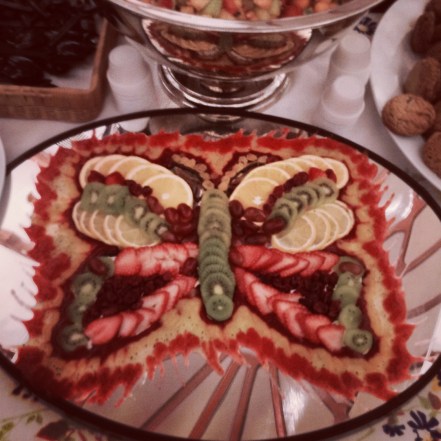
fruit salad
Chris Brogan has announced his 3 words for 2015. This annual challenge is an alternative to the classic resolution style. I have done it with success, and also done it when I forgot my words entirely. Like anything else, persistence is needed for results too occur. I am pleased with my own choices this year, patience, persistence, and poetry. They have meaning across the board to upgrades I aspire to make. I plan to use them liberally throughout the year. I also plan to use Brother Brogan’s words to apply to a specific change I am making in my household. There is no rule that says you can’t admire and swipe other people’s words if they suit you. His words work for my new world of menu planning. I have become convinced that improvisation is not the best way forward with nutrition. It has served me well, and I am healthy. I want to develop the skills and the results of managing our home kitchen like a chef with a restaurant. I know that planning and balance will bring lower costs and higher quality nutrition to our diet. We will waste less produce and use the freezer to make the most of what we buy. This new discipline fits perfectly with the words I am appropriating from Brother Brogan for this project.
His words are:
Thanks, as always, for your guidance, Chris. I am happily applying your words to my advantage this year. I have loved your teaching since Trust Agents. I hope your words will be fabulous for you as well. All the best in 2015.

psyche

psyche
Each night our psyche brings us images in dreams. We connect with them and live within the dream during our sleep. Upon awakening we sometimes lose the dream images as we file that dream somewhere within our unconscious and decide it is not part of our true reality. Notice that we are within the dream while asleep, and then the images are considered to be unreal when we are awake. We live within a gallery of art and image, dramas with set and costume, in our sleeping world. Our awakened ego is concerned with gathering information and meaning rather than absorbing art for art’s sake. We wake up and enter the world with an explanation for everything. By dismissing the power of the imagination we loose the opportunity to individuate. We diminish our own imagination by interpreting our dream images rather than interacting with them.
We run two systems in our awakened world, an economic system and a therapeutic system. All of our activities are divided into economic obligations and challenges or curing our ills. We are concerned with “growth” of our personal economy or “healing” our wounds. It is easy to see the connections that contribute to the cyclical nature of this limited spiral. What is not so simple is to break these cycles. If our addictions are fed by information, image is converted by the mind into interpretation. The ego prides itself on its ability to interpret everything. Since the ego determines that it alone is conscious, all the rest of reality can be fit into the unconscious basket. The ego explains the image and then its importance is belittled. We cease to interact with it once it has an explanation. Imagery has no explanation. Art and image are animate and inherently charged with insight.
I intend to respect the imagery inside of me by embracing a more poetic view of life. By bringing focus to imagination and imagery I want to contribute to my own creativity. I will investigate how I can interact with my psychic and artistic life through practice. This intention can only be controlled to a certain extent, and it is not my hope to contain my psyche, but to explore it. It has a lot to say.

Our new bed, Truth
Testing boundaries and applying discipline will lead to mastery of any skill we choose to practice. We generally rely on what we consider to be our strengths to solve most of our problems in life. Most of us hide our weaknesses, primarily from ourselves, since others can clearly see them. While I am on a big push to clean and clear out my home I notice similarities between my mental state and the state of all my various projects. While digging out all the clothing that is heading for new closets in other people’s houses I discover very cool things I had forgotten in the back of the closet. I have both stupid stuff I have barely worn and the most brilliant, well crafted wardrobe imaginable. The problem has been mixing them all together and overstuffing the space. Nothing is appealing when it is disheveled and jumbled. The same thing applies to my sewing supplies, my office desk, my kitchen cabinets, and, (dare I say it?), my mind. In each one of these cases I go looking for one thing and find 100s of useless items just hanging around for no reason, and a few real treasures I never see or use because they are in a sorry state of order. This clearing must continue until everything I own gives me joy. This must apply to all things, mental as well as physical, digital as well as analog. At the end of the month, which is the end of the year, our brand new bed will arrive. The mattress is named Truth. The truth is that I have a lot of cleaning to do before it arrives:
What needs to go?
What are the mental steps to take to assure I maintain my unobstructed new life?
I am looking forward to exposing this entire phenomena. Often it is said that our greatest strength is also our greatest weakness. I think we all keep a lot of junk out of sight. I maintain a clean and orderly home (to the naked eye), but stuffed into all available nooks and crannies are things I do not need or want. I believe my talents and spiritual life are similar to those overstuffed cabinets. Not only do I have way more than I can use, but I have some trouble distinguishing one thing from another because the agony is all wrapped around the ecstasy at this point. I don’t embrace resolutions. I do want to find myself at the end of 2015 owning fewer things and liking them more. How do you fight the clutter bug, Gentle Reader? Who will win in 2015? I am planning a victory!


My 7th great-grandfather had an inherited gift for bone setting. Both he and my 6th great-grandfather relieved suffering by using manipulative medicine. They had no degree in medicine but believed in their natural ability to pass this gift down to generations of Sweets.
“November 8th, 1724, Captain Benoni Sweet was baptised at St. Paul’s, in Narragasett, by the Rev. Mr. McSparran; and at the succeeding Easter, Captain Sweet was elected one of the Vestry.” [History of the Episcopal Church in Narragansett, Rhode Island, page 94.]
“James Sweet, the father of Benoni, emigrated from Wales [England] to this country, and purchased an estate at the foot of Ridge Hill, so called, in North Kingstown… Benoni had been a Captain in the British service–was well informed, and of polished manners. He was a natural bonesetter and the progenitor of the race in Rhode Island. He was styled Doctor Sweet, but he practised in restoring dislocations only. He was a regular communicant of the church, and officiated as a vestryman, until his death. ‘July 19th, 1751,’ says the record, ‘died Captain Benoni Sweet, of North Kingstown, in the ninetieth year of his age; Dr. McSparran preached his funeral sermon, and buried him in the cemetery of his ancestors.'” [History of the Episcopal Church in Narragansett, Rhode Island, page 94.]
“SWEET, Capt. Benoni, in 90th year, buried in his own family yard.” [Vital Record of Rhode Island, 1636-1850, v.10, page 384]
Benoni Sweet (1663 – 1751)
is my 7th great grandfather
Dr. James Sweet (1686 – 1751)
son of Benoni Sweet
Thomas Sweet (1732 – 1813)
son of Dr. James Sweet
Thomas Sweet (1759 – 1844)
son of Thomas Sweet
Valentine Sweet (1791 – 1858)
son of Thomas Sweet
Sarah LaVina Sweet (1840 – 1923)
daughter of Valentine Sweet
Jason A Morse (1862 – 1932)
son of Sarah LaVina Sweet
Ernest Abner Morse (1890 – 1965)
son of Jason A Morse
Richard Arden Morse (1920 – 2004)
son of Ernest Abner Morse
Pamela Morse
I am the daughter of Richard Arden Morse
The Bonesetter Sweets
Of South County, Rhode Island
By Martha R. McPartland
In colonial America, graduates of medical schools were few and far between. In Rhode Island there were only five medical school graduates practicing in 1800 and the first medical degree awarded in the state was a Brown University in 1814. Prior to that period, from its founding in 1636, Rhode Island had many men called “Doctor” with
little or no qualifications to back up their title. Some were the seventh son of a seventh son, and so believed to be endowed with special healing power; some were charlatans with a smattering of education and glib tongues, who took advantage of misfortune and ignorance; still others had a natural flair for caring for the sick and were able to relieve much suffering. In the last category was a remarkable family from the southern part of Rhode Island called, and still recalled, as the “Bonesetter Sweets.”
The Sweets were an old Rhode Island family whose progenitor, John Sweet, came to the state from Salem, Massachusetts in 1637. Of Welsh extraction, family tradition has it that their forbears in Wales had this innate facility for helping the sick. James Sweet , son of the immigrant, John, was the first of the American “Bonesetter Sweets.” He was born in 1622, came to Rhode Island with his parents, married Mary Greene and settled in what is commonly called South County, and more correctly named Washington County. Of the nine children of James and Mary Sweet, only Benoni , born in 1663, became a bonesetter. Traditionally, Benoni is said to have had a flowery and polished
manner—perhaps a forerunner of the bedside manner possessed by some of today’s medical men! He was called “Doctor” Sweet and his practice consisted of setting bones. He was a respected member of the community and a communicant of the historic Narragansett Church. When he died in 1751, Dr. James McSarren, rector of the
church, delivered a glowing eulogy. The inherited ability to set bones was not regarded by the Sweets as a vocation, but rather as an avocation. They were artisans by calling—stonemasons, blacksmiths, wheel-wrights, and carpenters. Bone setting was a sideline, as is demonstrated by an advertisement in the Providence Journal of February 16, 1830 and printed at the top or the first page of this article.
The remarkable part of this family was the fact that they never exploited their natural ability. Not one of them sought fame or fortune through this medium. The father usually selected one or two of his sons, probably those who showed a tendency in that direction, and instructed them in bonesetting. The Sweets did not deem this a magical thing, but more of an inherited knowledge acquired from their elders. They handled fractures, sprains, and dislocations with a skill to be envied by an orthopedic physician. Their skill was in the manipulation of bones but they were known to use herbs, ointments, and skunk grease in massaging too. Their knack was thought uncanny, as they so often succeeded where others, more learned and “better trained,” had failed. Instances naming local doctors who failed to relieve suffering that was later relieved by one of the Sweets have become a part of South County folklore.
Dr. Benoni Sweet selected his son, James , to carry on the family art. James was born in 1688 and not too much is known of his successes, but it was Job Sweet, son of James, who gained national recognition and established their bonesetting reputation. Job was born in 1724 and married Jemima Sherman in 1750. He lived all his life in the South County section of Rhode Island.
We all have shadow elements in our personalities. The attributes that reside in our blind side are clear to others but never to ourselves. Nations have not only espionage in the dark, but also shadow aspects of culture, hidden from the national personality. This explains why nationalism often leads to irrational pride as well as prejudice against people we do not know. We learned about torture by the CIA and without examination of the facts most Americans decided it was okay under the circumstances. What is so odd about that is they knew nothing about the circumstances. When the news broke that Cuba and the US would begin to talk about resuming relations, many Americans recoiled in horror because they don’t understand what the status quo entails. Nobody else in the world has an embargo against Cuba, and the US dollar is the official currency of the island. They make lots of money from tourism, including from plenty of Americans who travel on flights through Mexico, or on their big fat yachts. There is nothing to loose by resuming a diplomatic relationship, and much to gain.
I went to Havana through Miami in about 1995. I bought my package through a tour agency but did not apply for a special visa. I went to the airport and was allowed to board the plane with the Cubans from Miami who had permission in those days to visit a couple of times a year. There was a grand inquisition at the Miami airport and the CIA busted some people in the holding room who had money..more cash than was permitted. Dogs were brought in and detected the extra currency. I had a ticket but no specific study agenda in Cuba. The immigration officer at Miami international asked me what I was going to do in Cuba. I responded that I planned to study dance. I produced a tiny slip of note paper with my teacher’s address in Havana. He asked where I had met her. I told him in a dance workshop in Tucson. He turned to the dozen or so CIA dudes there and said, “If you believe her, she can go”. I went!! The Cubans on the flight were quite amazed that I made it on the flight. I was the last one out of the Havana airport because I was not carrying a “gusano”, a giant duffle bag full of goods, which are taxed by Cuba. They were puzzled when I told them I did not know anyone in Cuba and would not give away my things. I flew back to Miami with nothing at all. I gave away all my clothes, toothpaste, pens, and the suitcase itself.
I spent 4 days, and visited both my dance teacher and the family of a Cuban friend of mine. She gave me cash and asked me to take them out to a fancy dinner. It was all arranged at the buffet in my hotel. Only foreign tourists are allowed in the hotels. Since I had invited them, they had the rare privilege to experience the tourist facilities in their own city. They dressed up heavily and came at all hours of the day to see me. Since we were sitting in the lobby or in the dining room I had no problems with the staff. When I asked about bringing my dance teacher to the pool for a swimming lesson, that was quite another matter. The pool staff and the housekeeper in my room told me I would NEVER get a Cuban into that pool. This housekeeper had been invited by her own aunt, who was a hotel guest visiting from Spain, but was not permitted to sit poolside. I took this as a challenge, and convinced the concierge that it would be too embarrassing for me to retract the swim invitation I had already made to my friend. I whipped out the Spanish word pena, and wallowed in it. The argument took a while, but eventually I wore her down and was given a special permission to borrow a kick board for the use of a Cuban in the hotel pool. We had our lesson with many hotel staff members looking on in both shock and admiration. I won my personal little social revolution in the pool, and felt very satisfied.
I learned a lot while I was there. Since that time much has changed, and is obviously soon will change more rapidly. What struck me about the Cuban people was their resourcefulness and affection for life. They are the kings cariño, and the soul musicians and dancers of the Caribbean. They cook, they laugh, they party, they dance, in seriously limited circumstances. They accept the fact that their revolution has resulted in repression and dictatorship, and yet they still have pride in that revolution. They suffer from economic problems we do not imagine, and respond with creativity. I thought when I went that the relations between our countries would be resolved soon. Then Elian Gonzalez came to Miami in 2003, and was deported back to Cuba. Laws changed, visiting rights were withdrawn, and we slipped into another decade of the same separatist policy. I am not sure I will go to Cuba again, but do recommend it for anyone interested in music, architecture or tropical culture. There is no need for us to remain clueless about Cuba. There is much to learn about the rise and fall of communism. While we were busy being excessive about capitalism, they were busy with their communist revolution. The results vary, gentle readers. Neither communism nor capitalism has yielded such fabulous peace on earth. Let’s get over our ancient political categories to examine the potential for good. This deal was brokered by the cutest Pope in the Vatican, my man Francis. I am pleased that higher logic is being used to resolve this issue.
Jupiter is by far the most massive planet in our solar system. The Roman god Jupiter was worshiped as the purveyor of the universe. He was the ruler of the daytime sky, the god of lightning and thunder, and the political deity of the Roman state. As king of the gods he administered the cosmos. He is the son of Saturn, known for his jovial nature. Jove, as in by Jove the English expression, refers to the god Jupiter. Thursday is his day and protection of the state is his mission. He was the main man in the pantheon when Jesus was born in a Roman colony. He was revered for his reputation for abundance and good fortune, as well as very fine organizational and judicial skills. He was known for bringing chaos to order.
The fifth planet from the sun is now retrograde from the point of view of the earth. This means that due to our orbits around the sun, Jupiter appears from the earth to travel in reverse. This phenomena has significance in astrology, representing a chance to go over events in the past and make improvements. The Jupiter retrograde period will last until April, ending just as US taxes will be due. It represents a chance to review our organization and abundance issues. This time is a portal to edit and remake your own movie that has been running since last September. You do not have to believe in the power of Jupiter to know that good fortune regularly follows good organization. There is no need to worship the god of the daytime sky to use this time to significantly improve your own judgement and organization. Americans need to review the year for the IRS, if not for Jupiter. Take your habits through an honest evaluation aimed at creating more joviality and order. We all have room for improvement, Gentle Readers. What did you start last September that is not properly organized? Imagine jolly Jupiter guiding you through tax preparation and New Year’s resolutions. Redirect your attention to all that brings you joy. Rigorously remove disorder and chaos that clutter your life. Finish what you started, either by discarding it or completing it.

festive headgear
Christmas is such an anticipated holiday in America that it leaves lasting impressions on children. If I dig deeply into my memories of Christmas past there are certain phases that marked my history of celebrating.
The house was small and the farm very big. My grandmother made bread and cookies all the time. At Christmas she cranked up the volume and included cinnamon rolls. We played Chinese checkers, regular checkers, and Parcheesi. Between baking with my grandma and playing games with my grandpa all my wishes came true. I don’t know what my parents did, but I was always thrilled to be in Lincoln, Arkansas at the farm.
Pittsburgh had excellent quality building snow, so my friends and I constructed forts and had snowball wars. We had sleds, toboggans, and ice skates. At holiday break we were free to slip and slide all over town in our preferred method. We did have caroling in the 50’s with people showing up at your house singing and very cold. You were to invite them inside and give them hot chocolate. My mother made fruitcake (of which I was never a fan) and pralines (which were the best).
Special songs of the season, often with no religious connotations, are sung by bands of traveling musicians. The parranda grows as the host at each home visited joins the group and travels to the next home. Sometimes extemporaneous lyrics are created to flatter the host or the neighborhood. My parents were huge appreciators of the art form, and my dad was the boss of all the people in the petroleum camp. For this reason our house was the last stop of the night. The bar would open and the musicians would stay for hours, playing harps, rhythm instruments, cuatros, and guitars.
I had neither funds nor interest in entertaining like my parents had done. I did still like the large crowd festivities, but preferred to make the occasion pot luck. I still love this form of celebrating because each cook showcases something special that they want to prepare. I also like the progressive dinner, which goes from house to house for each course. Those seem to have fallen out of favor today, but they were fun while they lasted.
There is something excellent about paying others to do all the preparations and clean up for holidays. I spent wonderful holidays all over the world, in Chamonix, Swiss ski resorts, and one superb Christmas in Maui. If you have the extra cash and don’t mind traveling at peak times (when I did it the peak was not so hard to take) being in another land with room service can be a really good way to make the holiday season. Instead of making effort at home, the energy and money is spent on the travel itself.
We like to stay close to home and make very little fuss about our December now. I am working hard to clear space and give away old items rather than acquire any new ones. I use seasonal plants for decorations these days because I just don’t bother with electric lights and other time consuming ways to change the decor. We have no tree, and each year I give away more ornaments and outdoor decorative items. Not only are we happier during the season, we have nothing much to strike in January. This year we may zip up to Scottsdale for a meal at Posh and the farmers’ market. This is our family trip with our dog, who adores the FireSky Resort. The low key way to celebrate suits our lifestyle and our budget.

tropical

unique bloom
The way you do one thing is the way you do everything. This is the theory that detectives use when they construct a modus operandi for criminals they want to catch and crimes that may be linked. In business it is helpful to know the M.O. of your customers or clients in order to better serve them. This way of observing things applies to politics and daily life just as much as it does to business and law enforcement. In our world today it is often necessary to construct a modus vivendi between individuals or groups just to survive. The U.S Congress is engaged in just such a desperate way of doing business. We look at big institutions and see these conflicts but rarely do we bring it down to a personal scale. How do I know what my own M.O. is? How do others perceive my communication? Do I poison the conversation with preconceived notions?
Normally we start be assuming we are right and entitled to our opinion. In conflict, however, both sides usually reveal some irrational thinking that arises from prejudice. If we bring some reflection to the subject beliefs often cloud all evidence to the contrary. We may not be able to start from the position that we might be wrong, but by asking some simple questions we may discover our own ulterior motives and intellectual weakness.
Each of us has a unique way of doing business, and patterns are engrained in all of us. We could all do with less mendacity and obstruction in our lives. To do that we have to identify the ways we create that obstruction through our thoughts words and deeds. Look within, Gentle Readers. You are your own answer.

unique bloom

first box to go
I have a rather animistic relationship with my possessions and potential possessions. I find them in a somewhat psychic shopping style, and buy them in a love at first sight condition. This happens on a regular basis with jackets..and other items of clothing. I adore costuming and potential costuming. I like it way too much. When I first find the unusual jacket/prom dress/beaded top I believe we are meant to be a pair. I see us as fabulous fashion partners stunning and shocking our fans. This is where the delusion begins..but not at all where it ends. It ends in my closet, my garage, and alas, gentle readers, in my barn. The truth is that after a brief romance, all these dazzling duds live a life of drudgery, never seeing any action or fun. I need to set them free for their own self realization. They need to party as their original construction intended. No clothing is happy in the bottom of the drawer or the back of the closet.
Yesterday on PBS radio a lady was reviewing a book about Japanese style tidying up and animistic treatment of the objects in the home. The author had been a Shinto shrine maiden in Japan in her youth, so she really knew a lot about space and ritual. Her method of cleansing starts with a realization that we are not treating our objects with love and respect if we allow them to pile up and collect dust. She emphasizes the feeling of happiness an object must evoke in order to stay in our presence. She aptly notes that old papers never give us feelings of happiness. By keeping so many objects that do not make us happy (any more) we restrict our own spacious feeling and daily comfort. I listened in the car to this radio interview and felt very personally touched by this message. I recently chipped the glass on vase containing fake amaryllis that my mother gave me about 15 years ago. It has been on display in my living room in a prominent place all those years and we have enjoyed it. It is not by any means the only gift I have that she gave me, but I do feel an attachment. My partner and I talked it over and joked about it, and I am ready to part with the object, for the good of all involved. Someone may recycle it if I set it free. It has served its purpose and now it can do something new.
Today my friend is going to visit while I go through my clothing to determine which items truly contain joy for me now. I do not dare to estimate how much needs to go, but I now see my wardrobe as a family. I have cramped the pieces into prison quarters with no light or air. How could they possibly be happy as my wardrobe, overcrowded and starved for attention? The majority of these items need to live in another person’s wardrobe, where they can be loved and treated well. Then I will have a well ordered place for the happy items that will remain with me. The Japanese method suggests that while our socks are in a drawer, they are on holiday. We want them to rest and feel good for the next time they go on our feet. We must pay attention to the state of the holiday resort by assuring proper order and visibility for the resting clothing. I totally love this whole concept, and am sure my clothing will applaud the good news. I just told a friend that by the end of the year I plan to make my closet look like a Shinto shrine. He said, “Send me a picture.” Now I have made a true commitment, and at this point nothing looks less like a shrine than my closet. I have a goal and a deadline. I look forward to making the clothing that makes the cut very happy in the future.
 mermaidcamp