mermaidcamp
Keeping current in wellness, in and out of the water
You can scroll the shelf using ← and → keys
You can scroll the shelf using ← and → keys
Yesterday, 24 November, was Porch Fest in the Dunbar Spring neighborhood of Tucson. This local party includes musical entertainment scattered throughout the hood, food trucks, mesquite bean grinding, and more. I went to attend a food swap with a theme of local food. I went to my garden and harvested herbs, calamondins, and Jerusalem artichokes to make trade baskets. Since this was my first time to attend the food swap I was not sure what to expect..but it was better than I might have expected if I had had expectations. We set out our trade items and used a paper bidding system to indicate interest in swapping. I scored some spicy dill pickles, jalapeño prickly pear jelly, cranberry curd, rosemary focaccia, and delicious chive dip that was perfect on the focaccia. Best of all I am now an official swapper, with the chance to join in future swaps with my new friends. Everyone was super helpful and informative. I learned about new products and tasted some great items. I packed up my excellent swap and partied with friends for a while before sunset. Please note if you live somewhere else, it is sunny, and although for us it was a bit chilly in the shade, we are able to go outside and celebrate our neighbors, our talents, and our supreme good fortune almost all year. We have a diverse culture and a growing interest in sustainable practices such as rainwater harvesting and eating local. Our local music scene is diverse and sustainable too because our citizens come out to support local artists and musicians in an effort to make this a more artful place to live.
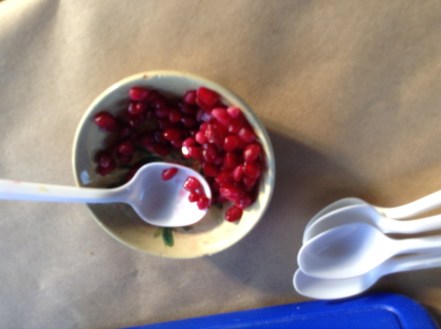
pomegranate swapper

as in, NOT Phoenix
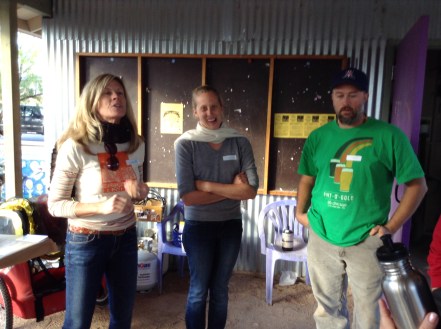
my fellow swappers

good times

squash
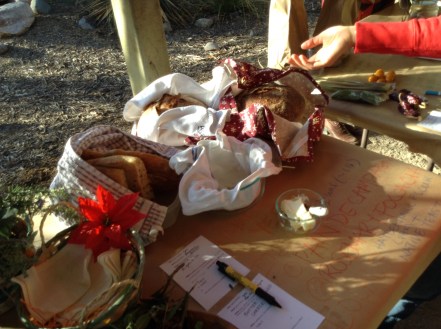
bread swapper

food hippies

good friends

my trade basket

swap table
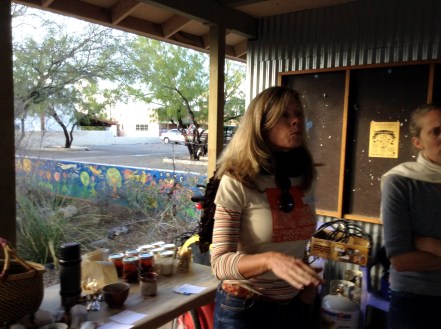
swap explained

painting mural

out to celebrate


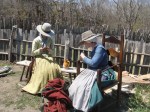
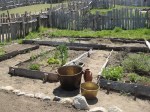
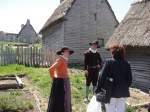
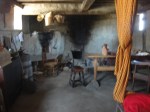
My ancestors attended the first Thanksgiving party in Plimouth Colony. Most of my heritage is English, and the Mayflower was full of my peeps. My 11th great-grandfather attended the feast as a representative of the Wampanoag people. When he first met the Pilgrims they gave him alcohol , which must have aroused his curiosity. The political system in New England was way different from the one in Europe. The local natives made friends with the Pilgrims with reservations (not the kind they have been granted by the US government). They had made contact with Brits before which had resulted in an outbreak of disease that killed a large number of the people. They saw the Mayflower, but kept a distance since they assumed these Brits would be diseased as well.
Quadequina is credited with bringing popcorn to the first Thanksgiving. The Wampanoags I met in Plymouth this year told me it was actually parched corn. Either way, there was a potluck dinner and Quadequina brought corn as his dish. He acted in good faith, was a respectful and polite guest, even allowing the Pilgrims to occupy his homeland and build a fort around their town. It was fairly impossible for the American natives to do due diligence on these religious Pilgrims who had arrived and planned to stay. Squanto, the famous translator, was about all the interface available. The Natives of New England were stuck with this highly unnatural situation through no fault of their own. They just happened to be where the Mayflower got stuck on the rocks. It was their luck.
When my 10th great-grandfather Gabriel Wheldon wanted to marry Quadequina’s daughter he gave his consent and helped the couple avoid disaster from the Pilgrims:
Gordon B. Hinckley, Shoulder for the Lord” by George M. McCune page 35- ” Two of the early immigrants to Plymouth colony were Gabriel Wheldon, of Arnold, Nottingham, England, and his brother (name unknown). Gabriel had been married in England before sailing to America but his first wife named Margaret evidentally was deceased at the time of his migration. Both brothers had a free spirit much like Stephen Hopkins and found their way to the camps of the Wampanoags. There they both fell in love with two of the daughters of chief Quadequina, younger brother of the Great Chief. They each married and Gabriel gave his second wife the English name ‘Margaret’ after his first spouse. The two counseled with their father-in-law and his older brother Massasoit regarding what to do. The Plymouth Colony would probably punish them for their intermarriage. Massasoit advised them to return to the colyn and all would be well. The Plymouth Colony tribunals saved face by banishing the couples from Plymouth for life but did not send them back to England. Gabriel and Margaret established their home in Barnstable where the Hinckleys came in late 1630’s and here Gabriel and Margaret raised a large family of girls. One of these was Catherine “Catone” Wheldon who married Stephen Hopkins'(First to build a house in Mattachesse Villiage/Yarmouth) oldest son Giles on October 9, 1639. Giles had been given the home his father had build in Yarmouth and the couple established their home and raised four children there. When Giles’ father Stephen passed away about July 1644, his father left an estate.. Some records give Margaret as the wife of Gabriel Wheldon. It seems she was his second wife, who, after his death, may have returned to England with Rev. Marmaduke Matthews and his wife. Other records state that Margaret was an Indian Princess, Wampanoag, and give her lineage for several generations. He _may_ have been Margaret’s brother. He immigrated 1638, aPreacher of the Church of Malden. He returned to England in 1655, and Several of the Malden Church members went with him. Of these returning pilgrims, the widow Margaret Wheldon, who left a law-suit over the estate of her deceased husband, Gabriel, also went to England. (from: Pg 155 The History of Malden, Massachusetts, 1633-1785). Rev Matthews died 1683 in England.
I don’t believe he is partial to either pecan or pumpkin pie. I think Quadequina would have liked to see us celebrate equal rights and justice each November. The story of Thanksgiving is mostly mythical, since very little was recorded at the time. Turkeys may not be the best logo for American seasonal gratitude. Popcorn deserves a place at the table.
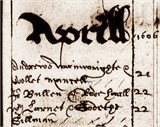
marriage record

coat of arms (with leg)

Goodith’s grave
My 12th great-grandmother arrived in Massachusetts Colony before 1632, and joined the church in Charlestown with her well respected husband. Her unusual first name is often misspelled in records, but it is an old English name.
Note: From “The Great Migration Begins…”: :’Goodith’ was a distinct given name, not to be confused with ‘Judith’, and not to be interpreted as ‘Goodwife,’ as has been done. “The Winthrop Society shows Goodith’s birth as circa 1585 and death as before 1632.
Judith Gillman was also known as Goodith Gillman. She was born in 1594 at Bermondsey, London, England. On 22 April 1606 at St. Olive, Southwork, Surrey, England, Judith married William Learned. Judith Gillman and William Learned were admitted to the church on 6 December 1632 at Woburn, Middlesex County, Massachusetts. Judith Gillman died on Friday, 24 June 1661 at Malden, Middlesex County, Massachusetts, at age 67 years.
[S466] Ancestral File. Family History Library, Salt Lake City, Salt Lake County, Utah, 1994. [S14] Wyman, Thomas Bellows. The Genealogies and Estates of Charlestown, Massachusetts 1629-1818. 1879. Reprint Somersworth, New Hampshire: New England History Press, 1982.
WILLIAM LEARNED d. Woburn, MA 1 Mar 1646, m. GOODITH GILMAN, d. 24 Jan 1661.
William Learned came from Bermondsey, Surrey, England and settled at Charlestown in the Massachusetts Bay in or before 1632, possibly in 1630 with the Winthrop fleet. He and his wife Judith were admitted to the First Church of Charlestown on Dec. 6, 1632, their names being the first two on the list of members. “1632, 10 mo., day 6, William Learned and Goodeth, his wife, were admitted”, being the first admissions after the separation from the Boston Church. He became a freeman on May 14, 1634 and a Selectman on Feb. 13, 1635-6. On March 2, 1637 he was chosen one of four to divide, for stinting, the common land, and on Feb. 12, 1637-8 he and Mr. Greene were appointed to settle the wages of the school-master.[2] On April 26, 1638 William Learned and five others were on a committee “to consider of some things tending toward a body of laws”
William was a subscriber to the town orders for Woburn, drawn up at Charlestown Dec. 18, 1640. In 1641 William moved to Woburn where he was one of the seven original members of the church on August 14, 1642. He was chosen constable April 13, 1643 and Selectman of Woburn in 1643 and 1645. These offices were only given to trusted and respected men.
Goodith Gillman (1592 – 1661)
is my 12th great grandmother
Sarah Learned (1604 – 1652)
daughter of Goodith Gillman
Mary Ewer (1637 – 1693)
daughter of Sarah Learned
Mehitable Jenkins (1655 – 1684)
daughter of Mary Ewer
Isaac Hamblin (1676 – 1710)
son of Mehitable Jenkins
Eleazer Hamblin (1699 – 1771)
son of Isaac Hamblin
Sarah Hamblin (1721 – 1814)
daughter of Eleazer Hamblin
Mercy Hazen (1747 – 1819)
daughter of Sarah Hamblin
Martha Mead (1784 – 1860)
daughter of Mercy Hazen
Abner Morse (1808 – 1838)
son of Martha Mead
Daniel Rowland Morse (1838 – 1910)
son of Abner Morse
Jason A Morse (1862 – 1932)
son of Daniel Rowland Morse
Ernest Abner Morse (1890 – 1965)
son of Jason A Morse
Richard Arden Morse (1920 – 2004)
son of Ernest Abner Morse
Pamela Morse
I am the daughter of Richard Arden Morse

Thanksgiving cactus

sky blue pink

sunset
When I think of an ideal day I have plenty of time and plenty of tasty snacks. The weather can be any way, but my awareness is high. When I think of the Thanksgiving season and the Black Friday vision of what is to come I become a serious holiday prepper. I am not preparing for the zombie apocalypse or the end of civilization, but for the temporary insanity of all the world shopping to be shopping. I am preparing to stay home, work very little, and dine in some fine establishments close to my home for holiday meals to savor, remember, and pay chefs to create. I will not find myself at Trader Joe’s, or any other grocer, the night before Thanksgiving because I will not need any groceries for my meal. I have what I need, reservations at Maynard’s. Situated in the old train station and across the street from Hotel Congress, this fancy restaurant gets rave reviews, and we have never tried it.
For our big December family gift to ourselves we are taking our coon hound to Scottsdale to her favorite hotel, Kimpton FireSky. She loves the dog centric customer service, and all the other guest dogs. We love to dine at Posh, right across the street. We will drive up for the improvisational cuisine and a break from being at home. There are many cute small businesses in Scottsdale that create a flavor in the old downtown that we enjoy. We like the art galleries and will probably hit a local farmers’ market or two while we are up there. It will be citrus and date season, and although Phoenix is no longer very agricultural, there will be some local products we don’t have down here in Tucson.
For Christmas Eve we have reservations to dine very close to home at Pastiche. This week you can buy gift cards at Pastiche that come with a 25% bonus. Next week the bonus goes down to 20%. I am armed with my $125 worth of Pastiche gift cards which I purchased for only $100. I am so ready to party. I am completely into the idea of doing no cleaning, cooking, or entertaining, other than inviting friends to join us out on the town. I used to enjoy a labor intensive, baking, crafting, decorating, cocktail partying holiday cheer. Now that is all just way too much effort. I appreciate the labor and creativity that chefs and restaurants can provide, while I take it easy and be grateful that there is no clean up after my nap.
Wishing for gifts changes over time. The kinds of things we want and what we believe we will gain from them may become more complex, or more simple than in childhood. When giving gifts my style is to prefer to share an experience, like a meal, a concert or class. When receiving I am the same. I have so much physical stuff I can’t really imagine owning more. The burden of taking care of worldly goods eventually comes with diminishing returns. Sometimes we are sentimental about objects and cling to them because they remind us of a person, place, or event. Certain things we made ourselves are important beyond reason because they mark our proficiency at a certain time. Things require space and some attention. As we acquire more stuff and it all needs attention, we may be loosing something more than just usable space.
I was very impressed the first time I studied with the Dalai Lama of Tibet in 1993. He gave us Buddhist teachings as well as his own point of view. One of the outstanding exercises I have always remembered from that teaching was about acquisition. He said:
He wanted us to be aware that the thrill is usually much diminished as soon as the object becomes our own. After owning something for a while we notice that it did not give us the total satisfaction we had expected from it. This is called buyer’s remorse..it is also called attachment. So caveat emptor all you little elves out there; Once you have your thing you will have to deal with it and find a place to put it.
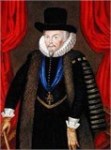


John Neville, 3rd Baron Neville de Raby
John Neville Baron Neville de Raby Spouse (s) Maud Percy
Elizabeth Latimer, 5th Baroness Latimer Issue Ralph Neville, 1st Earl of Westmorland
Thomas Neville, 5th Baron Furnivall
Elizabeth Neville
Alice Nevile
Maud Neville
Eleanor Neville
John Neville, 6th Baron Latimer
Elizabeth Neville Noble family House of Neville Father Ralph Neville, 2nd Baron Neville de Raby Mother Alice Audley Born 1328 Died 17 October 1388
John Neville, 3rd Baron Neville de Raby, KG (1328 – 17 October 1388) was born at Castle Raby, County Durham, England to Ralph Neville, 2nd Baron Neville de Raby and Alice de Audley. He fought in the Battle of Neville’s Cross on 17 October 1346 as a Captain in his father’s division. He was Knighted in 1360 and after his father’s death in 1367 he succeeded to the title of 3rd Baron Neville of Raby. In 1368 he served as the English ambassdor to France. He was Admiral of the King’s fleet and served in the wars against the Scots and French. He was made a Knight of the Garter in 1369. Neville married Maud Percy, daughter of Henry de Percy, 2nd Baron Percy and Idoine de Clifford. After Maud died in 1379 John married a second time to Elizabeth Latimer, daughter of William Latimer, 4th Baron Latimer.
Children
Six children by Maud Percy
Ralph de Neville, 1st Earl of Westmorland (1364–1425)
Thomas de Nevill, 5th Baron Furnivall (1377–1406)
Elizabeth de Neville (b. 1379)
Alice de Nevile (1379–1433)
Maud de Neville (b. 1379)
Eleanor de Neville (1379–1441), married Ralph de Lumley, 1st Baron Lumley. They were parents to Catherine de Lumley.
Two Children by Elizabeth Latimer
John de Neville, 6th Lord Latimer (1382–1430)
Elizabeth de Neville, Baroness Latimer (b. 1388)
Baron Percy
References
thePeerage.com Accessed May 13, 2007
Peerage of England Preceded by
Ralph Neville Baron Neville de Raby
1367–1388 Succeeded by
Ralph Neville

marzipan
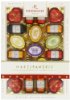
assorted marzipan
I enrolled again in Amazon’s 30 day trial of the Prime membership. I have done this before but not paid much attention to all the benefits. They allow you to quit within the trial period, which I did. Now I have been on a book diet for a year, and am curious about Kindle and the lending library. I had Kindle on iPad, but the Amazon Prime offer will only be available to members who own a Kindle devise. We have wanted to dump cable television for a while and wonder if the streaming video content from Amazon would be one way to wean ourselves. Amazon is not making it easy for Apple customers to get into the video program. I can watch on my iPad, but to get it on my big TV I had to buy a streaming device. I quickly found that Roku is compatible and the unit was very reasonably priced. The Kindle Fire HD fancy reader was on sale too. Since I can have instant gratification with the 2 day free delivery I decided to wrap up all the household holiday shopping on the spot, on the laptop. On Tuesday I will have, via free delivery service:
If our household can’t find enough entertainment and reading material to enjoy while we snack away on our marzipan from Germany we are just too lame for holidays. All we need to add are a few tasty homemade treats and some quality time entertaining our friends. During the holidays I like to drive even less than usual, so having everything we need at home is key to my enjoyment. If I am missing anything, Amazon will deliver it for free in 2 days. That is reassuring. I do feel that I have done some very Prime shopping. They will probably keep me on for the year this time.










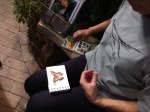
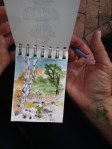
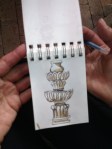
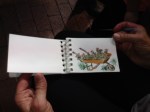
Each year Tucson Botanical Gardens opens a special tropical exhibit of butterflies. The greenhouse is maintained all year, but in the summer it is too costly to keep at temperature, so they take a break. I love to spend time in the butterfly magic display and do so very frequently. I am pretty excited to announce that they now have tiny tree frogs joining the butterflies. The frogs hide a bit from the crowd because they are nocturnal. I managed to see three and get some shots. Since it was Veterans Day lots of kids were in the house. I also met a woman who has taken a course at the gardens in pocket sketching. She had a tiny set of water colors and was popping out some tiny great art. This is my favorite entertainment in town. Members can go as often as we like, so I am a frequent butterflyer.

Bar Book

bar food

bar

festive friend
I have restricted my reading of books for the last year to three, Sacred Contracts by Carolyn Myss, How to Think Like Leonardo DaVinci by Michael Gelb, and Impact Equation by Chris Brogan and Julien Smith. This experiment was proposed by Brother Brogan about the time that he published Impact Equation. I went for the idea because I have always read voraciously but applied the information with much less vigor. I also have enrolled in a course to study the Sacred Contracts material which I find fascinating and endlessly useful. I read constantly this year, and did not really read the three books much at all after the first three or four months. By then all the other participants including Brother Brogan had all quit the program. I stuck it out because it served me. I found out there is such a thing as reading too many books. There is more to life than reading.
I have put more practical application and reflection into what I have read this year. I do not hurry or skip through anything that I read now, which is new. I have been a speed reader for 40 years, having studied at the public library where I went for lessons by Dick Cavett on video. Life is change. If I have spent all this untold time reading it seems I should be able to write. I should also be able to read contemplatively, a skill I have yet to acquire. As I allow myself to buy and read books once more I have a new perspective. I have discovered the U of A Poetry Center and my ancestor poet in it. I have been to a few poetry readings during this diet, which I liken to being driven by a chauffeur. The experience of a poetry reading includes everything about the ambiance and company. I plan to return to the Poetry Center for both the readings and to read in that amazing ambiance. I also plan to write poetry as a meditative practice. Most of all I plan to be strategic and particular about all my reading from now on. I think if there is a librarian at the pearly gates we will be asked to do book reports to show comprehension, not prove that we have been on a life long book binge.
Rather than yo-yo dieting, allowing myself to totally pig out at the library right out of the gate, I have purchased three practical and useful books beyond the poetry books I will read will super mindfulness. My recent purchase, The American Bar by Charles Shumann, is a huge hit, although I have not finished reading it. It was center stage last night when I created a signature cocktail for one of my guests. Now that I have a fresh start I do not plan to read every book in the library before I mix my first cocktail. Reading how-to books without doing any of the things about which one reads is probably pointless. I think the remedy was well timed and perfect for me. My name is Pamela Morse and I am a book-a holic. As a recovering reading addict I will allow myself to go to libraries, but no used book stores for now. I need to know that I can stay in control. So far, so good.
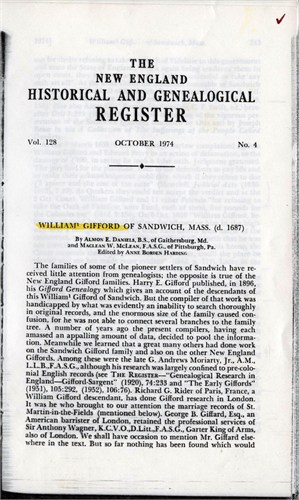
Gifford Genealogy
My 9th great grandfather was born in England and died in Sandwich, MA. He was a Quaker who was persecuted for his faith. He refused to sign the oath of fidelity to England, so he hd a hard time with the colonial authorities.
There is a record in England of a “Guilielm Gifford” (i.e., William Gifford) who married Elizabeth Grant on 11 February 1635 in St. Martin-in-the-Fields, London. Also, the London Merchant Taylors’ Guild shows a record: “William Gifford, son of Anthi (sic) Gifford of Dublin in the kingdom of Ireland, gentleman, apprenticed to Thomas Southerne of New Exchange, London, for a period of seven years from 7 December 1628.” Apprentices were forbidden to marry, so this would mean the apprenticed William Gifford would have been given his freedom 7 December 1635, in perfect time to be the one who married 11 February 1635/1636. Also, the records of St. Martin-in-the-Fields show that an Ananias Gifford married Maria Read on 18 November 1621. Ananias (also spelled Hananias, Hannaniah and Annaniah) is a relatively rare name. William named one of his sons Hannaniah, and the name has been carried down in the family. Also, the name occurs in the Giffords of Dry Drayton, county Cambridge, England. But it cannot be proven that these English records apply to the family of William Gifford of Sandwich.
Nor can the English ancestry of William Gifford of Sandwich be proven, according to Daniels & McLean. “English Giffords can be traced back to Normandy at the time of William the Conqueror when most branches usually spelled the name Giffard. Inevitably the temptation to connect the Sandwich Giffords with these celebrated families has produced a rash of printed accounts in which the connection is stated as fact but without solid references. (Cutter’s “Genealogical History of Western New York,” 2:901; “History of Bristol County, Mass.;” “Vineland (N.J.) Historical Magazine,” 3:32; “Seabury-Gifford Families,” Hartford (Conn.) 1941) In view of the fact that highly skilled professional genealogists have found no proof as yet of such connections, it can only be said that evidence has yet to be found to confirm these wishful thoughts.”
William Gifford of Sandwich was a Quaker, and as such, suffered persecution for his faith. “Little Compton Families” says “It is supposed that he was the William Gifford who in 1647 or earlier was ordered by the court at Stanford to be whipped and banished.” On 1 June 1658, he was one of a dozen men who “all of Sandwich were summoned, appeared to give a reason for theire refusing to take the Oath of Fidelitie to this government and unto the State of England, which again being tendered them in open court, they refused, saying they held it unlawful to take any oath att all.” At the court held 2 October 1658, they were fined L5 each. At the court held 1 March 1658/1659 George Barlow, Marshall for Sandwich, Barnstable and Yarmouth, complained against William Gifford and Edward Perry in an action of defamation, asking damages of L100, in saying he took a false oath. The defendants were ordered to pay 50s and make their acknowledgement publically, or else be fined L5 plus costs. As Quakers, they could not accept the verdict, and at the 2 October court William Gifford and 11 other Friends were fined L5 for refusing to take the Oath of Fidelitie. At the June 1660 court Gifford was again summoned to take the oath, again refused, and was again fined L5. In October 1660, for persisting in his refusal and for attending Quaker meeting, he was fined L57 — an enormous sum for those times. At this point he disappears from the records, and may have left Plymouth colony, but where he went is unknown. It has been suggested that he went to New Jersey which, like New Amsterdam, was then under the control of the Dutch. On 8 April 1665 William Gifford was one of the signers of the Monmouth (NJ) Patent, but there is no evidence he actually settled there; his sons Christopher and Hannaniah did, however. In a deed by his son Christopher William was described as a tailor.
On 10 November 1670 Mr. Gifford bought from mistress Sarah Warren of Plymouth, widow of Richard Warren, one half her share in the land at Dartmouth, which he gave equally to his sons Christopher and Robert by deed dated 6 May 1683. In 1673 William Gifford purchased land in Suckanesset (Falmouth) from the Indian Sachem, Job Noantico. Gifford continued to appear in Sandwich town records and in records of the Sandwich Friends meeting, and he married Mary Mills, also of Sandwich, at the Friends Meeting of 16 day 5 mo: 1683. Thirty witnesses signed the certificate, but none of William Gifford’s children signed the document, nor did James Mills, Mary’s brother.
 mermaidcamp