mermaidcamp
Keeping current in wellness, in and out of the water
You can scroll the shelf using ← and → keys
You can scroll the shelf using ← and → keys
I value my Triberr membership very highly, and love the opportunity to invite the world to join us. I invite artistic Tumblrs to come on over to see how I Tumble in the Artistic Expressions tribe. I have not promoted this arty little place in the world, but hope other expressive folks will drop by with some art to share. The benefits of Triberr compound themselves daily. Deep appreciation goes out to Dino, Dan, and Andres for both getting this party started, and improving it all the time. Thanks for the t shirt. I wear it with pride.
The vanishing middle class in America is the subject of much discussion. In fact, tonight some of the internet’s finest minds will tweet brilliant ideas in a twitter chat on this subject. How the advent of technology has reduced the need for big workforces that manufacturing employed in the past is part of our political history and our new economy. Pros and cons can be weighed, but there is nobody who believes our economic policies have not grown a very wealthy upper class with extrme privilege at the expense of the rest of the population. Our great divide grows larger each minute providing tax breaks, and a dream environment for big business while poverty grips our children and our elderly. The new fat cat is fat indeed. A generation of wealth has been wiped out and shifted to the wealthiest and most powerful of our citizens.
I had the pleasure of meeting Bill Moyers several times when I worked at fancy spas. He was a spa bunny. He is more charming in person than I ever imagined, quickly running to the top of my favorite celebrity list. I learned one time talking with him down in Mexico that his mother was from Texas, like mine. They both had the same first name, Ruby. His mom, however, was named Ruby Jewel. Wow. Last night on Charlie Rose his interview reminded me of all the reasons I love him, but it also taught me that we were both in Austin when he was working for LBJ and I was protesting LBJ. It’s like we’re connected.

amaryllis

sunflower

cactus

sunflwoer
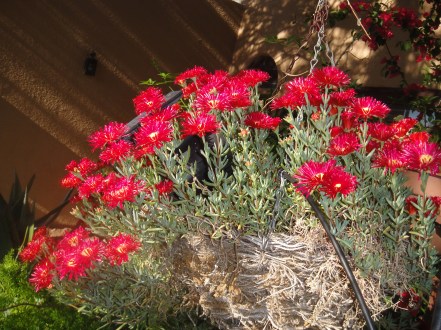
ice plant
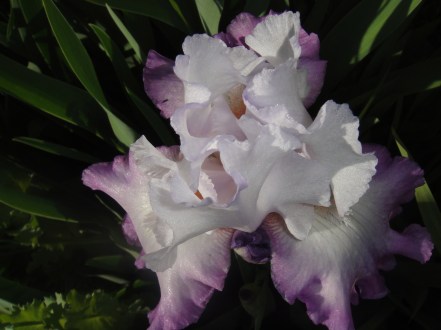
iris

sunflower

hollyhock

bee balm

sunflowers
Our relative freedom is under our control. We are sometimes the prisoners in our very own jail of procrastination, judgment, and something we call, running around. We often choose running around our decisions rather than making them, which, by default, makes them. If we can send armies to fight for freedom in harsh conditions what is stopping us from personally liberating ourselves to feel happy and free? Here are some places to look for or create more freedom in your life:
Practice defines our reality. We spend our time and energy as if we had no control over them. We learn what we study and we believe what favors our own superior position in the human crowd. Nobody survives alone without help from others. In history we chose the people who prepared our food and sewed our clothing carefully to make the most of the means at our disposal. We used resources in the same way because they were scarce. Most individuals were not lavished with great luxury, but if they were lucky they had liberty and the pursuit of happiness.
Today we know nothing of the people who prepare our food like products or sew our disposable fashion. We may have a vague feeling that everything we use was made in China, but that is usually the end of it. Many seek pleasure in acquisition of goods and services just to be piggy. This general shift in responsibility is sad in a big karmic way because we have essentially eliminated the need for gratitude to those who serve our material needs. We buy the workers and then discard them like the objects they make for us.
Gratefulness.org is an organization created to enhance gratefulness around the globe in every way. The offers and courses are imaginative and very helpful. One can study on line everything from gratitude poetry writing to living the hours like a monastic. Given the international state of affairs I salute the Gratefulness organization for addressing the main problems right at the root. If you have not visited these grateful folks and discovered what they are teaching, you are missing an opportunity to be guided to a more grateful state of mind. Grace is gratitude, gentle reader; don’t leave home without it.
Edict of Nantes
My 9th great-grandmother was born in France and died in Northern Ireland. As usual ,this exodus was inspired by an escape from religious persecution. Her family would later settle in South Carolina as Presbyterian religious and military leaders. She married into a family called Pickens, or Picon:
The Pickens Story. as told by Stuart Clark Pickens.
About 870 a.d. the Viking “Stirgud the Stout” and his men landed in the Orkneys and Northern Scotland. They came from Norway in an effort to expand. The Pickens name comes from this group of Vikings.
Later, under their Earl, Thorfinn Rollo, they invaded France about 910 AD. They held Paris under siege until the French King, Charles the Simple, conceded defeat and granted Northern France to Rollo, who became the first Duke of Normandy.
A descendant of Duke Rollo was Duke William who invaded England in 1066. William had a census taken in England in 1086 and compiled the Domesday Book. This Listing of names has Picken listed and many variations of the spelling as well. Most notably “Pinkeny” which in the 1200’s lived in Picquigny in the Somme in the arrondisement of Amiens in Normandy.
Ghilo Pinkeny was a Domesday book tenant in chief in the county of Northampton and others, and his son Ghilo, founded the Priory of Weedon in Northampton which was a branch of the original Priory at St. Lucien in Beauvais near Picquigny. They branched into Yorkshire and acquired Shrover Hall where they were landed gentry. They also established a seat in Oxfordshire where the name was Pinke.
The Pickens name emerged as a notable English family name in the county of Northampton where they were recorded as “a family of great antiquity seated as Lords of the Manor and Estates in that shire.”
In the late 1200’s many of the Norman families of England moved north to Scotland following Earl David of Huntingdon (who later became the second King of Scotland). They expanded into Scotland where the names were Pinkie, Pickie, and Picken. They settled in Inveresk in Midlothian, Scotland. Peter Pinkie was listed as a follower of Robert the Bruce in 1303. They flourished on these estates for several centuries spreading throughout Scotland.
There were Pickenses at the battle of Bannockburn in 1314 defeating the English who outnumbered them 5 to 1, gaining Scottish Independence. This battle was the first of many major victories giving the Scots a good reputation for winning battles.
In 1328 the Treaty of Northhampton was signed between the English King, Edward III and Robert I (Bruce) officially recognizing Scottish independence and Robert Bruce as it’s king. The following year, Earl David was crowned King upon the death of Robert the Bruce and Scotland was well on its way thanks in part to the efforts of the Pickens family.
In 1521 on May the 26th , Martin Luther was banned by the edict of Worms for his religious beliefs. Any deviation from Catholicism was considered blasphemous. There was a tremendous effort throughout Europe to spread Catholicism and keep these Protestant dissidents from converting the masses.
The Scottish would not be told how to think and so would not stand for any religious persecution. On the English border the Scotch Presbyterians were treated as low life and so the border was a hard place to live. They were forced into guerilla warfare just to survive. These “Border Reevers” became the best frontier fighters in the world. There were many of the Edinburgh Pickenses among this group of fighting farmers. The Border raids were finally quieted when the Scottish king James IV took the English throne as James I in 1603. These fighters were later used by the English to quiet the Irish.
The French huguenots in the mid 1500’s felt the same as the Scottish about religious persecution, and this common belief of religious freedom forged a friendship between the Scots and the French that lasted until 1685.
It was during this time, the late 1500’s, that one Robert Picken/Picon from Scotland went to France during the reign of King Henry IV (1589 – 1610). He held a diplomatic post in the Kings Court until 1610 when Louis XIII took the crown. He then returned to Scotland near the English border and lived there until his death. He had family in Edinburgh, Stewarton, Glasgow, and the Kintyre Peninsula. The border had become a friendly place at the time because a Scottish King sat on the English throne. (James I was also James VI of Scotland and the son of Mary, Queen of Scots). This made for what Robert thought would be an easy retirement.
When his son Andrew was born in 1624, the political climate was getting difficult. Charles I began his reign over England in 1625 and some of the attitudes changed toward the “Wily Border Reevers of Scotland”, so called because of the old hatred between the two countries under Elizabeth I (1558 – 1603). The Covenanters were also uprising against the English crown and England’s religious civil war was reaching into Scotland. The Scottish king James was no longer king and old hatreds built up again atop new hatreds. But it was still a tolerable life for Robert Picken/Picon because of his diplomatic status. Robert Senior died in 1644 and is buried in Lowland Scotland.
There were other Pickenses (Pickan) in Edinburgh who were believed to be Robert Picon’s (Pickens) brothers. A lot of their children moved to Ulster in the 1620’s and 1630’s. This was a colonization effort of the English to make Ireland “civilized”. (See Ulster History).
In 1644 Andrew had a son Robert named after Andrew’s father. Robert was born in Scotland according to LDS records. He went to France with his father at a young age. While in France, Robert met the young widow of a Frenchman named Jean Bonneau. Her name was Esther Jeane Benoit and she was from a Protestant huguenot family. They began a family there. Among Robert’s children were William Henry Pickens, who was born in 1669 (LDS) in France. His other sons were Andrew, John, Robert, Israel, and Thomas, and a daughter who married a Davis.
In 1651 Oliver Cromwell defeated Charles and began the commonwealth. The Irish Catholic rebellion was in full swing in Ireland and the English sent the Presbyterian/Covenanter Scottish armies (who called themselves God’s army) to stop them.
Catholicism was outlawed in Ireland and the Scots (fighting for the English) tried to convert the Irish Catholic Papists to the Presbyterian faith. That failed because the Scots didn’t want to tell people what to believe. So Cromwell’s army took over to enforce the English law.
Andrew Picken/Picon still believed, as most Scots did, in religious freedom and wanted to avoid that war because it seemed to him to be hypocritical. So he took his family to France to the town that his father had previously lived in.
The families enjoyed a peaceful existence in France until 1685 when they revoked the Edict of Nantes. There was no more religious freedom in France unless you were Catholic. This was a good reason for Andrew and his family to return to Scotland and find their relatives. So Robert and Esther, his parents and his children, and a host of French friends all went to Scotland to practice the Presbyterian faith. They became split on the subject of becoming Covenanters. Most believed that everyone should have the freedom to choose their religion. The Covenanters believed only in the right to be Presbyterian. The Catholics believed they were the one true religion.
This is what David Cody, Assistant Professor of English, Hartwick College had to say about the Covenanters.
“The Covenanters were supporters of the Scottish Covenant of 1638, which was a national protest against the ecclesiastical innovations in the Scottish Church imposed at Edinburgh and subscribed to by various nobles, ministers, and burgesses. Those who signed the Covenant, which was initially neither anti-royalist nor anti-Episcopalian, though it became both, declared that they would defend their religious beliefs against any changes not mandated by free assemblies and the Scottish Parliament. The term was also applied to their spiritual heirs who opposed the reintroduction of episcopacy in 1662.
“Some Covenanters were also signatories of the Apologetical Declaration which declared war on all established political officials, soldiers, judges, conformist ministers, and informers. This document, however, provoked a response upon the part of the authorities which became known as the Killing Times: during 1684-85, at least 78 persons were summarily executed for refusing to retract their allegiance to the declaration, and many others were executed after trial. Despite often brutal repression, especially during the period between 1678 and 1685, the excluded ministers, supported by the local aristocracy and independent peasantry, maintained an underground church in the south-western parts of Scotland.”
South Western Scotland is where our ancestors moved to at the time, Kintyre.
But in England the Covenanters were quelled and the Presbyterians were the lowest of second class citizens. Presbyterian marriages were considered not valid and they were labeled as fornicators. Anyone seen with a Presbyterian Covenanter was arrested with him and whole prisons were built to house them. It was a bad time near the border for humble Scottish cattle ranchers who were just trying to make a living.
Their land could no longer support them due to the ravages of war, and the English demanded outrageous taxes and rents. This caused so many people to leave Scotland that whole towns were left deserted. The massive emigration was compared to great swarms of bees rising out of the field.
A lot of the Pickenses went to the faraway tip of the Kintyre Peninsula to escape the strife and farm new land. It was 140 miles to the nearest city (Glasgow) along a thin strip of land, and it was only 14 miles across the water to Ireland (Ulster). Eventually Campbeltown became a busy port for refugees.
Then came the revolution of 1688 and Presbyterianism was restored as the state religion in Scotland.
In 1685, when the Pickenses arrived back in Scotland from France, they found that all their relatives had moved to Ulster, Northern Ireland. In the search for peace and religious freedom most of them followed the rest of their Clan to Ulster by way of Campbeltown, Argyll, Scotland. It seems that on their way through Scotland some members of the family stayed in the towns the went through.
CHILDREN OF ROBERT ANDREW PICKENS AND ESTHER JEAN BENOIT1. WILLIAM Henry born in France in 1669 went to Ireland with his father by way of Campbeltown, married Margaret Pike in 1693 in Ireland and had the following children all in Ireland: Israel born 1693; Margaret born 1695; Andrew born 1699; Robert Pike born 1697; William born 1705; John born 1710; Israel born 1712; Gabriel born 1715; and Lucy born 1718. All were born in Ireland and all moved to America in the spring of 1719. They appear in 1719 in Bensalem Church in Bucks County Pennsylvania as recent Immigrants from Ireland. 2. ANDREW moved to Fenwick and married Jane Mitchall; they had a daughter named Bessie who was christened May 13, 1705. 3. JOHN Stayed at Campbeltown and married Anne Colvine on June 2, 1691. They had at least 2 sons, James born March 20, 1692; and Alexander born July 9, 1693. 4. ROBERT moved to Glasgow and married Janet Corsby; they had at least 2 sons, Robert Christened June 5, 1707; and Alexander Christened August 27, 1721. 5. ISREAL born in France in 1676 went to Ireland with his father by way of Campbeltown, married and had at least 2 sons; William born in 1720, and Thomas born in 1730. 6. THOMAS stayed in Campbeltown and married a ? Clark; they had a daughter named Martha christened June 5 1692. 7. ?? A daughter who married a Davis. In Ulster in the 1690’s, the Irish papists, who were still mad at the Scots for Cromwell’s war 40 years earlier, banned Presbyterian services, and outlawed their ministers. So the Scotch/Irish Presbyterians had to have their services in the woods with guards posted at the corners to keep their ministers from being arrested. Hence the phrase, “They read their bibles with their guns cocked.”
The Irish cities of Derry and Coleraine were supposed to be English cities given to Lord Abercorn as a result of the Nine Years War. The Scots built a 20-foot wall around Derry to defend it from the English siege in the brutal winter of 1688-1689. The Scots lost the siege but were not displaced and so they took over Coleraine. Then came the Battle of the Boyne, on July 1, 1690.Click for a Map of the BattleAfter that the Protestants had no rights anymore. Ulster was so full of Scots that they outnumbered the English by 20 to 1. The Irish were happy that the English were being replaced by Scots, but still didn’t want so many Protestants in their country. Life was becoming just as hard for the Scots in Ireland as it was near the English border. This makes three generations that had to relocate because of religious persecution. They were tired of it.
They had heard of Pennsylvania.
There was a land where no one would tell you what to think or how to live. This land is not only rich farmland, but it is free for the taking! You could preach or worship any religion you want, Right next to someone preaching another religion. No tax, No Tithes, No rents, and No persecution. Imagine, Just walk into the frontier and claim a farm. Run it for only yourself and raise a family. Start a small village of just friends and family. If you’re a criminal – leave it behind. If you’re poor – leave it behind. If you’re afraid of being arrested for an “idea” – leave it behind. There is peace, prosperity and freedom on the frontier in the New World.
And all you have to do is get there.
There had been no harvest for 5 years due to the ravages of war and several severe winters. This recreated the need for emigration in the early days of the 1700’s. Many paid passage by agreeing to 4 years as indentured servants in order to take advantage of the fertile and free land in America.
Passage to America was not cheap, and to move your whole family (which was quite large back then) plus all your livestock, would cost a bundle. One could only go by ship and the voyage was tough enough without kids and livestock, if you could even get passage for livestock which wasn’t likely. If you could not afford passage, the only way was indentured servitude. There were rich American plantation owners who would pay for a man’s passage if he would work for a year. If he brought his family he would have to work four years. Unfortunately, some emigrants would literally jump from the ship to avoid the servitude altogether. They would disappear into the frontier and the plantation owner was out a considerable sum of money.
There were many references to bad ocean voyages, and even in the best of trips, which lasted 2 to 3 weeks; the ships were overloaded with people, the rations were short or just barely enough, the food was vermin ridden, and the water was stagnant and green with life. Many were blown off course northward. The weather would turn very cold and even icebergs were sighted. Hunger and thirst reduced them to shadows. Many killed themselves by drinking salt water or their own urine. Their journey lasted up to 13 weeks or 3 1/2 months. The disembarkation process at their destination was also harsh. First the ones who could pay full price were allowed to pay and get off the boat. Next the healthy ones were sold to their new masters for the full fee. Then unhealthy ones were sold at auction. This process often took several weeks. If one of the family died, the rest of the family members were held accountable for passage fees of the deceased. However, the Ulstermen thought they had found the Promised Land.
The Scots/Irish who had indentured themselves to reach the US, set out for the frontier immediately on fulfilling their Indenture. The “Frontier” was 40-50 miles west of Philadelphia. Across the Susquehanna River was the Alleghenies which marked the frontier. This is where the German Palatines settled. The Scots usually settled as far out as possible to be far enough from society so as to make their own kind of living. Just beyond the Ohio River lay the rich Cumberland Valley. Eventually, a ferry opened the Cumberland Valley to the Scots/Irish and it became their heartland. The French claimed to own the frontier beyond the Ohio River but there was no way to stem the flow of Scots/Irish to the area. Our ancestors settled in what was known as the “Seven Ranges” area, just beyond the Ohio River. They renamed the area “Scotch Ridge”. Scots were famous for being the furthest out on the frontier. They marked their property by cutting their initials in trees on their boundaries. Then cut circles in the bark to kill the tree. They refused to pay for the land, since God owned it. The wives spun flax, milled the corn, worked in the fields and bore 10-15 children. They also educated their own children. Homemade whiskey was important for trade and made a harsh frontier life more tolerable. The Whiskey also made the Indians more friendly to the Scots than the Germans or English. So the Scots made a good barrier between the Indians and the settled areas
Ester Jeanne Bonneau (1644 – 1699)
is my 9th great grandmother
William Pickens (1670 – 1735)
son of Ester Jeanne Bonneau
Anne Pickens (1680 – 1750)
daughter of William Pickens
Nancy Ann Davis (1705 – 1763)
daughter of Anne Pickens
Jean PICKENS (1738 – 1824)
daughter of Nancy Ann Davis
Margaret Miller (1771 – 1853)
daughter of Jean PICKENS
Philip Oscar Hughes (1798 – 1845)
son of Margaret Miller
Sarah E Hughes (1829 – 1911)
daughter of Philip Oscar Hughes
Lucinda Jane Armer (1847 – 1939)
daughter of Sarah E Hughes
George Harvey Taylor (1884 – 1941)
son of Lucinda Jane Armer
Ruby Lee Taylor (1922 – 2008)
daughter of George Harvey Taylor
Pamela Morse
I am the daughter of Ruby Lee Taylor
THE FRENCH TRADITION: General Andrew Pickens in his letter t General Lee in 1811 madethe following statement: “My father and mother came from Ireland. My father’s progenitors emigrated f rom France after the revocation of the Edict of Nantes. (Appendix No. I)” NOTE: Recently, I had someone check the listing of emigree from\ France after the Edict. There is not any listing for a Robert or Andre (Andrew) Pickin, Picken, Picon, Pican. Neither is there any listing for a Lady Ester J BONNEAU. It is my assumption that Robert married and moved to Ireland BEFORE the Edict, probably before 1667. I believe that the Robert showing in the Hearth Tax of 69 is in reality the same as William and Israel’s father. There seems to be some support for the claim that one Robert PICON, a Scotchman or Briton at the court of France was a Protestant who fled from Scotland in 1661 to avoid peresecution of Charles II. He may have gone to France in the days when there was a close alliance between Scotland and France. In France he is said to have married Madam Jean Bonneau, also a protestant. They fled France after the revocationof the Edict of Nantes by Louis XIV in 1685, annulling all privaledges granted to Prostestants by his grandfather Henry IV. Tradition continues that they went to Scotland, later to Northern Ireland, among their religious kinsmen, the Presbyterians
This was our first time to attend the Iron Chef Tucson competition that is held at Loews Ventana Canyon Resort. We took our dog and spent the night to make a little staycation out of the event. It was fun, surprisingly popular, and full of variety. The competition was won for the third year in a row by Ryan Clark. The trade show and competition brought out all kinds of people interested in cooking and dining. A good time was had by all, especially the dog, who enjoys hanging out in hotels.

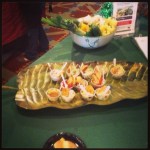






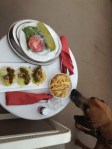

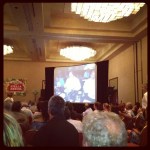



The trade show part of the even included samples, sips, and demos of many kinds of equipment, from knives to fancy stoves. There were vendors selling Nambe, candy, coffee, and even personal training. The most interesting thing I learned at the event is that our local food bank operates a culinary school that not only recycles food that would be wasted, but trains low income students to work in the food industry. This program has allowed the food bank to expand the prepared meals program in the community while training new students. I am so excited to hear about this. It has been in existence for 2 years, and this is the first time I have heard of it. I will follow up with a visit to the school, which is enrolling a new class next week.
One of my favorite vendors who installed a wood burning stove in my home is Val Romero. He owns Arizona Grill and Hearth. His company is an excellent source for all things grill, stove, and outdoor kitchen. My stove is the best upgrade I ever made to my living conditions, and the project was done with the utmost professionalism, and at a good price. He is a positive person with aloha in his attitude and fair dealing in his spirit. You will have a good time if you do business with Val.
For the first time since I was a child house calls from doctors are available to me. My insurance company just sent me a card to access doctors on the phone for $38 or less per consult. Now they are talking!!!! They sent me a notice recently to advise me that I may get a rebate under the new health care law, and I need only sit tight and wait for news of said rebate. Now they sent me cards to allow me to consult doctors without going to a creepy doctor’s office full of cooties. This is progress. I have made no attempt to understand how the new laws will work in my case. I have never taken any prescription drugs, and avoid contact with medical professionals at all costs. I have received very little in return for my premium payments for the last 12 years. I have no use for most of what they cover.
If this is Obamacare I want more of it. Nothing makes more sense to me than using our resources much more wisely in the health care business. I set up an account with the insurance company, provide medical history, and then I can request a consult. I don’t even have to go to drug store clinic;I just call or Skype. This is the most rational move I could imagine. I never trust medical doctors to diagnose correctly, which is essential for a good outcome. I would be a much happier patient if I had no mandatory wait in a room with a bunch of sick people. My experiences with my parents’ health care issues left permanent scars on my belief in doctors. I am very enthusiastic about the idea that Teledoc comes to me on my terms, and if there are pharma salesmen in the house serving tacos to the obese Teledoc office staff I will have no awareness of it.
I have been advised by Vizify that I am failing personal branding by not using my key words. I could not be more thrilled to hear this news. If there is one thing I want to avoid it is personal branding. This word counting cousin of Klout wants to publish yet another profile and share it all over the place. I have had other analytics of my public content which arrived at the conclusion that I was an expert in mangos. I am an expert in swimming and aquatic exercise, but am not intending to make all of my content prove that point.
I wanted to be a travel writer long ago when one had to actually get published by someone else. Now that I can say and do what I like when I like, I prefer to take up more than one subject. Travel still interests me, but I stay home more than I did when I was an agent in the good old days. I am a scribe, an historian, a reporter with my own beat. I sometimes write political opinions, but think it would be boring to do that regularly. I feature my ancestors, one at a time, to show my direct relationship to history. Botany is a passion, so I often photograph plants to share in this blog. I try not to create a diary of my life, but to share what I think others want to know. I am scribe at large.
I appreciate the chance to meet others and exchange thoughts and information. I have been very lucky to make the acquaintance of other family members here who have offered data about our common ancestors. That has been a happy unintended consequence of writing in public. Triberr has introduced me to a world of bloggers I enjoy reading as well as posting in my twitter stream. Our system allows us to syndicate each other through Triberr. It facilitates the flow of ideas, art, and information. I am pleased to live in a time that gives us this access to the previously closed world of publishing. I appreciate every gentle reader who reads, shares, and comments here. Thank you all for helping me fail personal branding.

Disbrow Coat of Arms
Peter Disbrow was instrumental in founding the town of Rye, New York. He and his brother ,Henry, operated a ferry to Oyster Bay.
Among these westward drifting settlers was a groupled by a Peter Disbrow who, after settling temporarily at Greenwich, led a small party still further west and settled on Manussing Island just off what was soon to be the site of the village of Rye. Just when he arrived on the island we do not know but in 1659 we find him associ-ated with his brother Henry operating a ferry between the island and Oyster Bay. And here, while it is Henry who founded our Disbrow line, let us spare a word for this Peter for he was an interesting lad. He was born in 1631 and died May 2nd, 1688 at Rye. “The successors of the Dutch West India Company in1660 were Peter Disbrow, John Coe, and Thomas Studwell.These were all residents of Greenwich at the time whenthe first Indian treaty was signed. Their leader wasPeter Disbrow, a young, intelligent, self-reliant youngman who seems to have enjoyed the thorough confidence ofhis associates; his name invariably heads the lists of the proprietors; and it is on all the treaties and declar-ations.” On January 3rd, 1660 he made a treaty with theIndians of Poningoe Neck for the purchase of that tractof land described as follows – “Lyeing on the Maine between a certain place called Rahonaness to the East and the Westchester Path to the 20 North and Southe to the Sea or Sound.” This includes the lower part of the present town of Rye on the east side of Blind Brook. On June 20th of that same year they concluded another treaty which gave them Manussing Island. With-in the next two and a half years they had acquired title to pieces of real estate that included, besides the area now covered by the towns of Rye and Harrison, much of the towns of North Castle and Bedford in New York, and Green-wich in Connecticut.
Peter Disbrow (1631 – 1688)
From The Rye Record
Rye’s Founders
– By Paul Rheingold –
Every history of Rye, including mine, starts with three Greenwich men, Thomas Studwell, John Coe and Peter Disbrow, buying Manursing Island from the Indians in 1660 and starting to farm. A fourth, John Budd, joined them a year later, buying other sections of what was to become Rye. Thanks to Bolton’s and Baird’s histories and genealogy on the Web, we know quite about the four founders.
They were not just farmers looking for new fields, but land buyers — proprietors or speculators, styling themselves “successors of the Dutch West India Company.” As their stories unfold, they emerge as three-dimensional people with families.Thomas Studwell (1600-1670), sometimes spelled Stedwell, was born in England at the family seat near Kent. Lord Say and Seal (one man, a British lord, who was sympathetic to the colonist) along with Lord Brook obtained a grant from the King to found a colony in the Connecticut area now named Saybrook. Lord Say and Seal sponsored Studwell for the grant in about 1635. In the 1650s, Studwell bought land in Greenwich and is in their town records.
He was about 60 when he bought the land on Manursing Island, signing with an “X” on the purchase from the Indians. Rye records show that he built a rude house on the island and later a more substantial home in the Mill Town area. With Coe and Disbrow, he acquired more land from the Indians on the mainland and west into what is now Harrison. By 1663, he and others began to sell land to later settlers. One deed shows the sale of a home on Mill Brook, as Blind Brook was then known.
Problems with the other Connecticut colonies arose soon after for Hastings (Rye’s original name), as reflected in documents signed by Studwell and the other two first settlers. In July 1662 they sent a declaration to the General Court in Hartford of their allegiance to that government (so long there were “holsom laws that are just and Righteous according to God and our capableness to receive”).
Baird in his usual comprehensive fashion traces the Studwell genealogy. His wife was Elizabeth, and there appear to have been three sons, one of whom, Joseph, was living in Rye in the early 1700s. In 1667, Studwell went with one son to Stamford and then to Greenwich, where he died. Much more information and the family line can be found in Marion J. Stedwell, “Steadwell, Stedwell, Studwell,” Heritage Books, 1996.
John Coe (1622-1702) was born in Suffolk, England. The family moved to America, first settling in Watertown, Mass., then Wethersfield, Conn., and finally Greenwich. In 1650, he married Hannah Jenner, and they had two children, Andrew in 1654 and Hannah in 1656.
Coe and his family lived in Stamford and sold property there in 1651, moving to Greenwich. Then, in 1659, he sold his home in Cos Cob in preparation for his new enterprise, as one genealogist put it. His name on the 1660 purchase from the Native American Shenowell and others is spelled Coo.
His original lot on Manursing Island was described as 2-3 acres on the north end of the island (now protected by a gate house). Later he is recorded as owning 14 salt meadow lots, a valuable commodity for feeding livestock. In 1663, the first three settlers, plus John Budd, now organized as a syndicate, sold the land on Manursing Island to a new syndicate, in which Coe remained as a member. Later, Coe sold land on the mainland to Hachaliah Brown, who became the progenitor of a significant Rye family. In 1672 Coe and Budd were listed as two of the 12 town proprietors.
In 1683 Coe, with others, is mentioned in an expired writ of error in the Court of Sessions, Kings County. This probably related to the litigation involving whether Rye was in New York or Connecticut. Around 1689 he is listed as living in Byram Neck. Baird reports he moved to Long Island, then under the jurisdiction of Connecticut.
Baird’s genealogy lists five sons. The eldest, also John, took over the homestead on North Manursing Island (which was then separated from the southern end by “Coe’s Ditch”). This he sold in 1668 to Stephen Sherwood and lived for a while on Grace Church Street where present-day Kirby Lane is. Baird traces the Coe family down seven generations to descendants living in and around Rye at the time of his writing, 1871.
You can learn more by reading “Robert Coe, Puritan”, John G. Bartlett, 1911.Peter Disbrow (1631-1688) (also spelled Disborough and Disbro) was born at the family seat in Essex. One ancestor was Major General Disborough. Peter came to America and in 1638 he married Sarah Knapp, who hailed from Watertown, Mass. They had six children, four of them daughters.
Although only about 30, he appears to be have been the leader of the families coming south to Rye, as his name is usually first in legal papers. Apparently he was in land negotiations with the Indians as early as January of 1660, six months before the purchase of Manursing Island. Several biographers describe Peter as an “intelligent, self-reliant young man who seems to have enjoyed the thorough confidence of his associates.”
Disbrow, along with the other three founders, sold some of the land holdings he had in Rye. In 1676 he divided up property south of the Byram River into 10-acre lots which he sold to planters. Further land sales were recorded in 1681. After the early years, Peter had a house in what was called “the Plains” area of Rye, which Baird describes as the area between Milton Road and Blind Brook, probably around Rectory Street.
It is recorded in Connecticut public records for 1681 that Peter had a disastrous fire and the General Court “doe remitt unto him his country rate for the year ensuing.”
A Disbrow genealogy is presented in Bolton, which showed many descendants, some living in Mamaroneck, as of 1848.
John Budd (1600 to 1669) has been credited with being a founder of New Haven and Southhold on Long Island as well as Rye. His house on Long Island, a National Historic Landmark and the oldest English-style building in New York State, was built in 1649 and moved 50 years ago to Cutchogue, where it is now a public museum.
Southold records for 1657 list his profession as judge. He may have moved across the Sound to Rye due to religious problems with his neighbors — Budd was a Quaker.
Born in England, Budd married Katherine Brown and came to America aboard the “Hector” in June 1637 with his wife and three children, the oldest about 20. The ship came to Boston, and then Budd and others in the party moved on to New Haven.
Budd appears in Rye in 1661 with a purchase of a large amount of land from the Indians, known thereafter as Budd’s Neck, running from the west side of Blind Brook to Mamaroneck. The deed of purchase from the Indians was later confirmed by a patent. In 1665 he became a seller of lands west of Blind Brook, which led to objections by the town proprietors. One of the later purchases was to the progenitor of the Jay family.
In Oct. 15, 1669, Budd wrote a document called a will but which today might better be described as a trust, in which he left all of his property in Rye to his son, John Budd Jr. This included the mill on the Blind Brook, where Oakland Beach Avenue crosses today. His son was obligated to pay 30 pounds a year to John and Katherine, or the survivor of the two. The payment was to be in wheat, pork and peas.
His two sons, John and Joseph, stayed in Rye. Joseph, known as Captain Budd, was prominent in town affairs, according to Baird. Their descendants were living in Rye when Baird wrote his book in 1871. For more, see Robert Bolton, Jr., “ A History of the County of Westchester,” 184 and Charles W. Baird, “History of Rye”, 1871.
Any descendants of these founders living in the Rye area are asked to come forward and participate in the programs being arranged to honor Rye’s 350th anniversary.


In 1635 My 10th great-grandfather participated in a political act in the Virginia Colony that landed him in trouble:
A Principal in the Overthrow of a Capricious Ruler
York History Series #A-5, April 1997by (the late) Dick Ivy, Honorary NMDA Member
Hearing of secret and unlawful meetings since January by some of his councilors concerning decisions of his rulership of Virginia, Governor Sir John Harvey apprehended and committed their “chief actors” William English, Nicolas Martiau and Francis Pott. On Apr. 28, 1635, the Governor’s Councilors Samuel Matthews, John Utie, Thomas Harwood, William Perry, William Farrer, William Peirce, George Menefie and Dr. John Pott came to the governor-called council meeting at his house. John Utie of Yorke’s Chiskiak Parish hit the governor hard on his shoulder and declared he was under arrest for treason. The others held him secure and told him to go back to England to answer the complaints against him. They set Martiau and others free and called for their force of 50 musketmen waiting at a short distance. On May 7, 1635, the councilors met at James Town, opened the floor to complaints, and elected Capt. John West as governor. The complaint included the giveaway to please the King of the Isle of Kent to Maryland by a willing Harvey for persecuted Catholics from England, ignoring the ownership claim by William Claiborne who was trading with the Indians here. A war ensued between forces from Maryland and Claiborne when the latter refused to become a Catholic, it is said. Martiau was granted 1,600 acres of land that year. The King reinstated Harvey and the rebels were ordered to appear at the King’s Star Court, but were never tried for an unknown reason. Finally, Harvey was recalled over another incident of poor judgment.
Capt Nicolas Martiau (1591, France-1657) & Jane Page Berkeley
Capt. Martiau [also recorded as Marlier, Martue, Martin, Martian] was a French Huguenot (in church of Threadneedle St.) from the Island of Ré. He was in the service of Henry Hastings, Earl of Huntingdon and member of the Virginia Company, and educated as a military engineer. He was naturalized as an Englishman by royal decree. He came to Jamestown aboard the “Francis Bona Venture” in 1620, legally representing the Earl to plan fortifications. He led a foray against the Indians at Falling Creek after the 1622 massacre. He joined the liberal party committed to the Virginia outlook, pleading for continuance of the House of Burgesses in 1623/4. He, with Captain George Utie and Captain Samuel Mathews, was responsible for sending the tyrant governor Harvey back to England.
There is some question about his wives. His first wife was Elizabeth, last name and date of death unknown. She was most likely the mother of Elizabeth (born 1625). Jane was the widow of Lt. Edward Berkeley, who died in 1625; they had a child named Jane. . After her death, Nicholas married Isabella, widow of Robert Felgete & George Beech, in 1646.
Martiau’s defense of the French king in an argument with Capt. Thomas Mayhew forced him to take a loyalty oath in Jamestown in 1627. He was granted 600 acres as Chiskiack, which became Yorktown (in 1644, the Cheskiack Indians were moved to the Pianketank, where they would be forced out by Augustine Warner; the tribe seems to have vanished at that point.) He served as Burgess 1632-33, and Justice for York Co. 1633-57. “He, with George Utie and Captain Samuel Matthews, sent the tyrant governor, Harvey, close prisoner back to England.” Harvey returned, bringing George Reade–Martiau’s future son-in-law–with him, but he was forced back to England again, leaving Reade as Acting Governor. Martiau moved to the present Yorktown site in 1630 on 600 acres, plus 700 for headrights, where he grew tobacco. On this land Cornwallis surrendered his troops to Martiau’s great-great-great-grandson, General George Washington in 1781. Martiau later was granted 2000 acres on the south side of the Potomac River, which he gave to Col. George Reade in 1657. (See John Baer Stoudt, Nicolas Martiau, The Adventurous Huguenot, The Military Engineers, and the Earliest American Ancestor of George Washington.)
Nicholas French Huguenot Martiau (1591 – 1657)
Martin, Marten, Martens, Martyn (French, Spanish, English) Descendant of Martinus [belonging to the god Mars, the god of war]; one who came from Martin, the name of places in Spain and France. The popularity of the name in Western Europe is due to St. Martin of Tours, the fourth century French saint.
Source: New Dictionary of American Family Names by Elsdon C. Smith, Gramercy Publishing Company, New York, 1988.
Nicolas Martiau – The Immigrant
This portion of the Family Roots and Branches is dedicated to the study of Nicolas Martiau (pronounced Mar-ti-o) and his descendants.
“The Adventurous Huguenot” and the father of Yorktown, Virginia, was born in France 1591, came to Virginia in 1620 and died in 1657 at Yorktown, Virginia. He was a Captain in the Jamestown militia during the Indian uprisings, a member of the Colonial Virginia House of Burgesses, and Justice of the County of York. In 1635 he was a leader in the thrusting out of Governor Harvey which was the first opposition to British Colonial Policy. He is the original patentee for Yorktown. He is buried at the Grace Church in Yorktown, Virginia.
Descendants of Nicolas are through his daughters, Mary (married Lt. Colonel John Scarsbrook), Sarah (married Captain William Fuller, Puritian governor of Maryland), and Elizabeth (married Lt. Col. George Reade). Nicolas is the earliest American ancestor of our first President George Washington.
Among the descendants of Nicolas Martiau we find – in addition to Washington – one Vice President of the United States, two Justices of the Supreme Court, three ministers to foreign countries, three cabinet officers, six governors of states, eight senators, eleven generals involved in the War Between the States, fifteen congressman, forty commissioned officers who served in the American Revolution,
2 of 3
2/6/13 12:24 PM
and a veritable host of men and women prominent in national life. Such names as General Thomas Nelson, a signer of the Declaration of Independance; Meriwether Lewis, explorer of Lewis and Clark fame; Duff Green; Thomas Nelson Page and Amelia Rives are of special interest.
In the early 20th century the registrar of the Colonial Dames of America in the state of Virginia contains the names of more than four hundred women who could trace their lineage to Nicolas Martiau.
Nicolas Martiau is my 15th great grandfather and one of two of my earliest American ancestors. Here is my line of descendent from that adventurous Hugenout – Nicolas Martiau:
Larry Van Horn, NMDA Member #174 (Scar(s)brook-Condon-Wills)
1. Nicolas Martiau & Jane ? (Berkley)
2. John Scar(s)brook & Mary Martiau
3. David Condon & Elizabeth Scar(s)brook
4. Elias Wills & Mary Condon
5. John Wills & Susanna Robertson
6. James Cole & Mary Wills
7. James Cole & Fanny Chisman Wills
8. Ware Oglesby & Elizabeth Dancy Cole
9. Aaron Redus & Lucy Ann Oglesby
10. James Ware Redus Jr & Leah Magee
11. Alexander Hamilton David Hurt & Mary Susan Redus 12. James Ira Hurt & Johanna Himena Schneider
13. Witt Lange Van Horn and Jeanette Iris Hurt
Nicolas Martiau Descendants – The First Six Generations
The link below is to an Adobe Acrobat PDF Descendants Chart that shows six generations of Nicolas Martiau Descendants. If you are a descendant of any of the below listed in this chart you are eligible for membership in the Nicolas Martiau Descendant Association (see below). The lines represented on this chart are lines that are accepted for membership in the NMDA. As more information is entered into our genealogy database, new charts will be placed on this website and the NMDA website. Be sure to check for these pages for future updates.
Nicolas Martiau Six Generation Descendants Chart (Adobe Acrobat format) The NMDA Lineage SocietyNicolas Martiau Descendant Association
Genealogist who can prove descend from Nicolas Martiau are eligible for membership in the Nicolas Martiau Descendant Association (NMDA). The NMDA was started in 1991. Two first cousins from California went to Yorktown to meet Dick Ivy (recently deceased), the Towne Crier and Historian, for a tour of the Martiau Family sites. One cousin fell and injured a knee, was propped up by the wall of the Grace Church cemetery. A lone man was in the mist, reading inscriptions. He paused at theColonel George Reade/Elizabeth Martiau stone, not aware of the Martiau Family buried there without a marker. This one act prompted the chain of events culminating in the first Tribute to Martiau held in 1993 and the 1997 grave marker dedication. A second Tribute was held in the Spring of 2000 and the third was held Spring 2004 in Yorktown. The cousins were Lee Yandell and Marty Dale. (Reade- Reade-Wattington).
The NMDA had over 182 members nationwide. I have the honor of serving as the National Registrar for this proud and prestigous lineage based organization. You can get more information on the NMDA by contacting me, Larry Van Horn, via email (link at bottom of this webpage) or visiting the official NMDA website at:
Nicolas Martiau Descendant Association
At this website you can download lineage and application formsin pdf format to aid you in the application process. On the website you will find selected members lineages, news, events, history and much more.
 mermaidcamp