mermaidcamp
Keeping current in wellness, in and out of the water
You can scroll the shelf using ← and → keys
You can scroll the shelf using ← and → keys
In each tree there are challenging branches. My own difficult ancestor to whom I have dedicated untold number of hours in research is Thomas Peterson. He is special because he is mentioned in the handwritten notes I had to begin my whole search. His granddaughter, Sarah Helena Byrne, wrote facts and her own opinions about family members, said he is Pennsylvania Dutch. She also mentions that his nephew, James Peterson, married my grandmother Scott after her first husband died. This seems simple enough, but I am stumped because I can’t find a record of Thomas’ birth in Indiana in 1825. His parents are alleged to be born in Pennsylvania, but I know facts were sometimes recorded incorrectly in the census. What were his parents doing way out west before the Civil War? Who were they, and where in Pennsylvania were they born? This all remains unanswered. It makes me crazy…
Thomas Peterson (1825 – ?)


I spent my school career through the 8th grade in the small town of Oakmont, PA, a suburb of Pittsburgh. This tiny, close knit (nosey) community was about the Oakmont Country Club and Edgewater Steel, and some other stuff. For kids it was paradise with millionaire robber baron neighbors providing lavish recreational opportunities. My parents were Republicans who disliked JFK and did not play golf. On one hand they were non conformist, and on the other, very concerned with image. I had a running battle with my mother for my entire grade school career about bangs, permanent waves, and white socks. These symbols of culture and control were so important to my mother that my wishes were never considered. She stuck my hair in the sink and put stinky stuff and curlers in it against my will, and with loud protest. She always cut my bangs off, mullet style. The most important symbol to Ruby Morse was the little girl’s need to wear white anklet socks. This was truly the most hated of all conditions, the white sock purgatory. Ruby Morse believed that wearing stockings was a sign of loose morals. I believed she inflicted the white socks as a crazed statement of micro management. We had deep, basic irreconcilable fashion differences.
Management of any kind was about to fly out the window when the family moved to San Tomé, Venezuela in 1963. My father became the general manager for Mene Grande ( Gulf Oil) for eastern Venezuela. This meant that I lived in a big house with servants and my father was the boss of everyone in the town where I lived. My teachers in school worked for my father, as did all my friends’ parents. Strangers constantly gave me lovely gifts, and it was obviously too hot to wear white socks. I was the lucky imperialist 13-year-old with everything. I lived in a remote place so radio was a lot less available than it had been in Pittsburgh. The strongest reliable signal came from Radio Havana. Fidel would hold forth for hours and then they played some music. Live music was everywhere. I had a harp serenade at my window by a guy who wrote the song for me. This could not have happened in Pennsylvania. Although San Tomé had a golf course, there was no other commonality with Oakmont, PA. Nothing could have been more drastic, really. I loved it, but when given the chance to choose where I would go abroad for 10th grade, I chose PA because I still thought of it as my US home. I have not visited Oakmont since 1964.
I will return to Oakmont to see some of my school friends in a couple of months. We have all traveled different paths, but mine diverged drastically and forever. I am bringing back memories and enjoying the stories that my classmates remember. Some scenes are vivid as I think of them, and some are gone. I hardly remember any of the parents. Our personalities are in tact, from what I can detect on our Facebook page. We will go and physically be in the building where we went to elementary grades together. I think it will be amazing..our own versions of what we remember. I look forward to it with great anticipation.
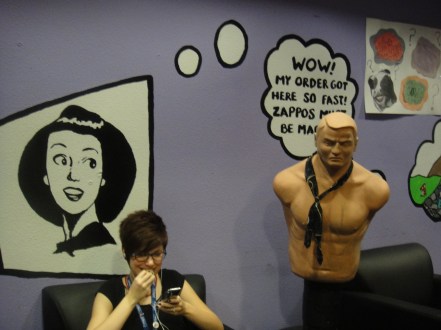
Zappos Headquarters
The 7th core value at Zappos is about team building. The social fabric of the Zappos team is strong and purposely flexible. Diversity is encouraged; self expression is made mandatory; teams tackle problems in groups. The jolly team spirit is evident in the work environment at Zappos headquarters. I think it is closer to being the happiest place on earth than Disneyland is..but that is not saying much. Family in the workplace means shared responsibility as well as camaraderie.
My specialty is teaching swimming. In order to teach the skill an environment of trust must exist. This week I had the pleasure of teaching two young ladies who are friends. They have a big age difference but get along well as friends. The right atmosphere brings out the best in everyone. The girls worked hard each day in lessons, and at the end of the week, they had their little doll family on the steps with them for a swimming lesson. They had become the teachers, inspiring the dolls with their confidence. This is how the positive team and family spirit works. It is contagious, and uplifting for everyone. Cooperation and inspiration are natural partners in business.
My 11th great-grandfather, John Taylor was one of the ten chaplains present at the Field of the Cloth of Gold. As I look at history through the perspective of my ancestors I learn details that blow my mind. Henry VIII is known even to American history students for his wives, divorces, and church business. Henry was a music fan, and imported some of my ancestors from Italy to be musicians in his court. I had never heard of this Field of Cloth of Gold, sort of a party Henry had with lavish tents and chaplains. The king of France really tripped him in the fight Henry arranged. I love this story, and am highly amused that my ancestor can be placed at the crazy Anglo-Franco party. I say let’s invite Vlad over for a topless wrestling match in DC. What do you think? Has any of you ever heard of this Field party? Those royals were just so kinky.
When I was in elementary school we had air raid drills to teach us how to protect ourselves if Russians tried to blow us up during school hours. We went out in the hall and stood against the wall with our arms against the wall wondering why Russians wanted to bomb us. The cartoon spies Boris and Natasha explained this reality to us. Fearless Leader, a thinly veiled Nikita Krushchev, was out to destroy us by sending hacks like Boris and Natasha to spy on us. The cold war was about nuclear weapons, but we had no idea what they were. We only knew they made mushroom clouds in cartoons. Maybe some of us knew about Hiroshima, but generally the big conspiracy against us remained unexplained. We shifted our national hatred from Germany to Russia after WWII, and our effort was focused on keeping communists from ruling the world. We were not alive for the Nazis but saw them in movies plenty. We had heavy brainwashing about Europe, which we also did not understand. History for us was all about the western hemisphere and manifest destiny.
The details of communism and how it operated to destroy us were vague at best. We later became aware that James Bond also recognized Russia as evil, but sometimes slept with Russian spies to gain intelligence. The plot thickened. We needed to stop communism in Viet Nam by killing people in the jungle while tripping on LSD. Things went downhill from there, even though communism and capitalism looked exactly the same on the inside. When the Soviet Union imploded it was from the same kind of corruption and propaganda that the United States is known for now. This war will be the globally warmer war, in which the stakes are higher, the cartoons more sinister. Now Fearless Leader is Vladamir Putin, and the accent still fits perfectly.
The decision to trust is a risk. Calculating risk should be a skill we develop and improve over our lives. The influence of relationships on our faith in others is central. Early betrayal can be a blessing because it can prevent deeper problems by showing true colors. Trust and the possibility of betrayal arise together. If we trust the government, or our spouse, or boss, we may find that faith has been misplaced. Few of us have the ability to accurately judge or predict the behavior of our closest companions. Being blind to imperfections is neither healthy nor honest. If we are honest we can admit our own imperfections, and our own potential to betray others. With perspective we can see how our national anger has damaged the entire society.
The rose-colored glasses version of America was a risk. The more we spun ourselves into the greatest country in the world, the more we found ourselves betrayed as a nation. The more we fought for our way of life around the world (whatever that meant), the more undesirable our way of life became. The more we declared war on everything from drugs to terror, the more ground we lost in the global trust department. Now American security is breeched on a regular basis in fairly spectacular fashion. It is lucrative, I imagine, for some, but it is becoming a badge of courage. If the seed of betrayal is trust, then it must also follow that after betrayal trust becomes mature and discerning. It is a cycle, gentle reader.

steps

flippers

stylin gear

play on steps

small group

lots of floatation

shade

deep end inspiration


watch and learn

options

facing mom
Confidence and floatation are close relatives. To swim is to move across the water, and it requires coordination and skill. To make learning both fun and effective for young swimmers they need to feel very good most of the time, and challenged to practice some of the time. I have learned from teaching hundreds of kids (and adults) to swim that the confidence it takes to control the breath is the heart of the swimming game. You honestly can’t teach breath control to tiny kids, and you would be foolish to use words like breath control or face in the water to older kids. You need to first recognize that you have completely different agendas.
Kids want to go off the diving board, do underwater flips and go touch the bottom. Very few kids care if they swim properly or master stroke technique. The ones who are fine technical swimmers usually don’t care about that at all. They just like to have fun at the pool. If a swim teacher wants to have fun at the pool that natural desire must be harnessed, never rushed. Making a drill too harsh or demands too tough can be a turn off for a shy student. It is important to alternate between what is already easy and what is yet to be learned. My new students are ideal because they already know each other. This saves much wear and tear since the girls are friends and know what to expect from each other. The older, taller ,more confident one is ready and able to inspire the younger more timid one without any showing off or ill temper. Lucky me. I am also fortunate that our young new swimmer is always in the pool with a parent, so she will not feel stranded in a new situation.
We also have the major stylin’ gear. The mermaid kick board, the floating raft, the matching pink goggles and the flippers are all worth trying. Some work better than others, and some are just there to make them feel they are real swimmers with real swimmer items. I believe in using all the tools and gear that might be helpful, but not allow the stuff to become the major focus, as it can easily with kids. It is natural and easy to switch from kick board exercises to floating to practicing bubbles while walking across the pool. One activity or tool does not become stale when you move through the lesson offering enough variety. Know that they only want to learn enough to swim away, so provide a safe setting in which they can do that. Keep it light because, after all, floating is all about trust and ease.
We have been liberated from long boring presentations we don’t watch anyhow. The new 15 second rule is not about food that has been on the floor. It is about editing. If you can’t express your idea in 15 seconds, you need editing. Instagram has met the public where their attention span is. It is a fun , effortless way to find if you really have content or if you are just taking up digital space. Artemisia, coon hound, was keen to try it out to portray her content.
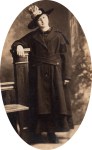
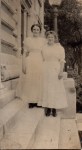

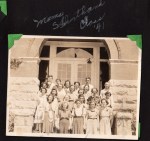


My grandmother, Olga Scott Morse, was a teacher of business skills. She graduated with her masters in education after she had four kids. She left them at home on the oil lease with their dad during the week to attend classes at Oklahoma State University. I believe that in the 1930s this was a bold feminist move. After graduation from OSU she taught typing and shorthand at a junior college near their home in Tonkawa,OK. Learning to type was a bold femenist move, believe it or not. Her students learned shorthand and typing and other current secretarial skills. The school to day is called Northern Oklahoma College. I stopped at the campus when I went to Oklahoma on an ancestry hunt a few years ago. I found her name in an old yearbook in the library, which was fun. I also looked through a lot of photos from the history of the school, where my dad and his brothers were students, but I did not find them. I walked around on campus, taking a break in my drive. Later, I found a picture of her with her students in the 1930’s in front of the central building at my uncle’s house in Wichita. I easily recognized the building since I had just been there.
Her mother, Sarah Helena Byrne, was a teacher and her great-grandfather , Amos Nichols,was also. My father was a university professor. The teacher archetype is all over my father’s family. I wonder if this is a DNA situation or all the reading and discipline that teachers represent. She was a farmer when I met her, having long since retired, but I remember her typewriter on the farm that had black keys..no letters. She could wail on that thing, but she had little reason to to so. I asked her to because I liked to watch her do it. She was a woman of many skills and talents, including flower and vegetable gardening. Most of the fruits and vegetables we ate in the winter in Pittsburgh were grown on my grandparents’ farm in Arkansas and frozen. I picture her in a sun bonnet, like all her friends wore, on the farm. Visiting the college where she taught before I was born was a really cool experience that showed me a part of her I never knew. For her day and place she was super highly educated and accomplished.
Olga Fern Scott (1897 – 1968)

British flag
Hannah Mead was widowed in England before she sailed to America. She arrived in Boston in 1637 with her son Isaac:
John BEECHER was born on 28 Mar 1594 in Kent, England. He died in 1637/38 in New Haven, Connecticut. He immigrated on 26 Jun 1637 to Boston Harbor. Arrived April 26, 1637 from Steldhurst County, Kent, England. In Governor Eaton’s Company. The first Beecher to reach New England was John Beecher, who came from Kent, England in 1637. He was in the company led by Rev. John Davenport and Theophilus Eaton who had been the Ambassador to Denmark and Deputy-Governor of India. The company crossed the ocean on the “Hector” and another sister-ship. These two ships, after a two month voyage, dropped anchor in Boston harbor. The company consisted of 50 men and 200 women and children and was the most prosperous that ever arrived in New England. Unfortunately, they landed in the midst of a quarrel about Anne Hutchinson who had set herself up as a preacher, irregardless of her sex. Not wishing to become involved, they sent out a scouting party to find another location to settle. They decided upon Quinnipiack on the Long Island Sound, the site of present day New Haven, Conn. The party built a hut and left seven of their men to hold the post for the winter and to prepare for the arrival of the rest of the company in the spring. John Beecher was one of the seven and he failed to survive the winter. Hannah arrived in the spring with her son Isaac and found her husband in an unmarked grave. Since she was the only midwife among them, and thus relied upon by the others in the company, she was given her husband’s allotment of land for herself and her son Isaac. One hundred and twelve years later, in 1750, when David Beecher was a boy of twelve, workmen who were digging a cellar for a house at the corner of George and Meadow Streets in New Haven came upon human bones, believed to be those of John Beecher.
(43) Hannah Beecher sailed from England with her son Isaac and was a widow at the time she left England. Husband John Beecher, one of the seven whom Eaton sent to New Haven in advance of the colony ,died before the colony arrived. He did not survive the first winter. It is established that this ship load of people was rather wealthy landowners from Steldhurst County, Kent, England. Since the company was rather young, it was felt that Hannah’s services of midwife would be greatly needed. She therefore was offered her husband’s land right in the new world if she would agree to go and fulfill this need, which she did. ——————————————————————————The will of Hannah Beecher was proved April 5, 1659 and is recorded in first part, vol i., p 80 of New Haven Probate Records as follows: “I Hannah Beecher of New Haven, expectying my great change do make this my last will and testament, I bequeath my soul unto the hands of my Lord Jesus Christ by whose meritt I hope to be saved and my body to be burried at the discretion of my Son William Potter my Executor. And for my worldly goods I give unto John Potter my Grand child twenty shillings and to Hannah Blackly, my Grand child twenty shillings to be paid to them within three months after my decease. And for the rest of my estate I give one third part to my son Isaac Beecher and two thirds to my eldest son William Potter, making him my Executor, desiring him to be as a father to his younger brother and his children. And in dividing my goods my will is that my son William should have my feather bed with that belongeth to it, unto his part and that the rest be divided at the discretion of my Overseers with the assistance of Sister Wakeman and sister Rutherford and I desire my loving friends Mr Mathew Gilbert and Job Wakeman to be overseers of this my last will whereunto I have set my hand this 13th day of June, Anno 1657. Witnesses, the mark of Mathew Gilbert, Hannah Becher John Wakeman, Sarah Rutherford. This source also indicates that the inventory of Hannah’s estate following her death in 1659 amounted to 55 pounds, 5 shillings, and 6d. ——————————Hannah (Potter) Beecher appears in early New Haven as a widow with sons: John Potter, William Potter, and Isaac Beecher. She has been considered to be the mother of Isaac Beecher, for she calls him her son in her will and gave him one third of her property, but recent investigations (source unproven ) suggest that Isaac was a step son, the son of her second husband by a former wife. SEE NOTE ON ISAAC BEECHER ENTRY. ————————————————– Note: There was in New Haven, says G.F. Tuttle, as early as 1641, a widow Hannah Potter, known as widow Potter the midwife. In 1643 she had two persons in the family, thirty pounds estate and twenty and one quarter acres of land. She is called “sister Potter the midwife,” in seating the meeting house in 1646. She is supposed to have been akin to the other Potters, but there is no record to show it. She has often been confounded with the widow Hannah Beecher, but the records clearly show that they were two different persons. ————————————————— Per “Families of Ancient New Haven”
Hannah Mead (1584 – 1659)
is my 10th great grandmother
William Potter (1608 – 1684)
son of Hannah Mead
Hannah Potter (1636 – 1700)
daughter of William Potter
Benjamin Mead (1666 – 1746)
son of Hannah Potter
Mary Mead (1724 – 1787)
daughter of Benjamin Mead
Abner Mead (1749 – 1810)
son of Mary Mead
Martha Mead (1784 – 1860)
daughter of Abner Mead
Abner Morse (1808 – 1838)
son of Martha Mead
Daniel Rowland Morse (1838 – 1910)
son of Abner Morse
Jason A Morse (1862 – 1932)
son of Daniel Rowland Morse
Ernest Abner Morse (1890 – 1965)
son of Jason A Morse
Richard Arden Morse (1920 – 2004)
son of Ernest Abner Morse
Pamela Morse
I am the daughter of Richard Arden Morse
The question of Hannah’s parents is not fully resolved:
Mrs. BEECHER was voted a portion of land by the New Haven colony for her services as physician and midwife. The land remained in the BEECHER family until 1879. The New Haven Hospital, built in the late 1800s stood on part of it, about a half mile west of the old Green.
SURNAME CONFUSION
One researcher has Hannah’s surname as BEECHER. But it is clear that she married a BEECHER, and I think someone confused BEECHER as her surname. I believe that Hannah was a MEAD who married a POTTER before BEECHER.
But another source claims she was Ann/Hannah LANGFORD. This Hannah was also born in Kent, ENG. But she died FEB 1658 in New Haven, New Haven, Connecticut, USA. (I need to determine which was the right Hannah. They were both listed as midwives.
Hannah was widowed in England and married a second time there. She is believed to have married John Beecher who was a member of the advance party which was sent to prepare for the settling of New Haven, CT. John died in New Haven before the arrival of the colony. The well known Beecher family (Henry Ward Beecher and Harriet Beecher Stowe, being two of the clan) descend from Hannah’s son Isaac Beecher.
 mermaidcamp