mermaidcamp
Keeping current in wellness, in and out of the water
You can scroll the shelf using ← and → keys
You can scroll the shelf using ← and → keys
The Avenger character is a masked marvel. Crusades for righteousness and fairness are the territory of this archetype. Comic book characters and super heroes use the avenger character to tell stories about balancing the scales of justice . The obvious shadow attribute the avenger can possess is the willingness to use violence to defend a cause. Frequently we see the misguided avenger on the loose; That is called the loose cannon because the lack of control is too obvious. They may be warriors or politicians, but their primary motive is to represent causes for the sake of others. They are aggressive.
Religious zealots in history have often convinced others to seek revenge or fight a holy war. Terrorism and family feuds are examples of avengers gone bad. When nations or political factions square off to avenge some perceived wrong this is the archetype in control. When the Republicans and the Democrats cut off all their noses to spite all their faces they are doing it because they believe they are finding vengeance. They tell the taxpayers they are fighting for us, but they are isolated in their own cartoon, unaware of the roles they play in our big drama. They fight because they feel entitled, and because we have allowed them to become so extreme. Their capes and masks must be recalled.

avenger card
Each of us has a child archetype within our psyche. Carolyn Myss outlines six kinds of archetypal children. They are:
The eternal child has an attachment to youth and immaturity. The positive eternal child is the stuff that ads are made of, enthusiastic, fresh and free. The shadow eternal child has a resistance to responsibility and rejection of the aging process. The need to stay youthful may lead to extreme dependence on others for security. The puer aeternus is a man who never accepts responsibility. He is frequently a character in fiction, and sadly appears often in real life. Peter Pan is a modern eternal youth story with Tinkerbell playing the puella aeterna. Clinging to youth can prevent one from reaching the full range of emotions and insights. Youthful enthusiasm and a willingness to make fresh starts are the positive aspects of this child persona. Adults who are consistently unreliable or dependent on others reflect the worst aspects of the eternal child.
 Peter Pan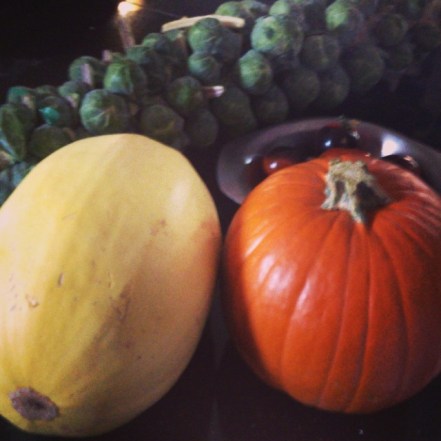
healthy food
The way words are used has a big effect on culture and expectations. The words health care have come to mean prescription drugs and medical procedures. Wellness has come to mean any kind of body work, cleanse, or restrictive diet. What is even more debilitating to the public health is that insurance policies determine the care most people use. There is abuse on both sides, by wellness quacks and medical losers. Wellness or health coaches are essentially practicing counseling in everything from nutrition to psychiatry. The unhealthy American population is vulnerable and guilty, willing to jump to all kinds of conclusions, buying into all kinds of cures and programs. The market is so crowded the consumer has been confused by all the possibilities. Now the public will need to understand how health insurance functions. This is a giant leap for the citizens, a shock to the system.
I made a living teaching and promoting health and wellness through water for many years. I have enjoyed waters and spas all over the world and had the pleasure of teaching many wonderful students. I have a strong healthy body that I treat to the best food and body work I can afford to give it. Since I love movement, I move. I don’t take any prescription drugs; my plan is to avoid them. The reasons I am keeping my insurance policy as it is, and not vexing myself trying to read all the options are:
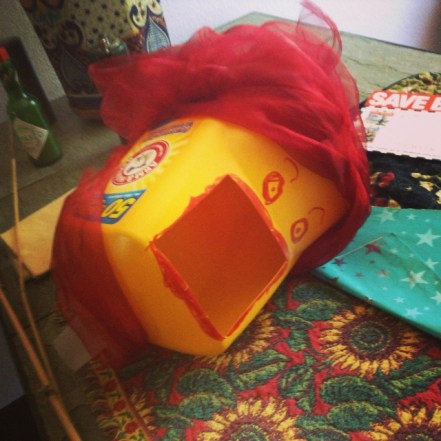
message for dog owners
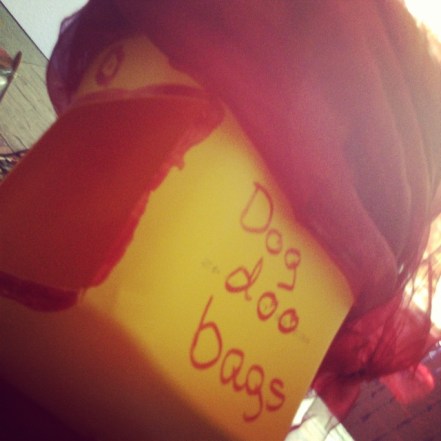
practical design
Our midtown Tucson neighborhood has pride of ownership issues. The landlords are not prone to take care of rental properties and the residents have become used to a very low level of environmental pride. Tagging of gang signs is chronic and dog owners leave waste behind everywhere. Doolen-Fruitvale Neighborhood, or DooFru for short, has an elementary school, an art college, and a Boys and Girls Club all adjacent to each other. I am asking the kids interested in art and design to enter a competition. The DooFru Design Derby will be an annual competition to design the best small enhancement to our neighborhood environment. We want to create a positive artful outlet that says we care about the space in which we live. We don’t have a place for mural art or sculpture, but we can do small, individual projects that make a difference.
This year we are designing dog doo bag dispensers out of used plastic containers. When filled with plastic bags, they not only remind dog owners to do the right thing, but provide the means with which to do it. Some other neighborhoods have employed the bag dispensers with great success. I walk my dog in one of these adjoining areas and have noticed a big improvement in the waste problem since they put up the bag dispensers. We hope by involving kids and art we will have an even bigger impact to create a cleaner and more well cared for environment. The kids from Boys and Girls Club have joined in many neighborhood clean up efforts, only to see the same trashy behavior arise. I believe they can have a bigger influence than adults if they sincerely take on the #DooFrudumpsdogdoo initiative. They can shame the adults and set a standard of awareness simply by making art for the good of the neighborhood. My own design is designed to give the idea to the kids, but definitely not to win the derby. My #DooFrudumpsdogdoo lady is a neighborhood spokesperson in need of kids’ art.
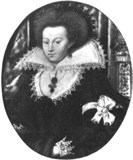
Elizabeth Whitbread
My 11th great-grandmother married into the Spencer family. Her son Gerard went to America.
Gerard Spencer, baptized at Stotfold, co. Bedford, 20 May 1576, died before 1646; married at Upper Gravenhurst, co., Alice Whitbread or Whitbred, who belonged to a family of some prominence. It seems quite possible that Gerard and his family moved from Stotfold some years before the emigration of his sons to New England; perhaps to London, where his brother Richard had become a prosperous haberdasher.
The English surname of “Spencer” derives from the Latin word dispensator, which means a storekeeper or shopkeeper. In medieval times, a feudal lord would employ a dispensator to have charge of his possessions and to oversee distribution and sale of supplies to the serfs, peasants, and tenant farmers who worked his land. In essence, a dispensator was something like a steward. This Latin term gave rise to the occupational family names of “Dispenser,” “Spencer,” “Spenser,” “Spence,” “Spens,” “Spender,” etc. Since there must have been thousands of dispensatori, there are naturally a large number of unrelated Spencer families. Even though he was the servant of a feudal lord or a king, a dispensator often himself would be of noble or knightly rank. The two best known medieval English families bearing a form of this surname were the Dispensers, Earls of Winchester, and the Spencers of Althorp, Northamptonshire, ancestors of the present Earls Spencer, who were the family of the late Diana, Princess of Wales, formerly known as Lady Diana Spencer. The Earls Spencer are also closely related to the Spencer-Churchill family, which includes the famous British Prime Minister Sir Winston Spencer-Churchill. During the Renaissance, an unscrupulous herald manufactured a spurious genealogy tracing the Spencers of Althorp back to the Dispensers of Winchester, but that fictitious genealogy was long ago debunked — there is no proof nor any reason to believe that the Spencers of Althorp had anything to do with the old Earls of Winchester.
Elizabeth Whitbread (1538 – 1599)
is my 11th great grandmother
Thomas Spencer (1571 – 1631)
son of Elizabeth Whitbread
Thomas Spencer (1596 – 1681)
son of Thomas Spencer
Margaret SPENCER (1633 – 1670)
daughter of Thomas Spencer
Moses Goodwin (1660 – 1726)
son of Margaret SPENCER
Martha Goodwin (1693 – 1769)
daughter of Moses Goodwin
Grace Raiford (1725 – 1778)
daughter of Martha Goodwin
Sarah Hirons (1751 – 1817)
daughter of Grace Raiford
John Nimrod Taylor (1770 – 1816)
son of Sarah Hirons
John Samuel Taylor (1798 – 1873)
son of John Nimrod Taylor
William Ellison Taylor (1839 – 1918)
son of John Samuel Taylor
George Harvey Taylor (1884 – 1941)
son of William Ellison Taylor
Ruby Lee Taylor (1922 – 2008)
daughter of George Harvey Taylor
Pamela Morse
I am the daughter of Ruby Lee Taylor
6. Gerald Spencer 3 (Michael S.2, John1) was baptized on 20 Apr 1576 in Stotfold, Bedfordshire, Eng 3 and died before May 1646 in Stotfold, Bedfordshire, Eng 1.
Documented events in his life were:
1. Mention in Will, Inv. or Prob.; 17 Mar 1644/45; London, Eng 3. Cited as the father of Jarrard, Thomas, Michaell Spencer who each received �50 in the will of their uncle Richard Spencer. Also father of William Spencer, deceased, with the legacy going to William’s children.
Gerald married Alice Whitebread 1 5, daughter of John Lawrence Whitebread and Eleanor Radcliffe, in Upper Gravenhurst, Bedford, England 1. (Alice Whitebread was born between 1578-1583 in Bedfordshire, Eng 1 5 and died about 1646 in Stotfold, Bedfordshire, Eng 1.)
Children from this marriage were:
+ 15 M i. Ensign Gerard Spencer 1 2 3 was baptized on 25 Apr 1614 in Stotfold, Bedfordshire, Eng 3 and died on 29 Jun 1685 in East Haddam, Middlesex Co., CT 1.
16 M ii. William Spencer 1 3 was baptized on 11 Oct 1601 in Stotfold, Bedfordshire, Eng 3 and died on 4 May 1640 in Hartford, Hartford Co., CT 1.
Documented events in his life were:
1. Mention in Will, Inv. or Prob.; Bef 20 Nov 1628; Upper Gravenhurst, Bedford, England 5. Received legacy in the will of his grandmother Eleanor (Radcliffe) Whitebread.
2. Residence; Bef 7 Jan 1632/33; Cambridge, Suffolk Co., MA 6. William Spencer is listed as an Inhabitant � no date given. but probably before the 7 Jan 1632 date given to items on p 4
3. Lands Recorded – Granted; 7 Jan 1632/33; Cambridge, Suffolk Co., MA 7. Common Pales devided as ffollo:– William Spencer 12 Rod
4. Lands Recorded – Granted; 2 Mar 1632/33; Cambridge, Suffolk Co., MA 8. Granted William Spencer the fwampe on the other fide the Creeke.
5. Oath of Freemanship/Allegiance; 4 Mar 1632/33; Massachusetts Bay Colony, MA 9.
6. Lands Recorded – Granted; 5 Aug 1633; Cambridge, Suffolk Co., MA 10. Lotts granted for Cowyardes:– William Spencer 3 Roods
7. Town Office; 3 Feb 1633/34; Cambridge, Suffolk Co., MA 11. James Olmfted & William Spencer chosen as two of the five men to order business for the town.
8. Town Service; 1 Sep 1634; Cambridge, Suffolk Co., MA 12. ffurther it is ordered that George St^ [ ] William Spencer fhall measuer out al^ [ ] ^ranted by the Towne and have IIId the Ac^ [ ] [ ] fame.
9. Lands Recorded – Granted; 1 Dec 1634; Cambridge, Suffolk Co., MA 13. Granted William Spencer that Corner of ground by Jofeph Myats between the Swamps to bee fett out by John Haynes Efqr.
10. Town Service; 3 Feb 1634/35; Cambridge, Suffolk Co., MA 14. chosen to survey town lands: James Olmfted & William Spencer [plus 3 others]
11. Town Service; 8 Feb 1634/35; Cambridge, Suffolk Co., MA 15. Townsmen present at the town meeting:– William Spencer.
12. Town Service; 20 Aug 1635; Cambridge, Suffolk Co., MA 16. It was ordered that William Spencer and George Steele fould meafuer all the meaddow ground and undeuided belonging to the Newtowne: and when it is Meafuered and deuided to euery man his proportcion there are to: meafuer every mans feuerally and Caufe ftakes to bee fett at each end and to haue three pence the Acker for the fame and whofoever fhall not pay for the meafueringe within one yeare then the ground to returne to them for meafueringe.
13. Lands Recorded – Granted; 20 Aug 1635; Cambridge, Suffolk Co., MA 16. ffurrther it is ordered that the fame [the meaddow ground and undeuided belonging to the Newtowne] fhalbee deuided acordinge to every mans seuerall proporcion herevnder written vntell it bee all difpoffed of viz:– William Andrews 2�
14. Town Office; 23 Nov 1635; Cambridge, Suffolk Co., MA 17. William Spencer chosen one of the nine men to �order busffiness of the whole Towne for the year following� also ordered that the Towne booke fhalbee at William Spencers house.
15. Town Service; 7 Dec 1635; Cambridge, Suffolk Co., MA 18. Townsmen present at the town meeting:– William Spencer. William Spencer & Mr. Bambrigg to view the fence about the ground between the swamps [to be erected by land holders] and decide if it is sufficient.
16. Town Service; 4 Jan 1635/36; Cambridge, Suffolk Co., MA 19. Townsmen present at the town meeting:– William Spencer. William Spencer & Thomas Hofmer charged with seeing that a foot bridge is built over the Creek at the end of Spring street
17. Lands Recorded; 8 Feb 1635/36; Cambridge, Suffolk Co., MA20. The Names of Thofe men who haue houfes in the Towne at this prefent as onely are to be acconted as houfes of the Towne:– William Spencer – 2; also in the Weftend:– William Spencer – 2
18. Mention in Will, Inv. or Prob.; 17 Mar 1644/45; London, Eng 3. His children received a legacy in the will of his uncle Richard Spencer of London, England.
19. Probate; 24 Jun 1650; Hartford, Hartford Co., CT 21. This Courte taking into Consideracon the estate of William Spencer deceased with the Information of the ourseers In the presence of Thomas Spencer Brother to the said William, iwth the Consent of the wife of William Edwards: the doe Judge that 30� is as much as the estate heere will bare to be sequestred for the use of the Children, wch is to bee paid to them according tot he will of the said William Spencer, provided that suffitient security bee giuen in to the Satisfaction of the ourseers for the payment of the debts of the said William Spencer, and the aforesaid Sum of 30� to the said Children as aforesaid: And prouided allso that whatsoeuer Shall bee paid heere or in England of any Estate due to the wife of the said William Spencer while Shee was the wife of William Spencer, or that Shall Come from Concord: two thirds thereof Shall be and remaine to the propper vse of the Children aforesaid.
Watching the US congressional dramatists perform for the nation I wonder how these folks make contact with reality. Systems thinking, or connessione provides a holistic, integrated, well proportioned view. The interests of many networks can be connected for the good of the entire system. Our congressional employees seem stuck on the idea that hostile, unproductive bickering is what the taxpayers deserve. Fractured care for our precious resources is eroding the national confidence. Rather than forming natural helpful alliances bills are created with purposeful conflicts of interests from the get go. It looks as if these representatives of the people are on some kind of very bad bummer trip, unable to view any kind of broad picture for fear of heavy freak out. They use their imaginations and creativity to whip up disharmony rather than working to connect the whole.
How can we use our own creativity as taxpayers to force these clowns to get it together on behalf of the American people? Can we imagine them working for us rather than wasting our money? I find that difficult. In the season of Halloween let us consult history and the ancestors to learn from the past. How did our ancestors off insane rulers? There have been plenty of them. We must connect the dots to understand the deep lessons history teaches. We must find the strength and the will to create a congress that works for us. We are capable of balance, even if we are not witnessing it in our elected officials.
The trickster is a character popular in many ancient mythical stories. This archetype pranks us and fools us in various ways. Like all of the Sacred Contracts, our interactions with this particular role will continue until we finally recognize the trick. The joke may be on us, or we may be the joker in the case. Good natured pranking can be done in a kind spirit; Often the dark side of the trickster misleads and harms the easily duped. When the joke is recognized as a dark misdeed the trickster is usually nowhere to be found.
I can see a pattern in my life of believing in financial tricksters. I did not carefully identify or assess risk to my own finances in my youth. I was a hedonist on a roll with no fear of failure. Even now when I believe I have done careful due diligence and consideration I am too lenient and trusting of others. While I don’t think anyone has been out to get me financially, I could have been surrounded with more trustworthy and helpful folks in my early years. The very good news is that I have become more cautious. I investigate potential partnerships and investments with much more vigor than I did in the past. I have some residual financial damage that keeps me vigilant today for any possible tricksters at work in my life. I hope I am all done with them. I can’t afford to be around them. If you have been tricked by tricksters were they stealing love, money, security, or all of the above?

memorial
My 10th great-grandfather was a carpenter who agreed to go to Maine in 1634 to stay for 5 years. He agreed to build a sawmill, a gristmill, and tenement houses for his employer, John Mason.
As extracted from Everett S. Stackpole’s “The First Permanent Settlement in Maine’
In 1634 there was an important development of the colony. Carpenters and millwrights were sent over from England in the Pied Cow, led by William Chadbourne, to build a sawmill and a “stamping mill” at the upper falls. This was the first grist-mill in New England to run by water, though Boston had a wind-mill to grind corn, and Piscataqua sent a small shipload there to be ground, James Wall was one of the carpenters and he made a deposition the 21st of the third month, 1652.
William CHADBOURNE (1582 – 1652)
is my 10th great grandfather
Patience Chadbourne (1612 – 1683)
daughter of William CHADBOURNE
Margaret SPENCER (1633 – 1670)
daughter of Patience Chadbourne
Moses Goodwin (1660 – 1726)
son of Margaret SPENCER
Martha Goodwin (1693 – 1769)
daughter of Moses Goodwin
Grace Raiford (1725 – 1778)
daughter of Martha Goodwin
Sarah Hirons (1751 – 1817)
daughter of Grace Raiford
John Nimrod Taylor (1770 – 1816)
son of Sarah Hirons
John Samuel Taylor (1798 – 1873)
son of John Nimrod Taylor
William Ellison Taylor (1839 – 1918)
son of John Samuel Taylor
George Harvey Taylor (1884 – 1941)
son of William Ellison Taylor
Ruby Lee Taylor (1922 – 2008)
daughter of George Harvey Taylor
Pamela Morse
I am the daughter of Ruby Lee Taylor
1. WILLIAM1 CHADBOURNE (RobertA), baptized Church of St Editha, Tamworth, Warwickshire, England 30 Mar 1582 (Tamworth parish register); died after his last appearance in Maine 16 Nov 1652 (qv); married Tamworth 8 Oct 1609 (ibid)ELIZABETH SPARRY, born perhaps about 1589, died after 1 Jun 1623 (birth of her last known child, Tamworth parish register). Her parentage has not been discovered; however, her surname is common in Staffordshire. William was the son of Robert and Margery or Margaret (Dooley) Chadbourne of Preston, Lancashire, and Tamworth, Warwickshire, England.
William arrived in New England aboard the Pied Cow 8 Jul 1634 (vide post) with James Wall and John Goddard. The three were under contract with Capt John Mason of London’s Laconia Company, a joint-stock company seeking profits in the new world. The purpose of the contract, dated 16 Mar 1633/4, was to build mills in Berwick. William was referred to as a housewright or master carpenter. The men began to build the first water-powered saw mill and grist mill in New England on 22 Jul 1634.
James Wall, carpenter and millwright, deposed on 21 May 1652 that about the year 1634 he and his partners William Chadbourne and John Goddard, carpenters, came over to Mason’s land on his account and their own, that Mr [Henry] Joslyn, Mason’s agent, brought them to certain lands at Asbenbedick Falls, as the Indians called the place, later the Great Works River in Berwick, where they carried on a sawmill and a stamping mill for corn three or four years. Wall built a house there and Chadbourne built another (Pope, The Pioneers of Maine and New Hampshire, 1623 to 1660, 218-19).
The house William built may be the one said by Stackpole in 1926 to be the oldest house in Maine. Part of its foundation is under the present house on the northwest corner of Brattle and Vine Streets on the road from the Lower Landing (Hamilton House) to the original mill site at Asbenbedick (later Great Works) Falls. William Chadbourne deeded the home to his son-in-law, Thomas Spencer, and a nice picture of it appeared in the Boston Evening Transcript of 25 Jun 1938. Other accounts suggest that the property occupied by Spencer was actually a second, later house, and that the early home stood in the northwesterly angle of the intersection of Brattle Street leading to the mouth of the Great Works River and the highway to Eliot.
The Asbenbedick Great Works was the site of a mill with nineteen saws built by the Leader brothers in the 1650s. The river was called Chadbournes River by many before and after, due to the Chadbourne dam and mill erected downstream in the late 1630s.
A copy of the Mason contract referred to above survives in the MA Archives 3:437. It stipulates that they were to stay five years and receive three fourths of the profits from the mills and own three fourths of the houses, which Mason was to furnish. At the termination of the contract they were to have fifty acres on lease for the term of “three lives” at the annual rent of three bushels of corn.
The articles brought on the vessel, which were taken from the company’s store were: one great iron kettle, for which Thomas Spencer was responsible, Irish blankets, one Kilkenny rug, one pair of sheets, one pentado coverlet, one brass kettle and seven spoons.
It is not clear when other members of William’s family arrived. His daughter Patience may have preceded him, since her husband Thomas Spencer came four years earlier and they may have had children between 1630 and 1634. Mason’s list of stewards and workmen sent contains the names “William Chadborn, William Chadborn, jun., and Humphry Chadborn,” but also indicates twenty-two women who are unnamed. It is known that the Pied Cow had made at least one crossing in 1631 and that the bark Warwick had made several early crossings, all for Capt Mason, but it is unlikely that William came on any of these trips, given the phrasing of Wall’s deposition which implies that he came in about 1634 (NEHGR 21:223-4).
Elizabeth is mentioned only in the couple’s marriage record. It is not known when or where she died. She may have come to Maine, for there is no burial record for her in Tamworth; however, no account of her has been found in the New World. Some have conjectured that William may have returned to England after deeding his Berwick homestead to son-in-law Thomas Spencer. No record of William’s death has been located in England or Maine.
In 1640, he and his sons were listed as NH residents (NHPP, Vol 1) before purchasing land in Kittery in those regions now called S Berwick and Eliot. Both William Sr and William Jr were in Boston in 1643 (LND, 134).
The Chadbournes, like the other people brought to ME by Mason, were not dissenters from the Church of England, emigrating for religious freedom, as was the case with most of the settlers in New England in this period. William’s father Robert, raised Catholic, professed to fear God as his reason for not attending the Church of England; but William’s family were members of the Church of England who perhaps intended to return to England after the terms of Mason’s contract were fulfilled. Indeed, that may be what William and Elizabeth Chadbourne did.
William Chadbourne, as a respected master carpenter and housewright, may have been contracted to build the so-called Great House at Strawbery Banke (now Portsmouth NH) used to house the Laconia Company’s stores and serve as a dwelling for the company workmen. The site of this building has recently been found, near the present Stawbery Banke village historic site. Claims have been made in published sources that the Great House was built by William’s son Humphrey circa 1631. Humphrey was said to have come on the Warwick in 1631, and no evidence has been found of William’s arrival before 1634. An error could have occurred because of a poorly-written paragraph in James Sullivan’s book, The History of the District of Maine , published in Boston MA in 1795, where William1, who built the Great House, and Humprhey2, who purchased land fromMr Rowles, are rolled into one. If Humphrey was baptized as an infant in 1615 he would have been sixteen at the time the Great House was built. He may very well have worked on it, although it is more likely that his father was given the contract for its building. The contract hasn’t survived and which of the Chadbournes was responsible for the building remains conjecture.
One William Chadbourne was admitted an inhabitant to the town of Portsmouth RI 25 February 1642[/3] (The Early Records of the Town of Portsmouth, Providence RI: The RI Historical Society, 1901, 19). He was granted land there in 1642 (ibid, 11), but the grant was not finalized, and it is doubtful he ever resided there. He was certainly gone by 28 Sep 1647 (ibid, 36). This may have been another William Chadbourne who is known to have come from Winchcombe (see discussion on this man in the Appendix).
On 3 Mar 1650/1, William and his sons, with others, were accused by Mrs Ann (Green) Mason, widow of Capt John Mason, of embezzling her husband’s estate. The claim was based on a contract which was not honored by either party because of the death of Capt Mason, and also based on the first recorded Indian deed in ME in 1643. The Chadbourne claim was upheld by the selectmen of Kittery and the Government of the Massachusetts Bay in New England.
On 4 May 1652, William Chadbourne was one of the chosen men assigned to a Kittery committee to pick a lot and build a meeting house. He was the first signer of the Kittery Act of Submission, 16 November 1652. We have no certain record of William after this date.
Does the fall equinox have special meaning to you? Native people around the world have marked and celebrated the night that is equal in northern and southern hemispheres in spring and fall for centuries. The balance of darkness and light, the nature of shadow, the harvest of what has been sown are celebrated at this powerful change of seasons. To enter winter with excess overhead or an insufficient supply has been a recipe for disaster since the first fairy tale was created. In both short and long terms fall is a time for risk assessment. The harvest is in, or soon will be, and it must last until new crops can be grown and harvested. Failure can mean starvation. Useless baggage must be jettisoned now to keep the boat afloat.
Today our supplies come from abroad and we don’t even know when and how harvests are made. Coal, natural gas, and petroleum are harvested to process, transport and refrigerate our food. The cost of the supply chain far outweighs the cost of the food itself. Our electronic devices are similar. They are harvested elsewhere and imported to us. Globalization demands that goods and services be produced at the lowest price and sold for the highest possible price. International business must take advantage of the lowest wages and least demanding labor forces. I believe that these imperialistic practices have caused a spiritual equinox. Forces that seem to be out of our control darken the skies and freeze out those with the fewest resources. Persephone returns to her husband Hades in the underworld every year as winter approaches. Her symbolic return in the spring celebrates light over darkness. As the days grow shorter and nights grow longer what seeds will you purposely germinate? Do you believe the violence and darkness being proliferated will be reversed?

fall color

change of season
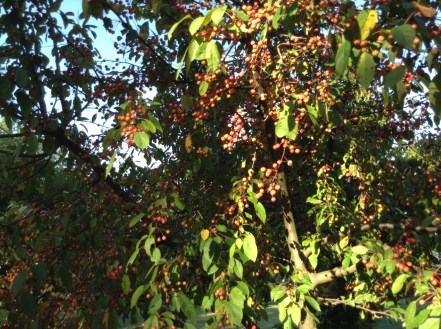
Autumn
I am afraid of the mix of media and social media consumed by the population in 2013. There are distractions of all shapes and sizes. Being over busy overbooked and overly self centered is a modern sign of success. Emotional wellbeing of average people has been sinking while stability slips out of sight. The youth will use technology in ways that are modeled by the adults they see. When parents and other adults lead the way to digital detox younger people may also consider life outside the smartphone.
I think the point Louis C.K. makes in this video about emotional range of motion is key. His claim that smartphone distraction is avoidance of fully feeling sadness or happiness in favor of a phone buzz strikes me as a valid observation. It is impossible to be engaged in meditation and smart phone love at the same time. Some feel the attachment to the full time companion, Phoney, is destroying social skills. I agree, but the strongest argument for limiting time and energy with Phoney is productivity. Phoney is there to procrastinate with you, to deny reality and to take you away from all the pending doom. It can never make you feel truly happy, but it does kill time.
Digital detox has entered the dictionary and folks are in treatment for FOMO ( fear of missing out). This is perhaps the most ironic of all conditions…to abandon real life with no fear of missing reality in favor of never missing out on the ability to respond to a phone. Do you know anyone who is in need of intervention for this tragic ailment? I do, but would not know where or how to begin.
 mermaidcamp