mermaidcamp
Keeping current in wellness, in and out of the water
You can scroll the shelf using ← and → keys
You can scroll the shelf using ← and → keys
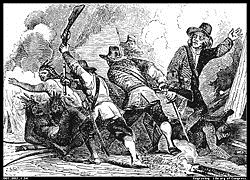
Pequot War 1637-1638
Thomas Redding was an early settler of Maine. He and his wife left a five year old child in the care of another man and never returned for him. The court awarded custody of the boy to the guardian since the promised upkeep for the child was never paid.
RESIDENCE: 1644: Scituate, Ma [BRLp10, quoting Plymouth Colony Court Records relating to their leaving their 5y old son in the care of Mr Gowan White, & failing to return to pay for his keep. The court awarded custody of the child to Mr White, unless the parents returned and paid for arrears in support]
1653: Took oath of allegiance to Massachusettes at Wells, Me as being of Saco, Me. and relocated at Three Islands, Cape Porpoise Harbor, Me (being as “Thomas Redding who hailed from New Plymouth”); he lived on the Great Island (which was known as “Redding Island” into the 1800’s) and managed the fishing Trade there until he returned to Saco about 1653/7. [BRLp11, quoting, Wilbur D. Spencer’s 1930 “Pioneers on Maine Rivers”].
1665: rem. Westcustego (the Indian name for what we call Yarmouth) [BRLp11, quoting, Wilbur D. Spencer’s 1930 “Pioneers on Maine Rivers”].
NOTE: Cape Porpoise River is now [ca.1920] known as Mousam River.
1666: “Living near the Lane family … who were living on the ‘Cousin’s Place'” [by this do we infer what is today known as “Cousin’s Island”?]BIOGRAPHY:
Quoted from: “The Redding Family and Its Relatives” by Billie Redding Lewis, Donated by the author April 1983 to (and on file at) the General Society of Mayflower Descendants Library, Plymouth, Mass.:
“No evidence has been found to connect Thomas Redding, the progenitor of the author’s family to the Thaddeus Riddan with whom Thomas is often confused. Most researchers believe all early Reddings, regardless of spelling, both in New England and the Virginia colonies, to be related.
“Banks [17] has Thomas Redding entering New England about 1635 but unfortunately, has found no ship nor English origin listed.
“One researching descendant states that Thomas came from Barbados to New England as did “John and James Saunders, Thomas Lane, John Spencer, John Manwaring, John and Thomas Hill, and others, who are found as Mr. Redding’s neighbors in what is now the state of Maine.” [18].
“Thomas Redding’s name does appear on a list of those who in 1635-8 [19] owned ten or more acres in Barbados but there is no documented proof that the Thomas Redding of Barbados is the same Thomas Redding of New England. It is quite probable, on the other hand, since Thomas, in 1639, married the sister of William Pennoyer, a wealthy London merchant, who was not only a cloth merchant but also a prosperous sea-merchant owning a number of vessels and some sugar planatations in Barbados.
“In 1637, Thomas Redding is found in “New Plymouth” as a fisherman and a volunteer for service in the Pequot War [20].
“On 20 July, 1639, Thomas Redding married Ellinor Pennoyer, who is recorded in Plymouth Colony records as Elinor “Penny”. Thomas’s name is not found again in Plymouth records until 1644 when he and Ellinor are in Scituate, Mass. where it is thought they lived less than a year & left their five year old son to be cared for by Gowan White. On 4 June, 1 645, the Plymouth Court Records state. [23]” ‘Whereas Thomas Riddings, about ayear since, came to Scituate and depted (departed) thence, leaueing a man child about fiv yeares of age with Gowen White, pmiseing him to pay xviij d p weeke for his keepeing & dyetting of him, but hath hitherto payd him nothing; and the said Gowen White hath since found him meate, drinke, and cloathes at his own charge; the court doth order and appoynt that the said shalbe wth the said Gowen White vntill he shall accomplish the age tweny and foure yeares; but if his father shall come and desire to take him away before the end of the said terme, that then he shall pay he said Gowen White for the keeping of him for such tyme as he shall haue beene wth him; and so also if bee shalbe placed wth another man.’.
“Thomas’s leaving his son is still puzzling to genealogists. The child was probably Thomas and Ellinor’s first-born since he was five years old at the time, making him born in 1640, a year after their marriage. Why was he left? Did the parents go to Barbados but did not want to change the child’s environment, or is this the period of time in which they moved to Maine and possibly did not want to subject their son to the lifestyle that would be rougher than that in Plymouth County? If they moved to Maine, why then was there no contact with Gowen White? True, travelling was not easy in those days, but the pioneers did not seem to allow obstacles to impede them completely.
“This writer could find no record of Thomas between the time he left his son in 1645 and when he took his Oath of Allegiance to Massachusetts Colony in what is now Maine, on 5 July, 1653. [25]”
[17] Charles Edward Banks, “Tophgraphical Dictionary of 2885 Emigrants”, p.234 … Baltimore.
[18] Fred E. Crowell, “Redding -Miller”, Boston “Transcript”, 1929
[19] NHGS Register, Vol. 39, taken from “Memoirs of the First Settlers of the Island of Barbados” …
[20] Winslow’s “Journal”, and Plymouth Colony Records
[23] Plymouth Colony Records; Book 2, Page 86 [25] James Savage, “A Genealogical Dictionary of the First Settlers of New England”, Vol. 4, Boston,
Thomas Redding (1607 – 1673)
is my 9th great grandfather
Martha Redding (1633 – 1702)
daughter of Thomas Redding
Abigail Taylor (1663 – 1730)
daughter of Martha Redding
Martha Goodwin (1693 – 1769)
daughter of Abigail Taylor
Grace Raiford (1725 – 1778)
daughter of Martha Goodwin
Sarah Hirons (1751 – 1817)
daughter of Grace Raiford
John Nimrod Taylor (1770 – 1816)
son of Sarah Hirons
John Samuel Taylor (1798 – 1873)
son of John Nimrod Taylor
William Ellison Taylor (1839 – 1918)
son of John Samuel Taylor
George Harvey Taylor (1884 – 1941)
son of William Ellison Taylor
Ruby Lee Taylor (1922 – 2008)
daughter of George Harvey Taylor
Pamela Morse
I am the daughter of Ruby Lee Taylor

memorial
My 10th great-grandfather was a carpenter who agreed to go to Maine in 1634 to stay for 5 years. He agreed to build a sawmill, a gristmill, and tenement houses for his employer, John Mason.
As extracted from Everett S. Stackpole’s “The First Permanent Settlement in Maine’
In 1634 there was an important development of the colony. Carpenters and millwrights were sent over from England in the Pied Cow, led by William Chadbourne, to build a sawmill and a “stamping mill” at the upper falls. This was the first grist-mill in New England to run by water, though Boston had a wind-mill to grind corn, and Piscataqua sent a small shipload there to be ground, James Wall was one of the carpenters and he made a deposition the 21st of the third month, 1652.
William CHADBOURNE (1582 – 1652)
is my 10th great grandfather
Patience Chadbourne (1612 – 1683)
daughter of William CHADBOURNE
Margaret SPENCER (1633 – 1670)
daughter of Patience Chadbourne
Moses Goodwin (1660 – 1726)
son of Margaret SPENCER
Martha Goodwin (1693 – 1769)
daughter of Moses Goodwin
Grace Raiford (1725 – 1778)
daughter of Martha Goodwin
Sarah Hirons (1751 – 1817)
daughter of Grace Raiford
John Nimrod Taylor (1770 – 1816)
son of Sarah Hirons
John Samuel Taylor (1798 – 1873)
son of John Nimrod Taylor
William Ellison Taylor (1839 – 1918)
son of John Samuel Taylor
George Harvey Taylor (1884 – 1941)
son of William Ellison Taylor
Ruby Lee Taylor (1922 – 2008)
daughter of George Harvey Taylor
Pamela Morse
I am the daughter of Ruby Lee Taylor
1. WILLIAM1 CHADBOURNE (RobertA), baptized Church of St Editha, Tamworth, Warwickshire, England 30 Mar 1582 (Tamworth parish register); died after his last appearance in Maine 16 Nov 1652 (qv); married Tamworth 8 Oct 1609 (ibid)ELIZABETH SPARRY, born perhaps about 1589, died after 1 Jun 1623 (birth of her last known child, Tamworth parish register). Her parentage has not been discovered; however, her surname is common in Staffordshire. William was the son of Robert and Margery or Margaret (Dooley) Chadbourne of Preston, Lancashire, and Tamworth, Warwickshire, England.
William arrived in New England aboard the Pied Cow 8 Jul 1634 (vide post) with James Wall and John Goddard. The three were under contract with Capt John Mason of London’s Laconia Company, a joint-stock company seeking profits in the new world. The purpose of the contract, dated 16 Mar 1633/4, was to build mills in Berwick. William was referred to as a housewright or master carpenter. The men began to build the first water-powered saw mill and grist mill in New England on 22 Jul 1634.
James Wall, carpenter and millwright, deposed on 21 May 1652 that about the year 1634 he and his partners William Chadbourne and John Goddard, carpenters, came over to Mason’s land on his account and their own, that Mr [Henry] Joslyn, Mason’s agent, brought them to certain lands at Asbenbedick Falls, as the Indians called the place, later the Great Works River in Berwick, where they carried on a sawmill and a stamping mill for corn three or four years. Wall built a house there and Chadbourne built another (Pope, The Pioneers of Maine and New Hampshire, 1623 to 1660, 218-19).
The house William built may be the one said by Stackpole in 1926 to be the oldest house in Maine. Part of its foundation is under the present house on the northwest corner of Brattle and Vine Streets on the road from the Lower Landing (Hamilton House) to the original mill site at Asbenbedick (later Great Works) Falls. William Chadbourne deeded the home to his son-in-law, Thomas Spencer, and a nice picture of it appeared in the Boston Evening Transcript of 25 Jun 1938. Other accounts suggest that the property occupied by Spencer was actually a second, later house, and that the early home stood in the northwesterly angle of the intersection of Brattle Street leading to the mouth of the Great Works River and the highway to Eliot.
The Asbenbedick Great Works was the site of a mill with nineteen saws built by the Leader brothers in the 1650s. The river was called Chadbournes River by many before and after, due to the Chadbourne dam and mill erected downstream in the late 1630s.
A copy of the Mason contract referred to above survives in the MA Archives 3:437. It stipulates that they were to stay five years and receive three fourths of the profits from the mills and own three fourths of the houses, which Mason was to furnish. At the termination of the contract they were to have fifty acres on lease for the term of “three lives” at the annual rent of three bushels of corn.
The articles brought on the vessel, which were taken from the company’s store were: one great iron kettle, for which Thomas Spencer was responsible, Irish blankets, one Kilkenny rug, one pair of sheets, one pentado coverlet, one brass kettle and seven spoons.
It is not clear when other members of William’s family arrived. His daughter Patience may have preceded him, since her husband Thomas Spencer came four years earlier and they may have had children between 1630 and 1634. Mason’s list of stewards and workmen sent contains the names “William Chadborn, William Chadborn, jun., and Humphry Chadborn,” but also indicates twenty-two women who are unnamed. It is known that the Pied Cow had made at least one crossing in 1631 and that the bark Warwick had made several early crossings, all for Capt Mason, but it is unlikely that William came on any of these trips, given the phrasing of Wall’s deposition which implies that he came in about 1634 (NEHGR 21:223-4).
Elizabeth is mentioned only in the couple’s marriage record. It is not known when or where she died. She may have come to Maine, for there is no burial record for her in Tamworth; however, no account of her has been found in the New World. Some have conjectured that William may have returned to England after deeding his Berwick homestead to son-in-law Thomas Spencer. No record of William’s death has been located in England or Maine.
In 1640, he and his sons were listed as NH residents (NHPP, Vol 1) before purchasing land in Kittery in those regions now called S Berwick and Eliot. Both William Sr and William Jr were in Boston in 1643 (LND, 134).
The Chadbournes, like the other people brought to ME by Mason, were not dissenters from the Church of England, emigrating for religious freedom, as was the case with most of the settlers in New England in this period. William’s father Robert, raised Catholic, professed to fear God as his reason for not attending the Church of England; but William’s family were members of the Church of England who perhaps intended to return to England after the terms of Mason’s contract were fulfilled. Indeed, that may be what William and Elizabeth Chadbourne did.
William Chadbourne, as a respected master carpenter and housewright, may have been contracted to build the so-called Great House at Strawbery Banke (now Portsmouth NH) used to house the Laconia Company’s stores and serve as a dwelling for the company workmen. The site of this building has recently been found, near the present Stawbery Banke village historic site. Claims have been made in published sources that the Great House was built by William’s son Humphrey circa 1631. Humphrey was said to have come on the Warwick in 1631, and no evidence has been found of William’s arrival before 1634. An error could have occurred because of a poorly-written paragraph in James Sullivan’s book, The History of the District of Maine , published in Boston MA in 1795, where William1, who built the Great House, and Humprhey2, who purchased land fromMr Rowles, are rolled into one. If Humphrey was baptized as an infant in 1615 he would have been sixteen at the time the Great House was built. He may very well have worked on it, although it is more likely that his father was given the contract for its building. The contract hasn’t survived and which of the Chadbournes was responsible for the building remains conjecture.
One William Chadbourne was admitted an inhabitant to the town of Portsmouth RI 25 February 1642[/3] (The Early Records of the Town of Portsmouth, Providence RI: The RI Historical Society, 1901, 19). He was granted land there in 1642 (ibid, 11), but the grant was not finalized, and it is doubtful he ever resided there. He was certainly gone by 28 Sep 1647 (ibid, 36). This may have been another William Chadbourne who is known to have come from Winchcombe (see discussion on this man in the Appendix).
On 3 Mar 1650/1, William and his sons, with others, were accused by Mrs Ann (Green) Mason, widow of Capt John Mason, of embezzling her husband’s estate. The claim was based on a contract which was not honored by either party because of the death of Capt Mason, and also based on the first recorded Indian deed in ME in 1643. The Chadbourne claim was upheld by the selectmen of Kittery and the Government of the Massachusetts Bay in New England.
On 4 May 1652, William Chadbourne was one of the chosen men assigned to a Kittery committee to pick a lot and build a meeting house. He was the first signer of the Kittery Act of Submission, 16 November 1652. We have no certain record of William after this date.

oldest Veteran’s memorial in the US
My 9th great grandfather was killed by my 11th great uncle. King Philip’s War was fought between the Wampanoag people and the colonists of Plymouth. This is the first, but not the last, war on American soil in which I had ancestors on both sides of the conflict. The memorial that commemorates this event is in preset day Providence, RI. It is the oldest Veterans memorial in the US. The vanquished native people were sent to the West Indies and sold into slavery. Nobody knows where the graves of my Wampanoag ancestors are.
Captain Michael Pierce was born in 1615 and died in1676. He and his descendants form the first American generation of Pierces in our family tree. Michael Pierce immigrated to the New World in the early 1640s from Higham, Kent, England to Scituate, in what later became Massachusetts. The ten year period from 1630 to 1640 is know as The Great Migration. During this period, 16,000 people, immigrated to the East Coast of North America.
Brother of famous Colonial Sea Captain, William Pierce. Captain Michael Pierce was the brother of the famous Colonial sea captain, William Pierce, who helped settle Plymouth Colony. Captain Michael Pierce played a significant role in the Great Migration. Historical records show that this one sea captain crossed the Atlantic, bringing settlers and provisions to the New World more frequently than any other. He had homes in London, the Bahamas and Rhode Island. He played a central role in the government of the early colonies. He was killed at Providence, one of the Bahama Islands, in 1641.
There were actually four Pierce brothers who made their mark on the New World: John Pierce (the Patentee), Robert Pierce, Captain William Pierce, and Captain Michael Pierce. All were grandsons of Anteress Pierce, and sons of Azrika Pierce and his wife Martha.
Marries Persis Eames. In 1643, Michael Pierce married Persis Eames of Charleston Massachusetts. His wife was born in Fordington, Dorsetshire England 28 October 1621. She was the daughter of Anthony Eames and Margery Pierce.
Pierce Family Moves to Scituate. Michael and Persis Pierce’s first child, a daughter, was born in 1645 and named Persis in honor of her mother. Unfortunately, their first child died in 1646 at one year of age. The new family settled first in Higham, but moved in 1676 to Scituate, where the Pierce family continued to reside for most of the next century. Scituate is located some 10 miles north of the original Plymouth colony. It was settled as early as 1628 by a group of men from Kent, England.
In 1646, Benjamin Pierce, their second child, a son and heir, was born. This son, Benjamin Pierce, fathered the second Pierce generation in this family tree. Twelve other children were born over the coming years: Ephraim, Elizabeth, Deborah, Sarah, Mary, Abigail, Anna, Abiah, John, Ruth and Peirsis.
Erected First Saw-Mill. Michael Pierce resided on a beautiful plain near the north river and not far form Herring brook. He assisted in erecting the first saw-mill. The mill was the first one erected in the colony. It is believed that Samuel Woodworth (1784-1842) wrote the song, “The Old Oaken Bucket,” concerning this river and mill in Scituate. Samuel Woodworth’s grandfather, Benjamine Woodworth, witnessed the signing of Captain Michael Pierce’s will, on January 1675. The lyrics to this classic American folk tune are given below:
How dear to this heart are the scenes of my childhood, When fond recollection presents them to view, The orchard, the meadow, the deep tangled wildwood, And ev’ry lov’d spot which my infancy knew. The wide spreading stream, the mill that stood near it, The bridge and the rock where the cataract fell. The cot of my father, the dairy house by it, And e’en the rude bucket that hung in the well. The old oaken bucket, the ironbound bucket, The moss-covered bucket that hung in the well. The moss-covered bucket I hail as a treasure, For often at noon when returned from the field, I found it the source of an exquisite pleasure, The purest and sweetest that nature can yield. How ardent I seized it with hands that were glowing, And quick to the white pebbled bottom it fell. Then soon with the emblem of truth overflowing, And dripping with coolness it rose from the well. The old oaken bucket, the ironbound bucket, The moss-covered bucket that hung in the well. How soon from the green mossy rim to receive it, As poised on the curb it reclined to my lips, Not a full flowing goblet could tempt me to leave it, Tho’ filled with the nectar that Jupiter sips. And now far removed from the loved situation, The tear of regret will intrusively swell. As fancy reverts to my father’s plantation, And sighs for the bucket that hung in the well. The old oaken bucket, the ironbound bucket, The moss-covered bucket that hung in the well.
Captain in the Local Militia Fighting the Indians. Unlike his famous brother, Captain William Pierce, Michael Pierce was not a sea captain. He attained the title, Captain, from the Colony court in 1669. Historical records show that he was first given the rank of Ensign under Captain Miles Standish, then later, in 1669, he was made Captain. These titles reflects his role as a leader in the local militia formed to protect the colony from the Indians.
Honored for Heroism in King Phillip’s War. Captain Michael Pierce’s memory is well-documented in American history. He is honored for the brave manner in which he died in defense of his country. The exact manner in which he died is repeated in more than 20 books and letters detailing the military history of the King Phillip’s War. This war took place between 1675 and 1676, and remains one of the bloodiest conflicts in American history. It was also a pivotal point in early American history. Although the English colonists were ultimately victorious over the Indians, it took the colonies over 100 years to recover from the economic and political catastrophy brought about by this conflict.
The battle in which Captain Michael Pierce lost his life is detailed in Drakes Indian Chronicles (pp. 220-222) as follows:
“Sunday the 26th of March, 1676, was sadly remarkable to us for the tidings of a very deplorable disaster brought into Boston about five o’clock that afternoon, by a post from Dedham, viz., that Captain Pierce of Scituate in Plymouth Colony, having intelligence in his garrison at Seaconicke, that a party of the enemy lay near Mr. Blackstorne’s, went forth with sixty-three English and twenty of the Cape Indians (who had all along continued faithful, and joyned with them), and upon their march discovered rambling in an obscure woody place, four or five Indians, who, in getting away from us halted as if they had been lame or wounded. But our men had pursued them but a little way into the woods before they found them to be only decoys to draw them into their ambuscade; for on a sudden, they discovered about five hundred Indians, who in very good order, furiously attacked them, being as readily received by ours; so that the fight began to be very fierce and dubious, and our men had made the enemy begin to retreat, but so slowly that it scarce deserved the name, when a fresh company of about four hundred Indians came in; so that the English and their few Indian friends were quite surrounded and beset on every side. Yet they made a brave resistance for about two hours; during which time they did great execution upon their enemy, who they kept at a distance and themselves in order. For Captain Pierce cast his sixty-three English and twenty Indians into a ring, and six fought back to back, and were double – double distance all in one ring, whilst the Indians were as thick as they could stand, thirty deep. Overpowered with whose numbers, the said Captain and fifty-five of his English and ten of their Indian friends were slain upon the place, which in such a cause and upon such disadvantages may certainly be titled “The Bed of Honor.” However, they sold their worthy lives at a gallant rate, it being affirmed by those few that not without wonderful difficulty and many wounds made their escape, that the Indians lost as many fighting men in this engagement as were killed in the battle in the swamp near Narragansett, mentioned in our last letter, which were generally computed to be above three hundred.”
Today, in Scituate, there is a Captain Pierce Road.
In Cumberland, Rhode Island, there is a monument called Nine Men’s Misery. A tablet near the monument reads:
NINE MEN’S MISERYON THIS SPOT WHERE
THEY WERE SLAIN
BY THE INDIANS
WERE BURIED
THE NINE SOLDIERS
CAPTURED IN
PIERCE’S FIGHT
MARCH 26, 1676
The monument is located in a dark, place in the woods, near a former monastery. The monastery is now a public library. The monument consists of little more than a pile of stones cemented together by a monk and marked with a plaque. However, this site is of major historical significance because it is concidered to be the oldest monument to veterans in the United States.
1. Captain Michael Pierce born 1615; died 3/26/1676.
married Persis Eames, 1643 (born. Oct. 28, 1621; died Dec. 31,1662). Micheal Pierce and Persis Eames had these 13 children:
2. Persis Pierce, born 1645. Persis died 1646 at 1 year of age. 3. >>>Benjamin Pierce, born 1646. 4. Ephraim Pierce, born 1647. Ephraim died 1719 at 72 years of age. 5. Elizabeth Pierce, born 1649. She married a Holbrook and gave birth to Captain Michael Pierce’s only two grandchildren at the time of his death who are mentioned in his will: Elizabeth Holbrook and Abigail Holbrook. 6. Deborah Pierce, born 1650. 7. Sarah Pierce, born 1652. 8. Mary Pierce, born 1654. She married Samuel Holbrook, 23 June 1675. Samuel was born in Weymouth, Mass 1650. Samuel was the son of William Holbrook and Elizabeth Pitts. Samuel died 29 October 1712 at 62 years of age. Mary Pierce and Samuel Holbrook had the following six children: Persis, Elizabeth, Bethiah, Samuel, Elizabeth, and Mary. 9.Abigail Pierce, born 1656. Abigail died 1723 at 67 years of age. 10. Anna Pierce, born 1657. 11. Abiah Pierce, born 1659. She married Andrew Ford. 12. John Pierce, born 1660. John died 28 June 1738 at 77 years of age. He married Patience Dodson 12 December 1683. 13. Ruth Pierce, born 1661. 14. Peirsis Pierce, born 1662. Persis 3 December 1695. She married Richard Garrett, 3rd, who was born in 1659. They lived in Scituate, Mass. and had three children: John (born 1706), Anna, and Deborah.
married Mrs. Annah James sometime soon after 1662. They had no children. Captain Michael Pierce remained married to Annah Pierce until his death. Annah Pierce is well provided for in his will.
Michael Pierce (1615 – 1676)
is my 9th great grandfather
Ann Pierce (1640 – 1655)
daughter of Michael Captain Pierce
Sarah Kinchen (1655 – 1724)
daughter of Ann Pierce
Philip Raiford (1689 – 1752)
son of Sarah Kinchen
Grace Raiford (1725 – 1778)
daughter of Philip Raiford
Sarah Hirons (1751 – 1817)
daughter of Grace Raiford
John Nimrod Taylor (1770 – 1816)
son of Sarah Hirons
John Samuel Taylor (1798 – 1873)
son of John Nimrod Taylor
William Ellison Taylor (1839 – 1918)
son of John Samuel Taylor
George Harvey Taylor (1884 – 1941)
son of William Ellison Taylor
Ruby Lee Taylor (1922 – 2008)
daughter of George Harvey Taylor
Pamela Morse
I am the daughter of Ruby Lee Taylor
When I read that he’d died during the Great Swamp Fight, it peaked my interest so I bought a book called King Philip’s War The History and Legacy of America’s Forgotten Conflict, by Eric B. Schultz and Michael J. Tougias. The following is an excerpt from the book describing Michael Pierce’s involvement in the conflict.
KING PHILIP’S WAR
PIERCE’S FIGHT, CENTRAL FALLS, RHODE ISLAND
The ambush of Captain Michael Pierce and his Plymouth Colony soldiers
occurred on Sunday, March 26, 1676, in the present-day city of Central
Falls, Rhode Island. Sometimes attributed to the Narragansett sachem
Canonchet, this ambush was in many respects a textbook military operation.
Several friendly natives escaped the engagement, but only nine English
survived, and these nine men were later discovered dead several miles
north of Central Falls in present-day Cumbedand, Rhode Island, a site now
known as Nine Men’s Misery. Not only was the ambush deadly for Pierce
and his men, but it was devastating to the morale of the colonies which, on
the very same day, witnessed the murder of settlers in Longmeadow, Massachusetts,
the burning of Marlboro, Massachusetts, and the destruction of
Simsbury, Connecticut.
Pierce, a resident of Scituate, Massachusetts, had gathered in Plymouth
a force of Englishmen from Scituate, Marshfield, Duxbury, Eastham, and
Yarmouth, supported by twenty friendly natives from Cape Cod. Together,
this band marched to Taunton, then along the Old Seacuncke Road
(Tremont Street) to Rehoboth (now East Providence, Rhode Island).
There, they were joined by several men from Rehoboth, expanding their total
number to sixty-three English and twenty friendly natives.
Reports indicated that a large group of the enemy had gathered in the
area of Pawtucket Falls, an ideal location from which to catch alewives,
salmon, and shad, and a natural fording spot in the river.149Pierce and his
men set out in pursuit. On Saturday, March 25, they skirmished with the
Narragansett, perhaps north of the falls, where, historian Leonard Bliss
concludes, Pierce “met with no loss, but judged he had occasioned considerable
to the enemy.”
It is not unreasonable to think that Pierce had skirmished with a small
patrol sent intentionally to meet and test the English-an exercise broken
off by the natives once they had gathered information on the size and”
strength of their opponent. In any event, Pierce met no other natives and returned
for the night to the garrison at Old Rehoboth. Meanwhile, armed
with information from the skirmish, native leaders undoubtedly set to work
devising a trap for the English troops.
On Sunday, March 26, Pierce and his troops returned to the field, probably
marching from present-day East Providence, north along the Seekonk
River (which becomes the Blackstone River), back toward Pawtucket Falls.
It is said that as they marched, they were watched by Narragansett from
Dexter’s Ledge, now the site of Cogswell Tower in Jenks Park, Central Falls
(rough distance and heavily wooded terrain made this questionable).
Somewhere close to the Blackstone, perhaps near a fording spot where
Roosevelt Avenue now crosses the river, in what Bliss describes as an
“obscure woody place,” they spotted four or five Narragansett fleeing as
if wounded or hurt. Had a more experienced commander witnessed this
show, he might have immediately fallen back. However, Pierce and his
troops charged after the bait, suddenly finding themselves surrounded by
“about 500 Indians, who, in very good order, furiously attacked them.”
Pierce apparently met the ambush on the eastern side of the Blackstone,
but crossed to the western side, where the natives were engaged in force. A
contemporary account of the battle by an anonymous Boston merchant,
paraphrased by Bliss, made the English out to be as heroic as possible, but
the devastation was complete:
Our men had made the enemy retreat, but so slowly, that it scarce deserved
the name; when a fresh company of about 400 Indians came in,
so that the English and their few Indian friends, were quite surrounded
and beset on every side. Yet they made a brave resistance for above two
hours, during all which time they did great execution upon the enemy,
whom they kept at a distance, and themselves in order. For Captain
Pierce cast his 63 English and 20 Indians into a ring and fought back to
back, and were double-double distance all in one ring, whilst the Indians
were as thick as they could stand thirty deep: overpowered with
whose numbers, the said captain, and 55 of his English, and 10 of their
Indian friends were slain upon the place; which, in such cause, and
upon such disadvantages, may certainly be styled the bed of honour.
It is unlikely, of course, that nine hundred natives participated in the ambush.
Nor does it seem logical that eighty-three men, disadvantaged by surprise,
terrain, and numbers, would have much chance of forcing even four
hundred warriors to retreat. (Contemporary writers reported that Pierce
and his men killed 140 of their enemy, a figure undoubtedly inflated.)
However, if Pierce and his troops crossed the Blackstone near present-day
Roosevelt Avenue, the battle may have moved northward along the river to
a spot near present-day Macomber Field on High Street, where a commemorative
marker was placed in 1907. The marker reads:
PIERCE’S FIGHT
NEAR THIS SPOT
CAPTAIN MICHAEL PIERCE
AND HIS COMPANY OF
PLYMOUTH COLONISTS
AMBUSHED AND OUTNUMBERED WERE
ALMOST ANNIHILATED
By THE INDIANS
MARCH 26 1676
ERECTED By THE STATE OF RHODE ISLAND
IN 1907
A visit to this site today places the traveler in a heavily industrialized area
surrounded by factories and baseball fields. It is worth remembering, however,
that Central Falls was once the “North Woods” of Providence and
remained only sparsely settled throughout the eighteenth century.
Marching along, Pierce would have seen a wooded land of oak, walnut,
chestnut, and birch trees with three falls (Pawtucket to the south, Valley to
the north, and Central near the crossing at Roosevelt Avenue) supplying the
Narragansett with rich fishing grounds. ’59Bycontrast, present-day Central
Falls is so densely built that the Blackstone River is all but invisible from
nearby Cogswell Tower.
Not all of Pierce’s troops died in the ambush. Several of the friendly natives
devised ingenious means of escape. One blackened his face with powder
like the enemy and passed through their lines without incident.16oAnother
pretended to chase his comrade with a tomahawk, the two running past
their enemies and on to safety.161It appears also that nine English soldiers
escaped death during the ambush, though the details of their story are conjecture
only. One tradition holds that they had gone ahead of the main body
of troops and were chased into present-day Cumberland, where they made
their stand against a large rock and all perished.161
A more plausible explanation is that these nine survived the ambush,
were taken prisoner, and were marched northward about three miles to a
piece of upland surrounded by swamp known as Camp Swamp. Here, upon
a large rock, they were executed. It was several weeks before their bodies
were found, scalped and uncovered, on this rock. The men were buried
some seventy yards northeast of the rock in a common grave. Above this
grave a heap of small stones was used to construct a fourteen-foot-Iong
stone wall, some three feet high and one foot wide at the base. To this
day, residents know this place as Nine Men’s Misery.
In the early twentieth century a cairn of stones (since damaged) was
placed over the spot, and in 1928 a granite marker was set by the Rhode Island
Historical Society. The marker reads:
NINE MEN’S MISERY
ON THIS SPOT
WHERE THEY WERE SLAIN BY
THE INDIANS
WERE BURIED THE NINE SOLDIERS
CAPTURED IN PIERCE’S FIGHT
MARCH 26, 1676
The cairn and marker can be found near the former Cistercian Monastery
on Diamond Hill Road, about six-tenths of a mile south of Route 295 in
Cumberland. (These grounds are now home to the Hayden Library, the
Northern Rhode Island Collaborative School, the Cumberland Senior Citizens
Department, and other city services.) A dirt road, heading northnortheast
from the northeast corner of the grounds, leads directly to the
site, which requires about a quarter-mile walk. (Many residents walk and
jog in this area and are able to point a visitor in the right direction.)
Around the time of the American Revolution a physician dug up remains
from the grave, identifying one skeleton as that of Benjamin Buckland
of Rehoboth by its large frame and double set of teeth.r65 When the
Catholic Order of Monks purchased the land, remains of the men killed at
Nine Men’s Misery were dug up and given to the Rhode Island Historical
Society. During the 1976 bicentennial celebration, after the land had been
turned over to the town of Cumberland for its use, the bones were reburied
at their original site.

Battle of Castellon
My 17th great grandfather was a general in the 100 Years’ War. He died in battle.
SIR J0HN13 TALBOT, K. G., first Earl of Shrewsbury born about 1385, married in 1406, Maud Nevill, eldest daugh- ter and co-heir of Thomas Nevill, Lord Furnivall, by whom heacquired vast estates in Hallamshire (including the Castle of Sheffield), in consequence of which he was summoned to Parlia- ment from 1409 to 1420 as John Talbot, Lord Furnival. On the death in childhood of his niece, Ankaret Talbot, in 1421, he succeeded also to the ancient Talbot estates in Linton and to the Baronies of Talbot and Strange of Blackmere. From 1412 to 1420 he served as Lord Lieutenant of Ireland; but in 1422 he entered into military pursuits and became one of the most renowned warriors of the martial age in which he lived. He gloriously sustained the cause of King Henry VL throughout his French realm in battle after battle, until the very name of Talbot became a terror to his foes. Once his forces were defeated by the army of the Maid of Orleans at the Battle of Patay in 1429, and he himself was taken prisoner; but four years later he was exchanged, and soon again in com- mand of an English army. For his brilliant achievements he was created in 1442 Earl of Shrewsbury and in 1446 Earl of Waterford. Later he was commander of the Castle of Falaise in Normandy (the birthplace of William the Conqueror), to which he added a massive keep, still known as the Talbot Tower. In 1453 he was again in command of an English army in France and was killed by a cannon shot at the Battle of Chastillon, 17 July 1453. He had been victorious in forty battles, and his death proved fatal to English dominion on the Continent. From this great Earl, the present Earl of Shrews- bury, the Premier Earl of England, is directly descended, (See Burke’s “Peerage” for 1904, pp. 1411-12; and G. E. Cock- ayne’s “Complete Peerage”, vol. 7, pp. 359-61, and 136-7.)
General John Talbot (1384 – 1453)
The Earl of Shrewsbury
The Death of Shrewsbury at the Battle of Castillon. Born1384 or 1387 Died July 17, 1453 Castillon-la-Battaile, Gascony Title Earl of Shrewsbury The Earl of Shrewsbury Earl ShrewsburyNationalityKingdom of EnglandWars and battlesHundred Years’ WarSiege of Orleans Battle of PatayBattle of Castillon †PredecessorNoneSuccessor John Talbot, 2nd Earl of ShrewsburySpouse(s)Maud Nevill Margaret Beauchamp Issue Parents Richard, 4th Baron Talbot and Ankaret, heiress of Richard John Talbot, 1st Earl of Shrewsbury, 1st Earl of Waterford, 10th Baron Strange of Blackmere, 7th Baron Talbot, 6th Baron Furnivall (1384/1387 – 17 July 1453) , known as “Old Talbot” was an important English military commander during the Hundred Years’ War, as well as the only Lancastrian Constable of France.
[edit] FamilyHe was second son of Richard, 4th Baron Talbot, by Ankaret, heiress of Richard, Baron Lestrange of Blackmere.
[edit] First marriageTalbot was married before 12 March 1407 to Maud Nevill, daughter and heiress of Thomas Nevill, 5th Baron Furnivall, the son of John Neville, 3rd Baron Neville de Raby. He was summoned to Parliament in her right from 1409.
The couple had four children:
In 1421 by the death of his niece he acquired the Baronies of Talbot and Strange. His first wife died on 31 May 1422
[edit] Second marriageOn 6 September 1425, he married Lady Margaret Beauchamp, daughter of Richard de Beauchamp, 13th Earl of Warwick and Elizabeth de Berkeley. They had six children:
Early career From 1404 to 1413 he served with his elder brother Gilbert in the Welsh war or the rebellion of Owain Glyndŵr. Then for five years from February 1414 he was Lord Lieutenant of Ireland, where he held the honour of Wexford. He did some fighting, and had a sharp quarrel with the Earl of Ormonde. Complaints were made against him both for harsh government in Ireland and for violence in Herefordshire. From 1420 to 1424 he served inFrance. In 1425, he was lieutenant again for a short time in Ireland.
Service in France So far his career was that of a turbulent Marcher Lord, employed in posts where a rough hand was useful. In 1427 he went again to France, where he fought with distinction in Maine and at the Siege of Orléans. He fought at the Battle of Patay where he was captured and held prisoner for four years.
He was released in exchange for the French leader Jean Poton de Xaintrailles. Talbot was a daring and aggressive soldier, perhaps the most audacious Captain of the Age. He and his forces acted as a kind of fire brigade ever ready to retake a town and to meet a French advance. His trademark was rapid aggressive attacks. In January 1436, he led a small force including Kyriell and routed La Hire and Xaintrailles at Ry near Rouen. The following year at Crotoy, after a daring passage of the Somme, he put a numerous Burgundian force to flight. In December 1439, following a surprise flank attack on their camp, he dispersed the 6000 strong army of the Constable Richemont, and the following year he retookHarfleur. In 1441, he pursued the French army four times over the Seine and Oise rivers in an unavailing attempt to bring it to battle.
[edit] The English AchillesHe was appointed in 1445 by Henry VI (as king of France) as Constable of France. Taken hostage at Rouen in 1449 he promised never to wear armour against the French King again, and he was true to his word. He was defeated and killed in 1453 at the Battle of Castillonnear Bordeaux, which effectively ended English rule in the duchy of Gascony, a principal cause of the Hundred Years’ War. His heart was buried in the doorway of St Alkmund’s Church, Whitchurch, Shropshire.[1]
The victorious French generals raised a monument to Talbot on the field called Notre Dame de Talbot. And the French Chroniclers paid him handsome tribute:
“Such was the end of this famous and renowned English leader who for so long had been one of the most formidable thorns in the side of the French, who regarded him with terror and dismay” – Matthew d’Escourcy
Although Talbot is generally remembered as a great soldier, some have raised doubts as to his generalship. In particular, charges of rashness have been raised against him. Speed and aggression were key elements in granting success in medieval war, and Talbot’s numerical inferiority necessitated surprise. Furthermore, he was often in the position of trying to force battle on unwilling opponents. At his defeat at Patay in 1429 he was advised not to fight there by Sir John Fastolf, who was subsequently blamed for the debacle, but the French, inspired by Joan of Arc, showed unprecedented fighting spirit – usually they approached an English position with great circumspection. The charge of rashness is perhaps more justifiable at Castillon where Talbot, misled by false reports of a French retreat, attacked their entrenched camp frontally – facing wheel to wheel artillery and a 6 to 1 inferiority in numbers.
He is portrayed heroically in William Shakespeare‘s Henry VI, Part I: “Valiant Lord Talbot, Earl of Shrewsbury, Created, for his rare success in arms”.
[edit] Cultural influenceJohn Talbot is shown as a featured character in Koei‘s video game known as ‘Bladestorm: The Hundred Years’ War‘, appearing as the left-arm of Edward, the Black Prince, in which he assists the former and the respective flag of England throughout his many portrayals.
Talbot appears as one of the primary antagonists in the PSP game Jeanne d’Arc.
See also
References
Political officesNew officeLord High Steward of Ireland1446–1453Succeeded by The 2nd Earl of ShrewsburyPeerage of EnglandNew creationEarl of Shrewsbury1442–1453Succeeded by John TalbotPreceded byAnkare t TalbotBaron Strange of Blackmere1421–1453Baron Talbot1421–1453Baron Furnivall1421–1453Peerage of IrelandNew creationEarl of Waterford1446–1453Succeeded by John Talbot

Seal of Virginia
Sara Rebecca Lewis, my 7th great grandmother, was born in colonial Virginia. She married James Jones in 1665.
Sarah Rebecca Lewis (1643 – 1725)
When her husband died she was given 4 human beings and the right to live on the plantation for life. Reading her husband’s will I notice how all the slaves, even the unborn ones, are willed as chattel to the members of the Jones family. The document starts with Almighty God and then moves directly into slavery. This is how Virginia was colonized:
Will of James Jones (I) (Chappell, Dickie & Other Kindred Families, p.63-4)
In the name of God. Amen. I James Jones (I) being weake and sick but of sound and perfect mind and memory, praise be therefore given to God, doe make and ordain this my present Last Will and Testament in the manner and form following, that is to say. First and principally I commend my soul into the hands of Almighty God, hoping through the merritts, Death and passion of my savior Jesus Christ to have full and free pardon of all my sins and to inherit everlasting life; and my body I commit to the earth to be decently buried at the discretion of my Executor, hereinafter named, and as touching the Disposition of all such temporal estate as it hath pleased Almighty God to bestow on me I give and dispose thereof as follows:
First. I will that all my debts and funeral expenses shall be paid and discharged.
Item. I will that my loving wife have the Labour of four negroes during her natural life, they are named Will, Robin, Maria and Betty. Provided they are not removed off the plantation I now live upon, if they are, then Immediately to return to my executor, which plantation I will my wife shall live Upon during her life.
Item. I give my wifes two sons two Negro children, one named James, the other unborn, the first child that either Betty or Maria shall bring to be the other, which two negro children to be Disposed of to my wifes two sons as she shall think fit, the unborn and the born child James to be and remain with their mothers till they come to the age of two years and a half year. My will is likewise that my wife have during her life what household stuff my executor shall see fit and that she have a reasonable yearly maintenance out of my stock.
Item. I give to my daughter Mary Dardin my negro man Jo –during her life.
Item. I give to my daughter Elizabeth a negro named Hanna to be at her disposal to do as she sees fit.
Item. I give to my daughter Hanna one negro named Jack to be at her disposal at her death or before as she sees fit.
Item. I give to my daughter Rebecca two hundred acres of land, lying in Surrey county, beginning from the Swamp up by the Spring, South, to the outline, that to be the headline, to her and her heirs forever.
Item. I give to my Granddaughter Eliza Glover, one hundred acres of land on the south side of Pond Runn, to be her and her heirs forever.
Item. I give to my grandson James Jones, this my plantation I live upon after my wifes Decease and all my land in Prince George county, after his father and mothers Decease, to him and his heirs forever.
Item. I give to my Grandson Thomas Chappell (Thomas Chappell Sr. (III)) one hundred acres of land lying in Surrey county from the Swamp South, joining upon William Cocke above the outline, to him and his heirs forever.
Item. I give to my Granddaughter Jane Cocke, daughter of John Cocke, one negro named Amy to her and her heirs forever as also one feather bed and bolster, one rug and one blanket, and if the ticke be bad Lett a new ticke be bought, as also two young cows, one young mair, One Iron Pot, two Pewter Dishes and one Doz.of Spoons.
All the rest and Residue of my personal Estate, goods and chattel whatsoever, I do give and bequeath to my Loving son James Jones, full and sole Executor of this my last Will and testament and I do hereby revoke, disannul and make void all former wills and Testaments by me heretofore made.
In Witness whereof I, the said James Jones (I) to this my last will and testament do set my hand and seal this the 6th day of April A.D.1719.
James Jones Seal (Sealed with wafer)
Signed and sealed in the presence of: Gilbert Hay Edward Prince Thomas Temple
At a Court held at Merchant’s Hope for Prince George County on the second Tuesday, in May, being the twelfth day of said month, A.D.1719, the above written last will of James Jones, deceased, was exhibited in Court by James Jones, his Executor, who made oath thereto and it being proven by the oaths of the witnesses thereto a certificate was granted to the said James Jones for obtaining a Probate in due form. Teste: Wm. Hamlin, Clerk
Wife’s letter to the Court:
Worthy Sirs: Having seen and heard read the Last Will of my late husband, James Jones, deceased, I therefore think fit to acquaint your W.p.T. that I think myself justly dealt by therein and to prevent further disputes I desire the will probated, I being willing to rely on the Legacy left me in said will. Given under my hand and seale this 20th April 1719.
Her Sarah X Jones Mark Seal (Sealed with red wafer)
Teste: E. Goodrich Mary Loyd
To the Worshipfull: His Majesty’s Justice of the Peace for Prince George County
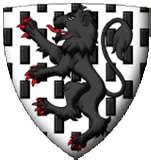
Coat of Arms Inchmartin
My 20th great-grandmother, Isabel Inchmartin, was an heiress in Perthshire, Scotland. She inherited lands that were known to be rich in salmon fishing. She was born in Perth and died in Fife. Times were tough in those days, so her survival for 59 years was impressive. She was able to pass her lands down through her daughters, which is also impressive, considering the times.
Isabel Inchmartin (1340 – 1399)
is my 20th great grandmother
Margaret Erskine (1357 – 1419)
daughter of Isabel Inchmartin
Isabel Glen (1380 – 1421)
daughter of Margaret Erskine
Isabel Ogilvie (1406 – 1484)
daughter of Isabel Glen
Elizabeth Kennedy (1434 – 1475)
daughter of Isabel Ogilvie
Isabella Vaus (1451 – 1510)
daughter of Elizabeth Kennedy
Marion Accarson (1478 – 1538)
daughter of Isabella Vaus
CATHERINE GORDON (1497 – 1537)
daughter of Marion Accarson
Lady Elizabeth Ashton (1524 – 1588)
daughter of CATHERINE GORDON
Capt Roger Dudley (1535 – 1585)
son of Lady Elizabeth Ashton
Gov Thomas Dudley (1576 – 1653)
son of Capt Roger Dudley
Anne Dudley (1612 – 1672)
daughter of Gov Thomas Dudley
John Bradstreet (1652 – 1718)
son of Anne Dudley
Mercy Bradstreet (1689 – 1725)
daughter of John Bradstreet
Caleb Hazen (1720 – 1777)
son of Mercy Bradstreet
Mercy Hazen (1747 – 1819)
daughter of Caleb Hazen
Martha Mead (1784 – 1860)
daughter of Mercy Hazen
Abner Morse (1808 – 1838)
son of Martha Mead
Daniel Rowland Morse (1838 – 1910)
son of Abner Morse
Jason A Morse (1862 – 1932)
son of Daniel Rowland Morse
Ernest Abner Morse (1890 – 1965)
son of Jason A Morse
Richard Arden Morse (1920 – 2004)
son of Ernest Abner Morse
Pamela Morse
I am the daughter of Richard Arden Morse
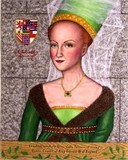
Elizabeth Wydville
QUEEN ELIZABETH WOODVILLE or WYDVILLE (1437-1492)
Jacquetta of Luxemburg, the fair young widow of the old warlike Duke of Bedford, took for her second spouse his favourite knight, the brave and handsome Sir Richard Woodville, when she came to England in 1435 to claim her dower. The time of the birth of her eldest child Elizabeth, the issue of marriage kept secret for fear of parliament, probably occurred in 1436. The matter burst out with great scandal the year after. Sir Richard was arrested and imprisoned in 1437; but as the king’s mother had married in lower degree to Owen Tudor, the young king was glad to pardon the second lady in his realm, as an excuse for showing mercy to his dying queen-mother. Jacquetta’s knight was therefore pardoned and sent home. They settled very happily at Grafton Castle, where they became the parents of a large family of handsome sons and beautiful daughters, among whom Elizabeth was fairest of the fair. The Duchess of Bedford kept the rank of the King’s aunt. His royal mother had died miserably in 1437, as shown in her life. Duchess Jacquetta, on occasions of ceremony, was the first lady in the land until the marriage of the king. Her daughter Elizabeth, took high rank among the maids of honour of Margaret of Anjou, and was the belle of her court, as two letters extant from Richard Duke of York and his friend the Earl of Warwick prove, recommending a Welsh hero, one of their knights-marshal, sir Hugh Johns, as a husband, they dwell on his great love inspired by her beauty and sweet manners; the letters show familiar acquaintance with Elizabeth, but they were of no avail. The court beauty had no fortune but her face, the Welsh champion none but his sword. She made a better match the same year with the heir of lord Ferrers of Groby, John Gray, rich, valiant, and years younger than the rejected Sir Hugh. Lord Ferrers was possessor of the ancient domain of Bradgate, which was afterwards to derive lustre as the birthplace of his descendant, lady Jane Grey. Elizabeth was appointed one of the fourt ladies of the bedchamber to Margaret of Anjou. John Gray held military command in the queen’s army. His death left Elizabeth with two infant sons, in 1460. Rancour so deep pursued the memory of John lord Gray, that his harmless infants, Thomas and Richard, were deprived of their inheritance of Bradgate. Elizabeth herself remained mourning and destitute at Grafton the two first years of Edward IV’s reign. Hearing that the young king was hunting in the neighbourhood of her mother’s dower castle at Grafton, Elizabeth waited for him beneath a noble tree known in the traditions of Northamptonshire, as “the queen’s oak,” hold a fatherless boy in either hand; and when Edward, who must have been well acquainted with her previously at the English court, paused to listen to her, she threw herself at his feet, and pleaded for the restoration of her children’s lands. Her downcast looks and mournful beauty not only gained her suit, but the heart of the conqueror. He was unwilling to make her his queen, but she left him to settle the question; knowing that he had betrayed others, her affections still clave to the memory of the husband of her youth. Her indifference increased the love of the young king. The struggle ended in his offering her marriage, which took place May 1, 1464. The marriage gave great offence to the mother of Edward IV. This lady, who, before the fall of her husband, Richard duke of York, at Wakefield, had assumed the state of a queen, had to give place to the daughter of a knight. It was on Michaelmas day, 1464, that Edward IV finally declared to Elizabeth to be his wedded wife, at Reading palace. The queen’s eldest daughter, Elizabeth, was born at Westminster palace about five months afterwards. The royal physicians, by means of their foolish studies of astrology, had assured king Edward that his expected child by his queen would prove a prince. The king, who was deep in the same kind of lore, had persuaded himself that his expected infant would wear the crown of England. One of these physicians, Dr. Dominic, obtained leave to station himself in the queen’s withdrawing-room, leading to her bed-chamber, in order that he might be the first to carry the tidings of the heir to Edward IV. Hearing the child cry, he called to one of the queen’s ladies, asking, “What her grace had?” The ladies were not in the best humour, being unwilling to answer “only a girl.” So one of them replied, “Whatsoever the queen’s grace hath here within, sure ’tis a fool that standeth there without.” Poor Dr. Dominic, being much confounded by this sharp answer, dared not enter the king’s presence. Elizabeth was crowned May 16, 1465, with great solemnity, in Westminster abbey, the young duke of Clarence officiating as high-steward. Elizabeth and Warwick were on friendly terms, as he stood godfather to her eldest daughter. The baptism of this princess for a while conciliated her two grandmothers, Cicely duchess of York, and Jacquetta duchess of Bedford, who were likewise her sponsors. The christening was performend with royal pomp, and the babe received her mother’s name of Elizabeth,—a proof that Edward was more inclined to pay a compliment to his wife than to his haughty mother. As prime-minister, relative, and general of Edward IV, the earl of Warwick had, from 1460 to 1465, borne absolute sway in England; yet Edward at that time so far forgot gratitude and propriety as to offer some personal insult to Isabel, his eldest daughter, who had grown up a beauty. Warwick had certainly been in hopes that, as soon as Isabel was old enough, he would have made her his queen, a speculation for ever disappointed by the exaltation of Elizabeth; so he gave his daughter Isabel in marriage to the duke of Clarence, and England was soon after in a state of insurrection. As popular fury was especially directed against the queen’s family, the Woodvilles were advised to retire for a time. The first outbreak of the muttering storm was a rebellion in 1468, in Yorkshire, under a freebooter called Robin of Redesdale, declared by some to have been a noble, outlawed for the cause of the Red rose. The murder of the queen’s father and brother followed in 1469. When the king advanced to suppress these outrages, he was seized by Warwick and his brother Montague, and kept at Warwick castle, where an experiment was tried to shake his affection to Elizabeth by the insinuation that her whole indluence over him proceeded from her mother’s skill in witchcraft. The Yorkist king escaped speedily to Windsor, and was soon once more in his metropolis, which was perfectly devoted to him, and where, it appears, his queen had remained in security during these alarming events. Again England was his own; for Warwick and Clarence, in alarm at his escape, betook themselves to their fleet, and fled. Then the queen’s brother, Anthony Woodville, intercepted and captured the rebel ships, but not that in which Warwick and Clarence, with their families, were embarked, which escaped with difficulty to the coast of France. The queen was placed by the king in safety in the Tower, before he marched to give battle to the insurgents. She was the mother of three girls but had not borne heirs-male to the house of York. Edward IV narrowly escaped being once more thrown into the power of Warwick, who had returned to England; but being warned by his faithful sergeant of minstrels. Alexander Carlile, he fled half-dressed from his revolting troops in the dead of night, and embarked at Lynn with a few faithful friends. Elizabeth was thus left alone, with her mother, to bide the storm. She was resident at the Tower, where her party still held Henry VI prisoner. While danger was yet at a distance, the queen’s resolutions were remarkably valiant; yet the very day that Warwick and Clarence entered London, she betook herself to her barge, and fled up the Thames to Westminster,—not to her own palace, but to a strong, gloomy building called the Sanctuary, which occupied a space at the end of St. Margaret’s churchyard. Here she registered herself, her mother, her three little daughters,—Elizabeth, Mary, and Cicely, with the faithful lady Scrope, her attendant, as sanctuary-women; and in this dismal place, November 1, 1470, the long-hoped-for heir of York was born. The queen was most destitute; but Thomas Milling, abbot of Westminster, sent various conveniences from the abbey close by. Mother Cobb, resident in the Sanctuary, charitably assisted the distressed queen, and acted as nurse to the little prince. Nor did Elizabeth, in this fearful crisis, want friends; for master Serigo, her physician, attended herself and her son; while a faithful butcher, John Gould, prevented the whole Sanctuary party from being starved into surrender. The little prince was baptized, soon after his birth, in the abbey, with no more ceremony than if he had been a poor man’s son. Early in March the queen was cheered by the news that her husband had landed, and soon after, that his brother Clarence had forsaken Warwick. The metropolis opened its gates to Edward IV, who hurried to the Sanctuary to embrace his wife and new-born son. The very morning of this joyful meeting, Elizabeth, accompanied by her royal lord, left Westminster palace, but soon after retired to the Tower of London, while her husband gained the battles of Barnet and Tewkesbury. The news of his success had scarcely reached her, before the Tower was threatened with storm by Falconbridge; but her valiant brother, Anthony Woodville being there, she, relying on his aid, stood the danger this time without running away. After Edward IV had crushed rebellion by almost exterminating his opponents, he turned his attention to rewarding the friends to whom he owed his restoration, and bestowed princely gratuities on those humble friends who had aided “his Elizabeth,” as he calls her, in that fearful crisis. When Edward IV fled in the preceding year from England, he landed with a few friends at Sluys, the most distressed company of creatures ever seen; for he pawned his military cloak, lined with marten fur, to pay the master of his ship, and was put on shore in his waistcoat. The lord of Grauthuse received, fed, and clothed him, lending him besides money and ships, without which he would never have been restored to his country and queen. Edward invited his benefactor to England. Lord Hastings received him, and led him to the far side of the quadrangle of Windsor castle, to three chambers. These apartments were very richly hung with cloth of gold arras; and when Grauthuse had spoken with the king in the royal suite, he presented him to the queen’s grace, they then ordered the lord chamberlain Hastings to conduct him to his chamber, where supper was ready for him. After refreshment, the king had him brought immediately to the queen’s own withdrawing-room, where she and her ladies were playing with little balls like marbles, and some of her ladies were playing with ninepins. Also king Edward danced with Elizabeth, his eldest daughter. In the morning the king came into the quadrant, the prince also, borne by his chamberlain, called master Vaughan, bade the lord Grauthuse welcome. The innocent little prince, afterwards the unfortunate Edward V, was then only eighteen months old. Then the queen ordered a grand banquet in her own apartments, at which her mother, her eldest daughter, the duchess of Exeter, the king, and the lord of Grauthuse all sat with her at one table. Elizabeth, in January, 1477, presided over the espousals of her second son, Richard duke of York, with Anne Mowbray, the infant heiress of the duchy of Norfolk. St. Stephen’s chapel, Westminster, where the ceremony was performed, was splendidly hung with arras of gold on this occasion. The queen led the little bridegroom, who was not five, and her brother, Earl Rivers, led the baby bride, scarcely three years old. They afterwards all partook of a rich banquet, laid out in the Painted-chamber. Soon after this infant marriage, all England was startled by the strange circumstances attending the death of the duke of Clarence. The queen had been cruelly injured by Clarence. Her father and her brother had been put to death in his name; her brother Anthony, the pride of English chivalry, had narrowly escaped a similar fate: moreover, her mother had been accused of sorcery by his party. She did not soothe her husband’s mind when Clarence gave him provocation. In fact, on the first quarrel, his arrest, arraignment, and sentence followed. He was condemned to death, and sent to the Tower. In his dismal prison a butt of malmsey was introduced one night, where he could have access to it. The duke was found dead, with his head hanging over the butt. Gloucester was certainly absent from the scene of action, residing in the north. On St. George’s day succeeding this grotesque but horrible tragedy, the festival of the Garter was celebrated with more than usual pomp; the queen took a decided part in it, and wore the robes as chief lady of the order. Her vanity was inflated excessively by the engagement which the king of France had made for his son with her eldest daughter. In the last years of king Edward’s life he gave the queen’s place in his affections to the beautiful Jane Shore, a goldsmith’s wife in the city, whom he had seduced from her duty. His death was hastened by the pain of mind he felt at the conduct of Louis XI, who broke the engagement he had made to marry the dauphin to the princess Elizabeth of York, but an intermittent fever was the cause. When expiring, he made his favourites, lords Stanley and Hastings, vow reconciliation with the queen and her family. He died with great professions of penitence, at the early age of forty-two, April 9, 1483. Excepting the control of the marriages of his daughters, his will gave no authority to the queen. She was left, in reality, more unprotected in her second than in her first widowhood. The Duke of Gloucester had been very little at court since the restoration. He was now absent in the north, and caused Edward V to be proclaimed at York, writing letters of condolence so full of kindness and submission, that Elizabeth thought she should have a most complying friend in him. Astounding tidings were brought to the queen at midnight, May 3, that the duke of Gloucester had intercepted the young king with an armed force on his progress to London, had seized his person, and arrested her brother, Earl Rivers, and her son, lord Richard Gray. In that moment of agony she, however, remembered, that while she could keep her second son in safety the life of the young king was secure. With the duke of York and her daughters she left Westminster palace for the Sanctuary; and she, and all her children and company, were registered as Sanctuary persons. Dorset, the queen’s eldest son, directly he heard of the arrest of his brother, weakly forsook his trust as constable of the Tower, and came into sanctuary to his mother. The archbishop of York brought her a cheering message, sent him by lord Hastings in the night. “Ah!” replied Elizabeth, “it is he that goeth about to destroy us.” — “Madam,” said the archbishop, “be of good comfort; if they crown any other king than your eldest son, whom they have with them, we will on the morrow crown his brother, whom you have with you here. And here is the great seal, which in like wise as your noble husband gave it to me, so I deliver it to you for the use of your son.” And therewith he handed to the queen the great seal, and departed from her in the dawning of the day. With the exception of the two beautiful and womanly maidens, Elizabeth and Cicely, the royal family were young children. The queen took with her into sanctuary Elizabeth, seventeen years old at this time, afterwards married to Henry VII. Cicely was in her fifteenth year. These princesses had been the companions of their mother in 1470, when she had formerly sought sanctuary. Richard duke of York, born at Shrewsbury in 1472, was at this time eleven years old. Katherine, born at Eltham about August 1479, then between three and four years old. Bridget, born at Eltham 1480, Nov. 20th, then only in her third year; she was afterwards professed a nun at Dartford. Gloucester’s chief object was to get possession of the duke of York, then safe with the queen. As the archbishop of Canterbury was fearful lest force should be used, he went, with a deputation of temporal peers, to persuade Elizabeth to surrender her son, urging “that the young king required the company of his brother, being melancholy without a playfellow.” To this Elizabeth replied, “Troweth the protector—ah! pray God he may prove a protector!—that the king doth lack a playfellow? Can none be found to play with the king but only his brother, which hath no wish to play because of sickness? as though princes, so young as they be, could not play without their peers—or children could not play without their kindred, with whom (for the most part) they agree worse than with strangers!” According to the natural weakness of her character, she nevertheless yielded to importunity, and taking young Richard by the hand, said, “I here deliver him, and his brother’s life with him, and of you I shall require them before God and man. Farewell! mine own sweet son. God send you good keeping! God knoweth when we shall kiss together again!” And therewith she kissed and blessed him, then turned her back and went, leaving the poor innocent child weeping as fast as herself. When the archbishop and the lords had received the young duke, they led him to his uncle, who received him in his arms with these words: “Now welcome, my lord, with all my very heart!” He then took him honourably through the city to the young king, then at Ely house, and the same evening to the Tower out of which they were never seen alive, though preparations went on night and day in the abbey for the coronation of Edward V. It is possible that Hasting’s death had some influence in the imprudent surrender of young York. If Elizabeth had any secret joy in the illegal execution of her brother’s rival and enemy, very soon she had to lament a similar fate for that dear brother, and for her son, lord Richard Gray, who were beheaded by sir Richard Radcliffe, June 24th, when the northern army, commanded by that general, commenced its march to London. When the massacre of every friend to the rights of his brother’s children was completed, and the approach of 9000 dreaded northern borderers intimidated the Londoners, the false protector entirely took off the mask. Buckingham induced Edward IV’s confessor, Dr. Shaw, who was brother to Gloucester’s partizan, the lord mayor, to preach a sermon against Edward V’s title, on pretence that Edward IV’s betrothment with lady Eleanor Butler had never been dissolved by the church. Shaw likewise urged the immediate recognition of the duke of Gloucester as sovereign, putting aside the children of Clarence on pretence of his attainder by parliament. Faint acclamations of “Long life Richard III” were raised by hired partizans, but the London citizens angrily and sullenly dispersed. Ratcliffe’s forces approached Bishopsgate on the 26th, and Richard III was proclaimed king. The unhappy queen Elizabeth Woodville and her daughters witnessed the proclamation of the usurper from the abbot’s house in the abbey. Richard then made his state visit to the Tower and city. Elizabeth and her daughters must perforce have been witnesses of his coronation, July 6, 1483. Soon after, the usurper, his wife, and son, now called Edward prince of Wales, made a grand progress to Warwick castle. The unfortunate sons of Elizabeth meantime were closely imprisoned under the care of sir Robert Brakenbury, one of Richard III’s northern commanders, who had been given the lieutenancy, under the notion that he would obey implicitly the usurper’s orders. Accordingly, Richard sent one of this gentlemen of the bedchamber, John Greene, ordering him to kill Edward IV’s sons forthwith. Brakenbury returned for answer “he would die first.” A midnight consultation took place between Richard III and his master of the horse, Sir James Tyrell, who left Warwick castle August 2, with commands to Brakenbury from king Richard that he was to surrender the keys of the Tower to sir James Tyrell for one night. On his ride from Warwickshire the master of the horse was attended by two retainers, one his squire, Miles Forrest, a northern champion of immense strength, the other his horsebreaker, John Dighton, a big, broad, square knave. Sir James had requested his own brother, Tom Tyrell, a brave gentleman, to aid him, but met with positive refusal, by which, if he lost the usurper’s favour, he gained from his country the appellation of “honest Tom Tyrell.” The three murderers reached the Tower of London after dark, August 3. Sir James Tyrell demanded the Tower keys; and in the very dead of the night when sleep weighs heaviest on young eyelids, one of the Tower wardens who waited on the hapless princes, Will Slaughter by name, guided the assassins through the secret passages, which still may be traced, from the lieutenant’s house to the portcullis gateway. There is a little dismal bedchamber hidden in the space between that tower and the Wakefield tower, approached with winding stone stairs, and which has leads on the top and an ugly recess in the walls, reaching to the ground and even beneath it. The leads communicated by a door to the Wakefield tower leaded roof, and thence to the water-stairs by a bricked-up doorway, still plainly to be seen. No spot could be more convenient for secret murder. Tradition has pertinaciously clung to it and called this fatal prison lodging the Bloody tower. Sir James Tyrell did not enter the chamber where the poor victims were sleeping, but his strong ruffians crept silently in, and oppressing the princes with their great strength and weight, stifled them with the bed-clothes and pillows. When the murders were completed Forrest and Dighton laid out the royal corpses on the bed, and invited sir James Tyrell to view their work. Tyrell ordered them to thrust them down the hole in the leads, which they did, and threw heavy stones upon them. Edward IV had lately strengthened that part of the Tower, little thinking the use to be made of it, as a poet born in his time makes him say—”I made the Tower strong; I wist not why—Knew not for whom.”
When Tyrell returned the keys to the lieutenant Brakenbury, the latter found his young prisoners had vanished. The murderous trio rode back to Warwick castle to report their doings to the head assassing. Richard III approved of everything his unscrupulous favorite and master of horse had done, excepting the disposal of his nephews’ corpses. He insisted that they should be raised from that niche and buried in consecrated ground with burial service. The averseness of sir Robert Brakenbury to have aught to do with the murders, threw great difficulty in the way of the usurper’s commands, prompted by the first twinge of conscience. It is from the confession of sir James Tyrell, put to death twenty years after for conspiring with the de la Poles, that these particulars are gathered, but he could not say where the poor children were ultimately buried: all he heard was that Richard III’s orders had been issued to the priest of the Tower, who had in the dead of night taken the bodies whither no one knew, as the old man died two or three days after. The secret was not guessed for two centuries; but when in 1674 King Charles II altered the White tower into a record office, under the flight of stairs leading up to the beautiful Norman chapel, was discovered a chest containing the bones of two children of the age of the murdered heirs of York. The orders of the usurper being fulfilled to the letter, the ground was consecrated as pertaining to the sacred place above; and deeply secret the interment was. Charles II had the poor remains of the heirs of York buried among their ancestors in Westminster abbey, where our young readers may remark the monument and inscription near Henry VII’s chapel. We must now return to the life of their unfortunate mother, Elizabeth Woodville, who being in sanctuary, early heard when and where her sons were murdered, which, says sir Thomas More, struck to her heart like the sharp dart of death: she swooned, and fell to the ground, where she lay long insensible. After she was revived and came to her memory again, with pitiful cries she filled the whole mansion. Her breast she beat, her fair hair she tore, and calling by name her sweet babes, accounted herself mad when she delivered her younger son out of sanctuary, for his uncle to put him to death. She kneeled down and cried to God to take vengeance; and when Richard unexpectedly lost his only son, for whose advancement he had steeped his soul in crime, Englishmen declared that the agonized mother’s prayer had been heard. The wretched queen’s health sank under the anguish inflicted by these murders, which had been preceded by the illegal execution of her son, lord Richard Gray, and of her brother, at Pontefract. She was visited in sanctuary by a priest-physician, Dr. Lewis, who likewise attended Margaret Beaufort, mother to Henry Tudor, Earl of Richmond, then an exile in Bretagne. The plan of uniting the princess Elizabeth with this last scion of the house of Lancaster, was first suggested to the desolate queen by Dr. Lewis. She eagerly embraced the proposition. The duke of Buckingham, having been disgusted by Richard, his partner in crime, rose in arms; but after the utter failure of his insurrection, Elizabeth was reduced to despair, and finally was forced to leave sanctuary, and surrender herself and daughters into the hands of the usurper, in March. She was then closely confined, with her daughters, in obscure apartments in the palace of Westminster. From thence she wrote to her son Dorset at Paris to put an end immediately to the treaty of marriage between Richmond and the princess Elizabeth. The friends who had projected the marriage were greatly incensed; but these steps were the evident result of the personal restraing the queen was then enduring. The successful termination of the expedition undertaken by the earl of Richmond, to obtain his promised bride and the crown of England, at once avenged the widowed queen and her family on the usurper, and restored her to liberty after the battle of Bosworth. Instead of the despotic control of Richard III’s swuire Nesfield, the queen, restored to royal rank, joyfully welcomed her eldest daughter, who was brought to her at Westminster from Sheriff-Hutton, remaining with her till the January following the battle of Bosworth, when she saw her united in marriage to Henry of Richmond, the acknowledged king of England. One of Henry VII’s first acts was to invest the mother of his queen with the privileges befitting the widow of an English sovereign. Unfortunately Elizabeth had not been dowered on the lands anciently appropriated to the queens of England, but on those of the duchy of Lancaster. However, a month after the marriage of her daughter to Henry VII she received possession of some of the dower-palaces, among which Farnham, of 102l. per annum, was by her son-in-law added to help her income. The Parliamentary Act, whereby she was deprived of her dower in the preceding reign, was ordered by the judges to be burnt. Much is said of her ill-treatment by Henry VII. However, at the very time she is declared to be in disgrace for patronizing the impostor who personated the young earl of Warwick, she was chosen by the king, in preference to his own beloved mother, as sponsor to his dearly-prized heir, prince Arthur. The last time the queen-dowager appeared in public was in a situation of the highest dignity. At the close of the year 1489 she received the French ambassador in great state; the next year Henry VII presented her with an annuity of 400l. Soon after she retired to the royal apartments at Bermondsey abbey. Elizabeth Woodville expired the Friday before Whitsuntide, 1492. Her will shows that she died destitute of personal property; but no wonder, for the great possessions of the house of York were chiefly in the grasp of the old avaricious duchess Cicely of York, who survived her hated daughter-in-law several years. Edward IV had endowed his proud mother as if she were a queen-dowager; while his wife was dowered on property to which he possessed no real title. On Whit Sunday the queen dowager’s corpse was conveyed by water to Windsor, and thence privately, as she requested, through the little part, conducted unto the castle. Her three daughters, the lady Anne, the lady Katharine, and the lady Bridget [the nun-princess] from Dartford, came by way of the Thames, with many ladies. And her son lord Dorset, who kneeled at the head of the hearse, paid the cost of the funeral. In St. George’s chapel, north aisle, is the tomb of Edward IV. On a flat stone at the foot of this monument are engraven, in old English characters, the words—
King Edward and his Queen, Elizabeth Widville.
×Elizabeth Wydeville Grey Plantagenet (1437 – 1492)
Cecily Bonville
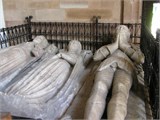
Grave
Cecily Bonville, 7th Baroness Harington and 2nd Baroness Bonville (c. 30 June 1460 – 12 May 1529) was an English peeress, who was also Marchioness of Dorset by her first marriage to Thomas Grey, 1st Marquess of Dorset, and Countess of Wiltshire by her second marriage to Henry Stafford, 1st Earl of Wiltshire.
The Bonvilles were loyal supporters of the House of York during the series of dynastic civil wars that were fought for the English throne, known as the Wars of the Roses (1455 –1485). When she was less than a year old, Cecily became the wealthiest heiress in England after her male relatives were slain in battle, fighting against the House of Lancaster.
Cecily’s life after the death of her first husband in 1501, was marked by an acrimonious dispute with her son and heir, Thomas Grey, 2nd Marquess of Dorset. This was over Cecily’s right to remain sole executor of her late husband’s estate and to control her own inheritance, both of which Thomas challenged following her second marriage to Henry Stafford; a man many years her junior. Their quarrel required the intervention of King Henry VII and the royal council.
Lady Jane Grey, Lady Catherine Grey and Lady Mary Grey were her great-granddaughters. All three were in the Line of Succession to the English throne, with Jane, the eldest, having reigned as queen for nine days in 1553.
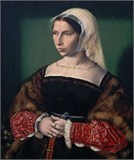
Cecily Bonville
Cecily Bonville
Cecily Marchioness Dorset Bonville (1460 – 1530)
The Bonville-Courtenay Feud was an episode in the War of the Roses in 15th centuryEngland. Often local concerns can dictate choice of side in civil wars. These two rival families lived in south-western England (Devon, Cornwall, Somerset). The Courtenays held the peerage Earldom of Devon and the Bonvilles were titled Lord Harington. Their dispute concerned the Stewardship of the Duchy of Cornwall. This was not a sinecure but rather a prestigious and financially rewarding position. Rival claims to this position triggered the feud. The feud led to considerable local bitterness and even murder. It was ended by government intervention. The War of the Roses was a time of shifting allegiances in British history as the tide of War presented opportunity for advancement to various factions. A similar feud was the Percy-Neville feud also at this time. In Ireland there was strife between the Butler family, Earls of Ormond versus the Fitzgerald line, Earls of Desmondand Kildare. Many senior members of the Bonville and Courtenay families were killed in the battles and skirmishes of the War of the Roses. This feud is relevant to Local History, Family History/Genealogy and the History of England specifically the War of the Roses.
In 1441 Devon was appointed to the lucrative stewardship of the Duchy of Cornwall, an office Henry VI had already conferred on Sir William Bonville [1] in 1437, Bonville was aWest Country gentleman whose growing influence at court threatened Courtenay domination in the region. He was punished after the skirmish at Dartford. Later conflict between Devon and Bonville’s party led to the murder of Nicholas Radford [2]. Imprisoned in the Tower of London as punishment,Devon was released in 1457 by authority of QueenMargaret of Anjou.
Quote
Nor [3]did the nobility act as though dynastic considerations were decisive. Richard Neville, Earl of Warwick, moved his support from the House of York (Edward IV) to theHouse of Lancaster (Henry VI) when it suited his own ambitions. When Lord Bonville shifted his support from Lancaster to York, his local rival the Earl of Devon switched his backing to the Lancastrians
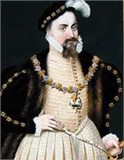
Thomas Grey
Thomas Grey, 2nd Marquess of Dorset was born on 22 June 1477.1 He was the son of Thomas Grey, 1st Marquess of Dorset and Cecilia Bonville, Baroness Bonville and Harington.2 He married, firstly, Eleanor St. John, daughter of Oliver St. John and Elizabeth Scrope.3 He married, secondly, Margaret Wotton, daughter of Sir Richard Wotton and Anne Belknap, in 1509.4 He died on 10 October 1530 at age 53.1 He gained the title of 2nd Marquess of Dorset.1 He succeeded to the title of 8th Lord of Astley [E., 1295] on 20 April 1501.5 He succeeded to the title of 8th Lord Ferrers, of Groby [E., 1299] on 20 April 1501.6 He succeeded to the title of 3rd Lord Bonville [E., 1449] before 2 June 1530.2 He has an extensive biographical entry in the Dictionary of National Biography.7
Child of Thomas Grey, 2nd Marquess of Dorset
Lord Thomas Grey+1
Children of Thomas Grey, 2nd Marquess of Dorset and Margaret Wotton
Catherine Grey+2 d. 1 May 1542
Elizabeth Grey+3 b. 1510, d. 1564
Henry Grey, 1st Duke of Suffolk+4 b. 17 Jan 1517, d. 23 Feb 1554
Thomas Marquess Dorset Knight Grey (1477 – 1530)
Thomas Grey, second Marquess of Dorset was an English peer, courtier, soldier and landowner, the grandfather of Lady Jane Grey, briefly Queen of England. Grey was the third son and eventual heir of Thomas Grey, 1st Marquess of Dorset, at the time England’s only marquess, and his wife, Cecily Bonville, the daughter and heiress of William Bonville, Baron Harington. His mother was in her own right Baroness Harington and Bonville and the richest heiress in England. The first marquess was the eldest son of Queen Elizabeth Woodville, so a stepson of King Edward IV and half-brother of Edwars, Prince of Wales, later King Edward V.
According to some reports, the young Grey attended Magdalen College School, Oxford, and he is uncertainly said to have been taught by the future Cardinal Wolsey.
Amoung the Queen of England’s closest relations, Grey and his younger brothers Leonard and Edward where welcome at court and became courtiers and later soldiers. In 1494 Grey was made night of the Bath and in 1551 knight of the Garter. Also in 1501 his father died and the younger Thomas inherited his titles and some of his estates. However much of the first Maquess’s went to his widow and not his sons, who didn’t come into his full inheritance until the death of his mother in 1530, shortly before his own death.
Later in 1501 he was chief answerer at the marrage of Arthur Prince of Wales to Catherine of Aragon. And was presented with a diamond and ruby Tudor rose at court. But in 1508 he was sent to the Tower of London and later a gaol in Calais under suspision of conspiracty against Henry the VIII, Grey was attainted and lost his title. However in 1509 he was pardoned and returned to court, and was summoned to parliment as Baron Ferrers of Groby. In 1511 he was summoned as Marquess of Dorset.
From 1509, Dorset was again an active courtier and took part with great distinction in many court tournamants, on one occasion in March 1524 nearly killing the king.
In 1514, with Charled Brandon, 1st Duke of Suffolk, Dorset escorted Henry VII’s daugher Princess Mary Rose to France for her wedding to King Louis XII.
Dorset owned land in 16 English counties and was a justice of the pease for several of them. In 1516, during a rivalry in Leicestershire with George, Baron Hastings, and Sir Richard Sacheverell, Dorset unlawfully increased his retinue at court and was brought before the Star Chamber and the Court of King’s Bench. He was bound over for good behaviour. As part of this rivalry, he greatly enlarged his ancestral home at Bradgate, Leicestershire.
In 1520, at the Field of Cloth of Gold, Dorset carried the sword of state. In 1521 he met the Holy Roman Emperor Charles V at Gravelines on the coast of France and escorted him on a visit to England. He helped with the entertainment of the court by maintaining a company of actors.
In 1521 Dorset sat in judgement on the Duke of Buckingham, despite being related to him by marriage. After is father’s death Dorset’s mother had married a brother of the Duke. Henry VIII rewarded Dorset with 3 of Buckingham’s Manors.
In 1524, Dorset’s Leicestershire feud with Lord Hastings turned into a fight between hundreds of men, and Cardinal Wolsey took action. Both rivals had to put up a bond for good behaviour of one thousand pounds, and Dorset was sent to Wales as Lord Master of Princess Mary’s Council.
In 1528, Dorset became constabel of Warwick castle , and in 1529 of Kentilworth Castle.
In 1529, recalling his role as ‘chief answerer’ at the marriage of Arthur , Prince of Wales, Dorset was a critical witness in favour of Henry VIII’s divorce of catherine of Aragon. He strongly supported the King’s contention that Arthur and Catherine’s marriage had been consummated.
In 1530, in the final months of his life. he assissted the King in the condemnations of Cardinal Wolsey.
Grey was the son and heir of Thomas Grey, 1st Marquess of Dorset, and his wife, Cecily Bonville, daughter and heiress of William Bonville, Baron Harington and of Lady Katherine Neville and granddaughter of Alice Neville, 5th Countess of Salisbry. Cicely Dorset’s maternal uncles included Richard Neville, 16th Earl of Warwick (called ‘Warwick the Kingmaker’), John Neville, 1st Marquess of Montagu and George Neville, Archbishop of York and Chancellor of England, while her aunts had married Henry de Beauchamp, 1st Duke of Warwick, William FitzAlan, 16th Earl of Arundel, Thomas Stanley, 1st Earl of Derby, and John de Vere, 13th Earl of Oxford. Cecily Grey succeeded her father as Baroness Harington in 1460, and 2 months later succeeded her great-grandfather William Bonville as Baron Bonville. After the death of her first husband, Cecily Dorset married her late husbands’s first cousin Henry Stafford, 1st Earl of Wiltshire, the younger son on Henry Stafford, 2nd Duke of Buckingham and of Catherine Woodville, Dorset’s aunt.
The younger Thomas Grey’s peternal grandparents were Queen Elizabeth Woodville and her first huband Sir John Grey of Groby, son and heir of Elizabeth Ferrers, Lady Ferrers of Groby, so his father the first marquess was a stepson of King Edward IV and half-brother of King Edward V. His grandfather Sir John Grey was killed at the Second Battle of St Albans, fighting on the Lancastrian side. His grandmother Elizabeth Woodville was the eldest daughter of Richard Woodville, 1st Earl Rivers, and Jacquetta of Luxembourg, widow of John of Lancaster, 1st Duke of Bedford. Following his grandmother’s marriage to Edward IV, members of her family gained advantages and made prosperous marriages. Elizabeth’s brother John Woodville, at the age of 20, married Catherine Neville, Dowager Duchess of Norfolk, then in her late sixties.
Through Jacquetta of Luxembourg, Dorset was descended from Eleanor of England, the daughter of King John and Isabella of Angouleme, and from several other European royal familes.
Thomas Grey first marriage was to Eleanor St John, a daugher of Oliver St John of Lydirard Tregoze, Wiltshire and of his wife Elisabeth Scrope, daugher of Henry le Scrope, 4th Lord Scrope of Bolton. Grey’s fathe-in-law Oliver St John (also known as Oliver of Ewell) was the son of Margaret Beauchamp, the great-great granddaughter of Roger Beauchamp, 1st Lord Beauchamp of Bletso, Keeper of Devizes Castle, and heiress to the Beauchamp estates. After the death of her first husband, another Oliver St John, she married John Beaufort, 1st Duke of Somerset.
In 1509, Thomas Grey married secondly Margaret Medley, daughter of Sir Robert Wottom of Boughton Malherbe, Kent and the widow of William Medley. She had 2 notable brothers, Sir Edward Wotton, treasurer of Calais, and NIcholas Wotton, a diplomat who in 1539 arranged the marriage between Henry VIII and Anne of Cleves. With Margaret, the younger Thomas Grey had four sons and four daughters, incuding Henry Grey, 1st Duke of Suffolk. His second wife survied him and died in or after 1535.
His younger brother Leonard Grey, 1st Viscount Grane served as Lord Lieutenant of Ireland from 1536 to 1540.
Dorset’s son Henry succeeded him as Marquess of Dorset, married Lady Francis Brandon, a granddaughter of King Henry VII, and in 1551 became Duke of Suffolk, by way of a new creation.
Dorsets granddaughter was Lady Jane Grey and successor of King Edward VI for 9 days. In 1554, together wiht Dorset’s other surviving sons. Lord John Grey and Lord Thomas Grey, Suffolk took part in Wyatt’s rebellion against Mary I’s marriage to Philip of Spain and in support of Lady Jane Grey. When this rebellion failed, all three were arrested, and Suffolk and his brother Thomas were executed, as were Lady Jane herself and her husband Lord Guilford Dudley. Lord John Grey survived, and in July 1603 his youngest son Henry Grey, was restored to the House of Lords by King James I as Baron Grey of Groby.
Dorset Died on 10 October 1530, and was buried in the collegiate church at Astley in Warwickshire. When he dies he held estates in London and in 16 counties, amounting to over 100 manors, and was one of the richest men in England. His grave was opened in the early 17th century and measurement of his skeleton suggested a height of 5″8′

O’Byrne COA
Recorded as O’ Byrne but more usually as Byrne, this is an Irish surname of great antiquity. Claiming descent from Bran, the king of Leinster, who died in 1052, this great clan originated in County Kildare where they held extensive territory until the Anglo-Norman invasion of Ireland in 1169 – 1170, when they migrated to Wicklow where they occupied the country between Rathdrum and Shillelagh. Their name in Irish is properly O’ Broin, meaning the male descendant of Bron, the raven. The O’ Broins, like their neighbours the O’ Tooles, were particularly noteworthy for their resistance to foreign aggression, and they continued to inaugurate native chiefs up to the end of the 16th Century. The seat of their chiefs was at Ballinacor, County Wicklow, and the territory over which they held sway was known as Crioch Branach. The celebrated “Leabhar Branach” or “Book of the O’ Byrnes” deals with the exploits of the clan in these times. Alderman Alfred Byrne (1882 – 1956), a distinguished recent member of the clan, was ten times Lord Mayor of Dublin. The Byrne coat of arms has the blazon of a red shield charged with a chevron between three silver dexter hands couped at the wrist, the Crest being a mermaid with comb and mirror proper. The first recorded spelling of the family name may be that of Fiacha Mac Hugh O’Byrne, the military leader. This was dated 1544 – 1595, in the Historical Records of Dublin, during the reign of Queen Elizabeth 1st of England, 1558 – 1603.
Patrick O’Byrne (1817 – 1890)
 mermaidcamp