mermaidcamp
Keeping current in wellness, in and out of the water
You can scroll the shelf using ← and → keys
You can scroll the shelf using ← and → keys


Most of the colonial British families settling in Barnstable, MA came from London. My 10th great-grandfather arrived in 1639, and is buried there. H probably left England because of religious persecution, the usual. He survived to a very ripe old age in his new country, and his grave can be located today.
James Hamblen, so far as has been ascertained, was the first of the name who settled in America. He came from London and settled in Barnstable, Massachusetts, in the Spring of 1639. Of his earlier life very little has been learned; records exist, however, from which some traces of him are supposed to have been discovered.The name of Hamblen appears frequently in th records of Plymouth Colony. The first mention is “March 1, 1741-2. James Hamblen was propounded for Freeman.”March 15, 1657, James Hamblen served on inquest on the body of a child, Simeon Davis.June 3, 1657, James Hamblen was sick and could not serve on the Grand Enquest.The name of James Hamblen appears in the list of Freemen of Barnstable in 1658.June 7, 1670, James Hamblen served on Grand Enquest; same day he was member of a trial jury.May 29, 1670, James Hamblen, Juni, and James Hamblen Seni, in list of Freeman.March 6, 1671, James Hamblen served on a jury.June 3, 1679, James Hamblen served on a jury in the case betgween Capt. John Williams and Edward Jenkins.July 7, 1681, James Hamblen served on juries.July 6, 1682, James Hamblen summoned to serve on a jury, and served.In the list of Freemen of Barnstable for 1689, among others appear the names of James Hamblen, James Hamblen, Jr., John Hamblen, Eleazar Hamblen.
James Hamblen (1606 – 1690)
From: Geneological and Personal History of the Allegheny Valley, Pennsylvania. By John Woolf Jordan. Lewis Historical Pub. Co., 1913 – 1162 pages:
James Hamlin (Hamblen) was living in London, England, in 1623. He came to New England and settled in Barnstable, Massachusetts, where he was a proprietor. He was admitted a freeman March 1, 1641-1642 and was on the list of those able to bear arms in 1643. He was a town officer. He married Ann.
GENEALOGICAL NOTES OF BARNSTABLE FAMILIES. James Hamlen was admitted a freeman of the Colony, and in 1643 was constable of the town of Barnstable. The usual spelling is Hamblin, but the descendants of James are not uniform. Eleazer, the great-grandfather of Vice President Hamlin, dropped the e as a useless letter, and his descendants have continued to do so. Family of James Hamblen. His son James and daughter Hannah were probably born in England, his other children in Barnstable. James.Hannah. Bartholemew, 11th April, 1642, bap. April 24. John, 26th June, 1644, bap. June 30. Sarah, 7th Nov. 1647, bap. same day. Eleazer, 17th March, 1649-50, bap. same day.Israel, 25th June, 1652, bap. same day. This record shows that Goodman Hamblen was very exact in the performance of what he believed to be a religious duty, that none of his children should die unbaptized.
“The greatness of a community is most accurately measured by the compassionate actions of its members, a heart of grace, and a soul generated by love.”
Coretta Scott King
I know a very special woman through social media named Ruby Taylor. She lives in Lancaster, PA, a town I knew well because I spent a year going to boarding school in Lititz, PA. She has a wonderful attitude, but the reason she caught my attention is that my mother’s name is Ruby Taylor. I study my ancestors to learn about ethical will and history. This week I thought about slavery in terms of my slave owning ancestor who ran away to Florida with her slaves in order to be in Spain in the 1700’s. She actually bought and sold slaves in Florida. This is heavy, and I can picture the whole crazy trip. Meanwhile the Zimmerman verdict was delivered in Florida. Much ado…
The most profoundly wise statement of the day came from Ruby Taylor:
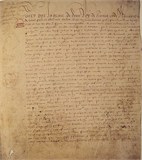
Edict of Nantes
My 9th great-grandmother was born in France and died in Northern Ireland. As usual ,this exodus was inspired by an escape from religious persecution. Her family would later settle in South Carolina as Presbyterian religious and military leaders. She married into a family called Pickens, or Picon:
The Pickens Story. as told by Stuart Clark Pickens.
About 870 a.d. the Viking “Stirgud the Stout” and his men landed in the Orkneys and Northern Scotland. They came from Norway in an effort to expand. The Pickens name comes from this group of Vikings.
Later, under their Earl, Thorfinn Rollo, they invaded France about 910 AD. They held Paris under siege until the French King, Charles the Simple, conceded defeat and granted Northern France to Rollo, who became the first Duke of Normandy.
A descendant of Duke Rollo was Duke William who invaded England in 1066. William had a census taken in England in 1086 and compiled the Domesday Book. This Listing of names has Picken listed and many variations of the spelling as well. Most notably “Pinkeny” which in the 1200’s lived in Picquigny in the Somme in the arrondisement of Amiens in Normandy.
Ghilo Pinkeny was a Domesday book tenant in chief in the county of Northampton and others, and his son Ghilo, founded the Priory of Weedon in Northampton which was a branch of the original Priory at St. Lucien in Beauvais near Picquigny. They branched into Yorkshire and acquired Shrover Hall where they were landed gentry. They also established a seat in Oxfordshire where the name was Pinke.
The Pickens name emerged as a notable English family name in the county of Northampton where they were recorded as “a family of great antiquity seated as Lords of the Manor and Estates in that shire.”
In the late 1200’s many of the Norman families of England moved north to Scotland following Earl David of Huntingdon (who later became the second King of Scotland). They expanded into Scotland where the names were Pinkie, Pickie, and Picken. They settled in Inveresk in Midlothian, Scotland. Peter Pinkie was listed as a follower of Robert the Bruce in 1303. They flourished on these estates for several centuries spreading throughout Scotland.
There were Pickenses at the battle of Bannockburn in 1314 defeating the English who outnumbered them 5 to 1, gaining Scottish Independence. This battle was the first of many major victories giving the Scots a good reputation for winning battles.
In 1328 the Treaty of Northhampton was signed between the English King, Edward III and Robert I (Bruce) officially recognizing Scottish independence and Robert Bruce as it’s king. The following year, Earl David was crowned King upon the death of Robert the Bruce and Scotland was well on its way thanks in part to the efforts of the Pickens family.
In 1521 on May the 26th , Martin Luther was banned by the edict of Worms for his religious beliefs. Any deviation from Catholicism was considered blasphemous. There was a tremendous effort throughout Europe to spread Catholicism and keep these Protestant dissidents from converting the masses.
The Scottish would not be told how to think and so would not stand for any religious persecution. On the English border the Scotch Presbyterians were treated as low life and so the border was a hard place to live. They were forced into guerilla warfare just to survive. These “Border Reevers” became the best frontier fighters in the world. There were many of the Edinburgh Pickenses among this group of fighting farmers. The Border raids were finally quieted when the Scottish king James IV took the English throne as James I in 1603. These fighters were later used by the English to quiet the Irish.
The French huguenots in the mid 1500’s felt the same as the Scottish about religious persecution, and this common belief of religious freedom forged a friendship between the Scots and the French that lasted until 1685.
It was during this time, the late 1500’s, that one Robert Picken/Picon from Scotland went to France during the reign of King Henry IV (1589 – 1610). He held a diplomatic post in the Kings Court until 1610 when Louis XIII took the crown. He then returned to Scotland near the English border and lived there until his death. He had family in Edinburgh, Stewarton, Glasgow, and the Kintyre Peninsula. The border had become a friendly place at the time because a Scottish King sat on the English throne. (James I was also James VI of Scotland and the son of Mary, Queen of Scots). This made for what Robert thought would be an easy retirement.
When his son Andrew was born in 1624, the political climate was getting difficult. Charles I began his reign over England in 1625 and some of the attitudes changed toward the “Wily Border Reevers of Scotland”, so called because of the old hatred between the two countries under Elizabeth I (1558 – 1603). The Covenanters were also uprising against the English crown and England’s religious civil war was reaching into Scotland. The Scottish king James was no longer king and old hatreds built up again atop new hatreds. But it was still a tolerable life for Robert Picken/Picon because of his diplomatic status. Robert Senior died in 1644 and is buried in Lowland Scotland.
There were other Pickenses (Pickan) in Edinburgh who were believed to be Robert Picon’s (Pickens) brothers. A lot of their children moved to Ulster in the 1620’s and 1630’s. This was a colonization effort of the English to make Ireland “civilized”. (See Ulster History).
In 1644 Andrew had a son Robert named after Andrew’s father. Robert was born in Scotland according to LDS records. He went to France with his father at a young age. While in France, Robert met the young widow of a Frenchman named Jean Bonneau. Her name was Esther Jeane Benoit and she was from a Protestant huguenot family. They began a family there. Among Robert’s children were William Henry Pickens, who was born in 1669 (LDS) in France. His other sons were Andrew, John, Robert, Israel, and Thomas, and a daughter who married a Davis.
In 1651 Oliver Cromwell defeated Charles and began the commonwealth. The Irish Catholic rebellion was in full swing in Ireland and the English sent the Presbyterian/Covenanter Scottish armies (who called themselves God’s army) to stop them.
Catholicism was outlawed in Ireland and the Scots (fighting for the English) tried to convert the Irish Catholic Papists to the Presbyterian faith. That failed because the Scots didn’t want to tell people what to believe. So Cromwell’s army took over to enforce the English law.
Andrew Picken/Picon still believed, as most Scots did, in religious freedom and wanted to avoid that war because it seemed to him to be hypocritical. So he took his family to France to the town that his father had previously lived in.
The families enjoyed a peaceful existence in France until 1685 when they revoked the Edict of Nantes. There was no more religious freedom in France unless you were Catholic. This was a good reason for Andrew and his family to return to Scotland and find their relatives. So Robert and Esther, his parents and his children, and a host of French friends all went to Scotland to practice the Presbyterian faith. They became split on the subject of becoming Covenanters. Most believed that everyone should have the freedom to choose their religion. The Covenanters believed only in the right to be Presbyterian. The Catholics believed they were the one true religion.
This is what David Cody, Assistant Professor of English, Hartwick College had to say about the Covenanters.
“The Covenanters were supporters of the Scottish Covenant of 1638, which was a national protest against the ecclesiastical innovations in the Scottish Church imposed at Edinburgh and subscribed to by various nobles, ministers, and burgesses. Those who signed the Covenant, which was initially neither anti-royalist nor anti-Episcopalian, though it became both, declared that they would defend their religious beliefs against any changes not mandated by free assemblies and the Scottish Parliament. The term was also applied to their spiritual heirs who opposed the reintroduction of episcopacy in 1662.
“Some Covenanters were also signatories of the Apologetical Declaration which declared war on all established political officials, soldiers, judges, conformist ministers, and informers. This document, however, provoked a response upon the part of the authorities which became known as the Killing Times: during 1684-85, at least 78 persons were summarily executed for refusing to retract their allegiance to the declaration, and many others were executed after trial. Despite often brutal repression, especially during the period between 1678 and 1685, the excluded ministers, supported by the local aristocracy and independent peasantry, maintained an underground church in the south-western parts of Scotland.”
South Western Scotland is where our ancestors moved to at the time, Kintyre.
But in England the Covenanters were quelled and the Presbyterians were the lowest of second class citizens. Presbyterian marriages were considered not valid and they were labeled as fornicators. Anyone seen with a Presbyterian Covenanter was arrested with him and whole prisons were built to house them. It was a bad time near the border for humble Scottish cattle ranchers who were just trying to make a living.
Their land could no longer support them due to the ravages of war, and the English demanded outrageous taxes and rents. This caused so many people to leave Scotland that whole towns were left deserted. The massive emigration was compared to great swarms of bees rising out of the field.
A lot of the Pickenses went to the faraway tip of the Kintyre Peninsula to escape the strife and farm new land. It was 140 miles to the nearest city (Glasgow) along a thin strip of land, and it was only 14 miles across the water to Ireland (Ulster). Eventually Campbeltown became a busy port for refugees.
Then came the revolution of 1688 and Presbyterianism was restored as the state religion in Scotland.
In 1685, when the Pickenses arrived back in Scotland from France, they found that all their relatives had moved to Ulster, Northern Ireland. In the search for peace and religious freedom most of them followed the rest of their Clan to Ulster by way of Campbeltown, Argyll, Scotland. It seems that on their way through Scotland some members of the family stayed in the towns the went through.
CHILDREN OF ROBERT ANDREW PICKENS AND ESTHER JEAN BENOIT1. WILLIAM Henry born in France in 1669 went to Ireland with his father by way of Campbeltown, married Margaret Pike in 1693 in Ireland and had the following children all in Ireland: Israel born 1693; Margaret born 1695; Andrew born 1699; Robert Pike born 1697; William born 1705; John born 1710; Israel born 1712; Gabriel born 1715; and Lucy born 1718. All were born in Ireland and all moved to America in the spring of 1719. They appear in 1719 in Bensalem Church in Bucks County Pennsylvania as recent Immigrants from Ireland. 2. ANDREW moved to Fenwick and married Jane Mitchall; they had a daughter named Bessie who was christened May 13, 1705. 3. JOHN Stayed at Campbeltown and married Anne Colvine on June 2, 1691. They had at least 2 sons, James born March 20, 1692; and Alexander born July 9, 1693. 4. ROBERT moved to Glasgow and married Janet Corsby; they had at least 2 sons, Robert Christened June 5, 1707; and Alexander Christened August 27, 1721. 5. ISREAL born in France in 1676 went to Ireland with his father by way of Campbeltown, married and had at least 2 sons; William born in 1720, and Thomas born in 1730. 6. THOMAS stayed in Campbeltown and married a ? Clark; they had a daughter named Martha christened June 5 1692. 7. ?? A daughter who married a Davis. In Ulster in the 1690’s, the Irish papists, who were still mad at the Scots for Cromwell’s war 40 years earlier, banned Presbyterian services, and outlawed their ministers. So the Scotch/Irish Presbyterians had to have their services in the woods with guards posted at the corners to keep their ministers from being arrested. Hence the phrase, “They read their bibles with their guns cocked.”
The Irish cities of Derry and Coleraine were supposed to be English cities given to Lord Abercorn as a result of the Nine Years War. The Scots built a 20-foot wall around Derry to defend it from the English siege in the brutal winter of 1688-1689. The Scots lost the siege but were not displaced and so they took over Coleraine. Then came the Battle of the Boyne, on July 1, 1690.Click for a Map of the BattleAfter that the Protestants had no rights anymore. Ulster was so full of Scots that they outnumbered the English by 20 to 1. The Irish were happy that the English were being replaced by Scots, but still didn’t want so many Protestants in their country. Life was becoming just as hard for the Scots in Ireland as it was near the English border. This makes three generations that had to relocate because of religious persecution. They were tired of it.
They had heard of Pennsylvania.
There was a land where no one would tell you what to think or how to live. This land is not only rich farmland, but it is free for the taking! You could preach or worship any religion you want, Right next to someone preaching another religion. No tax, No Tithes, No rents, and No persecution. Imagine, Just walk into the frontier and claim a farm. Run it for only yourself and raise a family. Start a small village of just friends and family. If you’re a criminal – leave it behind. If you’re poor – leave it behind. If you’re afraid of being arrested for an “idea” – leave it behind. There is peace, prosperity and freedom on the frontier in the New World.
And all you have to do is get there.
There had been no harvest for 5 years due to the ravages of war and several severe winters. This recreated the need for emigration in the early days of the 1700’s. Many paid passage by agreeing to 4 years as indentured servants in order to take advantage of the fertile and free land in America.
Passage to America was not cheap, and to move your whole family (which was quite large back then) plus all your livestock, would cost a bundle. One could only go by ship and the voyage was tough enough without kids and livestock, if you could even get passage for livestock which wasn’t likely. If you could not afford passage, the only way was indentured servitude. There were rich American plantation owners who would pay for a man’s passage if he would work for a year. If he brought his family he would have to work four years. Unfortunately, some emigrants would literally jump from the ship to avoid the servitude altogether. They would disappear into the frontier and the plantation owner was out a considerable sum of money.
There were many references to bad ocean voyages, and even in the best of trips, which lasted 2 to 3 weeks; the ships were overloaded with people, the rations were short or just barely enough, the food was vermin ridden, and the water was stagnant and green with life. Many were blown off course northward. The weather would turn very cold and even icebergs were sighted. Hunger and thirst reduced them to shadows. Many killed themselves by drinking salt water or their own urine. Their journey lasted up to 13 weeks or 3 1/2 months. The disembarkation process at their destination was also harsh. First the ones who could pay full price were allowed to pay and get off the boat. Next the healthy ones were sold to their new masters for the full fee. Then unhealthy ones were sold at auction. This process often took several weeks. If one of the family died, the rest of the family members were held accountable for passage fees of the deceased. However, the Ulstermen thought they had found the Promised Land.
The Scots/Irish who had indentured themselves to reach the US, set out for the frontier immediately on fulfilling their Indenture. The “Frontier” was 40-50 miles west of Philadelphia. Across the Susquehanna River was the Alleghenies which marked the frontier. This is where the German Palatines settled. The Scots usually settled as far out as possible to be far enough from society so as to make their own kind of living. Just beyond the Ohio River lay the rich Cumberland Valley. Eventually, a ferry opened the Cumberland Valley to the Scots/Irish and it became their heartland. The French claimed to own the frontier beyond the Ohio River but there was no way to stem the flow of Scots/Irish to the area. Our ancestors settled in what was known as the “Seven Ranges” area, just beyond the Ohio River. They renamed the area “Scotch Ridge”. Scots were famous for being the furthest out on the frontier. They marked their property by cutting their initials in trees on their boundaries. Then cut circles in the bark to kill the tree. They refused to pay for the land, since God owned it. The wives spun flax, milled the corn, worked in the fields and bore 10-15 children. They also educated their own children. Homemade whiskey was important for trade and made a harsh frontier life more tolerable. The Whiskey also made the Indians more friendly to the Scots than the Germans or English. So the Scots made a good barrier between the Indians and the settled areas
Ester Jeanne Bonneau (1644 – 1699)
is my 9th great grandmother
William Pickens (1670 – 1735)
son of Ester Jeanne Bonneau
Anne Pickens (1680 – 1750)
daughter of William Pickens
Nancy Ann Davis (1705 – 1763)
daughter of Anne Pickens
Jean PICKENS (1738 – 1824)
daughter of Nancy Ann Davis
Margaret Miller (1771 – 1853)
daughter of Jean PICKENS
Philip Oscar Hughes (1798 – 1845)
son of Margaret Miller
Sarah E Hughes (1829 – 1911)
daughter of Philip Oscar Hughes
Lucinda Jane Armer (1847 – 1939)
daughter of Sarah E Hughes
George Harvey Taylor (1884 – 1941)
son of Lucinda Jane Armer
Ruby Lee Taylor (1922 – 2008)
daughter of George Harvey Taylor
Pamela Morse
I am the daughter of Ruby Lee Taylor
THE FRENCH TRADITION: General Andrew Pickens in his letter t General Lee in 1811 madethe following statement: “My father and mother came from Ireland. My father’s progenitors emigrated f rom France after the revocation of the Edict of Nantes. (Appendix No. I)” NOTE: Recently, I had someone check the listing of emigree from\ France after the Edict. There is not any listing for a Robert or Andre (Andrew) Pickin, Picken, Picon, Pican. Neither is there any listing for a Lady Ester J BONNEAU. It is my assumption that Robert married and moved to Ireland BEFORE the Edict, probably before 1667. I believe that the Robert showing in the Hearth Tax of 69 is in reality the same as William and Israel’s father. There seems to be some support for the claim that one Robert PICON, a Scotchman or Briton at the court of France was a Protestant who fled from Scotland in 1661 to avoid peresecution of Charles II. He may have gone to France in the days when there was a close alliance between Scotland and France. In France he is said to have married Madam Jean Bonneau, also a protestant. They fled France after the revocationof the Edict of Nantes by Louis XIV in 1685, annulling all privaledges granted to Prostestants by his grandfather Henry IV. Tradition continues that they went to Scotland, later to Northern Ireland, among their religious kinsmen, the Presbyterians
My single Wampanoag ancestor, Quadequina is the only true American in my tribe. My DNA tests out at 96% from the British Isles. My pedigree is what is known in the US as blue blooded. My ancestors almost all left Europe in the early 1600’s to colonize America. They had a religious problem with the locals who were freaking out all over Europe in different religious ways. Suffice it to say the move to Plymouth or Jamestown was done with more than a little religious arrogance. The locals here had a perfectly adequate religious practice, but the Pilgrims and Virginians were bound to convert and enslave them in an exciting new monotheistic way. The God who sailed over with the Pilgrims was that angry, vengeful ,all by himself God who just had no patience or tolerance for the beliefs of others. This God provided for the English on American soil by making sure the king back home had power to scare the beJesus out of any non-believer.
Imagine the dismay of the locals in Massachusetts when they learned that the colonists not only sucked down their erstwhile property and hunting rights, but planned to take more of the same. King Philip , AKA my great uncle, planned and executed a revolution against the colonists, which is when things got ugly quickly and forever. When I visited Mashpee, the land that was given by the English to the tribe, by arrangement with the King in 1655, I thought I would see the graves of the elders who started Thanksgiving. I was mighty upset with my Pilgrim ancestors, even though one of them married into the tribe, the group in general was highly rude and creepy. I saw the graves of the Mayflower passengers, and their church….but not a clue as to the location of Quadequina’s resting place. Bury my heart at Mashpee.
I learned much about the way American history has been reconstructed, but I also got to meet some young Wampanoag people who have great pride and are reviving the language. I became very angry again when I found out the wampum belts that document this history are in England…and the tribe asked them to return the property to Mashpee. Wampum is a shell currency used to create agreements and make purchases. The belt was a form of contract used to define, for instance, real estate deals made with Brits. The state of Rhode Island was purchased with wampum. I have no power to get the wampum artifacts returned, or change the facts of history. I just wear the wampum I got on Cape Cod as a reminder of by beloved American tribe. On behalf of 96% of my blood, I apologize.

Archibald Campbell

Archibald Campbell tomb
My 14th great-gandfather was a powerful Marquess in Scotland who was beheaded by Charles I of England:
Archibald Campbell (1606 – 1661)
is my 14th great grandfather
Lord Neil Campbell (1610 – 1692)
son of Archibald Campbell
John Campbell (1633 – 1689)
son of Lord Neil Campbell
John Campbell (1662 – 1731)
son of John Campbell
Dugal Campbell (1699 – 1734)
son of John Campbell
Neil Campbell (1734 – 1777)
son of Dugal Campbell
Henry Campbell (1769 – 1863)
son of Neil Campbell
Elizabeth Campbell (1784 – 1861)
daughter of Henry Campbell
Mary McGill (1804 – 1898)
daughter of Elizabeth Campbell
John Wright (1800 – 1870)
son of Mary McGill
Mary Wright (1814 – 1873)
daughter of John Wright
Emiline P Nicholls (1837 – )
daughter of Mary Wright
Harriet Peterson (1856 – 1933)
daughter of Emiline P Nicholls
Sarah Helena Byrne (1878 – 1962)
daughter of Harriet Peterson
Olga Fern Scott (1897 – 1968)
daughter of Sarah Helena Byrne
Richard Arden Morse (1920 – 2004)
son of Olga Fern Scott
Pamela Morse
I am the daughter of Richard Arden Morse
Archibald Campbell, 1st Marquess of Argyll, 8th Earl of Argyll, chief of Clan Campbell, (1607 – 27 May 1661) was the de facto head of government in Scotland during most of the conflict known as the Wars of the Three Kingdoms. He was the most influential figure in the Covenanter movement that fought for the Presbyterian religion and what they saw as Scottish interests during the English Civil War of the 1640s and 1650s.
Family and early lifeHe was eldest son of Archibald Campbell, 7th Earl of Argyll, by his first wife Agnes Douglas daughter of William Douglas, 6th Earl of Morton, and was educated at St Andrews University, where he matriculated on 15 January 1622. He had early in life, as Lord Lorne, been entrusted with the possession of the Argyll estates when his father renounced Protestantism and took arms for Philip III of Spain; and he exercised over his clan an authority almost absolute, disposing of a force of 20,000 retainers, being, according to Baillie, by far the most powerful subject in the kingdom.
In the Covenanter movementOn the outbreak of the religious dispute between the king and Scotland in 1637, his support was eagerly sought by Charles I. He was made a privy councillor in 1628. In 1638, the king summoned him, together with Traquair and Roxburgh, to London, but he refused to be won over, warned Charles against his despotic ecclesiastical policy, and showed great hostility towards William Laud. In consequence, a secret commission was given to the Earl of Antrim to invade Argyll and stir up the MacDonalds against him. Argyll, who inherited the title at the death of his father in 1638, originally had no preference for Presbyterianism, but now definitely took the side of the Covenanters in defence of national religion and liberties. He continued to attend the meetings of the General Assembly of the Church of Scotland after its dissolution by the Marquess of Hamilton, when Episcopacy was abolished. In 1639, he sent a statement to Laud, and subsequently to the king, defending the General Assembly’s action. He raised a body of troops and seized Hamilton’s castle of Brodick in Arran. After the pacification of Berwick-upon-Tweed, he carried a motion, in opposition to James Graham, 1st Marquess of Montrose, by which the estates secured to themselves the election of the lords of the articles, who had formerly been nominated by the king. This was a fundamental change to the Scottish constitution, whereby the management of public affairs was entrusted to a representative body and withdrawn from the control of the crown. An attempt by the king to deprive him of his office as justiciary of Argyll failed, and on the prorogation of the parliament by Charles, in May 1640, Argyll moved that it should continue its sittings and that the government and safety of the kingdom should be secured by a committee of the estates, of which he was the guiding spirit. In June, he was trusted with a Commission of fire and sword against the royalists in Atholl and Angus, which, after succeeding in entrapping the Earl of Atholl, he carried out with completeness and cruelty.
It was on this occasion that the Bonnie Hoose o’ Airlie was burned. By this time, the personal dislike and difference in opinion between Montrose and Argyll led to an open breach. The former arranged that on the occasion of Charles’s approaching visit to Scotland, Argyll would be accused of high treason in the parliament. The plot, however, was disclosed, and Montrose, among others, was imprisoned. Accordingly, when the king arrived, he found himself deprived of every remnant of influence and authority. It only remained for Charles to make a series of concessions. He transferred control over judicial and political appointments to the parliament, created Argyll a marquess in 1641, and returned home, having, in Clarendon’s words, made a perfect deed of gift of that kingdom. Meanwhile, there was an unsuccessful attempt to kidnap Argyll, Hamilton, and Lanark, known as The Incident. Argyll was mainly instrumental in this crisis in keeping the national party faithful to what was to him evidently the common cause, and in accomplishing the alliance with the Long Parliament in 1643.
[edit] English and Scottish Civil WarIn January 1644, he accompanied the Scottish army into England as a member of the committee of both kingdoms and in command of a troop of horse, but was soon compelled, in March, to return to suppress royalists in the Scottish Civil War and to defend his own territories. He forced Huntly to retreat in April. In July, he advanced to abet the Irish troops now landed in Argyll, which were fighting in conjunction with Montrose, who had put himself at the head of the royalist forces in Scotland. Neither general succeeded in obtaining an advantage over the other, or even in engaging in battle. Argyll then returned to Edinburgh, threw up his commission, and retired to Inveraray Castle. Montrose unexpectedly followed him in December, compelling him to flee to Roseneath, and devastating his territories. On 2 February 1645, while following Montrose northwards, Argyll was surprised by him at Inverlochy. He witnessed, from his barge on the lake to which he had retired after falling from his horse, a fearful slaughter of his troops, which included 1500 of the Campbells.[1] He arrived at Edinburgh on 12 February and was again present at Montrose’s further great victory on 15 August at Kilsyth, whence he escaped to Newcastle. Argyll was at last delivered from his formidable antagonist by Montrose’s final defeat at Philiphaugh on 12 September. In 1646, he was sent to negotiate with the king at Newcastle after his surrender to the Scottish army, when he endeavoured to moderate the demands of the parliament and at the same time to persuade the king to accept them. On 7 July 1646, he was appointed a member of the Assembly of Divines.
Up to this point, Argyll’s statesmanship had been highly successful. The national liberties and religion of Scotland had been defended and guaranteed, and the power of the king in Scotland reduced to a mere shadow. In addition, these privileges had been still further secured by the alliance with the English opposition, and by the subsequent triumph of the parliament and Presbyterianism in the neighboring kingdom. The king himself was a prisoner in their midst. But Argyll’s influence could not survive the rupture of the alliance between the two nations on which his whole policy was founded. He opposed in vain the secret treaty concluded between the king and the Scots against the parliament. Hamilton marched into England and was defeated by Cromwell at Preston. Argyll, after a narrow escape from a surprise attack at the Battle of Stirling (1648), joined the Whiggamores, a body of Covenanters at Edinburgh; and, supported by John Campbell, 1st Earl of Loudoun and Alexander Leslie, 1st Earl of Leven, he established a new government, which welcomed Oliver Cromwell on his arrival there on 4 October.
War with the English Parliament and personal ruinThis alliance, however, was at once destroyed by the execution of Charles I on 30 January 1649, which excited universal horror in Scotland. In the series of tangled incidents which followed, Argyll lost control of the national policy. He describes himself at this period as “a distracted man…in a distracted time” whose ” remedies…had the quite contrary operation.”
He supported the invitation from the Covenanters to Charles II to land in Scotland, and gazed upon the captured Montrose, bound on a cart to execution at Edinburgh. When Charles II came to Scotland, having signed the Covenant and repudiated Montrose, Argyll remained at the head of the administration. After the defeat of Dunbar, Charles retained his support by the promise of a dukedom and the Garter, and an attempt was made by Argyll to marry the king to his daughter. On 1 January 1651, he placed the crown on Charles’s head at Scone. But his power had now passed to the Hamiltonian party.
He strongly opposed, but was unable to prevent, the expedition into England. In the subsequent reduction of Scotland, after holding out in Inveraray Castle for nearly a year, he was at last surprised in August 1652 and submitted to the Commonwealth. His ruin was then complete. His policy had failed, his power had vanished. He was hopelessly in debt, and on terms of such violent hostility with his eldest son as to be obliged to demand a garrison in his house for his protection.
Later life and writings
Archibald Campbell During his visit to Monck at Dalkeith in 1654 to complain of this, he was subjected to much personal insult from his creditors, and on visiting London in September 1655 to obtain money due to him from the Scottish parliament, he was arrested for debt, though soon liberated. In Richard Cromwell’s parliament of 1659 Argyll sat as member for Aberdeenshire.
At the Restoration, he presented himself at Whitehall, but was at once arrested by order of Charles and placed in the Tower (1660), being sent to Edinburgh to stand trial for high treason. He was acquitted of complicity in the death of Charles I, and his escape from the whole charge seemed imminent, but the arrival of a packet of letters written by Argyll to Monck showed conclusively his collaboration with Cromwell’s government, particularly in the suppression of Glencairn’s royalist rising in 1652. He was immediately sentenced to death, his execution by beheading taking place on 27 May 1661, before the death warrant had even been signed by the king. His head was placed on the same spike upon the west end of the Tolbooth as that of Montrose had previously been exposed, and his body was buried at the Holy Loch, where the head was also deposited in 1664. A monument was erected to his memory in St Giles’s church in Edinburgh in 1895.
While imprisoned in the Tower he wrote Instructions to a Son (1661). Some of his speeches, including the one delivered on the scaffold, were published and are printed in the Harleian Miscellany.
He married Lady Margaret Douglas, daughter of William Douglas, 7th Earl of Morton, and had two sons and four daughters

Sears family graveyard
My 10th great grandmother married a Mayflower Pilgrim, Richard Sears. Dorothy Jones was born about 1603, daughter of George and Agnes (_____) Jones of Dinder, Somerset. She married Richard Sears of Plymouth Colony by 1637. “Cady [i.e., Goody] Seares was buried the 19th of March [16]78[/9]” at Yarmouth.Their 3 children: i PAUL, b. about 1637 (d. Yarmouth 20 February 1707/8 in 70th year [gravestone]); m. by 1659 Deborah (eldest child aged thirteen on 3 July 1672, said to be daughter of George Willard. ii DEBORAH, b. about 1639 (d. Yarmouth 17 August 1732 “within about one month of 93 years of age;” m. by 1661 Zachariah Paddock (eldest child aged seventeen on 2 February 1678. iii SILAS, b. say 1641; m. by about 1665 Anna, probably daughter of James Bursell of Yarmouth
British flag
Hannah Mead was widowed in England before she sailed to America. She arrived in Boston in 1637 with her son Isaac:
John BEECHER was born on 28 Mar 1594 in Kent, England. He died in 1637/38 in New Haven, Connecticut. He immigrated on 26 Jun 1637 to Boston Harbor. Arrived April 26, 1637 from Steldhurst County, Kent, England. In Governor Eaton’s Company. The first Beecher to reach New England was John Beecher, who came from Kent, England in 1637. He was in the company led by Rev. John Davenport and Theophilus Eaton who had been the Ambassador to Denmark and Deputy-Governor of India. The company crossed the ocean on the “Hector” and another sister-ship. These two ships, after a two month voyage, dropped anchor in Boston harbor. The company consisted of 50 men and 200 women and children and was the most prosperous that ever arrived in New England. Unfortunately, they landed in the midst of a quarrel about Anne Hutchinson who had set herself up as a preacher, irregardless of her sex. Not wishing to become involved, they sent out a scouting party to find another location to settle. They decided upon Quinnipiack on the Long Island Sound, the site of present day New Haven, Conn. The party built a hut and left seven of their men to hold the post for the winter and to prepare for the arrival of the rest of the company in the spring. John Beecher was one of the seven and he failed to survive the winter. Hannah arrived in the spring with her son Isaac and found her husband in an unmarked grave. Since she was the only midwife among them, and thus relied upon by the others in the company, she was given her husband’s allotment of land for herself and her son Isaac. One hundred and twelve years later, in 1750, when David Beecher was a boy of twelve, workmen who were digging a cellar for a house at the corner of George and Meadow Streets in New Haven came upon human bones, believed to be those of John Beecher.
(43) Hannah Beecher sailed from England with her son Isaac and was a widow at the time she left England. Husband John Beecher, one of the seven whom Eaton sent to New Haven in advance of the colony ,died before the colony arrived. He did not survive the first winter. It is established that this ship load of people was rather wealthy landowners from Steldhurst County, Kent, England. Since the company was rather young, it was felt that Hannah’s services of midwife would be greatly needed. She therefore was offered her husband’s land right in the new world if she would agree to go and fulfill this need, which she did. ——————————————————————————The will of Hannah Beecher was proved April 5, 1659 and is recorded in first part, vol i., p 80 of New Haven Probate Records as follows: “I Hannah Beecher of New Haven, expectying my great change do make this my last will and testament, I bequeath my soul unto the hands of my Lord Jesus Christ by whose meritt I hope to be saved and my body to be burried at the discretion of my Son William Potter my Executor. And for my worldly goods I give unto John Potter my Grand child twenty shillings and to Hannah Blackly, my Grand child twenty shillings to be paid to them within three months after my decease. And for the rest of my estate I give one third part to my son Isaac Beecher and two thirds to my eldest son William Potter, making him my Executor, desiring him to be as a father to his younger brother and his children. And in dividing my goods my will is that my son William should have my feather bed with that belongeth to it, unto his part and that the rest be divided at the discretion of my Overseers with the assistance of Sister Wakeman and sister Rutherford and I desire my loving friends Mr Mathew Gilbert and Job Wakeman to be overseers of this my last will whereunto I have set my hand this 13th day of June, Anno 1657. Witnesses, the mark of Mathew Gilbert, Hannah Becher John Wakeman, Sarah Rutherford. This source also indicates that the inventory of Hannah’s estate following her death in 1659 amounted to 55 pounds, 5 shillings, and 6d. ——————————Hannah (Potter) Beecher appears in early New Haven as a widow with sons: John Potter, William Potter, and Isaac Beecher. She has been considered to be the mother of Isaac Beecher, for she calls him her son in her will and gave him one third of her property, but recent investigations (source unproven ) suggest that Isaac was a step son, the son of her second husband by a former wife. SEE NOTE ON ISAAC BEECHER ENTRY. ————————————————– Note: There was in New Haven, says G.F. Tuttle, as early as 1641, a widow Hannah Potter, known as widow Potter the midwife. In 1643 she had two persons in the family, thirty pounds estate and twenty and one quarter acres of land. She is called “sister Potter the midwife,” in seating the meeting house in 1646. She is supposed to have been akin to the other Potters, but there is no record to show it. She has often been confounded with the widow Hannah Beecher, but the records clearly show that they were two different persons. ————————————————— Per “Families of Ancient New Haven”
Hannah Mead (1584 – 1659)
is my 10th great grandmother
William Potter (1608 – 1684)
son of Hannah Mead
Hannah Potter (1636 – 1700)
daughter of William Potter
Benjamin Mead (1666 – 1746)
son of Hannah Potter
Mary Mead (1724 – 1787)
daughter of Benjamin Mead
Abner Mead (1749 – 1810)
son of Mary Mead
Martha Mead (1784 – 1860)
daughter of Abner Mead
Abner Morse (1808 – 1838)
son of Martha Mead
Daniel Rowland Morse (1838 – 1910)
son of Abner Morse
Jason A Morse (1862 – 1932)
son of Daniel Rowland Morse
Ernest Abner Morse (1890 – 1965)
son of Jason A Morse
Richard Arden Morse (1920 – 2004)
son of Ernest Abner Morse
Pamela Morse
I am the daughter of Richard Arden Morse
The question of Hannah’s parents is not fully resolved:
Mrs. BEECHER was voted a portion of land by the New Haven colony for her services as physician and midwife. The land remained in the BEECHER family until 1879. The New Haven Hospital, built in the late 1800s stood on part of it, about a half mile west of the old Green.
SURNAME CONFUSION
One researcher has Hannah’s surname as BEECHER. But it is clear that she married a BEECHER, and I think someone confused BEECHER as her surname. I believe that Hannah was a MEAD who married a POTTER before BEECHER.
But another source claims she was Ann/Hannah LANGFORD. This Hannah was also born in Kent, ENG. But she died FEB 1658 in New Haven, New Haven, Connecticut, USA. (I need to determine which was the right Hannah. They were both listed as midwives.
Hannah was widowed in England and married a second time there. She is believed to have married John Beecher who was a member of the advance party which was sent to prepare for the settling of New Haven, CT. John died in New Haven before the arrival of the colony. The well known Beecher family (Henry Ward Beecher and Harriet Beecher Stowe, being two of the clan) descend from Hannah’s son Isaac Beecher.

British flag
My 8th great-grandfather came from England to Virginia in the 1600’s. We don’t know much about him except that he arrived early in America. He was a large landowner and his wife inherited land from her brother as well. These early settlers in Virginia had plenty of obstacles to overcome to just survive.
Capt John Gregory born: 1623 in Stockwith, England died: 1676 Rappahannock County, Virginia Officer in the Colonial Militia. Emigrated to Virginia prior to 1656; settled on the north side of the James River in Charles County. 20 February 1663 had a grant of 600 acres in Rappahannock County. Vestryman in 1665.
Capt John Gregory(1623 – 1676)
is my 8th great-grandfather
Mary Gregory (1665 – 1747)
daughter of Capt John Gregory
John Taylor (1685 – 1776)
son of Mary Gregory
John Taylor (1727 – 1787)
son of John Taylor
John Taylor (1747 – 1781)
son of John Taylor
John Nimrod Taylor (1770 – 1816)
son of John Taylor
John Samuel Taylor (1798 – 1873)
son of John Nimrod Taylor
William Ellison Taylor (1839 – 1918)
son of John Samuel Taylor
George Harvey Taylor (1884 – 1941)
son of William Ellison Taylor
Ruby Lee Taylor (1922 – 2008)
daughter of George Harvey Taylor
Pamela Morse
I am the daughter of Ruby Lee Taylor
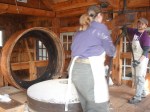
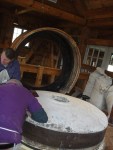

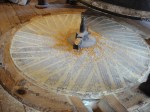


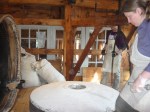


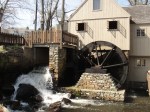
One of the most fascinating displays maintained by Plimouth Plantation is the grist mill. A recent acquisition, the mill grinds corn to show visitors how water powered mills made life possible in the colonies. Because the space is intimate the employees can be very helpful and informative. I learned a lot from my brief visit, and was given some good references to lean more. They employees are very well trained and seem to enjoy working with the visiting public.
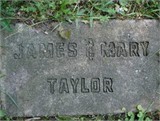
grave James and Mary Taylor
My 7th great grandfather sailed to America when he was 27 years old, to start a new life in the new world. Two different James Taylors on the early Virginia scene make research a bit tricky:
The James Taylor known in history as James Taylor 1st, may be the son of immigrant John Taylor and nephew of the above Dr. James Taylor. He was b in England 1635 and was transported to America under the Headright System by John Rosier of Northumberland Co., Va., 7 Feb 1650. He was well educated, an able lawyer, surveyor, vestryman of the church, and a member of the ‘40’s,’ a group of trustworthy men chosen to defend the Colony against Indians. Each man was levied a tax in arms and provisions. The record of this assignment is in the Parish Register of Northumberland County, Virginia, 1676, listed by Melnor Ljungstead in early court records and notes.
“James Taylor I was a large landowner and he was a prominent citizen in the colony. He was a lawyer and public official and served as a member of the House of Burgesses. He was sheriff of New Kent County in 1690 and vestryman of Saint George’s Parish. He was married, first, about 1666 in Virginia to Frances Walker who died September 23, 1680. He moved to Orange County, Virginia, and belonged to Saint Stephen’s Parish in New Kent County and also in King and Queen County…
“James Taylor I was married, second, to Mary Gregory August 12, 1682. She was born about 1665 and died about 1747. She was a sister of John Gregory, Jr., and they were from Essex County, Virginia. Her father was John Gregory and her mother was Elizabeth Bishop of Sittenbourne Parish, Rappahannock County, Virginia…”
James Taylor of New Kent County 10/21/1687 744 acres Rappahanock County Virginia Land Patents Book 7 page 625 South side of the Rappahanock River, 480 acres granted to Mr. Henry Abery, who sold to Mr. Robert Bishopp, who bequeathed to John Gregory, who gave to his sister Mary, now wife of said James Taylor; said land in danger of being lost was petitioned for by said Taylor the 1st day of the last Genrll. Court -04/15/1687 & granted by the Gov’r; beg. by the Indian Path alias Mr. Abrey’s path, to fork of Gregory’s Creek, on Richard Gregory’s lyne, in sight of John Gatewood’s plantation, to the Rowleing Roade. 246 acres for the transport of 5 persons: James Taylor, Hanna Martin, Robert Jones, Ursula Collis, Hanna Collier.
Mr. James Taylor and John Neal of New Kent County 10/20/1689 209 acres New Kent County Virginia Land Patents Book 8 page 16 in St Stephen’s Parish, on North side of Mattapony (Mattaponi) River, beg. below James Taylor’s plantation, along John Neel’s line, to Col. Thomas Walker, on Robert Jones, To Thomas White’s. Importation of 5 persons: Tho. Grimstone, Hugh Jones, Tho. Allen, Tho. Davis, Anne Brooking.
The Virginia Heraldica Being a “Registry of Virginia Gentry Entitled To Coat Armor” edited by Wm Armstrong Crozier; 2nd addition; Southern Book Co., Baltimore 1953, List James Taylor in Vol 7 on pg 108.
Crest: A naked arm couped at the shoulder embowed, holding an arrow ppr. Motto: Consequitur quodcunque petit. “Strikes what he aims at or he gains what he seeks.”
James Taylor, ancestor of the Caroline County family of that name, is said to have come from the vicinity of Carlisle, England. He was in VA before 1650 and took out patents of land on the Mattaponi River.
An old ring handed down in the family is said to have once been his property, and it bears engraved upon it the above crest which is that of the Taylors of Pennington Castle.
Taylor Caroline county Crest: A naked arm couped at the shoulder embowed, holding an arrow ppr. Motto: Consequitur quodcunque petit. James Taylor, ancestor of the Caroline county family of that name, is said to have come from the vicinity of Carlisle, England. He was in Virginia before 1650 and took out patents of land on the Mattaponi River. By his first wife, Frances, he had Jane, born 27 Dec., 1668; James, born 1674; Sarah, born 1676. His first wife died in 1680, and in 1682 he married Mary, sister of John Gregory, by whom he had the following children: John and Anne, twins, born 1685, John died young; Mary, born 1688; Edmund, born 1690; John, born 1693, died young; Elizabeth, born 1694, died young; John, born 1696. James Taylor died about 1698 at an advanced age. An old ring handed down in the family is said to have once been his property, and it bears engraved upon it the above crest which is that of the Taylors of Pennington Castle. The descendants of James Taylor have been exceedingly prominent in the history of the State, one of them–Zachary, becoming President.
Frances Bell Evans, a Gr Gdau of James Taylor has in her possession a Seal Ring, which bears the Taylor Arms, which he wore, and with the ring the legend has been handed down which is said to have added the fourth Boars’ Head to the Arms. It relates that when the Chase was at it’s height, a wild boar, hard driven, turned upon the Royal Huntsman, whereat there sprang to his defence one of the attending Knights, who interposing, thrust the animal through with his lance. The King, in gratitude, told him to prefer any request whatsoever and that it should be granted. From this time the “Crest” and Distinguishing Mark of this Knight and his descendants was the uplifted Arm with Lance in Hand, accompanied by the Motto:
“Consequitor quadcumque Petit” (He Strikes what He Aims at or He Gains What He Seeks).
The descendants of James Taylor have been prominent in the history of the State, one of them — Zachary, becoming President. A common ancestor with Pres. Lincoln. “Old Taylor” liquor was created by a KY relative.
“There are two recorded dates of the death of James Taylor, one April 30, 1698, and another September 10, 1698. He died in King and Queen County, Virginia, Saint Stephen’s Parish. King and Queen County was formed from New Kent County in 1691.
“James Taylor held many land patents. In 1671 he owned 1,650 acres of land along the Mattaponi River. Between 1687 and 1695 he purchased more land along the Mattaponi so that his total acreage was 13,925. In 1693 he deeded to trustees of South Farnham Parish two acres and fifty perches of land on the south side of Hoskins Creek for a church. He held a patent for 950 acres of land in Kent County, Virginia, where he built his home and named it Hare Forest, named for the Earls of Pennington Castle in England where Taylor ancestors are buried. By division of county lines his home was in Orange County, Virginia, where his children were born. This home is now located in Caroline County, Virginia, about eight miles from Bowling Green, Virginia. He died 30 April 1698, and is buried in King William County, Virginia, which was a part of his estate. (Comment: Note that some of the above information seems to be referring to Dr. James Taylor, the uncle of our James. Researchers beware!- his uncle may have built Hare Forest).
“On 6 June 1933 a memorial tablet to James Taylor 1st was unveiled at King and Queen County courthouse in Virginia. Dr. Rupert Taylor, Senator Henry Taylor Wickham and Admiral Hugh Redman of the U.S. Navy addressed the gathering. Following is some information taken from excerpts of their speeches: New Kent County was formed in 1654. King and Queen was formed from New Kent 1691. Essex was formed in 1692, King William 1701 and Caroline in 1727.
“In 1690 as Sub-Sheriff of New Kent, County, Virginia, James Taylor served summons on those connected with Jacobite disturbances. He was Attorney of several cases in Essex County. He was also connected with trying to stop the lawless organization known as ‘Plant Cutters,’ who destroyed and burned tobacco plants and beds at night in an effort to control the price of tobacco.
In 1683 Gov. Henry Chicheley called out the militia, arrested and punished the offenders. However, Lord Culpepper who represented England’s interests, didn’t agree with the decision. Consequently many were indicted and ‘hanged by the neck until they were dead.’
The Tablet is inscribed as follows:
“James Taylor of England emigrant lawyer, public officer, lived in St. Stephen parish, King and Queen County, Virginia, died April 30, 1698, first wife, Frances Walker, born 1640, died April 22 or Sept 22, 1680, she was the daughter of Thomas Walker and niece of Edward Walker of Virginia. James’s second wife, Mary Gregory, daughter of John Gregory the son of Roger Gregory who first married Mildred Washington, aunt of General/President George Washington. Mary was from Essex County, married August 12, 1682, from him were descended , President James Madison, President Zachary Taylor, Colonel James Taylor (Knighe of the Horse Shoe), Judge Edmond Pendleton, John Penn signer of the Declaration of Independence, John Taylor of Carolina, General James Taylor of Kentucky, Admiral David Taylor, Admiral Hugh Rodman, Admiral Robert M. Berry, and other distinguished churchmen, soilders, sailors and officials, in each generation who assisted in the formation and perpetuation of the colonies and this nation”.
“This tablet given by Jaquelin P. Taylor, seventh in descent, June 1933.” A short biography of James Taylor, filled with the errors alluded to above, is contained in Carte’s The Forebearers and Descendants of William Taylor and Mahala Cromwell:
“The Forebearers & Desc of Wlm Taylor & Mahala Cromwell” by Carrie Carte 1980 LDS 929.273T219c “Americans of Gentle Birth & Their Ancestors” LDS 973D2pa “Historical Southern Families” by Boddie LDS 975D2B Vol 4 & 5 Note:James Taylor age 28 is listed as a px on the Truelove of London to Bermuda in 1635 (from “The Original Lists of Persons of Quality 1600-1700 by John Hotlen 1931) See the 1st listed doc above for info on the Taylor home & cemetery James Taylor was a lineal desc of the Earls of Pennington & emigrated in 1635.
[Comment: Note that some of the above information, especially the dates, seems to be referring to Dr. James Taylor, the uncle? of our James. Researchers beware!]
In Family Puzzlers, Feb 3, 1977, No. 485: The Taylors of Orange trace their ancestry back to James Taylor of Carlisle, ENG. The time of his emigration to VA is not actually known. He settled on Chesapeake between North and York Rivers, and died in 1698.
Jamestown VA – 1624 MARTINS HUNDRED VA T460 ? TAYLOR 1624 JAMES CITY CO. VA T460 TAYLOR, Fortune
Moss, Mary m. 19 Aug., 1724, John Taylor. St. Paul’s Parish Register.
Submitted by Sara Beth Swope, a descendant of Mary & Samuel J. Dunn. 8/97; EMail: sbswope@netten.net
In 1987 she found the old Lewis-Taylor Cemetery now Crowder Cemetery, near Whiteville, Hardeman Co. TN. She mailed me Bible records, wills, charts, other researchers notes; a great deal of data on the Joseph Taylor and Mary Ann Taylor families who migrated to Hardeman Co. TN. See list below.
History of Fayette Co. TN. 1986; Family Puzzler 2-3-77 No. 485; Mary Ann Blackwell Bible records; R. B. Shore Bible Records; 1985 Taylor Descent; Shore chart & Shore Descent; Crowder Cemetery Picture; Rev Thomas Taylor memoirs; Joseph Taylor’s will and 1985 letter; Ancestory of Elizabeth Willis Goode by Carol J. McCraw and Col. Joseph Taylor record.
Other sources where info on James Taylor can be found are listed below some with conflicting info. One Thousand Years of Hubbard History Genealogy of the Cloyd Basye and Tapp Families Beverly’s History of VA St. Mark’s p. 74; Genealogical and Historical Notes on Culpeper, VA Register of Maryland’s Heraldic Families Vol 1 The Lewis Family of the Seventeenth Century
“Of Carlisle, ENG; much of the descent and vital statistics from NGS Quarterly Vol XVIII, Jun 1930, No 2. Located in VA between the York and North Rivers. 1693 DEED: King and Queen Co, VA, DB 8-268. Capt. Joshua Story, James Taylor, and Jonathan Fisher 9,150 acres. 1694 DEED: King and Queen Co, VA, DB 8-317. James Taylor 134 acres. 1695 DEED: King and Queen Co, VA, DB 8-414. James taylor 500 acres.
According to this researcher: Name is James Cary Taylor Birth: 1615 in Earl Hare,Carlisle,England 1 Death: 12 Sep 1698 in King And Queen,Virginia Father: Thomas Taylor b. 15 Mar 1574 in Hadley,Middlesex,London,England Mother: Margaret Swinderby b. 1578 in Copenhagen,Denmark Burial: Bowling Green,Caroline County,Virginia Mary Bishop Gregory (Wife) b. 1665 in Essex,Caroline County,Virginia Marriage: 12 AUG 1682 Children: Elizabeth Taylor b. 1684 Ann Taylor b. 1684 Mary Taylor b. 1686 Mary Bishop Taylor b. 2 Jun 1688 in Caroline County,Virginia John Powell Taylor b. 18 Nov 1696 in Caroline County,Virginia
Frances Walker (Wife) b. 1640 in Accomoac. Accomack County,Virginia Marriage: 1666 in New Kent County,Virginia Children: James Taylor b. 1668 James Taylor b. 14 Mar 1675 in King And Queen,Virginia Jane Taylor b. 1674 Sarah Taylor b. 1676
James Taylor held many land patents. In 1671 he owned 1,650 acres of land along the Mattaponi River. Between 1687 and 1695 he purchased more land along the Mattaponi so that his total acreage was 13,925. In 1693 he deeded to trustees of South Farnham Parish two acres and fifty perches of land on the south side of Hoskins Creek for a church. He held a patent for 950 acres of land in Kent County, Virginia, where he built his home and named it Hare Forest, named for the Earls of Pennington Castle in England where Taylor ancestors are buried. By division of county lines his home was in Orange County, Virginia, where his children were born. This home is now located in Caroline County, Virginia, about eight miles from Bowling Green,Virginia. He died 30 April 1698, and is buried in King William County, Virginia, which was a part of his estate. (Comment: Note that some of the above information seems to be referring to Dr. James Taylor, the uncle of our James. Researchers beware!- his uncle may have built Hare Forest).
James Taylor (1608 – 1698)
is my 7th great grandfather
John Taylor (1685 – 1776)
son of James Taylor
John Taylor (1727 – 1787)
son of John Taylor
John Taylor (1747 – 1781)
son of John Taylor
John Nimrod Taylor (1770 – 1816)
son of John Taylor
John Samuel Taylor (1798 – 1873)
son of John Nimrod Taylor
William Ellison Taylor (1839 – 1918)
son of John Samuel Taylor
George Harvey Taylor (1884 – 1941)
son of William Ellison Taylor
Ruby Lee Taylor (1922 – 2008)
daughter of George Harvey Taylor
Pamela Morse
I am the daughter of Ruby Lee Taylor
 mermaidcamp