mermaidcamp
Keeping current in wellness, in and out of the water
You can scroll the shelf using ← and → keys
You can scroll the shelf using ← and → keys
Tara is the magical center of the Emerald Isle. Maeve is the goddess of Tara. A self affirming magical Irish legend, Maeve was the sensual primal woman. Her name means intoxicated woman. She rules sovereignty as well as sexuality. As a symbol of the sovereign, she temporarily married the Kings of Ireland, and rejected those not up to the job. She is perhaps all legend and may have been a real queen.
Celtic women did not suffer the same unequal status as other Euro women. They held property and went to war. Queen Maeve granted sexual favors to the most valiant members of her army as part of standard operating procedures. She, like Cleopatra, was said to have had a multitude of lovers. Her husband had extramarital activity also. They went to war with each other over a bull. She felt the need to have exactly as much property as her husband, and allowed her lusty passion to turn to war. Her story, not recorded, but passed down in Celtic mythology, warns that hot passion can go either way. This wild, drunken, sexy queen had her way with Ireland, and perhaps still does.

Wemyss castle
Mine is a lowland clan derived from the McDuffs. My 21st great- grandmother was born in her own castle in Fife in 1322. It has been rebuilt, but is still privately owned by my family in Fife. I know someone who went to her ancestral castle in Scotland, and was invited in and treated very well by the contemporary royal inhabitants. These clansmen can have a broad idea of family, if you are truly in the bloodline. I am not really expecting the Wemyss clan to welcome and embrace me, but I would not mind seeing the gardens open to the public that have been created by my clan.
Margaret Wemyss (1322 – 1342)
from Electronic Scotland Com. The Scottish Nation – Wemyss:
This Sir David Wemyss, the elder son of Sri Michael, had a son, Sir David Wemyss, who was one of the guarantees for the release of David II., and this baron’s son, also named Sir David, was one of the hostages for that monarch’s ransom. The latter left a daughter, Margaret, married to Sir Patrick de Inchmartine, and by him had a daughter, Isabel de Inchmartine, heiress of that barony. This last married Sir Alan Erskine, and had two daughters, his co-heiresses, Margaret, wife of Sir John Glen, and Isabel, married to Sir John Wemyss of Rires and Kincaldrum, the heir male of the family. Besides the lands he held from his father, and those disponed to him by his father-in-law, he had extensive grants of lands in Fife and elsewhere, from Robert II. and Robert III. He had three sons, the second of whom, Duncan, was one of the hostages on the liberation of James I., and the third, Alexander, was ancestor of the family of Wemyss of Lathocar

Tulsa race riot 1921

Race riot Tulsa 1921
My father, Richard Arden Morse, was a bit of a racist, but did not have any idea of his own pedigree. His great-grandfather came to New York from Ireland during the potato famine with his O’Byrne parents and siblings, who dropped the O’ to assimilate. When asked, my father would say he was Scots Irish. This American term refers to the Ulster Scots, who have all those Orange issues in Northern Ireland. A little flash of orange ribbon drives these people, and their neighbors, completely batty. You would need to be born in Ulster to understand this, I think. The troubles are a completely local phenomena, although both sides have supporters elsewhere.
Richard Arden was born in Independence, Kansas on Feb 18, 1920. In December of 1920 armed violence broke out between white and black citizens of that town. It was a very small town, and this had to be a big impact on the area. In 1921 the city of Tulsa, where I was born, was host to one of the most violent of race wars of all time. The Tulsa racial violence of 2 June, 1921 was distinctly ignored by Oklahoma official history until very recently. I only lived in Tulsa for about 4 years, and my dad also left Independence with his family to live near Ponca City, Oklahoma during his school years.
He was for sure Irish, and when Mr. Scott married Ms Byrne, he was trending Scot again. However, I do not think he knew what any of this meant. I believe that my father’s racial prejudice was a karmic and cultural affliction. He did not openly dislike anyone because of race, but his actions betrayed his deeper ethics. To his credit, he and my mom made an effort not to pass the racist culture on to my brother and me.
Bridget OByrne (1808 – 1880)
is my 3rd great grandmother
James Oscar Byrne (1840 – 1879)
son of Bridget OByrne
Sarah Helena Byrne (1878 – 1962)
daughter of James Oscar Byrne
Olga Fern Scott (1897 – 1968)
daughter of Sarah Helena Byrne
Richard Arden Morse (1920 – 2004)
son of Olga Fern Scott
Pamela Morse
I am the daughter of Richard Arden Morse
Bridget O’Byrne was typical, but lucky. She survived the passage to New York, and most of her kids did also. She had a home in upstate New York. Sarah Helena, her daughter in law, wrote the notes I used to start my tree. The O’Byrnes of Wilna, Jefferson, NY gave their estate to a Catholic church there, and left the records of their family history with that church. A treasure hunt awaits me in upstate New York that may reveal all the Irish information I can handle, including Bridget’s family name. The Catholics of Wilna have my bingo card, and I am grateful.
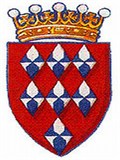
De Burgh Coat of Arms
My 20th great grandmother was born in Ulster, and died in Kildare, Ireland. Her father,Richard Og, was Earl of Ulster and a very powerful man:
Richard Og de Burgh, 2nd earl of Ulster (1259 – July 29, 1326), called The Red Earl, was one of the most powerful Irish nobles of the late 13th and early 14th centuries, a son of Walter de Burgh, the 1st Earl of Ulster (of the second creation) and Lord of Connacht.[1] His name, “Richard Og”, meant Richard the Young, probably a reference to his youth when he became earl in 1271, or to differentiate him from his grandfather, Richard Mor. He was also known as the Red Earl.
Richard Og was the most powerful of the de Burgh Earls of Ulster, succeeding his father in Ulster and Connacht upon reaching his majority in 1280.[1] He was a friend of King Edward I of England, and ranked first among the Earls of Ireland. Richard’s wife Marguerite de Guînes was the cousin of King Edward’s queen. He pursued expansionist policies that often left him at odds with fellow Anglo-Irish lords.
His daughter Elizabeth was to become the second wife of King Robert the Bruce of Scotland. However, this did not stop him leading his forces from Ireland to support England’s King Edward I in his Scottish campaigns and when the forces of Edward Bruce invaded Ulster in 1315, the Earl led a force against him, but was beaten at Connor in Antrim. The invasion of Bruce and the uprising of Felim O’Connor in Connacht left him virtually without authority in his lands, but O’Connor was killed in 1316 at the Second Battle of Athenry, and he was able to recover Ulster after the defeat of Bruce at Faughart.[1]
He died July 29, 1326 at Athassel Priory, near Cashel, County Tipperary.
Children and family
Lady Joan De Burgh, Baroness Darcy (1290 – 1359)
Lady Joan de Burgh was the daughter of Richard de Burgh, 2nd Earl of Ulster and Margaret.1 She married, firstly, Thomas FitzJohn FitzGerald, 2nd Earl of Kildare, son of John FitzThomas FitzGerald, 1st Earl of Kildare and Blanche de la Roche, on 16 August 1312 at Greencastle, County Down, Ireland.2 She married, secondly, Sir John Darcy, 1st Lord Darcy de Knayth, son of Sir Roger Darcy and Isabel d’Aton, on 3 July 1329.3 She died on 23 April 1359.1 From 16 August 1312, her married name became FitzGerald.1 As a result of her marriage, Lady Joan de Burgh was styled as Countess of Kildare on 12 September 1316. From 3 July 1329, her married name became Darcy.3
Children of Lady Joan de Burgh and Thomas FitzJohn FitzGerald, 2nd Earl of Kildare
· John FitzGerald2 b. 1314, d. 1323
· Maurice FitzThomas FitzGerald, 4th Earl of Kildare+1 b. 1318, d. 15 Aug 1390
· Richard FitzGerald, 3rd Earl of Kildare2 b. c 1319, d. 7 Jul 1333
Children of Lady Joan de Burgh and Sir John Darcy, 1st Lord Darcy de Knayth
· Elizabeth Darcy+3
· Aymer Darcy3
· Roger Darcy3
· Sir William D’Arcy+3 b. 1330
Citations
1. G.E. Cokayne; with Vicary Gibbs, H.A. Doubleday, Geoffrey H. White, Duncan Warrand and Lord Howard de Walden, editors, The Complete Peerage of England, Scotland, Ireland, Great Britain and the United Kingdom, Extant, Extinct or Dormant, new ed., 13 volumes in 14 (1910-1959; reprint in 6 volumes, Gloucester, U.K.: Alan Sutton Publishing, 2000), volume VII, page 222. Hereinafter cited as The Complete Peerage.
2. Charles Mosley, editor, Burke’s Peerage, Baronetage & Knightage, 107th edition, 3 volumes (Wilmington, Delaware, U.S.A.: Burke’s Peerage (Genealogical Books) Ltd, 2003), volume 2, page 2298. Hereinafter cited as Burke’s Peerage and Baronetage, 107th edition.
3. Charles Mosley, Burke’s Peerage and Baronetage, 107th edition, volume 1, page 1027.
I will soon have the opportunity to learn about the history of my ancestors in the museum at Plymouth, MA. This young man named Philip eloquently describes the first world war, which he believes happened on his homeland. I agree with him. The culture that introduced war rather than ball games for conflict resolution not only wiped out the Wampanoag population, but disrespected all aspects of the sovereignty of the nations who lived here. Forcing them from Eden is a pretty accurate way to describe what the Euro colonists did. They had everything (except yellow fever) before the colonists landed. Now a remnant of the culture is reenacted at Plymouth for tourists. There is also a small museum at Mashpee which I plan to visit. I am getting very excited about seeing it all in person.

Gov Thomas Dudley
Birth: Oct. 12, 1576, England,Death: Jul. 31, 1653BostonSuffolk CountyMassachusetts, USA Colonist, Colonial Governor. He was the second Governor of Massachusetts Bay Colony and member of the first Board of Overseers for Harvard “College.” Born in Northahmpton, England he married Dorothy Yorke and came to the colonies in 1626 as many did to follow the teachings of Reverend John Cotton. He and his wife came to the New World on the “Arabella” and after feeling that Plymouth was too vulnerable for attack by sea he and other members, most notably John Winthrop and Simon Bradstreet traveled up the river to higher ground. They traveled up the river and climbed a hill on the North shore. Local legend states that Dudley then thrust his came into the ground and declared “This is the place.” The location is now the corner of John F. Kennedy and Mount Auburn Streets. It is through this story that Thomas Dudley is considered the founder of Cambridge. Thomas’s wife Dorothy died in 1643 and the next year he married Katherine (Dighton) Hackburne, a widow. They moved from Cambridge and settled in nearby Roxbury. Thomas had eight children in all, five by Dorothy Yorke and three by Katherine Dighton. The most notable of his offspring was Joseph Dudley (born 1647) who became the future royal governor of Massachusetts. Joseph was born when Thomas was 70 years of age. In 1650 as one of his first acts as governor, he signed the charter to Harvard College, establishing the guidelines in which the University still uses for operation today. Harvard’s famed Dudley House is named for him as is Dudley Station in Roxbury on the commuter train line. He also established the Roxbury Latin School during the years he lived in that section of the city, the school is still open today and is considered one of the first public schools in America. He was a founder of the First Church at Boston, where a tablet honoring him was place. (bio by: R. Digati)
Gov. Thomas Dudley (1576 – 1653)
is my 10th great grandfather
Anne Dudley (1612 – 1672)
daughter of Gov Thomas Dudley
John Bradstreet (1652 – 1718)
son of Anne Dudley
Mercy Bradstreet (1689 – 1725)
daughter of John Bradstreet
Caleb Hazen (1720 – 1777)
son of Mercy Bradstreet
Mercy Hazen (1747 – 1819)
daughter of Caleb Hazen
Martha Mead (1784 – 1860)
daughter of Mercy Hazen
Abner Morse (1808 – 1838)
son of Martha Mead
Daniel Rowland Morse (1838 – 1910)
son of Abner Morse
Jason A Morse (1862 – 1932)
son of Daniel Rowland Morse
Ernest Abner Morse (1890 – 1965)
son of Jason A Morse
Richard Arden Morse (1920 – 2004)
son of Ernest Abner Morse
Pamela Morse
I am the daughter of Richard Arden Morse
Thomas was taken in as an orphan by by his great uncle, Richard Purefoy, brother of his mother’s mother. He lived with them at the Manor Faxton, about 20 miles from Yardley Hastings. At the age of 21 he was commissioned by Queen Elizabeth as a Captain to go to the aid of Henry IV of France at the seige of Amiens by the Spanish. He raised a company of 80 men, but by the time he reached France, the fighting had ended. He worked as steward (business manager) for the Earl of Lincoln, eventually leaving in 1627 (his soon to be son-in-law Simon Bradstreet took the position). He moved to Boston, Lincolnshire, England, and came under the influence of the Rev. John Cotton. He became a Nonconformist, a zealous Puritan and interested in settling in New England with the Mass. Bay Company. In 1629, he was one of the few who established the Mass. Bay Colony.He returned to manage the Earl of Lincoln’s estate until the Earl was imprisoned. Because of the continued persecution of non-conformists, he joined Winthrop’s expedition and sailed to New England aboard the flagship Arbella as Deputy Governor.The fleet arrived at Salem on 12 June 1630 where Governor Endicott and a group of settlers who had emigrated in 1628 had set up a colony but had few supplies. He moved to Charlestown and was one of the signers of the covenant of the First Church of Charlestown. In 1631 he moved to Newtowne (now Cambridge) and eventually moved to Ipswich. By 1639 he had moved to Roxbury to be nearer to Boston, the capital of the colony.The first general election by Freemen in the colony was held in May 1634 and Thomas Dudley was elected governor (John Winthrop had been governor since the founding of the colony – the people turned against him when it was discovered that he was holding the legislative powers amongst his court of assistants in contradiction to the charter). Dudley was reelected in 1640, 1645 and 1650 and was Deputy Governor for 13 years as well. All offices were for one year terms.
ref:above information copied from Owings Stone Family genealogy site.

Harvard Charter

Portsmouth Compact
The Puritans left England for religious freedom. As soon as they arrived in New England some of them needed to be religiously free of the Puritans in Plymouth. These ultra free people formed their own “Plantations” in Rhode Island. One such Bodie Politick was Portsmouth, which made it’s political agreement in 1638 with God Himself.
The Portsmouth Compact
The following is quoted from the book Story of Dr. John Clarke; The Founder of The First Free Commonwealth of the World; on the Basis of “Full Liberty in Religious Concernments” by Thomas W. Bickness, published by the Author, Providence, R. I., 1915; third edition. Note: In the book is a picture of the compact which has been scanned in color for these pages. The transciption has been corrected to spell Phillip Shearman’s name with two “L”s and to add the words “his mark” as they appear next to Henry Bull’s name and under his mark “+”.
Prior to leaving Boston, a compact was drawn up, under date of March 7, 1638, by which a number of the leading men of the proposed Colony incorporated themselves into “A Bodie Politik” to the end that they might go to their new Plantation in a formal organization, under a chosen leader or Governor.
The compact is as follows:
The 7th Day of the First Month, 1638
We whose names are underwritten do hereby solemnly in the presence of Jehovah incorporate ourselves into a Bodie Politick and as He shall help, will sub- mit our persons, lives and estates unto our Lord Jesus Christ, the King of Kings, and Lord of Lords, and to all those perfect and most absolute laws of His given in His Holy Word of truth, to be guided and judged thereby. William Coddington John Clarke William Hutchinson, Jr. John Coggeshall W illiam Aspinwall Sa muel Wilbore John Porter John Sanford Edwa rd Hutchinson, Jr. Esq. Thomas Savage Willi am Dyre William Freeborne Ph illip Shearman [ John Walker Richa rd Carder Willi am Baulston Edw ard Hutchinson, Sr. + H enry Bull [“his mark” written next to name] Randal l Holden
Exodus, 24c., 3:4.II Cron., 11c., 3. II Kings, 11:17.
This compact was signed originally by twenty-three persons. The original paper is in the keeping of the Secretary of State, at the State House, Providence, a photograph of which appears on the opposite page. Four names,– Thomas Clarke, brother of John, John Johnson, William Hall and John Bright-man, Esq.,– follow the nineteen that appear above. Erasure marks have been made over these names, the reason for which it is not easy to understand as the first three were among the first recorded settlers of Newport, and Mr. Brightman may have been.
Neither was a Constitution nor a Bill of Rights for a Colony. Boston called the compact an act of incorporation. Plymouth called theirs a covenant, Boston did the act in “the presence of Jehovah,” Plymouth wrote “in the presence of God.” Boston formed a “Bodie Politick,” Plymouth called theirs a “Civill Bodie Politick.” Boston submitted their “persons, lives and estates unto our Lord Jesus Christ.” * * * ** “And to all those perfect and most absolute lawes of His given us in His Holy word of truth, to be guided and judged thereby.” Plymouth promised submission and obedience to such “just and equal lawes, ordinances, acts, constitutions and offices” as might be enacted, constituted and framed. Each compact had for its purpose the formation of a civil state under an orderly government. The Boston paper was probably written by Dr. John Clarke, whose piety and purpose lent a strongly religious sentiment to the document, so much so that some historians have called it theocratic. But Dr. Clarke did not classify The Christ as a theocrat, for all his writings make the great Teacher the interpreter of a new Democracy in which soul-liberty is established and enforced.
Samuel G. Arnold, our Rhode Island historian, has given a very clear and just interpretation of the Portsmouth Compact. He says, “So prominent indeed is the religious character of this instrument, that it has by some been considered, although erroneously, as being itself ‘a church covenant, which also embodied a civil compact.’ Their plans were more matured than those of the Providence settlers. To establish a Colony independent of every other was their avowed intention, and the organization of a regular government was their initial step. That their object was to lay the foundation of a Christian state, where all who bore the name might worship God according to the dictates of conscience, untrammelled by written articles of faith, and unawed by the civil power, is proved by their declarations and by their subsequent conduct.” * * * *
My 10th great grandfather was on the list signing the document breaking up totally with England, church and state. They were disarmed and put in jail by the Puritans for praying in the home of Anne Hutchinson. They decided to leave.
Richard Carder (1604 – 1675)
is my 10th great grandfather

Portsmouth Compact

Providence, RI
John was born ca 1617 based on his age at the time of death, probably in England. In 1632 he came to Dorchester, Massachusetts, in service to Israel Stoughton, carpenter. He married by about 1640, Sarah . Since John was a young, unmarried servant when he first arrived in Dorchester, it is not surprising that he does not appear in the records very often during the 1630s. However, he also generated remarkably few records between 1640 and 1658, during which period he lived in Dorchester as a married man.
On October 3, 1632 the General Court ordered that “Alex: Miller & John Wipple shall give iijs iiijd apiece to their master, Israell Stoughton, for their wasteful expense of powder & shot”. On January 2, 1637/8 John was granted eight acres in Dorchester about the mill. “John Whiplle” was the last of the Dorchester proprietors to sign his name to an agreement submitting to arbitration a dispute over the fencing and division of land.
In 1641, John and Sarah became members of the Dorchester church. On November 15, 1658 “John Whiple of Dorchester…carpenter” sold to George Minot of Dorchester “his now dwelling house and housements scituate and being in Dorchester near the River Naponset together with thirty-seven acres of upland more or less thereto adjoining,” also “eight acres of salt marsh more or less lying near the place commonly called the penny ferry”; “Sarah the wife of the said John Whiple” relinquished her dower rights.” John then moved his family to Providence, Rhode Island.
On July 27, 1659, he was received in Providence as a purchaser. On February 3, 1661/2 John Whipple Sr. petitioned for a piece of land next to his orchard, but his will was referred to the next court. On July 27, 1662 John Whipple Sr. was permitted to exchange sixty acres at Mashapauge Pond for lands at Loquasqussuck. These lands were probably the eights acres at Loquasqussuck laid out to him by Thomas Harris Sr. on April 13, 1667. On November 23, 1663 John Whipple Sr. of Providence deeded to “my son John Whipple” a houselot formerly owned by William Arnold excepting two acres, two shares of meadow, six acres of upland, sixty acres of land at Loquasqussuck. On February 19 John Whipple Sr. drew lot #45 in the division of lands east of Seven Mile Line.
On November 13, 1666 John Whipple Sr. was granted permission to exchange his sixty acres at Tare Breech Plain. On February 24, 1674 John Whipple St. gave a deed of gift to his “son Eliezer Whipple”. On April 12, 1675 he drew lot #43 in the lands on the west side of Seven Mile Line. On January 27, 1674/5 John Whipple Sr. was granted permission to change a fifty-acre division of upland. On May 24, 1675 he drew lot #91 in the land on the east side of Seven Mile Line. He was among those who “stayed and went not away” in 1676 and as such was entitled to share in the disposition of Indian captives, whose services were sold for a term of years. On June 6, 1681 John Whipple Sr. was granted permission to exchange his twenty-five acres at Goatum valley “which he bought of Mr. Benedict Arnold”. On March 4, 1683/4 John Whipple Sr. made a deed of gift to his “son David Whipple”.
John was a carpenter and tavern-keeper. In 1669 John Whipple, Sr. was paid 10s. to allow the town council to meet at this house. In 1670 the amount was raised to 20s. He took the Oath of allegiance (freeman) May 31, 1666.
John held several offices in Providence. He was Deputy to the General Court, September 4, 1666. He served on a Petit jury October 19, 1670. John was a Providence selectman, 1670, 1674, and on April 27, 1676 he was made moderator. He served as Treasurer, June 1, 1668 and Surveyor, June 6, 1670-71. John was on the Committee to run the line, January 27, 1663/4 and on the Committee to consider building a new town house. He was on a jury, May 12, 1663. He was appointed to confer about mending a bridge, January 27, 1664/5, October 28, 1667. He was appointed to a Committee to arbitrate over fences, December 2, 1666. John was an arbiter in the matter of the estate of Resolved Waterman, deceased, January 9, 1700/1. He served on the Committee to “demand & receive at every garrison what was taken from the Indians,” September 7, 1676 and on the Committee to lay out a common, April 27, 1678.
John died on May 16, 1685 at Providence. Sarah predeceased him, dying sometime in 1666.
In his will, dated May 8, 1682 and proved May 27, 1685, John Whipple Sr. of Providence “being in a great measure of health…having many children & to prevent all differences that otherwise may hereafter arise…having formerly given unto three of my sons all my lands…namely Samuell, Eliazer & William equally to be divided among them…only excepting thirty acres which I gave unto my son John at the northwest end”; to “my three aforenamed sons, namely Samuell, Eliazer & William, each of them a quarter part of one right of commoning for pasturing, cutting of timber, & firewood”; to “my son Benjamin a right of lands in the late division which is already laid out unto him”; to “my son Jonathan one division of lands”; to “my son Joseph my dwelling house & my three home lots & the garden next the river, also a six acre lot…also twenty acres near Thomas Clemence his dwelling, also I give unto my son Joseph my share of meadow near Solletarey Hill & two six acre lots…also a five acre lot lying near where William Wickenden formerly dwelt; also one division beyond the Seven Mile Line…also I do give unto my son Joseph all other divisions which shall hereafter belong unto two rights throughout”; to “my sons John, Samuell, Eliazer, William, Benjamin, David & Jonathan unto these seven twelve pence to every of them”; to “my three daughters (namely) Sarah, Mary & Abigall unto every of them ten shillings”; to “my son Joseph all my right of lands in the Narragansett Country”; to “my son Joseph” residue; “my son Joseph my executor.”
In May of 1685, Thomas Olney, Town Clerk of Providence, deposed that he had gone to John Whipple, at his request, and obtained clarification of some of the bequests:
That upon ye sixteenth day of this instant may John whipple senior of the aforesaid towne of Providence sent for to speake with him; This deponant sayth he Emediatly went to him: the said John whipple then shewed him this paper & the writeing which on ye other side of this said paper is written down, desireing this deponant to peruse it. This deponant saith he then did peruse it, & haveing well perused it, he asked the said John whipple what his mind was concerning ye lands which in ye said writeing he had desposed of to his severall sons, whether or no he did intent by that writeing, or will that ye said lands should be unto his said sons & theire Heirs & Assignes for Ever, or only unto his said sons for terme of life, he Emediatly made this Answer; That how Ever it was worded in ye said writeing yet his mind & will was that his sons Each one of them should have those lands house & Rights which hee in ye said writeing unto Each one of them had desposed, to be unto them, theire Heirs & Assignes for Ever to despose ye same or any part thereof at any time as they see cause. & that ye same was his Mind & Will when ye said will was written: And further, that whereas in ye said Will it was omitted to be inserted that his son Jonathan should have one of his Rights of land & Comoning on ye west side of ye seven mile line, yet that was his mind & will; That his son jonathan whipple should have one of his Rights of land & Comoning on ye west side of ye seven mile line to be unto him his Heires & Assignes for Ever; and that was his mind when ye said will was written, how Ever by ye scribe it was omitted. And whereas in ye first part of ye said Will there is an Exception made only of thirty acres of land to his son John by him formerly given, that he owned to be a mistake, & that ye Exception must be of sixty acres which formerly by deede of Gift he had given to his son John whipple; and all the remainder of his said farme lieing about Loquasqussuck should be devided Equally betweene his said three sons (viz) Samuell, Eliezer, & william; This saith this deponant is trueth, & that hee tooke it Emediatly from ye said John whipple his mouth & wrott it downe. And also that whereas the said Will Expresseth a quarter part of a Right of Comoning to Each of his three sons, (namely) Samuell, Eliezer & william, he said his Meaneing intent & will was that it should be so farr westward as ye Seven mile line & no further; And that the said John whipple was then when hee did declare the Same of Sound mind & of Good memory May ye 27th: 1685 upon Oath…
The inventory of John Whipple Sr. was taken May 22, 1685 and totaled £41 11s. 10d., including no real estate, viz: yoke of oxen, 2 cows, 2 yearlings, 2 two years, 2 calves, steer, 3 swine, feather bed, 7 pewter platters, 5 pewter porringers, 3 old spoon, chisel, gauge, augurs, etc.
Captain John Whipple is buried in the Whipple family plot in the North Burial Ground on Main Street in Providence, Rhode Island. Some sources indicate that John and his wife Sarah were initially buried in the garden burial site near their home. Their bodies were moved to the North Burial Ground when it was established in 1700. The headstones of John and his wife Sarah are located approximately 48 feet west-south-west of the “Dahlia Path” sign in the cemetery. On the tomb stones of John and Sarah Whipple, in the north burial ground in Providence, are the following inscriptions:
In Memory ofCapt. John Whipple, whowas born in England &Died in Providence Townye 16th Day of May AnnoDom. 1685. About 68years of age
In Memory of Mrs. SarahWhipple, wife of Capt.John Whipple. She wasborn in Dorchester, inNew England, & Died inProvidence, Anno Dom.1666. Aged about 42years
Many published genealogies state John Whipple married Sarah They or Darling ca 1639. (He would have been 22-23, she 15-16.) No evidence has been found to confirm that Sarah’s maiden name was either They or Darling. Neither appears among early Dorchester surnames; the closest being Thayer. Sarah’s tombstone states she was born in Dorchester and died in Providence in 1666, aged about 42 years. The stones do not appear to be very ancient and may have been erected fifty years or more after the decease of Capt. Whipple and his wife. But if the year and age are correct, she would have been born ca 1624. Thus, she could not have been born in Dorchester, unless she was a Neponset Indian, since Dorchester wasn’t founded until 1630. English settlers didn’t marry Indians in those days, so we can presume she was white. With a birth date of 1624, we can be sure that if she was born in New England, it must have been in Plymouth, which was settled in 1620. Travel by a ferry at a cost of a penny per person between Dorchester and Plymouth was common in 1638.
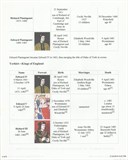
House of York
The British royals married as many people as possible, I think, and procreated with yet others. There were battles and schemes to take power from each other which I had never studied. I knew my maternal great grandmother from Selma Alabama was a descendant of these Plantagenet people. My brother once saw QE II in a convertible in Tobago in 1966 when he was less than 3 years old. The Queen and Price Philip stayed very near my parents at the Crown Point Hotel, right next to the airport. Little Ricky formed a highly unnatural interest the Queen. He had a little flag from that royal moment that he kept forever. None of them knew as they waved at Her Highness that both my parents are historically royally mixed up with the crown of Britain. Now that Richard III has been exhumed I looked into my relationship with him. On my mother’s side he is my uncle:
Richard III King of England Plantagenet (1452 – 1485)
is my 13th great grand uncle
Richard Plantagenet (1411 – 1460)
Father of Richard III King of England
Anne Plantagenet (1490 – )
Daughter of Richard
Henry Holland (1527 – 1561)
Son of Anne
John Holland (1556 – 1628)
Son of Henry
Francis Gabriell Holland (1596 – 1660)
Son of John
John Holland (1628 – 1710)
Son of Francis Gabriell
Elizabeth Holland (1652 – 1737)
Daughter of John
Richard Dearden (1645 – 1747)
Son of Elizabeth
George Dearden (1705 – 1749)
Son of Richard
George Darden (1734 – 1807)
Son of George
David Darden (1770 – 1820)
Son of George
Minerva Truly Darden (1806 – )
Daughter of David
Sarah E Hughes (1829 – 1911)
Daughter of Minerva Truly
Lucinda Jane Armer (1847 – 1939)
Daughter of Sarah E
George Harvey Taylor (1884 – 1941)
Son of Lucinda Jane
Ruby Lee Taylor (1922 – 2008)
Daughter of George Harvey
Pamela Morse
I am the daughter of Ruby Lee
Than again Richard III is my 14th great grandfather. I shudder to think how many different ways I may find to be his relative….I found another version in which he is my 1st cousin 17 x removed..He may well be all those things…
The Wampanoag tribe is known as the People of the First Light because they lived, hunted, fished and made wampum along the outer banks of New England before the Pilgrims landed. The dawn as viewed on this side of the Atlantic assures one that Europe is distant. New dawn in a new world is powerful natural medicine. As goes the story all across the nation, that medicine proved to be easily hackable by flim flam Euros. The First Light, and all the real estate with a fine view of same was desired by colonial imperialists as soon as they found it. Bare naked greed was employed to occupy the territory, form a government, and launch right into a big fat slave trade with big fat profits. Early in the disagreements King Philip, a native with a following, attempted to oust the invaders. This was used by the colonists as an excuse to starve and otherwise decimate the surviving native inhabitants in order to occupy all their real estate.
These same religious zealots who gave us the Salem witch trials used the Harvard Indian College as a political ploy to gain financial support in England for conversion of whatever was left of the heathen native people. This institution in Cambridge, like the Indian boarding schools in the western US, was designed to strip the natives of language and culture in order to make them good Christian citizens. Why colonize a place if you can’t decimate the population and make good fearful Christians of the survivors?
 mermaidcamp