mermaidcamp
Keeping current in wellness, in and out of the water
You can scroll the shelf using ← and → keys
You can scroll the shelf using ← and → keys

Mayflower document
My family in history is LOADED with Pioneers, including my own parents. I find that almost all of my people left Europe in the early 1600’s to come to America. They had both the sense of adventure and the wherewithal to make it happen. Before that they were running around Europe doing daring stuff, but the whole idea of sailing in a ship across the Atlantic to live in the New World was extremely bold. As soon as they arrived in Plymouth there was quibbling about religion, which lead to some banishment and some abandonment of the first settlements. Here we have at work both the light and the shadow aspects of the Pioneer. A passion for innovation and creativity can have the shadow aspect of a compulsive need to keep moving with no anchor.
My 11th great-grandfather, John Tilley sailed on the Mayflower, signed the Mayflower Compact, then promptly dropped dead. He did his pioneer thing and died in Plymouth Colony. Lucky for me, his daughter Elizabeth survived.
John was a singer of the Mayflower compact which was done November 11, 1620. Therefore, if the day and month aqre correct he must have died in 1621.
John Tilley (1571 – 1620 or 1621) was one of the settlers who traveled from England to North America on the Mayflower and signed the Mayflower Compact. Tilley died shortly after arrival in New England.
Overview
Tilley was christened in Henlow, Bedfordshire, England on 19 December 1571. He was the eldest child of Robert and Elizabeth Tilley. He had four sisters (Rose, Agnes, Elizabeth, and Alice) and three brothers (George, William, and Edward or Edmund). Research done by Robert Ward Leigh, using probate records, show that Tilley’s paternal grandparents were William and Agnes Tylle, his great-grandparents were Thomas and Margaret Tylle, and great-great-grandparents were Henry and Johann[a]? Tilly, all of Henlow.
On 20 September 1596 in Henlow, John married Joan Hurst Rogers, the daughter of William and Rose Hurst and the widow of Thomas Rogers of Henlow. Joan had had one daughter from her previous marriage. John and Joan had five children between 1597 and 1607. At least one child died young. Research by George Ernest Bowman shows that John was not the Jan Tellij that married Prijntgen Van den Velde in Leyden.
In September 1620, John and Joan embarked on the Mayflower along with their teenage daughter Elizabeth and John’s brother Edward Tilley and his wife Ann or Agnes (Cooper) Tilley. Edward and Ann brought along Ann’s relatives Henry Sampson and Humility Cooper. They left behind their older children, who were married by this time. They arrived at what would become Plymouth in November. John and brother Edward were amongst the men who signed the Mayflower Compact.
Unfortunately, the first winter after their arrival was extremely difficult and a number of the settlers died. Amongst these were John, wife Joan, brother Edward, and sister-in-law Ann. William Bradford reported, “…Edward Tillie, and his wife both dyed soon after their arrivall; and the girle Humility their cousen, was sent for unto Ento England, and dyed ther But the youth Henery Sampson, is still liveing, and is married, & hath .7. children. John Tilley and his wife both dyed, a litle after they came ashore…” This left daughter Elizabeth the only surviving member of the Tilley family in America. The orphan was taken in by John Carver but he and his wife both died that spring. Elizabeth later married John Howland, Carver’s former servant, and left many descendants. I am one.
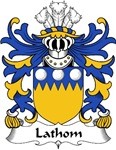
Latham Coat of Arms
Birth: Feb. 15, 1609KempstonBedfordshire, England
Death: Sep. 2, 1677NewportNewport CountyRhode Island, USA
Frances Latham (Dungan Clarke Vaughn) is known as the “Mother of Governors”. Her third husband was the Reverent William Vaughn. She had four children by her first husband; from the descendants of these children are many distinquished statesmen. There are seven children born of her second marriage, and these too have given many governors to the country. Each one of Frances Latham Clarke’s sons served his country, or church, with public service, and each daughter married men who did the same. “She was undoubtedly a very attractive woman, her three marriages would indicate. One can only imagine the gathering of distinquished men and women in the “Common Burial Ground” of Newport when Frances Vaughn, recently widowed for the third time was laid in her grave.There was her eldest Clarke son, then governor, her daughter Mary, with her husband, then Deputy-Governor John Cranston and later governor; and their son Samuel, who before the century closed would also be governor; her daughter Sarah, sometime the wife of Governor Caleb Carr; Barbara with her husband, James Baker, to be chosen the next year as deputy governor; Frances and her husband, Major Randall Holden, ancestors of several of Rhode Island’s governors and one of Washington: Weston Clarke, then attorney-general; James, Latham, and Jeremiah Clarke, with their sons and daughters, and Rev. Thomas Dungan, who perhaps was the one to say the last sacred words over his mother’s grave “Mother of Governors”Her father was Sargeant Falconer Lewis Latham to King Charles I.Children not listed below: John Dungan (died young), William Dungan, Frances Dungan Holden, Elizabeth Dungan (died young), Walter Clarke, Latham Clarke and Jeremiah Clarke Spouses: Married four times1st Lord Weston2nd William Dungan3rd Capt. Jerimah Clark4th Rev. William Vaughn Family links: Spouses: William Dungan (1606 – 1636) Jeremy Clarke (1605 – 1652) Children: Barbara Dungan Barker (1628 – 1677)* Thomas Dungan (1635 – 1688)* Mary Clarke Stanton (1640 – 1711)* Weston Clarke (1648 – 1730)* James Clarke (1649 – 1736)* Sarah Clarke Pinner Carr (1651 – 1706)* Inscription:Here Lyeth ye Body of Mrs. Frances Vaughn, Alias Clarke, ye mother of ye only children of Capt’n Jeremiah Clarke. She died ye 1 Week in Sept. 1677 in ye 67th year of her age.” Burial:Common Burying Ground NewportNewport CountyRhode Island, USA.

Caleb Carr at Rest
I must amend this post because I made an error in my tree. After I had the good luck to visit Caleb, I learned that I had the wrong Sweet in the 1600s. I have corrected the error, but will am leaving this here for his fans. He is not my 9th great grandfather, but is my relative.
Gov. Caleb Carr , born in London, Eng., Dec. 9, 1616, came to America with his brother Robert, on the ship Elizabeth Ann, which sailed from London May 9, 1635. He settled in Newport, R.I., with his brother Robert about 1640. He held many offices of public trust and honor during his lifetime, and accumlated considerable property. He was general treasurer from May 21, 1661 to May 22, 1662. In 1687-8, he was justice of the General Quarterly Session and Inferior Court of Common Pleas. He was governor of the colony in 1695, which last office he held till his death, which occured on the 17th day of December, of the same year. He was drowned. In religious belief he was a Friend or Quaker.
He had seven children by his first wife Mercy, (probably Mercy Vaughan) who died Sept. 21, 1675, and was buried in the family burying ground. The inscription on her gravestone reads as follows: “Here lieth interred ye body of Mercy Carr, first wife of Caleb Carr, who departed this life ye 21st day of September, in ye 45th year of her age, and in the year of our Lord, 1675.” His second wife was Sarah Clarke, (Widow Pinner) daughter of Jeremiah Clarke, and sister of Gov. Walter Clarke, and by whom he had four children. She was born in 1651 and died in 1706.
He died Dec.17, 1695, and was buried in the family burying ground on Mill street, beside his first wife. The inscription on his tombstone reads: “Here lieth interred the body of Caleb Carr, governor of this colony, who departed this life ye 17th day of December, 1695, in ye 73rd (79) year of his age.”
Caleb Carr (1623 – 1695)
is my 9th great grandfather
Sarah Carr (1682 – 1765)
Daughter of Caleb
John Hammett (1705 – 1752)
Son of Sarah
MARGARET HAMMETT (1721 – 1753)
Daughter of John
Benjamin Sweet (1722 – 1789)
Son of MARGARET
Paul Sweet (1762 – 1836)
Son of Benjamin
Valentine Sweet (1791 – 1858)
Son of Paul
Sarah LaVina Sweet (1840 – 1923)
Daughter of Valentine
Jason A Morse (1862 – 1932)
Son of Sarah LaVina
Ernest Abner Morse (1890 – 1965)
Son of Jason A
Richard Arden Morse (1920 – 2004)
Son of Ernest Abner
Pamela Morse
I am the daughter of Richard Arden
On May 9, 1635 the ship Elizabeth and Ann slipped her moorings and put out from London, England under the command of Roger Cooper, Master. Her destination was New England. On board were on hundred and two passengers bearing permission to emmigrate to the new world that lay on the western shore of their ocean.
Among these passengers two should command our attention. These are listed in the old records as Robert and Caleb Carr. The notation of “Taylor” is appended to the name of Robert designating his trade. A later writer, Dr. Turner of Newport, refers to them as from Scotland. As yet we do not know exactly from whence they came.
Sometime in the following June (early midsummer, one account says) the ship arrived in Boston harbor and our ancestors were in America.
For the next two years we have to guess as to the residence of the two passengers on the Elizabeth and Ann. For the remainder of their lives Robert and Caleb Carr were close associates of William Coddington who came from Boston, Lincolnshire, England as of of the original members of the Mass. Bay Company in 1629 and was a leading merchant in Boston, Mass. during this period. Robert and Caleb landed at Boston and two years later left Boston. Adding all these facts together are w not permitted to assume that our ancestors were for these first two years of the living on this side the Atlantic in the rapidly growing town of Boston.
Early in 1637 a group of Boston people led by William Coddington left Boston because of religious differences. They went to Providence and conferred with Roger Williams as to settling in those parts. With the active aid of Mr. Williams the group purchased from the Indians the large town of Quidnick and immediately proceeded to the business of founding the town of Pocassit (later called Portsmouth). It is thought that the Carrs left Boston with this group. Certainly they were early at the Pocassit settlement for on Feb. 21, 1638 Robert Carr was listed as an inhabitant. It is my thought that Caleb who was still but a child of fourteen accompanied Robert.
Many seem to have come to the new settlement at Pocassit that summer of 1638 and the following winter for in the spring of the next year William Coddington and a small group of the leading men removed to the south end of the island to lay out a new settlement leaving at Pocassit a goodly company to carry on.
Again the Carrs followed William Coddington and like him remained at the new settlement the rest of their days. the name which they gave this new home was remained unchanged all these years. It is still Newport.
Lying in the mouth of Narragansett Bay off shore from Newport is the sizable island of Conanicut (known now as Jamestown). In contrast with the forested shores of Aquidnick, Conanicut had some cleared land where the Indians had for generations summered and grown their corn and vegetables. This area of hay, pasturage and vegetable land appealed to the forest bound inhabitants of Newport. Thus in 1659 we find William Coddington, Benedict Arnold, William Brenton, Caleb Carr and Richard Smith leading a company of Newport citizens in arranging the transfer of Conanicut and the small adjoining islands of Gould and Dutch to themselves. Chief Quisaquam made the transfer on the part of the Indians.
Both Robert and Caleb were among the ninety-eight original purchasers of the island. It is thought that neither of the brothers resided on the island. This move was left to their children.
Wampum, or shell beads has been used for centuries in New England. After colonists arrived in America a currency exchange value was set to convert it European currency. This forever changed the meaning and trade value of what was a Native American tradition and source of historical pride. Once it was adopted by Dutch and English as currency it was manufactured in New York on Long Island as well as by Native tribes that dominated the newly created market for trading currency. Since both Native and Europeans could trade with it, it’s use thrived until the end of the 17th century. Counterfeiting was a problem during colonial times as it was more widely used. It was eventually phased out in favor of metal coins as the official currency of New England.
Before the colonists changed the meaning and tradition wampum was used in ceremonies and agreements.It is important as a covenant record and means of communication. Language was commonly understood in terms of wampum color. Messages and agreements were sealed by way of wampum belts created for the specific meaning. White shells had a brighter meaning and dark purple shells indicated heavier subjects. The tapestry woven into a wampum belt was a story. I am looking forward to seeing the new wampum being made today and perhaps some of the historical pieces. I will be visiting museums as well as living wampum artists. It is a fascinating subject.
Space and time are the first two elements of fine festivity. A party, gentle reader, must have room to breathe and become what it wants to be. One can always have impeccable timing if one takes time to consider the elements and the goals. My party in Providence, RI is to celebrate with the living and the dead. I will visit some of my ancestors who lived there in the early 1600’s and discover people who live there now. For me , this is an excellent balance. I like both groups equally.
The city contains historic buildings and museums that will please me a great deal, but I have also perceived some excellent night life and party opportunities downtown. I will visit Plymouth Colony, Martha’s Vineyard, and the Wampanoag village before returning to Providence to party. I will probably need a day to myself in the Rhode Island School of Design Museum, after which I believe I will feel like painting Rhode Island red (a little rooster humor). I love nothing better than historic architecture put to modern artful uses. I am highly attracted to the whole state because it is so tiny and well preserved. It appears to have fabulous taste and a high fun factor, not to mention a history of wealth and power. I am looking forward to discovering what Providence has in store for me.
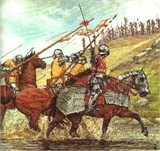
Battle of Blore Heath
My 15th great grandfather was a knight involved with Brit royalty. He lost his life defending it in a battle called Blore Heath. They were fighting about roses (red and white, although I am still not sure what the symbols meant) and the right to the throne. They were royals. They were angry. Things got bloody nasty:
The Battle of Blore Heath
September 23, 1459
After four years of uneasy peace the King presided over a wasting realm. No parliament had been summoned for three years, the country was sadly divided and distressed. The Yorkists were armed, armies were marching across all England. Lord Audley had recently raised a Lancastrian army centered round Market Drayton, and the Queen -through whom the King ruled- sent him orders to intercept Lord Salisbury, who was marching from Yorkshire to join the Duke of York at Ludlow. The two armies met head on two and a half miles east of Market Drayton at a place called Blore Heath. Salisbury, with 3,000 troops, was outnumbered by more than two to one, but could not avoid giving battle.
Audley took up a position just west of a little stream that crossed the Market Drayton-Newcastle-under-Lyme road, and Salisbury’s men were drawn up about 150 yards east of the present Audley Cross, which marks the spot where Lord Audley fell. The Yorkist left rested upon the boggy edge of a wood, but their right was in the air, and Salisbury made a laager of his wagons to protect this flank. Whether Salisbury feigned retreat in order to draw Audley on is not certain, but the Lancastrian commander was definitely the one to attack. Two cavalry charges were repulsed, the first with heavy loss to the Lancastrians, and then they mounted an infantry attack up the hill to the Yorkist position. But this too failed; there was no support from the cavalry, Lord Audley had already fallen and 500 Lancastrians chose this moment to desert to the enemy. Salisbury’s victory was complete and in the pursuit, which continued for two miles, the slaughter was very heavy. Possibly 2,000 Lancastrians perished in this battle, but fewer than 200 Yorkists fell.
For more information on the Battle of Blore Heath, contact Blore Heath 1459 online at http://www.bloreheath.org
YORKISTS LANCASTRIANS
Sir Christopher Conyers of Sokebourne, Durham
Sir Henry Bromflete, Wymington, Bedford
Sir John Conyers of Hornby, Yorkshire
Sir Robert del Booth of Wilmslow, Cheshire (killed in battle)
Sir Walter Devereux of Weobley, Herefordshire (killed in battle)
Sir John Bourchier of West Horsley, Surrey
Sir Richard Grey of Powis, Powis
Sir Hugh Calveley of the Lea, Cheshire (killed in battle)
Sir Richard Hamerton of Hamerton, Yorkshire
Sir William Catesby (Sr.) of Ashby St. Legers, Northamptonshire
Sir Thomas Harrington, Lancashire
Sir John Dawne of Cheshire
Sir Roger Kynaston of Hordley, Shropshire
Sir Jerkin Done of Wickington, Cheshire (killed in battle)
Sir Thomas Lumley of Lumley, Durham
Sir Robert Downes of Shrigley, (killed in battle)
Thomas Meering of Tong
Sir Thomas Dutton of Dutton, Cheshire (killed in battle)
Sir James Metcalfe of Nappa, Yorkshire
Sir John Dwnn of Cheshire, killed in battle
Sir John Middleton of Belsay Castle, Northumberland
Sir John Egerton of Egerton, Cheshire (killed in battle)
Sir Thomas Mountford of Hackforth, Yorkshire
Sir Nicholas of Eyton of Eyton, Shropshire
Sir Richard Neville (Earl of Salisbury) of Middleham, Yorkshire (fled to Calais)
Sir Richard Fitton of Gawsforth, Cheshire
Sir Richard Neville (Earl of Warwick) of Middleham, Yorkshire (fled to Calais)
Thomas Fitton, fate unknown
Sir Thomas Neville of Thornton Bridge, Durham
Sir John Haigh, killed in battle
Sir Robert Ogle of Ogle, Northumberland
Sir Edmund Hampden of Hampden, Buckinghamshire
Sir Thomas Parr of Kendal, Westmoreland
Sir Thomas Hesketh of Rufford, Lancashire
Richard Plantagenet, Duke of York, fled to Ireland
Sir Henry Holland of Darlington, Devon
Sir William Pudsey of Selaby, Durham
Sir John Legh of Booths, Cheshire (killed in battle)
Sir James Strangeways of Whorlton, Yorkshire
Sir Philip Maunsell of Scrurlage, Glamorgan
Sir Walter Strickland of Sizergh, Westmoreland
Sir Richard Molyneux of Sefton, Lancashire (killed in battle)
Sir John Wandesford of Kirklington, Yorkshire
Sir John Neville of Raby, Durham
Sir John Wenlock of Wenlock, Shropshire
Sir Ralph Shirley of Shirley, Sussex
Sir Walter Wrottesley of Wrottesley, Shropshire
Sir John Skidmore of Mochas, Herefordshire
Sir John Stanley of Pipe, Staffordshire
Sir Edmund Sutton of Dudley, Westmoreland
Sir John Sutton of Dudley, Westmoreland
Sir William Troutbeck of Dunham-on-the-Hill, killed in battle
James Touchet (Lord Audley) of Markeaton, Derbyshire (killed in battle)
Sir Hugh Venables of Kinderton (killed in battle)
©The Richard III Foundation, Inc.
Sir Richard Earl Sefton Molyneux (1422 – 1459)
is my 15th great grandfather
Thomas Sir 8th Earl of Sefton Molyneux (1445 – 1483)
Son of Sir Richard Earl Sefton
Lawrence Castellan of Liverpool Mollenaux (1490 – 1550)
Son of Thomas Sir 8th Earl of Sefton
John Mollenax (1542 – 1583)
Son of Lawrence Castellan of Liverpool
Mary Mollenax (1559 – 1575)
Daughter of John
Francis Gabriell Holland (1596 – 1660)
Son of Mary
John Holland (1628 – 1710)
Son of Francis Gabriell
Elizabeth Holland (1652 – 1737)
Daughter of John
Richard Dearden (1645 – 1747)
Son of Elizabeth
George Dearden (1705 – 1749)
Son of Richard
George Darden (1734 – 1807)
Son of George
David Darden (1770 – 1820)
Son of George
Minerva Truly Darden (1806 – )
Daughter of David
Sarah E Hughes (1829 – 1911)
Daughter of Minerva Truly
Lucinda Jane Armer (1847 – 1939)
Daughter of Sarah E
George Harvey Taylor (1884 – 1941)
Son of Lucinda Jane
Ruby Lee Taylor (1922 – 2008)
Daughter of George Harvey
Pamela Morse
I am the daughter of Ruby Lee

Elizabeth Darcy
My 19th great grandmother came from County Meath, Ireland, just like the O’Byrnes of the potato famine on my father’s side. She was a fancy lady with very famous ancestors herself. She was described by an historian as a wise and honorable lady.
Elizabeth Darcy (1331 – 1390)
is my 19th great grandmother
Johanna Hertforth (1345 – 1428)
Daughter of Elizabeth
Ellen Urswick (1364 – 1459)
Daughter of Johanna
Richard Molyneux (1386 – 1460)
Son of Ellen
Sir Richard Earl Sefton Molyneux (1422 – 1459)
Son of Richard
Thomas Sir 8th Earl of Sefton Molyneux (1445 – 1483)
Son of Sir Richard Earl Sefton
Lawrence Castellan of Liverpool Mollenaux (1490 – 1550)
Son of Thomas Sir 8th Earl of Sefton
John Mollenax (1542 – 1583)
Son of Lawrence Castellan of Liverpool
Mary Mollenax (1559 – 1575)
Daughter of John
Francis Gabriell Holland (1596 – 1660)
Son of Mary
John Holland (1628 – 1710)
Son of Francis Gabriell
Elizabeth Holland (1652 – 1737)
Daughter of John
Richard Dearden (1645 – 1747)
Son of Elizabeth
George Dearden (1705 – 1749)
Son of Richard
George Darden (1734 – 1807)
Son of George
David Darden (1770 – 1820)
Son of George
Minerva Truly Darden (1806 – )
Daughter of David
Sarah E Hughes (1829 – 1911)
Daughter of Minerva Truly
Lucinda Jane Armer (1847 – 1939)
Daughter of Sarah E
George Harvey Taylor (1884 – 1941)
Son of Lucinda Jane
Ruby Lee Taylor (1922 – 2008)
Daughter of George Harvey
Pamela Morse
I am the daughter of Ruby Lee
Elizabeth Darcy
Elizabeth Darcy, Countess of Ormond (3 April 1332- 24 March 1390), was the wife of James Butler, 2nd Earl of Ormond, and the mother of his six children, including James Butler, 3rd Earl of Ormond.
Family and lineageElizabeth Darcy was born on 3 April 1332 at Platten, County Meath, Ireland, the daughter of Sir John Darcy, 1st Baron Darcy of Knaith, Justiciar of Ireland, and his second wife Joan de Burgh. Sir John was a veteran of the Battle of Crecy. He held the offices of Constable of Nottingham Castle, Constable of the Tower of London, and Sheriff of Lancashire. From 1341- 1346, he was Chamberlain to King Edward III. Elizabeth had a brother Sir William Darcy, who married Catherine FitzGerald, by whom he had issue. She also had numerous half-siblings from her parents’ previous marriages. Her father’s first wife was Emeline Heron, by whom he had eight children, including his heir, John Darcy, 2nd Baron Darcy of Knaith. Elizabeth’s mother’s first husband had been Thomas FitzGerald, 2nd Earl of Kildare, by whom she had three sons, John FitzGerald, Richard FitzGerald, 3rd Earl of Kildare, and Maurice FitzGerald, 4th Earl of Kildare.Elizabeth’s paternal grandparents were Roger Darcy and Isabel d’Aton. Her maternal grandparents were Richard de Burgh, 2nd Earl of Ulster and Margaret de Burgh, daughter of Sir John de Burgh and Hawise of Lanvaley.One of her maternal aunts was Elizabeth de Burgh, wife of Robert the Bruce.Marriages and childrenOn 15 May 1346 in Ormond, Ireland, when Elizabeth was fourteen, she married her first husband James Butler, 2nd Earl of Ormond (4 October 1331- 18 October 1382), the son of James Butler, 1st Earl of Ormond and Lady Eleanor de Bohun. He was Lord Justice of Ireland in 1359, 1364, and 1376. He was also Constable of Dublin Castle in 1349. He was known as the Noble Earl, however, the Irish called him The Chaste.Upon her marriage to the Earl, Elizabeth assumed the title of Countess of Ormond.James and Elizabeth had six children: 1. Ralph Butler 2. Eleanor Butler (died 1392), married Gerald FitzMaurice FitzGerald, 3rd Earl of Desmond, by whom she had issue, including the 4th and 6th Earls of Desmond. 3. James Butler, 3rd Earl of Ormond (died 6 September 1405), before 17 June 1386, married firstly, Anne Welles, Countess of Ormond, daughter of John Welles, 4th Lord Welles and Maud de Ros, by whom he had issue, including James Butler, 4th Earl of Ormond. He married secondly, Katherine FitzGerald of Desmond, by whom he had further issue. In 1391, he purchased Kilkenny Castle. 4. Thomas Butler 5. Catherine Butler (born 1361), married firstly, Thomas Reade, by whom she had one son, Richard, and secondly, Thomas Fleming of Slane. 6. Joan Butler, married Tiege O’ Carroll
James Butler, 2nd Earl of Ormond, died on 18 October 1382 in Knocktopher and was buried in Gowran Church, Co. Kilkenny. Elizabeth married secondly, Sir Robert de Hereford, Seneschal of the Liberty of Tipperary, between 28 December 1383 and 30 March 1384.
DeathElizabeth Darcy died on 24 March 1390. She was not quite fifty-eight years old.
References 1. ^ Douglas Richardson, Kimball G. Everingham,Magna Carta Ancestry: A Study in Colonial and Medieval Families. p.161 2. ^ Charles Cawley, Medieval Lands, Earls of Ormond * http://www.Tudorplace.com.ar/DARCY.htm * http://www.Tudorplace.com.ar/BUTLER.htm * Charles Cawley, Medieval Lands, Earls of Ormond * Elizabeth Darcy at ThePeerage.com
My Dead Peeps
I have traveled in person only once to visit my dead ancestors and look for local records of their lives. I went to Tulsa, where I was born, and my grandparents are buried, but I can not find their graves. After my cousin went back to Iowa I did more investigation in the town where my father was born, Independence, KS. I drove to the small rural town of Ladore, where many of my ancestors settled when they came from Ohio and New York. I found the grave of one of my 2nd great grandmother while looking for somebody else. It made the hair stand up on my neck even in sweltering humid July in Kansas. I have been all over the world on all kinds of journeys, but this is a whole new way to look at travel…visiting history by combining the ancestors and geography. Kinky, and very cool.
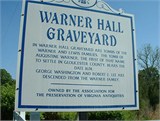
I have accumulated and am trying to geographically arrange data on ancestors around Plymouth Colony, MA and around Jamestown, VA. I will go to both destinations eventually, but have to choose one to be the first. The peeps are mostly very fancy in both places and we know how to find many of the graves, some homes, etc. I am not really into them for the royal blood and fame, I just like them because they survived. It is nothing like visiting living relatives. They are past judgement and are all very low maintenance. They are what you might call spooky. I just learned from a local that Virginia is a vortex for ticks, which makes graves in Massachusetts instantly sound so much more appealing. I am thinking now of flying to tick free, but cold Boston. Someday I will procure the right tick graveyard gear to safely visit my Virginians…like Mary, who is in the private and elite graveyard at Warner Hall with a lot of my other ancestors:
The walled family cemetery of the Warner and Lewis families is located on the Warner Hall property, southeast of Warner Hall. Access to the Graveyard is from the road North of Warner Hall and not from Warner Hall or the Driveway to Warner Hall located West of the Graveyard. The cemetery is the final resting place for many of the Warner and Lewis family members. The family cemetery, is also the resting place for such well known ancestors of George Washington, Robert E. Lee, The Queen Mother of England, and Queen Elizabeth II. Queen Elizabeth has visited Gloucester where she placed a wreath upon her ancestor’s grave. The cemetery has thirteen graves and plaques in memory of all the family. The cemetery is owned and maintained by the Association for Preservation of Virginia Antiquities (A.P.V.A.). The A.P.V.A. acquired the cemetery at Warner Hall in 1903, since which time the Association’s Gloucester Branch, now known as the Joseph Bryan Branch, has zealously maintained it.
There are thirteen graves in the Warner Hall Grave Yard. they are:1 Mary Warner (believed to be Mary Towneley Warner), 1614 – 16622 Augustine Warner I, 1611 – 16743 Augustine Warner II, 1642 – 16814 Mildred Reade Warner (wife of Augustine Warner II), 16945 Augustine Warner III, 1666 – 16866 Elizabeth Warner Lewis (d/o Augustine Warner II w/o Col John Lewis), 1672 – 17197 Col John Lewis (s/o John & Isabella Lewis h/o Elizabeth Warner), 1669 – 17258 Mary Chiswell Lewis (d/o John & Elizabeth Randolph Chiswell w/o Warner Lewis II, 1748 – 17769 Warner Lewis II (s/o Warner Lewis I & Eleanor Bowles Gooch Lewis & grandson of Col John Lewis & Elizabeth Warner Lewis), 1747 – 179110 Juliana Clayton (d/o Dr. Thomas & Isabella Lewis Clayton), 1731 – 173411 Isabella Lewis Clayton (d/o Col John Lewis & Elizabeth Warner w/o Dr. Thomas Clayton), 1706/7 – 1742 (the dates 1706/7 is exactly what is engraved on her stone)12 (Dr.) Thomas Clayton (h/o Isabella Lewis), 1701 – 173913 Caroline Lewis Barrett (d/o Warner Lewis II), 1783 – 1811

Private Graveyard at Warner Hall
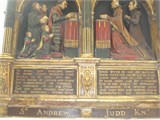
Sir Andrew Judde
My 14th great grandfather founded a famous school in Tonbridge in 1553. He was a trader, a risk taker, and an obvious negotiator. He was the Lord Mayor of London. He was a very wild thing. My father’s tree has many educators in the branches.
Andrew Judde** (1512 – 1586)
is my 14th great grandfather
In 1509 London apprenticed to John Buknell, “a Skinner and Merchant of the Staple of Calais” for 8 years. 23 Mar 1517 First evidence of him as Merchant of the Staple, so released at least a little early from his apprenticeship. On this date he paid the duty for a cargo of wool shipped to Calais. “Thereafter his name occurs frequently“.
In 1520 “took up his freedom as a member of the Skinners’ Company” London. 1520-1521 Fraternity of the Assumption of Our Lady, London; paid 4 shillings “entry money“; high on their list 1524. 1522-1523 Fraternity of Corpus Christi, London; “the account books of the Skinners show … that Andrew Judde paid 20 shillings on becoming one of the ‘Newe Brethern'”.
Mary Mirfyn was born circa 1521. Married Sir Andrew Judde in 1537, London. Died 14
Nov 1550. “Her funeral is entered both in Wriothesley’s Chronicle, and in Machyn’s Diary, both of which have been published by the Camden Society“.
In 1523 London co-executor of his father-in-law’s will with Mirfyn‘s own son. 1533 Master of the Skinners’ Co “and five times thereafter“. Merchant of the Staple of Calais. 12 Jul 1541 Alderman from this date ward of Farringdon without, London. Widowed before 1542? Had had five children with Mary; 2 not in his will. Married Agnes / Annys (—-) in 1542 London; 2nd wife, no children, nothing more known. In 1547 Treasurer of St Bartholomew’s Hospital, London, when it was remodelled. “Certainly one of the richest and most prominent of overseas merchants in early Tudor London“. 1550 Lord Mayor of London: “he had to deal with the problems caused by dearth and by the 1551 ‘calling down’ of the coinage“. One dau. survived from the 3rd marriage. In May 1553 Tonbridge School obtained letters patent for the erection of a free school with the Skinners’ Company as trustees. One of the Aldermen who signed the device of King Edward VI. In Sep 1555 Staple Inn, London, Felipe of Spain (consort of Queen Mary) passed the night at the Staple Inn, and “Sir Andrew presented the King with a purse containing a thousand marks in gold“. Circa 1556 Skinners Hall, London, Judde and Sir John Champneys donated money for the ceiling of the hall, and the Skinners had the arms of both carved as ornaments for the hall. Between 1556 and 1558 “At this time Sir Andrew was buying manors at Ashford and places adjoining from Sir Anthony Aucher, soon to lose his life at Calais. This estate passed to his daughter Alice and so to her son Sir Thomas Smyth, who in his turn was a benefactor of Tonbridge School“.
1557 and 1558 “Surveyor-general of all the London hospitals” London.
Before 1558 Resided at Eshetisford – Essetisford – Ashford, Kent. Will London; “Sir Andrew Jud, skinner, mayor 1551, erected one notable free school at Tunbridge in Kent, and alms houses nigh St. Helen’s church in London, and left to the Skinners lands to the value of 60 pounds 3 shillings and 8 pence the year; for the which they be bound to pay 20 pounds to the schoolmaster, 8 pounds to the usher, yearly, for ever, and four shollings the week to the six alms people, and 25 shillings and 4 pence the year in coals for ever“.
Buried Sep 1558, St Helen’s Bishopsgate, London. Probate Mar 1558 – 1605 Prerogative Court, Canterbury, Kent, Ref. 58 Noodes, 54 Welles (“De bonis non adm.”) grants, March 1558-9 & Aug 1605. Properties in St. Helene, London and Eshetisford, Kent, “etc.”
Sir Andrew, Six Times Master of the Skinner’s Company
Six times Master of the Skinners’ Company, Mayor of Calais and of London, Merchant Adventurer and Knight, Sir Andrew Judde was a man who took financial risks, grew wealthy and founded in Tonbridge one of the foremost public schools in England.
The Judde arms, with boars’ heads, and Skinners’ Company arms, with ermine, are displayed above the Porter’s Lodge entrance to Tonbridge School.
Judde (also often spelt Judd) was born about 1492, the youngest son of a significant Tonbridge landowner John Judde, whose lands were mainly to the south of the Medway, including Barden Park. His elder brothers inherited most of the estate, so Andrew went to London to seek his fortune. He was apprenticed between 1511 and 1517 to John Buknell, a man involved in both the fur trade, as a member of the Skinners’ Company, and the wool trade as a merchant of Calais – then a strategic port in English hands. Kentish wool was exported there and bought by foreign buyers, so that merchants of the ‘staple’, as Judde became in 1517, benefited from the profits in trade and in currency exchange.
Wool was not the only commodity traded through Calais. Sir Andrew’s name was also linked to trade in gold dust from Guinea, imports of oil and later also the fur trade with Russia. In 1533 he became Master of the Worshipful Company of Skinners, an annual post he was to hold six times. In 1550 he became Lord Mayor of London, when he was involved in a variety of problems ranging from the high price of larks to cases of treason. He was knighted by Edward VI at Westminster in the following year.
In his public life Sir Andrew attracted the favour of both Edward VI and Queen Mary despite the swing from Protestantism to Catholicism, through his overriding loyalty to the Crown. In spite of being nominally a Protestant, in Mary’s reign he was active in defending the city from Wyatt’s anti-Catholic rebellion.
The original building of Judde’s ‘Grammar School’ in Tonbridge, viewed from the High Street, as it was in 1836. (THS 12.003)
In 1553 there were two exciting developments in the life of Sir Andrew Judde. The first was that he received a charter from Edward VI to found a school in Tonbridge. Perhaps wishing to invest some of his wealth for the benefit of the town in which he grew up, he bought 30 acres of pasture land known as ‘sand hills’ just to the south of St. Pancras in London. The rents from this land were to provide funds for the new Tonbridge School, raising the sum of £13: 6s and 8d in 1558. Later, as this land was developed for housing the rents increased substantially, enabling the Skinners’ Company, who took over the management of the charity and governorship of the school on Sir Andrew’s death, to add to the Judde foundation a Workhouse (1720) and three more schools, including the Judd School in Tonbridge (1888) and Skinners’ School in Tunbridge Wells (1887).
The original foundation stone of Tonbridge School has been preserved and is now mounted above the Headmaster’s Entrance.
At its foundation, Tonbridge School was to be free, boarding and a grammar school. The last condition meant that the ‘three tongues’ of Latin, Greek and Hebrew should be taught. Another condition was that the school should be close to the Parish Church for regular worship and as Sir Andrew did not own land near enough, it is thought that he rented or bought land from his nephew Henry, who had just inherited land called ‘Houselands’ close to the centre of Tonbridge. The school opened there in 1553 with just 16 pupils, but now there are a total of about 3,200 children educated in Skinners’ Company schools.
The second important event in 1553 was the despatch of an expedition by the Merchant Adventurers Company of London, of which Sir Andrew was a prominent member. He and others financed the expedition to look for a north east passage through the Arctic to Asia, and to find new markets for English wool. Two of the three ships were lost near Lapland, but the third drifted by accident into the gulf of Archangel and its captain, Richard Chancellor, went on to make the difficult overland journey to Moscow to meet the tsar, Ivan the Terrible. He had with him a letter from the King and from that year the trade with Russia began and the Muscovy Company was created. Richard Judde, Sir Andrew’s son, was with Chancellor on his second expedition to Russia. On that occasion two of the four ships were lost which, with the first expedition, amounts to a less than fifty per cent rate of success. It was a risky enterprise but expeditions continued to be financed by the Company in which Sir Andrew played a leading role, and before long strict rules were drafted to improve safety and therefore the success of the expeditions. One expedition, to Guinea, brought back a rare trophy, the head of an elephant, which Sir Andrew kept in his house to show to visitors.
Sir Andrew Judde died in 1558 and was survived by his third wife, Mary, four sons and two daughters. He is buried in St. Helen’s Church on Bishopsgate in London, and a memorial there, thought to be commissioned by his heirs in about 1600, describes some aspects of his life. It is not thought to be very accurate since, because of his public duties, he never visited Russia and Guinea himself, though he was closely involved in the finance and organisation of expeditions there. The epitaph reads:
TO RVSSIA AND MVSCOVA / TO SPAYNE GYNNY WITHOVT FAYLE / TRAVELD HE BY LAND AND SEA / BOTHE MAYRE OF LONDON AND STAPLE / THE COMMONWELTHE HE NORISHED / SO WORTHELIE IN ALL HIS DAIES / THAT ECH STATE FULL WELL HIM LOVED / TO HIS PERPETVAL PRAYES
THREE WYVES HE HAD ONE WAS MARY / FOWER SUNES ONE MAYDE HAD HE BY HER / ANNYS HAD NONE BY HIM TRVLY / BY DAME MARY HAD ONE DOWGHTER / THVS IN THE MONTH OF SEPTEMBER / A THOWSANDE FYVE HVNDRED FYFTEY / AND EYGHT, DIED THIS WORTHIE STAPLAR / WORSHIPYNGE HIS POSTERYTYE
In addition to the Judd School, and Judd House at Tonbridge School, Sir Andrew’s name is commemorated by Judd Road in Tonbridge and Judd Street on what is now the Skinners’ Company Estate in St. Pancras.
Copies of An Essay on the Life of Sir Andrew Judde (1849) by George Maberley Smith and Sir Andrew Judde (1953) by H. S. Vere Hodge are in the Local Studies Collection at Tonbridge Reference Library.
 mermaidcamp