mermaidcamp
Keeping current in wellness, in and out of the water
You can scroll the shelf using ← and → keys
You can scroll the shelf using ← and → keys
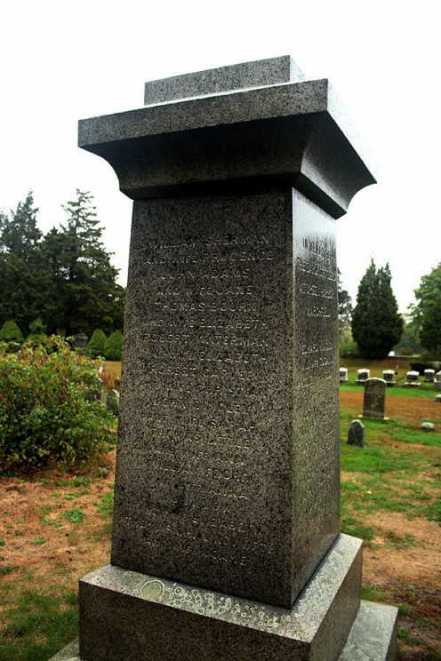
His name is on the monument dedicated to the early settlers of Green Harbor at the Winslow Cenetery in Marshfield, Mass.
The first record of Thomas Little in the new world was on the tax list of March 25, 1633. It is not known on which ship he had arrived. He moved to Marshfield, which is 14 miles from Plymouth. In the 1600’s 14 miles was a very long distance to travel. He was the constable in Marshfield, MA, in June of 1662.
Thomas married Anna Warren on April 19, 1633, in Plymouth Colony. They were the parents of about nine children.

Thomas Little, lawyer
Thomas Little was born in England before 1608 based on his marriage (Anderson, Great Migration). The Ancestral file, without documentation, lists his origin as Devon which is also known as Devonshire with Exeter as the county seat. According to many writers, he arrived at Plymouth, Massachusetts in 1630, but it is not positively known when, or on what ship he came. The earliest date in the Plymouth records is January 2nd, 1632/3, when he was taxed. He married, April 19th, 1633, Ann, born in England about 1612, daughter of Richard and Elizabeth Warren, who were Mayflower passengers (Avery 127, 129; NEHGR XIII, 279). Avery writes that Thomas Little came from England to Plymouth in 1630. He was a lawyer, and his coat of arms is still preserved at the old homestead in the house of Luther Little at Sea View, Massachusetts known as Littletown (Avery 126-127).
Thomas Little and Ann Warren had nine children as listed by Avery, Anderson in the “Great Migration,” and various others. Abigail married Josiah Keene; Patience married Joseph Jones; Ruth apparently unmarried; Hannah married Stephen Tilden; Mercy married John Sawyer; Isaac married Bethia Thomas; Ephraim married at Scituate Mary Sturtevant; Thomas died in King Phillips War; and Samuel married Sarah Gray (Anderson, Great Migration).
Thomas Little bought a shallop in 1633, and was enrolled for military service in August, 1643, at Plymouth, as was every other male in the Colony between 16 and 60 on that date (Avery 129-130).
His first residence was at Plymouth where he was a “Keeper of the Colony of New Plymouth books.” He was assessed 18 shillings in Plymouth tax lists of 1633 and 1634. In 1647, he had five acres of upland meadow on “Indian Brook,” listed as within the limits of the township of Plymouth, retaining that land in 1655. But in 1664, Jonathan Morey expressed an interest in the land that was “sometimes Thomas Little’s. Prior to that, in 1652, Thomas Little and his wife Ann sold a house and land on the Eel river in the township of Plymouth (a former residence). On 3 June 1662, Thomas Little had rights confirmed to a farm at Marshfield, and on 3 October 1665 was granted a hundred acres on which he settled title by 1 May 1666. Back in June 1662, he was a Marshfield Constable (Anderson, Great Migration, quoting Plymouth Records).
In his will, dated 17 May 1671, Thomas Little, Sr. bequeathed to “my loving wife all my housing and all of my land, upland and meadow on that side of the brook I now dwell, except only the meadow I purchased of Thomas Tildin and Morris Trewant.” He left land to sons Isacke and Ephraim land on the other side of the brook; all his land at Namassakett upland and meadow to his younger sons Thomas and Samuel, excepting an identified upland to grandson John Jones; a featherbed and furniture to Ephraim; the whole stock of cattle to be equally divided amongst all his children; and other dispositions. Administration of the estate was granted to Anna Little, his wife, on 14 August, 1662.(Anderson, Great Migration listing sources).
Thomas Little was buried at Marshfield, March 12, 1671. His widow died after February 19, 1675 (Avery 129-130).
There is some confusion from 28 October 1633 when a grant of land to Richard Warren was returned to court for failure to erect a building; the land was to be regranted to a Mr. Ralph Fogg upon his satisfactory payment to Widow Warren for her fence remaining there (PCR 1:18). But on 7 March 1636, “it is agreed upon, by the consent of the whole court, that Elizabeth Warren, widow, the relict of Mr. Richard Warren, deceased, shall be entered, and stand, and be purchaser instead of her said husband, as well because that (he dying before he had performed the said bargain) the said Elizabeth performed the same after his decease, and also for the establishing of the lots of lands givern formerly by her unto her sons-in-law Richard Church, Robert Bartlett, and Thomas Little, in marriage with their wives, her daughters” [PCR 1:54; 2:177]. On 5 May 1640, “Richard Church, Rob(er)te Bartlett, Thomas Little, and Mrs. Elizabeth Warren are granted enlargements at the heads of their lots to the foot of the Pyne Hills, leaving a way betwixt them and the Pyne Hills, for cattle and carts to pass” (PCR: 1:52). Ann Warren born est 1613, m. Thomas Little at Plymouth 19 April 1633 (PCR 1:13)
Thomas Little (1609 – 1675)
10th great-grandfather
William Little (1640 – 1731)
son of Thomas Little
William Little (1660 – 1740)
son of William Little
William Little Jr (1685 – 1756)
son of William Little
Jeanette Little (1713 – 1764)
daughter of William Little Jr
Andrew Armour (1740 – 1801)
son of Jeanette Little
William Armor (1775 – 1852)
son of Andrew Armour
William Armer (1790 – 1837)
son of William Armor
Thomas Armer (1825 – 1900)
son of William Armer
Lucinda Jane Armer (1847 – 1939)
daughter of Thomas Armer
George Harvey Taylor (1884 – 1941)
son of Lucinda Jane Armer
Ruby Lee Taylor (1922 – 2008)
daughter of George Harvey Taylor
Pamela Morse
I am the daughter of Ruby Lee Taylor
Our era in history may become known as the time of willful blindness. We have access to information from all over the world instantly, but people prefer to keep blind spots in place to protect status quo. As individuals and as institutions we choose to stay in the dark because we either have no confidence in evolution and change, or we may benefit from the circumstances as they stand.
Can you think of an example of willful blindness that has played havoc with your life? Can you remember choosing to stay blind yourself rather than standing up for the truth? I am pretty sure all of us have stood on both sides of this line. The saddest reason for staying willfully blind is a belief that one person can not change the course of history. The desire to be ignorant is more dangerous than we might want to believe.

Fall
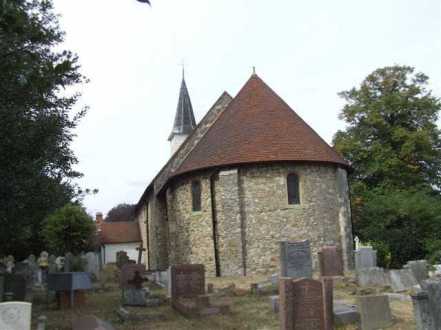
St James the Less Churchyard
Photo submitted by geoffrey gillon on findagrave.com
This is the final resting place of Sir Aubrey. I would love to visit Haleigh someday to take in the sights and visit my dead ancestors, in romantic ruin.
Located on High Street in Hadleigh, Essex, England – Cemetery notes and/or description from findagrave.com: Hadleigh is a town in southeast Essex, England, on the A13 between Benfleet and Leigh-on-Sea. Although a historic settlement with its castle, it has become intertwined with Benfleet to the West and Leigh-on-Sea to the East. This has led to the Hadleigh in Suffolk becoming more well known. Hadleigh is probably best known for its castle, and the country park that surrounds it. The castle has been a romantic ruin for a few hundred years, but parts of two towers are still standing. John Constable painted Hadleigh Castle in 1829, and the painting now resides at the Yale Center for British Art in USA.. Set at the top of a hill overlooking the Thames Estuary, it is possible to see as far as the Canary Wharf development to the west. Since the Local Government Act 1972, Hadleigh, along with Canvey Island, South Benfleet, and Thundersley has formed the parliamentary constituency and local government district and borough of Castle Point. General Booth, founder of the Salvation Army, established the Farm Colony in 1891 in Hadleigh. Today the colony operates an employment training centre for people who have special training needs, and accepts referrals from Social Services and the Employment Service. A reminder of the Salvation Army’s work in the area is a special section at the east end of the churchyard for the graves of Colony officers and workers. St. James the Less Church, like the castle, is a Norman building, with a typical Norman round east end, but the church is still in use today. It is built of Kentish ragstone with 3 feet thick walls. It remains picturesque despite the fact that it effectively stands in the central reservation or island, of the A13.(text by Geoffrey Gillon)

Hedingham Castle in Essex, John de Vere’s main residence
My 20th great-grandfather was tight with the Black Prince, who took good care of his people. Sir Aubrey was knighted and accompanied the Black Prince to Aquitaine in battle. His father, John de Vere, is both my 21st and my 20th great-grandfather. This is because I descend from two of his children, Aubrey and Margaret. I am pretty sure I also descend from the Edward Black Prince himself, but more about that later. When sorting out various branches of a tree it is really important to look carefully for errors.
Sir Aubrey 10th Earl of Oxford DeVere (1338 – 1400)
20th great-grandfather
Sir Richard, 11th Earl of Oxford DeVere KG (1385 – 1417)
son of Sir Aubrey 10th Earl of Oxford DeVere
Sir John 12th Earl of Oxford DeVere (1408 – 1462)
son of Sir Richard, 11th Earl of Oxford DeVere KG
John DeVere (1447 – 1509)
son of Sir John 12th Earl of Oxford DeVere
John DeVere (1490 – 1540)
son of John DeVere
Frances DeVere (1517 – 1577)
daughter of John DeVere
Thomas Howard (1536 – 1572)
son of Frances DeVere
Margaret Howard (1561 – 1591)
daughter of Thomas Howard
Lady Ann Dorset (1552 – 1680)
daughter of Margaret Howard
Robert Lewis (1574 – 1656)
son of Lady Ann Dorset
Robert Lewis (1607 – 1644)
son of Robert Lewis
Ann Lewis (1631 – 1686)
daughter of Robert Lewis
Joshua Morse (1669 – 1753)
son of Ann Lewis
Joseph Morse (1692 – 1756)
son of Joshua Morse
Joseph Morse (1721 – 1776)
son of Joseph Morse
Joseph Morse III (1756 – 1835)
son of Joseph Morse
John Henry Morse (1775 – 1864)
son of Joseph Morse III
Abner Morse (1808 – 1838)
son of John Henry Morse
Daniel Rowland Morse (1838 – 1910)
son of Abner Morse
Jason A Morse (1862 – 1932)
son of Daniel Rowland Morse
Ernest Abner Morse (1890 – 1965)
son of Jason A Morse
Richard Arden Morse (1920 – 2004)
son of Ernest Abner Morse
Pamela Morse
I am the daughter of Richard Arden Morse
Aubrey de Vere, 10th Earl of Oxford (c. 1338 – 15 February 1400) was the second son of John de Vere, 7th Earl of Oxford and Maud de Badlesmere, daughter of Bartholomew de Badlesmere, 1st Lord Badlesmere.
In 1360 he was made steward of the royal forest of Havering in Essex. In 1367 was retained to ‘abide for life’ with the Black Prince, with a substantial allowance. He was knighted, made constable of Wallingford Castle in 1375 and also given the honours of Wallingford and St. Valery, though he gave up Wallingford in 1378 for Hadleigh Castle. Edward III used him as an ambassador in seeking peace with France. In 1381, de Vere became a Chamberlain of the Royal Household and member of the privy council. In 1388 his nephew, Robert de Vere, Duke of Ireland and 9th Earl of Oxford was deemed a traitor, causing Aubrey to lose his post of chamberlain. However, after Robert’s death in 1392, the king gave Aubrey the title of Earl of Oxford allowing him to take a seat in parliament. Aubrey’s son, Richard became the 11th Earl of Oxford on his death.
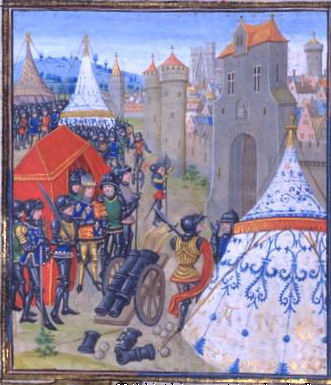
Siege of Rheims
My 20th great-grandfather was the 7th Earl of Oxford, hereditary Chamberlain of England. He was son and heir to Sir Alphonese de Vere and Joan Foliot, grandson of Sir Robert de Vere and Alice de Sanford, Sir Jordan Foliot and Margery Newmarch. He was husband of Maud de Badlesmere, daughter of Bartholomew Badlesmere and Margaret de Clare, widow of Robert FitzPayne. They were married before 27 March 1336 and had four sons and three daughters. John was a captain in King Edward III’s army, and as such participated in the Battle of Crécy and the Battle of Poitiers.
John de Vere, 7th Earl of Oxford (c. 12 March 1312 – 24 January 1360) was the nephew and heir of Robert de Vere, 6th Earl of Oxford. He succeeded as Earl of Oxford in 1331, after his uncle died without issue. John de Vere was a trusted captain of Edward III in the king’s wars in Scotland and France, and took part in both the Battle of Crécy and the Battle of Poitiers. He died campaigning in France in 1360. Throughout his career he was closely associated with William de Bohun, 1st Earl of Northampton, who was his brother-in-law.
Hedingham Castle in Essex, John de Vere’s main residence
John de Vere was the only son of Alfonso de Vere, and Jane, daughter of Sir Richard Foliot. Alfonso was a younger son of Robert de Vere, 5th Earl of Oxford, and brother of Robert de Vere, 6th Earl of Oxford. When the younger Earl Robert’s son died without issue in 1329, the earl obtained licence from the king to entail his estates on his nephew, John. It was in this way that John de Vere, when his uncle died 17 April 1331, became Earl of Oxford. He had made homage and received livery by 17 May.
In 1336 he married Maud, who was the second of the four daughters of Bartholomew de Badlesmere, 1st Baron Badlesmere, of Badlesmere in Kent and Margaret de Clare. Maud was a co-heiress of her brother Giles de Badlesmere, 2nd Baron Badlesmere. When Giles died in 1338, this brought a significant part of the Badlesmere inheritance into de Vere’s hands. The marriage also forged a strong bond with William Bohun, Earl of Northampton, who had married Badlesmere’s third daughter, Elizabeth de Badlesmere and thus became Oxford’s brother-in-law.The two campaigned together, sat on the same commissions and died the same year.
De Vere’s military career began with service on Edward III’s Scottish campaigns, in the 1330s Second War of Scottish Independence. He took part in the Roxburgh campaign of 1334–5, and in the summer campaign of 1335. Later in the decade, England’s military efforts turned towards France, with the beginning of the Hundred Years’ War. In March 1340, de Vere served in Flanders, and was therefore out of the country during Edward’s disputes with Archbishop John de Stratford. Oxford was not forced to take sides in the conflict, and has been described as a “political neutral”.
After a period in England, de Vere returned to the Continent in 1342, where he served with Northampton, who had been made lieutenant of Brittany. They both took part in the Battle of Morlaix that year. The next year the two earls were sent to Scotland to relieve Lochmaben Castle, and in 1345 they were again campaigning in Brittany. Tradition has it that, returning to England, their ships were forced ashore by bad weather, and the party was robbed of their possessions by the locals. In the summer of 1346 de Vere was campaigning with the king in Normandy, and took part in the Battle of Crécy. According to the chronicler Froissart, de Vere was fighting with the Black Prince, and was among the captains who sent a request to Edward III for reinforcements when the king famously answered ‘Let the boy win his spurs’. Oxford was also at the Siege of Calais, but reportedly fell ill in 1348, and did not take part in any major campaigning until 1355.
In 1355 he was again in the company of the Black Prince, and took part in the prince’s great raid in Languedoc. 19 September 1356, at the Battle of Poitiers, Oxford was in command of the vanguard together with the earl of Warwick. de Vere’s attack on the flank of the French cavalry, with a group of archers, did much to secure the English victory. His last campaign was Edward III’s Rheims campaign in 1359–60. Here he died, probably during the raid into Burgundy, on 23 or 24 January 1360. He was buried in the de Vere family’s burial place Colne Priory in Essex.
Maud de Vere died in 1366. The couple had four sons and two daughters. The eldest son, John, married the daughter of Hugh Courtenay, Earl of Devon, but died before his father, in 1350. Also another son, Robert, died in his father’s lifetime. The oldest remaining son was then Thomas, born around 1336–7, who succeeded his father in 1360. Thomas’s son Robert succeeded at his father’s death, but with Robert’s forfeiture in 1392, the earldom was given to Robert’s uncle Aubrey – the seventh earl’s fourth son. The eldest daughter, Margaret, married three times, while of the second, Matilda, little is known.
John de Vere, in the family tradition of the “fighting de Veres”, was active in almost all major military engagements in the years from 1340 to 1360. On the Roxburgh campaign he brought a retinue of twenty-eight men-at-arms and twelve mounted archers. In Brittany in 1342, the retinue had grown to forty men-at-arms, one banneret, nine knights, twenty-nine esquires, and thirty mounted archers. His retinue was of a diverse composition, and also included foreign mercenaries.[10] At one point, in the Battle of Poitiers, John Hawkwood, who was later to make his fortune as a condottiero in Italy, also served with de Vere. Yet in spite of this, de Vere never distinguished himself particularly as a military commander. Neither did he receive a great amount of royal patronage, and was never made a member of the Order of the Garter. This was largely a consequence of the de Vere family’s relatively modest resources among the English peerage. As an example can be mentioned that in the late 1340, £349 were owed to Oxford in arrears for his services, yet at the same time the king owed Northampton two debts of £782 and £1237. This obstacle of resources and status John de Vere was unable to overcome either by marriage or warfare.
from John de Vere, 7th Earl of Oxford
From Wikipedia, the free encyclopedia
John de Vere (1311 – 1359)
20th great-grandfather
Margaret De Vere (1340 – 1398)
daughter of John de Vere
Margaret De Lovaine (1372 – 1408)
daughter of Margaret De Vere
Thomas St Clair (1394 – 1434)
son of Margaret De Lovaine
Edith StClair (1425 – 1472)
daughter of Thomas St Clair
Alice Harcourt (1450 – 1526)
daughter of Edith StClair
Elizabeth Bessiles (1465 – 1511)
daughter of Alice Harcourt
Anne Fettiplace (1496 – 1567)
daughter of Elizabeth Bessiles
Mary Purefoy (1533 – 1579)
daughter of Anne Fettiplace
Susanna Thorne (1559 – 1586)
daughter of Mary Purefoy
Gov Thomas Dudley (1576 – 1653)
son of Susanna Thorne
Anne Dudley (1612 – 1672)
daughter of Gov Thomas Dudley
John Bradstreet (1652 – 1718)
son of Anne Dudley
Mercy Bradstreet (1689 – 1725)
daughter of John Bradstreet
Caleb Hazen (1720 – 1777)
son of Mercy Bradstreet
Mercy Hazen (1747 – 1819)
daughter of Caleb Hazen
Martha Mead (1784 – 1860)
daughter of Mercy Hazen
Abner Morse (1808 – 1838)
son of Martha Mead
Daniel Rowland Morse (1838 – 1910)
son of Abner Morse
Jason A Morse (1862 – 1932)
son of Daniel Rowland Morse
Ernest Abner Morse (1890 – 1965)
son of Jason A Morse
Richard Arden Morse (1920 – 2004)
son of Ernest Abner Morse
Pamela Morse
You are the daughter of Richard Arden Morse
John de Vere, 7th Earl of Oxford and 8th Great Chamberlain, born in 1313, became one of the most famous “Fighting Earls of Oxford,” renowned for bravery, gallantry, and chivalry as one of Edward III’s greatest generals, serving in Scotland, France, Flanders, Brittany and Gascony.
John was the son and heir of Sir Alfonso de Vere (d. 1328) [younger brother of Robert de Vere, EO6] by his wife Jane, daughter of Sir Richard Foliot. John succeeded his uncle, who left no issue, in April 1331. John EO7 actively participated in the wars of King Edward III’s, fighting in the Scottish campaigns of 1333 and 1335, in support of Edward Baliol. When war broke out with France in 1339, EO7 accompanied King Edward III to Flanders, and, in 1342 joined the first Breton campaign of William de Bohun, earl of Northampton. EO7 had, in his war party, 40 men-at-arms, one banneret, nine knights, 29 esquires, and 30 mounted archers, with an allowance of 56 sacks of wool as wages. On one occasion, when EO7 was returning from fighting on the continent, his ship was driven off course and wrecked on the shores of Connaught where some ‘barbarous people’ robbed the party of all of their possessions. [A similar encounter with pirates happened 200+ years later to the 17th Earl of Oxford upon his return from Italy and France in 1576). John de Vere, EO7, was a commander at the battles of Crecy, where he fought with a contingent of 160 men, including three bannerets and 27 knights. In October 1355, EO7 returned to France, joining the Black Prince in his famous raid into the Languedoc. EO7 shared the command of the first division at Poitiers with the Earl of Warwick, where he organized a crucial maneuver that saved the English archers from being downtrodden by the enemy’s cavalry.
“Yet all courage had been thrown away to no purpose, had it not been seconded by the extraordinary Gallantry of the English Archers, under the earl of Oxford, who behaved themselves that day with wonderful Constancy, Alacrity and Resolution ”
John de Vere, EO7, was killed during the siege of Rheims on January 24, 1360, during the British invasion of Burgundy. His corpse was brought back to England and interred in the family crypts at Colne Priory.
John’s will, dated November 1, 1359, contained bequests to Colne church and to the chapel (called the New Abbey) at Hedingham. EO7 also left instructions to his executors to pay out 400 marks sterling that had been accumulated by his ancestors in aid of the Holy Land.
John EO7 had married, in 1336, Maud Badlesmere [b. 1310, widow of Robert Fitzpayne], second sister and coheir of Giles, lord Badlesmere (d. 1338) of Badlesmere in Kent. The couple had had four sons and one daughter, Margaret or Maud. The sons were Thomas (1337-1371), the 8th Earl of Oxford, Aubrey, who became 10th EO in 1393, and John and Robert, who predeceased their father.
By EO7’s marriage, the title of Lord Badlesmere was added to the honorific employed by all later Earls of Oxford. His son Thomas succeeded him.
By Robert Brazil © copyright 2003
I subscribe to Hulu for a month at a time, then put the subscription on hold for the maximum time, 90 days. This means it is only in the home 4 months out of the year, which is perfect for us. I binge down on different new shows, and by the end of the month I have seen everything I care to watch. This month I have watched a lot of very well produced series. I have focused on comedy, seeing at least 10 stand up comedy specials. I also found many comedy tv series that make me very happy. My favorite, now that the month is coming to a close, is Selfie. This modern day version of Pygmalion is hysterically updated to show characters typical to our times. This social satire hits all the notes.
Eliza Dooley, the same archetype represented in My Fair Lady by Julie Andrews as Eliza Doolittle, has a modern twist as a self obsessed social media star. The romantic comedy takes a satirical look at workaholics, socialnetworkaholics , and corporate hierarchy. It is set in a children’s pharmaceutical company where Henry Higgins, the British snob, is thinly disguised as Henry Higgins, branding expert. The plot and characters are instantly recognizable, but the story unfolds in ways I could never have imagined. All the parts are extremely well played, but the writers and producers get major credit. This script makes me laugh for every reason, from physical comedy schtick to sophisticated satirical commentary woven into the whole story. Some of the smaller parts are the very best because they have such extreme personalities and dialogue. I will not give away more than that. Just watch it if you can.
The story of Pygmalion comes for the mythology of Greece. It is based on a god who fell in love with one of his own sculptures. In 1748 the story was presented at the prestigious Paris Opera House. This production, written by Jean-Philippe Rameau, was staged as a one act piece. Since that time this story has been told and retold, including the popular musical version with Rex Harrison playing the stuffy and rude Henry. The story has the same punch line every time.
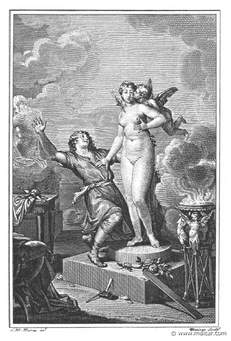
Greek god Pygmalion
“We could be heroes” today as Sun squares MARS and opposes Chiron in PISCES. this aspect is perfecting this week.
family history
My tenth great-grandfather was part of the Great Migration. He moved to Cape Cod in January of 1639. Many Pilgrims who moved out to Cape Cod got in trouble with the Plymouth church. In those days reaching villages on Cape Cod was a long hard journey from Plymouth. Some of my ancestors who lived on Cape Cod became (or already were) Quakers, and some moved to Rhode Island to escape the oppressive Pilgrim Fathers.
On January 7, 1639 the court record refers to the land grant to the first settlers John Crow, Thomas Howes, and Anthony Thacher as “the lands of Mattacheeset, now called Yarmouth”. This is considered the first usage of the name.
“Yarmouth” to represent the new township to the east of Barnstable.
Plymouth Colony: Its History and People 1620-1691 Part One: Chronological Histories Chapter 3: The Founding of Towns (1633-1643) Yarmouth On 7 January 1638/39, the Court of Assistants granted lands at “Mattacheeset, now called Yarmouth” to Mr. Anthony Thatcher, Mr. Thomas Howes, Mr. John Crow, and John Coite “to be enquired of.” Coite might have been the man of that name of Marblehead, but apparently he did not move to Plymouth Colony. Thatcher, Howes, and Crow were proposed [p.66] as freemen of Yarmouth, along with Mr. Marmaduke Mathews, Philip Tabor, William Palmer, Samuel Rider, William Lumpkin, and Thomas Hatch. It was also specifically noted that “Old Worden (dead),” Burnell, Wright, and Wat Deville were “Psons there excepted against,” probably meaning they were not eligible to be given freemen status, and showing that some form of settlement had already been in existence. In fact, on 4 September 1638 the General Court ordered the inhabitants of Sandwich and “Mattacheese or Yarmouth” to build a bridge over the Eel River (which was just a bit south of Plymouth town, and had to be crossed for travel between Plymouth and the Cape). On 5 March 1638/39 William Palmer was authorized by the General Court to be the one at Yarmouth who would exercise inhabitants in arms, and William Chase was elected constable there. It is apparent that earlier the Plymouth Court had granted land at Yarmouth to others also, for on 1 April 1639 it noted that lands at Mattacheese (another confusion of the names, for it should have been Mattacheeset) were granted to persons who should have inhabited there long ago, but did not, and the grantees “are not likely to come to inhabite there in their owne persons, and lest such as are there should receive in unto them unworthy persons, whereof the Court hath lamentable experience …, the Court doth order that onely such of them wch at present are there shall remayne & make use of some lands for their present necessity, but shall not divide any portions of lands there either to themselves or any others
American Genealogical-Biographical Index (AGBI)
John Sr Crowell (1590 – 1673)
10th great-grandfather
Yelverton Crowell (1621 – 1683)
son of John Sr Crowell
Elishua Crowell (1643 – 1708)
daughter of Yelverton Crowell
Yelverton Gifford (1676 – 1772)
son of Elishua Crowell
Ann Gifford (1715 – 1795)
daughter of Yelverton Gifford
Frances Congdon (1738 – 1755)
daughter of Ann Gifford
Samuel Thomas Sweet (1765 – 1844)
son of Frances Congdon
Valentine Sweet (1791 – 1858)
son of Samuel Thomas Sweet
Sarah LaVina Sweet (1840 – 1923)
daughter of Valentine Sweet
Jason A Morse (1862 – 1932)
son of Sarah LaVina Sweet
Ernest Abner Morse (1890 – 1965)
son of Jason A Morse
Richard Arden Morse (1920 – 2004)
son of Ernest Abner Morse
Pamela Morse
I am the daughter of Richard Arden Morse
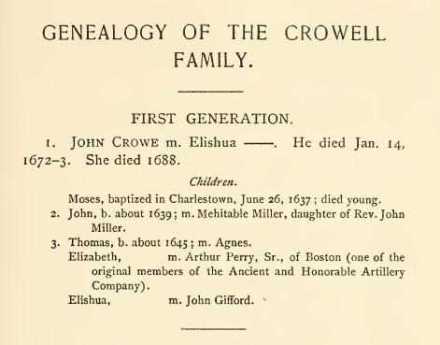
The Crowell family in North Dennis is descended from John Crow, who came, it is said, from Wales in 1635, to Charlestown, where he and his wife, Elishua, joined the church. It is probable that they sojourned there until 1639, when Mr. Crow came with Anthony Thacher and Thomas Howes to Yarmouth, with a grant from the court, having previously taken the oath of allegiance. All the first settlers
selected spots for their homes adjacent to good springs of water. The brook that flows through the village of North Dennis had numerous fine flowing springs to supply the need of the first comers. John Crow built his home north of the center of the present village, near the spot where the late Philip Vincent lived. His land, much of which is still owned by his descendants, was east of Indian Fields, and extended from the shore to the top of the hills back of the settlement. John Crow was a man of character and influence in the infant town of Yarmouth, filling many important offices. He died in 1673. His sons were: John, Samuel and Thomas. John married Mehitable. daughter of Rev. John Miller of Yarmouth. A grandson of John Crow, sr., whose name was John, was the first person buried in the North Dennis cemetery. He died in 1727. The name about that time had developed into Crowell. The offspring of John Crow are now to be found in all parts of the country, occupying important positions, with honor and credit to the name. Those who have remained upon the hereditary acres have produced in every generation men of ability and distinction. The late Hon. Seth Crowell and his cousin, Capt. Prince S. Crowell, and Mr. William Crowell, the well-known cranberry grower and seller, are illustrations of the character of the Crowells in the seventh generation. The family has never been large in North Dennis. Two pews in the old church sufficed to accommodate their needs for sitting room. Many of the family, before the old meeting house was torn down in 1838, had become desciples of John Wesley and left the church of their fathers.
Mr. Jeremiah Crowell, a descendant in the fourth generation from the grantee, John Crow, was for two generations a village celebrity. He lived in what was called “Crow Town,” just outside the western limits of Indian Field. The public highway went no farther east than his house in his day. The county road went through the woods south of Scargo hill. Mr. Crowell constructed a globe with the four quarters of the earth marked upon it. This was received by the Nobscusset children with open-eyed wonder. It was to be seen only, however, upon payment of one cent per head. He had besides a mammoth kite with a string a mile long, with a tail of wondrous length. He kept a daily journal of passing events, such as the capture of a whale, the arrival home of the Cod fishermen, the state of the weather, and the direction of the wind. But his great effort was the building of a pair of wings and attempting to fly. This was an achievement beyond his power to accomplish. The flying he regarded as practical and easy, but the alighting was difficult. He died at an advanced age, about the close of the last century.

My Ethnicity Map
REGIONAPPROXIMATE AMOUNT
Europe 99%
Great Britain 85%
Europe West 6%
Trace Regions 8%
West Asia < 1%
Trace Regions < 1%
I have studied my ancestry since 2008, and have made much progress. There are several dead ends that seem kind of hopeless. My maternal grandmother was an orphan who was adopted right after the Civil War in Mississippi in a county where the courthouse burned to the ground with all the records. I know who her adopted parents were, and that she had a brother named Fidel who was adopted by the same family. My paternal 2nd great-grandfather was part of a Swiss/Pennsylvania Dutch family. I know who his nephew was because I have written notes form my own great-grandmother. I can trace his nephew back to Virginia, and then to Switzerland, but I can find no record of his birth. I have not found his parents out of all the Petersons scattered all over the Midwest. I hold a grudge against the state of Indiana for this oversight/problem, because that was the state of his birth. I desperately want to hook up the data, but can’t find the hard evidence to do so.
The big problem with records of all kinds is that they were created by human beings. There are errors for all kinds of reasons. Since all these cases are extremely cold I have no way to verify anything I might find in writing beyond a shadow of a doubt. I have made errors because of common names like Taylor, Smith and Morse in my tree that can easily be mistaken for another person with the same last name. Still, I do learn a lot about the history of the times even when I am proceeding along an erroneous lead. When I find errors sometimes I can rebuild with accurate data easily, but often I am back to square one without a clue.
I sent my DNA sample to Ancestry.com when the service was first available. With few folks in the study my DNA was described as 99.9% from the British Isles. Now the a few years have passed and more comparison DNA has been added I am only 85% from Britain. I have not paid too much attention to this data, only checking in infrequently. The impressive part of this data is that I now have 540 4th cousins or closer in the site’s database. I have started looking at this as a new way to trace the connections because I was recently contacted by an adopted man looking for his birth parents. His closest DNA match is a 2nd cousin of mine. He and I do not show any match, but male DNA, containing the y chromosome, has more detailed information, as I have recently discovered. I began to research more about how these tests work and what we can discern from them. My relative in search of his roots informed me that a match can go back for up to 12 generations. Finally all my research may be useful to solve this adopted man’s mystery. He has turned my attention to this fascinating element of genealogy research that I had not really used. I don’t think I will solve my brick walls (as we call the dead ends in family trees), but it does give me a new way to discover my connections to all my relations. I am grateful all these 540 people felt curious enough to send in DNA samples for our mutual benefit. Have you examined your DNA, gentle reader? Any surprises?

Ranching
I have a solid memory of the morning of September 11, 2001. My father called me on the phone and told me the Pentagon had just been hit. I said “It’s just a Pentagon.” Then I turned on the TV news, and to my horror, learned about the tragic events that had taken place while I was rocking and rolling around my house, blissfully unaware. Those of us who were alive when JFK was shot all had a spooky feeling that this terror was all connected. The axis of evil had landed on our shores, and nothing would ever be the same. We lost our innocence, and many of us also lost our minds.
The first responders, and their sacrifices, came into focus like never before in modern history. The risks and the losses they take every day started to hit home in the hearts and minds of American citizens. Many folks joined the military because they felt the need to do something to protect our country. We got a Department of Homeland Security and the borders started getting way tighter. I was well aware of the border phenomena because I was working as a wetback gringa in Mexico at the time. Suddenly the Tecate border crossing, which had always been almost a joke border, became very strict. This clogged up the traffic, which would back up for blocks in Tecate, BC, waiting to cross. There were people who would wait in the line for you for a fee, and those people had all the work they wanted. Since I was a guest instructor, spending only a couple of weeks at time down there, the border issue really put a wet blanket on my commute. I had to drive 6 hours from Tucson, which I had accepted. I just could not handle waiting an hour in bumper to bumper traffic while waiting to leave the country. I determined after a couple of years that Mexico, lindo y querido, was no longer fun for me. I have not crossed the border since 2003. I have not seen the border wall, and I may never see it.
Things changed for the worse in Mexico because all kinds of people who had walked to the border from Guatemala, Chiapas, or Nicaragua were stuck. They had few options. The criminal element suddenly had a huge influx of desperate people to employ, a boon to smuggling and anything else they cared to do. They probably started digging new tunnels all over the place with their new source of labor. Our tiny town of TKT (the local way to spell Tecate) went from safe to wildly violent overnight. One of my Mexican colleagues came in to work all freaked out because she had discovered her boyfriend, chopped up in the trunk of a car. We went from zero to chopped up in the trunk of a car in no time. It was no longer safe for me to ride the public bus to Tijuana, use the route taxis to go to to the beach , or generally live it up in borderlandia. The party was over, but it had been very good while it lasted.
Now we mark the date with remembrance of the solemn occasion. I am afraid that the meaning is being lost. People are using it to sell merchandise, which really offends me. We all lost something on that day. I lost a country and a culture that I loved dearly. I mean Mexico when I say that, but in many ways my own country endured a cultural change from which we will not recover. What did you personally lose, gentle reader?
Loss of dignity at the mattress store

Lower Surry Church
Lawnes Creek Parish Church was the first church erected on Hogg Island in 1628 for the citizens of James City County who lived on the south side of the James River. Surry formed from James City County and the first parish for the area now encompassed by Surry County was known as “Lawnes Creek.”
The parish church members would have been buried at their place of worship as was the custom in those days.
This site is now occupied by the Surry Nuclear Plant.
No access permitted.
LAWNES CREEK PLANTATION, Rts 650 & 628
The peninsula of land about 2 miles in width and 8 in length between Lower Chippoakes Creek and Lawnes Creek and south of Hog Island, was, together with the lands adjoining upper Chippoakes Creek and opposite Jamestown, the first to be settled in Surry away from the James River. Virtually all this land had been patented before 1635, mainly by William Spencer, Captain William Pierce, Roger Delke, and Captain Lawrence Baker.
My 8th great-grandfather, John Holt was born in 1664 in Surry County, Virginia, a British colony. He died in 1705 Surry County, Virginia, hung by his own hand. His 8th great-grandson, George Harvey Taylor, committed the same “Felonious homicide of a man’s self” by drinking carbolic acid in 1941. George Harvey was my maternal grandfather. It is said that suicide reoccurs in families.
He was listed in the 1687 Cavalry of Surrey County, Virginia. John M. Holt was born in 1664 in Lawnes Creek Parish, Hog Island, Surry County, VA. John died 1705 at the age of 41 in Surry County, VA. John Holt committed suicide.
On Feb 24, 1685 Mr. John Holt and his wife were fined for not going to church by the Surry County Court. (This may have been rather harsh as she most probably was pregnant.)
In 1703 he petitioned the Legislature to be Keeper of the Ferry settled on James River to Archer’s Hope Creek on the north side. Appears on the 1704 Rent Roll for Surry County, VA On November of 1706 the Surry County Court Records state that “John Holt upon his petition is admitted to keep a ferry in Hog Island pursuant to a Law made to that purpose and for his better compliance therewith ordered that he forthwith provide and maintain one substantial flat bottom boat of at least fifteen feet by the keel for carrying over of horses as also one other boat of at least twelve or thirteen feet by keel for passengers with three able men constantly to attend the said service ant that he enter into a bond with good and sufficient security duly to perform the same. In May of 1710 John Holt petitioned the Court and they “exempted him from payment from his bond for keeping a ferry at Hog Island. (Surry County, Virginia Court Records, 1707-1711, Book VI
By 1704 the Holt family would own 2,768 acres in Surry County. Of this, 1,450 acres were controlled by Elizabeth Holt, wife of Randall Holt, Jr.. The remainder was owned by the sons of Randall and Elizabeth..
John Holt (1664 – 1705)
8th great-grandfather
David Holt (1685 – 1749)
son of John Holt
Sarah Holt (1740 – 1792)
daughter of David Holt
James Truly (1755 – 1816)
son of Sarah Holt
Elizabeth Betsy Truly (1782 – 1851)
daughter of James Truly
Minerva Truly Darden (1806 – 1837)
daughter of Elizabeth Betsy Truly
Sarah E Hughes (1829 – 1911)
daughter of Minerva Truly Darden
Lucinda Jane Armer (1847 – 1939)
daughter of Sarah E Hughes
George Harvey Taylor (1884 – 1941)
son of Lucinda Jane Armer
Ruby Lee Taylor (1922 – 2008)
daughter of George Harvey Taylor
Pamela Morse
I am the daughter of Ruby Lee Taylor
By 22 September 1705 John Holt “laid violent hands upon himself”
Suicide was against the law. Without regard to the rights of the heirs, the estate and property of the perpetrator reverted back to the crown. Govenor of Virginia Colony was Edward Nott decribes John as a man “who being under some indisposition of mind lately hanged himself…troubled with lunacy and distraction of mind.”
John’s eldest son David, had already received a substantial land grant from his grandfather David Crafford prior to David’s twenty-first birthday. John’s sons John Jr., Charles, Benjamin, and Joseph attended the hearing. The deposition of the court read in part: “Having labor’ d long under a very great Indisposition of Mind, and at last layd violent hands upon himself”, a coroner’s jury found that his estate was forfeited as “Felo de Se.” {Latin for “Felonious homicide of a man’s self”}
Governor Edward Nott appealed to the Crown for the family. He inventoried the estate at: 159I, 16s, 6d, and “his Five Surviving Children are fit Objects of Our Mercy and Compassion.”.
Queen Anne commanded the restoration of his estate to them on 7 Jan. 1706. “the said estate consisting chiefly in cattle proper for plantations and other perishable good is hereby to be restored to his five children John, David, Charles, Joseph and Benjamin. ibid, p.512.”
Source: I want to Especially THANK Charles Lindley Holt for sending me his research on this Virginia Colony HOLT family. THANK YOU. I used his dates and many of his ” ” ‘s.
Also:: Familysearch had some of this “(taken from the book “Adventurers of Purse and Person”.}” .

