mermaidcamp
Keeping current in wellness, in and out of the water
You can scroll the shelf using ← and → keys
You can scroll the shelf using ← and → keys
On Labor Day in Brooklyn every year there is a street carnival to mimic the Carnival in Trinidad which held the week before Lent. It is a chance for the West Indians living in New York to celebrate together with traditional costumes and musical competitions. In Port of Spain the best steel drum bands bring it to Panorama in the Grand Savannah. In Brooklyn the steel bands are small, but many of the really popular pan virtuosos move to New York to further their careers in music. The performers who are paid to entertain at the Brooklyn Museum are the same ones who appear on the big stage in Trinidad.
I attended the Brooklyn Carnival in September of 1989 when Dinkins was running for mayor against Ed Koch. At that time New York City was a big, fat, violent mess. The racial tension was palpable. The murder of a teenager in Bensonhurst, Brooklyn turned New York into a symbol of racial hatred and violence. The Koch/Dinkins race was perceived to be mostly about race. All my friends who lived in Manhattan told me I would get killed if I went to the Carnival just for being white. I already had my tickets to see the Mighty Sparrow and Tambu in a small venue, and I was not at all to be dissuaded.
Two things happened to me that week that were spectacular. There was a show running on Broadway called Black and Blue playing at the sumptuously classy Minscoff Theater. It was sold out, but I decided to go down to the box office right before a matinee and try my luck for a standing room only spot. The box office had nothing to sell me. A lady from group of extremely well dressed black people approached me and asked if I wanted a free ticket because their friend had cancelled. I offered to pay but she refused. I then proceeded to watch the show in a very good seat, way down front, right smack in the center of my new best friends. I was underdressed to be with them, but they did not seem to mind. I thanked them profusely, but we all had this feeling we were doing something kind of symbolic (because we were). I accepted the rare generosity and they bestowed it on me as some kind of show of racial solidarity. It was very cool.
I then felt completely confident to ignore my wimpy Manhattan friends who thought it was dangerous to go to a show at the Brooklyn Museum. I saw great musicians, had a wonderful time with my fellow concert goers, and then the most magical thing happened. The Mighty Sparrow, the undisputed king of Trinidad Carnival off all time, stepped down from the stage into the crowd in his Congo Man costume. He had just performed the song, and since the crowd was so tiny compared to Port of Spain, where he would have been mauled by fans, he personally mingled with the audience. I was hugged by the Mighty Sparrow in his Congo Man costume. Very few people can say that. I treasure the experience forever.
This year shootings erupted at the J’Ouvert parade and celebration. This warm up event is a costumed street parade leading up to the more formal Fat Tuesday costume balls and floats. It happens before dawn on Carnival Monday in Port of Spain. The costumes are anything but fancy, because celebrates the dark, sinful side of life before Lent takes over the calendar. It is time to blow it all out before 6 weeks of some kind of penance. The mas players who want to do it all start on Monday, then sleep very little between that opening party and Tuesday at midnight when it ends abruptly. The political significance is huge because it was the time slaves and European masters exchanged places in a symbolic way. This is where the very sarcastic and political practice of calypso was started. Brooklyn is now one of the places on earth that still has this culture.
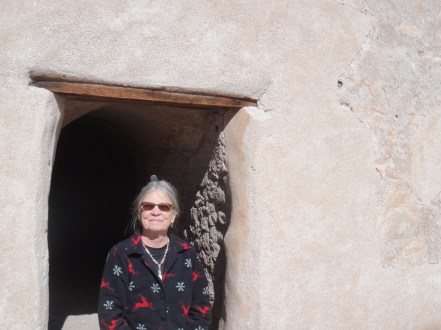
Dangerous
I was born in the year of the tiger. I did not discover this until I was middle aged. I only knew what I had read on the Chinese restaurant place mats. The problem with those place mats is the use of western years to measure Chinese years. Chinese new year falls any time between January and February, so it does not coincide with our calendar. I thought I was a rabbit based on this misinformation. I never really felt like a rabbit, so when I discovered the error I was somewhat relieved. If your birthday falls in December, January, or February you might want to check your animal sign for accuracy.
The reason it is pertinent is that a very large number of people on earth use this system to make decisions. You might not personally put any stock into Feng Shui or Daoist anything, but since such a large part of the world’s population does, I find it interesting. Big bucks are invested in Feng Shui for commercial buildings in Hong Kong, one of our big financial centers. There is a grand tradition and belief in this system. I don’t really make decisions with it, but do like to study the details. I feel the same way about western astrology. It is more than superstition because it has a long history and a following. I like learning about the way the ancients thought. They thought a lot about the stars, the moon and the sun. Farmers’ Almanac confirms that there is still some thought devoted to the positions of the astral bodies. I take note of special events in the sky, like today’s eclipse, as a matter of curiosity.
Curiosity may have killed some cats, but I feel I still have a few lives left to devote to everything that sets off my curious streak. In western astrology I am an Aquarius, a sign known for being aloof. Tigers are naturally aloof except when we need to kill and eat. Both of these signs are known as free (perhaps rebellious) spirits. Both are territorial and will defend the group that surrounds them. Both can act very swiftly without warning in order to protect the homeland. Both are perfectly happy being solitary, and don’t really care what others think. Both appear calm and reserved while being perfectly capable of pouncing on dishonorable players. Neither is motivated by power or money. Bravery and unpredictability is our stock in trade.
I am a metal tiger, highly conductive and sharp. I am a walking razor. Don’t you watch my size. I am dangerous!!!!!!!!! Don’t pull my tail.

Burial:
St Mary Churchyard
Warwick
Warwick District
Warwickshire, England

Sir Thomas in his grave

Sir Thomas and Lady Katherine
My 19th great-grandfather was born in Warwick Castle in Warwickshire, England Feb. 14, 1313. He was the 11th Earl of Warwick. He died of the plague on Nov. 13, 1369 in Calais, Departement du Pas-de-Calais, Nord-Pas-de-Calais, France
He was English nobility. He was one of the Founder Knights of the Order of the Garter in 1348. He was related to the Kings of England and held many offices under them including: Hereditary Chamberlain of the Exchequer, Hereditary Sheriff of Worcestershire, Warden of the Scottish Marches, Marshall of England, and Sheriff of Warwick and Leicester counties. He was known for his military prowess and fought in many battles: in Scotland, in France in command at Valenciennes, and with the King at Tournai, at the Battles of Crecy and seige of Calais, and in Lithuania as a crusader from 1362 to 1365. He married Katherine de Mortimer after a dispensation was granted for being related in the 3rd degree ,after February 22 1324. They had fifteen children, including Thomas, Knight, Knight of the Garter and his successor as Earl of Warwick. He died testate of the plague at Calais, France. (bio by: Michael Schwing) from Find a Grave
Thomas DeBeauchamp (1314 – 1369)
19th great-grandfather
WILLIAM BEAUCHAMP (1358 – 1411)
son of Thomas DeBeauchamp
Joan Elizabeth Beauchamp (1396 – 1430)
daughter of WILLIAM BEAUCHAMP
Elizabeth Butler (1420 – 1473)
daughter of Joan Elizabeth Beauchamp
Isabel Talbot (1444 – 1531)
daughter of Elizabeth Butler
Sir Richard Ashton (1460 – 1549)
son of Isabel Talbot
Sir Christopher Ashton (1493 – 1519)
son of Sir Richard Ashton
Lady Elizabeth Ashton (1524 – 1588)
daughter of Sir Christopher Ashton
Capt Roger Dudley (1535 – 1585)
son of Lady Elizabeth Ashton
Gov Thomas Dudley (1576 – 1653)
son of Capt Roger Dudley
Anne Dudley (1612 – 1672)
daughter of Gov Thomas Dudley
John Bradstreet (1652 – 1718)
son of Anne Dudley
Mercy Bradstreet (1689 – 1725)
daughter of John Bradstreet
Caleb Hazen (1720 – 1777)
son of Mercy Bradstreet
Mercy Hazen (1747 – 1819)
daughter of Caleb Hazen
Martha Mead (1784 – 1860)
daughter of Mercy Hazen
Abner Morse (1808 – 1838)
son of Martha Mead
Daniel Rowland Morse (1838 – 1910)
son of Abner Morse
Jason A Morse (1862 – 1932)
son of Daniel Rowland Morse
Ernest Abner Morse (1890 – 1965)
son of Jason A Morse
Richard Arden Morse (1920 – 2004)
son of Ernest Abner Morse
Pamela Morse
I am the daughter of Richard Arden Morse

Warwick Castle
As I go through my possessions in order to eliminate the items no longer useful to my life, I have discovered the “art supply” hoarder in me. I knew that I was a jacket and costume freak, and own way too many pieces of dress up clothing. I have discovered that I am equally attached to a whole bunch of stuff I can’t bring myself to eliminate. The largest category, other than books, is art supplies. In each and every room and cranny of my home I find items I have stashed because I believe I will someday make art with them. Some of this stuff has been here for a decade without being moved. The list is ridiculous and much longer than I imagined.
I own:
That is not even taking into consideration all the crazy fancy exotic groceries I collect because I believe I am a culinary artist all the time. I own some spices and tea I hauled home from Europe years ago…this is not something to hoard..it is intended to be consumed. My big issue is just to go ahead and use it. It must be done.
I can tell this as gotten completely out of hand and I must take some action. I need to discard some stuff, but more to the point, I need to use it. I have found a class that is offered at the Tucson JCC, where I enjoy my Silver Sneakers membership, in drawing and painting. It is held twice a week on a drop in basis. One buys a punch card and uses it at one’s own pace. The best part of this class is that you bring your own supplies. Hallelujah!!! I will take supplies for my own work, and perhaps be able to share (read unload) some of my excess with my fellow art students. I think this will help me come to terms with my artist archetype. Am I an artist or a hoarder with artistic illusions? We soon shall see, gentle readers. Do you have attachments to things you keep for making art?

Tattershall Coat of Arms
My tenth great-grandfather was born 1572 in Wininick, Lancashire, England, and died 1597 in Wininick, Lancashire, England. He married Ann Hyde on 11 Sep 1593 in Winewick, England, daughter of Robert Hyde and Beatrice Cleverly. His father was in the muster of soldiers in the County of Lancaster August 16, 1574, required to serve the Queen.
Richard Tattershall (1572 – 1597)
10th great-grandfather
Joanne Tattershall (1598 – 1635)
daughter of Richard Tattershall
Mary Greene (1633 – 1686)
daughter of Joanne Tattershall
Benoni Sweet (1663 – 1751)
son of Mary Greene
Dr. James Sweet (1686 – 1751)
son of Benoni Sweet
Thomas Sweet (1732 – 1813)
son of Dr. James Sweet
Samuel Thomas Sweet (1765 – 1844)
son of Thomas Sweet
Valentine Sweet (1791 – 1858)
son of Samuel Thomas Sweet
Sarah LaVina Sweet (1840 – 1923)
daughter of Valentine Sweet
Jason A Morse (1862 – 1932)
son of Sarah LaVina Sweet
Ernest Abner Morse (1890 – 1965)
son of Jason A Morse
Richard Arden Morse (1920 – 2004)
son of Ernest Abner Morse
Pamela Morse
I am the daughter of Richard Arden Morse
This family resided in Lancashire for several centuries before Richard was born. His daughter Joanne sailed to America with her husband and family but died either at sea or shortly after arrival in Boston.
The Lancashire Tattershalls
According to ‘Memories of Hurstwood’ the earliest records of Tattersalls in Lancashire begin with in the year 1380. In the year 1402 that is about 22 years after the death of Robert Tattersall of the Holme Extwistle, and Briercliff, we find the names of Richard and Edmund Tattersall as signatories to the costumale which is called the magna carta of Blackburnshire. Richard and John Tattersall who we find from this charter held an important position in the district in the year 1402 held their lands according to the custom and manner and honour of Lincoln. This fact links the Lincolnshire and Lancashire Tattersalls.
A list of all persons assessed to the Royal Subsidy in the township of Burnley in 1522, included Richard Tattersall 20s 12d. Richard Tattersall died in 1524 on 20th December. When he died he had 4 messuages, 80 acres of land, 16 acres of meadow, 40 acres of pasture, 10 acres of wood, 20 acres of moor and turbary, with their appurtenances in the towns of Brereclif and Burnley in the County of Lancaster. His son Christopher aged 36 inherited. His son Richard Tattersall died a very old man in 1587. He married a Barcroft of Barcroft Hall. He had three sons, Edmund, Richard and John and several daughters.
In the muster of soldiers in the County of Lancaster August 16, 1574 (Harl.MSS.1926) Richard Tattersall along with other local yeoman had each to furnish 1 longbowe, one sheffe of arrowes, one skull (or steel cap) and one bill for the use of Her Majesty. His youngest son John was a poor scholar at Oxford.
A copy of Richard Tattersall’s Will is preserved in the Probate Court of Chester dated 6th December, 1587 in which he is described as Richard Tattersall of Brearcliffe.

a rose is a rose
The phrase quid pro quo literally means something for something in Latin. When it was first used in the English language it referred to substitution of one medicine for another. The apothecary who switched the patient’s remedy for another one may have acted out of ignorance, or may have done so intentionally. Fraud may be involved in a quid pro quo arrangement, but it is not necessarily mendacious or premeditated. It merely suggests an exchange. There are plenty of beneficial exchanges and trades, so why does this term sound so creepy and illicit?
The usage extended from the pharmacy into legal matters. In this case the exchange of one thing for another may be used for favors, appropriate or inappropriate. Now it is common to use this phrase when we suspect some kind of financial hanky panky that smells like an illegal deal. Ponzi schemes and predatory lending might fall into this category. The Clinton Foundation has been in the news recently for possibly giving favors for donations. The issue is in the intent of both givers. If they both intend to evade the law through the trade, they may be acting criminally. I am sure this is hard to prove in court, but it is done all the time, nonetheless.
In personal business we have quid pro quo understandings with bosses, landlords, colleagues, and clients. It is good to examine them carefully to be sure that you have not entered an agreement that you can’t or don’t want to fulfill. There are both written and unwritten contracts that bind people. Healthy happy something for something trades are good for the community. Can you think of both good and bad examples from your past? If you are a good judge of character (caveat emptor) and value you can make sure you get a fair deal. Pay attention to the deals you make, gentle reader, and what you accept in trade.

a rose is a rose

Virgo constellation
The sun has just moved into Virgo for the transitional month between summer and fall. In just a month’s time it will be equinox. This month is perfect for cleaning and clearing space, time, and clutter of any kind. Virgo month is also the ideal time to upgrade daily health and fitness regimes. I have returned to a study that requires intense reading, meditation, and writing. I had fallen out of the discipline needed to finish the course, but now I am enjoying the material and looking forward to doing my homework. Virgo is all about discipline, order, and maybe a little bit of fussiness over details. This is the right time to take up journaling and daily meditation in order to ground body and mind. This is the month to put everything neatly in order, and keep it that way.
I believe that habits require 40 days to become a part of life. After the equinox I need to be vigilant and orderly with my newly established practices in order to secure them. Before the equinox I plan to do a major purge and tidy program in my home and garden. By cleaning and clearing space I will also clear some time for myself. Less stuff requires less maintenance. I am convinced that I will be happier owning far fewer books, pieces of clothing, papers, and personal mementos. I am going to listen to the joy of tidy book again because I still have a month of audible for free, and I think I need to hear it all one more time. I know the author is right about junk representing unresolved issues form the past. Physical space has a direct impact on physical as well as mental health. Clearing closets has the effect of clearing cobwebs from the mind.
To honor the virgin of the harvest in my own way I will use her energy to:
This will be an excellent jump start to the fall season. Establishing healthy habits and clean clear space is a gift that will go on giving through the end of the year.

Masterson Coat of Arms
My 10th great-grandfather was a deacon of the church in Leiden, Holland. He arrived in Plymouth in 1629 and died four years later.
Richard Masterson lived in Sandwich, Kent. He and several others were brought before church courts for criticizing the Church of England and the Book of Common Prayer, as well as for non-attendance at services. He was excommunicated several times. Richard Masterson was in Leiden by 7 Oct 1611. He was a wool comber by occupation. He bought a house on the Uiterstegracht on 2 Jan 1614, the sale of which was the subject of years of negotiation by his wife’s second husband. With four others, he wrote a letter from Leiden to William Bradford in 1625 about their hopes of emigrating to New England. From Michael Paulick’s research, it would seem that Masterson traveled between Leiden and Sandwich. Richard Masterson arrived in New England in 1629 from Leiden. Nathaniel Morton in his history of the Plymouth church described Masterson as a “holy man” and “experienced saint,” “the said Richard Masterson having bin officious with parte of his estate for publick Good; and a man of Abillitie as a second steven to defend the truth by sound argument Grounded on the scriptures of truth…” He died in 1633 in the epidemic of infectious fever and Mary Masterson married Rev. Ralph Smith, the minister for Plymouth until 1636. They moved to Manchester by 1645, and Ipswich by 1652.
Richard Masterson (1590 – 1633)
10th great-grandfather
Sarah Masterson (1612 – 1714)
daughter of Richard Masterson
Margaret Wood (1635 – 1693)
daughter of Sarah Masterson
Elizabeth Manchester (1667 – 1727)
daughter of Margaret Wood
Dr. James Sweet (1686 – 1751)
son of Elizabeth Manchester
Thomas Sweet (1732 – 1813)
son of Dr. James Sweet
Samuel Thomas Sweet (1765 – 1844)
son of Thomas Sweet
Valentine Sweet (1791 – 1858)
son of Samuel Thomas Sweet
Sarah LaVina Sweet (1840 – 1923)
daughter of Valentine Sweet
Jason A Morse (1862 – 1932)
son of Sarah LaVina Sweet
Ernest Abner Morse (1890 – 1965)
son of Jason A Morse
Richard Arden Morse (1920 – 2004)
son of Ernest Abner Morse
Pamela Morse
I am the daughter of Richard Arden Morse
Richard and Mary were among the Puritans in Leyden, Holland, but did not immigrate until 1629 on the second “Mayflower.” Their nephew John Ellis also made the voyage.
!Initial source: Family group sheet in the FGRA collection of the Family History Library, Salt Lake City, Utah, submitted by Edith Haddon
Littleford, 330 E 19th St, Idaho Falls, Idaho. Her source: Rec of Jewell David, Rt1 Box 822, Kent, Washington.
In “NEHGR” vol. 119 pg 162 is the extracted record of the marriage, “Archives of Leyden – Banns: the 1st; Nov. 9, 1619 – Richard
Masterson,woolcomber from Sandwich in England, accompanied by Wiliam Talbot and John Ellis, his brother-in-law with Mary Goodall, spinster, from Leiston , in England acc. by Elisabeth Keble and Mary Wing her acquaintnces.” The second banns were published Nov. 16th, the third banns Nov. 23rd and the marriage was performed “before Alpphen and Tetrolde, bailiffs this XXiii November 1619.” There is an article in “NEHGR” vol 144 (1990) pg 24, titled “The Mary Atwood Sampler”. It has an account of Richard and Mary (Goodall) Masterson which says “Richard Masterson, who was in Leyden, Holland, as early as 1611, was a woolcomber from Sandwich, England, according to the record of his marriage in Leyden 23 November 1619 to Mary Goodall, a spinster from ‘Leessen,’ England [perhaps Leiston in Suffolk?] (D. Plooij and J. Rendel Harris, “Leyden Documents Relating to the Pilgrim Fathers” [Leyden, 1920], IX, XL).
Richard died in 1633 when an ‘infectious fever of which many fell very sick and upwards of 20 persons died’ struck the Plymouth settlement (Samuel Eliot Morison, “Of Plymouth Plantation: 1620-1647 by William Bradford” [New York, 1975], 160). Mary (Goodall) Masterson married, second, before 1 July 1633 Rev. Ralph Smith of Plymouth. Mary, who ‘in 1650, according to a note of [Ralph] Smith, was sixty years old, died in 1659’ (D. Plooij, “The Pilgrim Fathers from the Dutch Point of View” [New York, 1932], 116.
An article, “The Sandwich Separatists”, by Michael R. Paulick, published in”NEHGR” vol 154 pg 353-369, names, on page 355, the wife of John Ellis, who was called brother-in-law in the Leiden marriage record of Richard Masterson. It quotes the parish register of St. Peter’s, Sandwich, Kent, England, giving the marriage of John Ellys and Blandyna Maistersonne. However, it says no baptismal record has been found for either of them but the baptisms of six of their children were listed. This article gives more detail about the separatist” movement in Sandwich and some of the activities of Richard Masterson. It quotes a 1977 history of Kent by Peter Clark that “by 1600 there was a signigicant group of vociferous left-wing radicals and separatists standing outside the mainstream of Kentish Puritanism.”
On page 358 is a quote from the records of the Sandwich Deanery: “To the 2 and 3 article wee presente Thomas Allen and Thomas Baker and
Richard Masterson for affirming that the forme of gods worshipp in the Churche of England established by lawe and contained in the booke of Common Prayer and administracion of the sacraments is a corrupt & unlawfull worshipp and repugnant to the scriptures and that the rites and ceremonyes in the Churche of England by lawe established are wicked anechristin & superstitious and suche as religiows godlie menn cannott neather maye with good conscience use or approve of. To the 65 article wee presente the saide Thomas Allen Thomas Baker
Richard Masterson & Abigaell Atkins for not frequenting there parishe churche one sondayes to heere divine service.
To the 66 (article) wee presente the saide Thomas Allen Thomas Baker & Richard Masterson & Abigaell Atkins for recusants which forebears to come to churche to common prayer & to heere gods word preached.” The article goes on to say “Richard Masterson was summoned but failed
to appear on 2 and 26 July, 22 October, 3 and 13 December 1613, and was excommunicated 17 January 1613/14 along with Allen, Baker, and
Atkins, the sentence delivered 13 February 1613[/14] by Harimus White, minister. [“Comperta and Detecta Book,” Sandwich Deanery, f59v,
ff59v-60r, f60v, f61r.]”
“The Book of Common Prayer established the form of Protestant worship and was enforced by the 1559 Act for the Uniformity of Common Prayer and Divine Service. This Act required ‘strict church attendance and rigid adherence to the Book of Common Prayer.’ All ministers of any parish were required to follow the written order of service for matins (morning service), evensong, and the administration of the sacraments. Substantial fines were imposed on any citizen who declared or spoke ‘anything in the derogation, depraving, or despising of the same book…’ or who refused to attend church services. [David Cressy and Lori Anne Ferrell, “Religion & Society in Early Modern England” (…1996), 56-59.] Separatists held the view that only services that were contained in the scriptures should be followed and all other forms of worship of man’s invention were ‘antechristin’.”
It quotes a letter written by the rector of St. Peter’s and other Sandwich ministers in 1613 to the Privy Council of James I, which said “many notablesectes and heresies” were being spread among the people “by such as have recourse unto the towns of Amsterdam, and other partes beyond the seaes” and among the “chiefest sowers” were “Richard Masterson the ellder and Richard Masterson the younger, Thomas Allen and John Ellis”
The article says “The reference to two Richard Mastersons is puzzling; so far, examination of the parish registers of Sandwich shows no trace of a Richard Masterson elder or younger. These terms were commonly – but by no means always – used for father and son or uncle and Nephew. Richard Masterson of St. Peter’s appears only in the ecclesiatical court records. Richard of Leiden was unmarried until 1619 so he had no children to baptize.[36] The note indicated by this number says “It should be noted that the St. Peter’s and St. Mary’s registers are particularly difficult to read, illegible in some areas. A John Maisterson is named in St. Peter’s parish register but his will of 1620 does not indicate any connection with Richard or Blandyna …” “It is possible that the Privy Council confused a Richard Marston with Richard Masterson. The pronunciation of both names with an English long ‘a’ might have sounded similar and perhaps led to a mix-up. Marston apparently had a Separatist reputation….”
The article went on to quote a warning letter to the mayor and stated that the law prohibited these activities and that those accused were fortunate in receiving only an “admonishon and reprehension”. However, “Richard Masterson was summoned 4 and 14 November 1614, and
excommunicated on 28 November 1614.” Still he continued and “had soon returned from Leiden as a professed Brownist or Separatist.” He
was summoned again 10 June 1616 with the following: “To the 2 article wee have one Richard Masterson whoe refuseth to come to our church
traduceth our service and ceremonyes ys a professed Brownest or Separest and hathe formerlye ben often presented and stubbornelye hath stood longe excommunicated and continuallye endeavoreth to infecte others with the same leavin soe that we are greived that the
performaunce of our duetyes herein hat noe better effecte.” He was excommunicated again on the 28th, and yet again on 20 December.
Further in the article it says “When Richard Masterson died in 1633 he was described by Bradford as one of the ‘ancient friends which have lived in Holland.’ If there was a single Richard Masterson, there is evidence that he might have been moving between Leiden and Sandwich. He is recorded in both locations at various times as follows:
7 Oct. 1611 betrothat in Leiden; called acquaintance of Isaac Allerton
2 July 1613 excommunicated in Sandwich with Allen, Baker, and Atkins
4 Nov. 1614 At Sandwich, ‘Lyeinge at Mr. Varall’s,’ excommunicated
22 Jan 1614/15 Leiden, various lawsuits 1612-1615 [Register 143:206]
Jan. 1615 Leiden, purchased house from Roger Wilson 10 Jun 1616 Sandwich, excommunicated as ‘Brownist or Separatist’ Dec. 1616 Sandwich, excommunicated with Mary Plofer for slander 4 Sept. 1618 Letter from Sabin Staresmore in London to John Carver March 1619 Leiden, certificate of good behavior includes Roger Wilson Perhaps his master, Christopher Verrall, who was wealthy and had powerful connections in Sandwich, had actually ‘underhand may[n]teyned and protected the offendors,’ as the Privy Council had accused him of doing. If Richard Masterson was not working with Verrall’s permission it is difficult to understand how he could maintain employment as a servant and travel back and forth between Sandwich and Leiden before Verral’s death in 1615. It is unlikely that any of those who had ‘recourse’ to Leiden made the trip between the two countries without the full knowledge of the other Leiden Separatists.”
The will of Christopher Verral is included in “Appendix” at the end of the article. It is long and difficult to understand but one sentence says “I do forgive my man Richard Masterson all the money which he oweth me and I give him 20s. to make him a ring in token of my good will.”
Letter sent to William Bradford and William Brewster by Richard Masterson and others
To our most dear, and entirely beloved bretheren, Mr. William Bradford and Mr. William Brewster, grace mercy and true peace be multiplied, from God our Father, through our Lord Jesus Christ. Amen.
Most dear christian friends and brethren, as it is no small grief Unto you, so is it no less unto us, that we are constrained to live thus disunited each from other, especially considering our affections each unto other, for the mutual edifying and comfort of both, in these evil days wherein we live: if it pleased the Lord to bring us again together, than which as no outward thing could be more comfortable unto us, or is more desired of us, if the Lord see it good; so see we no hope of means of accomplishing the same, except it come from you, and therefore, must with patience rest in the work and will of God, performing our duties to him and you assunder; whom we are not any way able to help, but by our continual prayers to him for you, and sympathy of affections with you, for the troubles which befal you; till it please the Lord to reunite us again. But our dearly beloved brethren, concerning your kind and respective letter, howsoever written by one of you, yet as we continue with the consent (at least in afection) of you both, although we cannot answer your desire and expectation, by reason it hath pleased the Lord to take to himself out of this miserable world our dearly beloved pastor, yet for ourselves we are minded as formerly, to come unto you, when and as the Lord affordeth means, though we see little hope thereof at present, as being unable of ourselves, and that our friends will help us we see little hope. And now, brethren, what shall we say further unto you; our desires and prayers to God, is (if such were his good will and pleasure) we might be reunited for the edifying and mutual comfort of both, which, when he sees fit, he will accomplish. In the mean time, we commit you unto him and to the word of his grace; whom we beseech to guide and direct both you and us, in all his ways, according to that, his word, and to bless all our lawful endeavours, for the glory of his name and good of his people. Salute, we pray you, all the church and brethren with you to whom we would have sent this letter. If we knew it could not be prejudicial unto you, as we hope it cannot; yet fearing the worst, we thought fit either to direct it to you, our two beloved brethen, leaving it to your goodly wisdom and discretion, to manifest our mind to the rest of our loving friends and brethren, as you see most convenient. And thus intreating you to remember us in your prayers, as we also do you; we for this time command you and all your affairs to the direction and protection of the Almighty, and rest,
Your assured loving friends
And brethren in the Lord,
FRANCIS JESSOPP,
THOMAS NASH,
THOMAS BLOSSOM,
ROGER WHITE,
RICHARD MAISTERSON.
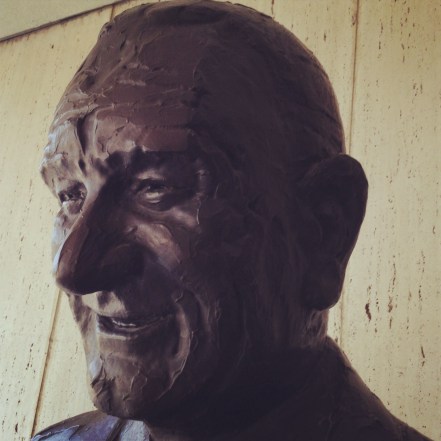
LBJ
I have been watching the HBO John Adams series about the American Revolution and the first American continental congress in Philly. It helps me see that our politicians are not in the worst situation in our history. Neither are they less favorably aligned than in the nation’s past. This congress we have today is about the same as all ruling bodies have always been, since the Roman Senate. The use of power by humans on earth has been punctuated with misery and cruelty. Conquest, political or military, has been imposed on nations, colonies, and entire continents. War and Peace have hung in the balance more times than we know, but always for the same reasons. War is an archetypal situation that repeats itself.
When we say history repeats itself we mean that archetypal events continue to occur. In the arch of recorded history we have seen the pendulum of power swing from feudalism to anarchy. Leaders have been both born and created in the struggle to survive. We think of those leaders as the representatives of the entire culture, but they may merely be the most famous. We know less about how the common person lived than we do about the fancy and well born. I know this very well from my study of my own ancestry. I learn more all the time about America by studying my ancestors’ lives. None of my forefathers was famous during the American Revolution, but many did fight in it. Power does flow through the events of man, but my religious ancestors would all say that fate is sealed by divine providence. Man is just a player on the eternal stage.
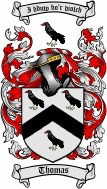
Thomas Coat of Arms
David Thomas is thought to have been born in Wales about 1620, David probably arrived in America about 1640-1 on the ship “Sampson”. It certainly is a fact that a session of the Quarterly Courts at Salem on 8th July 1645 “David Thomas” is a witness in a suit for defamation of character brought by John Bartoll against Alice, wife of John Peach, Jr, for having said that the plaintiffs wife, Parnell Bartoll, had “committed adultery with the Boatswain of the ship “Sampson” in the cabin of Parnell about four years ago.” This is the first record that we know of for David Thomas in America.
David lived in that part of Salem which is about to become the town of Marblehead. David left Marblehead probably early 1661, and removed to the part of Salem which later became Beverly. Two known maps showed the location of the Salem property of David Thomas agree that David owns Lot 16, which seems to have had no dwellings on it while David owned it.
It is significant that his wife Joanna executed her consent to the sale of the Beverly property by an instrument dated at Plymouth 14th July 1669. (Essex County Deeds book 3, pages 57 and 189). It seems this must have been the year David and Joanna Thomas moved to Middleborough. The birth of his son Edward Thomas on 6th February 1669 is the first entry in the Town Records of Middleborough, even though that entry may have been made at a later date, since the Town Records are said to have been destroyed by the Indians during King Philip’s War of 1675.
David is a Farmer at “Middlebury” and his family is one of the 16 families that constituted this Town in 1675. During this year when Indians attacked “Middlebury’s” new white inhabitants, forcing these settlers back into the Old Plymouth Colony Village. After this war ended these early settlers returned and 28th June 1677 those who had owned lands there, numbering 68 persons, met and agreed to re-settle “Middlebury” presently what is now called Middleborough.
David Thomas’s house at Middleborough (not standing anymore) is a little distance southeast of the town proper at the end of what is now Thomas Street at the area that became well known as “Thomastown”.
David Thomas (1620 – 1689)
9th great-grandfather
Mary Thomas (1664 – 1754)
daughter of David Thomas
Ann Northup (1696 – 1772)
daughter of Mary Thomas
Ann Gifford (1715 – 1795)
daughter of Ann Northup
Frances Congdon (1738 – 1755)
daughter of Ann Gifford
Samuel Thomas Sweet (1765 – 1844)
son of Frances Congdon
Valentine Sweet (1791 – 1858)
son of Samuel Thomas Sweet
Sarah LaVina Sweet (1840 – 1923)
daughter of Valentine Sweet
Jason A Morse (1862 – 1932)
son of Sarah LaVina Sweet
Ernest Abner Morse (1890 – 1965)
son of Jason A Morse
Richard Arden Morse (1920 – 2004)
son of Ernest Abner Morse
Pamela Morse
I am the daughter of Richard Arden Morse
David Thomas and his wife came from Salem to Middleboro soon after 1668, the of he selling his land in Salem. They settled in Thomastown, where their descedants are still living. He bought into the Twenty-six Men’s purchase.
He had sveral children, David, Joanna, William, Jeremiah, and Edward, the last born February 6 1669, the first birth in the early records of the town.
Source: History of the Town of Middleboro.

