mermaidcamp
Keeping current in wellness, in and out of the water
You can scroll the shelf using ← and → keys
You can scroll the shelf using ← and → keys
The ship Planter, under Master Nicholas Trerice/Travice, sailed from London April 2 or 11, 1635, arriving at Boston June 7, 1635. My tenth great-grandfather was 21 years old when he sailed to America on that ship.
Lt. Francis Peabody, the ancestor of the American Peabodys, was born at St. Albans, Hertfordshire, England, in 1614. He came to America in 1635 ; lived first in Lynn, and then in Ipswich, in then Massachusetts Bay colony. In 1639, he removed to Hampton, N.H., where he lived until 1657, when he came to Topsfield, Mass. He was useful in the new place, and was chosen to the office of selectman, as well as town clerk, both of which offices he held many years.
March 4, 1664, the town voted that Lt. Peabody have liberty ” to set up a grist mill and to flow so much of the town’s common as is needful for a mill so long as the mill does stand and grind for the town.”
The next year (1665), Mr. Peabody established the mill on Pyebrook. Who can estimate the joy of the inhabitants at that early period of having a grist mill to accommodate them in the grinding of their rye and corn! It marked a new era in the history of the Topsfield commoners.
March 7, 1671, the town voted that it was “willing that Lieut. Peabody shall set up a saw mill provided it does not do damage to any of the townsmen in their meadows.” The saw mill was built in 1672.
So far as the writer is able to learn, everything pertaining to these mills went along smoothly until 1691, when, the business having increased on account of the growth of the surrounding district, there was not a sufficient head of water during a part of the year to run the mills. Hewlett’s brook, a branch of Pye brook, left the latter stream and ran off to the northeastward, a short distance above the Peabody mills. As, at that time, there was no mill on Hewlett’s brook, Mr. Peabody was granted by the town the privilege of building a dam across this branch a few rods below its parting from the main stream, providing he pay satisfactory damages to the adjoining owners by reason of his flowing their meadows. The records speak of damages being received the following year by Thomas Dorman and sons, who had in 1690 erected a house within a few rods of the parting of the brook.* There was probably water power enough at the mills after the building of the dam as there are no papers showjng the want of it for more than fifty years afterwards.
During the year 1698 (?), after faithfully serving his day and generation, Lt. Francis Peabody passed away full of years and honors. By his will, dated Jan. 20, 1695, he gives his son Isaac Peabody the mills and mill-yard, the dwellinghouse by the mill, and other property.
Lieut Francis Peabody (1614 – 1697)
10th great-grandfather
Lydia Peabody (1640 – 1715)
daughter of Lieut Francis Peabody
Mary Howlett (1664 – 1727)
daughter of Lydia Peabody
John Hazen (1687 – 1772)
son of Mary Howlett
Caleb Hazen (1720 – 1777)
son of John Hazen
Mercy Hazen (1747 – 1819)
daughter of Caleb Hazen
Martha Mead (1784 – 1860)
daughter of Mercy Hazen
Abner Morse (1808 – 1838)
son of Martha Mead
Daniel Rowland Morse (1838 – 1910)
son of Abner Morse
Jason A Morse (1862 – 1932)
son of Daniel Rowland Morse
Ernest Abner Morse (1890 – 1965)
son of Jason A Morse
Richard Arden Morse (1920 – 2004)
son of Ernest Abner Morse
Pamela Morse
I am the daughter of Richard Arden Morse
 Frances Peabody’s signature
It is possible today to visit the home of my 11th great-grandfather, Augustine Steward. He was a successful mercer and mayor or Norwich.
Augustine Steward (1491 – 1571)
11th great-grandfather
Elizabeth Steward (1528 – 1575)
daughter of Augustine Steward
Augustine Jarnigo Sotherton (1553 – 1585)
son of Elizabeth Steward
Elizabeth Southerton (1582 – 1628)
daughter of Augustine Jarnigo Sotherton
Margaret Warner (1615 – 1649)
daughter of Elizabeth Southerton
Captain William GARTON (1635 – 1709)
son of Margaret Warner
Margaret Garton (1678 – 1773)
daughter of Captain William GARTON
Thomas Morris (1730 – 1791)
son of Margaret Garton
Joanna Morris (1762 – 1839)
daughter of Thomas Morris
John Samuel Taylor (1798 – 1873)
son of Joanna Morris
William Ellison Taylor (1839 – 1918)
son of John Samuel Taylor
George Harvey Taylor (1884 – 1941)
son of William Ellison Taylor
Ruby Lee Taylor (1922 – 2008)
daughter of George Harvey Taylor
Pamela Morse
I am the daughter of Ruby Lee Taylor
Augustine Steward was born in 1491 in the Tombland house opposite the Erpingham Gate of Norwich Cathedral. His father, Geoffrey, was a Norwich mercer and alderman. Shortly after Augustine’s birth the family moved from Tombland to a prestigious, stone-built house (Suckling House) in St. Andrews. Augustine was apprenticed to his father, who died in 1504. Augustine’s mother then married John Clerk, a rich merchant and grocer. John was mayor of Norwich in 1505 and in 1510. Augustine’s mother traded as Cecily Clerk with her own registered merchant’s mark.
A successful mercer
Augustine, known as Austen, became a highly successful Norwich mercer, who signed himself Awstyne Styward. He married twice and lived in the Tombland house where he was born. His first wife was Elizabeth Read of Beccles with whom he had a family of two sons and six daughters. His second wife, Alice Repps, from West Walton gave him a son and two daughters. Augustine was a Norwich councillor from 1522 to 1525, an alderman from 1526 to 1570 and Sheriff in 1526, He was Mayor in 1534, 1546 and 1556, a record that was only equalled by two other men within the sixteenth century. Augustine was also M.P for Norwich in 1542 and a Burgess in Parliament in 1547. During the sixteenth century, the office of mayor meant undertaking a demanding, full-time task for a year. A mayor’s own business had to be successful and so arranged that it could run without him. The mayor was expected to use his personal funds for some civic hospitality. However, the Corporation did stage a three-part show to mark Steward’s third term in office. It was recognised that Augustine had ‘allwayes ben a good and modest man, hee was beloved of poore and rich’.
Rebuilding the Guildhall
Steward’s influence was prominent in the 1534 rebuilding of the Council Chamber of Norwich Guildhall. He was involved with purchasing Black Friars Church, (St. Andrew’s Hall), from the Crown, for Norwich. A 1540 charter conveyed the Black Friar’s Monastery to the city for £81, paid by ‘our beloved Augustine Steward, of our city of Norwich, merchant.’ A portrait of Augustine in his mayoral robes can be seen in the Blackfriar’s wing of St. Andrew’s Hall.
Kett’s Rebellion
During Kett’s Rebellion in 1549, Augustine Steward played a leading part in negotiations between the rebels and the King’s army. Mayor Thomas Codde, who had been taken prisoner on Mousehold Heath by the rebels, appointed Steward his deputy. The Marquis of Northampton, representing the King, was entertained in Steward’s house. A plaque on the cathedral wall marks the spot, not far from Augustine’s house, where the rebels killed Lord Sheffield and Sir Thomas Cornwallis. Some of Kett’s followers ransacked Steward’s house but did not harm him. The Earl of Warwick used the house as his headquarters when he put down the rebellion.
Augustine Steward House
Steward’s home, opposite the cathedral, is a fine, surviving example of a successful Tudor merchant’s trading-house with goods stored in the stone undercroft and a shop or workshop at street level. The family lived in the upper storeys. Augustine’s house is jettied, and the timbers have warped over time giving the house a crooked appearance. An upper wing of brick, timber and plaster is built across Tombland Alley. Here you can see Augustine’s merchant mark and that of the mercer’s guild embossed on a corner stone, together with the date, 1549. Through the arch, the old house timbers are exposed and the carpenters’ marks can be seen, denoting the order in which the timbers were assembled on-site after being pre-cut in a timber yard. After Steward’s death in 1571, the house became in turn, a butcher’s, a broker’s, an antique dealer’s, a bookshop and a coffee house. At present it houses several antique dealers. Allegedly, there are underground passages leading from the crypt to the Cathedral and also to St. Gregory’s church. The ghost of a ‘Lady in Grey,’ a 1578 plague victim, is said to haunt the house.
A man of property
Augustine Steward owned Norfolk manors at Gowthorpe and at Welborne. His estate around Tombland extended along the north and west sides of St. George’s churchyard into Prince’s Street and included the site of an ancient inn. In later life he resided in a large, quadrangle house that he had built on Elm Hill, on the site of Paston Place originally owned by the Paston family. In 1507 all the houses on Elm Hill, except the modern Briton’s Arms, had been destroyed by fire. Augustine’s new house occupied the area now sub-divided into numbers 20, 22, 24 and 26. The carved beam over the archway of Crown Court bears Augustine Steward’s merchant mark on the right and the arms of the mercer’s guild on the left. Augustine Steward was buried in the church of St Peter Hungate.
Footnote
The house on Tombland where Augustine Steward was born still exists and has been called Augustine Steward House. It is generally reputed to date to 1530, however Marion Hardy, in an unpublished biography of Steward, discloses an earlier date for the house in the 1504 will of Augustine’s father, in which the house was mentioned as the location of Steward’s birth in 1491. Perhaps the 1491 house was damaged in the 1507 fires of Norwich and Augustine Steward re-built in 1530.
Further Reading
Blomefield F, The History of the City and County of Norwich, Volume 2. (Norwich 1745).
Hardy, M. Austen Steward of Norwich, unpublished partial manuscript.
Jones, W. H. A Quaint Corner of Old Norwich: Samson and Hercules and AugustineSteward’s Houses, Norwich, 1900.
Kennet, H. Elm Hill, Norwich: The Story of its Tudor Buildings and the People who Lived in them, ecollectit Ltd, Harleston, 2006.
Rawcliffe, C. and R. Wilson, (eds), Medieval Norwich, Hambledon and London, London, 2004.
Solomons, G. Stories Behind the Plaques of Norwich, Capricorn Books, Cantley,1981.
From “Genealogies of Virginia Families” vol. 5, page 546. Eldest son, Mercer, sheriff 1526, mayor 1534, 1546, 1556, M.P. 1541. Buried 1571 St. Peter Hungate.

Venus enters Virgo, and what we see, one way or another, is a shift toward wanting to be right, correct, or proper, to be able to stand confidently against criticism or critique–and that can prompt inventory-taking, a discriminating state of mind, and Self-criticism, among other things. Ruler of Virgo, Mercury, is involved in the only […] […]
via 9 July 2018 A Proper Virgin — Julie Demboski’s ASTROLOGY — Blue Dragon Journal

Landcaster County
Garton Bible records show Capt. William Garton’s father to be John Garton born 1615 and died 1698. He may be the son of a John Garton of Kingston-Upon-Hull (a wealthy merchant) who married Ann Hobson in 1614,
This Bible has an unbroken chain of possession in the same family. Captain William Garton was a planter, residing in Lancaster County, where he bought land in 1673. He is the oldest proven Garton in the line.
Will Of Captain William Garton, Will Book 10, pages 63-66, rec’d 8 Feb 1710.
“In the name of God, Amen, I Will Garton, of the parish of Christ Church in the County of Lancaster in Virginia, being sick, but in perfect memory, God be praised, I do make this my last will and testament, in manner and form following.
First – I bequeath my soul to Almighty God that made it, hoping to be saved by the meritorious death and resurrection of our Saviour Jesus Christ, my redeemer.
Item – to my son URIAH GARTON I bequeath a parcel of land beginning at a Pine tree at the head of the first long branch issuing out of Nanty Poyson Creek, running northeast to a corner tree at the first little branch that issues out of Deuber Cove.
Item – to my son JAMES GARTON I bequeath a parcel of land beginning in Black Sows Neck near Carel’s line so running up Carel’s line to a corner Maple northeast upon a marked line to a corner Red Oak thence northeast to the head of Deuber Cove concluding all within the said lines aforesaid.
Item- to my son ANTHONY GARTON I bequeath a parcel of land beginning at a corner Red Oak from thence to a corner stone in Tark [or Tarll].
Item – to my daughter KATHERINE GARTON I bequeath a parcel of land beginning at a Red Oak at the head of the spring branch issuing out of Tab’s Creek, all concluding within the aforesaid courses and corner line.
Item – All my land bequeathed to my sons and daughter aforementioned I bequeath to them and their heirs forever.
Item – It is my will that my three negroes shall tarry upon the plantation I now live upon, till my debts is paid and then to be equally divided along with my personal estate among my sons and daughters MARGARET and KATHERINE GARTON.
Item – to ESTHER MUGG, I bequeath a full share of my personal estate with my sons and daughters aforementioned if she comes.
I do appoint my sons and daughters aforementioned to see this my last will and testament performed.
Witness my hand and soul this twentieth day of December One Thousand Seven Hundred and Nine.
his
Will [+] Garton
Witnesses mark –
Murler [+] Noulin
William Buttery
Katherine (+) Buttery
Elizabeth [+] Rebelow
Item – To my sons and daughters I bequeath all bounds of Thomas Thompson’s patent lying between Tab’s Creek and Nanty Poyson Creek.
Item – To my son-in-law, Will Cutter, I bequeath more ______ which is on my plantation.
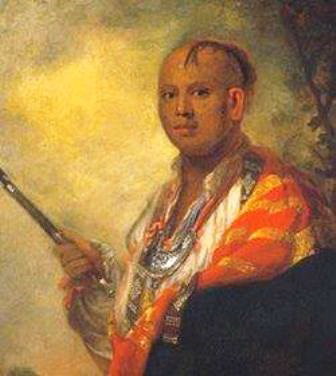
Chief Amatoya “Water Conjurer”

Chief Amatoya “Water Conjurer”
My 11th great-grandfather was half British and half Shawnee. He married a Shawnee woman and lived as a leader of her tribe. Natives were treated very badly by the colonists, who normally thought of them as inferior. This is one success story I am pleased to have in my family’s history.
Trader Carpenter (Amatoya / Moytoy I) married a Shawnee named Locha in 1668. Trader’s sister Pasmere Carpenter married the grandfather of Cornstalk Hokolesqua (Shawnee) in 1660. That same year the clan was driven south by the Iroquois. They moved along the Tennessee river, starting the villages of Running Water (where Thomas died in 1675), Nickajack, Lookout Mountain, Crowtown and Chota. Chota was created as a merging place of refuge for people of all tribes, history or color. It became similar to a capital for the Cherokee Nation. These villages had grown to about 2000 people by 1670 when the Carpenter clan moved to Great Tellico. Here Trader (Amatoya / Motoy I) married Quatsy of the Wolf Clan in 1680. Though Amatoya (Trader) was chief of the above mentioned villages, it was his son Moytoy II (sometimes called “Trader-Tom”) most people refer to as Moytoy and who many claim was crowned “Emperor of the Cherokee”.
CHRONOLOGY
1540
Hernando De Soto’s expedition to the Mississippi River is the first time Europeans are seen by American Indians in Kentucky.
1629
British colonists in Virginia establish a trade network with Cherokee living in the Appalachian Mountains.
1690
King William’s War begins.
1697
The Ryswick Treaty is signed at the end of King William’s War. Territories remain the same as before the War.
1702
The Cherokees and Creeks side with the French during Queen Anne’s War.
1716
Cherokee strengthen their alliance with the British.
1717
This date is engraved in a sandstone rockshelter in eastern Kentucky.
1730
Cherokee Chiefs Attakullakulla, Clogoittah, Kollannah, Onancona, Oukah Ulah, Skalilosken Ketagustah, and Tathtowe travel to Great Britain with Alexander Cuming.
1722
The Treaty of Albany is made between the Haudenosaunee and Great Britain. The Haudenosaunee are joined by the Tuscarora and they expand by alliance and conquest to control an area from southern Canada to Kentucky.
Chief Amatoya “Water Conjurer” (Trader Tom CARPENTER) aka MOYTOY I (1635 – 1693)
11th great-grandfather
Aganonitsi Quatsy Woman Wolf ClanTellico Cherokee Tellico (1650 – 1692)
daughter of Chief Amatoya “Water Conjurer” (Trader Tom CARPENTER) aka MOYTOY I
Delaware Indian Fivekiller (1674 – 1741)
son of Aganonitsi Quatsy Woman Wolf ClanTellico Cherokee Tellico
Solomon John Cherokee Kimborough (1665 – 1720)
son of Delaware Indian Fivekiller
Mourning Kimbrough (1689 – 1756)
daughter of Solomon John Cherokee Kimborough
Jane Jeanette Little (1713 – 1764)
daughter of Mourning Kimbrough
Andrew Armour (1740 – 1801)
son of Jane Jeanette Little
William Armor (1775 – 1852)
son of Andrew Armour
William Armer (1790 – 1837)
son of William Armor
Thomas Armer (1825 – 1900)
son of William Armer
Lucinda Jane Armer (1847 – 1939)
daughter of Thomas Armer
George Harvey Taylor (1884 – 1941)
son of Lucinda Jane Armer
Ruby Lee Taylor (1922 – 2008)
daughter of George Harvey Taylor
Pamela Morse
I am the daughter of Ruby Lee Taylor
Amatoya Trader Moytoy was a half white half Shawnee who went on to be a prominent chief and leader for the Cherokee people. His family line would lead the Cherokee for many years to come. This was a testement to the views of the Cherokee people before being abused by the English for many years. They took in a English settler as one of there own, He wed a Shawnee woman and became a member of the tribe.
Cleopatra married Opechancanough who was her father’s adopted brother and her adopted uncle
Matachanna traveled to England to be with her half-sister, Pocohontas, before she died. Matachanna went back to Virginia where she lived and died.
Cleopatra Powhatan the Shawano was born in 1590, near Jamestown colony, and died in 1680
Cleopatra Powhatan was half sister of Pocahontas
Going back to the era of John Smith . . . In the late 1500s/early 1600s a Powatan chief name Wahunsunacock [one of numerous variant spellings] had united some 30 Alonquian tribes into a powerful confederation. He had created the empire through conquest and alliances. He actually ruled as an emperor, not just a tribal chief. When the Jamestown colonists arrived, Wahunsunacock’s domain encompassed the entire region that was to become Virginia. Wahunsunacock did not use a title other than chief of the Powhatans. The colonists referred to him as simply “The Powhatan”, denoting his position as emperor over numerous tribal chiefs of the Powhatan nation. The Powhatan was not friendly toward the colonists, seeing them as encroachers.
Wahunsunacock’s younger brother, or half-brother, Opechanacanough, was the tribal chief who captured John Smith. He immediately took the captive Smith to Emperor Wahunsunacock who imposed the death sentence. Tradition holds that Wahunsunacock’s daughter Matoaka “LIttle Snow Feather”, nicknamed Pocahantas or “Playful One”, pleaded for her father to spare John Smith’s life. Pocahantas became an emissary between her father and the colonists and as such was instrumental in providing the food which saved them during the hard winter. The colonists, in turn, showed their appreciation by capturing and holding Pocahantas for ransom. After they had extracted the full ransom from Wahunsunacock, then they forged an alliance with him by marrying Pocahantas to John Wolfe, a planter in the Jamestown colony who is credited with introducing tobacco as a cash crop.
That much is familiar history. Then comes the chapter that is really relevant to our family. At the death of the elderly Wahunsunacock, his younger brother [it’s uncertain if he was a brother or a half-brother] Opchanacanough became successor to Wahunsunacock as emperor. As such, he is frequently also called The Powhatan. To distinguish between the two men I have chosen to use the technically accurate term “Emperor” for Wahunsunacock and “Chief” for Opechanacanough, since Opechanacanough was promoted from a “chief” to succeed Wahunsunacock who had forged the “empire”. In reading other histories, however, it is necessary to note that some writers use the term Powhatan for both brothers interchangeably which is unnecessarily confusing and actually incorrect. Sometimes I get the impression that some genealogy researchers do not grasp that they are two different men.
Emperor Wahunsunacock perhaps had hundreds of wives and children. Several of them are noted in historical documents, but none so well as Pocahantas and, to our benefit, her sister Cleopatra. Not only was Cleopatra a daughter of the Emperor, she was wife to the successor Chief/Emperor Opechanacanough. Now if you were paying attention and recall that Opehanacanough and Wahusunacock were brothers/half-brothers, you might realize that she was also Opechanacanough’s niece [or half-niece as the case may be]. They were a royal dynasty and keep in mind that the family lineage was preserved by most Native Americans, as they still do now, through the matriarchal line.
The relationship of Cleopatra and Pocahantas as full sisters is fully documented. After the death of Pocahantas, Pcahantas’ son had to apply for rights to get to visit his Indian relatives and in his written legal request specifically asks to visit his “mother’s sister Cleopatra” by name. Cleopatra obviously was not her Indian name, but rather what she was called by the colonists because since her husband was the successor ruling Chief/Emperor she was in fact Queen. The title seemed especially apropos to the colonists since not only was she Queen, but her exotic dark looks and elaborate trappings also seemed very regal, and reminiscent of the Egyptian queen.
Only I and probably 30 million other people descend from this royal hierarchy. While everyone is eager to prove their ancestry to Pocahantas because of her fame, Cleopatra was the only one to ascend to actual Queen. Pocahantas, for all her fame, was a mere Princess. The modern day Native American line of this family adapted the surname Powhatan from very early times.
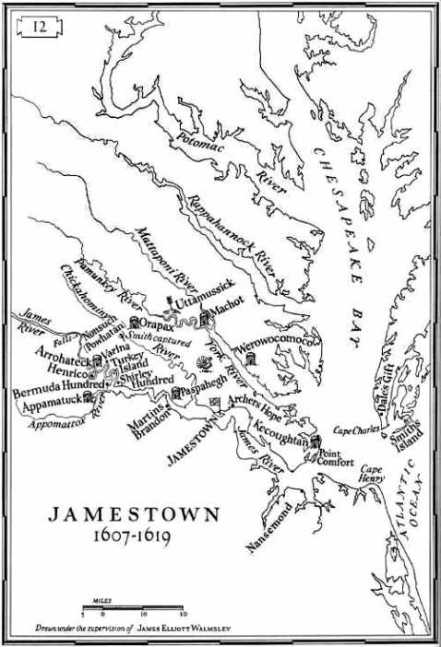
Jamestown

Constant Southworth in the Colony
Constant Southworth was born circa 1614 at Leyden, So. Holland, Netherlands. He married Elizabeth Collier, daughter of William Collier and Jane Clarke, on 2-Nov-1637 at Duxbury, Plymouth County, Massachusetts. Constant Southworth died on 10-Mar-1678/79 at Duxbury, Plymouth County, Massachusetts.
Constant Southworth, the son of Edward and Alice (Carpenter) Southworth, was probably born at Leiden ca. 1614-16, for his parents married there 28 May 1613 (Leiden Records, as in MD 10:2). The same records show that Edward Southworth had a brother Thomas then living in Leiden. Edward Southworth died, and his widow Alice came to Plymouth and married Gov. William Bradford on 14 August 1623.
Constant came to Plymouth in 1628, probably on the White Angel, and a contemporary account shows that the Plymouth Company paid twenty shillings for his passage and four shillings, eight pence per week for eleven weeks for his food (MHS Collections, 3rd Series, 1:199). It is assumed that he, and his brother Thomas, who must have come over later, lived with their mother and step-father, Governor Bradford. The Southworth family was apparently of gentle birth, but claims that Edward Southworth was identical with the Edward Southworth, son of Thomas and Rosamond (Lister) Southworth, or Samlesbury Hall, Lancashire, are not adequately supported. Constant Southworth married Elizabeth Coller daughter of William Collier (PCR 1:68). In his will, dated 27 February 1678/79, inventory 15 March 1678/79, he named his wife Elizabeth, son Edward; son Nathaniel; son William; daughter Mercy Freeman; daughter Alice Church, daughter Mary Alden daughter Elizabeth Southworth provided she did not marry William Fobes; daughter Priscilla Southworth; grandson Constant cousin Elizabeth Howland; and his brother Thomas. Constant held many important posts, including treasure, and ensign in the Duxbury military company.
Constant Southworth (1615 – 1679)
10th great-grandfather
Alice Southworth (1645 – 1719)
daughter of Constant Southworth
Elizabeth Church (1665 – 1691)
daughter of Alice Southworth
William Little Jr (1685 – 1756)
son of Elizabeth Church
Jane Jeanette Little (1713 – 1764)
daughter of William Little Jr
Andrew Armour (1740 – 1801)
son of Jane Jeanette Little
William Armor (1775 – 1852)
son of Andrew Armour
William Armer (1790 – 1837)
son of William Armor
Thomas Armer (1825 – 1900)
son of William Armer
Lucinda Jane Armer (1847 – 1939)
daughter of Thomas Armer
George Harvey Taylor (1884 – 1941)
son of Lucinda Jane Armer
Ruby Lee Taylor (1922 – 2008)
daughter of George Harvey Taylor
Pamela Morse
I am the daughter of Ruby Lee Taylor
Constant Southworth was born about 1614, based on his date of marriage. He died on March 11, 1678/9, in Duxbury. His ship was possibly White Angel, 1628
He lived in Holland. Constant Southworth was the son of Edward and Alice (Carpenter) Southworth, married in Leiden on May 28, 1613. His father was a say worker [weaver] there.
The family attempted to emigrate to New England in 1620, but apparently abandoned the voyage at London. In August 1620, Robert Cushman wrote a letter to Edward Southworth, the father, addressing it to Heneage House in London. It is unclear whether Edward Southworth died there or returned to Leiden.
Alice Southworth, the mother, emigrated to Plymouth Colony in 1623, leaving her two sons behind, either in England or Leiden. She probably left them with their Aunt Julia, the aunt who brought them both over in 1628. Alice Southworth married Governor William Bradford as his second wife that same year, soon after arriving.
Constant came to Plymouth in 1628, where he was admitted a freeman on January 1, 1637/8.
Constant Southworth married Elizabeth Collier on November 2, 1637, in Plymouth and had eight children. She died after February 20, 1678/9.
Constant’s brother, Thomas, is my paternal 10th great-grandfather. Their mother, Alice Carpenter, came to Plymouth a widow and married Governor Bradford in the first year after arrival.
Thomas Southworth (1617 – 1669)
10th great-grandfather
Elizabeth Southworth (1645 – 1716)
daughter of Thomas Southworth
Elizabeth Howland (1673 – 1724)
daughter of Elizabeth Southworth
Eleazer Hamblin (1699 – 1771)
son of Elizabeth Howland
Sarah Hamblin (1721 – 1814)
daughter of Eleazer Hamblin
Mercy Hazen (1747 – 1819)
daughter of Sarah Hamblin
Martha Mead (1784 – 1860)
daughter of Mercy Hazen
Abner Morse (1808 – 1838)
son of Martha Mead
Daniel Rowland Morse (1838 – 1910)
son of Abner Morse
Jason A Morse (1862 – 1932)
son of Daniel Rowland Morse
Ernest Abner Morse (1890 – 1965)
son of Jason A Morse
Richard Arden Morse (1920 – 2004)
son of Ernest Abner Morse
Pamela Morse
I am the daughter of Richard Arden Morse
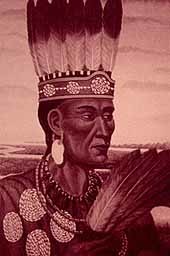 Powhatan 1545-1618
I recently received an advisory of a DNA match from my ancestry.com account that has brought me to a very exciting destination. This very famous Native American, the very same one we learned about in grade school, is my ancestor. I am excited, but want to verify all my results with more evidence. The DNA was from the Little family, and they brought me the information about all these Native American ancestors. I have not had a DNA test that has found any Native DNA. These results area combination of DNA, and record keeping (which can be faulty and has brought me to felonious conclusions in the past). I hope I can conclusively prove all the data, but in the meantime I am excited! It looks like my mother is descended from Pocahantas’ sister, Cleopatra.
Powhatan (born June 17, 1545; died April 1618), whose proper name was Wahunsenacawh (alternately spelled Wahunsenacah, Wahunsunacock or Wahunsonacock), was the paramount chief of Tsenacommacah, an alliance of Algonquian-speaking Virginia Indians in the Tidewater region of Virginia at the time English settlers landed at Jamestown in 1607.
Powhatan, alternately called “King” or “Chief” Powahatan by the English, led the main political and military power facing the early colonists, was probably the older brother of Opechancanough, who led attacks against the English in 1622 and 1644. He was the father of Pocahontas, who eventually converted to Christianity and married the English settler John Rolfe.
Captain John Smith described Powhatan as “…a tall well proportioned man… his head some what grey…. His age near 60; of a very able and hardy body to endure any labour. What he commandeth they dare not disobey in the least thing.”
 Powhatan’s Cloak in a museum at Oxford
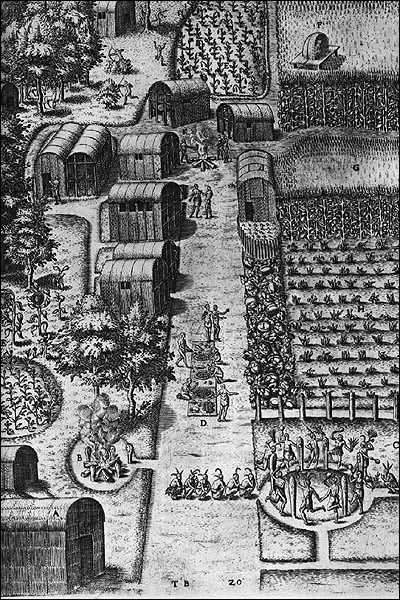 Powhatan Village called Towne of Secoton
Powhatan. The ruling chief and practically the founder of the Powhatan confederacy (q. v.) in Virginia at the period of the first English settlement. His proper name was Wahunsonacock, but he was commonly known as Powhatan from one of his- favorite residences at the falls of James r. (Richmond). According to Smith, of some 30 cognate tribes subject to his rule in 1607, all but six were his own conquests. At the time of the coming of the English, Powhatan is represented to have been about 60 years of age, of dignified bearing, and reserved and stern disposition. His first attitude toward the whites was friendly although suspicious, but he soon became embittered by the exactions of the newcomers. On the treacherous seizure of his favorite daughter, Pocahontas (q. v.), in 1613, he became openly hostile, but was happily converted for the time through her marriage to Rolfe. He died in 1618, leaving the succession to his brother, Opitchapan, who however was soon superseded by a younger brother, the noted Opechancanough.
Chief Wahunsonacock Powhatan (1547 – 1618)
14th great-grandfather
Princess Cleopatra Shawano Powhatan (1590 – 1680)
daughter of Chief Wahunsonacock Powhatan
Pride Chalakahatha Elizabeth (Cornstalk) Shawnee (1615 – 1679)
daughter of Princess Cleopatra Shawano Powhatan
Trader Tom Amatoya Carpenter Moytoy (1635 – 1693)
son of Pride Chalakahatha Elizabeth (Cornstalk) Shawnee
Quasty Woman (1650 – 1692)
daughter of Trader Tom Amatoya Carpenter Moytoy
Delaware Indian Fivekiller (1674 – 1741)
son of Quasty Woman
SOLOMON JOHN CHEROKEE KIMBOROUGH (1665 – 1720)
son of Delaware Indian Fivekiller
Mourning Kimbrough (1689 – 1756)
daughter of SOLOMON JOHN CHEROKEE KIMBOROUGH
Jane Jeanette Little (1713 – 1764)
daughter of Mourning Kimbrough
Andrew Armour (1740 – 1801)
son of Jane Jeanette Little
William Armor (1775 – 1852)
son of Andrew Armour
William Armer (1790 – 1837)
son of William Armor
Thomas Armer (1825 – 1900)
son of William Armer
Lucinda Jane Armer (1847 – 1939)
daughter of Thomas Armer
George Harvey Taylor (1884 – 1941)
son of Lucinda Jane Armer
Ruby Lee Taylor (1922 – 2008)
daughter of George Harvey Taylor
Pamela Morse
I am the daughter of Ruby Lee Taylor
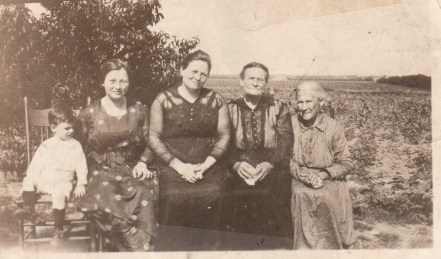
The grandmothers
What do you think you learned studying our family history?
Have you reached conclusions about the nature of human existence?
I believe the most pertinent thing I have learned is about delusion
We stay in deep canyons of ignorance in groups habitually
Are you saying we are all ignorant, or that you are so enlightened?
Not at all, dear ancestors, for my own generation I am frightened
Have you seen how the people are destroying Mother Earth?
You should know that this battle began in earlier centuries
That you choose what role you play by the company you keep
All your relations continue to speak directly to your soul’s mysteries

napo2018button
This is day 2 of National Poetry Writing Month. Join the fun all over the internet by following the hashtag #NaPoWriMo2018. Meet poets from around the world and submit your own work here. Let yourself bust a rhyme. Now is the time!!


If we were having coffee this Christmas morning I would invite you to sit back and enjoy the fire in the wood stove and the candle lighting around the room. I am up early to enjoy this predawn time, as usual. I am in a good mood because I realize how wonderful defining this year of 2017 has been. I did not plan to do a major change this year, but I have certainly accomplished one. I sold my extra red estate and pared down the size of my possessions in order to fit into my condo. This has been extremely liberating and satisfying. I am left with much less stuff, which I love much more.
I am serving coffee, and an assortment of teas, including some iced green tea. We have celebrated all month, and today have no plans to go out or do anything. We are not giving gifts because we just spent months deleting items from our possessions, and are not in the mood to fill up our space with stuff again. We are truly sated.
I did go on a shopping spree this fall, all of which has upgraded our lifestyle. I did little frivolous spending. Most of the spree was spent on very practical home improvements. I wrapped up the spree by buying a new garage door opener last weekend, because mine was on it’s last breath, about to break forever. I was so happy to replace it before it caused a tragic inconvenience in my life. I continue to take a box to the Goodwill each week to fine tune my stuff, since editing is forever. I have new underwear, socks, wifi speakers, and Alexa can now answer the phone on speaker. I have one more planned expenditure with my real estate profits, a hot springs vacation in February. I have not traveled much since I started my job last May, so I am planning a reward for myself in California. I will spa down for a few days, then stay in Joshua Tree in an air bnb. I have already booked my favorite hot springs hotel, but there are many highly desirable air bnb rentals near the Joshua Tree National Park. The decision is part of the fun for me. Are you going anywhere this winter? Do you like planing, or like to take off and see what happens? I like a good accommodation reservation and lots of free time. That is the perfect combination for me.
My blogging is slowly becoming regular once more. I changed may schedule at work, and have started doing my writing before I go to my job. This is working a little better. I do appreciate the return of the weekend coffee share because I enjoy keeping up with the group and the writing you are doing. Please join us on the weekends to share happenings and feelings over digital beverages. Eclectic Ali is hosting this movable feast, which includes a diverse group of writers from around the globe. The party is always digitally delicious. Merry Christmas to all! Thanks for stopping by.

#Weekendcoffeeshare

