mermaidcamp
Keeping current in wellness, in and out of the water
You can scroll the shelf using ← and → keys
You can scroll the shelf using ← and → keys

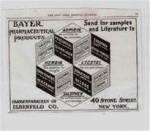

Drugs have won the war we have waged against them. Heroin is growing in popularity because it is a cheap substitute for the prescription drugs that are now the gateway. The profits are massive, and the corruption that accompanies the trade makes a joke of law enforcement. The name heroin was chosen by Bayer, the original marketers of the product, because it made the user feel like a hero. The company stopped manufacturing and selling heroin in 1913, and it was outlawed in the US in 1920. The Viet Nam war increased American use when 10-15% of our troops started using it while in Asia on deployment.
In the US today heroin use is on the rise . Young people between 18-25 are the fastest growing addict group. Mexican black tar heroin is smuggled in great quantity across the Arizona border. This corrupts our law enforcement and endangers our youth as it passes through on the way to it’s eventual market. The smuggling business includes all kinds of illicit drugs. It is organized by cartels run by very nasty individuals. The only way to pull the profit plug on the cartels is to reduce and eliminate demand on our side of the border. This is much easier said than done. From miracle cure to the ruin of our society, heroin has come a long way, baby.
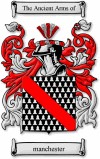
Manchester coat of arms
My 8th great grandfather was part of an unusual settlement in New Haven, Connecticut. He probably arrived in 1638 with a group of Puritans from England:
On April 24, 1638, a company of five-hundred English Puritans led by the Reverend John Davenport and Theophilus Eaton, a wealthy London merchant, sailed into the harbor. They soon discovered that the Quinnipiacks and other local tribes were much distressed by raiding bands of Pequots and Mohawks from surrounding areas. It was for this reason that Momauguin, the sachem of the Quinnipiacks, and other tribe members agreed to sell the tribe’s land to the Puritans. In return, the settlers pledged to protect the natives and to allow them the use of the lands on the east side of the harborNew Haven’s founders not only hoped to create a Christian utopia, they also saw in New Haven’s spacious harbor an opportunity to establish a commercial empire that would control Long Island Sound and possibly the coastline as far south as Delaware Bay. By 1640 a complete government had been established and the settlement, originally called Quinnipiac, was renamed Newhaven. The town plan was based on a grid of nine squares. In accordance with old English custom, the central square, now the Green, was designated a public common. By 1641 New Haven had grown into a community of approximately 800.
Over the next few years, however, the flow of newcomers began to weaken and trade with the outside world shifted more and more to Boston. In an attempt to establish direct trade with England, the settlers managed to assemble enough produce to fill a vessel which would become known as the “Great Shippe.” However, after setting sail in January, 1646, the ship and its crew were never heard from again. This disaster ended the dream of creating an economic empire and over the years New Haven became overshadowed by New Amsterdam and Boston.
from: http://www.cityofnewhaven.com/Mayor/History_New_Haven.asp
Thomas Manchester, the Manchester immigrant ancestor, was born in England, and was a resident of New Haven, Connecticut, in 1639, in the year following the planting of the colony. Afterward, however, he settled at Portsmouth, Rhode Island, where he is first mentioned in the land records, January 25, 1655, when he and his wife sold to Thomas Wood twelve acres of land. He married Margaret, daughter of John Wood.
In the settlement of her father’s estate, it was ordered March 17, 1655, that the son John pay his sister, Margaret Manchester, eight pounds. Eight acres of land were granted at Portsmouth to Thomas Manchester, December 10, 1657, and he sold to Richard Sisson one-three-hundredth right in Canonicut and Dutch Islands. In 1680 he was taxed four shillings. He and his wife testified, June 7, 1686, that they heard and saw Ichabod Sheffield married by William Paulstone. He deeded to his son John. July 9, 1691, his mansion house and lands at Portsmouth, except the place at the lower end of the ground, in possession of his son Thomas, one-half to be his at the death of grantor and the other after the death of grantor’s wife,mother of grantee, provided he pay to the sons Thomas, William and Stephen, ten shillings each, to Job twenty shillings and daughters Mary and Elizabeth ten shillings each. He also gave to John his personal property, including cattle, tools, etc.
Thomas Manchester died in 1691; his wife in 1693. Children: Thomas, born about 1650; William, 1654; John, died in 1708; George, admitted freeman in 1680; Stephen, mentioned in his own biography; Job, died 1713; Mary; Elizabeth.
Source:
New England families, genealogical and memorial
By William Richard Cutter (pgs. 853-854)
Thomas Manchester (1620 – 1691)
is my 8th great grandfather
Elizabeth Manchester (1667 – 1727)
daughter of Thomas Manchester
Dr. James Sweet (1686 – 1751)
son of Elizabeth Manchester
Thomas Sweet (1732 – 1813)
son of Dr. James Sweet
Thomas Sweet (1759 – 1844)
son of Thomas Sweet
Valentine Sweet (1791 – 1858)
son of Thomas Sweet
Sarah LaVina Sweet (1840 – 1923)
daughter of Valentine Sweet
Jason A Morse (1862 – 1932)
son of Sarah LaVina Sweet
Ernest Abner Morse (1890 – 1965)
son of Jason A Morse
Richard Arden Morse (1920 – 2004)
son of Ernest Abner Morse
Pamela Morse
I am the daughter of Richard Arden Morse
Thomas Manchester was born in England about 1620, and died at Portsmouth, R.I., about 1691. He was an early pioneer of Quinnipiac, called New Haven after 1640, in the Plantation of Connecticut: since he is found there in 1639, it would seem probable that he was of the company of Yorkshire settlers who in 1638 came to America with Ezekiel Rogers, the famous non-conformist minister, with the view of joining the Quinnipiac Plantation, although many of them eventually settled elsewhere.
The New Haven colony differed very much from other colonies. Many of the colonists put up large houses. As an explanation why this style of building was so general, it may be said that the founders of New Haven were mainly gentlemen and merchants, used to living in superior houses in London and other parts of England. For a period,Thomas continued at Quinnipiac, but removed to Portsmouth, R.I, before 1642.
On February 25/1642 he was appointed to serve on the next jury. From 1674 till his death, he was Town Sergeant. He became a considerable landed proprietor. Prior to 1655 he acquired land on the island of Aquidneck, and on January 25/1655, he made a deed of a tract of 12 acres there to Thomas Wood.
On December 10/1657, he shared in the land division and received eight acres at Portsmouth. He also had sharein Dutch Island and Quononoquet Island, and conveyed his interest in 1/300th right therein to Richard Sisson on July 6/1658. His mansion and homestead was built on his Portsmouth land.
On July 9/1691, Thomas deeded to his son John, his mansion house and all lands at Portsmouth, except the piece at the lower end, which had been theretofore deeded to his son Thomas. According to the deed, half was to be John’s on hisbrother Thomas’ death, and the remaining half upon the death of his Mother, conditioned always that pay to his brothers Thomas, William and Stephen, 10 shillings each, to Job 20/-, and to his sisters Mary and Elizabeth, ten shillings each. John also received from his father his personal property, cattle, chattels, implements, bonds, sums of money, and whatever belonged to him at the time of his death.
Thomas Manchester married, prior to 1650, Margaret Wood, who died about 1693, daughter of John Wood of Portsmouth, R.I., who bequeathed to his daughter Margaret the sum of œ8.
Next Saturday, 5 April, 2014 will be a big day in Dragoon, Arizona. The first run in Texas Canyon is organized to coincide with a food festival, a wine and brew fest, and a spring fling. Dragoon is just about an hour’s drive away from Tucson on I-10. The Amerind Foundation Museum is primo Native art displayed perfectly. The collections are impressive, and the galleries designed with the greatest of care. If you have not visited the museum next Saturday is a great day to do it. Admission will be free for the day, and the festivals will round out the activities. Runners should register early if they want to compete in the trail run.
Ryan Redcorn, an Osage entrepreneur, has produced this video of smiling Indians. It is dedicated to Edward Curtis whose Native American images dominate the web and the memory. Just yesterday I was at the Arizona State Museum viewing some Curtis photos shot in Arizona, and all were new to me. His seemingly endless portfolio was shot in the first decades of the 20th century. The work has become controversial. Mr. Redcorn believes in producing yourself, which inspired him to create this video as a counterpoint to Curtis.
I was in Pawhuska, Oklahoma a few years ago on an ancestry hunt. My cousin and I were trying to sort out a story that our great-grandmother as Cherokee. We never found any evidence pro or con, but we went to the tribal headquarters of both the Osage and Cherokee tribes to seek answers. My cousin (like many Americans) was stuck on the romantic notion that we are Cherokee. When I saw the tiny museum in Pawhuska and talked to the curators I wanted to be Osage. They were always distinct among the 5 civilized tribes. They got rich from oil and spent much of their wealth buying products from France, especially elaborate fashion items. My father told me when he was a kid the Osage used to drive around in Cadillacs with goats in the back seat. I am probably not descended from the Osage tribe, but I do really admire the way they are. I loved the art, the history, and their sense of humor on my visit with them. Now I also love Ryan Redcorn who has a sense of humor and a bigger sense of justice.

Philip Sherman’s house
My 8th great grandfather moved to Rhode Island as many of my ancestors did. He became a Quaker and the first secretary of Rhode Island Colony.
Philip Sherman (1610 – 1687)
is my 8th great grandfather
Eber Sherman (1634 – 1706)
son of Philip Sherman
Mary Sherman (1688 – 1751)
daughter of Eber Sherman
Thomas Sweet (1732 – 1813)
son of Mary Sherman
Thomas Sweet (1759 – 1844)
son of Thomas Sweet
Valentine Sweet (1791 – 1858)
son of Thomas Sweet
Sarah LaVina Sweet (1840 – 1923)
daughter of Valentine Sweet
Jason A Morse (1862 – 1932)
son of Sarah LaVina Sweet
Ernest Abner Morse (1890 – 1965)
son of Jason A Morse
Richard Arden Morse (1920 – 2004)
son of Ernest Abner Morse
Pamela Morse
I am the daughter of Richard Arden Morse
THE HON. PHILIP SHERMAN, WAS THE SON OF SAMUEL SHERMAN AND PHILIPPA WARD. HE MARRIED SARAH ODDING; THE DAUGHTER OF WILLIAM GEORGE ODDING AND MARGARET POTTER OF BRAINTREE, ESSEX CT, ENGLAND IN (1633/XX/XX),HE WAS A MAN OF MELANCOLY TEMPER WHO CAME TO BOSTON IN (1633/XX/XX) AND UPON A JUST CALLING HE WENT BACK TO ENGLAND AND RETURNED BETWEEN (1636-1637) WITH A BLESSING, IN (1637) BECAUSE OF HIS RELIGIOUS FEELINGS HE WAS BANISHED ALONG WITH JOHN COGGESHALL AND HENRY BULL FROM THE ROXBURY BAY COLONY, BOSTON, MASS, USA. LEAVING FOR RHODES ISLANDS WERE ALL BECAME RULING OFFICIALS CHOSEN TWONE CLERKE (JUNE 1649-1656), TOWNE MAGISTRATE (1656-1679), LAYER OUT OF HIGHWAYS (1683), MEMBER OF COMM. ADJUICATION (1684-1687), AND WAS THE FIRST SECRETARY AND RECORDER OF THE COLONY OF RHODES ISLANDS.
In Bertha L. Stratton’s book, “Sherman and Other Families,” she made the statement that Philip Sherman intended to settle in New Hampshre, but the climate proved too severe and so the lands there were abandoned. Upon discussion with Roger Williams at Providence, Rhode Island, the other people from Massachusetts bought Aquidneck Island in Narraganset Bay. Nineteen men signed the compact for the town in 1638. Upon leaving the church in Roxbury, Philip joined with the Friends. The Massachusetts Court ordered Philip to appear before them on 12 Mar 1638, he did not go. But he continued as a prominent figure in Rhode Island; he was the General Recorder in 1648-1652 & the Deputy to the Assembly in 1665-1667. Tradition says he was a “devout and determined man, and he was also a “neat and expert penman & an educated man,” and his Last Will & Testament “shows that he was wealthy for those times.”
Philip Sherman immigrated to Roxbury, MA and married Sarah Odding shortly after his arrival. He might have felt pressured to marry quickly, because bachelors especially of such an advanced age as 23 were looked upon with suspicion, and their single state could even effect business opportunities and social acceptance.
According to Representative Men of Old Families of Southeastern Massachussets, by J. H. Beers & Company, in a biographical entry of one of Philip’s descendants, Philip Sherman “took the side of Anne Hutchinson,” a brave woman in Salem, MA who maintained that women should be allowed to hold prayer meetings as well as men, and proceeded to hold such meetings in her home in defiance of the rules of the time and demands that she quit. She, with some members of her family including young grandchildren, were driven out of Salem into the wilderness of Rhode Island. Families in sympathy for her or in fear of retaliation for their past support and/or defense of her beliefs soon followed to Rhode Island, and Philip Sherman and his family were among the group that left Salem following her ouster.
In Providence, Philip met Roger Williams, founder of Rhode Island promising religious freedom to it’s citizens. Williams advised Philip andthe members of his party to purchase Aquidneck from the Indians, which they did on 1 Jul 1639. They created their own government with Coddington chosen to be the first governor of Rhode Island, and Philip chosen to be secretary.
Some historians believe that the death of Anne Hutchinson with most of her family during an attack of native Americans was the first act in several that led to the end of the Puritan Church. Members of the communities in all the colonies were horrified that she was banished for her beliefs and suffered so. Many felt banished themselves from England when their Puritan faith had been banned, and her treatment forced them to recognize their own harshness.
Philip left what is now called “the Congressional Church” and joined the Society of Friends, or Quakers.
He was the father of 13 children, and many of his descendants served America as congressmen and soldiers.
Pandora was created as a trophy bride for Prometheus’ younger brother, Epimetheus. She was intentionally created of earth and water to play havoc with humans. The gods endowed her with super powers, thus worthy of her name which means all-gifted. After her arrival at her husband’s house she opened her famous box (or jar) which was full of evil spirits. Like Eve, she had orders to keep the box closed but her curiosity was too strong. Unlike Eve, at the bottom of Pandora’s box one spirit remained, Elpis, the spirit or diamon of hope. While the evil spirits escaped and forced man to do hard labor, just like the expulsion from the Garden of Eden, hope remained in Pandora’s box. Her daughter, Pyrrha was the first mortal child born on earth. Pyrrha and her husband survived the Great Deluge to repopulate the earth, not unlike Noah and his family.
Can you think of events in your life or in history that remind you of Pandora’s box?
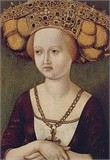
Cymburgis Masovia
My 16th great grandmother was Polish, and was the mother of a Holy Roman Emperor. My ancestor, her daughter, Katharina, was Archduchess of Austria:
Cymburgis Masovia (1391 – 1429)
is my 16th great grandmother
Katharina Archduchess Austria Von Habsburg (1420 – 1493)
daughter of Cymburgis Masovia
Christof I VanBaden (1453 – 1527)
son of Katharina Archduchess Austria Von Habsburg
Beatrix Zahringen (1492 – 1535)
daughter of Christof I VanBaden
Sabine Grafin VonSimmern (1528 – 1578)
daughter of Beatrix Zahringen
Marie L Egmond (1564 – 1584)
daughter of Sabine Grafin VonSimmern
Richard Sears (1590 – 1676)
son of Marie L Egmond
Silas Sears (1638 – 1697)
son of Richard Sears
Silas Sears (1661 – 1732)
son of Silas Sears
Sarah Sears (1697 – 1785)
daughter of Silas Sears
Sarah Hamblin (1721 – 1814)
daughter of Sarah Sears
Mercy Hazen (1747 – 1819)
daughter of Sarah Hamblin
Martha Mead (1784 – 1860)
daughter of Mercy Hazen
Abner Morse (1808 – 1838)
son of Martha Mead
Daniel Rowland Morse (1838 – 1910)
son of Abner Morse
Jason A Morse (1862 – 1932)
son of Daniel Rowland Morse
Ernest Abner Morse (1890 – 1965)
son of Jason A Morse
Richard Arden Morse (1920 – 2004)
son of Ernest Abner Morse
Pamela Morse
I am the daughter of Richard Arden Morse

Cymburgis Masovia
She was born in Warsaw and died in Lower Austria at an Abbey. It is said she contributed the protruding lower lip of the Habsburgs.
Cymburgis (also Cimburgis, Zimburgis or Cimburga) of Masovia (Polish: Cymbarka mazowiecka) (1394 or 1397 – September 28, 1429) in January 1412 became the second wife of the Habsburg Duke Ernest the Iron of Austria (since 1414 Archduke) and thus a Duchess/Archduchess of the Inner Austrian line in Styria, Carinthia and Carniola.
Cimburgis was born at Warsaw in the Duchy of Masovia to Duke Siemovit IV of the Masovian Piast dynasty and his wife Alexandra of Lithuania, daughter of Grand Duke Algirdas, a scion of the Gediminid dynasty, and sister of Władysław II Jagiełło, King of Poland.
Though his elder brother William’s engagement with the Polish princess Jadwiga had mortifyingly failed, Ernest after the death of his first wife Margaret of Pomerania proceeded to Kraków to court Cymburgis. Though not approved by the Habsburg family, the marriage turned out to be a happy one. As the mother of the later Emperor Frederick III, Cymburgis, after Gertrude of Hohenburg, became the second female ancestor of all later Habsburgs, as only his branch of the family survived in the male line. Although controversial, it has been claimed (since at least by Robert Burton in 1621) that she brought the distinctive protruding lower lip (progenism) into the family, a particular physical characteristic of most members of the family for many generations until the 18th century.[2] It can even be recognized in some of her distant descendants today (though not as markedly). Cymburgis’ statue in the Innsbruck Hofkirche church however does not show this feature.
Tradition has it that she was also known for her exceptional strength, which, for example, she showed by driving nails into the wall with her bare hands and cracking nuts between her fingers. Strength also distinguished one of her descendants, Augustus II the Strong, who allegedly broke a horseshoe bare fisted. Cymburgis outlived her husband and died at Türnitz in present-day Lower Austria. She is buried at Lilienfeld Abbey.
Descendants
5 children died at young age
Frederick III, Holy Roman Emperor (1415–1493)
Margaret, wife of Frederick II, Elector of Saxony
Albert VI, Archduke of Austria (1418–1463)
Catherine (1420–1493), wife of Charles I, Margrave of Baden-Baden
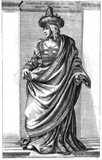
Cymburgis Masovia
How prescient was Sir Paul when he said of course it’s going to go well here when we talk about the Ukraine girls? This song was sarcastic when it was written, and is more ironic now than ever. We are back in a state very similar to the Cold War, and the joke is heavy. Was there ever true communism??? I say no, just state capitalism, which is a sorry substitute. Today we know that putting our heads down in the hall of the school will not protect us from a full blown nuke attack. Do you see a good way to end the Russian stand-off, gentle readers?
Learning about archetypes has taught me to look at life more closely, and free myself of some old restrictive self images. We all play different parts in our own lives. As we age our desires naturally change and our personalities become more complex. In our history we can discern times when one role has been the dominant one, giving way to another as time passed. Some of us never outgrow our rebel, and some are artists whose latent talent is not discovered until a ripe old age. We all have within our psyches a child, a victim, a saboteur, and a prostitute that are brought to the spotlight by different circumstances.
Plato called this phenomena forms. Carl Jung coined the phrase and defined basic archetypes. He taught that these pure images arise in dreams and in reality as a result of the collective consciousness. Carolyn Myss has evolved the work to include many more archetypes, and has created books, cards, and courses to teach the concepts. It is a powerful practice to draw a timeline of your own life and remember when you encountered strong archetypes in yourself and other people, and how that may have been repeated. All religions use archetypes to teach lessons because they are memorable. The archetype in my first house is the hedonist. When that hedonist is good she is very very good, and when she is bad she is horrid. Such is the case with all of these eternal and universal roles. They have both a light and a dark side. The possibilities are endless. Do you have a strong dominant role you have played throughout your life?
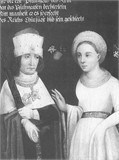
Otto and Agnes
Agnes Countess Of Rhein (1202 – 1267)
is my 21st great grandmother
Elisabeth Wittelsbach Duchess Bavaria (1227 – 1273)
daughter of Agnes Countess Of Rhein
Consort Elisabeth the Romans Carinthia (1263 – 1313)
daughter of Elisabeth Wittelsbach Duchess Bavaria
Albrecht Albert II ‘The Wise’ Duke of Austria Habsburg (1298 – 1358)
son of Consort Elisabeth the Romans Carinthia
Leopold III “Duke of Austria” Habsburg (1351 – 1386)
son of Albrecht Albert II ‘The Wise’ Duke of Austria Habsburg
Ernst I “Ironside” Archduke of Austria Habsburg (1377 – 1424)
son of Leopold III “Duke of Austria” Habsburg
Katharina Archduchess Austria Von Habsburg (1420 – 1493)
daughter of Ernst I “Ironside” Archduke of Austria Habsburg
Christof I VanBaden (1453 – 1527)
son of Katharina Archduchess Austria Von Habsburg
Beatrix Zahringen (1492 – 1535)
daughter of Christof I VanBaden
Sabine Grafin VonSimmern (1528 – 1578)
daughter of Beatrix Zahringen
Marie L Egmond (1564 – 1584)
daughter of Sabine Grafin VonSimmern
Richard Sears (1590 – 1676)
son of Marie L Egmond
Silas Sears (1638 – 1697)
son of Richard Sears
Silas Sears (1661 – 1732)
son of Silas Sears
Sarah Sears (1697 – 1785)
daughter of Silas Sears
Sarah Hamblin (1721 – 1814)
daughter of Sarah Sears
Mercy Hazen (1747 – 1819)
daughter of Sarah Hamblin
Martha Mead (1784 – 1860)
daughter of Mercy Hazen
Abner Morse (1808 – 1838)
son of Martha Mead
Daniel Rowland Morse (1838 – 1910)
son of Abner Morse
Jason A Morse (1862 – 1932)
son of Daniel Rowland Morse
Ernest Abner Morse (1890 – 1965)
son of Jason A Morse
Richard Arden Morse (1920 – 2004)
son of Ernest Abner Morse
Pamela Morse
I am the daughter of Richard Arden Morse
AGNES ([1201]-16 Nov 1267, bur Scheyern). The Notæ Sancti Emeranni record the marriage of “Otto dux Bawarie” and “filiam Heinrici palatine Rheni”. The Altahenses Annales name “Agnes ducissa Bawarie” when recording the birth of her son Ludwig.
m (Worms May 1222) OTTO von Bayern, son of LUDWIG I Duke of Bavaria, Pfalzgraf bei Rhein & his wife Ludmila of Bohemia (Kelheim 1206-Landshut 29 Nov 1253, bur Scheyern). Pfalzgraf bei Rhein 1228. He succeeded his father in 1231 as OTTO II “der Erlauchte” Duke of Bavaria.
 mermaidcamp