mermaidcamp
Keeping current in wellness, in and out of the water
You can scroll the shelf using ← and → keys
You can scroll the shelf using ← and → keys

jet
I have learned to budget time by planning many trips for myself and travel clients. When tour companies take groups out on an excursion the itinerary is published to give all a sense of unity. Planning time for commuting in a city or check in at a strange terminal must be done with precision and plenty of lead time. I think travelers are often too optimistic about the amount of time it really takes to get across town or out of town. Being on time for appointments or performances is essential to enjoying a visit. I also think free unstructured time to explore is an important element of happy tourism.
Here are the ways I like to expand my world when I travel. I use time in new ways:
I learn before I go. My research into options can take weeks for some destinations. I study maps and transit systems, look up details and make notes if there is something I want to make sure I see. No matter what I learn from reference materials I always ask for a local’s opinion if I can. Once I have made the arrangements for the elements of the trip, lodging, transportation, dining, and exploration I believe it is important to give in to serendipity as much as possible. I find that being open in both mood and schedule allows the magic of the place to speak to me. Sometimes I meet cool people who inform me; other times I am called by special architecture or botany. I find that when I plan and inform myself just enough to know where I am, but not too much to make assumptions, time is my ally. It expands and allows me to turn a few days into an exciting yet easy to accomplish new adventure of discovery. I am working on turning next week in San Francisco into just that. If you know about something special I need to know before I go, please pipe up, gentle reader. I do enjoy the unusual, and already know about many of the usual highlights of the bay area. I am open to learn more.

Humphrey and Isabella
My 14th great grandfather met his future bride in a very romantic return of her glove on his lance. They married and gave the queen their first born daughter. I find the gifting of the daughter to be a bit bizarre, but that is what they did.
In the chancel of the old parish church of Elstow, near Bedford–so famous for its associations with the childhood of John Bunyan*— a monument recording Sir Humphry Radcliffe of that place, and his wife, Dame Isabella Radcliffe. As the name of the latter is not even mentioned in the extinct peerage of fir Bernard Burke, perhaps a short account of a little episode in the history of this worthy pair may not be without interest to my readers. It is hardly needful to say more about the Radcliffes or Ratcliffes–for the word was spelt both ways indifferently when writing was rare and printing was almost unknown–than that they are of undoubted Saxon origin, and that they took their name from the village of Radcliffe, near Bury, in Lancashire. We read that one, Richard de Radcliffe, of Radcliffe Tower, seneschal and minister of the royal forests in the neighborhood of Blackburn, accompanied Edward I. to Scotland, and received from that sovereign, towards the end of his reign, ‘a grant of free warren and free phase in all his demesne lands of Radcliffe.’From him were descended a variety of noble houses–as the Radclyffes, Lords Fitzwalter, and Earls of Sussex; those of Foxdenton, and of Hitchin; and the unfortunate Earls of Derwentwater, who forfeited their Northumbrian castle of Dilston, as well as their lives, in the cause of the ‘young Chevalier,’ and the luckless house of the Stuarts.
One of his descendants, Sir John Radcliffe, was summoned to Parliament by Henry VII., in right of his mother, as Baron Fitzwalter; he was also steward of the Royal Household, and acted jointly with Jasper Tudor, Duke of Bedford, as High Steward of England at the coronation of Henry’s queen, Elizabeth Plantagenet. But afterwards, being involved in the wild conspiracy of Perkin Warbeck, he was attainted, and lost his head on the scaffold at Calais.
His son, however, found so much favor with Henry VIII that he was restored in blood, and, having held the command of the van of the army sent to France under the Earl of Surrey, he was created Viscount Fitzwalter and Earl of Susses. He was a zealous supporter of the king in his quarrel with Wolsey and the Pope, and he found his reward in a life-patent of the office of Lord High Chamberlain, together with a grant of the noble abbey of Cleve, in Somerset, the ruins of which to the present day form one of the most beautiful features of the country near Minehead, and Watchet, and Dunster. He was thrice married, and on each occasion his wife was a noble dame; his first choice being a daughter of Henry Stafford, Duke of Buckingham, his second a Stanley, and his third an Arundell of Lanherne. The earl desired that Humphrey, the youngest son of his first marriage, should marry a wealthy heiress of a county family; but the son took a different view of the matter from that taken by his parents for him. Very naturally and very pardonably he said that he preferred to choose for himself.
King Henry had announced his intention of being present at a tournament in the tilt-yard at Hampton, and great preparations had been made for the occasion. As the king rode along the way from London, the windows and the balconies about Kensington were all hung with colored cloths and silks. Among the crowd of spectators in the balconies was a plain citizen of London, Edmund Harvey, along with his wife and their daughter Isabel. The ladies in the neighboring windows thought the latter nice looking, and even pretty; but no one ‘knew who she could be,’ as the old folks were but commonplace in appearance, and clearly had not been brought up in the regions of courts and cities. The father, as may be imagined, pointed out the nobles as they passed by with their trains and retinues; but Isabel had no ears for her father, and her eyes scanned each new arrival for the face of a youth whom she had met on a chance occasion, and who had professed an attachment to her, in spite of the fact that she was not the daughter of a courtier or a noble.
At length there rode along a body of knights, with their lances borne aloft and their colors flying in the wind; they were headed by the Earl of Sussex, who was attended by his son Humphrey, a fair and well-favored youth, who looked little more than twenty years of age. Isabel, however, had no difficulty in recognizing him and the black steed on which he sat, and which champed the bit and foamed beneath his rein. The truth is that they had met before at another tourney, when Sir Humphrey had incurred the scorn and displeasure of some of the king’s courtiers because of a slight civility and courtesy which he had shown to herself, her father, and her mother, whom none of the gallants knew by sight or by name, their names not having been entered by the Heralds on the rolls of the ‘College of Arms.’ Eagerly did Isabel lean over the balcony in the hope of catching his eye, and grateful did she feel for a sudden halt, which was occasioned by the pressure of the crowd.
The young knight, however, was too deeply engaged in thought to take notice of the gay and smiling occupants of the balconies above his head, for he little imagined that Isabel Harvey would be among the company. But as they moved on a few steps he was roused from his reverie by a start of his horse, caused by the fall of a glove from one of the balconies. Gallantry prompted him to pick up the glove and to return it to its fair owner. Upon looking up, his eyes met those of the fair Isabel; and as he returned to her the glove on the point of his lance, and she bowed her thanks, he felt that she was not insensible to his regard for he. He quietly watched his opportunity to fall back from the gay procession as it moved along, and guided his horse down a narrow side lane, where he remained till the pageant had passed by. His object in so doing was to prevent his father, the earl, from noticing Isabel; for he well knew the haughtiness of his temper, and his zeal for the dignity of his order, and his inflexible ambition to ally his son to the heiress of some noble house or other.
Having emerged from his retreat, the young knight came again beneath the window, and, after bowing in a courtly manner, addressed the father of Isabel, who was just about to leave the balcony. On their descending into the street, the young knight dismounted, and accompanied them back to the city, leading his horse, and entertaining them, as they passed along the Strand and through Fleet Street, by his lively and elegant conversation. On reaching their home near Cheapside, Edmund Harvey pressed the knight to join them at their meal, and he gladly closed with the invitation. So well indeed did be succeed in gaining the confidence of his newly-found friend, that ere they parted the knight confessed to him his love for the fair Isabel, and received her father’s permission to ask her band, if she had no objection.
The rest of this story may be easily imagined. On the morrow the knight accompanied them back into the country, and, representing himself to be only one of the gentlemen of the earl’s retinue, he espoused the fair Isabel a few days afterwards in the priory church of Elstow. For many months-indeed, it may have been years- -he did not disclose the full secret of his rank, nor did the fair Isabel know that she had a claim to be styled ‘My Lady; The secret, however, oozed out at length ; and in due course of time their union was blessed by the birth of sons and daughters, the eldest of whom became one of the special favorites of Queen Elizabeth.
Immediately on the accession of `her highness’ she made Humphrey Radcliffe a knight, and gave him a post at court near her person, and took his eldest daughter, Mary, as her ‘Mayden of Honor and Gentelwoman of the Privie Chamber’–a post which she filled `honorably, virtuously, and faithfully for forty years,’ as her monument tells us.
It was in the year 1566, on the 13th day of August, that Sir Humphrey Radcliffe died at Elstow, and he was buried a week later in the chancel, as stated above, by the side of his affectionate and faithful wife Isabel, and soon afterwards one of his sons erected to their memory the memorial already mentioned.
As for Mary Radcliffe, she suffered less than perhaps any other person about the Court from the whims and caprices of her royal mistress. Being possessed of great penetration and judgment, together with a high sense of honor and unshaken fidelity, she could not fail to command the esteem even of ‘the Maiden Queen.’ Although remarkable for her personal beauty, she was inaccessible to the flatteries of the fops and gallants by whom Elizabeth was surrounded, and many a smart repartee and rebuff was received by the courtiers who tried to turn the head and the heart of Mary Radcliffe. On one occasion, indeed, writes Sir Nicholas Le Strange in an anecdote communicated by Lady Hobart, ‘Mistress Radcliffe, an old courtier in Queen Elizabeth’s time, told a lord whose conversation and discourse she did not like, that his wit was like a custard, having nothing good in it but the soppe, and, when that was eaten, you might throw away the rest.`*
Throughout the long period of her services at Court, Mistress Radcliffe bore a character unblemished by a spot of evil fame or reproach. She looked upon herself, she would say, as a New Year’s gift, for it was on that day in 1561-2 that she was first presented by her father to the Queen’s Majesty, and accepted by her ; and never afterwards, to the end of her days, did she fail to give the Queen–who loved all sorts of presents, and did not think it ‘more blessed to give than to receive’–some kind of annual remembrance of that eventful morning.
As she was still living to make her yearly present on the new year of 1600, Mistress Isabel Radcliffe might very justly be called an old courtier of the jealous Queen, who was not very firm in her friendships, or very scrupulous about discharging those who failed to please her. The actual date of her death is not recorded by ‘the unlettered muse’ of Elstow.
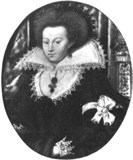
Elizabeth Whitbread
My 11th great-grandmother married into the Spencer family. Her son Gerard went to America.
Gerard Spencer, baptized at Stotfold, co. Bedford, 20 May 1576, died before 1646; married at Upper Gravenhurst, co., Alice Whitbread or Whitbred, who belonged to a family of some prominence. It seems quite possible that Gerard and his family moved from Stotfold some years before the emigration of his sons to New England; perhaps to London, where his brother Richard had become a prosperous haberdasher.
The English surname of “Spencer” derives from the Latin word dispensator, which means a storekeeper or shopkeeper. In medieval times, a feudal lord would employ a dispensator to have charge of his possessions and to oversee distribution and sale of supplies to the serfs, peasants, and tenant farmers who worked his land. In essence, a dispensator was something like a steward. This Latin term gave rise to the occupational family names of “Dispenser,” “Spencer,” “Spenser,” “Spence,” “Spens,” “Spender,” etc. Since there must have been thousands of dispensatori, there are naturally a large number of unrelated Spencer families. Even though he was the servant of a feudal lord or a king, a dispensator often himself would be of noble or knightly rank. The two best known medieval English families bearing a form of this surname were the Dispensers, Earls of Winchester, and the Spencers of Althorp, Northamptonshire, ancestors of the present Earls Spencer, who were the family of the late Diana, Princess of Wales, formerly known as Lady Diana Spencer. The Earls Spencer are also closely related to the Spencer-Churchill family, which includes the famous British Prime Minister Sir Winston Spencer-Churchill. During the Renaissance, an unscrupulous herald manufactured a spurious genealogy tracing the Spencers of Althorp back to the Dispensers of Winchester, but that fictitious genealogy was long ago debunked — there is no proof nor any reason to believe that the Spencers of Althorp had anything to do with the old Earls of Winchester.
Elizabeth Whitbread (1538 – 1599)
is my 11th great grandmother
Thomas Spencer (1571 – 1631)
son of Elizabeth Whitbread
Thomas Spencer (1596 – 1681)
son of Thomas Spencer
Margaret SPENCER (1633 – 1670)
daughter of Thomas Spencer
Moses Goodwin (1660 – 1726)
son of Margaret SPENCER
Martha Goodwin (1693 – 1769)
daughter of Moses Goodwin
Grace Raiford (1725 – 1778)
daughter of Martha Goodwin
Sarah Hirons (1751 – 1817)
daughter of Grace Raiford
John Nimrod Taylor (1770 – 1816)
son of Sarah Hirons
John Samuel Taylor (1798 – 1873)
son of John Nimrod Taylor
William Ellison Taylor (1839 – 1918)
son of John Samuel Taylor
George Harvey Taylor (1884 – 1941)
son of William Ellison Taylor
Ruby Lee Taylor (1922 – 2008)
daughter of George Harvey Taylor
Pamela Morse
I am the daughter of Ruby Lee Taylor
6. Gerald Spencer 3 (Michael S.2, John1) was baptized on 20 Apr 1576 in Stotfold, Bedfordshire, Eng 3 and died before May 1646 in Stotfold, Bedfordshire, Eng 1.
Documented events in his life were:
1. Mention in Will, Inv. or Prob.; 17 Mar 1644/45; London, Eng 3. Cited as the father of Jarrard, Thomas, Michaell Spencer who each received �50 in the will of their uncle Richard Spencer. Also father of William Spencer, deceased, with the legacy going to William’s children.
Gerald married Alice Whitebread 1 5, daughter of John Lawrence Whitebread and Eleanor Radcliffe, in Upper Gravenhurst, Bedford, England 1. (Alice Whitebread was born between 1578-1583 in Bedfordshire, Eng 1 5 and died about 1646 in Stotfold, Bedfordshire, Eng 1.)
Children from this marriage were:
+ 15 M i. Ensign Gerard Spencer 1 2 3 was baptized on 25 Apr 1614 in Stotfold, Bedfordshire, Eng 3 and died on 29 Jun 1685 in East Haddam, Middlesex Co., CT 1.
16 M ii. William Spencer 1 3 was baptized on 11 Oct 1601 in Stotfold, Bedfordshire, Eng 3 and died on 4 May 1640 in Hartford, Hartford Co., CT 1.
Documented events in his life were:
1. Mention in Will, Inv. or Prob.; Bef 20 Nov 1628; Upper Gravenhurst, Bedford, England 5. Received legacy in the will of his grandmother Eleanor (Radcliffe) Whitebread.
2. Residence; Bef 7 Jan 1632/33; Cambridge, Suffolk Co., MA 6. William Spencer is listed as an Inhabitant � no date given. but probably before the 7 Jan 1632 date given to items on p 4
3. Lands Recorded – Granted; 7 Jan 1632/33; Cambridge, Suffolk Co., MA 7. Common Pales devided as ffollo:– William Spencer 12 Rod
4. Lands Recorded – Granted; 2 Mar 1632/33; Cambridge, Suffolk Co., MA 8. Granted William Spencer the fwampe on the other fide the Creeke.
5. Oath of Freemanship/Allegiance; 4 Mar 1632/33; Massachusetts Bay Colony, MA 9.
6. Lands Recorded – Granted; 5 Aug 1633; Cambridge, Suffolk Co., MA 10. Lotts granted for Cowyardes:– William Spencer 3 Roods
7. Town Office; 3 Feb 1633/34; Cambridge, Suffolk Co., MA 11. James Olmfted & William Spencer chosen as two of the five men to order business for the town.
8. Town Service; 1 Sep 1634; Cambridge, Suffolk Co., MA 12. ffurther it is ordered that George St^ [ ] William Spencer fhall measuer out al^ [ ] ^ranted by the Towne and have IIId the Ac^ [ ] [ ] fame.
9. Lands Recorded – Granted; 1 Dec 1634; Cambridge, Suffolk Co., MA 13. Granted William Spencer that Corner of ground by Jofeph Myats between the Swamps to bee fett out by John Haynes Efqr.
10. Town Service; 3 Feb 1634/35; Cambridge, Suffolk Co., MA 14. chosen to survey town lands: James Olmfted & William Spencer [plus 3 others]
11. Town Service; 8 Feb 1634/35; Cambridge, Suffolk Co., MA 15. Townsmen present at the town meeting:– William Spencer.
12. Town Service; 20 Aug 1635; Cambridge, Suffolk Co., MA 16. It was ordered that William Spencer and George Steele fould meafuer all the meaddow ground and undeuided belonging to the Newtowne: and when it is Meafuered and deuided to euery man his proportcion there are to: meafuer every mans feuerally and Caufe ftakes to bee fett at each end and to haue three pence the Acker for the fame and whofoever fhall not pay for the meafueringe within one yeare then the ground to returne to them for meafueringe.
13. Lands Recorded – Granted; 20 Aug 1635; Cambridge, Suffolk Co., MA 16. ffurrther it is ordered that the fame [the meaddow ground and undeuided belonging to the Newtowne] fhalbee deuided acordinge to every mans seuerall proporcion herevnder written vntell it bee all difpoffed of viz:– William Andrews 2�
14. Town Office; 23 Nov 1635; Cambridge, Suffolk Co., MA 17. William Spencer chosen one of the nine men to �order busffiness of the whole Towne for the year following� also ordered that the Towne booke fhalbee at William Spencers house.
15. Town Service; 7 Dec 1635; Cambridge, Suffolk Co., MA 18. Townsmen present at the town meeting:– William Spencer. William Spencer & Mr. Bambrigg to view the fence about the ground between the swamps [to be erected by land holders] and decide if it is sufficient.
16. Town Service; 4 Jan 1635/36; Cambridge, Suffolk Co., MA 19. Townsmen present at the town meeting:– William Spencer. William Spencer & Thomas Hofmer charged with seeing that a foot bridge is built over the Creek at the end of Spring street
17. Lands Recorded; 8 Feb 1635/36; Cambridge, Suffolk Co., MA20. The Names of Thofe men who haue houfes in the Towne at this prefent as onely are to be acconted as houfes of the Towne:– William Spencer – 2; also in the Weftend:– William Spencer – 2
18. Mention in Will, Inv. or Prob.; 17 Mar 1644/45; London, Eng 3. His children received a legacy in the will of his uncle Richard Spencer of London, England.
19. Probate; 24 Jun 1650; Hartford, Hartford Co., CT 21. This Courte taking into Consideracon the estate of William Spencer deceased with the Information of the ourseers In the presence of Thomas Spencer Brother to the said William, iwth the Consent of the wife of William Edwards: the doe Judge that 30� is as much as the estate heere will bare to be sequestred for the use of the Children, wch is to bee paid to them according tot he will of the said William Spencer, provided that suffitient security bee giuen in to the Satisfaction of the ourseers for the payment of the debts of the said William Spencer, and the aforesaid Sum of 30� to the said Children as aforesaid: And prouided allso that whatsoeuer Shall bee paid heere or in England of any Estate due to the wife of the said William Spencer while Shee was the wife of William Spencer, or that Shall Come from Concord: two thirds thereof Shall be and remaine to the propper vse of the Children aforesaid.
Watching the US congressional dramatists perform for the nation I wonder how these folks make contact with reality. Systems thinking, or connessione provides a holistic, integrated, well proportioned view. The interests of many networks can be connected for the good of the entire system. Our congressional employees seem stuck on the idea that hostile, unproductive bickering is what the taxpayers deserve. Fractured care for our precious resources is eroding the national confidence. Rather than forming natural helpful alliances bills are created with purposeful conflicts of interests from the get go. It looks as if these representatives of the people are on some kind of very bad bummer trip, unable to view any kind of broad picture for fear of heavy freak out. They use their imaginations and creativity to whip up disharmony rather than working to connect the whole.
How can we use our own creativity as taxpayers to force these clowns to get it together on behalf of the American people? Can we imagine them working for us rather than wasting our money? I find that difficult. In the season of Halloween let us consult history and the ancestors to learn from the past. How did our ancestors off insane rulers? There have been plenty of them. We must connect the dots to understand the deep lessons history teaches. We must find the strength and the will to create a congress that works for us. We are capable of balance, even if we are not witnessing it in our elected officials.
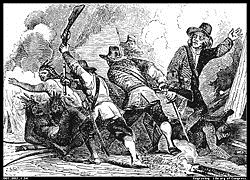
Pequot War 1637-1638
Thomas Redding was an early settler of Maine. He and his wife left a five year old child in the care of another man and never returned for him. The court awarded custody of the boy to the guardian since the promised upkeep for the child was never paid.
RESIDENCE: 1644: Scituate, Ma [BRLp10, quoting Plymouth Colony Court Records relating to their leaving their 5y old son in the care of Mr Gowan White, & failing to return to pay for his keep. The court awarded custody of the child to Mr White, unless the parents returned and paid for arrears in support]
1653: Took oath of allegiance to Massachusettes at Wells, Me as being of Saco, Me. and relocated at Three Islands, Cape Porpoise Harbor, Me (being as “Thomas Redding who hailed from New Plymouth”); he lived on the Great Island (which was known as “Redding Island” into the 1800’s) and managed the fishing Trade there until he returned to Saco about 1653/7. [BRLp11, quoting, Wilbur D. Spencer’s 1930 “Pioneers on Maine Rivers”].
1665: rem. Westcustego (the Indian name for what we call Yarmouth) [BRLp11, quoting, Wilbur D. Spencer’s 1930 “Pioneers on Maine Rivers”].
NOTE: Cape Porpoise River is now [ca.1920] known as Mousam River.
1666: “Living near the Lane family … who were living on the ‘Cousin’s Place'” [by this do we infer what is today known as “Cousin’s Island”?]BIOGRAPHY:
Quoted from: “The Redding Family and Its Relatives” by Billie Redding Lewis, Donated by the author April 1983 to (and on file at) the General Society of Mayflower Descendants Library, Plymouth, Mass.:
“No evidence has been found to connect Thomas Redding, the progenitor of the author’s family to the Thaddeus Riddan with whom Thomas is often confused. Most researchers believe all early Reddings, regardless of spelling, both in New England and the Virginia colonies, to be related.
“Banks [17] has Thomas Redding entering New England about 1635 but unfortunately, has found no ship nor English origin listed.
“One researching descendant states that Thomas came from Barbados to New England as did “John and James Saunders, Thomas Lane, John Spencer, John Manwaring, John and Thomas Hill, and others, who are found as Mr. Redding’s neighbors in what is now the state of Maine.” [18].
“Thomas Redding’s name does appear on a list of those who in 1635-8 [19] owned ten or more acres in Barbados but there is no documented proof that the Thomas Redding of Barbados is the same Thomas Redding of New England. It is quite probable, on the other hand, since Thomas, in 1639, married the sister of William Pennoyer, a wealthy London merchant, who was not only a cloth merchant but also a prosperous sea-merchant owning a number of vessels and some sugar planatations in Barbados.
“In 1637, Thomas Redding is found in “New Plymouth” as a fisherman and a volunteer for service in the Pequot War [20].
“On 20 July, 1639, Thomas Redding married Ellinor Pennoyer, who is recorded in Plymouth Colony records as Elinor “Penny”. Thomas’s name is not found again in Plymouth records until 1644 when he and Ellinor are in Scituate, Mass. where it is thought they lived less than a year & left their five year old son to be cared for by Gowan White. On 4 June, 1 645, the Plymouth Court Records state. [23]” ‘Whereas Thomas Riddings, about ayear since, came to Scituate and depted (departed) thence, leaueing a man child about fiv yeares of age with Gowen White, pmiseing him to pay xviij d p weeke for his keepeing & dyetting of him, but hath hitherto payd him nothing; and the said Gowen White hath since found him meate, drinke, and cloathes at his own charge; the court doth order and appoynt that the said shalbe wth the said Gowen White vntill he shall accomplish the age tweny and foure yeares; but if his father shall come and desire to take him away before the end of the said terme, that then he shall pay he said Gowen White for the keeping of him for such tyme as he shall haue beene wth him; and so also if bee shalbe placed wth another man.’.
“Thomas’s leaving his son is still puzzling to genealogists. The child was probably Thomas and Ellinor’s first-born since he was five years old at the time, making him born in 1640, a year after their marriage. Why was he left? Did the parents go to Barbados but did not want to change the child’s environment, or is this the period of time in which they moved to Maine and possibly did not want to subject their son to the lifestyle that would be rougher than that in Plymouth County? If they moved to Maine, why then was there no contact with Gowen White? True, travelling was not easy in those days, but the pioneers did not seem to allow obstacles to impede them completely.
“This writer could find no record of Thomas between the time he left his son in 1645 and when he took his Oath of Allegiance to Massachusetts Colony in what is now Maine, on 5 July, 1653. [25]”
[17] Charles Edward Banks, “Tophgraphical Dictionary of 2885 Emigrants”, p.234 … Baltimore.
[18] Fred E. Crowell, “Redding -Miller”, Boston “Transcript”, 1929
[19] NHGS Register, Vol. 39, taken from “Memoirs of the First Settlers of the Island of Barbados” …
[20] Winslow’s “Journal”, and Plymouth Colony Records
[23] Plymouth Colony Records; Book 2, Page 86 [25] James Savage, “A Genealogical Dictionary of the First Settlers of New England”, Vol. 4, Boston,
Thomas Redding (1607 – 1673)
is my 9th great grandfather
Martha Redding (1633 – 1702)
daughter of Thomas Redding
Abigail Taylor (1663 – 1730)
daughter of Martha Redding
Martha Goodwin (1693 – 1769)
daughter of Abigail Taylor
Grace Raiford (1725 – 1778)
daughter of Martha Goodwin
Sarah Hirons (1751 – 1817)
daughter of Grace Raiford
John Nimrod Taylor (1770 – 1816)
son of Sarah Hirons
John Samuel Taylor (1798 – 1873)
son of John Nimrod Taylor
William Ellison Taylor (1839 – 1918)
son of John Samuel Taylor
George Harvey Taylor (1884 – 1941)
son of William Ellison Taylor
Ruby Lee Taylor (1922 – 2008)
daughter of George Harvey Taylor
Pamela Morse
I am the daughter of Ruby Lee Taylor
The trickster is a character popular in many ancient mythical stories. This archetype pranks us and fools us in various ways. Like all of the Sacred Contracts, our interactions with this particular role will continue until we finally recognize the trick. The joke may be on us, or we may be the joker in the case. Good natured pranking can be done in a kind spirit; Often the dark side of the trickster misleads and harms the easily duped. When the joke is recognized as a dark misdeed the trickster is usually nowhere to be found.
I can see a pattern in my life of believing in financial tricksters. I did not carefully identify or assess risk to my own finances in my youth. I was a hedonist on a roll with no fear of failure. Even now when I believe I have done careful due diligence and consideration I am too lenient and trusting of others. While I don’t think anyone has been out to get me financially, I could have been surrounded with more trustworthy and helpful folks in my early years. The very good news is that I have become more cautious. I investigate potential partnerships and investments with much more vigor than I did in the past. I have some residual financial damage that keeps me vigilant today for any possible tricksters at work in my life. I hope I am all done with them. I can’t afford to be around them. If you have been tricked by tricksters were they stealing love, money, security, or all of the above?

memorial
My 10th great-grandfather was a carpenter who agreed to go to Maine in 1634 to stay for 5 years. He agreed to build a sawmill, a gristmill, and tenement houses for his employer, John Mason.
As extracted from Everett S. Stackpole’s “The First Permanent Settlement in Maine’
In 1634 there was an important development of the colony. Carpenters and millwrights were sent over from England in the Pied Cow, led by William Chadbourne, to build a sawmill and a “stamping mill” at the upper falls. This was the first grist-mill in New England to run by water, though Boston had a wind-mill to grind corn, and Piscataqua sent a small shipload there to be ground, James Wall was one of the carpenters and he made a deposition the 21st of the third month, 1652.
William CHADBOURNE (1582 – 1652)
is my 10th great grandfather
Patience Chadbourne (1612 – 1683)
daughter of William CHADBOURNE
Margaret SPENCER (1633 – 1670)
daughter of Patience Chadbourne
Moses Goodwin (1660 – 1726)
son of Margaret SPENCER
Martha Goodwin (1693 – 1769)
daughter of Moses Goodwin
Grace Raiford (1725 – 1778)
daughter of Martha Goodwin
Sarah Hirons (1751 – 1817)
daughter of Grace Raiford
John Nimrod Taylor (1770 – 1816)
son of Sarah Hirons
John Samuel Taylor (1798 – 1873)
son of John Nimrod Taylor
William Ellison Taylor (1839 – 1918)
son of John Samuel Taylor
George Harvey Taylor (1884 – 1941)
son of William Ellison Taylor
Ruby Lee Taylor (1922 – 2008)
daughter of George Harvey Taylor
Pamela Morse
I am the daughter of Ruby Lee Taylor
1. WILLIAM1 CHADBOURNE (RobertA), baptized Church of St Editha, Tamworth, Warwickshire, England 30 Mar 1582 (Tamworth parish register); died after his last appearance in Maine 16 Nov 1652 (qv); married Tamworth 8 Oct 1609 (ibid)ELIZABETH SPARRY, born perhaps about 1589, died after 1 Jun 1623 (birth of her last known child, Tamworth parish register). Her parentage has not been discovered; however, her surname is common in Staffordshire. William was the son of Robert and Margery or Margaret (Dooley) Chadbourne of Preston, Lancashire, and Tamworth, Warwickshire, England.
William arrived in New England aboard the Pied Cow 8 Jul 1634 (vide post) with James Wall and John Goddard. The three were under contract with Capt John Mason of London’s Laconia Company, a joint-stock company seeking profits in the new world. The purpose of the contract, dated 16 Mar 1633/4, was to build mills in Berwick. William was referred to as a housewright or master carpenter. The men began to build the first water-powered saw mill and grist mill in New England on 22 Jul 1634.
James Wall, carpenter and millwright, deposed on 21 May 1652 that about the year 1634 he and his partners William Chadbourne and John Goddard, carpenters, came over to Mason’s land on his account and their own, that Mr [Henry] Joslyn, Mason’s agent, brought them to certain lands at Asbenbedick Falls, as the Indians called the place, later the Great Works River in Berwick, where they carried on a sawmill and a stamping mill for corn three or four years. Wall built a house there and Chadbourne built another (Pope, The Pioneers of Maine and New Hampshire, 1623 to 1660, 218-19).
The house William built may be the one said by Stackpole in 1926 to be the oldest house in Maine. Part of its foundation is under the present house on the northwest corner of Brattle and Vine Streets on the road from the Lower Landing (Hamilton House) to the original mill site at Asbenbedick (later Great Works) Falls. William Chadbourne deeded the home to his son-in-law, Thomas Spencer, and a nice picture of it appeared in the Boston Evening Transcript of 25 Jun 1938. Other accounts suggest that the property occupied by Spencer was actually a second, later house, and that the early home stood in the northwesterly angle of the intersection of Brattle Street leading to the mouth of the Great Works River and the highway to Eliot.
The Asbenbedick Great Works was the site of a mill with nineteen saws built by the Leader brothers in the 1650s. The river was called Chadbournes River by many before and after, due to the Chadbourne dam and mill erected downstream in the late 1630s.
A copy of the Mason contract referred to above survives in the MA Archives 3:437. It stipulates that they were to stay five years and receive three fourths of the profits from the mills and own three fourths of the houses, which Mason was to furnish. At the termination of the contract they were to have fifty acres on lease for the term of “three lives” at the annual rent of three bushels of corn.
The articles brought on the vessel, which were taken from the company’s store were: one great iron kettle, for which Thomas Spencer was responsible, Irish blankets, one Kilkenny rug, one pair of sheets, one pentado coverlet, one brass kettle and seven spoons.
It is not clear when other members of William’s family arrived. His daughter Patience may have preceded him, since her husband Thomas Spencer came four years earlier and they may have had children between 1630 and 1634. Mason’s list of stewards and workmen sent contains the names “William Chadborn, William Chadborn, jun., and Humphry Chadborn,” but also indicates twenty-two women who are unnamed. It is known that the Pied Cow had made at least one crossing in 1631 and that the bark Warwick had made several early crossings, all for Capt Mason, but it is unlikely that William came on any of these trips, given the phrasing of Wall’s deposition which implies that he came in about 1634 (NEHGR 21:223-4).
Elizabeth is mentioned only in the couple’s marriage record. It is not known when or where she died. She may have come to Maine, for there is no burial record for her in Tamworth; however, no account of her has been found in the New World. Some have conjectured that William may have returned to England after deeding his Berwick homestead to son-in-law Thomas Spencer. No record of William’s death has been located in England or Maine.
In 1640, he and his sons were listed as NH residents (NHPP, Vol 1) before purchasing land in Kittery in those regions now called S Berwick and Eliot. Both William Sr and William Jr were in Boston in 1643 (LND, 134).
The Chadbournes, like the other people brought to ME by Mason, were not dissenters from the Church of England, emigrating for religious freedom, as was the case with most of the settlers in New England in this period. William’s father Robert, raised Catholic, professed to fear God as his reason for not attending the Church of England; but William’s family were members of the Church of England who perhaps intended to return to England after the terms of Mason’s contract were fulfilled. Indeed, that may be what William and Elizabeth Chadbourne did.
William Chadbourne, as a respected master carpenter and housewright, may have been contracted to build the so-called Great House at Strawbery Banke (now Portsmouth NH) used to house the Laconia Company’s stores and serve as a dwelling for the company workmen. The site of this building has recently been found, near the present Stawbery Banke village historic site. Claims have been made in published sources that the Great House was built by William’s son Humphrey circa 1631. Humphrey was said to have come on the Warwick in 1631, and no evidence has been found of William’s arrival before 1634. An error could have occurred because of a poorly-written paragraph in James Sullivan’s book, The History of the District of Maine , published in Boston MA in 1795, where William1, who built the Great House, and Humprhey2, who purchased land fromMr Rowles, are rolled into one. If Humphrey was baptized as an infant in 1615 he would have been sixteen at the time the Great House was built. He may very well have worked on it, although it is more likely that his father was given the contract for its building. The contract hasn’t survived and which of the Chadbournes was responsible for the building remains conjecture.
One William Chadbourne was admitted an inhabitant to the town of Portsmouth RI 25 February 1642[/3] (The Early Records of the Town of Portsmouth, Providence RI: The RI Historical Society, 1901, 19). He was granted land there in 1642 (ibid, 11), but the grant was not finalized, and it is doubtful he ever resided there. He was certainly gone by 28 Sep 1647 (ibid, 36). This may have been another William Chadbourne who is known to have come from Winchcombe (see discussion on this man in the Appendix).
On 3 Mar 1650/1, William and his sons, with others, were accused by Mrs Ann (Green) Mason, widow of Capt John Mason, of embezzling her husband’s estate. The claim was based on a contract which was not honored by either party because of the death of Capt Mason, and also based on the first recorded Indian deed in ME in 1643. The Chadbourne claim was upheld by the selectmen of Kittery and the Government of the Massachusetts Bay in New England.
On 4 May 1652, William Chadbourne was one of the chosen men assigned to a Kittery committee to pick a lot and build a meeting house. He was the first signer of the Kittery Act of Submission, 16 November 1652. We have no certain record of William after this date.
Does the fall equinox have special meaning to you? Native people around the world have marked and celebrated the night that is equal in northern and southern hemispheres in spring and fall for centuries. The balance of darkness and light, the nature of shadow, the harvest of what has been sown are celebrated at this powerful change of seasons. To enter winter with excess overhead or an insufficient supply has been a recipe for disaster since the first fairy tale was created. In both short and long terms fall is a time for risk assessment. The harvest is in, or soon will be, and it must last until new crops can be grown and harvested. Failure can mean starvation. Useless baggage must be jettisoned now to keep the boat afloat.
Today our supplies come from abroad and we don’t even know when and how harvests are made. Coal, natural gas, and petroleum are harvested to process, transport and refrigerate our food. The cost of the supply chain far outweighs the cost of the food itself. Our electronic devices are similar. They are harvested elsewhere and imported to us. Globalization demands that goods and services be produced at the lowest price and sold for the highest possible price. International business must take advantage of the lowest wages and least demanding labor forces. I believe that these imperialistic practices have caused a spiritual equinox. Forces that seem to be out of our control darken the skies and freeze out those with the fewest resources. Persephone returns to her husband Hades in the underworld every year as winter approaches. Her symbolic return in the spring celebrates light over darkness. As the days grow shorter and nights grow longer what seeds will you purposely germinate? Do you believe the violence and darkness being proliferated will be reversed?

fall color

change of season

Autumn
I am afraid of the mix of media and social media consumed by the population in 2013. There are distractions of all shapes and sizes. Being over busy overbooked and overly self centered is a modern sign of success. Emotional wellbeing of average people has been sinking while stability slips out of sight. The youth will use technology in ways that are modeled by the adults they see. When parents and other adults lead the way to digital detox younger people may also consider life outside the smartphone.
I think the point Louis C.K. makes in this video about emotional range of motion is key. His claim that smartphone distraction is avoidance of fully feeling sadness or happiness in favor of a phone buzz strikes me as a valid observation. It is impossible to be engaged in meditation and smart phone love at the same time. Some feel the attachment to the full time companion, Phoney, is destroying social skills. I agree, but the strongest argument for limiting time and energy with Phoney is productivity. Phoney is there to procrastinate with you, to deny reality and to take you away from all the pending doom. It can never make you feel truly happy, but it does kill time.
Digital detox has entered the dictionary and folks are in treatment for FOMO ( fear of missing out). This is perhaps the most ironic of all conditions…to abandon real life with no fear of missing reality in favor of never missing out on the ability to respond to a phone. Do you know anyone who is in need of intervention for this tragic ailment? I do, but would not know where or how to begin.

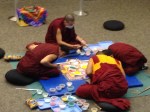






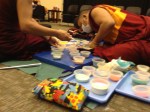
We are lucky to have a tradition of sand mandala making at the U of Arizona Bookstore. Monks have been visiting to draw them on the floor in the basement for years. This is the third one I have been lucky enough to witness. This time they are making the Buddha of Compassion. After they create the image the sweep up the sand and dispose of some of it in water, in a ritual representing the cosmos. This demonstration of attachment and enlightenment is illustrated clearly when the sand is swept and the American viewers rush in to get a bag of the magical sand to take home and keep. The monks don’t need to do that; they are off to draw and destroy many more mandalas all over the world. They do it to show the futility of attachment. It is a beautiful way to illustrate the point.
 mermaidcamp