mermaidcamp
Keeping current in wellness, in and out of the water
You can scroll the shelf using ← and → keys
You can scroll the shelf using ← and → keys


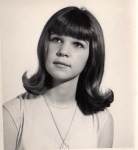




Sights, sounds and smells ignite memories. There are strong connections of which we are unaware that link us to the past. We are conditioned by both culture and anticipation. If we remember (or think we recall) a season, an event, or a place we create expectations. I went to see my classmates last week in Pennsylvania to both test and fill my memory bank. When I first arrived in the small town where I grew up I walked directly to my old home to jog my memory. It did stir up both direct event recollection and a sense of the place. It has not changed much. I haven’t either.
You are what your deep, driving desrire is.
As your deep, driving desire is, so is your will.
As your will is, so is your deed.
As your deed is, so is your destiny. – Brihadaranyaka Upanishad

bloom
The era of likes with mouse clicks has ushered in various forms of approval that may or may not be sincere. Approval requires judgement and investigation. False approval requires nothing but a click on a button. This false world of endorse, like, share is the nightmare underlying quid pro quo SoMe relationships. I know people on various platforms with whom I almost always agree, and others with whom I never agree. This is not so different from daily social life. Social clicks, clubs and groups in real life at least have the opportunity to see each other engage. Some avatars and auto retweeters my be the social media equivalent of codependent. They thrive on false acceptance and deliver the same to others. They both spend and accept the fake currency of unfounded and insincere mutual praise.
Experience teaches us how to avoid being spammed or interrupted by endless chatter as we learn the ropes in social media. I openly joke around with my social media image, freely admitting I edit out any content unflattering to me. Everyone does; nobody uses a personal platform to highlight the worst in themselves. In the past mad men produced media to sell to consumers. Today we are all both the consumer and the media producers. Much ado has been made about the commercial value of this new influence horizon. I agree that consumers benefit form the vast array of information available to them today. The social influence and digital bonds of personal branding may be insidiously damaging as well as lucrative.
The unintended consequences of the digital edited public persona create havoc with the self image and the soul. Being fully present in a community or personal relationship is a high standard to keep. Making basic decisions today about budgeting time and resources is generally stressful. Conscious deliberate action will make the difference between finding a happy medium and wasting precious time creating delusions. It is a brave new world. Caveat emptor.
What kind of power does an exorcist have? Technically Catholic priests are in the business of exorcism, but in day to day life some people play the role of the exorcist to friends or family. I personally do not have much experience with this archetype, but we all recently witnessed a bookkeeper in a school in Georgia display extraordinary ability to drain the evil out of a situation. Antoinette Tuff found the strength to talk down a deranged gunman with 500 rounds of ammunition. Later in an interview she told the 911 dispatcher with whom she had been on the phone that she had been terrified. She called the courage to act the grace of God. I imagine that priest or not, it is always the grace of God that provides the purging of evil. Do you have any experience with exorcist archetypes?
In 1469 in what is now Pakistan, the Sikh religion was born in the form of a teacher, Guru Nanak. He was exceptional as a student, grasping deep meaning at an early age. At this time in history Muslims and Hindus were close and friendly in that part of the world. His ministry was as a poet and musician, a travelling troubadour. He began a line of 10 gurus who passed the hymns and stories along to the future generations. Today Sikhs keep these traditions alive by teaching their children the ancient shabads. They welcome visitors to take part if they like, but there is no attempt to convert. Most Sikhs were born in India to Sikh parents. Understanding some history and philosophy fosters respect for the religious beliefs and practices of others. The group gathers for a meal after the ceremony, which is social and friendly.

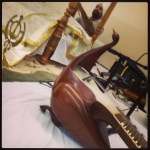
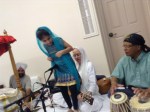
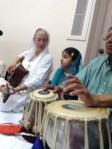
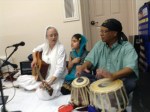
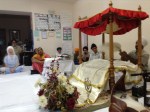
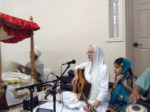


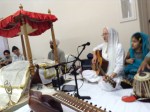
I attended the services of the Sikh gurdwara to see and hear my friend Nirviar Kaur Khalsa play her instrument, the taus. She showed me the beautifully carved string instrument a few weeks ago after the services had concluded. She practices on the taus about two hours daily to create the background ragas for the shabads she chants for the ceremony. Her voice is very well practiced to paint these musical pictures of the one, the friend, the eternal guru. The message reminded me of the Sufis, but the service reminded me a lot of Jews and Catholics. The music is all in minor keys (like Jewish music) , and there is no written vocal music. This technique is passed down in person in the same way the Torah is taught in person. The music itself is the prayer and the meditation for the congregation, not unlike chanting in Latin or Hebrew. Her vocation to study and revive some of the most ancient shabads is now her passion. She shares this talent and hard work because she wants to embody inner peace in the Sikh tradition. Although I am not a Sikh I can appreciate her historical preservation efforts as well as the ideas she promotes in her practice.
I asked some of the congregation how they feel about her dedication to master this ancient art and religious practice from India. She is very highly praised by everyone. One lady I had met on my previous visit told Nirvair as she left she wished she could leave a tip for the music, which is a common practice in India. It is remarkable that she is so committed to her vocation to preserve this tradition here in the United States. I learned that professional ragis from Phoenix charge $500 a visit to come to your gurdwara and do the music. Since the entire service is sung the importance of the musical accompaniment is central to the experience.
Al Qaeda is using this hashtag to solicit ideas for media ops #اقتراحك_لتطوير_اﻹعلام_الجهادي — you should all send some.
— Don’t Panic Online (@dontpanic) August 15, 2013
This is a real twitter stream with some of the funniest tweets in history. Not since @Pontifex opened his papal twitter account has there been such a snark storm. The most feared terrorist organization in the world wants suggestions to improve on line presence and customer service. WOW!!!
If you enjoy irony take a few minutes to sift through the snark in response to this historic request. There are similarities to the papal stream, but this one is funnier, and nobody asks Al Qaeda to RT anything. Americans have snark!!!! I am proud of this quality we have to make fun of the obvious.
The lover archetype is often used in literature, and has both good and evil tendencies. The lover brings passion and full appreciation to a person, place, or thing. The shadow lover brings obsessive and self-destructive devotion playing the part of a lover. Joy, tragedy, and identity arise from this archetype; often personal romance is the central theme in a life. If dreams and history are examined, we will learn what kind of lovers we really are. Each romance has two different equal and opposite reactions to each action. Possessive fantasy is an unhealthy substitute for healthy adult emotions.
Like pendulums swing, we as lovers also swing and revolve around a center of pure, potent, eternal love. Our human tendencies to project onto others that with which we cannot deal create turbulence in romance as well as platonic relationships. The lover who brings to the relationship a self well loved is more likely to find a lover who also takes care of and appreciates his or her own fine qualities. If outer trappings like cosmetics, status and wealth are primarily valued, there may come to pass a shocking chill when these things go into decline. If we depend on another person or group to always agree with us or compliment us we are not very likely to form relationships with much depth or meaning.
If your life story became a romance novel or a movie what kind of lover would you be? Who would be the hero of the story? What obstacles would the hero overcome? Who is the author of your love story? Is it possible that someone else designed your romantic ideal?
My friend Nirvair Kaur Khalsa has had a long career as director of the Montessori schools she founded in Tucson. I met her yesterday at Khalsa Montessori ,where the Sikh community meets for gurdwara. Nirvair plays and sings the ancient ragas for the congregation on an instrument that has been revived by her teacher, the taus. This beautiful stringed instrument was played by the guru’s traveling teaching band during a time when peace flourished between Sufis, Sikhs, HIndus and Moslems. She explains some history of her religion here:
Her interest in religion made her curious about the origins of the teachings she follows. She has studied with Bhai Baldeep Singh, who is bringing back the instrument his ancestors made and played. These religious poems were sung by the Sikh gurus who used them for worship and teaching. The musical tradition was passed from person to person, so today Nirvair is one of a few people practicing and preserving the lovely peacock shaped stringed taus. She gave me a sample in her office:
I plan to return when she is singing during the ceremony. The instrument is a work of art in itself; it produces the sound of ancient India. Her vocation to learn and play these poems of traditional significance in the original way is impressive. I believe the gentle readers would like to see this peacock cello in full glory.
“Shame is a soul eating emotion” Carl Gustav Jung
Today shame is often related to compulsive behavior. It seems also to be the reason for codependent rather than meaningful relationships. Everyone knows shame in some part of life, so it is a common denominator. In small doses it is the element that keeps us from enjoying being ourselves. In larger quantities it is crippling. It’s a shame so much energy is spent on shame. While it cannot be avoided completely during one’s life it can be kept in check.
Carl Jung, Leo Swiss shrink and alchemist, invited his patients to record their own visions as he did in his Red Book. He councils patients to record their visions in order to interpret the voice of the soul:
“Think of it in your imagination and try to paint it. Then when these things are in some precious book you can go to the book & turn over the pages & for you it will be your church-your cathedral-the silent places of your spirit where you will find renewal. If anyone tells you that it is morbid or neurotic and you listen to them-then you will
lose your soul-for in that book is your soul. ~Red Book; Page 216.
Today we have digital means of making art which I enjoy as self expression. What Carl is talking about here, however, is hand on paper. He tells the patient to use good paper and art supplies to document all visions. He explains that by drawing the vision the magnetism it contains is neutralized. He suggests that the expression of the detail is an important way to build self understanding. I will continue to enjoy my digital art making, but think it is time to spend more time with hand on paper. I love to draw mandalas and other geometric patterns. I wonder if I begin now if I can produce a Red Book worth saving. Have you started your Red Book?

birth chart Jung
 mermaidcamp