mermaidcamp
Keeping current in wellness, in and out of the water
You can scroll the shelf using ← and → keys
You can scroll the shelf using ← and → keys

crew
Returning from the voyage with a dangerous leak in the hull
The ship barely remained afloat while listing toward starboard
The lifeboats had all been deployed when the mast snapped
The crew had no choice but to try to make land on the carcass
Of the wooden vessel, laden with treasure, sinking from the weight
Plundered booty, food stores and ammunition, symbols of victory
Were all tossed overboard in an attempt to save human life
What did this say about the success of the voyage?
How does this comfort those who drowned in the service
Of the now deceased captain of this ship?

solo at the top
The course included exasperating coded directions to find the path. Only the experts who had experience in mathematical code could make any sense of it. The others gathered strength for the climb by resting, meditating, and stretching. The recruits knew they would not all be able to make the ascent to the peak. Some would not be in physical condition for the rigors of the steep hike. Others could not resign themselves to the idea that only a few of them would survive the attempt to scale the sacred solo rock.
It was said that the surviving members of the party would be initiated into the noble society of knights of the vast horizon. This powerful, yet underground fraternity required extreme loyalty as well as full secrecy from the membership as well as their families. Sons usually followed fathers into the lodge. Often the young disappeared during the testing phase, never to be found. The most powerful worked hard to assure their progeny had the power and the accomplishments to inherit command upon death of a leader.
A complex game took place when a leader died or left. The people believed that this process revealed the best person to step into the newly vacated position. Potential candidates were summoned to the town square and given maps. Each map was different and contained both real and bogus directions to reach the summit of solo peak. The player who managed to climb to the overlook before sundown would be given the office. The new leader left his mark on the rock then hurried back down to the village.
The trip back down the steep rocky path was the most treacherous part of the journey. All the other candidates hide and do what they can to ambush and kill the new leader so they can claim the win. The field is thinned to one at the end. Nobody is sure if the winner is the one they saw at the top of solo peak, or just the one who managed to kill the others and make it back to the village. And that is how politics were born.

#writephoto
This story is in response to this week’s photo prompt on Sue Vincent’s Echo. Please join us each Thursday to interpret her intriguing image. It is fun to see how many different ways people use it.

arms
The masters of war have gathered armies before.
The youth have been sacrificed in other generations to satisfy the desires of rulers greedy for more power, control, wealth.
As times change value comes and goes, while control is more elusive.
The digital reality of our big data and big vulnerability sets us up for conflict and invasion by enemies.
The new definition of war and the lowered probability of peace has altered the course of history.
Ancient weapons of ignorance and separation are still in use. Placing blame is still the most common excuse for leadership.
It is futile for us to worry or vex ourselves about our fate. Sadly, it is in the hands of some dangerous hombres.

Canadian Prime Minister Justin Trudeau released his own Spotify playlist Saturday. Trudeau’s “PM Mix” features 39 songs. Canadian artists including Drake, Shawn Mendes, k.d. lang and The Tragically Hip are prominently featured, as well as other songs by artists like Fiona Apple, R.E.M., Peter Gabriel and Nenah Cherry. Trudeau tweeted about the playlist Saturday morning…
via This Is What’s on Justin Trudeau’s Summer Spotify Playlist — TIME

raw borscht on ice
If we were having coffee this weekend I would invite you to drink iced tea while enjoying the last of my three blooming jasmine varieties. The yard is again scented with that sweet jasmine flavor that carries well in a breeze. You will want to observe it from the front window while we chat because the heat out there is harsh. Sit back and relax in the air conditioning while I pour your favorite iced tea. I also have two kinds of raw fermented borscht for you, which restores your electrolytes and adds probiotics to your diet. It is like a floating salad suspended in beet juice and kvass. It cools you and helps you keep balance in the heat. I also think it is yummy, but you can decide for yourself. The cucumber and dill will remind you of pickle juice.
If we were having iced tea this week I would tell you I decided to join Audible for a year because the subscription was discounted heavily. For $100 a year I have access to books and podcasts that make my new job a dream. I can do my job and listen to books without distraction. It is a wonderful two birds with one stone situation. I finished the book on biological biodiversity, then knocked off a book about writing by Jeff Goins, and have started The Power of Memoir, by Linda Joy Meyers. This book is inspirational to me because I have studied my family history for years, and written a few very short poems about the ancestors (who were poets themselves). I have wanted to write historical fiction, but never attempted it. Ms Meyers lays out all the steps needed to write a riveting memoir, some of which I have done, like the genealogy research. I was inspired by the book to use my grandmother as the subject this week of my short fiction in response to Sue Vincent’s Thursday prompt. I think I can apply what I am leaning from this generous and well written instruction to my own writing. It can unlock many stories for my future. I recommend the book to all writers, even if you do not plan to write a memoir. She covers technique we all need to remember.

The Power of Memoir
I began my weekly #WeedWednesday feature with a post in the lab at the grow where I work. The short, warm up, educational piece was well received by readers. It is fun and easy to do, and it informs me as well as the audience. There is so much advancement in the science of medical marijuana that I will have much material to cover on this subject. I plan to interview the experts about the plant varieties and all the ways we process the plant to create various therapies. There are new developments all the time, so I doubt that I will ever run out of material for that segment.
How did you spend the week? Have you made progress with your writing, or with your life? Have another glass of tea and fill me in on the details.

#WeekednCoffeeShare
Thanks for joining me today for tea and borscht. Stay cool, and preserve what you still have of your political cool. It looks like it will be needed for a long time in the US. Wishing all the sentient beings everywhere independence and time to savor it. Please visit our hostess, Emily, from Nerd in the Brain for more coffee and news. Read, write, comment, or just drink lots of digital coffee with us every weekend.
Welcome to the first edition of cannabis college. I plan to present a short informative post each Wednesday about the current state of development in the science of medical marijuana. Much has changed, and I anticipate more science based therapies will be developed using cannabis in the near future. I work at the Desert Bloom Re-Leaf Dispensary grow, where we grow indoor and outdoor crops. In the lab and kitchen we produce a wide range of products, which is expanding as new products are tested and developed for the patients. I am new on the job, and learning more every day. I know I am curious about all the varieties being grown and the products on the market. I hope to enlighten both myself and the gentle readers in this series on the science behind this growing industry. Patients now have amazing control of dosage and specific medicine for various conditions. I want to find out more about this, and share what I learn with you.
Justin McKenzie is one of our head growers, with years of experience in growing and processing cannabis. He was good enough to join me in the lab to answer some questions about CO2 extraction. This is the beginning process for many end products. Next we will cover butane extraction in the lab, then go to the kitchen to see what happens there. I am very curious about all the new ways to micro dose cuisine.

Juliana in the kitchen

apparition
Crawling on our bellies through the mud, James Bond style, we quietly exited the castle. Our scuba gear was hidden in the brush at the end of the tunnel. We had the documents we needed to prove the identity of the spy we had come to investigate. Her tricky double agent status had fooled us into thinking she was interested in helping us. As we proceeded with some caution we discovered her true intention was theft and subsequent sale of our defense plan. Ever since that covert meeting at the tavern she had turned up in curious ways. We sensed that we were being followed, and took pains to put her off our scent. Finally we discovered the source of her power and wealth. She was fully funded by the Inquisitors, and was expected by her masters to defeat us through espionage.
Our island was infiltrated by the Inquisitors without our knowledge. The slow trickle of foreign settlers all claimed to be loyal to our mission. The last island in the sea that was not ruled by a conglomerate was to be our Eden. We planned to live in harmony with nature, cultivating the plants, the social customs, and the laws that would preserve our tiny paradise. Refugees from all over the world had journeyed to our island to take part in this bold social experiment. Science and politics had failed us when they combined to dominate the world. Our diet had been reduced to just corn, potatoes, and animal fat. We were starving on many levels. The abundance and freedom we once cherished had been sold. Humanity had sold itself for secure employment in a mysterious system that enslaved the populace. Now our survival would depend on our ability to weed out those who intend to destroy our culture.
The justice system had been corrupted, but there was a single official who retained both integrity and power. The Judge Most High still had the ability to rule in favor of morality. He told us that with evidence he could convince the other rulers to allow our culture to survive in freedom. Some of the most powerful rulers had started to think they had gone too far with the total control of agriculture, environment, and religion. They feared creativity had been wiped out forever to feed the factory machine. They feared the automaton nation might eventually become too weak to survive under the strict and repressive circumstances. They wondered if nature was angry at the killing of all her diverse species for the sake of “markets”.
We managed to sneak away, but wondered if we could make it to the Judge Most High without being caught. We saw a hazy figure blocking the end of the tunnel that lead out to the beach. At first we could not distinguish if the figure was man or woman, friend, or foe. We continued in silence with deep anxiety, wishing for the best. Finally we saw that the Judge Most High was waiting for us. Our fate was sealed. Either the Judge Most High was truly an ethical figure, or we were about to turn over evidence to a double agent. There was only one way out of this predicament. It was show time.
#writephoto
This story is written in response to Sue Vincent’s Daily Echo photo prompt this week. Tune in to read, write, and comment here. It is fun to see how many differences there are in the responses.

London
Sarah Allerton was born in London in 1588, and died in Plymouth Colony in 1633. She arrived in the new world on the ship Anne with her third husband in 1632 after my 13th great-grandfather had sailed on the Mayflower then died shortly after arrival in the colony. Her brother Isaac was a signer of the Mayflower Compact as well, and assistant to Governor Bradford in America. Isaac later disgraced himself, moved to New Amsterdam, and became known as the first Yankee trader.
Sarah Allerton’s parents are not given but information is provided by unknown sources. Her parents would have been Edward Allerton, b. 1555 St. Dionis, Backchurch, London, England, died 1590 England, and Rose Davis, b. ca. 1559 in St. Peters, Corningshire, died June 1596 in England. Edward’s father was William Allerton, b. 1529. Sarah however certainly had at least two brothers. Isaac’s will also mentions a “brother Breuster”. The two siblings were:
1) Isaac Allerton, b. ca. 1586. He was one of the more famous of the Pilgrim Fathers. He was originally a tailor in London and was married in Leyden, the same day as his sister, 4 November 1611, to Mary Norris of Newbury, England, b. ca. 1588.
He came over on the Mayflower, with his wife and three children, and became First Assistant (1621 to ca. 1631) to Governor Bradford. Mary Norris died in childbirth, with a stillborn son, the first winter. She died 25 February 1620/1 on the Mayflower, while the first houses were still being built at Plymouth. In ca. 1626 he married Fear Brewster, b. 1606 at Scrooby, England , daughter of William and Mary Brewster, William being one of the most famous Pilgrims. Fear had arrived in Plymouth in July 1623, on the Anne, the same ship that brought Mary Priest and her two children.
Isaac was well known for his unscrupulous dealings with fellow Pilgrims and eventually left the colony in disgrace in the 1630’s when he lost the support of William Brewster. “A most enterprising man, he engaged in commercial pursuits at Marblehead and in Maine and later resided at New Amsterdam.” . He is often remembered as “the first Yankee trader”. Fear died in Plymouth before 12 December 1634. Isaac Allerton was probably married a third time to Joanna Swinnerton, before 1644, probably New Haven, CT. There were no known children from this marriage. He died insolvent between 1 and 12 February 1658/9 in New Haven, CT. Joanna was still living in 1684. Isaac’s children were (Sarah and Isaac were by his second wife):
Bartholomew, b. ca. 1612, in Leyden, Holland. Bartholomew returned to England. He first married Margaret _____ and then Sarah Fairfax, prob. in Rumbough, Suffolk, England. He died between 15 October 1658 and 19 February 1658/9, prob. at Bramfield, Suffolk, England. Four children are recorded.
Remember, b. ca. 1614 in Leyden. She m. Moses Maverick, before 6 May 1635 and died between 12 Sept. 1652 and 22 Oct. 1656. Moses lived in Lynn, Salem, and at Marblehead (all MA) in the time they were married. They had seven children, born at Lynn and Salem. Moses remarried in Boston to Eunice (Cole) Roberts by whom he had four children.
Mary, b. June 1616, m. Thomas Cushman, ca. 1636, in Plymouth, MA. Cushman came to Plymouth in 1621 on the Fortune. They had eight children. She died 28 November 1699, Plymouth, MA, the last survivor of those who came on the Mayflower. One of her grandchildren, Allerton Cushman, married in 1726 to Elizabeth Sampson, cousin of Benjamin Sprague.
Child, buried St. Peters, Leyden, 5 February 1620.
Stillborn son, b. 22 December 1620 on the Mayflower, Plymouth Harbor.
Sarah, b. ca. 1627 in Plymouth, died young before 1651.
Isaac Allerton, Jr., b. between 22 May 1627 and 1630, Plymouth, MA. He married first to Elizabeth _____, ca. 1652 (2 children) and then to Elizabeth Willoughby, a widow of Overzee and Colclough, ca. 1663, in Norfolk County, VA. Elizabeth was born in 1635 in England (12). They had three children, all born in Westmoreland Co, VA. Isaac became the first Plymouth student at Harvard (he graduated according to in 1650) and later went into business and made a fortune himself. He died Westmoreland Co., VA in 1702.
As is the case for Degory Priest, a General Society of Mayflower Descendents book is available on the first five generations of Isaac Allerton’s descendents. A somewhat earlier and shorter version, covering four generations, was published in 1996. Isaac Allerton has apparently a relatively small number of descendants compared to other Mayflower passengers, but is an ancestor to Presidents Zachary Taylor and Franklin D. Roosevelt (the latter also descended from Degory Priest through Sarah). The presidents are both thus our very remote (!) relatives: President Zachary Taylor (1784-1850), through Isaac Allerton Jr., was a 5th cousin to Mary (Scott) Wisdom; President Franklin D. Roosevelt (1882-1945), through Degory Priest, was an 8th cousin to Paul Graham.
2) Sarah Allerton, b. ca. 1588 at London . She was first married to John Vincent and then married to Degory Priest as noted above. Having received word of her husband’s death, she remarried on 13 November 1621 in Leyden, to Godbert Godbertson (name used in but also often called Cuthbert Cuthbertson). They arrived in July-August of 1623 on the Anne with their three children (two by Degory Priest). It is possible that there were two additional children with them by the first marriage of Godbertson (I think there is a reference to five children that arrived with them in and see also mention of three Cuthbertson below). Francis Sprague, another of my ancestors, was also a passenger. Godbert (ca. 1590-633), a Dutch Walloon, was a hat-maker in Leyden. He had been married previously in 1617 to Elizabeth Kendall. He became a “purchaser”, i.e., a shareholder in the Pilgrim Company when it was formed in 1626. He died seven years later, in Plymouth, of “infectious fever”. She died in Plymouth before 24 October 1633. On 11 November 1633 their son-in-law Phineas Pratt was appointed “to take possession of the personal property of Cuthbert Cuthbertson and his wife Sarah”.
If we were having coffee today I would urge you to celebrate National Iced Tea Day with me. I know the national days can really be a bit much, but this one is a winner. I have so many iced teas from which you can choose. I personally am very hung up on White Strawberry alternating that with Peppermint Butler iced tea. I love the refreshing zip of each of these. The white strawberry has a fruity and light taste that is good to guzzle on hot days like this. The Peppermint Butler has real candy canes in the mix, so it delivers a wonderful minty punch that feels like a cool (brief) breeze. Please have a seat while I prepare a couple of unbreakable pitchers of iced tea to take with us to the pool.

black passionfruit sun tea
We are meeting again this week in the pool at my condo village. The sun is scorching and the pavement will burn your feet, so take a dip to chill yourself before we drink tea and exchange stories. I want to hear about your writing projects and your life. I hope both are going well. I know some of you are working on novels and longer works of fiction. I also tip my hat to those of you who write micro fiction, which is mighty hard to do well. I try it a bit in response to Sue Vincent’s weekly photo prompt. This week I wrote a poetic verse that did not rhyme, but once again touched on dystopia and doom. There is a pattern, and it has nothing to do with Sue’s pictures. I do notice some others with depressing responses, so maybe it is a way to deal with our world politics. On a lighter note, I am having a good time writing weekly tea reviews, which are completely apolitical. In fact, I think tea and coffee parties are a wonderful way to take a break from the current situation while just savoring the moment. My Tuesdays are dedicated to tea and all the wonders and benefits of drinking it, until further notice. I include the offer from Adagio above in case you want to chill your belly and chill your emotions at the same time. Camomile is a sedative and calming tea, being offered free with any purchase made today.
I will skip world politics, since it is being covered everywhere. I just want to say the Mike Bloomberg has proven to be my hero, which I would not have suspected. His personal financial support for the Paris Accord makes a fabulous point….We CAN do it. I think people will step up all over the world in response to repression of science, so maybe it is not the worst thing to have these obstructionist crazies on board. They expose the terrible status quo. I remain optimistic.
Here in Tucson I am making salsa today with the fresh produce haul I procured this morning. I am roasting tomatoes and Poblano chiles for use all week. The house and the back yard smell like chiles, which does stimulate my appetite. When we return from the pool let me make you a couple of tacos with this smoky goodness. I like to roast the veggies and use them in many ways later in the week. I have been on a vichyssoise kick, and have found all kinds of cold creamy potato soups. So far I have done them with asparagus, and with corn, and a classic potato slightly flavored with one jalapeño. The variations are endless, so I am experimenting with all kinds. I think the Poblano will be a great addition. All of them are broth, potatoes, leeks, heavy cream, and something. It is hard to ruin, and easy to serve. I took corn vichyssoise soup shots to my colleagues at work this week. It was very popular. I will tell you more about my new job next week, since I have been rattling on for a while here.

Weekend-Coffee-Share-Pic
Thanks for stopping for some iced tea and sympathy this weekend. I appreciate Emily for hosting this movable feast each weekend at her blog, Nerd in the Brain. Please join us for digital beverages and a chat.

Alexios I
Alexios I Komnenos, or Comnenus (Greek: Αλέξιος Α’ Κομνηνός) (1048 – August 15, 1118), Byzantine emperor (1081–1118), was the son of John Comnenus and Anna Dalassena and the nephew of Isaac I Comnenus (emperor 1057–1059). The military, financial and territorial recovery of the Byzantine Empire began in his reign.
Life
Alexius’ father declined the throne on the abdication of Isaac, who was accordingly succeeded by four emperors of other families between 1059 and 1081. Under one of these emperors, Romanus IV Diogenes (1067–1071), he served with distinction against the Seljuk Turks. Under Michael VII Ducas Parapinaces (1071–1078) and Nicephorus III Botaneiates (1078–1081), he was also employed, along with his elder brother Isaac, against rebels in Asia Minor, Thrace and in Epirus.
Alexius’ mother wielded great influence during his reign, and he is described by his daughter, the historian Anna Comnena, as running next to the imperial chariot that she drove. In 1074, the rebel mercenaries in Asia Minor were successfully subdued, and, in 1078, he was appointed commander of the field army in the West by Nicephorus III. In this capacity, Alexius defeated the rebellions of two successive governors of Dyrrhachium, Nicephorus Bryennius (whose son or grandson later married Alexius’ daughter Anna) and Nicephorus Basilakes. Alexius was ordered to march against his brother-in-law Nicephorus Melissenus in Asia Minor but refused to fight his kinsman. This did not, however, lead to a demotion, as Alexius was needed to counter the expected Norman invasion led by Robert Guiscard near Dyrrhachium.
While the Byzantine troops were assembling for the expedition, Alexius was approached by the Ducas faction at court, who convinced him to join a conspiracy against Nicephorus III. Alexius was duly proclaimed emperor by his troops and marched on Constantinople. Bribing the western mercenaries guarding the city, the rebels entered Constantinople in triumph, meeting little resistance on April 1, 1081. Nicephorus III was forced to abdicate and retire to a monastery, and Patriarch Cosmas I crowned Alexius I emperor on April 4.
During this time, Alexius was rumored to be the lover of Empress Maria of Alania, the daughter of King Bagrat IV of Georgia, who had been successively married to Michael VII Ducas and his successor Nicephorus III Botaneiates, and was renowned for her beauty. Alexius arranged for Maria to stay on the palace grounds. It was also thought that Alexius may have been considering marrying the erstwhile empress. However, his mother consolidated the Ducas family connection by arranging the Emperor’s marriage to Irene Ducaena, granddaughter of the Caesar John Ducas, the uncle of Michael VII, who would not have supported Alexius otherwise. As a measure intended to keep the support of the Ducae, Alexius restored Constantine Ducas, the young son of Michael VII and Maria, as co-emperor and a little later betrothed him to his own first-born daughter Anna, who moved into the Mangana Palace with her fiancé and his mother.
However, this situation changed drastically when Alexius’ first son John II Comnenus was born in 1087: Anna’s engagement to Constantine was dissolved, and she was moved to the main Palace to live with her mother and grandmother. Alexius became estranged from Maria, who was stripped of her imperial title and retired to a monastery, and Constantine Ducas was deprived of his status as co-emperor. Nevertheless, he remained in good relations with the imperial family and succumbed to his weak constitution soon afterwards.
This coin was struck by Alexius during his war against Robert Guiscard.
Byzantine-Norman Wars
Alexius’ long reign of nearly thirty-seven years was full of struggle. At the very outset, he had to meet the formidable attack of the Normans (led by Robert Guiscard and his son Bohemund), who took Dyrrhachium and Corfu, and laid siege to Larissa in Thessaly (see Battle of Dyrrhachium). Alexius suffered several defeats before being able to strike back with success. He enhanced this by bribing the German king Henry IV with 360,000 gold pieces to attack the Normans in Italy, which forced the Normans to concentrate on their defenses at home in 1083–1084. He also secured the alliance of Henry, Count of Monte Sant’Angelo, who controlled the Gargano Peninsula and dated his charters by Alexius’ reign. Henry’s allegiance was to be the last example of Byzantine political control on peninsular Italy. The Norman danger ended for the time being with Robert Guiscard’s death in 1085, and the Byzantines recovered most of their losses.
Alexius had next to deal with disturbances in Thrace, where the heretical sects of the Bogomils and the Paulicians revolted and made common cause with the Pechenegs from beyond the Danube. Paulician soldiers in imperial service likewise deserted during Alexius’ battles with the Normans. As soon as the Norman threat had passed, Alexius set out to punish the rebels and deserters, confiscating their lands. This led to a further revolt near Philippopolis, and the commander of the field army in the west, Gregory Pakourianos, was defeated and killed in the ensuing battle. In 1087 the Pechenegs raided into Thrace and Alexius crossed into Moesia to retaliate but failed to take Dorostolon (Silistra). During his retreat, the emperor was surrounded and worn down by the Pechenegs, who forced him to sign a truce and pay protection money. In 1090 the Pechenegs invaded Thrace again, while the brother-in-law of the Sultan of Rum launched a fleet and attempted to arrange a joing siege of Constantinople with the Pechenegs. Alexius overcame this crisis by entering into an alliance with a horde of 40,000 Cumans, with whose help he crushed the Pechenegs at Levounion in Thrace on April 29, 1091.
The Byzantine Empire at the accession of Alexius I Comnenus, c. 1081
This put an end to the Pecheneg threat, but in 1094 the Cumans began to raid the imperial territories in the Balkans. Led by a pretender claiming to be Constantine Diogenes, a long-dead son of the Emperor Romanos IV, the Cumans crossed the mountains and raided into eastern Thrace until their leader was eliminated at Adrianople. With the Balkans more or less pacified, Alexius could now turn his attention to Asia Minor, which had been almost completely overrun by the Seljuk Turks.
Byzantine-Seljuk Wars
As early as 1090, Alexius had taken reconciliatory measures towards the Papacy, with the intention of seeking western support against the Seljuks. In 1095 his ambassadors appeared before Pope Urban II at the Council of Piacenza. The help which he wanted from the West was simply mercenary forces and not the immense hosts which arrived, to his consternation and embarrassment, after the pope preached the First Crusade at the Council of Clermont later that same year. Not quite ready to supply this number of people as they traversed his territories, the emperor saw his Balkan possessions subjected to further pillage at the hands of his own allies. Alexius dealt with the first disorganized group of crusaders, led by the preacher Peter the Hermit, by sending them on to Asia Minor, where they were massacred by the Turks in 1096.
The second and much more formidable host of crusaders gradually made its way to Constantinople, led in sections by Godfrey of Bouillon, Bohemund of Taranto, Raymond IV of Toulouse and other important members of the western nobility. Alexius used the opportunity of meeting the crusader leaders separately as they arrived and extracting from them oaths of homage and the promise to turn over conquered lands to the Byzantine Empire. Transferring each contingent into Asia, Alexius promised to supply them with provisions in return for their oaths of homage. The crusade was a notable success for Byzantium, as Alexius now recovered for the Byzantine Empire a number of important cities and islands. The crusader siege of Nicaea forced the city to surrender to the emperor in 1097, and the subsequent crusader victory at Dorylaion allowed the Byzantine forces to recover much of western Asia Minor. Here Byzantine rule was reestablished in Chios, Rhodes, Smyrna, Ephesus, Sardis, and Philadelphia in 1097–1099. This success is ascribed by his daughter Anna to his policy and diplomacy, but by the Latin historians of the crusade to his treachery and falseness. In 1099, a Byzantine fleet of 10 ships were sent to assist the Crusaders in capturing Laodicea and other coastal towns as far as Tripoli. The crusaders believed their oaths were made invalid when the Byzantine contingent under Tatikios failed to help them during the siege of Antioch; Bohemund, who had set himself up as Prince of Antioch, briefly went to war with Alexius in the Balkans, but was blockaded by the Byzantine forces and agreed to become Alexius’ vassal by the Treaty of Devol in 1108.
Personal life
During the last twenty years of his life Alexius lost much of his popularity. The years were marked by persecution of the followers of the Paulician and Bogomil heresies—one of his last acts was to publicly burn on the stake Basil, a Bogomil leader, with whom he had engaged in a theological dispute. In spite of the success of the crusade, Alexius also had to repel numerous attempts on his territory by the Seljuks in 1110–1117.
Alexius was for many years under the strong influence of an eminence grise, his mother Anna Dalassena, a wise and immensely able politician whom, in a uniquely irregular fashion, he had crowned as Augusta instead of the rightful claimant to the title, his wife Irene Ducaena. Dalassena was the effective administrator of the Empire during Alexius’ long absences in military campaigns: she was constantly at odds with her daughter-in-law and had assumed total responsibility for the upbringing and education of her granddaughter Anna Comnena.
Succession
Alexius’ last years were also troubled by anxieties over the succession. Although he had crowned his son John II Comnenus co-emperor at the age of five in 1092, John’s mother Irene Doukaina wished to alter the succession in favor of her daughter Anna and Anna’s husband, Nicephorus Bryennius. Bryennios had been made kaisar (Caesar) and received the newly-created title of panhypersebastos (“honoured above all”), and remained loyal to both Alexius and John. Nevertheless, the intrigues of Irene and Anna disturbed even Alexius’ dying hours.
Legacy
Alexius I had stabilized the Byzantine Empire and overcome a dangerous crisis, inaugurating a century of imperial prosperity and success. He had also profoundly altered the nature of the Byzantine government. By seeking close alliances with powerful noble families, Alexius put an end to the tradition of imperial exclusivity and coopted most of the nobility into his extended family and, through it, his government. This measure, which was intended to diminish opposition, was paralleled by the introduction of new courtly dignities, like that of panhypersebastos given to Nicephorus Bryennius, or that of sebastokrator given to the emperor’s brother Isaac Comnenus. Although this policy met with initial success, it gradually undermined the relative effectiveness of imperial bureaucracy by placing family connections over merit. Alexius’ policy of integration of the nobility bore the fruit of continuity: every Byzantine emperor who reigned after Alexius I Comnenus was related to him by either descent or marriage.
Family
By his marriage with Irene Ducaena, Alexius I had the following children:
Anna Komnene, who married the Caesar Nicephorus Bryennius.
Maria Komnene, who married (1) Gregory Gabras and (2) Nicephorus Euphorbenos Katakalon.
John II Komnenos, who succeeded as emperor.
Andronikos Comnenus, sebastokratōr.
Isaac Comnenus, sebastokratōr.
Eudocia Komnene, who married Michael Iasites.
Theodora Komnene, who married (1) Constantine Kourtikes and (2) Constantine Angelos. By him she was the grandmother of Emperors Isaac II Angelos and Alexios III Angelos.
Manuel Komnenos.
Zoe Komnene.
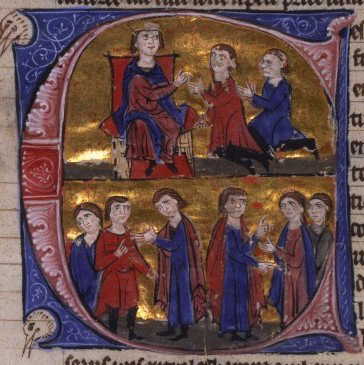
Council of the Crusaders

