mermaidcamp
Keeping current in wellness, in and out of the water
You can scroll the shelf using ← and → keys
You can scroll the shelf using ← and → keys
I am a revolutionary. I am in flashback mode during this political season. When I watched the PBS documentary about the Black Panther Party my mind was blown thinking about the similar tactics employed by our government today. Police are still outside the law, are still involved in brutality rather than community protection. In my neighborhood the police force protects criminals and refuses to respond to those who want to stop crime. I think it is scary that abuse of power continues to be our greatest obstacle to peace and prosperity. In 1968 J Edgar Hoover had absolute power to invade privacy and snuff Americans at will. Today the FBI is asking Apple to give them a back door to everyone’s iPhones. Today we have drones out killing people for our “freedom and democracy”. Have we ever had freedom and democracy for all our citizens? I think not.
I was involved, but not old enough to vote, in the 1968 election that sent Tricky Dick Nixon to the White House. I was in the audience at the University of Texas at Austin to listen to Eugene McCarthy, and later to Hubert Humphrey, during my freshman year on campus. I decided to register to vote as a Libertarian as soon as I was 21. The Democrats were more to my liking but both parties struck me as corrupt anachronisms dedicated to keeping war and prejudice alive around the globe. I was not alone in this belief. I am still not the only person who sees our system as dangerously off course.
We all feel that things have gotten out of hand, and we all want a better future for our country. I know that is true, even though the campaign rhetoric has become vile and toxic. With the new twist of a Supreme nomination stakes are high and emotions are higher. If we the people allow super pacs and nasty grudges to continue to drive our political outcomes we will all continue to feel let down by our government. This election, very much like the election of 1968, will have profound consequences on our image around the world as well as our own economy. No matter how you feel (Bern or no Bern) it is time to register to vote and exercise your right to elect officials you trust. History is being made very rapidly. Get out the vote, gentle readers. Do it now before all the hippies drop dead from exhaustion.
This is a word to add to your vocabulary. Use Gasherbrum in a sentence as soon as possible in order to remember the meaning.
Imagine yourself climbing one of the highest mountains in the world, a steep jag of rock in a corner of the Karakoram, pinched between Pakistan and China. You are hanging on a rope, swinging against a rock face, a mile above the glacier below but not so far from the glacier to your side. A chunk breaks off the glacier hanging just over there… it resounds: “Gasherbrum!” You swing on the rope, thrash for room, bump on the rock and gash your bum.
Heck, why settle for one of the highest mountains in the world? Take seven of them. Or anyway seven peaks in one massif. That’s the Gasherbrum. One might be forgiven for thinking it’s Gascherbrunn, which would seem properly Germanically alpine, but these peaks are nowhere near Switzerland or Austria. And their name is from Balti, a language that is a form of Ladakhi, which is in…
View original post 326 more words
Income inequality is the issue that is driving our destiny. Pay attention to the details.
Lately the internet has become full of arguments about the merits and demerits of Bernie Sanders and Hillary Clinton. Over the past couple weeks, I’ve been discussing and pondering all the various views about this, and I’m increasingly of the opinion that most of the people engaging in this debate don’t really understand what is at stake in the democratic primary. This is in part because many Americans don’t really understand the history of American left wing politics and don’t think about policy issues in a holistic, structural way. So in this post, I want to really dig into what the difference is between Bernie and Hillary and why that difference is extremely important.
View original post 2,130 more words
This election of 2016 gives us an unprecidented opportunity to change our federal government for the better. The American people have been through the economic ringer while banks “recovered” nicely with taxpayer assistance. The real estate market where I live is still on a very slow track to recovery, and the stock market is tanking right now over the price of oil. Ordinary tax payers have felt powerless and probably resentful to see the way our government conducts itself and spends our treasury’s money. Various movements from #OccupyWallStreet to #BlackLivesMatter have coalesced to express rage against the system. As these feelings and political movements grow the ability to share our thoughts has expanded exponentially.
This election may be televised, but the instant power of twitter has changed the way the candidates compete. The playing field is more open to view than the games in the past that decided our national political future. Anyone with a twitter account is free to comment, disclose, and persuade. It reminds me of the University of Texas tower (site of the very first famous mass shooting by a veteran at a school), which says “You shall know the truth and the truth will set you free” (John 8:32) Truth and freedom have been generally under siege from all corners. Each of us has personal truth and freedom, but it gets very gnarly trying to decode the nation’s truth and freedom. These words evoke talk of war and the military, always used to protect our national freedom. The irony now that the veterans of our freedom wars are in bad shape and need care and attention sends a signal that all is not well. All is not revealed. Truth about what happens to our troops, and in our wars has been buried under a giant pile of PTSD. The brave men and women of our armed forces have taken the biggest hit to their freedom and security. Someone has lied to us about the entire nature of this war business.
The economy may or may not be in peril for banks and the super wealthy Americans. The economic outlook for the middle class looks gloomy to me at the moment. Poverty is spreading among the senior population and children. Homelessness and addiction is common for the hero veterans we sent to fight for our “freedom”. These truths should motivate the voters of this nation to look for a better solution. I endorse Bernie Sanders for president because #WeAreBernie. I believe the truth will set us free from unreasonable government, but we need to face the truth together to make this happen. How do you feel, gentle reader? Do you think we can come clean and make the government work for the people? No matter what you think I hope you will vote and make your voice heard.
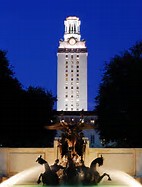
UT tower
This is an all too common ailment in our world…
I am re-reading Margaret Heffernan’s ” Willful Blindness” and was reminded about the Febreeze (I think) ad that depicts how we can go nose blind to the odours around us because the become part of the soup we are swimming in. What would be the Febreeze solution to not seeing other possibilities as possible because we have such a great investment in continuing the current practice? What spray could get rid of (not mask) the stench of complacency? How do we break the confirmation bias mold and launch into the unknown?

Maybe it happens by playing against tendencies. I am going to explore ‘taking the other path’ this month and will report in when I am stunned, surprised or disturbed by the results. I will try to persistently think about my decisions and when faced with a fork, take the one that my ‘instincts’ reject. Today, I don’t know what…
View original post 26 more words
We went out to eat in our neighborhood today to celebrate the new year. I was thinking of eggs Benedict but we arrived after the breakfast menu had been retired. Much to my delight the lunch menu had been updated since our last visit to include many new dishes that are right up my culinary alley. The Arizona Inn is a very classy place to dine, stay, or do just about anything. I used to take my mother there all the time because she loved the ambiance. I am also a fan of the reserved, quiet atmosphere and the historic style. In Tucson nobody really needs to put up a Christmas tree at home because the Inn provides a fabulous super tree in the library every year for all of us to enjoy. They keep the wood fire going and the charm flowing for hotel guests, so off the street visitors are treated to the same upgraded style. We love the dining room, but the Audubon Bar is adjacent which has a patio where the full menu is also available. The entire space is elegant and designed for classic leisure. I am not sure if many remember classic leisure, but it includes well designed surroundings, croquet, and fabulous service.
I was surprised to see the jackfruit Korean tacos so I ordered them. My starter of vegetarian spring rolls was fresh and delicious. The salad on which the rolls were served was the most sumptuous part of the dish, adding texture and another layer of flavor to go with the dipping sauces. To be honest I would have been satisfied after that course, but the tacos arrived and they really excited me. I finished my soba noodles and two of my tacos, which took me past the point of sensible portions. I am guilty of overeating on New Years Day!! Well, I made no resolutions, so I guess I did not break any. Bob was not able to finish his paella after his starter of corn and cauliflower chowder. I tasted the chowder, another vegetarian item, and really like it too. Bob ordered take out dessert, so the experience lives on in the fridge as two kinds of cake.
Our service was delivered with impeccable precision and grace by Mike Yaugor who has worked at the Inn for six years and likes it. I try not to hound waiters with my lacto-ovo vegetarianism by asking too many questions, but I need specificity. Mike was proactively ready to serve anyone, even vegans. He knew everything about everything on the menu. When Bob ordered paella, which normally is served after 5 pm, he proactively found out that the kitchen could accommodate the order at lunch time. Mike is my kind of guy, a happy, attentive, detail oriented server, comfortable with his colleagues and his guests. He did not mind asking the chefs to don the toques to come out for kudos on camera. Nathan Brown and Mathew Patton were holding down the kitchen on 1 January, 2016. They kicked out a lunch that made our celebration special and memorable. We are both impressed with the innovative new twists to the offerings. We’ll be back! This is, by far, the best restaurant in my neighborhood at the moment.

The tree

Happy New Year!!
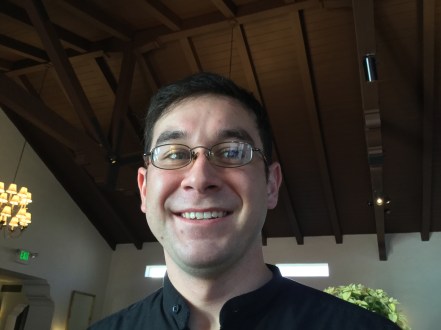
Mike Yaugor

Korean jackfruit tacos
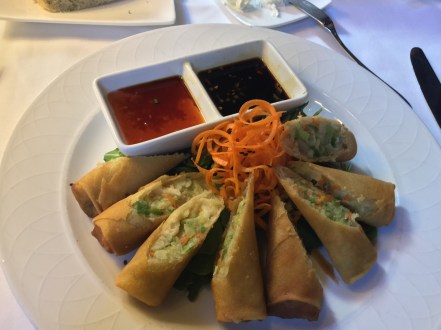
spring rolls


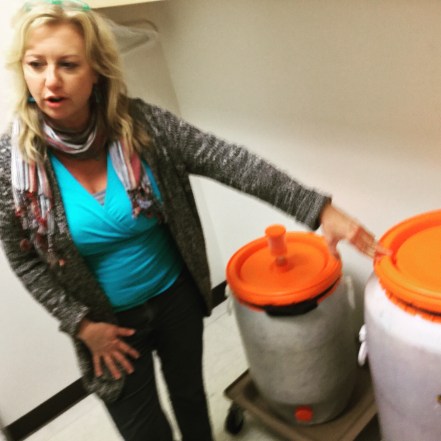
Suzette in her kitchen
Chris Brogan was my first teacher of social media by way of his books. He is very smart in my opinion, and constantly evolves. One of his practices for which he is now very well known is finding three words to inspire at the first of every year. To replace resolutions, the words are meant to inspire and represent goals. On January 1 Chris will drop his words, as is his custom, for the eleventh year in a row. Well done, Brother Brogan. I know I am not the only one who appreciates your leadership in this exercise. Three is plenty if they are kept alive daily for an entire year. That is the idea of having only a few….. no excuse not to work on them. I am looking forward to a happy and fun 2016. My words are:
I plan to combine forces with a wonderful woman I met in Phoenix by chance. She makes the best artisanal sauerkraut I have ever tasted. The Garden Goddess was planning to expand her distribution to Pima County, where I live, when we met. There are some logistical issues to work out, but we are looking at an arrangement that is extremely simplistic and independent. I am very interested in the teaching part of the concept because I have become a fermented foods crusader and believer. I am reading books and experimenting like a mad scientist in my own kitchen as well as eating Suzette’s kraut daily. This is a very exciting adventure for me. I know most people might not be so turned on about teaching others to make their own sauerkraut, but I feel a complete sense of mission to teach the world to ferment raw food and feel so much better. Fermented foods themselves are a simple, independent adventure you can enjoy at home. It is an explosive and exciting new hobby/passion I look forward to cultivating in 2016.

fermenting artisanal kraut
The “meaning of the holidays” is a phrase that has been diluted. Although this commercial venture of the company was done for public relations purposes, there could be no better public relations. I wish all the gentle readers comfort and joy for the season and beyond.
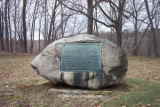
Memorial to the First Settlers Amesbury-1654 Golgotha
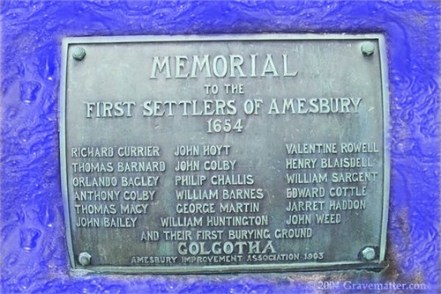
Memorial to the First Settlers Amesbury-1654 Golgotha
My 10th great-grandfather came to America from Bath, England in 1632 and founded many towns in New England. We know a lot about him because he went to court often, and the records remain in tact. If he had not been so contentious with his dealings we might know little about his life.
William Sargent was born 28 Mar 1609 in Bath, Somerset, England. His parents were Richard SARGENT and Katherine STEVENS. He migrated to America in 1632 and was often referred to as a “seaman”, “mariner” or sometimes “yeoman” in legal documents. He married Elizabeth PERKINS in 1633 in Amesbury, Essex, Mass. He was made Freeman on 22 May 1639. After Elizabeth died, he married Joanna Pinder Rowell. William died sometime between 24 Feb 1673/74, when his name appeared on a Norfolk Land Deed, and 8 April 1675, when inventory was taken on his estate in Amesbury, Essex, Mass.
William helped found more towns than any of our other ancestors: Agawam – now Ipswich Mass, Wessacucoh – now Newbury Mass, Winnacunnet – now Hampton NH, South Merrimac – now Salisbury – Mass, and Salisbury New Town -now Amesbury Mass.
Elizabeth Perkins was born 31 Mar 1611 in Hillmorton, Warwickshire, England. Her parents were John PERKINS and Judith GATER. Elizabeth died 18 Sep 1670 in Salisbury, Essex, Mass.
Joanna Pinder was born in 1621. She was the daughter of Henry and Mary Pinder. She married Valentine Rowell on 14 Nov1643 in Salisbury, Mass. She married as her second husband William Sargent on 18 Sep 1670 in Amesbury, Mass. Joanna Pinder married Richard Currier as her third husband on 26 Oct 1676 in Amesbury, Mass. She died in October 1690 in Amesbury.
Children of William and Elizabeth:
1.
Mary Sargent
27 Sep 1634 Amesbury, Essex, Mass
Phillip Challis
1652
Salisbury
27 Sep 1716
Amesbury, Mass
2.
Thomas Sargent
11 Jun 1643 Salisbury, Essex, Mass
Rachel Barnes (daughter of William BARNES)
2 Mar 1668 Salisbury
27 Feb 1706
Amesbury, Mass
3.
William Sargent
2 Jan 1645 Salisbury
Mary Colby (daughter of Anthony COLBY)
23 Sep 1668 Amesbury
31 May 1712
Amesbury
4.
Lydia Sargent
17 Jun 1647 Salisbury
1661
Salisbury
5.
Elizabeth Sargent
22 Nov 1648 Salisbury
Samuel Colby (Son of Anthony COLBY)
1667
Salisbury
5 Feb 1736
Amesbury
6.
Sarah SARGENT
29 Feb 1652 Salisbury
Orlando BAGLEY Jr.
22 Dec 1681 Amesbury
3 Oct 1701 Salisbury
The earliest record seeming to bear on the origin of this Sargent family appears in the Abbey church at Bath, England, under date of Nov 22, 1602, where the record of the marriage of Richard Sargent and Katherine Stevens is set out, and it states further “Ano Dom. 1630, Jenning Walters and Joane Sargent were married April 15,” and under “Baptism,” “Elizabeth, the daughter of Richard Sargent, 28 day, 1603, October; 1606, June, William the Sonne of Richard Sargent the 28th; March, 1609, Joane the daughter of Richard Sargent was baptised the 26th.” No further record of father or son is found there, and it is inferred that they may have gone to London and William shipped from there.
One historian of the Sargent family says: “At first I was not inclined to believe this William was our ancestor, or from this part of England. But since learning that the father of William’s first wife, ‘Quarter Master John Perkins,’ was at Agawam in August, 1631, a short time after arriving in America, and that he came from near Bath, England, it seems quite probable that if William was from there and with Captain Smith in 1614, when the latter landed at Agawam and wrote up its beauties and advantages, William may have returned and induced John Perkins and others to emigrate.”
The first record found of William is in the general court records of Masschusetts Colony in April, 1633, where a copy of an act appears to protect him and other grantees of land at Agawam, now Ipswich. Massachusetts, in their rights. The next record is that of his oath of allegiance and fidelity in 1639. It is shown by records and deeds that he was one of the first settlers at Wessacucoh, now Newbury, in 1635; at Winnacunnet, now Hampton, New Hampshire, in 1638.
Oct 1638 – The reverend Stephen BACHILER and his company, who had received permission from the general court when united together by church covenant, commenced a settlement at Winicowett. He was at this time residing in Newbury. On Mr. Rawson’s request, the place was called Hampton. The following persons, residents of Newbury, went with Mr. Bachiler. John Berry, Thomas COLEMAN, Thomas Cromwell [Giles CROMWELL‘s brother], James DAVIS, William Easton, William Fifield, Maurice Hobbs, Mr. Christopher Hussey [BACHILER’s son-in-law], Thomas Jones, Thomas Marston, William Marston, Robert Marston, John Moulton, Thomas Moulton, William Palmer, William SARGENT, and Thomas Smith. Smith, however, soon returned to Newbury. A few went to Salisbury.
Our ancestos’ lots are underlined in red. William Sargent’s lot was at the corner today’s Winnacunnet Road and Park Ave. — Map of the homes of the original settlers of Hampton, NH, recreated from published maps and ancient records in 1892
Lafayette Road, and Winnacunnet Road, Hampton, NH on Google Maps
The main road going horizontally across the top of the map then, at right, angling down to the right corner, is today’s Winnacunnet Road. At the bottom right corner it leads “To The Sea”.
Today’s Lafayette Road/Route One starts in the top left and goes vertically down (south) into the thicker road, then about 2/3 of the way down angles sharply off to the left corner in the small road reading “To Salisbury”. That road today is pretty much straight as an arrow north to south.
Midway down that same road a small road angles off to the left that reads “To Drake Side”. That is today’s Drakeside Road.
The fat road leading from the point where Route One angles off “To Salisbury” to the right and its meeting with Winnacunnet Road, is today’s Park Ave.
The two roads leading off the bottom of the map both say “To the Landing”, and at the time were both ends of a single road that went in a loop. Today they are still there, called Landing Road, but are cut off in the middle by a new highway.
Lastly the small road in the top right is Mill Road.
First called the Plantation of Winnacunnet, Hampton was one of four original New Hampshire townships chartered by the General Court of Massachusetts, which then held authority over the colony. “Winnacunnet” is an Algonquian Abenaki word meaning “pleasant pines” and is the name of the town’s high school.
In March 1635, Richard Dummer and John Spencer of the Byfield section in Newbury, came round in their shallop, came ashore at the landing and were much impressed by the location. Dummer, who was a member of the General Court, got that body to lay its claim to the section and plan a plantation here. The Massachusetts General Court of March 3, 1636 ordered that Dummer and Spencer be given power to “To presse men to build there a Bound house”.
The town was settled in 1638 by a group of parishioners led by Reverend Stephen Bachiler, who had formerly preached at the settlement’s namesake:Hampton, England. Incorporated in 1639, the township once included Seabrook, Kensington, Danville, Kingston, East Kingston, Sandown, North Hampton and Hampton Falls..
William was at South Merrimac. now Salisbury, Massachusetts, in 1639, and that “William Sargent, townsman and commissioner of Salisbury,” had a tax rate December 25, 1650, of 7s. 4d.
William Sargent – Ipswich Lot
He was next located at Salisbury New Town, now Amesbury and Merrimack, in 1655, where he resided until his death in 1675. He is believed to have married Elizabeth Perkins about 1633, as she came with her parents to America in the ship “Lion,” in the spring of 1631. She died before September 18, 1670, for William married at that time Joanna Rowell, who survived him and married Richard Currier, of Amesbury. The children of William Sargent seem to have been as follows, but owing to lack and contradiction of records there is uncertainty about them: Mary, Elizabeth, died young: Thomas, William, Lydia, Elizabeth, died young; Sarah, died young; Sarah and Elizabeth.
Over half the first settlers names on this memorial are our ancestors. They are: Richard Currier, Orlando BAGLEY Sr., John Bailey, William BARNES, Thomas Barnard, Henry Blaisdell, Philip Challis, Anthony COLBY, John COLBY, Edward Cottle, Jarret Haddon, John HOYT, William Huntington, Thomas Macy, George MARTIN, Valentine Rowell, William SARGENT and John Weed.
OFFICES: Essex grand jury, 13 April 1652 Petit jury, 8 April 1662, 24 June 1662, 13 April 1669, 12 April 1670 . Sworn clerk of the train band of Salisbury on 8 April 1651
ESTATE: “It is ordered that no person whatsoever shall go to plant or inhabit at Aggawam, without leave from the court, except those that are already gone, viz. …
1634 – ” Willm Srjeant” In a grant at Ipswich,, William Sargent received twelve acres of land
6 Sep 1638 – ” Willi[am] Sergant” was in the list of petitioners, mostly Newbury men, headed by [our ancestor] Stephen BACHILER, were granted “liberty to begin a plantation at Winnacunnet [Hampton]”1:236].
The Grantees and Settlement of Hampton, N. H. By Victor Channing Sanborn — Kenelworth, Ill.Essex Institute Historical Collections, 53 – (1917), Pgs. 228-249
That little band, the first settlers of Winnicunnet (afterwards called Hampton) was composed of at least two diverging groups. Search must be made in Southern England (Hampshire and Wiltshire) and in Eastern England (Norfolk and Suffolk) to find the homes of these men. They came from Newbury, Ipswich and Watertown, under the leadership of Stephen Bachiler.
The first authentic record is found in the list of those who presented their petition to the General Court of Massachusetts at that session which began on 6 September, 1638.
“The Court grants that the petitioners, Mr. Steven BACHILER , Christopher Hussey, Mary Hussey vidua, Tho: Crumwell, Samuel Skullard, John Osgood, John Crosse, Samu: Greenfeild, John Molton, Tho: Molton, Willi: Estow, Willi: Palmer, Willi: SERGANT, Richrd Swayne, Willi: Sanders, Robrt Tucke, wthdivers others, shall have liberty to begin a plantation at Winnacunnet”.&c.
The first six grantees were all from the south or west of England. The last ten were probably from Norfolk or Suffolk. The “divers other”, being unnamed, we may not assign, but they probably included others of Bachiler’s neighbors or kinsmen, among them being his three Samborne grandchildren.
“Will[iam] Sargent” was in the section of married men in the list of first comers to Hampton
7 Nov 1644 – John Severans of Salisbury, planter, sold to William SARGENT of Salisbury, planter, twenty acres of upland in Salisbury on the west side of Powwos river
25 Mar 1647 – Anthony “Colebie” [our ancestor Anthony COLBY] of Salisbury, planter, deeded to William SARGENT of Salisbury, seaman, a dwelling house and house lot in Salisbury between Jarred Haddon and Henry Browne
16 Dec 1652 – William SARGENT of Salisbury sold to [our ancestor] John BROWNE of Hampton, the meadow and upland adjacent to Aquilla Chase and widow “Bristos”.
15 April 1659 – William SARGENT of Salisbury sold to John Woodin of Salisbury upland in Salisbury near the “Pawwaus River above the falls”
In his will of 20 June 1663 Theophilus SHATSWELL of Haverhill named “my brother Wilyam Sargent & my kinsman Lieutenant Philip Challis” his overseers; Philip Watson-Challis had married Mary, the eldest child of William Sargent. Recent research has shown that no sibling of Theophilus Shatswell married William SARGENT, and the two wives of William Sargent have been identified. The most likely remaining solution is that Theophilus Shatswell married a sister of William Sargent. Perhaps Theophilus married William’s sister Susanna SARGENT in 1639 in Ipswich, Mass. Susanna Sargent was born in 1618 in England. Susanna died in Oct 1672 in Ipswich, Mass
1 Nov 1666 – William Sargent of Salisbury, seaman, gave for “natural affection” to his son Thomas Sargent thirty acres of upland in Salisbury abutting the Merrimack River
22 Oct 1669 – William Sargent of Amesbury gave for “natural affection and other considerations” to his “beloved son Thomas Sargent” six acres of marsh granted to him by Salisbury, and a sweepage lot of salt marsh in Salisbury at a place called “ye beache” being lot number 8 containing three acres and four rods, being half the lot of marsh between two islands called “Barnss Iland” and “Ware Iland” ].
9 Oct 1669 – William Sargent of Amesbury, planter, gave for “natural affection and other considerations” to his “beloved son William Sargent” a great lot of upland containing two hundred acres in Amesbury, a lot of upland in ox common containing eight acres, a lot of upland west of the great pond containing forty acres, a lot of upland in “burchin meadow hill” containing forty-five acres “which I bought of Edward Goe”; the last division of three acres in the pond meadow (all the foregoing in Amesbury); and half his first division of the higledee pigledee lots of salt marsh in Salisbury.
4 Mar 1670/71 – William Sargent of Amesbury, seaman, sold for £2 10s. to William Sargent Jr. of Amesbury, planter, two acres of upland at the Indian ground in Amesbury; wife Johana Sargent made her mark to this deed
23 Apr 1672 – William Sargent of Amesbury, yeoman, sold to Isaac Green of Hampton 2 acres of salt marsh called Hall’s farm
1 Jul 1673 – William Sargent Sr. of Amesbury, with the consent of his wife, “Janna,” sold to Thomas Wells of Amesbury ninety-five rods of land in Amesbury, part of his houselot.
1 Oct 1673 – “William Sergent … of Almsberry in Norfolke senior and mariner” mortgaged to Nathaniel Williams of Suffolk County eight acres of upland in Amesbury that Sergeant had by exchange with Richard Currier .
24 Feb 1673/74] – William Sargent Sr. of Amesbury, seaman, sold to Caleb Moody of Newbury, maltster, for £5 1s. “my second division higledee pigledee” lot of salt marsh containing three acres in Salisbury .
18 Oct 1696 – Among parcels sold by William Sargent Jr. on to Henry Deering, was a great lot of upland given by his grandfather [unnamed] to his father William Sergeant, “containing by estimation 200 acres in Amesbury amongst the great lots”
WILL: In his will, dated 24 March 1670/1 and proved 13 April 1675, “
William Sargent of the town of Emsbery,” seaman, “being in pritty good health of body…” bequeathed to “my grandchild William Challis” £5; to “my grandchildren: Elizabeth, Lidia, Mary and Phillip Watson Challis” each of them 20s.; to “my grandchildren Dorethie, & Elizabeth Colby” each 20s; to “my grandchild William Sargent” 30s.; to “my daughter Elizabeth the wife of Samuel Colby” £5; residue to “my daughter Sarah” and if she die without children, the housing and lands to be equally divided to “my four children hereafter named i.e.: my sons Thomas & William: & my daughters: Mary and Elizabeth”; “my son Thomas Sargent and my daughter Sarah Sargent” executors; loving “brother-in-law Mr. Tho: Bradbury” and esteemed friend Major Robert Pike (son-in-law of Joseph MOYCE) , overseers .
The inventory of the estate of “Willi. Sargent, Senr.,” taken 8 April 1675 by Thomas Sergeant and John Weed, totalled £196, of which the real estate totalled £137 10s., including “housing & lands about the house & orchard on both sides [of] the country way,” £85; “half the lot in the tide meadows, £16; “a Higledee Pigledee lot in the salt marsh” £25; “a lot lying in … Lyons Mouth,” £5 10s.; “a lot in the great swamp,” £2; “a lot in … Bugmore,” £4 .
Unmarried daughter Sarah chose to have her “loving brother” Thomas act in her behalf as executor, 14 April 1675 .
Although William had married his last wife, Joanna, just a few months before he wrote his will, and she survived him, she was not mentioned, strongly implying that there was a pre-nuptial agreement (of which no record can now be found).
The Sargent family were some of the original settlers of the Agawam section of Ipswich, Essex co., MA, with William receiving 12 acres in the 1634 Ipswich Land Grant. The family later moved to Newbury, Essex co., MA; Hampton, Rockingham co., NH; Salisbury, Essex co., MA and finally Amesbury, Essex co., MA. Remember that NH & ME were all part of MA at the time. The family moved from Newbury to Hampton because “…’Willli[am] Sergant’ was amongst the list of petitioners mostly Newbury men who were headed by Stephen Bachiler, who were on 6 September 1638 granted ‘liberty to begin a plantation at Winnacunnet [what is now Hampton, Rockingham co., NH]…” And “Will[iam] Sargent” is listed as one of the married men in the list of first comers to Hampton..
The Sargents found themselves in court over disputes with their neighbors on many occasions. Given the fact that this pattern of contentiousness continued after Eliabeth’s death, I contend that William was the fractious party in the area. On 26 December 1643, William “Sargeant” sued Mr. William Hook of Salisbury for 56s. in corn. William acknowledged the court’s judgment in favor of Mr. Jonathan Wade on 26 September 1648. Michael Spencer sued him for detaining corn and other goods on 2 Jan 1650.
In 1672, William Sargent and Joanna his second wife sued Christopher Osgood for debt due part of the estate of Joanna’s late husband, Valentine Rowell . However, Joanna was curiously not mentioned in his will, although she had married him a few months earlier. To contemporary credible researchers, this strongly suggests that there was a pre-nuptial agreement between them which left Joanna nothing.
William Richard Sargent (1606 – 1675)
is my 10th great grandfather
Mary Sargent (1634 – 1716)
daughter of William Richard Sargent
John Challis (1655 – 1741)
son of Mary Sargent
Mary Challis (1699 – 1739)
daughter of John Challis
Amos Nicholls (1740 – )
son of Mary Challis
Amos Nicholls (1780 – )
son of Amos Nicholls
Amos Nicholls (1808 – 1868)
son of Amos Nicholls
Emiline P Nicholls (1837 – )
daughter of Amos Nicholls
Harriet Peterson (1856 – 1933)
daughter of Emiline P Nicholls
Sarah Helena Byrne (1878 – 1962)
daughter of Harriet Peterson
Olga Fern Scott (1897 – 1968)
daughter of Sarah Helena Byrne
Richard Arden Morse (1920 – 2004)
son of Olga Fern Scott
Pamela Morse
I am the daughter of Richard Arden Morse
refugees from Arizona….
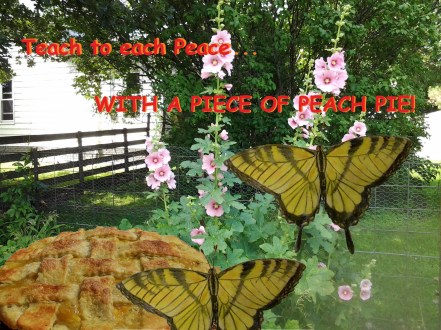
In the 1960’s back in Iowa, family reunions started happening around this time of year. We would make long treks to distant parts like Spencer, Iowa or Coralville, Iowa to meet with cousins by the dozens, with Great Aunts and their great families… people we looked somewhat like and were actually related to, but usually didn’t see more than twice in any given year. And there were some who lived in far off Cleveland, Ohio that you only saw twice in the entire decade. And it isn’t real easy to play with the kids you are related to but don’t see every day. Squabbles happen more often than not. What was the solution to that kind of warfare? According to Great Aunt Marie, the solution was a nice piece of peach pie. The offending cousin and I would each get a slice of the solution to eat side by side…
View original post 360 more words


