mermaidcamp
Keeping current in wellness, in and out of the water
You can scroll the shelf using ← and → keys
You can scroll the shelf using ← and → keys

winter writing challenge
I just read in a fellow blogger’s post about the ROW80 challenge. I have just started a practice to improve my writing by creating poetry and art. I had not planed to commit to a daily routine, but I am finding that starting the creative day by drawing, editing photos, and making visual art I am more likely to be observant for the day. Observant includes in this case a full attention to detail as I go through my life, and easy flawless observance of boundaries I have set. Since the group is making personal goals a shared conversation, observant will also mean that I pay attention to my fellow writers and the way they express themselves. This idea arrived at a most propitious time, since 80 days of tracking my goal of a more poetic life will give me a good jump start to a full time practice. I look forward to learning how other people contribute to this exercise.
Observe and Grow are the key words for my goal. I hope to grow my vocabulary, my skills, and my creativity by publishing art and poetry. By observing the world, as well as my dreams, I will find richer, more vibrant subjects. I tend to be a scribe, writing just the facts, and supporting the facts with some photo documentation. I still enjoy that, but feel I could do some story telling, humor, and abstract sound pieces if I develop my poetic sense. I want to see where poetry leads me. I am not seeking approval for the work as much as I am wondering what will happen when I apply myself.
For the next 80 days I will observe what happens when I write a poem each day. This is an adventure I will share. It will include:
It is my desire to explore a different way of using the written word. I think it will open new doors for my self expression. I also believe my daily life will be enriched by looking for poetic subject matter. I publish my art and poetry on my Tumblr blog, The Flow.

winter writing challenge
Full Moon Blessings for the Wolf Moon

 It is a New Year and time to set your intentions for this year by the light of the moon. For many people the Wolf Moon holds deep meaning and this is a good time to let your inner wolf howl!
Every new moon that comes around I use as a checkpoint for my life. The new moon is about starting with an empty clean slate; it is the conception of an idea to become birthed into life with the coming full moon. I do this just like thousands of others have for literally thousands of years.
There are many different ways to do a Full Moon release. You do not have to be outside to perform this release! Here are some of my favorites!
Write down all of the things
that you would like to release
on a piece of paper
Grab a pot, use a fireplace or something…
View original post 52 more words
fruit salad
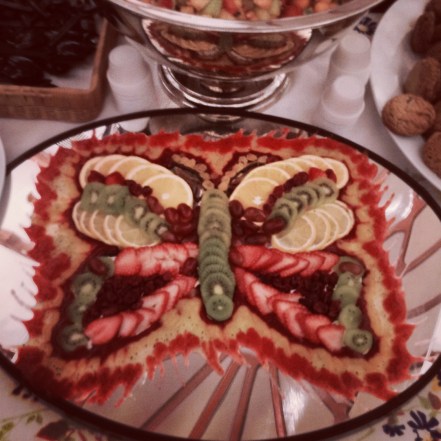
Chris Brogan has announced his 3 words for 2015. This annual challenge is an alternative to the classic resolution style. I have done it with success, and also done it when I forgot my words entirely. Like anything else, persistence is needed for results too occur. I am pleased with my own choices this year, patience, persistence, and poetry. They have meaning across the board to upgrades I aspire to make. I plan to use them liberally throughout the year. I also plan to use Brother Brogan’s words to apply to a specific change I am making in my household. There is no rule that says you can’t admire and swipe other people’s words if they suit you. His words work for my new world of menu planning. I have become convinced that improvisation is not the best way forward with nutrition. It has served me well, and I am healthy. I want to develop the skills and the results of managing our home kitchen like a chef with a restaurant. I know that planning and balance will bring lower costs and higher quality nutrition to our diet. We will waste less produce and use the freezer to make the most of what we buy. This new discipline fits perfectly with the words I am appropriating from Brother Brogan for this project.
His words are:
Thanks, as always, for your guidance, Chris. I am happily applying your words to my advantage this year. I have loved your teaching since Trust Agents. I hope your words will be fabulous for you as well. All the best in 2015.

Affeton Castle
My 12th great-grandfather was a very petty, criminal, mean man, eventually shunned by society. I am descended from both his son and his daughter.
SIR “JUDAS” STUKELEY
SIR LEWIS STUKELEY, or Stucley, who has been branded as the Judas of Devonshire, was the eldest son of John Stukeley, of Affeton, by Frances St. Leger. He had two brothers and several sisters. He was great-nephew to “Lusty” Stucley, and partook of that vein of meanness and treachery that characterized Thomas. He was married to Frances daughter of Anthony Monk, of Potheridge, a family which, if not more ancient, was free from the taint of baseness that savoured three of the Stukeleys. By her he had five sons; none were knighted, the shame of the father rested on them, and it was not till the next generation that knighthood was again granted to the representative of the Stukeleys, of Affeton.
Lewis himself was knighted, not for any worthiness that he had shown, but as the representative of a good family, when James I was on his way to London in 1603. In 1617 he was appointed guardian of Thomas Rolfe, the infant son of Pocahontas by J. Rolfe. Then he was created Vice-Admiral of Devon, and in that capacity he left London in June, 1618, with verbal orders from the King to arrest Sir Walter Raleigh, then arrived at Plymouth on his return from the Orinoco. Sir Walter had been released from his long captivity in the Tower, because he gave hopes to James of finding a gold-mine in Guiana. He had been there before, had brought away auriferous spar, and had heard tidings of deposits of gold. James was in debt and in need of money, and he clutched at the chance of getting out of his difficulties through the gold of Guiana. That there was gold there is certain; Raleigh’s mine has been identified; but since he had left the Orinoco, the Spaniards had pushed up the river and annexed land and built stations.
James did not want to break with the Spanish Government and gave Raleigh instructions not to come to blows with the Spaniards. Unhappily, Raleigh’s lieutenant, whom he had dispatched up the river, did come to blows with them, and blood was shed; it was however in self-defence, for the Spaniards had fallen upon the English party when unprepared and killed some of them. This unfortunate business, and the fact that Raleigh could not reach his gold-mine, the way to it being intercepted by the Spaniards, made him turn back with a heavy heart. On reaching Plymouth, he hasted towards London to state the case to the King, when he was met at Ashburton by his cousin, Sir Lewis Stukeley, with smiles and professions of love—but having war in his heart. His rancour against his kinsman was due to a quarrel in 1584, when, as Stukeley asserted, Sir Walter did “extreme injustice” to Stukeley’s father, then a volunteer in Sir Richard Grenville’s Virginia voyage, by deceiving him in a matter of a venture he had made. James was in a great fright lest he should be plunged in war with the King of Spain, and very angry because the gold-mine had not been found; and Stukeley was promised £500 to worm out of his cousin some damning admissions, as that there never had been any goldmine at all, and to betray these to James. Stukeley had received only verbal instructions from the King. He therefore reconducted Raleigh back to Plymouth, where he placed him in Radford, the house of Sir Christopher Harris, who was charged with his custody, till Stukeley received orders from James. Raleigh was ill—or feigned to be ill—the former is the more probable, and he being laxly guarded formed a plan of escape to France. He commissioned Captain King, the only one of his officers who remained faithful to the last, to make arrangements for flight with the master of a French vessel then lying in the Sound. At nightfall, the two stole from Radford and got into a boat lying at the little quay below the house. They had not rowed far, however, before qualms came over Raleigh; it seemed to him unworthy of his past and of his honour to fly his native land; and he perhaps counted too securely on the generosity of the despicable James. He changed his mind, and ordered King to return to Radford. Next day he sent money to the Frenchman, and begged him to wait for him another night. Night came, but Raleigh did not stir. This singular irresolution in a man so energetic, ready, and firm, points surely to the fact that he was ill at the time, suffering from the ague which so often prostrated him. Stukeley at length received orders to take his prisoner to London, and the opportunity to escape was gone for ever. As Raleigh passed through Sherborne, he pointed out the lands that had once been his, and related how wrongfully they had been taken from him.
At Salisbury Raleigh complained of illness, and begged to be allowed to halt there for a while. It was asserted by a French quack, Mannourie, set as a spy over him, that he got the doctor to anoint him so as to produce sores wherever the ointment was applied. This was one of the charges afterwards brought against him, at the special insistence of King James, who always kept his eye on trifles. Whilst Raleigh was at Salisbury, Sir Lewis Stukeley robbed him of all his jewels and money, leaving him only the emerald ring on his finger, engraved with the Raleigh arms. It has been asserted that Sir Walter endeavoured here to bribe his cousin to connive at his escape. Had this been the case, Stukeley would certainly have mentioned it in his “Humble Petition,” and justification of his conduct after the execution of Raleigh. He was not the man to fail to flaunt such a feather in his cap as that he had resisted a bribe, had such a bribe been offered him.
Whilst Raleigh lay ill at Salisbury, Captain King hurried up to London, by his master’s direction, to hire a vessel to wait at Gravesend till he should be able to go on board. The master of the vessel at once betrayed the matter. Sir William St. John, a captain of one of the King’s ships, immediately took horse and rode to meet Stukeley and his prisoner on their way to town, and encountered them before he reached Bagshot. Stukeley then confided to him certain charges against Raleigh which he was to lay before the King.
Next day Stukeley had fresh matter to dispatch to the Court. It was this: La Chesnee, the interpreter of the French Embassy, visited Sir Walter at Brentford. He had brought with him a message from Le Clerc, agent for the King of France, offering him a passage on board a French vessel, together with letters of introduction which would secure him an honourable reception in Paris. Raleigh thanked him for the offer, but replied that he had already provided for his escape. All this Stukeley learned by applying his ear to the keyhole or by worming the secret out of Raleigh by professions of kindness and desire to assist him to escape.
James at once took alarm. A plot with France was a serious matter at that time. He accordingly directed Stukeley to continue to counterfeit friendship with Raleigh, to assist him in his meditated escape, and only to arrest him at the last moment; and to bring this attempt as one more charge against Raleigh. So Stukeley continued to insinuate himself into the confidence of his cousin, and endeavoured by all means in his power to wheedle out of him such papers as might afford evidence of his designs and might serve to help to bring him to the scaffold.
On his arrival in town, Raleigh was conducted to his own house in Broad Street. There he was revisited by Le Clerc, who repeated his former offers.
The next morning Sir Walter got into a boat attended by Stukeley, all smiles, and the honest King; and, as prearranged, he was arrested at Woolwich and at once lodged in the Tower.
On 29 October, 1618, Raleigh’s head fell under the executioner’s axe. He was a victim to Spanish resentment and to James’s meanness in offering him as a sacrifice to curry favour with Spain. Gardiner says Raleigh was executed “nominally in accordance with the sentence delivered in 1603; ln reality because he had failed to secure the gold of which James was in need. The real crime was the King’s, who had sent him out without first defining the limits of Spanish sovereignty.”
The writer of the notice of Sir Lewis Stukeley in the Dictionary of National Biography takes a lenient view of Stukeley’s conduct. “Stukeley certainly gave hostile, not necessarily false evidence against Raleigh. He seems to have been a harsh, narrow-minded, and vulgar man, glad to have his cousin in his power, to revenge himself on him for the pecuniary loss his own father had entertained.” Gardiner says: “Stukeley seems to have thought it no shame to act as a spy upon the man who had called upon him to betray his trust;” but it is precisely this charge that cannot be established. We have no good evidence that Raleigh did attempt to bribe him. Popular opinion ran strongly against Stukeley, and he was nicknamed Sir Judas. He tried to hold up his head at Court, but no man would condescend to speak to him. He met on all sides with glances full of contempt and gestures of disgust. He hurried to James, and offered to take the Sacrament upon the truth of a story Raleigh had denied on the scaffold—that he had been offered a commission by the French King (the story came through Mannourie); but no one would have believed Stukeley a whit the readier had he done this.
Indeed, Mannourie subsequently admitted that it was false, when he was arrested for clipping the gold, the blood money, he had received for spying on Sir Walter. In a letter from the Rev. T. Lorkin to Sir T. Puckering on 16 February, 1618-19, he says: “Manourie, the French Apothecary, (who joigned with Stukely in the accusation of Syr Walter Raleigh) is at Plimouth for clippyng of gold … his examination was sent up hether to the King, wherein … (as I hear from Syr Rob. Winde, cupbearer I thincke to his Majesty, who saith he read the examination) that his accusation against Raleigh was false, and that he was wonne thereto by the practise and importunity of Stukely, and now acknowledges this his present miserable condition a judgment of God upon him for that.”
When Stukeley made this offer to King James, a bystander dryly observed that if the King would order him to be beheaded, and if he would then confirm the truth of his story with an oath while on the scaffold, then possibly he might be believed.
One day Sir Judas went to call on the old Earl of Nottingham, who was Lord High Admiral, and asked to be allowed to speak to him. The Earl turned on him instantly. “What,” he said, “thou base fellow! Thou who art reputed the scorn and contempt of men, how darest thou offer thyself into my presence? Were it not in my own house, I would cudgel thee with my staff for presuming to be so saucy.” Stukeley ran off to whine to the King, but even there he met with no redress. “What,” said James, “wouldst thou have me do? Wouldst thou have me hang him? On my soul, if I should hang all that speak ill of thee, all the trees in the country would not suffice.” It was even said, probably without truth, that James had said to Stukeley, “Sir Walter’s blood be on thy head.”
A few days after the scene with the King, it was discovered that Stukeley had been for many years engaged in the nefarious occupation of clipping coin. It was even said that he tampered in this way with the very gold pieces which had been paid to him as the price of his services for lodging Raleigh in the Tower and betraying him. When arrested he endeavoured to excuse himself by inculpating his son. Could meanness descend to a lower depth?
“1618-19. Jan. 12. … Upon Twelf night Stukely was committed close prisoner in the Gate house for clipping of gould. He had receyved of the Exchequer some weeks before £500 in recompense for the service he had performed in the business of Syr Walter Raleigh, and beganne (as is said) to exercise the trade upon that ill-gotten money (the price of blood). Upon examination he endeavoured to avoid it from himself, by casting the burden either upon his sonne or man. The former playes least in sight and can not be found. The servant is committed to the Marshalsay, who, understanding that his Master would shift over the business to him, is willing to sett the saddle upon the right horse, and accuses his Master.”[1]
But the accusation was not pressed. King James owed Stukeley too deep a debt to let him suffer, and he threw him a pardon, so that the evidence against him was not gone into. It may be remembered that “Lusty” Stukeley had also been implicated in clipping and coining, and had only escaped arrest by flying the country.
Stukeley, an outcast from society in London, went down to Affeton. But even there he was ill-received. The gentry would not speak to him, his own retainers viewed him with a cold, if not hostile, eye, and rendered him but bare obedience.
The brand of Cain was on him, and he fled from the society of his fellow men to the isle of Lundy, and shut himself up in the lonely, haunted tower of the De Mariscoes. There he went raving mad and perished (1620), a miserable lunatic on that rock, surrounded by the roaring of the waves and the shrieks of the wind. His body was conveyed to South Molton, so that he was denied even a grave beside his ancestors at Affeton.
For authorities, see Gardiner, Prince Charles and the Spanish Marriage, Vol. I, London, 1869; Dr. Brushfield’s Raleghana, Part VII; the Dictionary of National Biography, s.n.; and the various Lives of Raleigh.
↑ Letter from T. Lorkin to Sir T. Puckering.
Sir Lewis Stukely (1523 – 1620)
is my 12th great grandfather two times
Lewis Stukely (1544 – 1570)
son of Sir Lewis Stukely
Mary Stukely (1570 – 1591)
daughter of Lewis Stukely
Mary Periam Wescott (1581 – 1681)
daughter of Mary Stukely
James Sweet (1622 – 1695)
son of Mary Periam Wescott
Benoni Sweet (1663 – 1751)
son of James Sweet
Dr. James Sweet (1686 – 1751)
son of Benoni Sweet
Thomas Sweet (1732 – 1813)
son of Dr. James Sweet
Thomas Sweet (1759 – 1844)
son of Thomas Sweet
Valentine Sweet (1791 – 1858)
son of Thomas Sweet
Sarah LaVina Sweet (1840 – 1923)
daughter of Valentine Sweet
Jason A Morse (1862 – 1932)
son of Sarah LaVina Sweet
Ernest Abner Morse (1890 – 1965)
son of Jason A Morse
Richard Arden Morse (1920 – 2004)
son of Ernest Abner Morse
Pamela Morse
I am the daughter of Richard Arden Morse
simple ways to heal your skin in the bath
The power of Nextdoor! An Atlanta group organized a fundraising event through the site to help a local clinic.
 Neighbors Magen Gamble and Lori Harris, who helped organize the event. Photo courtesy of the Newnan Times-Herald.
Thanks to two good samaritans and one post on a Nextdoor website, an Atlanta-area charity will have quite the Christmas.
Magen Gamble and Lori Harris are two residents and members of Nextdoor Featherston Heights who are determined to raise money for charity this holiday season. Magen and Lori posted on Nextdoor, asking for their neighbors to purchase small luminaries, with proceeds going to the Coweta Samaritan Clinic, a local clinic that provides free primary medical care to uninsured local residents.
More than 100 neighbors responded and are planning to participate in the neighborhood’s first annual luminaria fundraiser. In total, over 3,000 luminarias will be lit throughout the Featherston Heights neighborhood, using more than 1,200 pounds of sands and thousands of candles.
“It all came together so quickly, it’s been amazing to watch,”…
View original post 41 more words
We all have shadow elements in our personalities. The attributes that reside in our blind side are clear to others but never to ourselves. Nations have not only espionage in the dark, but also shadow aspects of culture, hidden from the national personality. This explains why nationalism often leads to irrational pride as well as prejudice against people we do not know. We learned about torture by the CIA and without examination of the facts most Americans decided it was okay under the circumstances. What is so odd about that is they knew nothing about the circumstances. When the news broke that Cuba and the US would begin to talk about resuming relations, many Americans recoiled in horror because they don’t understand what the status quo entails. Nobody else in the world has an embargo against Cuba, and the US dollar is the official currency of the island. They make lots of money from tourism, including from plenty of Americans who travel on flights through Mexico, or on their big fat yachts. There is nothing to loose by resuming a diplomatic relationship, and much to gain.
I went to Havana through Miami in about 1995. I bought my package through a tour agency but did not apply for a special visa. I went to the airport and was allowed to board the plane with the Cubans from Miami who had permission in those days to visit a couple of times a year. There was a grand inquisition at the Miami airport and the CIA busted some people in the holding room who had money..more cash than was permitted. Dogs were brought in and detected the extra currency. I had a ticket but no specific study agenda in Cuba. The immigration officer at Miami international asked me what I was going to do in Cuba. I responded that I planned to study dance. I produced a tiny slip of note paper with my teacher’s address in Havana. He asked where I had met her. I told him in a dance workshop in Tucson. He turned to the dozen or so CIA dudes there and said, “If you believe her, she can go”. I went!! The Cubans on the flight were quite amazed that I made it on the flight. I was the last one out of the Havana airport because I was not carrying a “gusano”, a giant duffle bag full of goods, which are taxed by Cuba. They were puzzled when I told them I did not know anyone in Cuba and would not give away my things. I flew back to Miami with nothing at all. I gave away all my clothes, toothpaste, pens, and the suitcase itself.
I spent 4 days, and visited both my dance teacher and the family of a Cuban friend of mine. She gave me cash and asked me to take them out to a fancy dinner. It was all arranged at the buffet in my hotel. Only foreign tourists are allowed in the hotels. Since I had invited them, they had the rare privilege to experience the tourist facilities in their own city. They dressed up heavily and came at all hours of the day to see me. Since we were sitting in the lobby or in the dining room I had no problems with the staff. When I asked about bringing my dance teacher to the pool for a swimming lesson, that was quite another matter. The pool staff and the housekeeper in my room told me I would NEVER get a Cuban into that pool. This housekeeper had been invited by her own aunt, who was a hotel guest visiting from Spain, but was not permitted to sit poolside. I took this as a challenge, and convinced the concierge that it would be too embarrassing for me to retract the swim invitation I had already made to my friend. I whipped out the Spanish word pena, and wallowed in it. The argument took a while, but eventually I wore her down and was given a special permission to borrow a kick board for the use of a Cuban in the hotel pool. We had our lesson with many hotel staff members looking on in both shock and admiration. I won my personal little social revolution in the pool, and felt very satisfied.
I learned a lot while I was there. Since that time much has changed, and is obviously soon will change more rapidly. What struck me about the Cuban people was their resourcefulness and affection for life. They are the kings cariño, and the soul musicians and dancers of the Caribbean. They cook, they laugh, they party, they dance, in seriously limited circumstances. They accept the fact that their revolution has resulted in repression and dictatorship, and yet they still have pride in that revolution. They suffer from economic problems we do not imagine, and respond with creativity. I thought when I went that the relations between our countries would be resolved soon. Then Elian Gonzalez came to Miami in 2003, and was deported back to Cuba. Laws changed, visiting rights were withdrawn, and we slipped into another decade of the same separatist policy. I am not sure I will go to Cuba again, but do recommend it for anyone interested in music, architecture or tropical culture. There is no need for us to remain clueless about Cuba. There is much to learn about the rise and fall of communism. While we were busy being excessive about capitalism, they were busy with their communist revolution. The results vary, gentle readers. Neither communism nor capitalism has yielded such fabulous peace on earth. Let’s get over our ancient political categories to examine the potential for good. This deal was brokered by the cutest Pope in the Vatican, my man Francis. I am pleased that higher logic is being used to resolve this issue.
Angels were common before Jesus was born. There were happy spirits protecting humans all over the pre-Christian world. Some people today debate the powers and presence attributed to angels because we know them through story and legend. Their existence is a rhetorical belief, but there has been no empirical evidence that proves they are here with us. December is a very popular time to display angels and even dress up and portray them in live nativity scenes. In the darkest month of the Northern Hemisphere’s year, angels usher in the light. They often wear white, have white wings and a bright body halo. They are messengers, beings of light, that assist humans on both sides of the grave. They intercede for the benefit of humans.
December is the right time to settle into a hot herbal bath, light a candle, and put out the do not disturb sign for the human element. Around the winter solstice have a conversation with angels. If this is easy and natural for you, pray and get in touch with the angelic realm. If you need some help getting used to the idea of being surrounded by beings of light, do some meditating. Soak in the aromas of your scented tub, breathing deeply and leave thought behind. Have a conversation, out loud or in your mind, with the spirit guardians of your life. Imagining the presence of another dimension, allow yourself to say what is in your heart and ask for help that you know you need. You can do it with eyes open our closed. Using this method is a formula to make wishes come true. Belief in our angels is belief in supernatural powers at work on our behalf. Speaking to angels has been done by all kinds of people without shame or embarrassment for a very long time. The time is right to tell your deepest wishes to the angels, Gentle Readers.
hot springs and Hello Kitty???What could be more therapeutic???


