mermaidcamp
Keeping current in wellness, in and out of the water
You can scroll the shelf using ← and → keys
You can scroll the shelf using ← and → keys
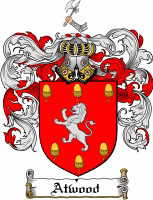
Atwood Coat of Arms
John Wood, the oldest immigrant ancestor of the Wood family, came to Massachusetts in 1635 aboard the ship Matthew. Most of his adult children followed him to America soon after.
John Wood is also known as John Atwood in some records; his baptismal name is “Johanem Wood” according to E. F. Atwood; however, I have yet to locate that record, so it may be a mistake. In the Sanderstead parish birth records his name is recorded as “Johannes” (not Johanem) with a date of 4 Feb 1582. Johannes is the Latinized version of John, often used in official records. He was a twin to Dericke who died in infancy. His baptism was recorded in both Sanderstead and Gatton parishes. It is not known why his birth was recorded at Gatton (a parish that is also located in Surrey, about three miles from Reigate), but it leads me to speculate that John’s mother may have originally come from that parish.
From the Sanderstead Parish Register of baptism records:
1582 Feb 4, Johannes t Dericke Woode gemille Nicholaj Woode
translation: 1582 Feb 4, John and twin Derick Wood born to twin bearing (father) Nicholas Wood
Since John Wood was baptised in Sanderstead, Surrey, England on 4 February 1582, it is likely that he was born about that time because it was customary to baptise infant children. He was probably born in Sanderstead since that is where his father, Nicholas and mother Olive (Harman) had a home. The Wood family had been associated with Sanderstead since about 1400 and had constructed a manor house there known as “Sanderstead Court.” The title to the lands in Sanderstead are somewhat confusing at this point in time and it is not entirely clear whether the family was actually living at Sanderstead Court or in one of the other houses in the parish.
John Wood married Joan Coleson of Saint Martin’s Parish, London in the summer of 1612. They had at least seven children, all born in England, five were sons and two were daughters. Johanna and Agnes are questionable children; they are included here until their ancestry is confirmed fully. Philip is sometimes included as a child of John and Joan, however, this is not the case. Most of the other children were baptised at St. Martins in the Fields church in London. E. F. Atwood believes that after the birth of his second son, John (in 1613), he and his family moved to Chancery Lane in London. He does not provide documentation for this assertion, however.
John was a “leather seller” in England. A notation in The Gentleman’s Magazine in 1848 indicates that John Atwood was a member of the Leatherseller’s Company on 22 January 1628; he sponsored a man with a highly unusual name to membership in the guild–Praysgod Barbone. Leather sellers were involved in selling, whiting, sorting and staking leather, and they belonged to a guild in London that regulated the trade; their guild hall was a large and elaborate building and they derived both social and financial benefits from belonging to the guild. Leather craftsmen making leather goods and parchment could also belong to this guild. Leather was an essential product with many uses during this time.
When John’s father, Nicholas, died in 1586, he left his estate to his youngest son Richard. Normally the oldest son would inherit his father’s estate, so this was an unusual bequest. Richard died 17 years later in about 1603 and his estate was inherited by the oldest brother in the family, Harman. According to court documents summarized by E. F. Atwood in Ancestry of Harman Atwood, John sued his older brother on 1 Feb 1631 saying he should be the heir of the estate, not Harman:
“Harman Atwood doth confess that he hath a copy of a Court role, dated 37 Henry 8 (1546-47) which proves that Nicholas Wood was the heir, that Thomas Wood, a young son, had certain manor lands settled on him by his father, John Wood, and that on the death of said Thomas, Nicholas Wod was possessed of said lands, according to the custom of said manor.”
Atwood maintains that this proceeding was used to simply sort out ownership of various Wood/Atwood lands, and that it was not filed in anger over John’s perceived disinheritence. King Henry had taken some lands belonging to the Wood/Atwood family some years before when he dissolved the monastaries in England. The land the Wood/Atwood family owned had previously belonged to the monastary, and it may well have been a legal maneuver by the Wood/Atwood family to clarify their rightful ownership of lands in Sanderstead parish and elsewhere. It is probably from this incident that E. F. Atwood says that some of John’s descendants claim he left for America after being disinherited.
I believe that Atwood is probably correct because if John was unhappy with his brother Harman after Richard’s death it seems unlikely that he would have named his own son “Harman” in 1612. E. F. Atwood’s conclusion is that this suit was merely a legal technicality to sort out ownership rights of Sanderstead. This conclusion would indicate that John did not leave England because of dissatisfaction with his inheritance, but for other reasons–possibly religious, possibly financial, or possibly for adventure.
It is not known what prompted John to leave England for the new colonies in America in 1635, but we can make a few guesses based on John’s personal circumstances as well as the political and religious climate in England at the time. James I, the English King (1566 – 1625), faced opposition on many fronts. James did not trust the growing Puritan movement in England, and viewed it as a threat to his royal control of the church. Tensions continued to increase after James was succeeded by his son, Charles I, and finally reached a breaking point with the English Civil Wars.
Many Puritans, who became known as Dissenters, faced discrimination and persecution in England. They sought to “purify” the Church of England and objected to many of its ceremonies such as exchanging rings during marriage, inviting “evil doers” to share in communion, using the sign of the cross in baptism, etc. Many of the Dissenters’ preachers were driven to ruin by the King through excessive taxation. This persecution lead to the first of several exoduses of Puritans, the first of which was to Leyden, Netherlands in about 1605. Most Puritans only stayed in the Netherlands for 10-15 years, however, and many eventually moved to America. The first group of Puritans arrived on the Mayflower in 1620 and founded the Plymouth Colony.
John may have well have been prompted by religious convictions to leave his English homeland and settle in the predominatly Puritan Plymouth Colony. We know that three of his sons married into staunch Puritan families after arriving in America. At least one leather seller in London was persecuted by the King for his beliefs and burned at the stake while John lived in London.
John may have also been motivated by financial considerations. As a younger son, John had been forced to fend for himself financially. It seems that his older brother, also named John (born 1576) had knowledge of the Plymouth Colony for he was recognized by the Treasurer of the stock company that funded the colony as a “special friend.” John’s brother’s relationship to the Plymouth Colony may have had an impact on John. It is also possible that since he had not been successful in his law suit against his brother Harman for a share in his father’s estate, John may have felt that the New World offered more oppotunity than London.
It is believed that John left England on 21 May 1635 aboard the Matthew. John’s name appears in the ship’s register in London, with 131 others; they were first transported to Saint Christopher’s Island (now known as St. Lucia), an island in the Leeward chain in the Caribbean. Richard Goodladd, owner and master of the Matthew per a warrant from the Earl of Carlisle. Before they were allowed to leave England they were compelled to take an oath of allegiance that they would be loyal to their King and their mother country.
Shortly after arriving in Plymouth, he was admitted as a freeman on 3 Jan 1636 which meant that he took an oath of allegiance to the Colony and could vote in elections and participate in the governemntal life of the colony:
“Mr. John Atwood, John Jenkin, John Weekes, Josiah Cooke, Willm Paddy, Robte Lee, Nathaniell Morton, Edward Forster, Georg Lewes, and Barnard Lumbard were made free this Court and sworn accordingly.” (The Wood family relationship with the Morton family would continue for many years.)
John’s wife, Joan, also came to America, but it appears that she did not sail with him on the Matthew since her name is not listed on the ship’s manifest. She came over on a later voyage, however, it is not clear which ship brought her.
From records of land transactions we know that John purchased land in Plymouth next to John Dunham shortly after his arrival. The land was granted to John Wood on 7 November 1636:
“had divers porcons allowed them, 3 acres in breadth & two in length, next to the land of John Dunham the elder…” The others were John Dunham Jr., John Wood, Samuell Eedy, Web Addy, Josiah Cooke, Thomas Atkinson, and Joshua Pratt, “All wch psons haue or are to build in the towne of Plym., and these lands to belong to their dwelling howses there, & not to be sold fro their howses.”
Citation: 7 Nov 1636 Plymouth Colony Records, Vol. 1:46
The following summer, in 1638, William Bradford describes an interesting incident that undoubtedly would have made an impression on John:
“This year, aboute the 1. or 2 or June, was a great and fearfull earthquake; it was in this place heard before it was felte. it came with a rumbling noyse, or low murmure, like unto remoate thunder; it came from the norward, and passed southward. As the noyse aproached nerer, they earth began to shake, and came at lenght with that violence as caused platters, dishes, and such like things a stoode upon shelves to clatter an d fall downe; yea, persons were afraid of the houses themselves. It so fell oute that at the same time diverse of the cheefe of this towne were mett together at one house, conferring withsome of their friends that wre upon their removall from the place, (as if the Lord would herby shew the signes of his displeasure, in their shaking a peeces and removalls one from an other.) How ever it was very terrible for the time, and as the men were set talking in the house, some women and others were without the dores, and the earth shooke with that vilence as they could not stand without catching hould of the posts and pails that stood next them; but the vilence lasted not long. And about halfe an hower, or less, came an other noyse and shaking, but nether so loud nor strong as the former, but quickly passed over; and so it ceased. it was not only on the sea coast, but the Indeans felt it with in land; and some ships that wre upon the coast were shaken by it. So powerfull is the mighty hand of the Lord, as to make both the earth and sea to shake, and the mountaines to tremble before him, when he pleases; and who can stay his hand?”
Citation: Bradford, Of Plymouth Plantation
Four of John’s adult sons also came to America after him:
Stephen went to Eastham, Mass. in about 1648-50
John to Plymouth, Mass. in about 1636
Henry to Middleborough, Mass. in about 1641
Harman to Boston, Mass. in about 1642
It is possible that his other son, William, also came to Charlestown, Mass. (this is based on speculation by E. F. Atwood in Ye Atte Wode Annals).
Three of John’s sons married into prominent Puritan families:
John Wood married Sarah Masterson in 1642 in Plymouth. She was the daughter of Richard Masterson who had been a Deacon at Leyden, Holland, the first home of the Puritans.
Henry married Abigail Jenney in 1644 in Plymouth. She was the daughter of Capt. John Jenney and Sarah Carey who had first gone to Leyden, Holland before coming to America.
Stephen married Abigail Dunham in 1644 in Plymouth. She was the daughter of John Dunham and Abigail Barlow who had originally gone to Leiden, Holland and married there on 22 Oct 1622.
John only lived eleven years in his new American homeland. He died on 27 Feb 1644 in the Plymouth Colony. His will is dated 20 Oct 1643, and was proved on 5 Jun 1644.
E. F. Atwood in Ye Atte Wode Annals (1930) has provided a copy of the suit John filed against Harman in London in 1631. In this suit he is identified as the son of Nicholas and is also identified as a “leather seller:”
Chrles iw. 15-33. Wood Alias Atwood Vs. Atwood. Feb 1, 1631.
Humbly comlayning, your orator, John Wood, alias Attwood, of the City of London, leather seller, that whereas Nicholas Wood, alias Attwood, late of Sanderstead cum Longhurst, County Surrey, deceased father to your orator, was siezed of lands, etc., in Sanderstead, and did, about 28 Elizabeth [1586], convey on parcel of lands called Mancocke and another parcel lying by Parkland, in the bottom towards Comes Wood Head, and a parcel lying by Mitheley, Great Burye, called Opeley, and one close lying at Ledowne, and one parcel abutting upon the house of Henrie Best, all which lands, the said Nicholas Wood alias Atwood, did convey for the use of Oliphe, his wife, for her life, and for the use of Ritchard Wood alias Attwood, his youngest sonne, and after the death of the said Nicholas and Ritchard, the said Oliphe, about 1603, also died; after whose death, the lands descended unto your orator, as youngest sonne of the said Nicholas. But now Harman Wood, alias Attwood, being the eldest son of your orator’s father, and lord of the said manor of Sanderstead cum Longhurst, hath entered the said premises and pretends to disenherit your orator of the same.
ANSWER of Harman Atwood, Gent., Says bill of complaint it devised by the complainant without just cause and denies that he combined with Thomas Collett, the steward of said manor, concerning any controversy and says the complainant has no right or title to said premises. he doth confess that he hath a copy of a Court Role, dated 37 Henry 8 (1546-7) which proves that Nicholas Wood was the heir, that Thomas Wood, a younger son, had certain manor lands settled on him by this father, John Wood, and that on the death of said Thomas, Nicholas Wood was possessed of said lands, according to the custom of said manor.
Note [by E. F. Atwood]: “The above is merely an abstract made for genealogical purposes, hence does not always conform to exact wording of the original. It seems clear that the leather seller was never meant by Nicholas to inherit these lands, but thence comes our traditions of disinheritance, etc. As (Sanderstead manor was confiscated a few years earlier, yet John and Nicholas were left undisturbed in possession of lands bought by Peter in 1346, a Court Roll was necessary to avoid confusion as to titles of the two lands called Sanderstead Manor, one owned by the Greshams and one by the Wood-Atwoods.”
Born John Attwood, John was was the last in his direct line to have a coat of arms. He was descended from knights of the shire, bodyguards of English kings and members of parliament. He was a younger son of his father, Nicolas Atwood. Therefore, he did not expect to inherit an estate. John chose to seek his fortune in the American colony of Plymouth. When John learned that his older brothers had died without eligible issue for his father’s title, he sailed to England to claim it. But his youngest brother, who had remained in England, had secured it from the courts before John was able to to gain his rightful title and estate. John returned to Plymouth, and his name was changed to Wood. Some of his American relatives kept the the name Atwood. He, his son Henry Wood, and grandson John Wood were sometimes called Atwood and confused with people
John Atwood (1582 – 1644)
10th great-grandfather
John Thomas Wood (1614 – 1675)
son of John Atwood
Margaret Wood (1635 – 1693)
daughter of John Thomas Wood
Elizabeth Manchester (1667 – 1727)
daughter of Margaret Wood
Dr. James Sweet (1686 – 1751)
son of Elizabeth Manchester
Thomas Sweet (1732 – 1813)
son of Dr. James Sweet
Samuel Thomas Sweet (1765 – 1844)
son of Thomas Sweet
Valentine Sweet (1791 – 1858)
son of Samuel Thomas Sweet
Sarah LaVina Sweet (1840 – 1923)
daughter of Valentine Sweet
Jason A Morse (1862 – 1932)
son of Sarah LaVina Sweet
Ernest Abner Morse (1890 – 1965)
son of Jason A Morse
Richard Arden Morse (1920 – 2004)
son of Ernest Abner Morse
Pamela Morse
I am the daughter of Richard Arden Morse
My tenth great-grandfather immigrated to American in 1635 in the Pilgrim ship the “Mathew”.
John Wood, imigrant ancestor, 1635, arrived at Plymouth Colony; married Joan Coleson of Saint Martin’ England, who did not come with her husband, but later ship. John’s name appears in the register in London, with others; they were first transported to Saint Christophers, in the ship, Mathew, Richard Goodladd, owner and master, 21st May 1635. Before they were allowed to leave England they were compelled to take the oath of allegiance that they would be true to their mother country– “ye oath of allegiance supreme”. During the reign of Queen Elizabeth the Puritans fared badly in England, many men and women being arrested and thrown into prison because they sought to retain their own religious beliefs which were deemed contrary to the teachings of the Church of England. Many of them fled to Holland. On the death of Queen Elizabeth, she was succeeded by King James who was more lenient with the Puritans and freely allowed them to emigrate to America, the first settlement etablished in Virginia being called Jamestown. Later (1620) the Puritans came to Plymouth. Still later, many settled in Boston and Boston became the capital of Massachusetts Bay Colony.
John Wood landed first at Boston, but soon removed to Plymouth. The record of his baptism in England gives the date 24th December 1614. He became “propr.” of Plymouth Massachusetts, 1635-36; he owned land, was constable and on the grand jury. March 25th was recognized as New Year in England and her colonies. His wife Joan Coleson dying soon thereafter he removed to another section of Plymouth which later became the town of Plympton. While there the son John Wood married Sarah Masterson, daughter of Richard Masterson, who had been a deacon at Leyden, Holland, and whose wife was Mary Goodsell of Lancaster (married 26th November 1619). John Wood later moved to Portsmouth on the Island of New Port which was then a part of Massachusetts. Children of John and Sarah (Masterson) were: Thomas, Henry, Walter, William, John, Elizabeth. The records most frequently mention the sons Thomas and John. The father died in 1643-44, The son John Wood, died about 1675.

Originals by Adam Grant
I am listening to the book Originals by Adam Grant. This audio book is the second of my free treats in the 3 month Audible subscription I have initiated. I am employing Alexa in the Echo to read the book to me at home. When I go to the gym I switch to the iPod or iPad for a workout. The system knows how to bookmark my last page and start in that spot without a hitch. This is fun for now, but I don’t see myself keeping the membership for the extra $15 a month. You still have to purchase the audio books beyond that basic dues payment. I like it as a temporary novelty, but I still have some of my favorite books on audio CD, which is the only way I can listen in my car.
I love the theory as well as the writing in this book. The way originality develops and makes change possible in the world is a subject this author has studied from many perspectives. His many concrete examples of entrepreneurs who both fail and succeed to execute meaningful change help the reader understand how power and status quo operate. The common beliefs that great risk and speed are the keys to cultural change are disproven with real stories. Procrastination may well be the innovator’s best friend. By waiting for the first line to fail in various ways, the second line is an a much better position to correct mistakes while proving the need for the same innovations. “A prophet is not without honor except in his hometown and among his own relatives, and in his own household.” Mark 6:4
Birth order and other lifestyle factors are studied as possible catalysts for becoming a meaningful leader. Groupthink is the enemy of originality. When non-conformists are able to use influence to create a change in culture, in business or in politics, it is because the original has learned to open a cultural mentality, destroying the myth of the cult. Even in our fast-changing world with innovation running copiously toward individualization status quo is still the strongest force.
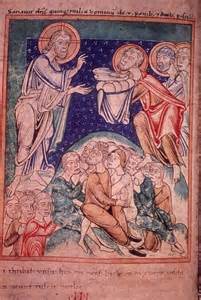
art by Hildegard von Bingen

Hildegard von Bingen
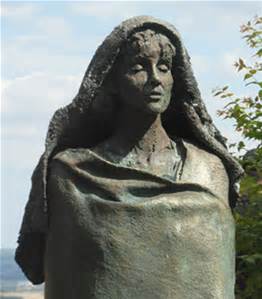
Hildegard von Bingen
“Even in a world that’s being shipwrecked, remain brave and strong.”
Hildegard von Bingen, mystic, visionary, polymath
Hildegard was born in 1098 in Bermersheim vor der Höhe, County Palatine of the Rhine, Holy Roman Empire. She died on17 September 1179 (aged 81) at Bingen am Rhein, County Palatine of the Rhine, Holy Roman Empire. She is venerated in Roman Catholic Church (Order of St. Benedict), Anglican Communion, and Lutheranism. She was canonized 10 May 2012 (equivalent canonization), Vatican City by Pope Benedict XVI. Her major shrine is Eibingen Abbey in Germany. Her parents gave her as an oblate to a Benedictine order when she was a child. She had visions before being enclosed in in order on All Saint’s Day, 1112.
She learned to read and write, wrote three books of visionary theology, and preached throughout the Rhineland during her lifetime. She was exceptional for her time, and her work still shines as poetry inspired by divine mysticism. She wrote music, created a written language, and was the author of what might have been the first morality play. Her place in history remains because of her prolific recorded work. She left us 70 poems and 9 books. She wrote music and was an accomplished artist. She recorded medical and pharmaceutical texts that are consulted and studied today. I know of pharmacies in Europe that offer her original formulas today. She wrote letters to popes, bishops and nuns that survive. We are lucky she learned to write, a rare privilege for a woman at that time. Her profound teachings apply to us now more than ever. The world needs mystics and visionaries to lift us out of this material rut in which we find ourselves. We all need to learn to be feathers on the breath of God. We are too dependent on the earth, and have forgotten to look up to the heavens for eternal blessings. What did she say about this?
“Listen: there was once a king sitting on his throne. Around Him stood great and wonderfully beautiful columns ornamented with ivory, bearing the banners of the king with great honor. Then it pleased the king to raise a small feather from the ground, and he commanded it to fly. The feather flew, not because of anything in itself but because the air bore it along. Thus am I, a feather on the breath of God.”
Hildegard von Bingen

baby Hildegard von Bingen
Surf culture is unique and specific to the location. Surfers know each other by hanging out on the same breaks. Today I saw a circle of boards out beyond the break. My friend told me this was a paddleout, a surfer funeral. As we walked down the beach we saw many others people in attendance for the service. There was health food catering, Hawaiian music, flowers, leis, and a special place of honor for the deceased guy’s grandmother. I had never seen anything like this. The people gathered with a reverence for nature as well as for their dead friend. The ceremony involved gathering on the boards, perhaps setting a lei or some flowers out to sea. They may have dropped his ashes. Then the surfers spread out to catch waves in to the shore to join those on the beach. It was beautiful. This was a fitting tribute by his surfer friends, and a perfect way to honor his life.
Surfers are focused. They just don’t mind the hassles or the schlepping it takes to catch a wave. Some devote their lifestyle completely to the sport. Most need to make some money on the side so they can afford to surf the rest of the time. There is a strong sense of community that keeps them all afloat. I feel lucky to have witnessed this sweet and meaningful goodbye. It contrasts sharply with the typical funeral home event. I am considering learning to surf just so I can have one of these when I go. This sublime symbolic gesture says more to me than any religious ceremony could offer.

Cardiff Beach

surfer memorial

tribute

Coat of Arms of Scotland(1660-1689).
Latin is sometimes the most technical as well as the most expressive way to convey a concept. The phrase Nemo Me Impune Lacessit means “Wha daur meddle wi’ me?” in Scottish. This is the motto of the Scottish Dragoon Guards. It translates literally into English as “No one cuts me with impunity.” I like the way it makes clear where the line has been drawn. This was also the motto of my ancestors in the Stewart clan. I like all my ancestral warriors, but I think I like the Scotsmen the best. Even when they came to America to be Presbyterians they were badass Revolutionary War heroes in South Carolina. They had a super strong sense of independence.
This phrase was taught to me by one of the gentle readers of this blog, and I treasure it, along with my ancestors who embodied it. Thank you John Holton for this tasty and meaningful piece of history. I hope to go someday to Edinburgh Castle where it is written above the entrance.
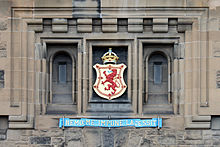
Edinburgh castle Nemo me
impune lacessit

badge
The theories used to administer law enforcement agencies have changed with the times. The current political climate demands a thorough examination of the criminal justice system from top to bottom. The DOJ’s 21st Century Guidelines are a step in the right idealistic direction. Much thought has been put into the basic “pillars” of law enforcement best practices. The country seems to be more divided each day on the subject of police relationships with the public. Some paint the entire force as rotten based on the criminal behavior now available for broadcast to the world. Others advocate for support for the cops no matter what they are doing. The second group always refers to a few rotten apples, but they never mention the rest of the proverb…a few rotten apples spoil the whole barrel. Staying with the fruit analogy, I think it is the responsibility of the administrators of cities to responsibly go through the barrels on a regular basis to assure that the law enforcement culture is not rotten.
The war on drugs has not only given us an opiate addicted society, but also great opportunity for the most common kinds of corruption to flourish. Arizona is a wild west state famous for “conservative” law enforcement, al estilo de Joe Arpaio. Indeed, Arizona has had some famous historical stand offs around law and order. The Gunfight at the OK Corral was exactly that. Doc and Wyatt are symbols of everything we love about Tombstone and the legends too tough to die. After the Earps and Doc shot the Clantons they high tailed it to Tucson, and the rest is history. The Arizona Rangers were founded in Tombstone during the Territory days, and still have a proud tradition, although today they are a volunteer organization. It is a serious challenge to maintain the proud traditions and, at the same time, be vigilant of corruption. It is not a black and white question.
How do you feel, gentle reader? Do you think there is a problem with individual cops, or with the leadership? Or do you feel everything is going well with the criminal justice system right now?

Ranger history

Doc and Wyatt

Judge Celina

suiting out
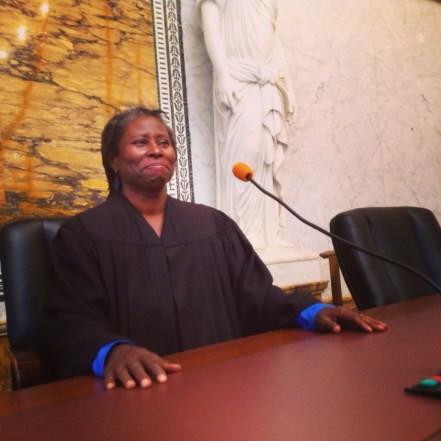
Judge Ardell

Judge Donna
A few years ago I went to California to take a workshop from a group called Tribal Truth. I was invited to go by a good friend who flaked out after I had paid for it. I decided to go because it was taking place at a hot spring I like in SoCal, so I figured I would have fun at the hot spring at least. We were assigned roommates to share dorm style accommodations. The lady assigned to me was a working Jungian therapist who told me right off the bat she had always been a “good girl”. She was relatively sophisticated…I mean, she did actually have a practice in Jungian therapy…but her “good girl” had been blinded by the light. I think her dad had been a preacher. She and I discussed the events of the first night and had different opinions about them. I thought the whole thing was bogus because the meditation they used was plagiarized from Carolyn Myss without crediting her, and they seemed generally lame.
I don’t remember how I found Celina and Donna, my rebel with a cause soul sisters, but we met and conferred about the nature of this Tribal Truth business. We had all paid a lot, and they had driven down from the fabulous east bay to make the most of the weekend. Donna had a lot of experience in the physic realm, along with some bad experiences with a “psychic” cult. She was instantly against the ethics in the room because she was sensitive to the use of so-called truth to control, rob and manipulate others. I didn’t like it because of the plagiarism and this idea that these leaders were somehow gifted, holy, and tribal. Celina is an osteopathic manual practitioner who is highly attuned to dishonesty too. On the first night in the conference room we were given our assignment for the weekend. We were to make up an imaginary business and pitch it to the crowd, like a start-up generator run by plagiarizing glitter fairies. Donna was born in the year of the dog. Both Celina and I were born in the year of the tiger. We decided our business would be the simplest of business plans. Our company, Two Tigers and a Dog Psychic Protection Agency would just sell stickers to put up on any home or business. The stickers would say “This building protected by Two Tigers and a Dog Psychic Protection Agency.” That’s it. We laughed uproariously.
When we told the group we were dropping out because we were all finished with our assignment they went crazy. They tried to shame us into “not breaking the sacred circle”. They made us stay to do something stupid with this circle concept, so I stood up and said something like “sacred, my ass”…and the three of us left to spend our day at the hot spring having fun. Two Tigers and a Dog had so much more fun than those who struggled to identify themselves with these bogus sprit guides. The Jungian therapist moved out of my room because I was a heretic to the tribal situation. This was the best because my room then had 3 beds for…two tigers and a dog to have slumber parties. We partied on, then parted.
We got together years later in the Mission District of SFO with my friend Ardell, a long time friend and personal healer. The federal government had been closed by the Zodiac Killer (Ted Cruz), but we were invited to visit the 9th circuit court of appeals building, probably the most elegant building in the city. We felt so lucky to see the building and meet justices. Then we all got to wear my friend Peter’s robe for a photo shoot. If I knew how to photoshop I would make that sticker for the protection agency, with us all dressed in Peter’s robe. Ardell is a snake, but that can be scary too. Two Tigers, a Dog, and a Snake Psychic Protection Agency is a thing. If you see these women on a sticker….just leave that property alone..don’t take a chance. We are watching you. You never know where we might be.
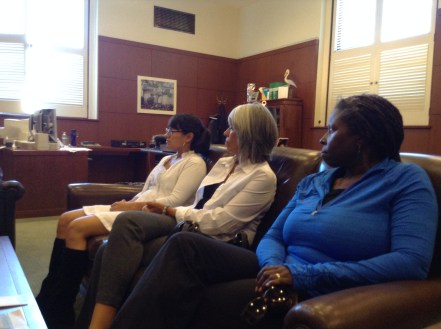
in chambers

Pamela the Persuasive

(MUNICH) — The teenager behind Friday’s deadly shooting rampage at a Munich mall had planned his attack for a year and chose his victims at random, investigators said Sunday. Bavarian investigator Robert Heimberger said the shooter, an 18-year-old German-Iranian identified only as David S., visited the site of a previous school shooting in the German…
via Munich Shooter Planned Attack for a Year, Officials Say — TIME
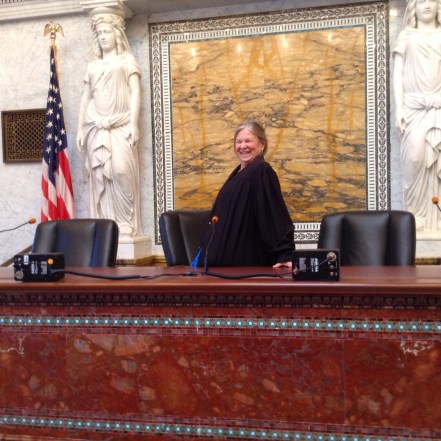
babes of justice
What is the opposite of resisting arrest? The cops resisting citizens who want to present evidence to stop crime is that. I have spent almost a decade trying to stop the obvious crime in my immediate neighborhood. This has turned out to be an illusive dream because I could not manage to show the TPD the evidence. Once this had been going on for a few years, we were then subjected to a fake neighborhood watch for the sole purpose of willfully denying crime is crime. This proved the point that crime left to fester just get worse. Now we were forced to keep all the crime in place, and pay taxes to support a fraudulent neighborhood watch. Everything has gone in the opposite direction of justice. We have been forced to keep the crime we have (which is significant) by a completely clueless system designed to serve and protect us. You don’t have to be shot in the back by the cops to have your life ruined by their dishonesty.
Finally, about a month ago I physically took the evidence to the station for the captain to review. During the month nobody has contacted me or informed me at all. This week TPD sent 3 cops to my house to ask what is happening, as if this is the first time they have heard of this. I showed them the evidence I still had at the house and told this very long complicated story one more time. They did not understand and asked me to call 911 if the ongoing financial fraud continued. This is not a realistic way to stop financial fraud.
Still TPD is completely silent. I told them I am not at all comfortable leaving that evidence at the station since the captain is on vacation, and he is specifically the only one I can trust. Silence. I fully expect that evidence to disappear at the Midtown police station and the whole 10 years of obstruction of justice to be swept under the table. We hear about corruption in government, but I have lived through a decade of it at the most extreme levels. These people aren’t even in collusion. They are simply clueless, too clueless to even collude. This is the scariest discovery I have made. They don’t intend to prevaricate. They just have no contact with reality. This corrupt bubble must be broken for the safety of us all.
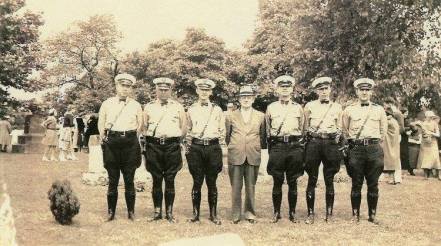
Oakmont police force 1947
When I was growing up in a small suburb of Pittsburgh my town had a small police department. Oakmont was so small that neighborhood policing was natural, as well as the only option. Everyone knew everyone’s business and everyone’s children. The photo above of the 1947 Oakmont force with the mayor was only a few years before I took up residence in the town. This was taken, no doubt, on Memorial Day after the parade at the cemetery. This is probably all the motorcycle cops, with the mayor in the middle. None of the people in this picture could have imagined how much the role of the police would change in society.

motorcycle cops today
I had a frank discussion recently with Officer Marquis, who is a motorcycle cop at TPD. I asked him what it is like to wear the vest. His answers surprised me because he brought up an issue I had never considered. He told me how hot it makes him. OMG, you are out in Tucson in the summer wearing leather boots, and now you need to add a ceramic vest to protect your vital organs!!! How cruel and unusual can your job be? I was just thinking about the way the weight compresses the spine, but he made me see another way the vest has unintended consequences. The K9s are not allowed to wear their vests for too long because it will overheat and damage their organs and possibly their brains. Meanwhile, we are roasting our human cops. Officer Marquis wears a lighter style vest with ceramic inserts that he adds when he wears it. I think this eliminates a few ounces of the total burden..but then there is the physical mastery of the bike, which is heavy in itself. Tough job.
We talked about his bike and other interesting stuff. He seemed pretty happy about his job, despite the roasting factor. I asked him if he feels like a target (this was months before the world truly went barbaric). He said yes. On his motorcycle he is obviously less protected than the car cops. He was not complaining and I am absolutely sure he would not have brought the subject up had I not done so. I went on to ask a couple more cops that day if they felt like targets. The other two said no, but I wonder what they might answer now, after the the violent events of last week. All cops have to feel like victims now, because it is a very reasonable assessment of the situation that prevails.
The lady cop vests look particularly uncomfortable. I am not sure how they are fitted, but this lady told me hers was as long as possible (makes sense). She said she does not feel like a target. I was apparently the only person from the fashion police who had ever asked her about it. It does not flatter the female figure, to say the least. Even Jessica Rabbit would look like the Marshmallow guy from Ghostbusters in the lady cop vest. This lady cop wears hers well and does not mind wearing it, but one can only imagine how attractive she is in real life.

lady in vest
I have become obsessed with this vest question. It is symbolic as well as physical. It does compress their spine and add weight for their skeleton to carry, as well as keep them safe. It heats them up and makes it hard to cool down. The looney in Dallas wore one himself. In Tucson the cops have to pay for their own because city taxes are not set aside for that. I am shocked that the city can get away with that. In private industry I don’t think you can demand that workers risk their lives and BYO safety equipment. Can you think of an example of that, gentle reader?
I doubt that people here know that there is a charitable organization here with a purpose of providing the vests to the individual cops. Adopt-a-Cop is the program provide this necessary safety equipment to the force, since as taxpayers we are not even doing THAT. We need to step up to solve our civil unrest problems on all sides. This seems like a basic step to take, Tucson. Let’s buy them vests. Then let’s get some new politicians who will put the vests in the city’s budget.

