mermaidcamp
Keeping current in wellness, in and out of the water
You can scroll the shelf using ← and → keys
You can scroll the shelf using ← and → keys
Professional pumpkin carving has reached a high level of skill and art. I admire food art of all kinds, and am used to seeing intricate melons and fruits carved by Asians into extremely detailed shapes. Now we can boast of our own home grown American food carver who creates extreme masterpiece pumpkin carvings. While others are hoisting and throwing them Ray is turning the autumn symbols into amazing sculptures. Like a sand mandala, a pumpkin sculpture is born to die. The ephemeral nature of the craft makes it all the more special. Ray shares his technique with kids in school in hopes of nurturing the next pumpkin Da Vinci. If you have considered carving a jack o lantern this year, why not attempt a bust of your mail carrier, or of your child’s teacher? Good luck! Happy Halloween, Gentle Readers.
October brings ancient celebrations and rituals to life. Samhain, Halloween, Guy Fawkes Day,as well as Divali, fall at the end of October and beginning of November. They have in common ritual use of fire as part of the celebrations. As we enter the darkest part of the year in the northern hemisphere we honor the dead and invite them to partake in their former earthly pleasures. Day of the Dead is only one of the cultural holidays designed around remembering. The season is the right time to let go, to clean, clear, and remember. This is possible without any formal outward practice. You don’t have to dress up or build an altar to honor this change of season.
We all go through dark times in life. Lighting up the sky with fires and fireworks reminds us of energy shared, passed on, and finally no longer needed. You don’t need to be religious to understand the sacred nature of the inheritance of our human life. To be able to walk on the earth is not a small gift. Without the generations that survived before us we would not exist. We may notice a feeling of guidance from the ancestors, or simply a reverence for those who created our existence out of their own. I sometimes feel a deep sense of regret when I consider the lives of my ancestors. Who knows if that comes from me or from them. What can be known is that our connection to our ancestors is permanent. What we can learn from knowing about them and from imagining the way they lived gives us some insight into our own strengths and weaknesses. The ancestors know about those strengths and follies because they had them before we did, under different circumstances. I believe they would like for us to learn from their experiences.
Clarkdale, AZ
I bought the audio book Falling Upward at the suggestion of a fellow student at a conference I attended last June. I encountered the contemplatives for the first time, and had a lot to learn from them. James Finley guided us for a meaningful and educational weekend. I owned an audio book by Dr Finley and Carolyn Myss covering the subject I have already heard at the conference, transcending trauma. This complex idea deserved a review, so on my recent car trip I listed to the trauma book to deepen my understanding. On my trip back home I decided to hear Richard Rohr read his own book, Falling Upward. I started from Clarkdale before dawn and arrived in Tucson about 10 in the morning. Most of the drive was really scenic, but even Phoenix traffic was bearable because I was enjoying the book so thoroughly. I have one disc still to hear, but I am fully ready to recommend this book to anyone, especially to those over 40. This is another way to look at retirement planning, from a spiritual perspective.
Falling Upward explains spirituality as it pertains to the two halves of life. In other words, humans are involved in the giant birth/death/recycle action of the universal field. There is a time for building up, and a very appropriate time for breaking down. All of nature does this constantly. Although Mr Rohr is a Franciscan and a Catholic priest, his point of view is not all presented from a theological stance. He knows history very well and uses his experience in the study of initiation rites of native people around the world to draw large conclusions. His conviction is that humans are capable of taking a grand excursion of the soul. He reminds us that all saints and holy figures leave home on a big crazy journey, only to return to home. The journey represents necessary suffering that teaches the mystery beyond the suffering. In the second half of life this death of the perceived self, or being in the world but not of it, can lead to enlightenment. In our culture many of us cling to the structures we built in our youth as if there is nothing greater or beyond our own creative control. Falling Upward involves letting go to the point that previous reality fades from view as we float to our intended home in eternal bliss. Sound kooky??? Well, it is. All the saints and prophets were considered to be out of their minds. Many were killed. Before the truth sets you free it generally makes you appear to be crazy.
I like to hear authors read their own books to me. I feel like it becomes more personal. This one is very special because I had never heard of Richard Rohr before his fan told me about him last June. Now I am a huge fan too. I invite you to listen, gentle reader. I could make a big difference in the end.

Falling Upward

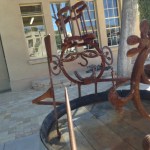

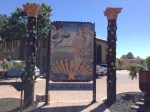




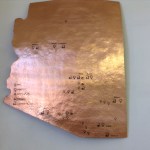


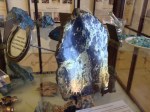
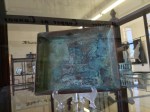


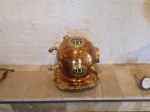
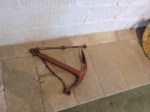

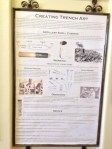




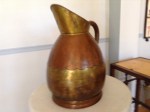


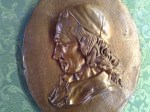


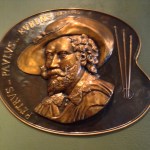


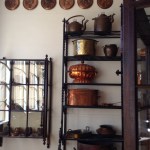
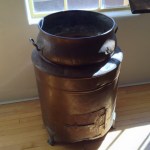

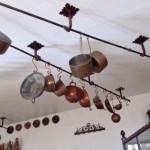


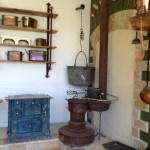

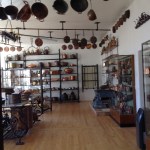


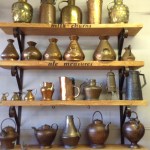

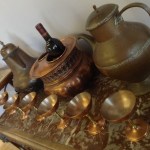

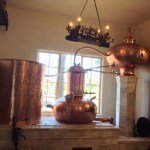
One highlight of my recent trip to the historic and supposedly spooky Historic 89A from Cottonwood to Jerome was the new museum housed in the old Clarkdale high school. This old building with giant windows lets in an abundance of natural light. This is really the perfect place to display copper. Jerome, the mining town up the hill, is a famous ghost destination and artist colony. There was a very large copper mine that brought wealth to the town. The family that has started the museum owns a copper shop in Jerome. They rent the ground floor of the high school building, and rent the upstairs to residential tenants who serve as security at night. I think it is a great gig to live upstairs because the view, the location, and the fact that the copper art is always downstairs make it uniquely attractive.
The very extensive military and kitchen collections are on permanent loan from private collectors. There is a temporary collection of antique tin cookie forms, mostly Santas, but bunnys and other holiday shapes as well. I learned a lot from the extensive charts and informative posters. The museum covers the history, the myth and meaning, the mining, and the art that resulted. I love the look of copper, but appreciate the other qualities it has, such as antibacterial. Everything is covered well and the staff (owner) checks in frequently to see if the patrons have questions about the exhibits. I saw him take great care and a lot of time when kids were visiting with parents. There is no formal tour, but the space is small and the guest is invited to ask for more guidance. I normally spend an extra long time in museums, and this was no exception. I was fascinated and needed to look at all the detail. I noticed other patrons were also sitting down and spending time looking deeply at the displays. One of my favorite rooms contains spent artillery shells from WWI that were turned into “trench art” by soldiers. I believe anyone would enjoy seeing this museum. It has artistic and historic value displayed in a place that makes it shine. If you are in the Clarkdale area to ride the train, don’t miss this awesome museum just around the corner from the train station.

shrimp plant

fairy duster

desert rose
Science Friday is a show on PBS radio that I enjoy. This week I heard a story that has fascinated me. They are sponsoring a nationwide program to encourage people to enter into science experiments. The scientific methods are shared with anyone who cares to discover literally anything. Citizen science is a booming area of interest. Anyone can participate and if the results are shared on line with the hashtag #observeeverything there is a chance of encouragement and coaching from other scientists. The idea is to observe anything with a question in mind. Random observation can be the place to start. If you start today to closely watch what happens around you something may catch your fancy that can be the basis of your experiment. It should truly interest you and make you curious. There may be something you have been wondering about for a while, or you may stumble upon a phenomena you can’t explain or interpret. After you narrow down a question or theory to prove you need to take detailed notes and maybe some photos or videos to support your experiment.
I did a lot of science at home with my father when I was a child. I was struck by the way my dad was relatively careless with chemicals. He brought chemicals home from his job at Gulf Oil research. I like the dry ice the best. He liked to blow things up and make bombs. That was okay, but there were some fairly dangerous accidents as a result of my dad’s science lab in the garage, the backyard, and the front sidewalk. One time we spilled an explosive mix designed to be dropped in small quantities on the sidewalk to pop when it was touched. My father set of the toxic explosive spill with a broom and it flared up and looked like it might set the front porch on fire for a few minutes. I preferred to put dry ice in the bathtub and blow bubbles that would rest on the top of the CO2. I was also allowed to play with a large bottle of mercury..that’s right, mercury. My friends and I rolled it around in our hands…OY! I had access to a Teslacoil that we used to make our hair stand on end and to zap each other. I guess my childhood was a kind of mad experiment.
I have been making bitters lately and have been thinking maybe there is an experiment I could do that relates to different kinds of bitters and their effects on the body. Since it is subtle I don’t know how one might go about such a test, but I am considering that as a possible subject. I think the thing to do is go start that observation and see if something jumps up at me and wants to be studied. Is there a question you are itching to answer? Take a look at the twitter stream or the #observeeverything streams on any social media to follow the latest and see where the citizen science movement will lead us.

Bringham coat of arms

headstone
My 10th great-grandmother came to America on the ship Suzan and Ellen in 1635. She was born in Spaulding Moor, Yorkshire, England. Her profession on the ship’s log is listed as vixor (a word for which I find no definition) , her husband’s as a husbandman, and my 9th great-grandfather, Thomas Crosby, was 8 weeks old. He was lucky to survive the crossing at such a tender age. Ann’s husband died young, and she married a minister who went broke and died of melancholia. This was a huge drag for Ann. Lucky for me they survived.
Ann Brigham (1606 – 1675)
is my 10th great grandmother
Thomas Crosby (1635 – 1702)
son of Ann Brigham
Sarah Crosby (1667 – 1706)
daughter of Thomas Crosby
Sarah Sears (1697 – 1785)
daughter of Sarah Crosby
Sarah Hamblin (1721 – 1814)
daughter of Sarah Sears
Mercy Hazen (1747 – 1819)
daughter of Sarah Hamblin
Martha Mead (1784 – 1860)
daughter of Mercy Hazen
Abner Morse (1808 – 1838)
son of Martha Mead
Daniel Rowland Morse (1838 – 1910)
son of Abner Morse
Jason A Morse (1862 – 1932)
son of Daniel Rowland Morse
Ernest Abner Morse (1890 – 1965)
son of Jason A Morse
Richard Arden Morse (1920 – 2004)
son of Ernest Abner Morse
Pamela Morse
I am the daughter of Richard Arden Morse
Ernest Howard Crosby, In the portion of the family history taken from the October New York Genealogical and Biograpical Record, Surmises that Simon Crosby ‘may have come to America as one of the company of the Rev. Thomas Shepard, who crossed the ocean in that year (1635) and settled at Newtown, now Cambridge, Massachusetts. This Mr. Shepard was preceeded or accompanied by a large number of his freinds and acquaintances. He had taken orders in the Church of England, and had held livings in Yorkshire and Northumberland, but he enertained conscientious scruples regarding the ceremonies of his church, and was consequently so harassed by those in authority that he left England, and became one of the most eminent clergymen in New England. The Cheif reason for establishing Harvard College at Cambridge is that he lived there.’
This record goes on to state that before the end of 1635 we find Simon Crosby living at Newtown (Cambridge). He was admitted as a freeman on March 3, 1636 and chosen as a selectman in the fall of that year. In September of 1637 he was elected surveyor of highways; was selectman again in 1638, and in October of that year was elected constable.
On Dec. 5, 1636 land was granted to him and six others for pasture. He died in Cambridge in September 1639, at only 31 years of age. The cause of his death is not known, but we can surmise that his death may have been fairly sudden, since he died intestate. An addendum to Ernest Howard Crosby’s record quoted above says that the orginal inventory of the estate of Simon Crosby, signed by his widow Anne, is on file in the archives of Massachuetts at Boston. It places the value of his property at 433 pounds.
Holme-on-Spaulding-Moor, in York Co., England is an extensive Parrish located 15 miles SE of the city of York.
Simon and his wife came over in the ship “Susan and Ellen.”
Notes for ANNE BRIGHAM:
It is from Thomas 7, the firstborn, that our line descends, but before proceeding to his generation, it may be of interest to record some of the facts of the later life of the widowed Anne Crosby. In 1646 or l647, she married the Rev. William Tompson, aa distinguished clergyman in Braintree (now Quincy), Mass., who apparentlly pursued his religious duties with zeal but with little regard for financial gain. Ernest Howard Crosby’s record says that in Aug. of 1652 she sold the Crosby house4 with six acres adjoining, and also 147 acres of land in the neighborhood. Mr. Tompson’s health was finally undermined ‘by melancholia’, and he retired from preaching in 1659. He died in 1666, leaving his family in straitened circumstances. In 1668 Anne petitioned the General Court, complaining that moneys due her for his services were witheld. She died in 1675 and was buried in the Quincy churchyard. We have no record of what became of her daughter Ann, her only child by Mr. Tompkins.
At this point, it may be as well to record what is known of two other brothers, both younger than Thomas:
Simon Jr., born 1637, moved early in life to Billerica, Mass. and was the first innkeeper in that town. He was Representative in the General Court in 1691, 1697, and 1698. (Indications are that it is from him that the Alonzo Crosby descent is traced.)
Joseph, the third son, is the ancestor from which Ernest Howard Crosby descends. Born in 1639, he was just 7 months old when his father, Simon the Emigrant, died. When his mother remarried, he was taken by her to live with his stepfather’s family. He passed his life there as a farmer, but was always prominent in town affairs, frequently serving on committees.
Children of SIMON CROSBY and ANNE BRIGHAM are:
ii. SIMON CROSBY, b. Aug 1637, CAMBRIDGE, MA.; d. Unknown.
iii. JOSEPH CROSBY, b. Abt. 1639, CAMBRIDGE, MA.; d. Unknown.
Here are the notes from the ship on which they arrived in Salem:
In the Ship Suzan And Ellen EDWARD PAYNE Mr for New-England Theis pties herevnder
expressed have brought Certificates from the Minister of Justices of their Conformitie and that they
are no Subsidy Men.
Columns represent: name, occupation, and age of each passenger.
1 Procter, John Husbandman 40
2 Proctor, Martha 28
3 Proctor, John 3
4 Proctor, Marie 1
5 Street, Alice 28
6 Thorton, Walter Husbandman 36
7 Thorton , Johanna 44
8 North, John 20
9 Pynder, Mary 53
10 Pynder, Francis 20
11 Pynder, Marie 17
12* Pinder, Katherine 10
13 Pynder, Jo: 8
14 Skofield, Richard 22
15 Weeden, Edward 22
16 Wilby, George 16
17 Hawkins, Richard 15
18 Parker, Tho: 30
19 Burd, Symon 20
20 Mansfield, Jo: 34
21 Cole, Clement 30
22 Jones, Jo: 20
23 Burrow, Wm 19
24 Atwood, Phillip 13
25 Snowe, Wm 18
26 Lumus, Edward 24
27 Saltonstall, Richard Husbandman 23
28 Saltonstall, Merriall 22
29 Saltonstall, Merriall 9 mos.
30 Wells, Tho: 30
31* Coop, Peter 28
32 Lambart, Wm 26
33 Podd, Samvel 25
34 Belcher, Jeremy 22
35 Clifford, Marie 25
36 Coe, Jane 30
37 Riddlesden, Marie 17
38 Pellam, Jo: 20
39 Hitchcock, Matthew 25
40 Nicholls, Elizabeth 25
41 Carpenter, Tomazin 35
42 Fowle, Ann 25
43 Gordon, Edmond 18
44 Sydlie, Tho: 22
45 Leach, Margaret 22
46 Smith, Marie 21
47 Swayne, Elizabeth 16
48 Wells, Ann 20
49 Bewile, Grace 30
50 Taylor, Dvonis 48
51 Smith, Hanna 30
52 Backley, Jo: 15
53 Battrick, Wm 18
Theis vnder written names are to be transported to New-England imbarqued in the
Suzen And Ellen
EDWARD PAYNE Mr:
the pties have brought Certificates from ye Ministers of Justices of the peace
yt they are no Subsidy Men: and are conformable to ye orders and discipline of
the Church of England.
54 Hudson, Ralph A Drap 42
55 Hudson, Marie vixor 42
56 Hudson, Hanna children 14
57 Hudson, Eliz: children 5
58 Briggham, Tho: 32
59 Thwing, Ben: servant 16
60 Gibson, Ann servant 34
61 Kirk, Judith servant 18
62 Moore, Jo: servant 41
63 Knowles, Henry servant 25
64 Richardson, Geo 30
65 Thomlins, Ben: 18
66 Thomlins, Edward 30
67 Ford, Barbara 16
68 Broomer, Joan 13
69 Brooke, Richard 24
70 Brooke, Tho: 18
71 Crosby, Symon husbandman 26
72 Crosby, Ann vixor 25
73 Crosby, Tho: child 8 weeks
74 Rowton, Ric: husbandman 36
75 Roswton, Ann vixor 36
76 Rowton, Edmond child 6
77 Greene, Percivall husbandman 32
78 Greene, Ellin vixor 32
79 Trane, Jo: servant 25
80 Dix, Margaret servant 18
81 Atherson, Jo: 24
82 Blason, Ann 27
83 Buckley, Ben: 11
84 Buckley, Daniell 9
85 Corrington, Jo: 33
86 Corrington, Mary 33
Durga is the mother goddess capable of killing demons. She was born from the anger of Brahma, Vishnu, and Shiva and outfitted with every weapon of the gods. She was brilliant, and extremely bad assed. She is the very angry mother who drives demons from the earth and puts the fear of retribution in all her children. She has nine different forms she may assume in her motherly duties. During the festival of Navaratri she is worshiped in three of her forms. First Durga the destroyer purifies for three days as only wrathful mother can. Then Lakshmi takes over for three days of bestowing spiritual wealth. The final three days are ruled by Saraswati, the mother of wisdom. To skip any one of the three mothers is to fail to grasp the whole meaning of the creative essence. The feminine spark, or Shakti, does all the work and holds all the energy. In 2014 Navaratri lasts from 25 September until the 3 October. The Durga puja is an affirmation of good over evil, a classic version of mother knows best. She will remove the miseries of life and chase the demons out of the building. Respect her in all her forms…..you want to stay on her good side.


In our dreams characters, including ourselves, play grand archetypes. Last night as I dreamed military factions were fighting it out in a prolonged battle. The warrior rarely appears in my dream life so I have considered it as a signal of some kind of change. The dream did not really upset or frighten me. In fact, after a while awake I fell back into sleep and dreamed about the same theme for a while again, which is very rare in my life. I normally do not go back to sleep, but I felt there was a story I needed to finish. Nobody won the war and I believe there were more than two fighting factions, sort of like Syria today. The warrior is an important archetype without which we would all be too vulnerable. Protection is something everyone needs, from within as well as from others.
In yoga the warrior pose is a wonderful strengthening posture. When one masters it one truly does feel like a warrior and a hero. To be a warrior archetype does not always mean to be a soldier or professional in the business of protection. The best attributes of this archetype are skill, strength, discipline and self sacrifice in the conquest over ego. The best warrior is stoic and possesses a tough will to conquer. The worst warrior is indifferent to the suffering of others. The shadow practice of this soldier in the dark is trading ethics for victory at any cost. The hero as well as the heel are contained within the warrior archetype. Loyalty and invincibility are identified with this character. Mercenaries and gunslingers are also part of the tribe.
I wondered today if thinking about my ancestors and the Civil War in the United States might be part of this dream’s arrival. I have been studying and considering how my family moved from Selma, Alabama to East Texas after the war and bought property with gold. They traveled by oxcart to get there. Both my 2nd great grandfather and his father-in-law were in the war, the older man conscripted to make steel in Birmingham Alabama to provide munitions to the Confederacy. The Confederate money was worthless after the war, so I wonder how they managed to have enough gold to buy property in Texas. Many southern cotton farmers had moved to the area, so the majority of the population was black, as a remnant of slavery and cotton. My people were religious and donated land for a church in the area. I have been thinking about what it is like to fight in a war like that and be on the loosing side, then move to a new place. They had to handle a lot of change and hardship during one lifetime, and the period after the war may have been as difficult as the war itself.
My relationship with this dream is asking me to be stronger and more disciplined. I have done very little self-sacrifice or tough willed commitment during my time on earth. I know few soldiers in my real life, and have no contact with war and the risk of loosing a loved one. As war explodes around the globe I stay relatively insulated until someone new invades Tucson. We all depend on cops, soldiers, and sailors to keep us safe from harm, but I normally give them little thought. War is hell, and most of us defer that hell to warriors and prefer not to know much about the details. Historical wars seem to me to be linked to spiritual warfare. How do you relate to the warrior archetype? Do you take the role of protector in your life? Who protects you?
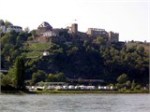
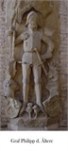

My 16th great-grandfather had an extremely lavish wedding when he wed my 16th great-grandmother. They had three children together and then the Pope gave Count Philipp a divorce. This divorce by Pope thing was popular at the time for nobility. His father, Johann IV, the Count of Katzenelnbogen, gave the world riesling grapes and wine. His sons died before he did, so the male line ended with his death. One of the castles the family owned, Rheinfels, is the largest on the Rhine. Today there is still a ruin that can be visited.
Rheinfels Castle (German: Burg Rheinfels) is a castle ruin located above the left (West) bank of the Rhein in Sankt Goar, Germany. It was started in 1245 by Count Diether V of Katzenelnbogen. After expansions, it was the largest fortress in the Middle Rhein Valley between Koblenz and Mainz. It was slighted by French Revolutionary Army troops in 1797. It is the largest castle overlooking the Rhine,and historically covered five times its current area.
In the year 1435 the Rüsselsheim castle administrator Klaus Kleinfisch began a new wineyard. His annual account shows the purchase of riesling Setzreben for 22 shilling. This kind of wine had a higher quality than the other french wines, was more aromatic but also frost-resistant. His new choice was – wineyards can exist more than onehundred years – the turningpoint in winehistory. Up to this point the old documents only reported red, white or black wine according to their colour. Even in the year 1402 the electoral prince of mainz ordered to grow no other wines than his french wines. After the rüsselsheim vintage Riesling quickly showed up all the way down the river rhine. Up to the year 1600 riesling became top wine. In the castle of Darmstadt count Johann IV united the two most powerful counties of the “holy roman empire of the german nation” in one of the most beautiful medieval marriages of his son Philipp d. Ältere of Katzenelnbogen with countess Anna of Württemberg. Even his son-in-law landgrave Heinrich III of Hessen was enthusiastic about this amount of gold , silver and wine. In 1427 the 10 most important katzenelnbogen castles were consuming about 200 000 liters of wine a year and in 1436 storing 1.5 million l wine in mainz . The counts were remarkably rich supporting arts and could afford rewarding medieval singers like Walther von der Vogelweide with a diamond. They created the most powerful castle, the first undefeatable german “bollwerk” Auerbach, defended themselves on the largest german castle with the largest german wine-cellar the Rheinfels castle. They loved the power but were sophisticated. Thanks to their correct book-keeping we can read about their live, family affaires and trading. One vase of china and one tankard is all they left. But the writings tell us and still want to be searched.
They gave us the riesling wine, one symbol of pride worth to be honoured.
The successors may have formed a modern top wine out of the riesling plant, but the documented first grower of the most important german and one of the most important international wines was Johann IV, the Count of Katzenelnbogen.
Additional the county customs writer noticed the first bratwurst export to cologne in 1410, the records listed bratwurst for 1gulden on a boat loaded with wine. This is the first proof of the traditional german bratwurst. The size is defined by pork casings. The transport itself tells us katzenelnbogen bratwurst must have been widely known.
Philip I of Katzenelnbogen (1402 – 1479), also known “Philip the Elder” was Count of Katzenelnbogen from 1444 to 1479 and was the last male descendant of the Counts of Katzenelnbogen (his two sons died before him). His parents were John IV, Count of Katzenelnbogen (younger line) and Anne of Katzenelnbogen (older line), who merged the two lines of the family back together in 1402.
Marriage and issue
Philip married on 24 February 1422 in Darmstadt with Anna of Württemberg (1408–1471), daughter of Eberhard IV “the Younger” of Württemberg. In 1456, he obtained from the Pope a divorce from bed-and-board. In 1474 Philip married Anna of Nassau-Dillenburg.
Philip had three children with his first wife:
Philip the Younger (* 1427; † 27 February 1453), married in 1450 Ottilie of Nassau. In 1453 they had a daughter Ottilie of Katzenelnbogen.
Eberhard († 1456), canon of Cologne, was stabbed in Bruges (Flanders).
Anna (* 5 September 1443; † 16 February 1494), married in 1458 margrave Henry III of Hesse (15 October 1441 — 13 January 1483). In 1471, they had a son William III, who was the last male descendant of this line of the House of Hesse.
Legacy
In 1444 Philip initiated a major renovation of the collegiate church of Sankt Goar.
In 1449 he bought off the rights on St. Goar held by abbot John of the Abbey at Prüm.
In 1470 he handed Upper Katzenelnbogen and its seat Darmstadt to his son-in-law Henry III of Hesse.
Philip’s sons Eberhard and Philip the younger died before his death, so when Philip died in 1479, the Katzenelnbogen died out in the male line. The County of Katzenelnbogen fell to the Landgraviate of Hesse, which was ruled at the time by Philip’s son-in-law Henry III of Hesse in Marburg.
This article incorporates information from the German Wikipedia.
Philipp l Count of Katzenelnbogen (1402 – 1479)
is my 16th great grandfather
Philipp VonKatzenelnbogen (1427 – 1453)
son of Philipp l Count of Katzenelnbogen
Ottilie Countess Katzenelnbogen vonKatzenelnbogen (1453 – 1517)
daughter of Philipp VonKatzenelnbogen
Beatrix Zahringen (1492 – 1535)
daughter of Ottilie Countess Katzenelnbogen vonKatzenelnbogen
Sabine Grafin VonSimmern (1528 – 1578)
daughter of Beatrix Zahringen
Marie L Egmond (1564 – 1584)
daughter of Sabine Grafin VonSimmern
Richard Sears (1590 – 1676)
son of Marie L Egmond
Silas Sears (1638 – 1697)
son of Richard Sears
Silas Sears (1661 – 1732)
son of Silas Sears
Sarah Sears (1697 – 1785)
daughter of Silas Sears
Sarah Hamblin (1721 – 1814)
daughter of Sarah Sears
Mercy Hazen (1747 – 1819)
daughter of Sarah Hamblin
Martha Mead (1784 – 1860)
daughter of Mercy Hazen
Abner Morse (1808 – 1838)
son of Martha Mead
Daniel Rowland Morse (1838 – 1910)
son of Abner Morse
Jason A Morse (1862 – 1932)
son of Daniel Rowland Morse
Ernest Abner Morse (1890 – 1965)
son of Jason A Morse
Richard Arden Morse (1920 – 2004)
son of Ernest Abner Morse
Pamela Morse
I am the daughter of Richard Arden Morse
Katzenelnbogen originated as a castle built on a promontory over the river Lahn around 1095. The lords of the castle became important local magnates, acquiring during the centuries some key and highly lucrative customs rights on the Rhine. The Counts of Katzenelnbogen also built Burg Neukatzenelnbogen and Burg Rheinfels on the Rhine. The German family died out in 1479, while the Austrian lineage continued, and the county became disputed between Hesse and Nassau. In 1557, the former finally won, but when Hesse was split due to the testament of Philipp the Magnanimous, Katzenelnbogen was split as well, between Hesse-Darmstadt and the small new secondary principality of Hesse-Rheinfels. When the latter line expired in 1583, its property went to Hesse-Kassel (or Hesse-Cassel), which added the inherited part of Katzenelnbogen to its side-line principality of Hesse-Rotenburg. After the Congress of Vienna, this part of Katzenelnbogen was given to Nassau in exchange for property that had been taken away from it; after the War of 1866, with all Nassau, it became part of Prussia.
In 1945, Hesse-Darmstadt was united with most of the Prussian province of Hesse-Nassau, which included the former Hesse-Kassel along with Nassau and the formerly Free City of Frankfurt, to form the federal state of Hesse. Thus, Hesse now includes the larger part of former county of Katzenelnbogen. A smaller part of Nassau, including the old castle and village bearing the name of Katzenelnbogen, ended up as part of Rhineland-Palatinate (part of the Rhein-Lahn and Westerwaldkreis districts). One of the titles of the Queen of the Netherlands (the House of Orange-Nassau) is that of Countess of Katzenelnbogen.
Etymology
The name Katzenelnbogen derives from the old Cattimelibocus. It consists of the ancient Germanic tribal name of the Chatti and Melibokus, the Roman name of any mountains, like the Harz or the Teutoburg Forest. Over the centuries the name changed to Katzenelnbogen: “cat’s elbow”.
History of wine
In the history of wine, Katzenelnbogen is famous for the first documentation of Riesling grapes in the world: this was in 1435, when the storage inventory of Count John IV of Katzenelnbogen, a member of the Holy Roman high nobility, lists the purchase of vines of “Rieslingen”.
Terror is the new leisure. We have become so accustomed to the word being used all over the world to describe atrocities, political take overs, and now the rising stars of the terror world, ISIS. The meaning has become scattered and diluted, so now that real sociopathic mobs roam the desert with intent to do massive destruction we have no new way to describe what they do. We have allowed fear and loathing to become part of everyday living. While I am personally glad I am not in a position to direct military or political policy I do see a reason for declaring exactly what we are doing (besides fear and loathing) with our military might. When war is actually declared there is incentive to negotiate peace and end the war. By free styling war with no declarations we have gathered new enemies and spread distrust all over the globe. I have objected and protested publicly against war since I was a teenager, but in all that time the government has never had the guts to declare one. We are just participating in one huge covert operation that changes frequently and irrationally as we become less popular.
John McCain and I have never agreed before and will not be likely to do so in the future. I usually think my Senator from Arizona is a paranoid militaristic dweeb with too many houses. If a bunch of violent punks can declare themselves to be a sovereign nation and run rampant over rule of law the United States needs to declare SOMETHING!!! Are we bullies? Are we cowardly? Are we completely out of touch with reality? I think yes to all of the above questions. I personally think this is more than a decisive moment in history. It is pivotal now to stop this armageddon warm up before momentum takes us to a new world order that we can’t imagine.
What terrifies me is the idea that our government is full of self serving and dishonest people who have no will to act. I am not naming any names because there is no individual responsible. It is a culture that tells us to “support our troops” without telling us what those troops are really doing and why. Going to war is serious business, but going straight to hell because we won’t declare war or peace terrifies me.

