mermaidcamp
Keeping current in wellness, in and out of the water
You can scroll the shelf using ← and → keys
You can scroll the shelf using ← and → keys

Hill coat of arms
My tenth great-grandfather arrived early in Massachusetts, and settled in Malden to be a miller and an inn keeper.
Abraham HILL arrived in Malden, MA in the 1630’s, among the first settlers there. He first received Lot #59, and then bought more land on the south side of Salem St. Later, when some 5 acre lots were divided up, he received 2 1/2 acres.
According to the History of Malden, Robert LONGE, the father of Abraham’s wife, Sarah, was also one of the first in Malden and received 5 acres. Daniel SHEPHERDSON, whose ggranddaughter,Sarah PARKER m. Moses’ grandson, Moses HILL, was also a pioneer in Malden.
Thomas CALL, the other grandfather of Joanna CALL, was a tenant of the SKINNERS. The house stood at the corner of Cross and Walnut Sts.
The only other mention of Abraham in the Malden book is that he was one of nine signers of a petition asking for a four mile square of land called Pennycooke to be an addition to the town.
Abraham Hill, the first American HILL ancestor of this branch of the family, was born in 1615, and was an inhabitant of Charlcstown, Massachusetts, in 1636. He kept a mill for John Coitmore, and was the owner of five lots of land in Charlestown and the neighborhood. He was admitted to the church in 1659, and his wife,’ Sarah Long, daughter of Robert Long, born in England in 1617, was admitted to the church in 1644. Abraham and Sarah (Long) Hill were married in 1639, and had eight children : Ruth, baptized in 1640, married William Augur; Isaac. 1641; Abraham. 164.1: Zachary, whose sketch follows; Sarah, 1647; Sarah, born and died in 1649; Mary, 1052 : Jacob, March, 1656-57. Abraham Hill died February 13, 1669-70, and the inventory of his estate amounted to six hundred and thirty-three pounds.
is my 10th great grandfather
daughter of Abraham Hill
son of Ruth Hill
daughter of Abraham Eager
daughter of Lydia Eager
Joseph Morse III (1752 – 1835)
son of Mary Thomas
John Henry Morse (1775 – 1864)
son of Joseph Morse III
son of John Henry Morse
Daniel Rowland Morse (1838 – 1910)
son of Abner Morse
son of Daniel Rowland Morse
Ernest Abner Morse (1890 – 1965)
son of Jason A Morse
Richard Arden Morse (1920 – 2004)
son of Ernest Abner Morse
I am the daughter of Richard Arden Morse






Recently reminded of the superb quality of the cuisine at Feast, we took the middle of the day on Saturday to enjoy it. I started with the violet flavor and mysterious look of the Cuyahoga cocktail, which improved as the ice melted. It was a new twist on lunch beverages that grew on me. In fact, I ordered another one to go with my salad. Bob wanted to try snails, so he ordered quail and snail, which he said was mostly mushroom in flavor, and he liked it. My first courses were delightful wild rice savory pancakes with sautéed vegetables, and a fried artichoke heart dish we both loved. I enjoyed the gnocchi salad, but was too full to finish. The use of pan fired gnocchi as croutons made this a filling dish I will have again today for lunch. Bob loved the banana and pork combo he ordered.
We passed on dessert in order to attend an event to support the Humane society of Tucson. A vegan bake sale, complete with adoptable dogs, was the perfect place to buy our take home tofu cheesecake and peanut butter brownies for the late afternoon snacking. We napped, we slowly chipped away at our dessert until nighttime. There was only one vegan peanut butter brownie left to split for breakfast.
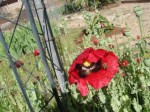
Poppies have been cultivated since ancient times. Poppy seeds are used in magic as well as in cooking. They are associated with rest and remembrance. It was mythically created by Ceres while she was in search of Persephone, as a symbol of grief. Death and pleasure are symbolized by red poppies. The bees are very active on them, although red flowers are typically pollinated by hummingbirds. I think they are being sedated.






Last night was the first food and wine tasting presented by Slow Food in Tucson. I would call it a complete success.


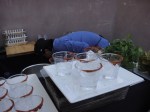


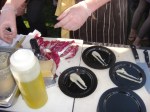

We attended with our friend Sara, who enjoys a tasty bite as much as we do. We arrived early, and set out with a really outstanding Bloody Mary served by Pasco kitchen and lounge. Their urban farm cuisine is totally amazing. We plan to go to brunch there this weekend for more. We tasted our way through the most innovative dishes and drinks put together in one place by the Slow Food people. The live band and the lively crowd of foodists made this a party to treasure in the tastebuds of the mind. I started out to be very precise and document all the flavors and happy moments, and then happiness took over. We ran into old friends and I abandoned the picture taking to just have fun. I am not, gentle reader, a real reporter. I am an enthusiastic and opinionated blogger who loves to taste. I had more wine than beer, but am still of the opinion that the beer is better in Arizona than the wine. The beverages were all worth trying and complimented the food nicely. I came away liking a beer from Dragoon Brewery as my fave new discovery. It is Stronghold Session Ale, with a dark and festive flavor.
The chefs all made amazing bites, and were willing to serve me the plate without meat when it was easy. Chef Ryan Clark, the host chef of the event, served green posole, vegetarian, with the option to add pork. I loved him for that, and think the posole should go on his menu because it is epic. Doug Levy from Feast made mesquite biscuit mini sandwiches that drove me and the whole crowd wild. Everyone was talking about those. He did not mind that we were all snatching more than one. The radishes with mozzarella foam butter from Zona 78 were incredible, as was the grilled radicchio. They brought their farmers with them which was very cute. Acacia served me a plate minus the meat which was fabulous. There was no bad food at all. From my own taste perspective I gave Nancy Taylor, a woman who wrote a book and supports Slow Food with it the best dish award. She served prickly pear. Nopales, prickly pear cactus pads, are delicious, lower the blood sugar of those who eat them, and are virtually free to anyone who wants to go pick cactus. I adore nopales, and have a never ending search for the best recipe featuring them on earth. At the moment Ms Taylor is in first place with her tepary been, chiltepin salad. I will knock this off in my kitchen very soon. The contest will continue, however. Don’t hesitate to contact me, gentle readers, if you have a recipe for nopal. I am open to learning them all.
We discussed our discoveries on the way home in the car. Bob, Sara and all have all discovered new restaurants we want to visit, and been reminded that we are surrounded by talented, caring, creative chefs. This is all very good news.

My 9th great-grandmother was a published poet. She was born in England and died in Massachusetts. Much is known about her because of her famous father and husband, but for a Pilgrim she was a feminist. Her poems were about cosmology and the elements. She was an intellectual in her own right. This is a good account from http://www.famouspoetsandpoems.com:
Anne Bradstreet
Anne Bradstreet was born in 1612 to a nonconformist former soldier of Queen Elizabeth, Thomas Dudley, who managed the affairs of the Earl of Lincoln. In 1630 he sailed with his family for America with the Massachusetts Bay Company. Also sailing was his associate and son-in-law, Simon Bradstreet. At 25, he had married Anne Dudley, 16, his childhood sweetheart. Anne had been well tutored in literature and history in Greek, Latin, French, Hebrew, as well as English.The voyage on the “Arbella” with John Winthrop took three months and was quite difficult, with several people dying from the experience. Life was rough and cold, quite a change from the beautiful estate with its well-stocked library where Anne spent many hours. As Anne tells her children in her memoirs, “I found a new world and new manners at which my heart rose [up in protest.]”a. However, she did decide to join the church at Boston. As White writes, “instead of looking outward and writing her observations on this unfamiliar scene with its rough and fearsome aspects, she let her homesick imagination turn inward, marshalled the images from her store of learning and dressed them in careful homespun garments.”Historically, Anne’s identity is primarily linked to her prominent father and husband, both governors of Massachusetts who left portraits and numerous records. Though she appreciated their love and protection, “any woman who sought to use her wit, charm, or intelligence in the community at large found herself ridiculed, banished, or executed by the Colony’s powerful group of male leaders.”Her domain was to be domestic, separated from the linked affairs of church and state, even “deriving her ideas of God from the contemplations of her husband’s excellencies,” according to one document.This situation was surely made painfully clear to her in the fate of her friend Anne Hutchinson, also intelligent, educated, of a prosperous family and deeply religious. The mother of 14 children and a dynamic speaker, Hutchinson held prayer meetings where women debated religious and ethical ideas. Her belief that the Holy Spirit dwells within a justified person and so is not based on the good works necessary for admission to the church was considered heretical; she was labelled a Jezebel and banished, eventually slain in an Indian attack in New York. No wonder Bradstreet was not anxious to publish her poetry and especially kept her more personal works private.Bradstreet wrote epitaphs for both her mother and father which not only show her love for them but shows them as models of male and female behavior in the Puritan culture.An Epitaph on my dear and ever honoured mother, Mrs. Dorothy Dudley, Who deceased December 27, 1643, and of her age, 61Here lies/ A worthy matron of unspotted life,/ A loving mother and obedient wife,/ A friendly neighbor, pitiful to poor,/ Whom oft she fed, and clothed with her store;/ To servants wisely aweful, but yet kind,/ And as they did, so they reward did find:/ A true instructor of her family,/ The which she ordered with dexterity,/ The public meetings ever did frequent,/ And in her closest constant hours she spent;/ Religious in all her words and ways,/ Preparing still for death, till end of days:/ Of all her children, children lived to see,/ Then dying, left a blessed memory.Compare this with the epitaph she wrote for her father:Within this tomb a patriot lies/ That was both pious, just and wise,/ To truth a shield, to right a wall,/ To sectaries a whip and maul,/ A magazine of history,/ A prizer of good company/ In manners pleasant and severe/ The good him loved, the bad did fear,/ And when his time with years was spent/ In some rejoiced, more did lament./ 1653, age 77There is little evidence about Anne’s life in Massachusetts beyond that given in her poetry–no portrait, no grave marker (though there is a house in Ipswich, MA). She and her family moved several times, always to more remote frontier areas where Simon could accumulate more property and political power. They would have been quite vulnerable to Indian attack there; families of powerful Puritans were often singled out for kidnapping and ransom. Her poems tell us that she loved her husband deeply and missed him greatly when he left frequently on colony business to England and other settlements (he was a competent administrator and eventually governor). However, her feelings about him, as well as about her Puritan faith and her position as a woman in the Puritan community, seem complex and perhaps mixed. They had 8 children within about 10 years, all of whom survived childhood. She was frequently ill and anticipated dying, especially in childbirth, but she lived to be 60 years old.Anne seems to have written poetry primarily for herself, her family, and her friends, many of whom were very well educated. Her early, more imitative poetry, taken to England by her brother-in-law (possibly without her permission), appeared as The Tenth Muse Lately Sprung Up in America in 1650 when she was 38 and sold well in England. Her later works, not published in her lifetime although shared with friends and family, were more private and personal–and far more original– than those published in The Tenth Muse. Her love poetry, of course, falls in this group which in style and subject matter was unique for her time, strikingly different from the poetry written by male contemporaries, even those in Massachusetts such as Edward Taylor and Michael Wigglesworth.Although she may have seemed to some a strange aberration of womanhood at the time, she evidently took herself very seriously as an intellectual and a poet. She read widely in history, science, and literature, especially the works of Guillame du Bartas, studying her craft and gradually developing a confident poetic voice. Her “apologies” were very likely more a ironic than sincere, responding to those Puritans who felt women should be silent, modest, living in the private rather than the public sphere. She could be humorous with her “feminist” views, as in a poem on Queen Elizabeth I:Now say, have women worth, or have they noneOr had they some, but with our Queen is’t gone?Nay, masculines, you have taxed us long;But she, though dead, will vindicate our wrong.Let such as say our sex is void of reason,Know ’tis a slander now, but once was treason.One must remember that she was a Puritan, although she often doubted, questioning the power of the male hierarchy, even questioning God (or the harsh Puritan concept of a judgmental God). Her love of nature and the physical world, as well as the spiritual, often caused creative conflict in her poetry. Though she finds great hope in the future promises of religion, she also finds great pleasures in the realities of the present, especially of her family, her home and nature (though she realized that perhaps she should not, according to the Puritan perspective).Although few other American women were to publish poetry for the next 200 years, her poetry was generally ignored until “rediscovered” by feminists in the 20th century. These critics have found many significant artistic qualities in her work.
Anne Dudley (1612 – 1672)
is my 9th great grandmother
John Bradstreet (1652 – 1718)
son of Anne Dudley
Mercy Bradstreet (1689 – 1725)
daughter of John Bradstreet
Caleb Hazen (1720 – 1777)
son of Mercy Bradstreet
Mercy Hazen (1747 – 1819)
daughter of Caleb Hazen
Martha Mead (1784 – 1860)
daughter of Mercy Hazen
Abner Morse (1808 – 1838)
son of Martha Mead
Daniel Rowland Morse (1838 – 1910)
son of Abner Morse
Jason A Morse (1862 – 1932)
son of Daniel Rowland Morse
Ernest Abner Morse (1890 – 1965)
son of Jason A Morse
Richard Arden Morse (1920 – 2004)
son of Ernest Abner Morse
Pamela Morse
I am the daughter of Richard Arden Morse
Here is an example her work:
Part of the poem “Contemplations” said to be the finest of Anne Dudley Bradstreet’s poems:
“Sometimes now past in the autumnal tide,
When Phoebus wanted but hour to bed,
The trees all richly clad, yet void of pride,
Were gilded O’er by his rich golden head.
Their leaves and fruits seemed painted, but was true
of green, of red, of yellow, mixed hue,
Rapt were my senses at this delectable view
I wist not what to wish, yet sure, thought I
If so much excellence abide below,
How excellent is He that dwells on high,
Whose power and beauty by His works we know,
Sure He is goodness, wisdom, glory, light,
That hath this underworld so rightly sight,
More Heaven than Earth was her, no winter & no night.”




Ruta Graveolens is a medicinal and magical herb. It has meaning for the Pope as well as for Central American shamans. The herb of grace, as it is known, has been used for centuries to guard or protect entrances. The Catholic church uses the plant rue to sprinkle holy water. Shamans use it for bathing and ceremony. Bathing with it can be especially effective as a liberation. It is mentioned in the Bible, in Shakespeare, and in Ethiopian cooking. The smell is pungent and bitter, the flowers yellow and bright. I use this plant to guard the back entrance of my garden. It is spreading and doing an excellent job of keeping things safe.
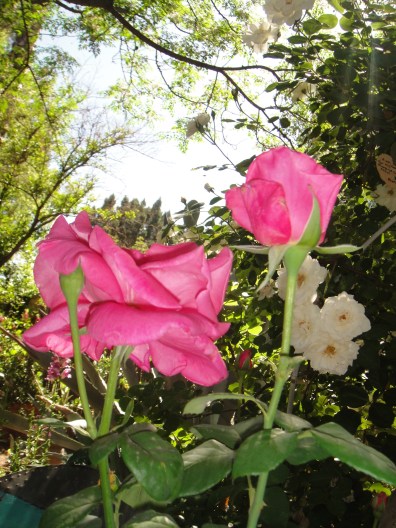
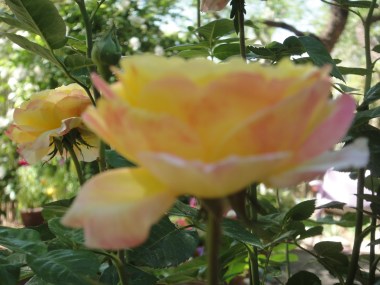
roses

roses
Today is National Haiku Poetry Day.
Daylight springs
Scent travels fast
Morning blast
If you have not written poetry this may be the day it is easy to become a poet. Try your hand. You have nothing to loose. Nobody can make you publish it. Pay attention. Be amazed. Tell the story.




We are always providing something. It can be waste and decay, or it can be brilliance. Usually it is both. The buzzword-o-moment is provide value through content. This blog, for instance, is intended to provide the gentle reader with some facts, entertainment, and history. Unlike printed media, if the system does not crash this digital data will exist forever. We are now kicking out content of all kinds a mile a minute to be archived permanently in the cloud. Value is not only in the eye of the beholder, but in the almost infinite ability to search and surf on this future cloud. While we stuff this cloud with presumed value the earth itself requires more attention.
Bees and pollinators provide for the future. Seed libraries leave a legacy to generations that follow. Look down, gentle reader. Wisdom resides in nature. Meditative attention to nature is healing and holistic. Withdrawal from the seasons, the botany, and the wildlife of the land deprives the spirit and represses the soul.




Powerful voice of reason, the garden
The calming fleeting beauty of flowers and trees
Brushstrokes of genius, music of color and urgency
Soothe the mind and heal the body




I have lived in my condo for 11 years in central Tucson. My location next door to a full time charity scam in operation for many years has ruined quality of life, safety, and property value while giving the neighbors a dim view of law enforcement. I can think of few crimes ethically and morally lower than taking advantage of the public’s ignorance and sympathy to make a living by claiming falsely to be doing charity. I have learned that most of the public does not write off tax deductible donations, and therefore may be completely unaware of the laws governing charity and donations. Sandra Day O’Connor has her work cut out for her in her attempt to teach Americans how government works.
Ignorance is not all bliss for the folks supporting charity scamming over real non profits. Giving an unreported income to a scam hurts legitimate charities by diverting donations, money and volunteer time to private, criminal (unreported) purposes. These days when the Food Bank and Salvation Army are scraping to get by, it is especially insulting to compete with community resources by scamming for donations that are never reported. The laws are in place to protect the public, but there is not much sophistication about the law. The IRS grants non-profit status to those who prove they are serving the community. Once the status of 501C3 non profit corporation is obtained strict accounting must be submitted to the IRS to keep the status. Deciding that you are entitled to collect donations from the public without following any laws that legal charities have to follow is a lot like stealing resources from the victims you claim to help. If you cash in on sympathy for the homeless without really helping the homeless find shelter or improve their lives your crimes are deeply immoral. Shelters that are there all the time for them need the donations that are diverted by scammers who decide they are above the law. One of the typical ways scammers approach the public is to donate for holidays. This one is no different, collecting donations full time to supposedly help someone eat outside in a park on a holiday. If you give support to anyone, please check to know that your “charity” reports donations to the IRS and has some oversight.
In Tucson it is easy to live above the law. We have the 20th worst run city in America, according to some Wall Street Journal poll. I think the listing was overly flattering to Tucson. You can openly beg for donations, collect them in a residential condo, then solicit help from the public to prepare food in a residential kitchen to be served outdoors in a park to homeless people. You can break the revenue laws of the US and Arizona, the health code of Pima County, the zoning laws of the city of Tucson for as many years as you like. Your neighbors can report your crime to the cops, the city councilwoman, the mayor, the city manger and the IRS. No response or help will come from the vast numbers of folks who are paid to enforce the law. They do not see any problem with breaking all these laws to run a charity scam in a residential condo. Law enforcement is the least of their concern.
 mermaidcamp