mermaidcamp
Keeping current in wellness, in and out of the water
You can scroll the shelf using ← and → keys
You can scroll the shelf using ← and → keys
Our society is experimenting with self sustaining living. In recent decades focus has changed from local production of food and goods to a transportation heavy supply chain. We now pay little to produce our goods in countries with lax labor laws and spend fortunes shipping those goods around the globe. The skills of preserving food, and even growing food have been lost to a great extent, but there is new interest in reviving local farming and local cuisines. Popular classes and books are teaching:
These alternative practices offer students ways to save money and become more creative. Learning new skills can reap big benefits for society as well as individuals. The future will be shaped by the habits we develop now. Communities focused on improving local, self-sustaining economies are becoming more common. The trend is strong and, in my opinion, will grow in the future. Have you made any changes in your own life to create a more self sustenance?
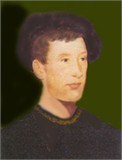
Thomas DeHoland
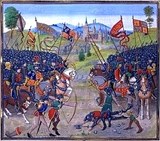
Battle of Najera
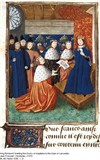
Richard II deeding Aquitaine to Lancaster
Thomas Deholand is my ancestor on both sides of my family. My maternal line looks like this:
Thomas DeHoland (1350 – 1397)
is my maternal 18th great grandfather
Edmund Holland (1383 – 1408)
son of Thomas DeHoland
Eleanor DeHoland (1405 – 1452)
daughter of Edmund Holland
Ann Touchet (1441 – 1503)
daughter of Eleanor DeHoland
Anna Dutton (1449 – 1520)
daughter of Ann Touchet
Lawrence Castellan of Liverpool Mollenaux (1490 – 1550)
son of Anna Dutton
John Mollenax (1542 – 1583)
son of Lawrence Castellan of Liverpool Mollenaux
Mary Mollenax (1559 – 1575)
daughter of John Mollenax
Francis Gabriell Holland (1596 – 1660)
son of Mary Mollenax
John Holland (1628 – 1710)
son of Francis Gabriell Holland
Mary Elizabeth Holland (1620 – 1681)
daughter of John Holland
Richard Dearden (1645 – 1747)
son of Mary Elizabeth Holland
George Dearden (1705 – 1749)
son of Richard Dearden
George Darden (1734 – 1807)
son of George Dearden
David Darden (1770 – 1820)
son of George Darden
Minerva Truly Darden (1806 – 1837)
daughter of David Darden
Sarah E Hughes (1829 – 1911)
daughter of Minerva Truly Darden
Lucinda Jane Armer (1847 – 1939)
daughter of Sarah E Hughes
George Harvey Taylor (1884 – 1941)
son of Lucinda Jane Armer
Ruby Lee Taylor (1922 – 2008)
daughter of George Harvey Taylor
Pamela Morse
I am the daughter of Ruby Lee Taylor
Thomas Holland, 2nd Earl of Kent (1350–April 25, 1397) was an English nobleman and a councillor of his half-brother Richard II.Thomas was the son of Thomas Holland, 1st Earl of Kent and Joan of Kent. His mother was a daughter of Edmund of Woodstock, 1st Earl of Kent and Margaret Wake. Edmund was in turn a son of Edward I of England and his second Queen consort Marguerite of France, and thus a younger half-brother of Edward II of England.
When his father died in 1360 Thomas became Baron Holand. His mother was still Countess of Kent in her own right. At sixteen, in 1366, Holland was appointed captain of the English forces in Aquitaine. He fought in various campaigns over the following years, and was made a Knight of the Garter in 1375.
Richard II became king in 1377, and soon Holland acquired great influence over his younger half-brother, which he used for his own enrichment. In 1381 he was created Earl of Kent.
Marriage and issue
Holland married Alice FitzAlan, daughter of Richard FitzAlan, 10th Earl of Arundel, and Eleanor of Lancaster. They had eight children:
Thomas Holland, 1st Duke of Surrey, who succeeded him
Edmund Holland, 4th Earl of Kent, married Constance of York
John Holland
Joan Holland, married Edmund of Langley, 1st Duke of York
Alianore Holland, married first Roger Mortimer, 4th Earl of March and second Edward Cherleton, 5th Baron Cherleton
Margaret Holland, married first John Beaufort, 1st Earl of Somerset and second Thomas of Lancaster, 1st Duke of Clarence
Elizabeth Holland, married Sir John Neville (eldest son of Ralph Neville, 1st Earl of Westmoreland)
Eleanor Holland, married Thomas Montacute, 4th Earl of Salisbury
Through the marriages of his daughters, he became the ancestor of many of the prominent figures in the Wars of the Roses, including Richard Plantagenet, 3rd Duke of York and Warwick the Kingmaker
Military career
At sixteen, in 1366, Holland was appointed captain of the English forces in Aquitaine. Over the next decade he fought in various campaigns, including the Battle of Nájera, under the command of his stepfather Edward, the Black Prince. He was made a Knight of the Garter in 1375.
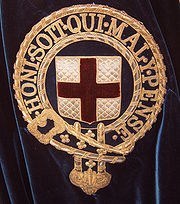
Order of the Garter
The Battle of Nájera, a k a the Battle of Navarrete, 3 April 1367
Fo ught between an Anglo-Gascon army and Franco- Castilian forces near Nájera, in the province of La Rioja, Castile. The English were led by Edward, the Black Prince, and John of Gaunt, Duke of Lancaster, allied with Peter of Castile (sometimes called “Peter the Cruel”) against his brother Henry of Trastámara (Spanish: Enrique II).
Peter and Henry had been in armed conflict, the Castilian Civil War, for some time before the intervention of foreign powers was sought. Peter begged assistance from the Black Prince in Bordeaux to restore him to his throne. James IV of Majorca also agreed to support Peter.
History
With 24,000 men, the Anglo-Gascon army marched south from Aquitaine and crossed the river Ebro at Logroño. They took control of the fortified village of Navarrete and continued towards Nájera to face Henry’s Franco-Castilian army, the latter’s strength being 60,000. Despite the large size of his army, Henry’s commander, Bertrand du Guesclin was later reported to have been reluctant to face the English in a pitched battle, but he was overruled.
The battle began with the English longbowmen gaining dominance over the French archers. Then, the English vanguard, led by Sir John Chandos and the Duke of Lancaster, attacked the French mercenaries commanded by Du Guesclin and Arnoul D’Audrehem. The chronicler Froissart gives detailed information about the participants in the battle.
Under the pennon of St. George, and attached to the banner of Sir John Chandos, were the free companies, who had in the whole twelve hundred streamers. Among them were good and hardy knights and squires, whose courage was proof; namely, Sir Robert Cheney, Sir Perducas d’Albret, Robert Briquet, Sir Garsis du Chastel, Sir Gaillard Viguier, Sir John Charnels, Nandon de Bagerant, Aymemon d’Ortige, Perrot de Savoye, le bourg Camus, le bourg de l’Esparre, le bourg de Breteuil, Espiote, and several others.
Th e Castilian cavalry, under heavy arrow fire from the English longbowmen, fled early, leaving Henry’s battle exposed to attack from the mounted English rearguard. The Franco-Castilian army disintegrated and retreated, pursued by the English, back to the bank of the river Najerilla. Du Guesclin was captured, but Henry escaped and fled.
Peter and the English completely routed Henry and the French, inflicting heavy losses. Unlike at other battles of the Hundred Years’ War, at Nájera it was the English who were attacking dismounted French troops. As with many other battles of the period, the English longbow proved a significant advantage, probably for the first time in the Iberian Peninsula. However, the battle was of dubious long-term significance as Peter and the Black Prince fell out over money, and Peter was not able to maintain his rule for long without foreign support.
References
Sir John Froissart; Translated from the French by Thomas Johnes. Chronicles of England, France and Spain and the Surrounding Countries. London 1808
My paternal connection to Sir Thomas looks like this:
Sir Thomas Holand Knight deHolland (1350 – 1397)
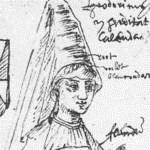
Sibilla Anjou
My 25th great grandmother was from the House of Anjou (like the pear) . Her father, Fulk, was a crusader who is buried at the Church of the Holy Sepulchre in Jerusalem, as King of Jerusalem, which is a very big deal, and pretty creepy. I have been there but did not think to look for my ancestors at the time. The Anjous are Plantagenets in that way that royal Euros had lots of different names and houses. The crusade thing is equally confusing. This is how the Anjous took over the English throne:
The Plantagenets are also called Angevins, because their immediate paternal progenitors were Counts of Anjou, an autonomous county in northern France. They descend in the male line from from the Counts of Gatinais, one of whom had married an heiress to the county, her Anjou ancestors deriving from an obscure 9th century nobleman named Ingelger. It is due to this lineage that the Plantagenets are sometimes referred to as the First House of Anjou. One of the more notable Counts was Fulk, a crusader who became King of Jerusalem. It was his son, Geoffrey, nicknamed Plantagenet, who gave his name to the dynasty, and Fulk’s grandson, Henry, was the first of the family to rule England.
Henry’ s claim to the English throne came through his mother, the Empress Matilda, who had claimed the crown as the daughter of Henry I of England. Empress Matilda’s brother William Adelin had died in the wreck of the White Ship, leaving Matilda her father’s only surviving legitimate child. However, on Henry’s death in 1135, Matilda’s cousin Stephen of Blois was supported by much of the Anglo-Norman nobility, and was able to have himself crowned instead. A tightly fought civil war known as The Anarchy ensued, with Matilda gaining support from her illegitimate half-brother, Robert, 1st Earl of Gloucester. The balance swayed both ways during the war, Matilda gained control at one point and carried the title “Lady of the English” before Stephen forced her out to Anjou. Unrest and instability continued throughout Stephen’s reign, while on the continent, Geoffrey managed to take control of the Duchy of Normandy for the Angevins in 1141 but seemingly showed no interest in campaigning across the Channel.
Sibilla went to Jerusalem where her father married the queen. Later she became a nun, like lots of my royal female ancestors:
Sibylla of Anjou (c. 1112-1165) was a daughter of Fulk V of Anjou and Ermengarde of Maine, and wife of William Clito and Thierry, Count of Flanders.
In 1123 Sibylla married to William Clito, son of the Norman Robert Curthose and future Count of Flanders. Sibylla brought the County of Maine to this marriage, which was annulled in 1124 on grounds of consanguinity. The annulment was made by Pope Honorius II upon request from Henry I of England, William’s uncle; Fulk opposed it and did not consent until Honorius excommunicated him and placed an interdict over Anjou. Sibylla then accompanied her widower father to the crusader Kingdom of Jerusalem, where he married Melisende, the heiress of the kingdom, and became king himself in 1131. In 1139 she married Thierry, Count of Flanders, who had arrived on his first pilgrimage to the Holy Land.
She returned to Flanders with her new husband, and during his absence on the Second Crusade the pregnant Sibylla acted as regent of the county. Baldwin IV, Count of Hainaut took the opportunity to attack Flanders, but Sibylla led a counter-attack and pillaged Hainaut. In response Baldwin ravaged Artois. The archbishop of Reims intervened and a truce was signed, but Thierry took vengeance on Baldwin when he returned in 1149.
In 1157 she travelled with Thierry on his third pilgrimage, but after arriving in Jerusalem she separated from her husband and refused to return home with him. She became a nun at the convent of St. Lazarus in Bethany, where her step-aunt, Ioveta of Bethany, was abbess. Ioveta and Sibylla supported Queen Melisende and held some influence over the church, and supported the election of Amalric of Nesle as Latin Patriarch of Jerusalem over a number of other candidates. Sibylla died in Bethany in 1165.
With Thierry she had six children:
Sibilla d’Anjou born about 1105 Anjou, France died 1165/67
father: *Foulques V “le Jeune” Count of Anjou & King of Jerusalemborn 1092 Anjou, France
died 10 November 1143 Jerusalem, Holy Landburied Church Of Holy Sepulchre, Jerusalem, Holy Land
mother: *Ermengarde (Ermentrude) du Maineborn about 1096 Maine, France
died 1126 Maine, Francemarried 11 July 1110 France
siblings:
*Geoffrey V “le Bon” Plantagenet born 24 August 1113 Anjou, France; died 7 September 1151 Chateau, France
Mathilde d’Anjou born about 1104 Angers, Maine-et-Loire, France; died 1154 Fontevrault Abbey, Fontevrault, Maine-et-Loire, France
Elias d’Anjou born about 1111 Anjou, France; died 15 January 1151 St Serge Abbey, Angers, Anjou, France buried L’Abbey des Sergela, Angers, France
spouse: *Dietrich (Thierry) d’ Alsaceborn about 1099 Alsace, France
died 17 January 1168married 1134
children:
*Marguerite de Lorraine born about 1135 Alsace, France died 15 November 1194
*Matthieu d’ Alsace born about 1137 Flanders, Belgium died 1214 buried St. Judoc, Ponthieu, France
While hanging out in the steam room at my health club I noticed a man wearing a lot of silver jewelry and thought it must be hot on his skin. After a few steam room conversations I discovered that he is a metal sculptor who had worked in a shop in Tucson that I had later used as a pottery studio in the distant past. I have not worked with clay for a long time, but Jerry has evolved from making simple objects to producing very artful and complicated mixed media art. He worked as a ferrier. He played polo in Colorado. He bought the Village Blacksmith shop 30 years ago from another blacksmith. His art today is centered around birds in action. His knowledge about anatomy of birds has grown deeper as he has worked in this specialty field. I was very lucky to have a personal tour of the shop and sculpture on display. He participates in the Pima Arts Council open studio tours. Since there was no fire during my visit I thought my gentle readers would also enjoy watching the tools and Jerry in action:

Isabelle de Hainault
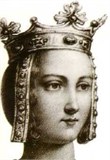
queen consort of France
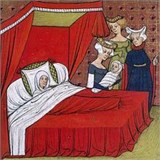
Isabelle gives birth
Isabella of Hainault (Valenciennes, 5 April 1170 – 15 March 1190, Paris) was queen consort of France as the first wife of King Philip II of France.
Early life
Isabella was born in Valenciennes on 5 April 1170, the daughter of Baldwin V, Count of Hainaut, and Margaret I, Countess of Flanders. At the age of one, her father had her betrothed to Henry, the future Count of Champagne. He was the nephew of Adèle of Champagne, who was Queen of France. In 1179, both their fathers swore that they would proceed with the marriage, but her father later agreed to her marrying Philip II of France.
Queen of France
She married King Philip on 28 April 1180 at Bapaume and brought as her dowry the county of Artois. The marriage was arranged by her maternal uncle Philip, Count of Flanders, who was advisor to the King.
Isabella was crowned Queen of France at Saint Denis on 28 May 1180. As Baldwin V rightly claimed to be a descendant of Charlemagne, the chroniclers of the time saw in this marriage a union of the Carolingian and Capetian dynasties.
The wedding did not please the queen mother, since it had meant the rejection of her nephew and the lessing of influence for her kinsmen. Though she received extravagant praise from certain annalists, she failed to win the affections of Philip due to her inability to provide him with an heir; although she was only 14 years old at the time. Meanwhile, King Philip in 1184, was waging war against Flanders, and angered at seeing Baldwin support his enemies, he called a council at Sens for the purpose of repudiating her. According to Gislebert of Mons, Isabella then appeared barefooted and dressed as a penitent in the town’s churches and thus gained the sympathy of the people. Her appeals angered them so much that they went to the palace and started shouting loud enough to be heard inside.
Robert, the king’s uncle, successfully interposed and no repudiation followed as repudiating her would also have meant the loss of Artois to the French crown.
Finally, on 5 September 1187, she gave birth to the needed heir, the future King Louis VIII of France.
Death
Her second pregnancy was extremely difficult; on 14 March 1190, Isabella gave birth to twin boys named Robert and Philip. Due to complications in childbirth, Isabella died the next day, and was buried in the cathedral of Notre Dame in Paris. She was not quite 20 years old and was mourned for greatly in the capital, since she had been a popular queen.
The twins lived only four days, both having died on 18 March 1190. Her son Louis succeeded her as Count of Artois. Isabella’s dowry of Artois eventually returned to the French Crown following the death of King Philip, when her son Louis became king.
Isabelle De Hainault (1170 – 1190)
Fashion follows function. In the 1950’s a model had limited options. She could be a junior or a high fashion model, a field that was evolving. Jean Patchett was a Mad Man’s dream, a fashion model married to a New York banker. She set style, but was not drawing any revenue from the rip off of her iconic eye and mouth printed on pairs of pajamas. She was in the vanguard of personal branding, but not the beneficiary of it. This interview with Edward R Murrow is a trip to a more sexist time. Jean’s famous eye had become an icon, but she had no creative control over it. She was happy just to be an icon with a famous eye, and her banker husband is happy for the same reasons.
She left us with some stunning images of her beautiful self in some amazing fashion. We will never know how liberated she was. She was able to live a life full of more travel opportunities than many had in that time, and the photos reflect her world travel. Her decision to be serious rather than smile in her shots is what made her a “high fashion” model. She was a ground breaker. She perfected the genre.
Sacrifice is presented as desirable in some circles. Women in particular are lead to believe that sacrifice will be rewarded, even when the reward is not in sight. While we can’t go through life without any instances of victimhood, making a habit of it is a very bad idea. Feminism had a lot to do with rejecting victim status, and yet women today are wrapped up in a number of delusional mindsets that rob happiness. Perfection will not be attained for more than a few seconds in any arena, so expectations must be matched to that reality. Striving for more of everything without stopping to enjoy what we have will lead us in a downward cycle. There is no amount of money or status that can change the need to wallow in the role of the victim. Sore winners abound, and wining does not make them happy. Suffering is a matter of perspective and is not absolute.
I have been studying and meditating on Thomas Moore’s new book, A Religion of One’s Own, which I am enjoying. When I heard him talk about the book he said many of his patient’s in his counseling practice were treated too harshly in childhood. Since this heavy discipline was sometimes associated with religion, these adults suffer today from combinations of guilt and inappropriate self punishment. Mixed messages from our youth of spirituality and sacrifice can create havoc in the soul. Take good care of yourself, gentle reader.
The Declaration of Independence is often quoted saying:
“We hold these truths to be self-evident, that all men are created equal, that they are endowed by their Creator with certain unalienable Rights, that among these are Life, Liberty and the pursuit of Happiness.”
I believe that our short-sighted system that rewards politicians for serving special interests of all kinds is dishonest. Lobbyists and lawyers write the laws that favor their patrons. Our lawmakers just pass them with little revision or thought. This is not what the taxpayers intended when we paid our taxes. I wrote both a senator and a congressman about serious issues in the last year. The senator has not responded at all. The congressman never answered my concern but sent me an e-mail asking me to rate the quality of the help I had received from his office. I replied that there had been none, so it was not applicable. There has still been no response. I give it an F.
Education is the way out of this hole in which we find American democracy. It seems that the people who know who government works are abusing the systems, while the majority are not well served by the results. iCivics is addressing the problem of a large undereducated population that does not participate in elections. In the future we can hope educated people will make the bureaucracy responsive to all citizens. Learning how the government is intended to work is the first step toward making it work.
Americans have started to rebound from the culture of excess. The Tiny House Movement is a valid reaction to the waste and lack of awareness of the past. It is a growing trend with new options sprouting up all the time. There are rolling versions that replace the old trailer model of mobile home. There are plans to build your own as well as contractors who specialize in this kind of construction. The biggest advantage I can see is the tiny amount of time it would require to keep it clean. It would be impossible to leave any clutter I should imagine, since you have to see it constantly if you are not organized. I am so far from being able to contain myself like this. I own a barn and have an entire extra lot in which to garden. I do think it is an admirable goal, so I have started to think about what it would take for me to get tiny. I must start by selling many of my treasures that I no longer treasure. How hard would it be for you to go tiny?
The medicinal use of gin to prevent kidney problems in the tropics was made popular by the British. It was invented in the 17th century by Dutch medical professor Dr Franciscus Sylvius who called it Genever. It was pure alcohol flavored with juniper berries. The medicinal qualities of the berries treated the expatriate Dutch kidney complaints, since juniper is a diuretic. William of Orange made it popular in the UK. For almost the entirety of the eighteenth century half the population of England was guzzling gin. The cheapness and availability made it the curse of lower class London.
Gin and tonic also came about for medicinal treatment, for malaria. Quinine in tonic water was effective in prevention of malaria for the Brits in tropical parts of the Empire. One of the greatest fans of this medicinal drink was a medical doctor himself. Graham Chapman of Monty Python stayed drunk with Keith Moon of the Who for the decade of the 1970’s in an homage to the eighteenth century, I suppose. Dr. Chapman calculated how much gin and tonic would kill a person, and consumed just short of that amount each day. That is a scientific view of self destruction that is unusual. It took a toll. Now for Python lovers there will be a revival called One Down Five to Go in London.
 mermaidcamp