mermaidcamp
Keeping current in wellness, in and out of the water
You can scroll the shelf using ← and → keys
You can scroll the shelf using ← and → keys










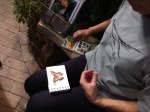
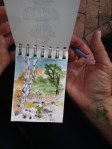
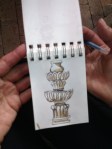
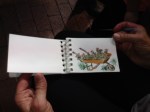
Each year Tucson Botanical Gardens opens a special tropical exhibit of butterflies. The greenhouse is maintained all year, but in the summer it is too costly to keep at temperature, so they take a break. I love to spend time in the butterfly magic display and do so very frequently. I am pretty excited to announce that they now have tiny tree frogs joining the butterflies. The frogs hide a bit from the crowd because they are nocturnal. I managed to see three and get some shots. Since it was Veterans Day lots of kids were in the house. I also met a woman who has taken a course at the gardens in pocket sketching. She had a tiny set of water colors and was popping out some tiny great art. This is my favorite entertainment in town. Members can go as often as we like, so I am a frequent butterflyer.

Coat of Arms
My 14th great grandfather was knighted by the first Duke of Suffolk. He is one of several Knights of the Bath in my family. He was involved with Henry VIII’s divorce, which is called his Great Matter:
Knighted by 1st Duke of Suffolk
Sir Edmund Bedingfield or Bedingfeld (1479/1480 – 1553), Knight of the Bath.
In 1523 Bedingfield was knighted by Charles Brandon, 1st Duke of Suffolk for demonstrating bravery in the French Wars. In 1539 he inherited from his brother Robert the great estate of Oxburgh Hall, King’s Lynn, Norfolk.
He married Grace Marney (d. in or after 1553), the daughter of Henry Marney, 1st Baron Marney.
Sir Edmund Bedingfield was entrusted with the care of Katherine of Aragon, at Kimbolton Castle, following the proceedings of 18 June 1529, concerning King Henry VIII’s Great Matter (divorce).
His first son Sir Henry Bedingfield (1510-1583), succeeded to his estate.
Edmund Bedingfield (1483 – 1552)
We can tell from his probate papers that Sir Edmund had worldly wealth.
In the name of God, Amen. The ninth day of August in the reign of our most dreadSovereign Lord Edward the Sixth by the grace of God of England, France and Ireland King, Defender of the Faith, and in earth of the Church of England and also of Ireland the Supreme Head, the fifth, I, Sir Edmund Bedingfield of Oxburgh in the county of Norfolk, knight, whole and perfect of mind and remembrance, thanked be God, fearing nevertheless the unstableness of this present world, do make my testament and last will in form as hereafter ensueth, that is to say:
I commend my soul to Almighty God, trusting by the merits of the passion of Christ, my Saviour and Redeemer, to have remission of my sins;
My body I will to be buried after the most laudable manner and custom of Christ’s church in such place and after such form as shall seem most convenient to mine executors;
And I give to the high altar of Oxburgh Church for my tithes negligently forgotten ten shillings;
Item, I bequeath to the reparation of the said church forty shillings;
And I bequeath to the like reparations of the churches of Redlingfield and Denham, to
each of them 20s;
Item, I bequeath unto my wife, Dame Grace Bedingfield, all such jewels as she hath beenused to wear upon her body, together with all my jewels and plate except a piece of silver parcel gilt engraven in the boton [sic] with ‘God’s blessing’ and the Bedingfields’ arms;
And also I give unto her all my right, interest and title which I have in and to the farm and lease of Skaleshoo in the parts of marshland in the county of Norfolk;
And I give also unto her all such sheep cattle as I shall have going there and depastured at the time of my death, and all my milch kine and other cattle being not above one year ofage the which at the same time of my death shall be remaining at Redlingfield & Denham in the county of Suffolk;
And I give and bequeath unto my son, Sir Henry Bedingfield, knight, all my harness, weapons and habiliments of war which shall remain at Oxburgh in the armoury there at the time of my said death, to th’ intent he may serve the King’s Majesty therewith at all times when he shall be commanded; And where by the last will and testament of Sir Henry Marney, knight, Lord Marney, it
was assigned, willed and bequeathed unto the said Sir Henry Bedingfield by the name of ‘Henry Bedingfield, son and heir apparent’ to me, the said Sir Edmund Bedingfield, one hundred pounds of plate then belonging to the said Lord Marney, to be delivered and disposed in such wise as in the same testament and last will is expressed & declared, considering now that I, the said Sir Edmund, before this time have divers and sundry ways issued and paid divers great and notable sums of money as well for th’ attaining of the inheritance of Sir Thomas Bedingfield, knight, mine eldest brother, lately departed, as also in obtaining of the King’s Majesty the manor of Bedlingfield [=Bedingfield] in the county of Suffolk, which both by the sufferance of Almighty God shall descend and come unto the said Sir Henry and his heirs, and also considering that at divers other times I have been beneficial unto him, as amongst other upon my departure from my late farm at Massingham the said Sir Henry had of my gift as well part of my plate and utensils of household as also divers cattle, as horses and kine, besides other necessaries and
implements of husbandry, I think myself by good reason and all conscience to bedischarged against the said Sir Henry and for the said sum of one hundred pounds;
Also I will that all such stuff of household remaining at Oxburgh which was agreed upon between Dame Alice Burgh, late wife of my said brother, Sir Thomas Bedingfield, knight, and me, the said Sir Edmund, by mediation of Sir John Spelman, Sir Roger
Townshend, knights, and Humphrey Carwell, esquire, shall be delivered by mineexecutors unto my said son, Sir Henry Bedingfield, knight, within one month nextensuing after my decease, that is to say:
First, in the chamber called the great chamber, a featherbed with a bolster; item, acovering of verdures with arms, and a tester of the same with curtains of green sarsenet; also a hanging of arras, two cushions with arms, a cupboard with a carpet thereon, a
coffer and a chair;
Item, in the chamber called the King’s chamber, a featherbed with a bolster, a mattress, a pair of fustians, a covering of red and green sarsenet twilted, a tester of tawny and black satin embroidered with unicorns and scallop shells, two cushions with arms, a cupboard with a green cloth thereon, two chairs, a carpet in the window, two cob-irons in the chimney;
I tem, in the chamber next the said King’s chamber, a featherbed with a bolster, a pair of blankets, a covering of tapestry, the hangings in the chamber of red and yellow canvas, and a form;
Item, in the inward chamber next unto the chamber called the Queen’s chamber, afeatherbed with a bolster, a blanket, a covering of russet cloth, a tester of stained cloth, and a form;
Item, in the said chamber called the Queen’s Chamber, a featherbed with a bolster, a pair of blankets, a covering of red say with arms and a tester of the same, the curtains of white linen cloth, a trundle-bed with a featherbed and a bolster, a blanket, a covering, a cupboard with the cloth thereupon, a cloth of red say in the window, a long chair with a cloth therein, another chair, and three cushions without arms;
Item, in the parlour, a hanging of red say stained, a cupboard, the long table, and a trussing bed in the chamber of the said parlour;
Item, in the chapel, a pair of chalice with the paten, the altar-cloths, the hangings of white sarsenet, and 4 cushions; item, a pall cloth of black velvet with a white cross; And I give unto the said Sir Henry one piece of silver parcel gilt where is engraven
‘God’s blessing’ and the Bedingfields’ arms, to remain to him as an heirloom in such wise as I received the same piece of my said brother, Sir Thomas Bedingfield;
And I bequeath unto the said Sir Henry my two stoned horses which be both ridden;
And over that, I do likewise assign, will and bequeath unto the said Sir Henry all and all manner of utensils belonging to my bakehouse at Oxburgh, together with other necessaries occupied and used for the purpose and intent of baking and brewing which at the time of my death shall remain at and within my said bakehouse there, and also all such utensils belonging to the kitchen there as was agreed upon by the said Dame Alice Burgh and me, the said Sir Edmund, by mediation of the said Sir John Spelman, Sir Roger Townshend, knights, and Humphrey Carvell, esquire;
And I give unto the said Sir Henry all mine eyries of swans called(?) swan-marks, except one couple of old eyries remaining at Redlingfield;
Item, I give and bequeath unto my said son, Sir Henry, all such coals, timber, boards and stone or other thing appertaining to reparations of the house of Oxburgh that shall remain at Oxburgh at the time of my death, all which said bequests and legacies I will shall enure and remain unto the said Sir Henry only upon condition that the same Sir Henry nor his executors shall not at any time hereafter claim of mine executors or th’ executors of them any parcel of the said sum of one hundred pounds before assigned, willed and bequeathed unto him by the testament and last will of the said Henry, Lord Marney;
And I give and bequeath unto my grandchild, Frances Sulyard, daughter of John Sulyard, Esquire, one hundred marks of good and lawful English money, to be paid to her at the day of her marriage or else at th’ age of 21 years, foreseen always that if the said Frances do die before marriage had and before she shall attain unto the age of 21 years, that then the said hundred marks to be divided by even portions between my youngest sons then living;
An d I give and bequeath unto my said wife, Dame Grace, all and all manner myhousehold stuff and other necessary implements together with my utensils of husbandry now remaining as well at Oxburgh as at Redlingfield not before assigned, willed or bequeathed to my said son, Sir Henry Bedingfield, to do therewith her will and pleasure;
And I heartily desire and require my said wife to give unto my servant, John Turner, forty shillings by year during his life, and if it shall happen my said wife to die, the said John then living, then I will mine executors shall from thenceforth yearly content and pay unto the said John Turner forty shillings during his natural life;
Also I will and bequeath to the children of my said son, Sir Henry Bedingfield, nowliving, one hundred pounds of good and lawful English money, to be equally divided amongst them, and to be paid to them at their several ages of 21 years or else at such days
as they and every of them shall happen to be married;
And I give to the children of my son, Francis Bedingfield, fourscore pounds of good and lawful English money, to be equally divided among them and to be paid to them in such sort and at such times as in the article last before-mentioned is declared and specified;
Also, I give and bequeath to the children of my son, Anthony Bedingfield, threescore pounds of good and lawful English money equally to be divided among them, and to be paid to them in like manner and time;
Provided always and my will is that if it shall happen any of the children of my said sons, Sir Henry, Francis and Anthony, to die before marriage had and before their several ages of 21 years, then I will that the portion and portions of such and as many of their said children as shall so happen to die shall be equally divided and given unto my children Anthony, Humphrey and Edmund, if they then do live, or else to as many of them as then shall be living, to their further advancement and relief;
And further I give and bequeath unto my said wife, Dame Grace, all my pullery and swine, together with all my corn and hay remaining as well at Redlingfield as at Oxburgh at the time of my death, and also all mine interest and term of years which I have in the parsonage and tithe corn of Hoxne in the said county of Suffolk;
Also I give unto my sons, Anthony, Humphrey & Edmund, to each of them forty pounds of good and lawful English money (my debts being first paid), provided always that if the said Anthony, Humphrey or Edmund do die within six years next after my decease, then I will that the portion or portions of such of them so dying shall be equally divided between my said younger sons then living;
And I give and bequeath to Margaret, the wife of Thomas Parke, otherwise calledThomas Tailor, my servant, to be delivered unto her within six weeks after my death, twenty ewe sheep going in Westhall flock in Cley;
And I give unto Adam Roberts, my servant, £6 13s 4d besides his quarter’s wages and livery;
An d I give and bequeath unto Edmund Grymston, William Shuldham, John Brooke, William Dey, Robert Nollothe, Robert Cooke, John Hewar, Thomas Spicer, Simon Bedall, Robert Clarke and Robert Barwicke, to every of them besides their quarter’s
wages and liveries forty shillings of good and lawful English money;
And in like manner I give and bequeath unto Edmund Grene, Robert Jerves, Thomas Caton, Thomas Parke, John Turnor, Henry Raydon, Thomas Stocke, Henry Jubye, Edmu{n}d Roberd{es}, Daniel Elstigoode(?), Thomas Laycocke, John Eyslingh{a}m,
William Skoldinge, Edward Hosteler, Robert Turnepenny, Humphrey Shulderham, Henry Spencer, John Cooke and Thomas Hewar, my servants, to every of them besides their quarter’s wages and their liveries, twenty shillings;
Item, I give to every one of mine other servants besides their quarter’s wages and their liveries, ten shillings;
And I give to Margaret Popper, forty shillings;
And I give unto the right worshipful and right so mine assured good brother and friend, Sir Roger Townshend, knight, (blank);
The residue of my goods, chattels and debts not before assigned, willed or bequeathed, I freely give them and every of them to mine executors, whom I ordain, constitute and make my well-beloved wife, Dame Grace Bedingfield, my son, Anthony Bedingfield, and Thomas Caton, my servant, to every of which I give, for their pains to be taken in and about th’ execution and performance of this my testament, ten pounds and their reasonable costs;
And furthermore I, the said Sir Edmund Bedingfield, do revoke, annul and annihilate all other wills and testaments by me made, devised or ordained before the day of the date of this my present last will and testament, these witnesses. Per Edmund Bedingfield.

Bar Book

bar food
bar

festive friend
I have restricted my reading of books for the last year to three, Sacred Contracts by Carolyn Myss, How to Think Like Leonardo DaVinci by Michael Gelb, and Impact Equation by Chris Brogan and Julien Smith. This experiment was proposed by Brother Brogan about the time that he published Impact Equation. I went for the idea because I have always read voraciously but applied the information with much less vigor. I also have enrolled in a course to study the Sacred Contracts material which I find fascinating and endlessly useful. I read constantly this year, and did not really read the three books much at all after the first three or four months. By then all the other participants including Brother Brogan had all quit the program. I stuck it out because it served me. I found out there is such a thing as reading too many books. There is more to life than reading.
I have put more practical application and reflection into what I have read this year. I do not hurry or skip through anything that I read now, which is new. I have been a speed reader for 40 years, having studied at the public library where I went for lessons by Dick Cavett on video. Life is change. If I have spent all this untold time reading it seems I should be able to write. I should also be able to read contemplatively, a skill I have yet to acquire. As I allow myself to buy and read books once more I have a new perspective. I have discovered the U of A Poetry Center and my ancestor poet in it. I have been to a few poetry readings during this diet, which I liken to being driven by a chauffeur. The experience of a poetry reading includes everything about the ambiance and company. I plan to return to the Poetry Center for both the readings and to read in that amazing ambiance. I also plan to write poetry as a meditative practice. Most of all I plan to be strategic and particular about all my reading from now on. I think if there is a librarian at the pearly gates we will be asked to do book reports to show comprehension, not prove that we have been on a life long book binge.
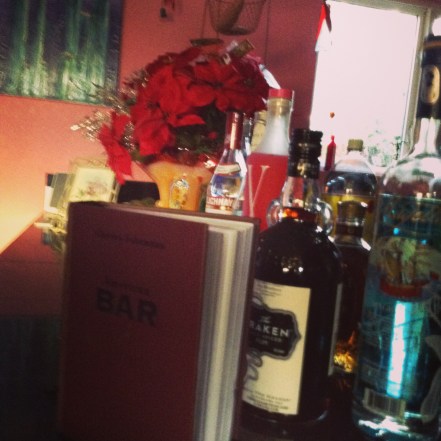
Rather than yo-yo dieting, allowing myself to totally pig out at the library right out of the gate, I have purchased three practical and useful books beyond the poetry books I will read will super mindfulness. My recent purchase, The American Bar by Charles Shumann, is a huge hit, although I have not finished reading it. It was center stage last night when I created a signature cocktail for one of my guests. Now that I have a fresh start I do not plan to read every book in the library before I mix my first cocktail. Reading how-to books without doing any of the things about which one reads is probably pointless. I think the remedy was well timed and perfect for me. My name is Pamela Morse and I am a book-a holic. As a recovering reading addict I will allow myself to go to libraries, but no used book stores for now. I need to know that I can stay in control. So far, so good.

Justice
What is obstruction of justice, exactly? Many of us feel that somehow our relationship with the government is unjust. We think our tax dollars are spent without enough consideration. We feel cheated. We feel mislead. The formal definition of obstruction of justice is complex and complicated. Federal law defines perjury as obstruction thusly:
I. Whoever
II. a. under oath or b. in any
i. declaration,
ii. certificate,
iii. verification, or iv. statement
under penalty of perjury as permitted under Section 1746 of title 28, United States Code376 III. in any proceeding before or ancillary to
a. any court or
b. grand jury of the United States
IV. knowingly
V. a. makes any false material declaration or
b. makes or uses any other information, including any
i. book,
ii. paper,
iii. document,
iv. record,
v. recording, or vi. other material,
knowing the same to contain any false material declaration,
shall be fined under this title or imprisoned not more than five years, or both.377
So if you lie to the Feds about Federal law you will be in trouble with the court. Richard Nixon was brought down for his mendacity. He made an effort to mislead the judicial system. If you were alive for Watergate his is probably the face of political hanky panky at it’s most absurd. Since Nixon, however, we are not feeling that our democratic tax dollars are used fairly. We see our elected officials blatantly serving the lobbyists who support them. We see the giant and growing discrepancies between the most wealthy and the poverty-stricken. We are watching as liberty and justice for all vanishes from the United States of America. A sliding scale for prosecution of crime fills the jails and penitentiaries with people of color while the banker robbers of the world are still mostly loose on the town. There is now a sense that the government spies on the citizens, lies to the citizens, and often fails to serve the interests of the citizens. The fourth branch of government is now lobbyists. We never see their faces, but we know they are out to lunch with our elected officials and we are not. In our guts we know this is unfair.
Gifford Genealogy
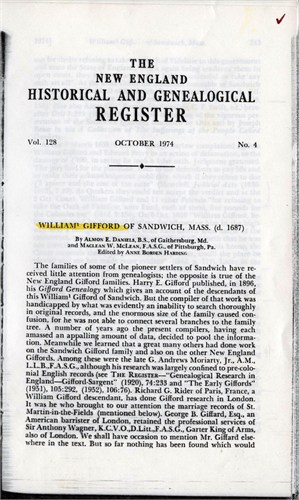
My 9th great grandfather was born in England and died in Sandwich, MA. He was a Quaker who was persecuted for his faith. He refused to sign the oath of fidelity to England, so he hd a hard time with the colonial authorities.
There is a record in England of a “Guilielm Gifford” (i.e., William Gifford) who married Elizabeth Grant on 11 February 1635 in St. Martin-in-the-Fields, London. Also, the London Merchant Taylors’ Guild shows a record: “William Gifford, son of Anthi (sic) Gifford of Dublin in the kingdom of Ireland, gentleman, apprenticed to Thomas Southerne of New Exchange, London, for a period of seven years from 7 December 1628.” Apprentices were forbidden to marry, so this would mean the apprenticed William Gifford would have been given his freedom 7 December 1635, in perfect time to be the one who married 11 February 1635/1636. Also, the records of St. Martin-in-the-Fields show that an Ananias Gifford married Maria Read on 18 November 1621. Ananias (also spelled Hananias, Hannaniah and Annaniah) is a relatively rare name. William named one of his sons Hannaniah, and the name has been carried down in the family. Also, the name occurs in the Giffords of Dry Drayton, county Cambridge, England. But it cannot be proven that these English records apply to the family of William Gifford of Sandwich.
Nor can the English ancestry of William Gifford of Sandwich be proven, according to Daniels & McLean. “English Giffords can be traced back to Normandy at the time of William the Conqueror when most branches usually spelled the name Giffard. Inevitably the temptation to connect the Sandwich Giffords with these celebrated families has produced a rash of printed accounts in which the connection is stated as fact but without solid references. (Cutter’s “Genealogical History of Western New York,” 2:901; “History of Bristol County, Mass.;” “Vineland (N.J.) Historical Magazine,” 3:32; “Seabury-Gifford Families,” Hartford (Conn.) 1941) In view of the fact that highly skilled professional genealogists have found no proof as yet of such connections, it can only be said that evidence has yet to be found to confirm these wishful thoughts.”
William Gifford of Sandwich was a Quaker, and as such, suffered persecution for his faith. “Little Compton Families” says “It is supposed that he was the William Gifford who in 1647 or earlier was ordered by the court at Stanford to be whipped and banished.” On 1 June 1658, he was one of a dozen men who “all of Sandwich were summoned, appeared to give a reason for theire refusing to take the Oath of Fidelitie to this government and unto the State of England, which again being tendered them in open court, they refused, saying they held it unlawful to take any oath att all.” At the court held 2 October 1658, they were fined L5 each. At the court held 1 March 1658/1659 George Barlow, Marshall for Sandwich, Barnstable and Yarmouth, complained against William Gifford and Edward Perry in an action of defamation, asking damages of L100, in saying he took a false oath. The defendants were ordered to pay 50s and make their acknowledgement publically, or else be fined L5 plus costs. As Quakers, they could not accept the verdict, and at the 2 October court William Gifford and 11 other Friends were fined L5 for refusing to take the Oath of Fidelitie. At the June 1660 court Gifford was again summoned to take the oath, again refused, and was again fined L5. In October 1660, for persisting in his refusal and for attending Quaker meeting, he was fined L57 — an enormous sum for those times. At this point he disappears from the records, and may have left Plymouth colony, but where he went is unknown. It has been suggested that he went to New Jersey which, like New Amsterdam, was then under the control of the Dutch. On 8 April 1665 William Gifford was one of the signers of the Monmouth (NJ) Patent, but there is no evidence he actually settled there; his sons Christopher and Hannaniah did, however. In a deed by his son Christopher William was described as a tailor.
On 10 November 1670 Mr. Gifford bought from mistress Sarah Warren of Plymouth, widow of Richard Warren, one half her share in the land at Dartmouth, which he gave equally to his sons Christopher and Robert by deed dated 6 May 1683. In 1673 William Gifford purchased land in Suckanesset (Falmouth) from the Indian Sachem, Job Noantico. Gifford continued to appear in Sandwich town records and in records of the Sandwich Friends meeting, and he married Mary Mills, also of Sandwich, at the Friends Meeting of 16 day 5 mo: 1683. Thirty witnesses signed the certificate, but none of William Gifford’s children signed the document, nor did James Mills, Mary’s brother.










I became familiar with this legal term when my parents were robbed by lawyers who worked for a care home owner. A young lawyer obtained the signatures of my severely mentally impaired parents in front of no witnesses and proceeded to use those signatures to rob them at the bank, destroy all their civil rights, trapping my dad in the care home, as was the plan. Two weeks after they robbed and attacked my parents they ran away but kept about $8000 or so for the so called services they had performed. To recover from this attack my parents’ real lawyer had to work and be paid to restore their estate plans and civil rights. It was costly and destructive as well as blatantly criminal. I wrote to everyone including John Evans, the Federal prosecuting attorney in Tucson. I was told that since they had obtained the signatures, even though they did not know my parents and had drastically damaged their health and well being, as well as their finances, they were allowed to pretend for those two weeks to represent my parents and be paid for it. The FBI initially investigated the case and told me there was obvious fraud. Later they told me they had to drop the case because the border issues demanded all the man power in Tucson. It felt distinctly as if the Feds decided that lawyers can commit crimes because they will fight back if you attempt to bust them for their obvious crimes. It is easier to pick on border crossers than your friends at the AZ Bar. Eventually the Bar did slap the young lawyer on the wrist, but he had already left the firm where he had robbed my parents. To say that I lost all respect would be an extreme understatement.
I have now owned a home that is supposed to be governed by an HOA. The people on our HOA board have refused to do anything that AZ law requires of them, but have insisted that they have a right to invite the general public here to donate to a charity scam they have run in the condo next door to me and at the curb for many years. Feeding the Homeless in Tucson Parks is the philanthropical outreach our HOA board has used to express their special jurisdiction here in our public areas. This 100% criminal operation has been been in operation in this same location for many years. Since they have never been stopped breaking AZ law or stealing money from the dues directly they decided to give themselves the right to use the non profit corporation (our HOA) and our public areas and driveway to operate this charity scam. None of the volunteer hours, or truck loads of bread, or cash donations that came in the mail, or items left in the driveway for many years has ever been reported to the IRS. I have been informed by the HOA lawyer that the board has broken no laws by using our property to run this criminal scam. That means they plan to continue to use the fire lane in front of my home to invite the public here to be hostile to the entire neighborhood and pretend they are doing philanthropy. The latest known solicitation for donations was done to Tucson Appliance for a new stove this spring. That stove belongs in a homeless shelter or the food bank, not in a residential condo that has been used for criminal purposes. If soliciting drive by donations and pretending to be a charity is not a crime against the neighbors and society I think it would be very hard to find one. My neighbors and I have reported these crimes for years, but law enforcement has not been available to stop this. I have the impression that law enforcement cares very little about stopping crime or enforcing laws. I may be wrong, but we shall see.
If you are asked for donations from anyone, ask to see the 501C3 the IRS issues legal charities. It is apparently easy to operate fraudulent philanthropical donation sites for many years with no interference from the IRS. Our local law enforcement has practiced and advised willful blindness to these crimes, which I think is incredibly weird. I have hired and put a lawyer on retainer because this has gone on for too long and seriously damaged our property value. I think we are entitled to law enforcement from the agencies we pay to enforce the law. However, if you need to hire and pay a lawyer to show those agencies probable cause it is better than allowing crime to trash your neighborhood.

Dr Kenny
In May I was asked to draw a time line of my spiritual life. The participants in Thomas Moore’s workshop at Kripalu gathered in small groups to discuss what we found drawing the timelines. The brief discussion among 3 students was revealing and gave me much to ponder. One of us had been drawn to church and attending mass by herself as a child, with no particular parental support for her daily devotion to Catholic ritual. The other woman in my group had been influenced heavily by her environment and felt trapped without a known exit strategy. My own timeline referred to my parents and briefly to church (because I only had to be a Sunday school student for a couple of years) but after the age of 16 had nothing to do with formal religion. The exercise was quite challenging, finding the major spiritual events or pivotal points in the soul’s journey.
My studies in Sacred Contracts with Carolyn Myss also includes assignments to create archetype timelines. I am finding this practice to be the most powerful of all the exercises I have ever used. It seems we warp the past and forget much of what seems extraneous, storing symbols that represent the events or people rather than storing an accurate version of reality in the past. I went to my elementary school a few months ago in the company of the people with whom I attended elementary school. We reminded each other of the past, but we had different versions edited and stored in our vaults of memory. When we toured the auditorium I knew it was the scene of one of my first encounters with the rebel archetype. On the occasion of my third polio shot I became violent with the nurse, principal and staff who were trying to inoculate me. I curled up in a chair in the front row and used my feet to strike out at the adults. I won the battle and did not get that shot. The school never informed my parents, so I was 3rd vaccination free until the oral type came out and we all took it again. Victory was sweet, and I felt that I had vanquished a dangerous and vicious foe. It was Valentine’s Day. I returned to my classroom uninoculated in my little red and white dress. A rebel was born.
When I saw the auditorium as an adult I found myself walking next to a classmate who has become a medical doctor. I also found myself giving Dr. Kenny, who was extremely popular and cool as a kid, a very hard time about his decision to practice medicine. I don’t dislike Kenny at all, but was completely involved in a highly displaced freak out over medical procedures I do not trust. This rebel theme continues throughout my life with a special concern over medical professionals and everything they do. Rational or not, my mistrust for all things allopathic has grown and I believe it has served me well. What I have discovered by creating timelines to assist my memory is that these themes that started early in life have shaped our lives and decisions in profound ways. Opposite my rebel archetype is the teacher archetype who wants to teach others healthy alternatives and self care. Duality is inherent in looking into the past. We are the actor, director, and the script writer of our own dramas. Once we have edited the memory of events it is likely we have hidden our own shadow qualities from ourselves. To make peace with past agreements and commitments gone sour it is necessary to find what part one played at the time. Timelines are like story boards that illustrate the flow of events and emotions that created our past. Our futures will be defined by our understanding of the past. I think I am having a big breakthrough realizing that Kenny would never hurt me, and maybe I have vexed myself unnecessarily over fear of medical professionals giving me shots. I can probably stop striking out at the adults with my patent leather shoes. Thanks, Dr. Kenny, for the fabulous Jungian analysis. I feel much better now.

Theobald at rest
My 21st heat-grandfather was the first butler in Ireland. This position granted him the prisage of wines. His father had been the hereditary butler of England before him. He lost his butler position for a couple of years because of irregularities as a sheriff. He seems to be descended from William the Conqueror, which brings us to the Doomsday book, but there is much to investigate to know if that is true conclusively. For one thing Henry II had so many oral bastards that he is the all time champ of British monarchs, I believe.
The ancestry of Theobald FitzWalter, the first Butler of Ireland, has been a fruitful theme for genealogists. No fewer than eight versions have been advanced at various times, including one that his mother was a sister of St. Thomas à Becket. This claim was put forward by the 4th Earl of Ormonde in 1444, when he procured an Act of Parliament declaring his descent from the martyred Archbishop. Despite this legislative authority, doubt has been cast on the claim by irreverent modern genealogists, who have pointed out that if the legend were true, the Butler ancestress would have been a grandmother at the age of eight! But while the descent from Agnes à Becket must be rejected, there is reason to believe that she was closely connected by marriage to Theobald FitzWalter, which may have given rise to the family tradition.
In 1937, the Hon. Patrick Butler (now lord Dunboyne) wrote a monograph in which he summarised the various versions of the early ancestry of the Butler family. This was followed in 1939 by Mr. T. Blake Butler’s Origin of the Butlers of Ireland. In this erudite and well-documented paper, Mr. Butler, showed that Theobald FitzWalter’s father, Hervey Walter (with whom the Ormonde pedigree commences in Burke’s Peerage) was grandson of Walter, who is mentioned in Doomsday Book as holding 27 manors in Norfolk and Suffolk, and who, Mr. Butler surmised, was connected with the Malet family. Further researchers made by him have confirmed this conjecture, and established that the above-mentioned Walter was in fact Walter de Caen, whom genealogists identify as a brother of William Malet, the great East Anglian landowner who fought at Hastings, and is said to have been the only companion of the Conqueror who was half English. It was perhaps for this reason that he was entrusted by William with the task of burying the body of King Harold on the seashore after the battle. As a result of Mr. Blake Butler’s researches, the house takes its place among the very few families in the Peerage who can trace their ancestry in the male line to the Norman Conquest.
L’envoi“The history of the illustrious house of Butler of Ormonde”, wrote Sir Bernard Burke, “is in point of fact, the history of Ireland from the time of the Anglo-Norman invasion. At the head of the great nobility of that country have ever stood the Butlers and the Geraldines, rivals in power and equals in renown.”
The families who are the subject of this memoir were cadet branches of that famous house, and they are not of course comparable in historical importance to the main line of the Ormonde earls. But the story unfolded in these pages shows that they too, played a part in historic events in Ireland which should not be lost in oblivion.
Theobald I FitzWalter, 1st Chief Butler of Eng & Ire, de Butler (Boteler) (1170 – 1206)
Theobald Walter or Theobald Butler or Theobald Walter le Boteler was the first Baron Butler and the first Chief Butler of Ireland. He also held the office of Butler of England and was the High Sheriff of Lancashire for 1194.[1] Theobald was the ancestor of the Butler family of Ireland. He was involved in the Irish campaigns of King Henry II of England and John of England. His eldest brother Hubert Walter became the Archbishop of Canterbury and justiciar and Lord Chancellor of England.
Family
Theobald was the son of Hervey Walter and his wife Maud de Valoignes, who was one of the daughters of Theobald de Valoignes.[2] Their children were Theobald, Hubert – future Chief Justiciar and Archbishop of Canterbury, Walter, Roger and Hamon. Theobald Walter and his brother Hubert were brought up their uncle Ranulf de Glanvill, the great justiciar of Henry II of England who had married his mother’s sister Bertha.
Career
On 25 April 1185, Prince John, in his new capacity as “Lord of Ireland” landed at Waterford and around this time granted the hereditory office of butler of Ireland to Theobald. Theobald’s father had been the hereditary holder of the office of butler of England. Some time after, King Henry II of England granted him the prisage of wines, to enable him, and his heirs, the better to support the dignity of that office. By this grant, he had two tons of wine out of every ship, which broke bulk in any trading port of Ireland, and was loaded with 20 tons of that commodity, and one ton from 9 to 20.[3] Theobald accompanied John on his progress through Munster and Leinster. At this time he was also granted a large section of the north-eastern part of the Kingdom of Limerick. The grant of five and a half cantreds was bounded by:
“…the borough of Killaloe and the half cantred of Trucheked Maleth in which it lay, and the cantreds of Elykarval, Elyochgardi, Euermond, Aros and Wedene, and Woedeneoccadelon and Wodeneoidernan.”
These are the modern baronies of Tullough (in County Clare), Clonlisk and Ballybritt (in County Offaly), Eliogarty, Ormond Upper, Ormond Lower, Owney and Arra (in North Tipperary), Owneybeg, Clanwilliam and Coonagh (in County Limerick).[
Theobald was active in the war that took place when Ruaidrí Ua Conchobair attempted to regain his throne after retiring to the monastery of Cong, as Theobald’s men were involved in the death of Donal Mór na Corra Mac Carthaigh during a parley in 1185 near Cork. In 1194 Theobald supported his brother during Hubert’s actions against Prince John, with Theobald receiving the surrender of John’s supporters in Lancaster. Theobald was rewarded with the office of sheriff of Lancaster, which he held until Christmas of 1198. He was again sheriff after John took the throne in 1199.
In early 1200, however, John deprived Theobald of all his offices and lands because of his irregularities as sheriff. His lands were not restored until January 1202.[9] A manuscript in the National Library of Ireland points to William de Braose, 4th Lord of Bramber as the agent of his restoration:
“Grant by William de Braosa, (senior) to Theobald Walter (le Botiller) the burgh of Kildelon (Killaloe) … the cantred of Elykaruel (the baronies of Clonlisk and Ballybrit, Co. Offaly), Eliogarty, Ormond, Ara and Oioney, etc. 1201.”
“Elykaruel” refers to the Gaelic tuath of “Ely O’Carroll”, which straddled the southern part of County Offaly and the northern part of Tipperary (at Ikerrin). The other cantreds named are probably the modern baronies of Eliogarty, Ormond Upper, Ormond Lower and Owney and Arra in North Tipperary.
Theobald founded the Abbey of Woney,[11] in the townland of Abington (Irish: Mainistir Uaithne, meaning “the monastery of Uaithne”), of which nothing now remains,[12] near the modern village of Murroe in County Limerick Ireland around 1200.[11] He also founded the Cockersand Abbey in Lancaster, Abbey of Nenagh in County Tipperary, and a monastic house at Arklow in County Wicklow.
Issue
Theobald married Maud le Vavasour, heiress of Robert le Vavasour, a baron of Yorkshire,[2] John Lodge in the Peerage of Ireland in 1789 gave the year as 1189, but on no apparent authority, as no other author follows him on this. He died between 4 August 1205 and 14 February 1206, and was buried at Owney abbey. Their children were Theobald le Botiller, 2nd Chief Butler of Ireland and a daughter Maud who married Gerard de Prendergast who had an only daughter who married John de Cogan.
I like this ad for Brits drinking tea so much I wanted to share it with you. I noticed the tea comes from a company called Taylors…I do hope these are the folks from my ancestral family, but there were and are a whole lot of Taylors. Either way the ad makes me very happy. Enjoy!!

St George Cross
My 23rd great grandmother was the sister of Saint Thomas Becket, Archbishop of Canterbury. She is the ancestor of Margaret Tyndale, whose husband was burned at the stake for reading the bible in English. Although they spend several generations as the official bottlers to the royal Brits (a much more entertaining and lucrative employment), they revert to religion like salmon swimming upstream. They go on crusades and get crazy over the crown and religion. My own great grandfather Taylor was a preacher and a Confederate soldier. You might say it is in the blood.
Lady Gilberta Godiva le Becket (1100 – 1186)
my 23rd great grandmother
Hervey Butler (Boteler) (1130 – 1190)
son of Lady Gilberta Godiva le Becket
Theobald I FitzWalter, 1st Chief Butler of Eng & Ire, de Butler (Boteler) (1170 – 1206)
son of Hervey Butler (Boteler)
Theobald II le Boteler (1200 – 1230)
son of Theobald I FitzWalter, 1st Chief Butler of Eng & Ire, de Butler (Boteler)
Lady Maud Matilda DeVerdun Countess DeBoteler Countess Arundel (1225 – 1283)
daughter of Theobald II le Boteler
Matilda Tideshall FitzAlan Baroness Corbet De Arundel (1244 – 1309)
daughter of Lady Maud Matilda DeVerdun Countess DeBoteler Countess Arundel
Sir Thomas Corbet of Moreton, Knight of The Bath Corbet (1281 – 1310)
son of Matilda Tideshall FitzAlan Baroness Corbet De Arundel
Knight Sir Robert XII Corbet, Lord of Moreton Corbet (1304 – 1375)
son of Sir Thomas Corbet of Moreton, Knight of The Bath Corbet
Sir Roger XIII (Lord of Morton) Corbet (1330 – 1396)
son of Knight Sir Robert XII Corbet, Lord of Moreton Corbet
Robert Corbet (1383 – 1440)
son of Sir Roger XIII (Lord of Morton) Corbet
Blanche Corbet (1423 – 1458)
daughter of Robert Corbet
Humphrey Coningsby (1458 – 1535)
son of Blanche Corbet
Amphyllis Coningsby (1478 – 1533)
daughter of Humphrey Coningsby
Margaret Tyndale (1510 – 1555)
daughter of Amphyllis Coningsby
Thomas Taylor (1548 – 1588)
son of Margaret Tyndale
Thomas Taylor (1574 – 1618)
son of Thomas Taylor
James Taylor (1608 – 1698)
son of Thomas Taylor
John Taylor (1685 – 1776)
son of James Taylor
John Taylor (1727 – 1787)
son of John Taylor
John Taylor (1747 – 1781)
son of John Taylor
John Nimrod Taylor (1770 – 1816)
son of John Taylor
John Samuel Taylor (1798 – 1873)
son of John Nimrod Taylor
William Ellison Taylor (1839 – 1918)
son of John Samuel Taylor
George Harvey Taylor (1884 – 1941)
son of William Ellison Taylor
Ruby Lee Taylor (1922 – 2008)
daughter of George Harvey Taylor
Pamela Morse
I am the daughter of Ruby Lee Taylor
 mermaidcamp