mermaidcamp
Keeping current in wellness, in and out of the water
You can scroll the shelf using ← and → keys
You can scroll the shelf using ← and → keys

Order of the Bath
My 17th great grandfather, Sir Thomas Corbet, was a knight. His father was a sheriff in Shropshire, a job that would be passed down through the family. His roots could be traced to Normandy before the Doomesday survey, but I have not yet followed my branches back to that date. Shropshire was near Wales, where they had quite a bit of trouble with the Welch who did some nasty castle destruction.
01. Hugo Le Corbet, Cevalier of Pays de Caux, Normandy, flourished from 1040 and 1076, and was dead before the Domesday survey of 1086.
02. Roger Fitz Corbet, Domesday Baron of Cause, formerly Alretone, Shropshire, England, as it was called in Domesday, was born about 1050 to 1056, and died about 1134 as Pagan Fitz John, sheriff and governor of Shropshire, having succeeded Richard de Belmeis, held Cause in 1134, and would not have dared to take it during Roger’s lifetime; the castle was destroyed by the Welsh attacking Pagan Fitz John. It had been one of the strongholds along the Welsh border between the rivers Dee and Wye. He married the heiress of Talsey.
03. William Corbet, second Baron of Caus, lived in Wattlesborough as the Castle of Cause was destroyed by the Welsh attack on Pagan Fitz John.
04. Simon Corbet, of Pontesburie, close to the Welsh frontier, and probably died before his father, William.
05. Thomas Corbet, called the Pilgrim.
06. Sir Richard Corbet, of Wattlesborough flourished in 1217 and 1222. May be the same person as #7, Richard Corbet below.
07. Sir Richard Corbet of Wattlesborough died before 1255. He married probably by 1196 to Joanna Toret, coheir of Bartholomew Toret of Moreton Toret, Salop, who flourished in 1196-1229 and also had lands in Yorkshire.
08. Sir Richard Corbet, son of Richard, knight of Wattesborough, flourished 1225-1248, and was Lord of Morton at the Inquest of Bradfort Hundred taken in 1255. He married Petronilla, lady of Edge Baldenham and Booley, who was living in 1272, made a grant to Buildwas Abbey in 1223, succeeded his grandfather Bartholomew Toret, and was Jusiciar of Shropshire.
09. Sir Robert Corbet, son of Richard and Petronilla was born abt 1234 in Morton Corbet, Shropshire, England. He married 2nd, Mathilda De Arundel in about 1280. He was of full age in 1255, and apparently served as the Sheriff of Shropshire (1288-1289). He died in 1300 and was buried in the chapal at Alberbury which he had built.
10. Thomas Corbet, son of Robert and Matilda was born abt 1281. He married Amice, possibly Hussey, daughter of Ralph Hussey. Thomas died in 1310 at age 29.
11. Sir Robert Corbet, son of Thomas and Amice was born on Decmeber 25, 1304. He married Elizabeth Le Strange, daughter of Fulk le Strange and Eleanor Giffard before March 1323. He was noted as lord of the Vill of Moreton Corbet in 1316, but had not been granted knighthood by 1326. He purchased Shawbury from Giles de Erdington, which property was conveyed to Thomas Gery, vicar of Morton, and Thomas de Lee of Southbache. He went to some lengths to pass his lands to Roger Corbet’s heirs. Robert died on Decmeber 3, 1375.
12. Sir Thomas Corbet, son of Robert and and Elizabeth died about 1359. He married Elizabeth (Amice).
13. Sir Roger Corbet, son of Thomas and Elizabeth was born abt 1330 in Moreton Corbet. He married Margaret De Erdington, daughter of Giles De Erdington abt 1363. He died abt. 1394.
14. Sir Robert Corbet, son of Roger and Margaret was born on December 8, 1383. He married Margaret abt 1400 whose last name is not known. As his parents were both dead when he was eleven, his wardship and marriage were granted by King Richard II to Thomas Percy, Earl of Worcester, who was obliged at the beginning of the reign of Henry IV to hand over the wardship to John Burley I of Broncroft. Robert proved his age in 1405. He served as Justice of Shropshire from March 14, 1410 to February 1416, and served the county in Parliament in 1413 and 1419. In May 1413 he and Richard Lacon (who held office on the Fitz Alan estates) joined David Holbache and Urian St. Pierre (both of whom represented Shrewsbury) in acting sureties for a Matthew ap Maredudd. In 1413 problems with tax collections were blamed on the dislike of Robert Corbet and Richard Lacon for their nominees as tax collectors. As a result indictments were brought agains Robert and Roger Corbet, Richard Lacon, John Burley II and other esquires of the Earl of Arundel. In 1415 Robert and Roger Corbet served in King Henry V’s first expedition to France. Robert was Sheriff of Shropshire in from November 23, 1419 until he died.
15. Sir Roger Corbet, son of Robert and Margaret was born about 1415. He married Elizabeth Hopton in 1450, the daughter of Thomas Hopton and Eleanor Lucy. Roger died on June 8, 1467.
16. Sir Richard Corbet, son of Roger and Elizabeth was born in 1451 in Moreton Corbet. He married Elizabeth Devereux before 1478. Elizabeth is the daughter of Sir Walter Devereux and Agnes Ferrers. Richard died on Decmeber 6, 1493.
17. Sir Robert Corbet, son of Richard and Elizabeth was born in 1477. Robert married Elizabeth Vernon, daughter of Sir Henry Vernon and Anne Talbot. He died on April 11, 1513 and was buried in Moreton Corbet. His wife Elizabeth survived him by fifty years and was called the “old Lady Corbet of Shawbury.”
18. Dorothy Corbet, daughter of Robert and Elizabeth was born abt. 1511. She married Sir Richard Mainwaring of Ightfield.



My father read Tom Sawyer and Huck Finn aloud to me when I was very young. There were other books that followed, but he really loved those two stories, and made them come alive while reading them. He liked to sing and recite poetry. We sang at parities all the time. Since we had a player piano, talent was no barrier to musical contribution. I pumped happily away for hours singing with the piano rolls. I still know the words to most of those songs, or could with some prompting, remember the lyrics. I wrote songs myself as a teen, but do not remember them at all, which is funny. I do remember The Cremation of Sam McGee by Robert W Service, which my father knew by heart. As an Okie in Pennsylvania I know he identified heavily with Sam McGee because he frequently and randomly said “Since I left Plumtree, down in Tennessee, it’s the first time I’ve been warm.”
My dad was a funny troubadour of sorts who did not know that his 8th great grandmother was Mistress Bradstreet, Pilgrim poet. He did often say,” You’re a poet, your feet show it, they’re Longfellows.” Now that I have discovered the Bradstreet connection I am revising the rhyme:
Keep the beat,
Think on your feet,
You’re a Bradstreet.
Since I found Mistress Bradstreet at the Poetry Center I am wondering about my own relationship to words and poetry. Do I have any poetic DNA that I need to develop? Curious, I attended the inauguration of Arizona’s new poet laureate, Alberto, Tito, Rios of Nogales, AZ. He addressed the crowd, read some poems, then answered some questions from the audience. He is a professor so he found it easy to teach the group. His style includes plenty of comedy, which holds the attention. An audience question was, “What is the difference between writing poetry and writing prose?” His answer was perfect and memorable. He said, ” Each line in a poem should be able to stand by itself. If one of my poems shattered and all the lines were left alone, each should be strong enough to get a good job in another poem.” I love that. I also love the Poetry Center which is very near my home. I don’t really think the lines in my poem above could find work elsewhere, but if I work on it, perhaps the spirit of Mistress Bradstreet will guide me to achieve better outcomes.
The other fine advice Mr Rios gave, which he illustrated with a story from his youth, was that you observe events and happenings in your life that will die without a story if you do not tell them. His attitude is that all of us have the potential to use words in a poetic way, and the experience enhances our own lives when we do it. We also liberate objects and events that want their stories to be told. This magical reality view of the objects comes naturally from his bilingual and bicultural background. In Spanish reflexive verbs make the world a highly animated place in which things take action. I believe Tito Rios is the perfect artistic and cultural representative who could have been chosen as our official poet. I am pleased to have been in the special inaugural audience.

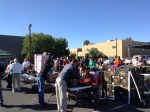
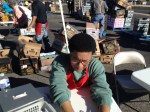




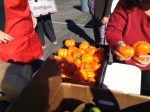

The port of Nogales, AZ is the main entry point for Mexican produce to enter the United States. There are tons of fruits and vegetables traded daily at the peak of the season. Each winter the wholesale warehouses hum with activity. The nature of the wholesale produce business requires that losses must be accepted when the goods can’t be sold or moved quickly. The 3000 Club in Santa Cruz County has created a wonderful program to stem waste at the border, and provide fresh healthy foods in neighborhoods that need more access to fruits and vegetables. They partner with churches and other facilities that have large parking lots in Tucson. The volunteer crews load semi trucks full of produce that is at peak ripe condition and send them to the parking lots where anyone can buy 60 pounds of produce for $10. This Market on the Move is saving people money, but what I like best is the distribution of fresh foods to those who might not otherwise buy or try it.
I enjoy the challenge of filling my box (Since there are only two of us at home, I do not overfill it.) with the selections of the week, then making tasty dishes with them. This week I went too late to score any tomatoes, which are always popular. Tiny watermelons were limited to two each. They look precious, and are fun to have in November. Zucchini, yellow squash, cucumbers, and golden bell peppers were the featured crops on special. I decided to juice the cucumbers, roast or grill the peppers, and make soup with the squash. The Market on the Move is like the show Chopped on Food Network, in which you prepare dishes from what you find in the basket. I try to recruit some help from my neighbors as soon as I get home. My friend Mindy has just returned from Philadelphia where her son in law is a fancy chef. She passed along a roasted bell pepper soup recipe while I convinced her to take some home. The chef makes his soup with roasted peppers, a tiny bit of stock and cream cheese. Mindy and I decided that this was very fine, but we are going to use mascarpone since we have no allegiance to Philadelphia. If you have some good ideas that relate to bell peppers or squash I am very interested right now. If you live in a city that offers this sport, the ingredient challenge, I urge you to try it. For $10 you have little to loose.


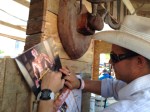






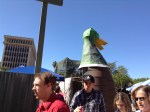





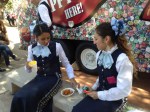
I attended the anual chili cook off to support our local firefighters union. Each station designs a booth and makes a chili dish. The chili is judged by a panel, and the booth design is judged by popular Facebook vote. The annual event is a really fun way to meet locals and enjoy time downtown. The creativity of the booth design and the costumes always amuse. This year the Drexel Heights Station outdid themselves with a Duck Dynasty theme. I took my calendar with me and was able to find four of the guys to give me autographs on their pictures. They serve beer and play live music, but it differs from other community events in that the firefighters union uses all the proceeds to adopt families in need to help them. We don’t have the opportunity to see our firefighters all together at the same time very often. Seeing them enjoy themselves so much and serve the community too is a blast. We love our firefighters in Tucson. They keep us safe and represent the spirit of the town in a friendly and creative way. I bought a tee shirt for Bob which he will like a lot, and an apron for myself, to remind me not to burn down the house.
This is much more appealing than writing a novel.
There’s a lot of buzz each November around NaNoWriMo — you may notice some of your favorite blogs dedicating themselves to churning out 50,000 words this month.
If 50,000 words seem like 49,000 too many or you’re more interested in blogging than writing a book, NaBloPoMo — National Blog Posting Month — might be your speed: a challenge to post once every day for the entire month of November. No theme, no word count, no rules; just you, your blog, and 30 new posts.
NaBloPoMo started in 2006 in response to NaNoWriMo; not every blogger has the time or inclination to write a book, but the idea of a challenge that forces participants to stretch themselves, grow as bloggers, and be part of a supportive community is undeniably appealing. As founder Eden Kennedy, the power blogger behind fussy.org, put it:
If there’s one thing creative people…
View original post 782 more words

Maud
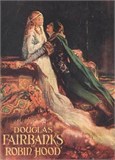
Maud as Maid Marian
My 21st grandmother married two husbands, the second of which (not my grandfather), was Robin Hood:
Maud le Vavasour, Baroness Butler
Following the death of Theobald in early February 1206, Maud returned to England into the custody of her father, who, having bought the right of marrying her at the price of 1200 marks and two palfrys, gave her in marriage, on 1 October 1207, to Fulk FitzWarin.[3] Fulk was the son of Fulk FitzWarin and Hawise de Dinan, who subsequent to a violent quarrel with King John of England, sought refuge in the woods and became an outlaw. Maud accompanied him. The legendary figures of Robin Hood and Maid Marian are said to be based on Fulk and Maud.
By FitzWarin, Maud had a son and a daughter:
DeathMaud le Vavasour died sometime before 1226. She had numerous descendants including the Earls of Ormond, the Earls of Arundel, Anne Boleyn, Mary Boleynand Elizabeth I.In fiction
Maud is the main protagonist in Elizabeth Chadwick’s The White Castle, which relates in highly fictional form, her life and adventures as the wife of Fulk FitzWarin.
References
Maud le Vavasour (1187 – 1282)
is my 21st great grandmother
Theobald II le Boteler (1200 – 1230)
son of Maud le Vavasour
Lady Maud Matilda DeVerdun Countess DeBoteler Countess Arundel (1225 – 1283)
daughter of Theobald II le Boteler
Matilda Tideshall FitzAlan Baroness Corbet De Arundel (1244 – 1309)
daughter of Lady Maud Matilda DeVerdun Countess DeBoteler Countess Arundel
Sir Thomas Corbet of Moreton, Knight of The Bath Corbet (1281 – 1310)
son of Matilda Tideshall FitzAlan Baroness Corbet De Arundel
Knight Sir Robert XII Corbet, Lord of Moreton Corbet (1304 – 1375)
son of Sir Thomas Corbet of Moreton, Knight of The Bath Corbet
Sir Roger XIII (Lord of Morton) Corbet (1330 – 1396)
son of Knight Sir Robert XII Corbet, Lord of Moreton Corbet
Robert Corbet (1383 – 1440)
son of Sir Roger XIII (Lord of Morton) Corbet
Blanche Corbet (1423 – 1458)
daughter of Robert Corbet
Humphrey Coningsby (1458 – 1535)
son of Blanche Corbet
Amphyllis Coningsby (1478 – 1533)
daughter of Humphrey Coningsby
Margaret Tyndale (1510 – 1555)
daughter of Amphyllis Coningsby
Thomas Taylor (1548 – 1588)
son of Margaret Tyndale
Thomas Taylor (1574 – 1618)
son of Thomas Taylor
James Taylor (1608 – 1698)
son of Thomas Taylor
John Taylor (1685 – 1776)
son of James Taylor
John Taylor (1727 – 1787)
son of John Taylor
John Taylor (1747 – 1781)
son of John Taylor
John Nimrod Taylor (1770 – 1816)
son of John Taylor
John Samuel Taylor (1798 – 1873)
son of John Nimrod Taylor
William Ellison Taylor (1839 – 1918)
son of John Samuel Taylor
George Harvey Taylor (1884 – 1941)
son of William Ellison Taylor
Ruby Lee Taylor (1922 – 2008)
daughter of George Harvey Taylor
Pamela Morse
I am the daughter of Ruby Lee Taylor
The Celtic holiday Samhain is still celebrated by some on October 31. The city of Dublin is embracing the ancient holiday in new ways. Poetry is a way to create connection with the future and also with the past. Some poems and songs survive from anonymous authors, while ancient Greeks are preserved in drama, ode and epic. Translation is a tricky thing, especially when translating Pagan rituals to Catholic practices. My ancestors, the O’Byrnes, came from County Meathe where Samhain was and is celebrated. I hope someday to visit Dublin to see these Irish in action with their ancient tradition.
Since I am in Tucson, with a strong and popular All Souls’ Day party I plan to add poetry this year by attending the reading on Friday night at the U of A Poetry Center by our new poet laureate. He is from the border, our own very specific and special place. This border has been directly responsible for plenty of death, and plenty of opportunity. In a spiritual sense our border has never been real, but artificial, setting a trap, catching little prey. It makes crime irresistible to the desperate. It works to incentivize illegal behavior. If the dead are visiting this week they will have no trouble crossing the border, even though they may have died trying. I look forward to the experience.



This holiday season I have decided to create a diet plan. Each year we splurge eating outside of our normal diet to enjoy some seasonal goodies both at home and out and about. I think it is silly to deny yourself all relatively unhealthy foods since it creates a special power around the food. You can taste almost anything, then put it down and walk away without harming yourself. Moderation in all things may seem stingy in comparison to the commercial holiday cheer with merchandise at the base of it all. Gifting or not gifting is easy at our house. We like experiences better than items so very few presents are given unless they are special yard sale finds. We love art, but filled our home already, so we have to go to galleries and museums to see anything new. Our tradition involves making treats and attending special events. This season I am mindfully setting a budget, not so much in dollars, but in calories, alcohol, and fat.
If I allow myself to be mindless at the supermarket I end up with a lot of unhealthy treat ingredients that will become cookies, etc. I have become a creative bartender and now have a vast array of interesting liquor with which to mix cocktails. The idea of the taste profile of the cocktail is to enhance your snacks or meal. I enjoy creating new cocktails from recipes and sometimes by experiment. Since I enjoy taking risks in the kitchen, my bar tending is a natural extension of that exploratory spirit. I am carried away with using seasonal ingredients and the fruit from my garden in cocktail recipes. I could not work at a bar since I know few classic drinks, but in terms of kinky creations I get better all the time. Therein lies the problem. These tasty spirits take over the situation and decide that moderation is out the window for the night. One good taste leads to another. Last winter I did allow the spirit of alcohol to leave the barn door open for the spirit of sugar and other inferior foods to enter my body in mass quantities. My general health suffered from this overdose, and required reform of my diet in order to recover.
This winter as the nights grow longer and the wood stove glows I am starting a written log of what I eat and drink. This is not for publication, but for my own information. I will not allow sneaky spirits, holiday or otherwise, make me fat this winter. They have no power over me. I never drank hard alcohol until a couple of years ago when I bought some cheap bourbon to pour on my dad’s grave on All Soul’s Day. My parents both loved to cocktail way too much, which was responsible for many of their health problems. I have chosen to have a different relationship with alcoholic spirits. Cheers! Happy Holidays! Think before you drink!!!
Tethys was a titan, which means an original goddess, before Zeus and the Olympians took over the pantheon. Her sisters were Nyx and Gaia, who ruled darkness and the earth. She was Mother of the Sea, ruling clouds, springs, rivers, and streams. Her children were called Oceanids. Water is the emotional element; Tides, currents and undertows closely resemble human emotional forces. The energy or wave of an emotion passes through the body as well as the life of the person involved. Tethys is known as the goddess of nursing, and if you think of feeding the earth with clean water, her services are needed more than ever today. To get in touch with Tethys realize that flow and currents can be ridden, but it is folly to fight against them. Emotional problems are the same; Denial or repression will not end them, but can make the ride much rougher. You can not change the waves, but you can learn to surf.
The month of novels is almost upon us. Is this your year?
It’s just a few days until November, and you know what that means: National Novel Writing Month, better known ’round these parts as NaNoWriMo, is near.
We know some of you have been waiting all year for this month! For those of you who are new to this project, here’s the gist:
View original post 894 more words


