mermaidcamp
Keeping current in wellness, in and out of the water
You can scroll the shelf using ← and → keys
You can scroll the shelf using ← and → keys
The era of click to endorse has only just begun. The competition for likes, comments, retweets and tagging is intense and will only become more brutal. LinkedIn has become very brazen in promoting endorsement clicks as a means to engage. Along with inviting 14 year olds to join, they have started to promote connection in a new creepy way. People you may know flashes before your eyes as you check LinkedIn for any reason. I have found new connections from whom I received no invitation, and I am sure I did not invite. I had basically left my profile there alone for months, only to return and find myself endorsed by people I have never met. The reason I had not been involved for a while was an aversion to this spammy, very bogus kind of alleged professional conduct.
I have joked extensively about this with others and have noticed other bloggers taking up the subject. I have decided to do something about the endorsement situation from my own point of view. First, let me say that if you don’t know me and want to give me endorsement clicks on LinkedIn please continue to feel free to do so. The space for written endorsements is still available for the purpose of praising real life shared professional experiences. I intend to use it to create video endorsements of people I actually want to endorse. They will praise people I know and with whom I have had some experience that has been positive. I hope this revolution in candor will raise awareness about all those people who crave endorsement, but who lack the understanding or the skills to acquire it in real life. We need to show them compassion without enabling them.
In archetypal roles we have potential to play out a positive aspect of a well-known character, such as the king, or play the shadow aspect. The king is such an essential male character in myth and culture that most men see themselves in some way to be a king. King of the home castle may be the only one, but there is a royal male at some point that will be portrayed by a man. The inner king and queen relationship, the balance between understanding and wisdom vs discipline and justice is at the heart of any society. When power is in the hands of weak or corrupt leadership, even within one’s own personality, balance must be restored for the good of society. When we see the strife in Syria and Egypt today it looks like the end of civilization.
The war and economic destruction still rampant in the world is the collective consciousness struggling with this ruling authority. I wonder, when I watch my neighbors as well as rioting middle easterners, if the earth will perish in flames sometime soon. Radioactivity is spewing out of Japan and sewage rolling into rivers all over the globe. When post apocalyptic themes are portrayed in fiction they seem too close to reality today. I love the movie Tank Girl which is a parody about authority, power, and the use of resources. Tank Girl is part of a severely abused underclass, dominated by the all-powerful utility company. They control all resources, except the resourcefulness of Tank Girl herself.
In 1469 in what is now Pakistan, the Sikh religion was born in the form of a teacher, Guru Nanak. He was exceptional as a student, grasping deep meaning at an early age. At this time in history Muslims and Hindus were close and friendly in that part of the world. His ministry was as a poet and musician, a travelling troubadour. He began a line of 10 gurus who passed the hymns and stories along to the future generations. Today Sikhs keep these traditions alive by teaching their children the ancient shabads. They welcome visitors to take part if they like, but there is no attempt to convert. Most Sikhs were born in India to Sikh parents. Understanding some history and philosophy fosters respect for the religious beliefs and practices of others. The group gathers for a meal after the ceremony, which is social and friendly.

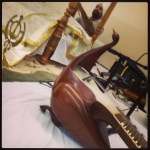
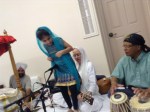
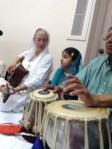
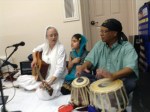
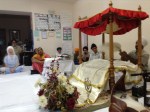
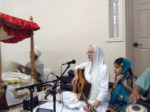


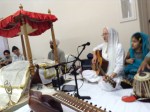
I attended the services of the Sikh gurdwara to see and hear my friend Nirviar Kaur Khalsa play her instrument, the taus. She showed me the beautifully carved string instrument a few weeks ago after the services had concluded. She practices on the taus about two hours daily to create the background ragas for the shabads she chants for the ceremony. Her voice is very well practiced to paint these musical pictures of the one, the friend, the eternal guru. The message reminded me of the Sufis, but the service reminded me a lot of Jews and Catholics. The music is all in minor keys (like Jewish music) , and there is no written vocal music. This technique is passed down in person in the same way the Torah is taught in person. The music itself is the prayer and the meditation for the congregation, not unlike chanting in Latin or Hebrew. Her vocation to study and revive some of the most ancient shabads is now her passion. She shares this talent and hard work because she wants to embody inner peace in the Sikh tradition. Although I am not a Sikh I can appreciate her historical preservation efforts as well as the ideas she promotes in her practice.
I asked some of the congregation how they feel about her dedication to master this ancient art and religious practice from India. She is very highly praised by everyone. One lady I had met on my previous visit told Nirvair as she left she wished she could leave a tip for the music, which is a common practice in India. It is remarkable that she is so committed to her vocation to preserve this tradition here in the United States. I learned that professional ragis from Phoenix charge $500 a visit to come to your gurdwara and do the music. Since the entire service is sung the importance of the musical accompaniment is central to the experience.

Coat of Arms Inchmartin
My 20th great-grandmother, Isabel Inchmartin, was an heiress in Perthshire, Scotland. She inherited lands that were known to be rich in salmon fishing. She was born in Perth and died in Fife. Times were tough in those days, so her survival for 59 years was impressive. She was able to pass her lands down through her daughters, which is also impressive, considering the times.
Isabel Inchmartin (1340 – 1399)
is my 20th great grandmother
Margaret Erskine (1357 – 1419)
daughter of Isabel Inchmartin
Isabel Glen (1380 – 1421)
daughter of Margaret Erskine
Isabel Ogilvie (1406 – 1484)
daughter of Isabel Glen
Elizabeth Kennedy (1434 – 1475)
daughter of Isabel Ogilvie
Isabella Vaus (1451 – 1510)
daughter of Elizabeth Kennedy
Marion Accarson (1478 – 1538)
daughter of Isabella Vaus
CATHERINE GORDON (1497 – 1537)
daughter of Marion Accarson
Lady Elizabeth Ashton (1524 – 1588)
daughter of CATHERINE GORDON
Capt Roger Dudley (1535 – 1585)
son of Lady Elizabeth Ashton
Gov Thomas Dudley (1576 – 1653)
son of Capt Roger Dudley
Anne Dudley (1612 – 1672)
daughter of Gov Thomas Dudley
John Bradstreet (1652 – 1718)
son of Anne Dudley
Mercy Bradstreet (1689 – 1725)
daughter of John Bradstreet
Caleb Hazen (1720 – 1777)
son of Mercy Bradstreet
Mercy Hazen (1747 – 1819)
daughter of Caleb Hazen
Martha Mead (1784 – 1860)
daughter of Mercy Hazen
Abner Morse (1808 – 1838)
son of Martha Mead
Daniel Rowland Morse (1838 – 1910)
son of Abner Morse
Jason A Morse (1862 – 1932)
son of Daniel Rowland Morse
Ernest Abner Morse (1890 – 1965)
son of Jason A Morse
Richard Arden Morse (1920 – 2004)
son of Ernest Abner Morse
Pamela Morse
I am the daughter of Richard Arden Morse
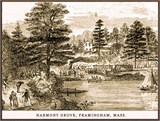
Framingham, MA

Rice Coat of Arms
My tenth great-grandfather came to America with his parents. He became the deacon of a church, as his father had been. This may explain why he changed his name from Edmund to Edward, to distinguish between the two Deacon Rices. He lived to a ripe old age in Massachusetts.
Edward Rice (1622 – 1712)
Deacon Edward Rice1,2 (M)b. c 1619, d. 15 Aug 1712, #57
Deacon Edward Rice was the son of Deacon Edmund Rice and Thomasine Frost. Deacon Edward Rice was christened on 26 October 1622 at Stanstead, England; (20th per Rice Gen’l Register) under the name Ryce. The 1622 baptism record gives the child’s name as Edmund, not Edward. Nonetheless, your authors are convinced that Edward was the child baptized (and of course born) that year, and that he exaggerated his age in later life.3,4 He married Agnes Bent circa 1647.5,3,6 Deacon Edward Rice died on 15 August 1712 at Marlborough, MA, at about age 93. 5, 7 He received one lot in the Sudbury Two-Mile Grant in 1655. In 1655 at Sudbury, MA.8 He resided in 1664 at Marlborough, MA, were he was a Deacon of the church.9 He declared age 42 in a paper filed in court on 2 October 1666 at Middlesex County Court, Cambridge, MA.10 He was assessed 8s 7d in the 1688 Marlborough tax roll. In 1668 at Marlborough, MA.11 He was in a land transaction on 1 April 1686 at Sudbury, MA, to their son Edmund Rice of Sudbury, half of the farm lying within the bounds of Sudbury, “near the spring”. (Edward had purchased this from his father Edmund and some purchased from his brother Benjamin. John Rice of Sudbury, a brother of Edmund had the choice half.) Deed recorded 16 August 1734.5,12 He was elected deacon in 1687.13 He was questioned in court aged 70y in 1692 at MA.14 A 1712 obituary in the Boston News Letter gave the death year as 1711 and said he had been born in Berkhamstead in 1618. It also said he had 142 descendants at that time, of which 119 were living. It further said that Edward’s brother Henry, who had died in Framingham in 1711, had a similarly large number of descendants.15 WRN: 3.
Children of Deacon Edward Rice and Agnes Bent:
Lydia Rice (30 Jul 1648 – 30 Jul 1648) Lydia Rice (10 Dec 1649 – 24 Sep 1723) John Rice (20 Dec 1651 – 06 Sep 1719) Deacon Edmund Rice (09 Dec 1653 – 25 Sep 1719)Daniel Rice (08 Nov 1655 – 14 Jul 1737) Caleb Rice (08 Feb 1657 – 27 Apr 1658) Jacob Rice (02 Feb 1660 – 30 Oct 1746) Anna Rice (19 Nov 1661 – 02 May 1731) Dorcas Rice (29 Jun 1664 – 24 Mar 1753) Benjamin Rice (22 Dec 1666 – 23 Feb 1748/49) Abigail Rice (09 May 1671 – a 1709)
Birth: Oct. 20, 1622
Stanstead
Suffolk, England
Death: Aug. 16, 1712
Marlborough
Middlesex County
Massachusetts, USA
Edward was the son of Deacon Edmund Rice and Thomazine Frost.
He married Agnes Bent, daughter of John Bent and Martha Blanchard, in 1646, Massachusetts.
They were the parents of at least eleven children
Lydia Rice July 30, 1648-July 30, 1648
Lydia Rice December 10, 1649-September 24, 1723
John Rice December 20, 1651-July 28, 1733, married Tabitha Stone, May 20, 1655-1720
Edmund Rice December 09, 1653-September 25, 1719
Daniel Rice November 08, 1655-July 14, 1737
Caleb Rice February 08, 1656-April 27, 1658
Jacob Rice February 02, 1660-October 30, 1746
Dorcas Rice January 29, 1663-March 24, 1753
Benjamin Rice December 22, 1666-February 23, 1748
Abigail Rice May 09, 1671-August 22, 1768
Anna Rice November 19, 1661-May 02, 1731
Family links:
Parents:
Edmund Rice (1594 – 1663)
Thomasine Frost Rice (1599 – 1654)
Spouse:
Agnes Bent Rice (1631 – 1713)*
Children:
John Rice (1651 – 1719)*
Note: The 1908 inscription records for this cemetery do not list a marker.
Burial:
Old Common Cemetery
Marlborough
Middlesex County
Massachusetts, USA
Al Qaeda is using this hashtag to solicit ideas for media ops #اقتراحك_لتطوير_اﻹعلام_الجهادي — you should all send some.
— Don’t Panic Online (@dontpanic) August 15, 2013
This is a real twitter stream with some of the funniest tweets in history. Not since @Pontifex opened his papal twitter account has there been such a snark storm. The most feared terrorist organization in the world wants suggestions to improve on line presence and customer service. WOW!!!
If you enjoy irony take a few minutes to sift through the snark in response to this historic request. There are similarities to the papal stream, but this one is funnier, and nobody asks Al Qaeda to RT anything. Americans have snark!!!! I am proud of this quality we have to make fun of the obvious.
The lover archetype is often used in literature, and has both good and evil tendencies. The lover brings passion and full appreciation to a person, place, or thing. The shadow lover brings obsessive and self-destructive devotion playing the part of a lover. Joy, tragedy, and identity arise from this archetype; often personal romance is the central theme in a life. If dreams and history are examined, we will learn what kind of lovers we really are. Each romance has two different equal and opposite reactions to each action. Possessive fantasy is an unhealthy substitute for healthy adult emotions.
Like pendulums swing, we as lovers also swing and revolve around a center of pure, potent, eternal love. Our human tendencies to project onto others that with which we cannot deal create turbulence in romance as well as platonic relationships. The lover who brings to the relationship a self well loved is more likely to find a lover who also takes care of and appreciates his or her own fine qualities. If outer trappings like cosmetics, status and wealth are primarily valued, there may come to pass a shocking chill when these things go into decline. If we depend on another person or group to always agree with us or compliment us we are not very likely to form relationships with much depth or meaning.
If your life story became a romance novel or a movie what kind of lover would you be? Who would be the hero of the story? What obstacles would the hero overcome? Who is the author of your love story? Is it possible that someone else designed your romantic ideal?
I had the pleasure of interviewing Geoff about his process writing his new novel, Exodus. My brand new Skype recording software may have been the reason our call was frozen a couple of times. We then proceeded without the recording since the new software has not been tested and it seemed the likely culprit.
Geoff grew up with two journalist parents writing in different styles. He said the only criticism he has heard so far on his novel came from his dad, who was the editor of the Philadelphia Enquirer. I wanted to know how he came up with a drama set in Kansas, USA, starring Jason of the Argonuat fame, in a post apocalyptic world dominated by fundamentalist religious persons. It must be said that he is a sci fi fan as well as a justice freak. His use of an historical character from Greek literature is part of a story that was in his head. He studied European history as a minor in college, so his knowledge of the various forms of fundamentalism that swept through Europe (Inquisition, Crusades, etc) is extensive. His story is not about race, but about religious fanaticism. Setting it 300 years into the future makes it clear that the story is fiction. Using themes that have filled human history with war and drama, Geoff examines how society could totally break bad if the intolerance is not contained. I am not a fiction reader, but I like Geoff both in print and in person, so I might break the 30 year fiction fast to read Exodus when it comes out August 26 . Those of you who like steampunk and fiction with a side of political ethics will probably love this book:
 mermaidcamp