mermaidcamp
Keeping current in wellness, in and out of the water
You can scroll the shelf using ← and → keys
You can scroll the shelf using ← and → keys
In each tree there are challenging branches. My own difficult ancestor to whom I have dedicated untold number of hours in research is Thomas Peterson. He is special because he is mentioned in the handwritten notes I had to begin my whole search. His granddaughter, Sarah Helena Byrne, wrote facts and her own opinions about family members, said he is Pennsylvania Dutch. She also mentions that his nephew, James Peterson, married my grandmother Scott after her first husband died. This seems simple enough, but I am stumped because I can’t find a record of Thomas’ birth in Indiana in 1825. His parents are alleged to be born in Pennsylvania, but I know facts were sometimes recorded incorrectly in the census. What were his parents doing way out west before the Civil War? Who were they, and where in Pennsylvania were they born? This all remains unanswered. It makes me crazy…
Thomas Peterson (1825 – ?)


I spent my school career through the 8th grade in the small town of Oakmont, PA, a suburb of Pittsburgh. This tiny, close knit (nosey) community was about the Oakmont Country Club and Edgewater Steel, and some other stuff. For kids it was paradise with millionaire robber baron neighbors providing lavish recreational opportunities. My parents were Republicans who disliked JFK and did not play golf. On one hand they were non conformist, and on the other, very concerned with image. I had a running battle with my mother for my entire grade school career about bangs, permanent waves, and white socks. These symbols of culture and control were so important to my mother that my wishes were never considered. She stuck my hair in the sink and put stinky stuff and curlers in it against my will, and with loud protest. She always cut my bangs off, mullet style. The most important symbol to Ruby Morse was the little girl’s need to wear white anklet socks. This was truly the most hated of all conditions, the white sock purgatory. Ruby Morse believed that wearing stockings was a sign of loose morals. I believed she inflicted the white socks as a crazed statement of micro management. We had deep, basic irreconcilable fashion differences.
Management of any kind was about to fly out the window when the family moved to San Tomé, Venezuela in 1963. My father became the general manager for Mene Grande ( Gulf Oil) for eastern Venezuela. This meant that I lived in a big house with servants and my father was the boss of everyone in the town where I lived. My teachers in school worked for my father, as did all my friends’ parents. Strangers constantly gave me lovely gifts, and it was obviously too hot to wear white socks. I was the lucky imperialist 13-year-old with everything. I lived in a remote place so radio was a lot less available than it had been in Pittsburgh. The strongest reliable signal came from Radio Havana. Fidel would hold forth for hours and then they played some music. Live music was everywhere. I had a harp serenade at my window by a guy who wrote the song for me. This could not have happened in Pennsylvania. Although San Tomé had a golf course, there was no other commonality with Oakmont, PA. Nothing could have been more drastic, really. I loved it, but when given the chance to choose where I would go abroad for 10th grade, I chose PA because I still thought of it as my US home. I have not visited Oakmont since 1964.
I will return to Oakmont to see some of my school friends in a couple of months. We have all traveled different paths, but mine diverged drastically and forever. I am bringing back memories and enjoying the stories that my classmates remember. Some scenes are vivid as I think of them, and some are gone. I hardly remember any of the parents. Our personalities are in tact, from what I can detect on our Facebook page. We will go and physically be in the building where we went to elementary grades together. I think it will be amazing..our own versions of what we remember. I look forward to it with great anticipation.
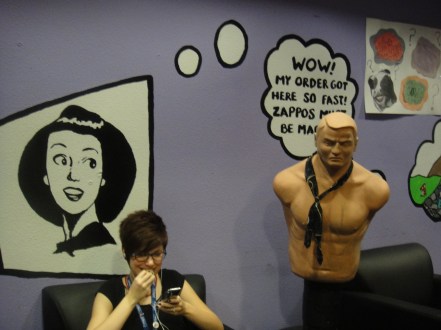
Zappos Headquarters
The 7th core value at Zappos is about team building. The social fabric of the Zappos team is strong and purposely flexible. Diversity is encouraged; self expression is made mandatory; teams tackle problems in groups. The jolly team spirit is evident in the work environment at Zappos headquarters. I think it is closer to being the happiest place on earth than Disneyland is..but that is not saying much. Family in the workplace means shared responsibility as well as camaraderie.
My specialty is teaching swimming. In order to teach the skill an environment of trust must exist. This week I had the pleasure of teaching two young ladies who are friends. They have a big age difference but get along well as friends. The right atmosphere brings out the best in everyone. The girls worked hard each day in lessons, and at the end of the week, they had their little doll family on the steps with them for a swimming lesson. They had become the teachers, inspiring the dolls with their confidence. This is how the positive team and family spirit works. It is contagious, and uplifting for everyone. Cooperation and inspiration are natural partners in business.
My 11th great-grandfather, John Taylor was one of the ten chaplains present at the Field of the Cloth of Gold. As I look at history through the perspective of my ancestors I learn details that blow my mind. Henry VIII is known even to American history students for his wives, divorces, and church business. Henry was a music fan, and imported some of my ancestors from Italy to be musicians in his court. I had never heard of this Field of Cloth of Gold, sort of a party Henry had with lavish tents and chaplains. The king of France really tripped him in the fight Henry arranged. I love this story, and am highly amused that my ancestor can be placed at the crazy Anglo-Franco party. I say let’s invite Vlad over for a topless wrestling match in DC. What do you think? Has any of you ever heard of this Field party? Those royals were just so kinky.
In Tucson and around the country damage from mold is a serious issue. This health hazard can be dangerous to humans and pets. It is most devastating to real estate value because insurance companies rightly treat it like the plague. Mold that is rampant must be treated and removed to avoid spread and contamination of the entire area. Since the property with an adjoining wall has been used to collect donations for a decade, the water has been leaking profusely for months, and everything points to heavy duty mold damage I have repeatedly asked the HOA board that collects the donations from the public to hire Rocky the Mold Dog, who appears on TV. He is a beagle with a nose for mold. He sniffs the property and helps the humans identify problems so they can be treated. All health department code has been violated in this building for more than a decade. The unsupervised food collection, storage, and preparation in a leaky environment is a very likely contributor to the growth of mold. There is probable cause to believe the building is completely infested with mold which is damaging my home every day.
There is much more than a conflict of interest between the HOA board members who run the charity scam collecting donations, and the property owners in this neighborhood. I had some work done on my home recently and was informed by the contractor who did the work about the level of danger to my structural integrity posed by the neglect of my next door neighbor. He took some pictures of the rotting roof piled with debris, and explained that the load of all that garbage was a serious threat to my home. He taught me a lot that I did not know about the dangers and damage that mold represents. I read my insurance policy and spoke to my agent who explained the complex and very depressing details of mold, what it does, and what happens to your insurance policy once it is discovered. I am officially freaked out about the physical damage the charity scam has done to my home. The donation traffic has slowed to nothing, the water leak was repaired a couple of days ago after leaking for at least 6 months. I need the people who took advantage of all their neighbors to begin to acknowledge reality and the neighborhood by getting a mold test to confirm or deny the presence of a very hazardous material. Their behavior suggests that they do no believe in cause and effect. Believe it or not, every action will continue to have an equal and opposite reaction.

Passengers on the Bevis
Thomas Reeves is not the only one of my ancestors who arrived in America on the ship Bevis, nor is he the only one who came as an indentured servant. He landed after becoming a freeman in the colony, in Springfield, MA (a city I drove right past in May) where he was a blacksmith and the town drummer. How cute, the official drummer!! I wonder who the official town fife player was. His son Thomas, who moved to Long Island after his father’s death, seems to have continued the family trade of blacksmithing.
Thomas Sr (generation #1 in America) came from Southampton, England in 1638 on the “Bevis” and arrived in Boston. He was an indentured servant to Henry Byley, but became the servant of John Gore and lived in Roxbury, MA until 1644 when he became a freeman. He married Hannah Rowe on Apr 15, 1645 at Roxbury. They moved to Springfield, MA where he was a blacksmith and the town drummer. He died at Springfield on Nov 5, 1650 in his late twenties after fathering three children, two of which survived to adulthood (Thomas, Mary, John). His wife later remarried Richard Excell (or Exile) of Springfield on June 4, 1651, by whom she had four children (Mary, John, Lydia, Abigail). She died in 1660 in Spreingfield. He was still in the Springfield are in 1681. Mr. Excell presumably then moved to Southampton, LI with his step-son Thomas Jr and died there Feb 24, 1714, after suffering financial problems, according to his will. He also suffered from wounds received in King Phillip’s War.
There was another Thomas Reeves in MA who was born earlier and married a Mary Purrier.
Thomas Sr may have had an aunt Mary who immigrated with him and married William Webster, or the story about her is inaccurate in her age at death. Her husband was a the son of Gov. John Webster of Conn. She was accuased of being a witch in Hadley 1n 1673 by the county court in Northampton, but was acquitted at her trial in Boston in 1683. She died in 1696, her husband dying in 1688.
When I was in elementary school we had air raid drills to teach us how to protect ourselves if Russians tried to blow us up during school hours. We went out in the hall and stood against the wall with our arms against the wall wondering why Russians wanted to bomb us. The cartoon spies Boris and Natasha explained this reality to us. Fearless Leader, a thinly veiled Nikita Krushchev, was out to destroy us by sending hacks like Boris and Natasha to spy on us. The cold war was about nuclear weapons, but we had no idea what they were. We only knew they made mushroom clouds in cartoons. Maybe some of us knew about Hiroshima, but generally the big conspiracy against us remained unexplained. We shifted our national hatred from Germany to Russia after WWII, and our effort was focused on keeping communists from ruling the world. We were not alive for the Nazis but saw them in movies plenty. We had heavy brainwashing about Europe, which we also did not understand. History for us was all about the western hemisphere and manifest destiny.
The details of communism and how it operated to destroy us were vague at best. We later became aware that James Bond also recognized Russia as evil, but sometimes slept with Russian spies to gain intelligence. The plot thickened. We needed to stop communism in Viet Nam by killing people in the jungle while tripping on LSD. Things went downhill from there, even though communism and capitalism looked exactly the same on the inside. When the Soviet Union imploded it was from the same kind of corruption and propaganda that the United States is known for now. This war will be the globally warmer war, in which the stakes are higher, the cartoons more sinister. Now Fearless Leader is Vladamir Putin, and the accent still fits perfectly.

Archibald Campbell

Archibald Campbell tomb
My 14th great-gandfather was a powerful Marquess in Scotland who was beheaded by Charles I of England:
Archibald Campbell (1606 – 1661)
is my 14th great grandfather
Lord Neil Campbell (1610 – 1692)
son of Archibald Campbell
John Campbell (1633 – 1689)
son of Lord Neil Campbell
John Campbell (1662 – 1731)
son of John Campbell
Dugal Campbell (1699 – 1734)
son of John Campbell
Neil Campbell (1734 – 1777)
son of Dugal Campbell
Henry Campbell (1769 – 1863)
son of Neil Campbell
Elizabeth Campbell (1784 – 1861)
daughter of Henry Campbell
Mary McGill (1804 – 1898)
daughter of Elizabeth Campbell
John Wright (1800 – 1870)
son of Mary McGill
Mary Wright (1814 – 1873)
daughter of John Wright
Emiline P Nicholls (1837 – )
daughter of Mary Wright
Harriet Peterson (1856 – 1933)
daughter of Emiline P Nicholls
Sarah Helena Byrne (1878 – 1962)
daughter of Harriet Peterson
Olga Fern Scott (1897 – 1968)
daughter of Sarah Helena Byrne
Richard Arden Morse (1920 – 2004)
son of Olga Fern Scott
Pamela Morse
I am the daughter of Richard Arden Morse
Archibald Campbell, 1st Marquess of Argyll, 8th Earl of Argyll, chief of Clan Campbell, (1607 – 27 May 1661) was the de facto head of government in Scotland during most of the conflict known as the Wars of the Three Kingdoms. He was the most influential figure in the Covenanter movement that fought for the Presbyterian religion and what they saw as Scottish interests during the English Civil War of the 1640s and 1650s.
Family and early lifeHe was eldest son of Archibald Campbell, 7th Earl of Argyll, by his first wife Agnes Douglas daughter of William Douglas, 6th Earl of Morton, and was educated at St Andrews University, where he matriculated on 15 January 1622. He had early in life, as Lord Lorne, been entrusted with the possession of the Argyll estates when his father renounced Protestantism and took arms for Philip III of Spain; and he exercised over his clan an authority almost absolute, disposing of a force of 20,000 retainers, being, according to Baillie, by far the most powerful subject in the kingdom.
In the Covenanter movementOn the outbreak of the religious dispute between the king and Scotland in 1637, his support was eagerly sought by Charles I. He was made a privy councillor in 1628. In 1638, the king summoned him, together with Traquair and Roxburgh, to London, but he refused to be won over, warned Charles against his despotic ecclesiastical policy, and showed great hostility towards William Laud. In consequence, a secret commission was given to the Earl of Antrim to invade Argyll and stir up the MacDonalds against him. Argyll, who inherited the title at the death of his father in 1638, originally had no preference for Presbyterianism, but now definitely took the side of the Covenanters in defence of national religion and liberties. He continued to attend the meetings of the General Assembly of the Church of Scotland after its dissolution by the Marquess of Hamilton, when Episcopacy was abolished. In 1639, he sent a statement to Laud, and subsequently to the king, defending the General Assembly’s action. He raised a body of troops and seized Hamilton’s castle of Brodick in Arran. After the pacification of Berwick-upon-Tweed, he carried a motion, in opposition to James Graham, 1st Marquess of Montrose, by which the estates secured to themselves the election of the lords of the articles, who had formerly been nominated by the king. This was a fundamental change to the Scottish constitution, whereby the management of public affairs was entrusted to a representative body and withdrawn from the control of the crown. An attempt by the king to deprive him of his office as justiciary of Argyll failed, and on the prorogation of the parliament by Charles, in May 1640, Argyll moved that it should continue its sittings and that the government and safety of the kingdom should be secured by a committee of the estates, of which he was the guiding spirit. In June, he was trusted with a Commission of fire and sword against the royalists in Atholl and Angus, which, after succeeding in entrapping the Earl of Atholl, he carried out with completeness and cruelty.
It was on this occasion that the Bonnie Hoose o’ Airlie was burned. By this time, the personal dislike and difference in opinion between Montrose and Argyll led to an open breach. The former arranged that on the occasion of Charles’s approaching visit to Scotland, Argyll would be accused of high treason in the parliament. The plot, however, was disclosed, and Montrose, among others, was imprisoned. Accordingly, when the king arrived, he found himself deprived of every remnant of influence and authority. It only remained for Charles to make a series of concessions. He transferred control over judicial and political appointments to the parliament, created Argyll a marquess in 1641, and returned home, having, in Clarendon’s words, made a perfect deed of gift of that kingdom. Meanwhile, there was an unsuccessful attempt to kidnap Argyll, Hamilton, and Lanark, known as The Incident. Argyll was mainly instrumental in this crisis in keeping the national party faithful to what was to him evidently the common cause, and in accomplishing the alliance with the Long Parliament in 1643.
[edit] English and Scottish Civil WarIn January 1644, he accompanied the Scottish army into England as a member of the committee of both kingdoms and in command of a troop of horse, but was soon compelled, in March, to return to suppress royalists in the Scottish Civil War and to defend his own territories. He forced Huntly to retreat in April. In July, he advanced to abet the Irish troops now landed in Argyll, which were fighting in conjunction with Montrose, who had put himself at the head of the royalist forces in Scotland. Neither general succeeded in obtaining an advantage over the other, or even in engaging in battle. Argyll then returned to Edinburgh, threw up his commission, and retired to Inveraray Castle. Montrose unexpectedly followed him in December, compelling him to flee to Roseneath, and devastating his territories. On 2 February 1645, while following Montrose northwards, Argyll was surprised by him at Inverlochy. He witnessed, from his barge on the lake to which he had retired after falling from his horse, a fearful slaughter of his troops, which included 1500 of the Campbells.[1] He arrived at Edinburgh on 12 February and was again present at Montrose’s further great victory on 15 August at Kilsyth, whence he escaped to Newcastle. Argyll was at last delivered from his formidable antagonist by Montrose’s final defeat at Philiphaugh on 12 September. In 1646, he was sent to negotiate with the king at Newcastle after his surrender to the Scottish army, when he endeavoured to moderate the demands of the parliament and at the same time to persuade the king to accept them. On 7 July 1646, he was appointed a member of the Assembly of Divines.
Up to this point, Argyll’s statesmanship had been highly successful. The national liberties and religion of Scotland had been defended and guaranteed, and the power of the king in Scotland reduced to a mere shadow. In addition, these privileges had been still further secured by the alliance with the English opposition, and by the subsequent triumph of the parliament and Presbyterianism in the neighboring kingdom. The king himself was a prisoner in their midst. But Argyll’s influence could not survive the rupture of the alliance between the two nations on which his whole policy was founded. He opposed in vain the secret treaty concluded between the king and the Scots against the parliament. Hamilton marched into England and was defeated by Cromwell at Preston. Argyll, after a narrow escape from a surprise attack at the Battle of Stirling (1648), joined the Whiggamores, a body of Covenanters at Edinburgh; and, supported by John Campbell, 1st Earl of Loudoun and Alexander Leslie, 1st Earl of Leven, he established a new government, which welcomed Oliver Cromwell on his arrival there on 4 October.
War with the English Parliament and personal ruinThis alliance, however, was at once destroyed by the execution of Charles I on 30 January 1649, which excited universal horror in Scotland. In the series of tangled incidents which followed, Argyll lost control of the national policy. He describes himself at this period as “a distracted man…in a distracted time” whose ” remedies…had the quite contrary operation.”
He supported the invitation from the Covenanters to Charles II to land in Scotland, and gazed upon the captured Montrose, bound on a cart to execution at Edinburgh. When Charles II came to Scotland, having signed the Covenant and repudiated Montrose, Argyll remained at the head of the administration. After the defeat of Dunbar, Charles retained his support by the promise of a dukedom and the Garter, and an attempt was made by Argyll to marry the king to his daughter. On 1 January 1651, he placed the crown on Charles’s head at Scone. But his power had now passed to the Hamiltonian party.
He strongly opposed, but was unable to prevent, the expedition into England. In the subsequent reduction of Scotland, after holding out in Inveraray Castle for nearly a year, he was at last surprised in August 1652 and submitted to the Commonwealth. His ruin was then complete. His policy had failed, his power had vanished. He was hopelessly in debt, and on terms of such violent hostility with his eldest son as to be obliged to demand a garrison in his house for his protection.
Later life and writings
Archibald Campbell During his visit to Monck at Dalkeith in 1654 to complain of this, he was subjected to much personal insult from his creditors, and on visiting London in September 1655 to obtain money due to him from the Scottish parliament, he was arrested for debt, though soon liberated. In Richard Cromwell’s parliament of 1659 Argyll sat as member for Aberdeenshire.
At the Restoration, he presented himself at Whitehall, but was at once arrested by order of Charles and placed in the Tower (1660), being sent to Edinburgh to stand trial for high treason. He was acquitted of complicity in the death of Charles I, and his escape from the whole charge seemed imminent, but the arrival of a packet of letters written by Argyll to Monck showed conclusively his collaboration with Cromwell’s government, particularly in the suppression of Glencairn’s royalist rising in 1652. He was immediately sentenced to death, his execution by beheading taking place on 27 May 1661, before the death warrant had even been signed by the king. His head was placed on the same spike upon the west end of the Tolbooth as that of Montrose had previously been exposed, and his body was buried at the Holy Loch, where the head was also deposited in 1664. A monument was erected to his memory in St Giles’s church in Edinburgh in 1895.
While imprisoned in the Tower he wrote Instructions to a Son (1661). Some of his speeches, including the one delivered on the scaffold, were published and are printed in the Harleian Miscellany.
He married Lady Margaret Douglas, daughter of William Douglas, 7th Earl of Morton, and had two sons and four daughters
The decision to trust is a risk. Calculating risk should be a skill we develop and improve over our lives. The influence of relationships on our faith in others is central. Early betrayal can be a blessing because it can prevent deeper problems by showing true colors. Trust and the possibility of betrayal arise together. If we trust the government, or our spouse, or boss, we may find that faith has been misplaced. Few of us have the ability to accurately judge or predict the behavior of our closest companions. Being blind to imperfections is neither healthy nor honest. If we are honest we can admit our own imperfections, and our own potential to betray others. With perspective we can see how our national anger has damaged the entire society.
The rose-colored glasses version of America was a risk. The more we spun ourselves into the greatest country in the world, the more we found ourselves betrayed as a nation. The more we fought for our way of life around the world (whatever that meant), the more undesirable our way of life became. The more we declared war on everything from drugs to terror, the more ground we lost in the global trust department. Now American security is breeched on a regular basis in fairly spectacular fashion. It is lucrative, I imagine, for some, but it is becoming a badge of courage. If the seed of betrayal is trust, then it must also follow that after betrayal trust becomes mature and discerning. It is a cycle, gentle reader.

Garbo Mata Hari
Does it sound like a compliment to you to be called a traitor by Dick Cheney? Do you wonder what espionage is? Do Julian Assange, Bradley Manning, and Edward Snowden appear to be more or less trustworthy than the United States government? Do you trust the military to police itself? My personal theory is that leaking is the new journalism. More high profile leaks will be celebrated with caviar and vodka faster than you can say Vlad’s your uncle. Shortly a woman will join the ranks of leaky whistle blowers, and the balance will shift. You do not need any psychic abilities to predict this. You simply need to wake up and smell the data.
 mermaidcamp