mermaidcamp
Keeping current in wellness, in and out of the water
You can scroll the shelf using ← and → keys
You can scroll the shelf using ← and → keys
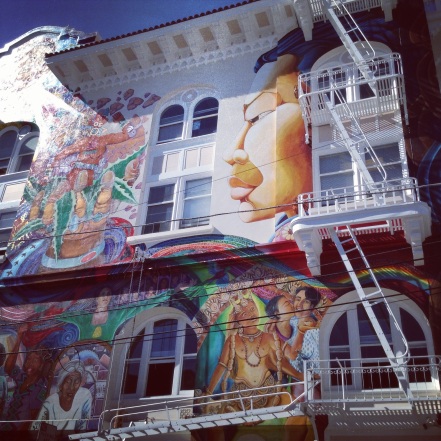
structure
The flames swirl around the stairwell growing hotter
Banisters on fire fall, crashing melting decorative copper
Elegant mythology and theories made in the distant past
Have been blown to pieces shattering with a loud balst
Where is the mental door that leads to the blissful truth?
Does the fire escape lead us to the place of nothing to prove?

vehicle
“There are only two mistakes one can make along the road to truth; not going all the way, and not sharing.”
The Buddha
The truth for a grade school student is not the same as the truth for a senior citizen. Perspective is the reason we believe one thing or another at any given time. Now we see through a glass darkly, but then face to face. This means that we have more knowledge of the bigger picture as we mature and travel along the road to truth. We should be acquiring sophistication and compassion for other living things as we become more visionary on this path. Observation of the world political situation leads us to believe that we are failing at that mission. We have wandered off the route into unmapped territory. Dark ignorance and evil intent appear to be taking ground in the battle against harmony and peace.
In all fairy tales and mythology the hero learns from tragic mistakes. At the end of the story the moral is clear and the lesson is imprinted in the mind of the audience. Once committed the hero has no choice. Like Arjuna in the Bhagavad Gita, the hero is taught mastery through trust in divine guidance in freaky circumstances. He fights the symbolic battles he finds obstructing his way. The hero is fated to go all the way. That is what distinguishes his character from others. He finishes the difficult job, then shares the wisdom he has found within his quest. He saves the day and teaches an important social and political object lesson to the people.
Action without attachment was the lesson Krishna taught Arjuna during the heat of battle. It is impossible to know the moral of a story until it ends, so it is imperative that the hero finish his job. As I experience the presidential politics of 2016 I certainly hope there is a blue guy driving the chariot who will lead us into a surprise ending. These are certainly freaky circumstances with strong catalytic tendencies. How do you think this story will end, gentle reader? Fill in the blank.

Insight
Mercury Transit in history
On 9 May the astronomers of Europe, and other regions, having screwed their sun filters onto their telescopes, will settle down to observe a transit of Mercury. For any not familiar with astronomical jargon that is when the planet Mercury crosses the face of the sun.
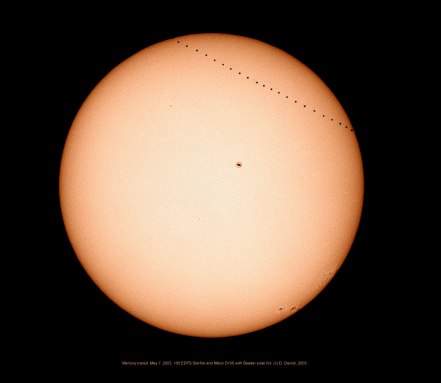 Astronomy Picture of the Day: A Mercury Transit Sequence: Image Credit & Copyright Dominique Dierick
Neither as rare nor as spectacular as the similar transits of Venus, it will still be regarded as a major event in the astronomical calendar. Transits of Venus occur in pairs separated by eight years approximately once every one hundred and twenty years. The last pair was in 2004 and 2012. The cycle of occurrences of transits of Mercury is much more complex but there will be a total of fourteen in the twenty-first century with next Monday’s being the third. Because Mercury is much smaller than Venus…
View original post 714 more words
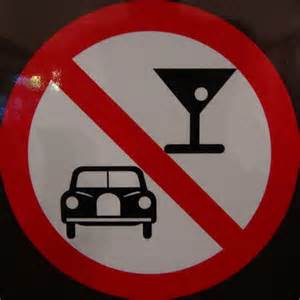
Don’t Drink and Drive
After a long career in public service Ann Day had retired from the Board of Supervisors in Pima County. The 77-year-old was driving alone on Saturday morning when a drunk driver crossed a raised median and slammed head on into her vehicle. The car behind could not stop in time, and crashed into the back of her car. She was pronounced dead at the hospital shortly after the accident. This tragic death took place at 7:40 am. We don’t know if the driver woke up and started drinking or was still drunk from Friday night. He has been charged with manslaughter for this senseless death.
Ann and her older sister Sandra Day O’Connor grew up on a cattle ranch founded by her paternal grandfather in 1880 near the New Mexico border. Henry Clay Day was a homesteader on his ranch when Geronimo was still roaming that land. The family history is Arizona history, with an emphasis on education. Henry Clay Day served as chairman of the board of supervisors of Graham County, setting an example that Ann and her esteemed sister would follow. Ann served 10 years in the state senate and 12 years on the Pima County Board of Supervisors. She was a Republican who was known for her independent streak. She was well-respected by colleagues and constituents, many of whom are expressing their grief about this tragedy.
She was killed near the shopping center where Gabby Giffords was shot. My own parents were shoppers at that center. They might have been at the Safeway had the shootings happened a few years earlier. My mom and dad took the transport to that center, operated by assisted living facility where they rented an apartment. My dad loved to drive the Safeway carts inside the store because it was the only driving he was allowed to do at that point. Jarred Laughlin could have gunned down my parents had timing been different. That is exactly the thought I have when I drive past that center.
The irony of public servants loosing life to loose canons of various kinds is not lost on me. Ann Day was not targeted for her political service like Gabby. She was randomly selected to die as the result of one of our society’s ugliest problems, drunk driving. Jarrad Barnes, 24 years old, is charged for taking the life of a woman he did not know. Since her family and her history are prominent we can only hope this will bring much-needed attention and solutions to the drunk driving epidemic in America. We can’t take away everyone’s cars, so we need to change public behavior. This common habit has touched too many families in this country. We need to solve this serious problem.

Don’t Drink and Drive
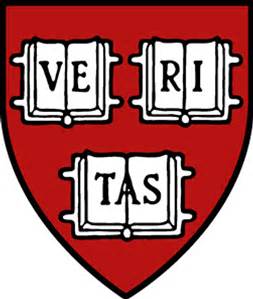
Harvard motto
In ancient Rome the goddess Veritas ruled truth and sincerity. In Greece she was known as Altheia, and is mentioned in Aesops Fables:
Aesop, Fables 531 (from Babrius 126) (trans. Gibbs) (Greek fable C6th B.C.) :
“A man was journeying in the wilderness and he found Veritas [Aletheia, Truth] standing there all alone. He said to her, ‘Ancient lady, why do you dwell here in the wilderness, leaving the city behind?’ From the great depths of her wisdom, Veritas (Truth) replied, ‘Among the people of old, lies were found among only a few, but now they have spread throughout all of human society!’”
[N.B. This fable is preserved only in a Latin text. Aesop’s Aletheia (Truth personified) becomes Veritas in the Latin.]
Her father is Saturn in Rome and Zeus in Greece. One creation story found in Aesop’s Fables tells us how she was created by Prometheus along with her arch enemy Mendacium. She is the mother of virtue. Her name is often included in mottos. Harvard’s motto is simply Veritas. The pursuit of truth was considered to be an essential part of Roman citizens’ duty. To discern and tell the truth is a full time job. Forgery and subterfuge are everywhere and always will be. The difference between Veritas and Mendacium is feet. Mendacity literally has not feet on which to stand. Veracity walks away with conviction.
Aesop, Fables 530 (from Phaedrus Appendix 5) :
“Prometheus, that potter who gave shape to our new generation, decided one day to sculpt the form of Veritas [Aletheia, Truth], using all his skill so that she would be able to regulate people’s behaviour. As he was working, an unexpected summons from mighty Jupiter [Zeus] called him away. Prometheus left cunning Dolus (Trickery) in charge of his workshop, Dolus had recently become one of the god’s apprentices. Fired by ambition, Dolus (Trickery) used the time at his disposal to fashion with his sly fingers a figure of the same size and appearance as Veritas [Aletheia, Truth] with identical features. When he had almost completed the piece, which was truly remarkable, he ran out of clay to use for her feet. The master returned, so Dolus (Trickery) quickly sat down in his seat, quaking with fear. Prometheus was amazed at the similarity of the two statues and wanted it to seem as if all the credit were due to his own skill. Therefore, he put both statues in the kiln and when they had been thoroughly baked, he infused them both with life: sacred Veritas (Truth) walked with measured steps, while her unfinished twin stood stuck in her tracks. That forgery, that product of subterfuge, thus acquired the name of Mendacium [Pseudologos, Falsehood], and I readily agree with people who say that she has no feet: every once in a while something that is false can start off successfully, but with time Veritas (Truth) is sure to prevail.”
[N.B. This fable is preserved only in a Latin text. Aesop’s Aletheia (Truth personified) becomes Veritas in the Latin.]
These fables are useful to us during the campaign season during which a large part of our job is to distinguish truth from rhetorical and cultural beliefs. It has never been more important for us to verify what we believe.

Immigrant
My 7th great-grandfather was a gentleman and a trader in Massachusetts Colony. Another descendant paid a professional genealogist to research his history. The results that follow are fascinating because she takes steps to figure out which of the various William Thomas’s my ancestor was. I have made big mistakes in my own tree on the ancestors with very common names like John Taylor. Record keeping varies from place to place and time to time. I am impressed and pleased with this expert research. I once paid for research to be done by the Somerset PA Historical Society, which I visited in person. They stiffed me and did no investigation for the fee they charged. This experience burned me on the idea of paid experts. This example is very well done. The lady who did the work is:
Diane Rapaport, Historical Consultant/Attorney Quill Pen Historical Consulting, P. O. Box 204, Lexington, MA 02420 Tel.: 781-698-7884 (866-QUILLPEN) – Fax: 781-861-6744 (888-QPFAXES) Email: diane@quillpenhistorical.com Web: http://www.quillpenhistorical.com
She does very thorough work. Thanks to James Crawford for making this public information. We appreciate your contribution, cousin.
William Thomas (1695 – 1733)
7th great-grandfather
Mary Thomas (1729 – 1801)
daughter of William Thomas
Joseph Morse III (1756 – 1835)
son of Mary Thomas
John Henry Morse (1775 – 1864)
son of Joseph Morse III
Abner Morse (1808 – 1838)
son of John Henry Morse
Daniel Rowland Morse (1838 – 1910)
son of Abner Morse
Jason A Morse (1862 – 1932)
son of Daniel Rowland Morse
Ernest Abner Morse (1890 – 1965)
son of Jason A Morse
Richard Arden Morse (1920 – 2004)
son of Ernest Abner Morse
Pamela Morse
RESEARCH REPORT for JAMES CRAWFORD
May 31, 2010
By Diane Rapaport
Research Objective
Documentation of the parents and origins of William Thomas:
b. 1695, Marlborough, MA (or Wales?)
d. 25 July 1733, Marlborough, MA
m. 19 June 1721, to Lydia Eager (b. 03 July 1696, Marlborough, MA, d. 12 Oct 1735, Marlborough, MA)
Their children:
Lovina Thomas, b. 15 Aug 1721, Marlborough, MA, d. Shrewsbury, MA
Sophia Thomas, b. 28 July 1723, Marlborough, MA, d. 24 Aug 1745
William Thomas, b. 19 Mar 1724, Marlborough, MA [Note: Per Marlborough Vital Records, year should be 1725; see below.]
Lydia Thomas, b. 30 Sep 1727, Marlborough, MA
Mary Thomas, b. 16 Feb 1729, Framingham, MA [Note: Marlborough Vital Records suggest that the birthplace was Marlborough; see below.]
Odoardo Thomas, b. 7 May 1731, Marlborough, MA
[Note: The information about William Thomas and his family, which you provided by .ged file, is unsourced. The Ancestry record “hints” in other public trees include only “OneWorldTree” and “Massachusetts Marriages” database, which are not authoritative sources.]
Summary of Research Results
Jim, I searched numerous record sources—vital records, probate records, land records, trial court records, and secondary sources (which I found online and at the Massachusetts Archives, the Middlesex County Registry of Deeds, and the New England Historic Genealogical Society)—for clues to the life and origins of William Thomas. I found much documentation about William (which I am providing to you as PDF and JPG files, posted at the “Files and Messages” page of our project at Ancestry’s Expert Connect – scroll down to the bottom of that page, where you will find the files, which you can read or download to your computer).
The search revealed other men named William Thomas in Middlesex County, Massachusetts, during the relevant time period, including a Native American from the town of Natick, the son of a blacksmith from Newton, and a “husbandman” (the colonial term for a farmer or laborer) from Lambstown in Worcester County (where, as it turns out, your William had connections). But I was able to distinguish these other men from your William Thomas, who was identified consistently in the records as a “gentleman” (and in a few instances as a “trader”), suggesting that he was of a high social rank. I also discovered in the Middlesex County Court records that he was a licensed “retailer” and probably operated a store in Marlborough; the license was transferred to his wife Lydia after his death.
I discovered that William purchased land in Framingham, the town next to Marlborough, in 1720, just before his marriage to Lydia; at the time of that land purchase, he was identified in the deed as being of Framingham, suggesting that he already lived there. I could not find any record of his purchasing property in Marlborough (although the probate records indicate that he owned real estate in the town); it is possible, since Framingham adjoins Marlborough, that the land was actually the same that he purchased in 1720, and that the town boundaries changed. (I found no evidence of other Thomas families in Framingham before that date.) And, I discovered documentation in the Worcester County land records, as well as in the Middlesex County probate records, that William began buying land in Shrewsbury, Worcester County, shortly before his death.
In the 8 hours authorized for this project, I was unable to determine more about William’s origins. I did find evidence, in the guardianship records of his children (after the death of William and his wife), that William’s sons chose an uncle from Shrewsbury, Asa Bouker, to be their guardian. I did not have time to do any research about Asa Bouker or his connections with either William or Lydia. I found evidence in land and probate records of other people with the Thomas surname in early Middlesex County and elsewhere in Massachusetts (see my notes, below), but I did not have time to follow up on those leads. One promising name might be Nathaniel Thomas of Plymouth (identified as “Esquire,” suggesting that he was a “gentleman” like William), who had some connection with a wealthy Elizabeth Thomas who died in Medford, Middlesex County, in 1729. Perhaps William was indeed of Wales, as you suggested. Also intriguing is the name of his son, Odoardo, which my quick Google search indicates is an Italian name, and may suggest some cosmopolitan origins for your William Thomas.
The next step that I would recommend is to search for more information about Asa Bouker of Shrewsbury, Nathaniel Thomas, and other early Thomas families in Massachusetts, as well as resources about early Boston, since William Thomas or his family (like many families of high social rank) may have spent time there upon arriving in New England. I also would recommend a more review of the probate and land records that I have obtained (I provided you with copies, but have not made a thorough study), to see if there are any other clues about family members. I would be happy to continue the search, if you would like to consider authorizing more time!
Sources Consulted
VITAL RECORDS
Massachusetts Vital Records to 1850 (database of the New England Historic Genealogical Society)
Searched Thomas surname in Marlborough, MA:
In published Marlborough Vital Records, earliest entry is marriage of William and “Lidia” Eager in 1721 (see copy, Thomas Wm & Eager Lidia marriage.pdf), followed by their children’s births (see copy, Thomas Wm children births.pdf), and the deaths of William, his wife Lydia, and their daughter Sophia (see copy, Thomas Wm Lydia Sophia deaths.pdf). [Note: According to the vital records, son William was born 1725, not 1724, and daughter Mary was born in Marlborough, not Framingham, but otherwise all the dates match up with the information in your family tree (except there is no record or date for William Sr.’s birth).]
Searched Thomas surname in Middlesex County to 1721:
In published Newton Vital Records, marriage record of:
Thomas, William and Anna Loverin, Aug. 29, 1695, in Watertown (see copy, Newton VRs marriages.pdf). But note that William and Anna had a daughter in 1695. However, it appears that this William Thomas of Newton and a first wife, Elizabeth, had a son William in 1687; see below.
Thomas, Joanna, ch. William and Ann (second w.), Oct. 28, 1695.
Thomas, William, s. William and Elizabeth, Aug. 31, 1687. (See copy, Newton VRs births.pdf.) Probably this is the William Thomas, blacksmith, and his son, and no relation to your William Thomas. See notes re: probate records, below.
Searched Thomas surname in Worcester County to 1721:
Found only a Sarah Thomas who married in Mendon in 1707.
Searched Thomas surname in Framingham:
No early Thomas entries
Note: I have not made an exhaustive search of the available published vital records. Many births were not recorded with the town officials, however, but evidence can be found in collateral records, such as church, land, probate, etc. I did not have time to search church records.
LAND RECORDS
(Reviewed at Middlesex County Registry of Deeds and on microfilm at New England Historic Genealogical Society)
As you will see, I reviewed some deed records for dates afterWilliam Thomas’ death, since sometimes deeds are not recorded until years after the conveyance.
Middlesex County, MA
Grantee Index, 1639-1799 (microfilm)
(and I briefly searched deed book volumes, where indicated)
I searched for early entries with the Thomas surname, before William’s death in 1733, which I noted, since the index did not refer to the town, and reviewing the records might show connection with Marlborough or William Thomas:
1685, July 20, Thomas, Ales & Benjamin, from E. Corlett, 9: 411 – Ales Thomas of Boston & Benjamin his son, purchased land in Cambridge
1686, Oct 20, Thomas, John &al from F. Hinchman, 10: 7 – no Thomas found on this page
1687, March 9, Thomas, Edward, agent, from W. Cutter, 10: 33 – Mentions Edward Thomas of Boston
1697, Nov 23, Thomas Edward, from C. Morton, 12: 106 – no Thomas found on this page
1701, Dec 12, Nathaniel Jr from J. Croade, 13: 89 – Nathaniel Thomas Jr. of Plymouth buys land in Groton
1719, May 11, Thomas, Joshua, from M. Meeds, atty, 20: 333 – Joshua Thomas of Boston
1720, March 30, Thomas, John & Solomon, Samuel’s est., deposition 12: 733 – no Thomas found on this page
1721, Aug 18, Thomas John &al, deposition, 21: 412 – re: John Thomas of Natick, Indian
Entries for William Thomas, all after his death date:
1735, Feb 27, Thomas, William, from Edward Clap, 36: 516 – This seems likely to be your William Thomas, since it refers to him as “gentleman” and the conveyance in Framingham occurred in 1720, before his marriage. (Copy, Thomas Wm deed Mdsx v36p516.jpg and Thomas Wm deed Mdsx v36p517.jpg.)
1739 March 12, Thomas, William, from B. Tray, 39: 642 –William Thomas of Natick, Indian
1742, Dec 11, Thomas, William, from T. Bowman, 44: 51 – William Thomas of Natick
1745, Apr. 2, Thomas, William, from M. Speen, 45: 97
1747, Feb. 10, Thomas, William, from S. Abram, 46: 429
1752, Feb 8, Thomas, William, from M. Tom, 49: 357
Other William Thomas entries after this date, but not until 1782; no entries found for Lydia Thomas
Grantee Index, 1639-1799, A-G
Found several entries for surname Eager (Eagar, Augur, Egar), who might be relatives of Lydia Eager, but no entries for Lydia.
Grantor Index, 1639-1799, S-Z
(and I briefly searched deed book volumes, where indicated)
No entries for a William Thomas until 1738:
1738, Feb 19, Thomas, William, to D. Morse and J. Carver, 39: 542, 547 – William Thomas of Natick, Indian
No other entries for William Thomas until 1749:
1749, July 24, Thomas, William, to J. Loring, 49: 61
Worcester County, MA
Grantee Index, 1731-1839, P-Z (microfilm)
(and briefly searched deed books, where indicated)
1734, Thomas, William, from Gerstrom Keyes, Nahum Ward and Eleaser Rice, 4: 432-437, Shrewsbury deeds (Copies, Thomas Wm deed Worcester v4p433.jpg, Thomas Wm deed Worcester v4p434.jpg, Thomas Wm deed Worcester v4p435a.jpg, Thomas Wm deed Worcester v4p435b.jpg, Thomas Wm deed Worcester v4p436.jpg, Thomas Wm deed Worcester v4p437.jpg) – These land purchases occurred in 1730 and 1733, and refer to William as “of Marlborough,” “Gentleman” and “Trader.” No other people surnamed Thomas are mentioned, and no obvious clues to his origins, although it is possible that he may have been related to some of the people involved.
1734, Thomas, William, from Saml Smith, 5: 161, Hardwick – William Thomas of Lambstown, husbandman, 1734
1736, Thomas, William, from Saml March, 9:25, Hardwick –William Thomas of Lambstown, husbandman, 1736
1737, Thomas, William, from John Jordan, 9: 73, Hardwick –William Thomas of Lambstown, husbandman, 1736
1740, Thomas, William, from Amos Thomas, 13: 141, Hardwick –William Thomas, husbandman, of Lambstown, Worcester County, and Amos Thomas, husbandman of same town. Deed signed 1739, so obviously not your William Thomas.
1746, Thomas, William, from Amos Thomas, 20: 556, Hardwick
1746, Thomas, William, from Amos Thomas, 22: 1, Hardwick
And more William Thomas entries after this date, to 1838
No entries for Lydia Thomas
Grantor Index, 1731-1839, T-Z (microfilm)
1735, Thomas, William, to Stephen Harrington, 7:17
1740, Thomas, William, to Ebenr Foskett, 13: 68
1740, Thomas, William Jr., to Ebenr Foskett, 13: 68
1742, Thomas, William, to Amos Thomas, 16: 207
And more William Thomas entries after this date, to 1836
The only Lydia Thomas entry was:
1787, Thomas, Lydia, to Fos Fayerweather, 102: 20
PROBATE RECORDS
(Reviewed at Massachusetts Archives)
Early Thomas records in Middlesex probate:
William, Newton, 1698, Will, 22416
Will refers to this William Thomas as a blacksmith, and he signs will with mark. Leaves estate to widow for her life, and then to son William. Small estate, about 50 pounds.
William, Newton, 1699, Guardian, 22417
Papers say he is about 12 years old in 1699. Nathaniel Hancock appointed guardian.
William, Marlborough, 1734, Administration, 22418. This is your William Thomas. See copy, Thomas Wm Mdsx probate.pdf. Note: I did not have time to make a thorough study of these records for further clues.
William, Marlborough, 1740, Guardian, 22421. This is the son of your William Thomas. See copy, Thomas Wm Jr Mdsx guardianship.pdf.
Lydia, Marlborough, 1735, Administration, 22406. This is the wife of your William Thomas. See copy, Thomas Lydia Mdsx probate.pdf.
Lydia, Marlborough, 1743, Guardian, 22419. Mary, Marlborough, 1743, Guardian, 22419. Sophia, Marlborough, 1743, Guardian, 22419. These are William and Lydia’s daughters. See copy, Thomas Wm daughters Mdsx guardianship.pdf.
Odoardo, Marlborough, 1743, Guardian, 22420. This is the son of your William Thomas. See copy, Thomas Odoardo Mdsx guardianship.pdf.
Elizabeth, Medford, 1729, Will, 22399
Leaves most of property to nephew Henry Dunster, etc.; gives gold ring to Nathanil Thomas Esqr., but mentions no other Thomas heirs; apparently wealthy [consider copying re: freed slave Tonney]
Paul, Natick, 1746, Administration, 22408
Solomon, Natick, 1736, Administration, 22412
Solomon Jr., Natick, 1737, Administration, 22413
Early Thomas entries in Worcester County probate:
Aaron, Hardwick, 1748, Guardianship, 58837
Amos, Hardwick, 1754, Will, 58844
Israel, Hardwick, 1748, Guardianship, 58869
William, Leominster, 1746, Administration, 58910
William, Hardwick, 1747, Administration, 58911
OTHER COURT RECORDS
Middlesex County Court Folio Collection index
Thomas, Lydia, Concord 1733-127-A-II
Paid excise tax
Thomas, Lydia, Marlborough, 1733-129-A-3
Granted retailer’s license
Thomas, William, 1725-86x-III
Marlboro retailer
Thomas, William & Jonathan How, 1730, 119-A-2
Renewed license
Thomas, William, 1727-252-2
Marlboro licensed retailer
Thomas, William, 1726-107x-4
Marlboro licensed retailer
Thomas, William, 1685-117-6
Bond for administrator of Mark Woods & Strattons’ Est.
TOWN HISTORIES
Mary E. Spalding, for Franklin P. Rice, Colonial Records of Marlborough, Mass. (Boston: NEHGS, 1909) – Early records, only to 1660s
Charles Hudson, History of the Town of Marlborough, Middlesex County, Massachusetts, from its First Settlement in 1657 to 1861, with a Brief Sketch of the Town of Northborough. . . (Boston, Press of T. R. Margin, 1862). Brief entry for William Thomas family on p. 458. (No new information.)
Marlborough, Massachusetts, Burial Ground Inscriptions: Old Common, Spring Hill, and Brigham Cemeteries (Worcester, Mass.: Franklin P. Rice, 1908). No inscriptions for surname Thomas.
Note: Marlborough town records, 1666-1847, are available from FHL on microfilm.

calories in
During my month as a poet I lost count of calories. They (the calories) did not forget about me. The extras have lodged themselves around my waist, as my jeans alerted me this week. I need to get back on track, and Fitbit has improved my ability to do so. This morning Fitbit informed me that since our relationship began I have walked 1,997 miles, which means now I am over 2000 miles charted, graphed and tracked for my information.
While I have been wearing the device my needs have changed over time, and my involvement with recording data has varied from close attention to nothing. I used to record my water drinking and all my food, as well as my water exercise when the Fitbit was not on my wrist. My enthusiasm for this lagged and my need to get sounder sleep became the most urgent need I had. During our time of doggie hospice last year I had to get up many times during the night, and I was very upset about the end of our dog’s life. My sleep, usually my finest talent, had gone to hell. The sleep recording feature of my device became a real help as I tried different methods of improving my sleep. I figured out that honey before bed and during the night when I let the dog out seriously helped the ability to rest soundly.
Now I am back to being a star sleeper, but need to get back on track with a healthy weight loss program. New aspects of the feedback are helping me do that very effectively. In order to decrease the evils inflicted upon us by the sedentary life the new rule is to move at least 250 steps each hour. My daily goal is 10,000 steps, so obviously I need to move more than 250 steps some hours. The reminder to log those 250 steps gets me up from my desk or the evening news and gets me to move. It only takes about 2 minutes to take 250 steps. I find that once I have started to move I end up moving for at least 1000 steps before returning to my seat. At the end of the day there is a very helpful chart with active versus sedentary time spent. At 11:30 am I show 37% active and 63% stationary. I also can see a comparison between todays active total and my 30 day average. In the past when I finished my daily goal I felt free to let sloth take over the agenda for the rest of my day. Now I feel the need to get my 250 steps every hour and move that ratio of active/stationary in favor the more movement.
There is news on the calorie front as well. The dashboard now calculates not only the calories burned but also calories left to be burned. If food is logged there is also a comparison of calories consumed vs those burned. This is why I need to begin to record my diet again. I find it very helpful to see how many calories I still need to use to come out even for the day. Right now, although I have finished 10,605 steps, my calories are not yet half used…1,098 burned, 1380 still remain to be spent. New research shows that short intense blasts of exercise achieve much more than had previously been believed. I have new thoughts on this matter. I am going to concentrate on making sure I get in 250 steps during my waking hours, with an emphasis on sprinting. I think what is best for my body is a hard aerobic sprint every hour, and I now have the tools to remind me and reward me for this behavior. I am highly motivated by charts. Lucky me. I plan to sync my data as well as my attention to Fitbit for the greatest benefit. Do you use a tracking device, gentle reader? What do you like best about it?

Dashboard 2016-05-05 at 11.55.55 AM
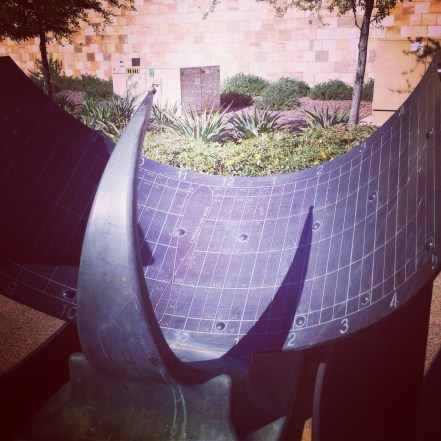
sundial
As individuals and as groups we all have blind spots. We accept beliefs without knowing all the facts simply because it is impossible to know all the facts. Especially in institutional settings we excuse resistance to change as part of keeping to tradition. If we look back in history we will notice that over time what was at one time considered to be true is now regarded as folly. Tradition is one thing and resistance to reality is quite another matter. Institutions protect dysfunctional operations not out of pride, but out of lack of awareness. The set it and forget it attitude runs strong in institutions and government agencies. It takes some tragic outcome to bring about change in some cases. It is impossible to observe one’s own actions if one is willfully blind. Thus, the blindness begets more blindness, becoming contagious.
What would Sir Isaac Newton think about the conditions that prevail?
No matter who wins the scary American presidential election now taking place, the financial and environmental imbalance will be rampant around the world. Balance can only be restored through awareness and planning. Without a plan we will careen ever closer to entropy. The solution is pre-political. Our awareness needs to cover all the people places and things with which we have contact. This energy drain, or misappropriated energy, is needed for the good of the entire planet in order to restore some kind of equilibrium. Plug the leaks in your own boat today. We are taking on water and listing to port.
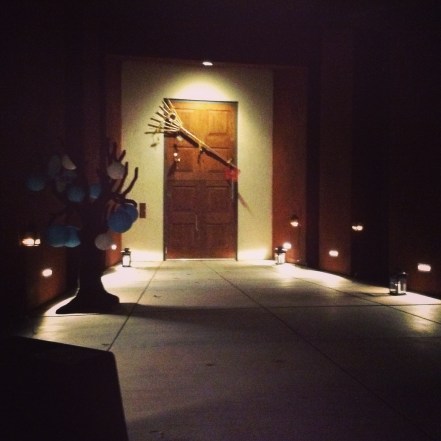
door in the darkness

The Judge
I was born with ample bossiness, and raised to rebel. I entered professions in which people paid me to tell them what to do. In travel (in the old days) clients planned trips with the advise of agents. I was an outside sales travel agent, meaning I worked for and found my own clients outside the agency. It was a perfect job for me because I have travelled extensively and don’t mind at all sharing my opinions. Agencies were full of very well-travelled agents because the suppliers used to treat us like royalty. If I had not been to a destination I had only to ask around the office to find someone who knew the place. It was a very cosmopolitan place to work. Everyone was very jolly until the airlines cut commission, signaling the end of supplier/agency relationships. It was very good while it lasted, and I am glad I was there for the gravy train.
I taught fitness and swimming in fancy spa settings. This required a different kind of bossiness, which required very little encouragement to bloom. The guests relinquish entirely too much power and responsibility in the spa atmosphere. The real key is not making them mind you in your presence (which they are paying big bucks to do). Success can only be measured after the student has returned to home/work/family and all the habitual triggers that exist there. When they try to integrate what they learned at the spa into real life, if they whip out the hand out you provided and do something (anything) they learned, you have succeeded in the mission. If they mind you back at home, then you are a boss.
I like the current fad to label things done with confidence “like a boss”. I agree that taking charge and speaking one’s own mind can be the difference between success and failure, and even between happiness and depression. Finding ones voice as a boss is valuable and must be done with respect and caution. Do not surprise unsuspecting members of your family or workforce with your newfound authority. Practice safe bossiness with appropriate subservients. Use your head.
Remember the fall of Rome when Caesar obviously just took on WAY too much dominance over the Romans. Don’t let things get out of hand with your bossy self. Use discretion as you boss your way around this world.

NaPoWriMo2016
I am a happy graduate of National Poetry Writing Month, 2016. This, my third time participating, taught me some good lessons. The best part of the month is always reading and discovering other poets. Here are just a few wonderful poems I found written during April:
There are more poets than I can possibly mention that show great talent and unique perspective. I hope you will investigate to find some poetry you like to read in this group or at the library. People take this 30 poems in 30 days challenge for different reasons. I find it stimulates my vocabulary as well as my visual sense because I always use an image with my poem. Sometimes I draw it. Each year I tell myself how therapeutic it is to create poetry and that I will continue the craft on my tumblr, which is linked for #NaPoWriMo with my wordpress for poetry month. This could be the year, gentle readers. The consistent lesson I have learned from these three years of participation is that other people like the poems that are not my own favorites, and vice versa. Later when I read some of my work I am kind of surprised it came from me, but there it is. These are a few of the reasons I urge you to write some verse:
You don’t have to show anyone what you write in order to benefit from trying your hand as a poet. You might be one…and don’t know it. Don’t wait until April 2017 to start. If you start now you will be sufficiently warmed up for the next round.

 mermaidcamp