mermaidcamp
Keeping current in wellness, in and out of the water
You can scroll the shelf using ← and → keys
You can scroll the shelf using ← and → keys

Padre Kino

Padre Kino
I initiated my new fabulous senior pass for the national parks yesterday at Tumacacori. It was a full moon night and a special program was presented. The park reopens a few times a year to let the public experience the place after dark. The ranger was a wonderfully knowledgeable presenter who showed a lot of pride in her position. This is a unique park because it preserves history of a mission that was abandoned. The original mission was founded by Padre Kino, who visited a couple of times before he died, but had little contact with the locals. He became popular by gifting the natives with seeds, animals and trees. Mission land was granted for the natives to use, but not trade or sell. Success through new agriculture was the main selling point used by the missionaries. By farming within the mission walls the crops were protected from wildlife and livestock grazing in the area. Crops and animals were introduced that provided food in seasons when native plant harvests were scarce.
Kino was a member of the Jesuit order, which would eventually be banished from New Spain by the king. The Franciscans took over the place, but when Mexico won independence the funds no longer flowed from Spain. The missionaries moved north to Mission San Javier del Bac, which is still in use today as a Catholic church. The abandoned site sat empty until the National Park Service took over.


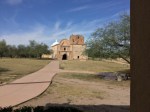


The full moon tour was an exciting and authentic way to honor this historic place by learning about the past. I learned many new facts that make me curious to learn more and return in the future to take in this very special atmosphere. I plan to make the most of my senior pass by checking out all the national parks in Arizona. I will have many happy travels in the future by tuning into programs and events such as the one we enjoyed yesterday as a day trip . If you know a senior (62 or over) who does not yet have a pass, this would make the very best of holiday gifts. It works for a whole car load of visitors. You only need one senior pass per car for free entry for all passengers. Maybe it is time to start traveling with a senior on board.
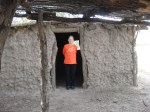

Arizona is full of scenic places with ancient civilizations. We are privileged to have such a rich cultural and natural tradition surrounding us. Now that I am loaded with my lifetime park pass I will be taking full advantage of it.


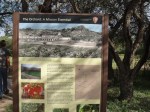

candle lanterns

altar in the church

park ranger and Padre Kino

look up
Life can throw challenging circumstances and people into the mix at any time. Our own composure and resilience is our biggest investment because the quality of our time is tied to it. The sayings on tee shirts about keeping calm then doing something are not only comical but are also practical. We can hardly accomplish our best work if we are flipping out about something. Remaining calm in the face of tense situations is an accomplishment. We need personal tool boxes ready to employ when stress becomes hard to handle. Although many practices work, the tools must be tailored to the individual. What lifts my mood might not be fun for you, so this takes some discernment. Packing the right tools for the job requires concentration as well as honesty. You need to know not only what will work for you but also what you will actually practice.
Meditation takes many forms, not all of which require sitting still. Walking meditation and mindfulness training are both active ways to keep moving while training the mind to focus and stay clear. Mantras, chanting and other sounds are excellent tools to anchor the mind. Formal training is wonderful, but we don’t need to wait to start a practice. Artistic expression provides simple straightforward access to the unconscious. Making art requires a special sensibility, a focus on creativity that is strong. Tapping into the inner artist is a way to train the mind and liberate the soul.

look up
Here are a few ways I find inner peace and concentration through art:

look up
I have no professional aspirations as an artist, yet I consider myself artistic. I am not meditative 100% of the time I engage in the above activities, but frequently they lead to a calmer happier state of mind. I believe each of us has essential creative gifts to offer which we have the option to develop. Finding time to immerse ourselves in our own creative juices can be a path to peace and happiness.

look up
spirits of the dead
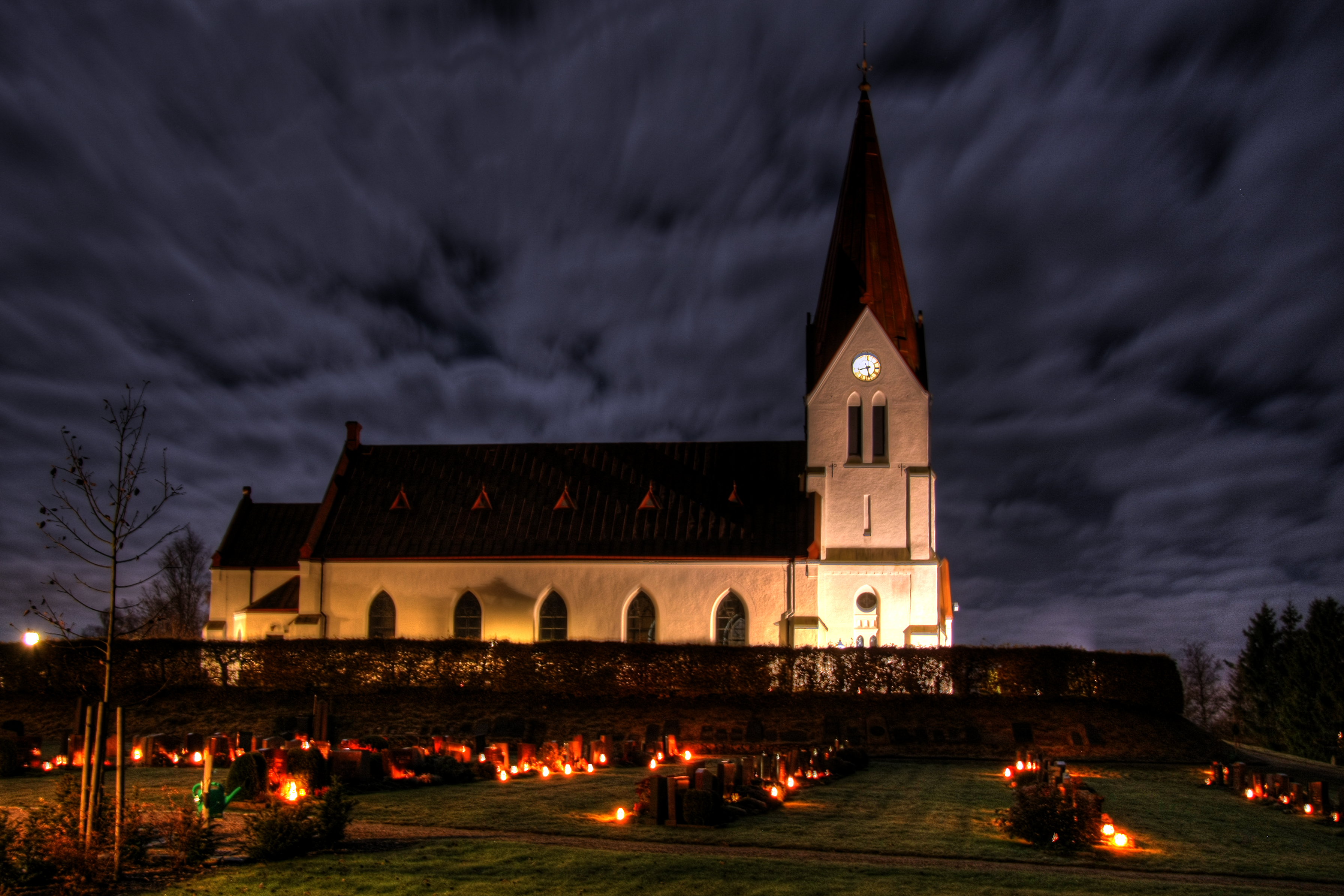
(image) https://upload.wikimedia.org/wikipedia/commons/0/07/Alla_helgons_dag_vid_R%C3%B6ke_kyrka-1.jpg
The Celts have learned every celebration has its risks.
The Druids taught them this, and the Druids are correct. Samhain is a festival of the harvest; the end of summer; the preparation for the winter to come. Samhain is a juncture.
As they all know, junctures lead to sundry places. There is both the leaving and the coming. A time of disquiet. A time of danger for those unprepared.
It holds the magic and the power of midnight. Midnight is a powerful time because it is the juncture of two days. Midnight of Samhain thus holds double the power. It can not be avoided. It must be met with all the power mortal man can muster. It must not be met alone.
On the Eve of Samhain, the border between Life and the OtherWorld is breached. A door swings invitingly open, but it is not inviting those who live. It is inviting those who have died…
View original post 277 more words
My 7th great-grandfather was born on May 7, 1667 in Greenwich, Fairfield County,Connecticut and died Feb. 22, 1746 in Greenwich. He is buried in the Old Burying Ground there.

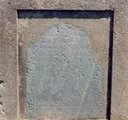
Benjamin Mead was an officer in the local militia and served a term as Surveyor for Fairfield County. Reports of his action in the French and Indian War are misleading, as he died before the Seven Years’ War war started. That said, that global war was only part of an ongoing conflict in Europe from 1689-1763 that had combat ramifications in North America on at least 4 occasions when wars were officially declared. In addition to having names these wars also had numbers under the rubrique of “Intercolonial Wars,” much as we have numbered “World Wars”– since the individual wars had different names in Britain than on the Continent, the numbering system helped keep things (somewhat) straight. Finally, the Intercolonial Wars, as they were called in Europe, were called the French And Indian Wars in North America.
Benjamin Mead was old enough to have fought in any of the first three of these, King William’s War or War of the League of Augsburg (1st Intercolonial) and Queen Anne’s War or War of the Spanish Succession (2nd Intercontinental) being the most likely. So in this sense, any action he saw during those wars makes him a veteran of the French and Indian Wars.
Spouses:
Sarah Waterbury Mead (1677 – 1745)*
Rachel Brown Mead (1680 – ____)*
Children:
Benjamin Mead (1701 – 1783)*
Eliphelet Mead (1704 – 1796)*
Elizabeth Mead Peck (1705 – 1783)*
Keziah Mead Howe (1707 – 1808)*
Obadiah Mead (1719 – 1759)*
Nehemiah Mead (1721 – 1791)*
Hannah Mead Mead (1726 – 1815)*
Siblings:
Ebenezer Mead (1663 – 1728)*
Hannah Mead Scofield (1664 – 1728)*
Jonathan Mead (1665 – 1712)*
Benjamin Daniel Mead (1667 – 1746)
Benjamin Daniel Mead (1667 – 1746)
is my 7th great grandfather
Mary Mead (1724 – 1787)
daughter of Benjamin Daniel Mead
Abner Mead (1749 – 1810)
son of Mary Mead
Martha Mead (1784 – 1860)
daughter of Abner Mead
Abner Morse (1808 – 1838)
son of Martha Mead
Daniel Rowland Morse (1838 – 1910)
son of Abner Morse
Jason A Morse (1862 – 1932)
son of Daniel Rowland Morse
Ernest Abner Morse (1890 – 1965)
son of Jason A Morse
Richard Arden Morse (1920 – 2004)
son of Ernest Abner Morse
Pamela Morse
I am the daughter of Richard Arden Morse
We know what has happened to his house in Greenwich:
Benjamin Mead, the son of John Mead, one of the 15 proprietors, inherited from his father 15 acres of property in Cos Cob in 1696. The will describes the inheritance as “five acres of land at Stickling brock (Strickland Brook) as it is lyd out to mee, and all my lands & meadow lying & and being at that place commonly cauled Coscob, as it is Layd out to mee & ten acres of upland above ye road aded now to ye five”.
In 1697, Benjamin built a house on the land, a two room saltbox with center chimney. A rear lean-to, including a kitchen ell was added in 1732 according to an architectural field study by the Greenwich Historical Society.
Obadiah Mead bought the Bible Street land and house from his father Benjamin Mead in 1746 (1756) for 200 pounds New York money. In that same year Obadiah married Lois Todd daughter of the Reverend Abraham Todd minister of the Second Congregational Society in Greenwich. The couple had 2 daughters, Mary Mead b.Aug 10 1757, d.2/14/1815 and Phoebe. Obadiah died in 1759 while the girls were young.
When the girls came of age the land was divided between them with a Dower lot for their mother. Mary eventually married Michael Cox Timpany b. abt 1755, d. 10/25/1811. Mary eventually inherited her sister and mothers shares to the land.
John Timpany, son of Mary and Michael, bought the house from his mother in 1813. In 1841 he sold the house to 3 of his daughters; Elvira, Hannah and Adelice (Delia) with the provision that they care for him the rest of his life. John died 11/15/1855.
Elvira Moshier never married and held the house until she died in 1880 willing her land to Sarah Ann Moshier Olmstead, wife of Henry Olmstead and the daughter of her sister Lois and James Moshier who were farmers on Cognewaug Road.
Sarahann held on to the house until she died and it was the purchased by her younger brothers Samuel Augustus Moshier, who ran a grocery on Greenwich Avenue, and Franklin Pierce Moshier who ran a livery / stable / early car dealership on Lewis Street.
Sam and Frank held onto the house until the early 1930’s, renting it out to family member (such as John Timpany Moshier who was waked in the Parlor November 1927).
I believe the house left the family due to losses incurred by Franklin and Augustus Moshier with the stock crash of 1929.
Since then the hous has turned over many, many times.
Very recently, a new owner, claiming the house was leaning, renovated the house. It now looks like a “new” old house….
I am in luck that a new model for Medicare patients has come to my neighborhood. Today Iora Primary Care opened a new practice very close to my home. My health insurance agent told me about this new practice that operates in a revolutionary way. I was invited to the ribbon cutting this morning that was well attended and very festive. Dr. Rushika Fernandopulle and some of the senior staff of the company flew out to Tucson from Boston, the site of the home office. The day had started with a heavy downpour and thunderstorm, but the weather cleared in time for an excellent party, some brief speeches, an official proclamation by the mayor of Tucson, and a ceremonial ribbon cutting to launch the business. A fine time was had by all. I sat down with Dr. Fernandopulle later this afternoon to learn more about our new local health care option. He has some great ideas.
His model was born partly from frustration in his American practice of primary care and partly from experience working around the world. By observing what works well with low or no tech he has crafted a system that takes advantage of good relationships first. The team approach makes the best use of both the patient and the doctor’s time. The office has a casual feel to it, and all the employees I met are enthusiastic about their jobs. I think Rushika is right that the synergy of culture is what distinguishes this medical practice from all others. I am very pleased to be given this choice for my Medicare coverage.

Rushika

Julie

healthy spread

Half Moon Beer

Mission Garden
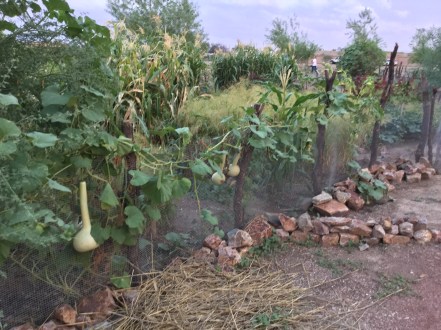
gourd crop
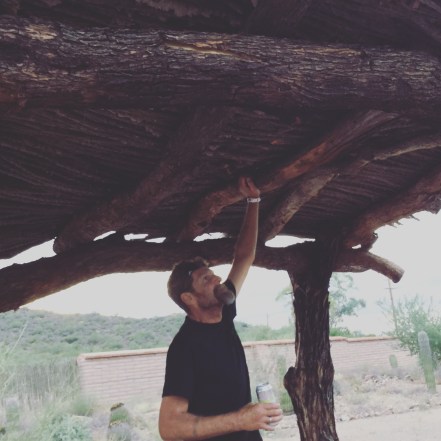
adobe ramada
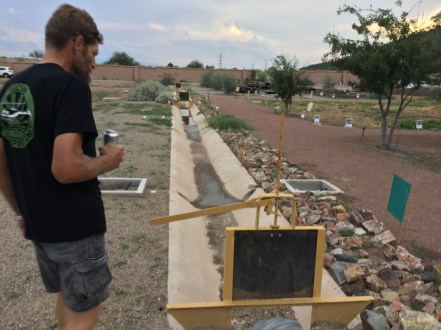
irrigation system
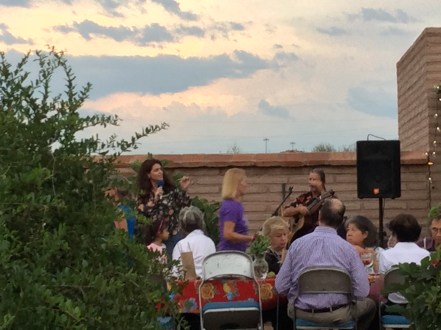
Regina Romero, City Council

historic crops

A Mountain

Missy the party cow
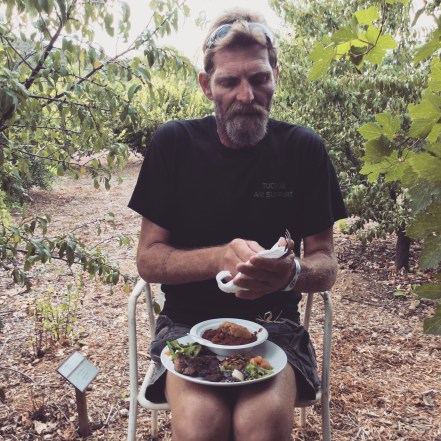
Bob dining in the garden
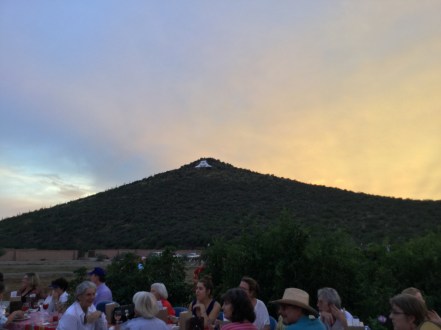
sunset dining in the garden

sunset dining in the garden
The Friends of Tucson’s Birthplace held a fine dinner party in the garden yesterday. Our historic Mission Garden has been rebuilt in the original site close to the Santa Cruz River. The agricultural heritage of the location is ancient. The garden is being developed as a living museum preserving original species grown by the Spanish colonial conquistadors who built the San Augustin Mission. The orchard of stone fruits, citrus, quince and figs is growing strong and bearing fruit. Gardens of okra, corn, chiles and other native crops thrive within the walls of the preserved site.
Local chefs were invited to create specialties for the Farm to Table event. We were excited to taste the food and also to get to tour the gardens. Musicians were hired to play throughout the space, which added an artistic note to the already splendid surroundings. The city councilwoman from that ward spoke briefly about the importance of agricultural history and her own family’s collection of historic recipes. All the food was over the top creative and fresh. My partner Bob enjoyed the grass fed beef and the buffalo chile, but most of the dishes served were vegetarian. Drinks were served with dinner, but for an extra fee we enjoyed a specialty beer brewed from organic wheat grown from preserved species. The beer tasted fantastic, and sold out quickly.
The event was a success for all involved. The chefs, no doubt, won some new fans with their creative concoctions. The garden certainly is a place we will plan to visit again in the future. In fact we may go to the quince festival next weekend at which we would have chance to win a special antique Spanish heirloom variety quince tree. The quince crop is ripe and abundant in the orchard, looking very pretty. The beauty and history preserved in this spot is a great asset to the city, and will only improve with time.
The hedonist archetype is both admired and disrespected in our society. We receive mixed messages about fun, enjoyment, and merchandise. “How much is too much?”, is a question we are in the process of answering. During our holiday season excess is encouraged in all things. We see images of over decorating, over eating, over indulging in sweets and alcohol as mandates to celebrate with certain products. If we give in to the marketing engines we will let our health and finances go in order to buy holiday goods. There is a fine line between genuine appreciation that brings joy and repetitive addictive habits that have flatlined. The solution is not to give up pleasure or fine things in life. To find balance we each need to find our own specific definitions of pleasure. We also need to monitor exactly how much pleasure is still left in long standing habits. We may be fooling ourselves sometimes.
Since I am a hedonist in the first house it is important for me to evaluate and stay aware of the ways in which I indulge myself. I am attached to sensuality and leisure which could easily lead to lack of discernment. In order to stay healthy I must stay clear about how much time, money and effort I spend to feel good. A feeling of wellbeing and good energy is the reward for putting health first. The shadow hedonist is like the cartoon red devil sitting on a shoulder acting as the conscience. This little delusion devil is persuasive. The dark side of hedonism is ironically anhedonia. The pursuit of pleasure to one’s detriment eventually results in a complete inability to experience pleasure. Addictions that require treatment are common now in America. What starts as a good time ends frequently in heartache.
When you think of the hedonist does someone you know come to mind? Do you recognize a hedonist in yourself? Calibrate the Fun-O-Meter to make sure you are still having some.
Ikigai, a perspective on purpose

Ikigai – the place where passion meets mission, vocation and profession. A place where we sit, contented and ‘right’ with the world, a place of where the energy flows freely, beautifully, productively. A place where we have purpose.
When this diagram appeared on my personal Facebook feed last week I just had to share it. I also promised myself that I’d take some time out to give form to what each arm of the diagram means to the ‘Realize Beauty’ me. I guess in doing this it will be a sort of business ‘sanity check’ or review….
Here goes.
View original post 851 more words
And all the men and women merely players;
They have their exits and their entrances,
And one man in his time plays many parts,
His acts being seven ages.
William Shakespeare sets out seven ages of man in this monologue from As You Like it. Carl Jung used characters as archetypes to describe the different aspects of one human life. These archetypes are played out in ancient Greek drama and mythology. From biblical proverbs to modern fiction characters based on eternal qualities of humanity are employed to tell stories. We embody different characters during our journey toward the end of life, sometimes joyous and other times somber. We act as students and as guides, as teachers and as pilgrims. Our energies are spent on our greatest passions, and we become known for our most obvious traits. Both our view of the world and the world’s view of us is constantly changing. The way we relate to one group may be different from the way we act toward another one.
Before we die we play parts that we have never considered. The soul is intricate and connected to the past as well as the future. Spirit and soul demand that our basic clay be sculpted into figures that arise from our dreams. The figures are fired in a kiln of experience and discernment. We are asked to step out on a ledge of unknowing in order to satisfy our inner longings. Some of our feelings come from the ancestors and some from our society. By observing our inner lives we can make the acquaintance of our own archetypes at work. By looking into patterns from the past and present we may notice how we fit into the story with other archetypes, the other players on the stage with us.
October is time for costuming and honoring the dead. Let us notice which characters cross our paths, and which ones we are playing. We are the casting directors of our own dramas….scary, isn’t it?

miniature Halloween
Feline Familiars
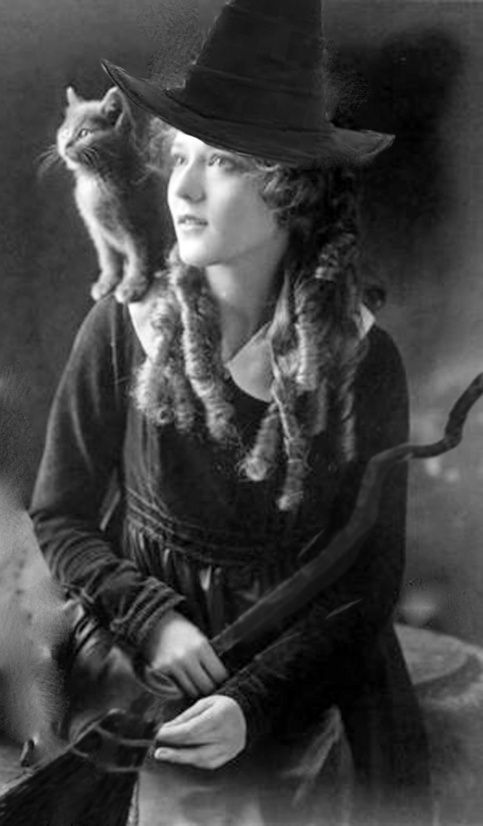
Photo: Pinterest
Mabel and her mother Sofie raised cats. They weren’t just any cats, they were Familiars. They were cats who knew, and were, magic. They were Witches’ cats. They were cats who had power and knew how to use it.
Mabel’s mother didn’t know how far back the line of cats went. Raising Familiars was simply what the Paws family did. Mabel, herself, was raised surrounded by cats. They slept in her cradle, licked milk off of her rosebud lips, purred into her tiny ears and cuddled around her to keep her warm and safe. To say that Mabel and her mother loved cats was a huge understatement. The cats loved them back but everyone knew they couldn’t stay together. Each had a job to do and a path to follow. Everyone except for Bunny. Bunny was a stray. She was a tiny little thing, undernourished, dehydrated and desperate…
View original post 368 more words


 mermaidcamp