mermaidcamp
Keeping current in wellness, in and out of the water
You can scroll the shelf using ← and → keys
You can scroll the shelf using ← and → keys
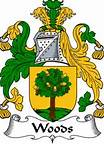
Woods Coat of Arms
My tenth great-grandfather was born Feb. 6, 1610, in England. He died July 10, 1678, Marlborough, MA.
John WOODS, a pin-maker by trade, arrived in America at age 26 in 1635 aboard the ‘Hopewell,’ and first settled at Salem, MA, but removed to Sudbury, MA by 1638, becoming a proprietor there in 1639. He was admitted freeman on May 10, 1642, and received several Sudbury land grants through 1655. After Marlborough was formed in 1660, John sold his property at Sudbury and relocated to Marlborough, where he had been granted land and served in various town offices. On Apr. 4, 1664, he deposed that he was about age 54. His will, dated Nov. 26, 1677 and proved Oct. 1, 1678, names his wife Mary, his three sons, daughter Katherine, son-in-law John BELLOWS, and grandchild Hannah LEVINS. The inventory of his estate, on Jul. 19, 1678 at £303.03.07, mentions son-in-law Joseph NEWTON. Married about 1633.
John Woods (1610 – 1678)
is my 10th great grandfather
John Woods (1641 – 1716)
son of John Woods
Lydia Woods (1672 – 1738)
daughter of John Woods
Lydia Eager (1696 – 1735)
daughter of Lydia Woods
Mary Thomas (1729 – 1801)
daughter of Lydia Eager
Joseph Morse III (1756 – 1835)
son of Mary Thomas
John Henry Morse (1775 – 1864)
son of Joseph Morse III
Abner Morse (1808 – 1838)
son of John Henry Morse
Daniel Rowland Morse (1838 – 1910)
son of Abner Morse
Jason A Morse (1862 – 1932)
son of Daniel Rowland Morse
Ernest Abner Morse (1890 – 1965)
son of Jason A Morse
Richard Arden Morse (1920 – 2004)
son of Ernest Abner Morse
Pamela Morse
I am the daughter of Richard Arden Morse
My 7th great-grandfather was born on May 7, 1667 in Greenwich, Fairfield County,Connecticut and died Feb. 22, 1746 in Greenwich. He is buried in the Old Burying Ground there.

Benjamin Mead was an officer in the local militia and served a term as Surveyor for Fairfield County. Reports of his action in the French and Indian War are misleading, as he died before the Seven Years’ War war started. That said, that global war was only part of an ongoing conflict in Europe from 1689-1763 that had combat ramifications in North America on at least 4 occasions when wars were officially declared. In addition to having names these wars also had numbers under the rubrique of “Intercolonial Wars,” much as we have numbered “World Wars”– since the individual wars had different names in Britain than on the Continent, the numbering system helped keep things (somewhat) straight. Finally, the Intercolonial Wars, as they were called in Europe, were called the French And Indian Wars in North America.
Benjamin Mead was old enough to have fought in any of the first three of these, King William’s War or War of the League of Augsburg (1st Intercolonial) and Queen Anne’s War or War of the Spanish Succession (2nd Intercontinental) being the most likely. So in this sense, any action he saw during those wars makes him a veteran of the French and Indian Wars.
Spouses:
Sarah Waterbury Mead (1677 – 1745)*
Rachel Brown Mead (1680 – ____)*
Children:
Benjamin Mead (1701 – 1783)*
Eliphelet Mead (1704 – 1796)*
Elizabeth Mead Peck (1705 – 1783)*
Keziah Mead Howe (1707 – 1808)*
Obadiah Mead (1719 – 1759)*
Nehemiah Mead (1721 – 1791)*
Hannah Mead Mead (1726 – 1815)*
Siblings:
Ebenezer Mead (1663 – 1728)*
Hannah Mead Scofield (1664 – 1728)*
Jonathan Mead (1665 – 1712)*
Benjamin Daniel Mead (1667 – 1746)
Benjamin Daniel Mead (1667 – 1746)
is my 7th great grandfather
Mary Mead (1724 – 1787)
daughter of Benjamin Daniel Mead
Abner Mead (1749 – 1810)
son of Mary Mead
Martha Mead (1784 – 1860)
daughter of Abner Mead
Abner Morse (1808 – 1838)
son of Martha Mead
Daniel Rowland Morse (1838 – 1910)
son of Abner Morse
Jason A Morse (1862 – 1932)
son of Daniel Rowland Morse
Ernest Abner Morse (1890 – 1965)
son of Jason A Morse
Richard Arden Morse (1920 – 2004)
son of Ernest Abner Morse
Pamela Morse
I am the daughter of Richard Arden Morse
We know what has happened to his house in Greenwich:
Benjamin Mead, the son of John Mead, one of the 15 proprietors, inherited from his father 15 acres of property in Cos Cob in 1696. The will describes the inheritance as “five acres of land at Stickling brock (Strickland Brook) as it is lyd out to mee, and all my lands & meadow lying & and being at that place commonly cauled Coscob, as it is Layd out to mee & ten acres of upland above ye road aded now to ye five”.
In 1697, Benjamin built a house on the land, a two room saltbox with center chimney. A rear lean-to, including a kitchen ell was added in 1732 according to an architectural field study by the Greenwich Historical Society.
Obadiah Mead bought the Bible Street land and house from his father Benjamin Mead in 1746 (1756) for 200 pounds New York money. In that same year Obadiah married Lois Todd daughter of the Reverend Abraham Todd minister of the Second Congregational Society in Greenwich. The couple had 2 daughters, Mary Mead b.Aug 10 1757, d.2/14/1815 and Phoebe. Obadiah died in 1759 while the girls were young.
When the girls came of age the land was divided between them with a Dower lot for their mother. Mary eventually married Michael Cox Timpany b. abt 1755, d. 10/25/1811. Mary eventually inherited her sister and mothers shares to the land.
John Timpany, son of Mary and Michael, bought the house from his mother in 1813. In 1841 he sold the house to 3 of his daughters; Elvira, Hannah and Adelice (Delia) with the provision that they care for him the rest of his life. John died 11/15/1855.
Elvira Moshier never married and held the house until she died in 1880 willing her land to Sarah Ann Moshier Olmstead, wife of Henry Olmstead and the daughter of her sister Lois and James Moshier who were farmers on Cognewaug Road.
Sarahann held on to the house until she died and it was the purchased by her younger brothers Samuel Augustus Moshier, who ran a grocery on Greenwich Avenue, and Franklin Pierce Moshier who ran a livery / stable / early car dealership on Lewis Street.
Sam and Frank held onto the house until the early 1930’s, renting it out to family member (such as John Timpany Moshier who was waked in the Parlor November 1927).
I believe the house left the family due to losses incurred by Franklin and Augustus Moshier with the stock crash of 1929.
Since then the hous has turned over many, many times.
Very recently, a new owner, claiming the house was leaning, renovated the house. It now looks like a “new” old house….

Pickens Coat of Arms
My 8th great-grandfather was born in 1644 in France. He died in 1700 in
County Limerick, Ireland. He was a Protestant who fled from religious persecution in France.
Robert Andrew Pickens (1644 – 1699)
is my 8th great grandfather
William Henry Pickens (1670 – 1735)
son of Robert Andrew Pickens
Andrew Sr Pickens (1699 – 1756)
son of William Henry Pickens
Jean Pickens (1738 – 1824)
daughter of Andrew Sr Pickens
Margaret Miller (1771 – 1853)
daughter of Jean Pickens
Philip Oscar Hughes (1798 – 1845)
son of Margaret Miller
Sarah E Hughes (1829 – 1911)
daughter of Philip Oscar Hughes
Lucinda Jane Armer (1847 – 1939)
daughter of Sarah E Hughes
George Harvey Taylor (1884 – 1941)
son of Lucinda Jane Armer
Ruby Lee Taylor (1922 – 2008)
daughter of George Harvey Taylor
Pamela Morse
I am the daughter of Ruby Lee Taylor
The following information was compiled by Mrs. Wendell Pickens, Costa Mesa, California.
The old, old story of Robert Pickens I, handed down to us by tradition, tells us that in the last half of the seventeenth century there was a man in France, probably of Scottish birth, by the name of Robert Pickens, who, it is said, held an official position as Chief Justice of the Court, and who was probably a Protestant of the Presbyterian Church. In this account of the Pickens family, he will be known to us as Robert Pickens I.
The name of his wife has been handed down to us as Esther Jane Bonneau, who, it is said, was a widow, possessing unusual beauty and was of the Huguenot faith.
When the Edict of Nantes was unwisely and unjustly revoked 22 October 1685, the persecution of the Protestants in France became so intense that large numbers of useful, as well as rich inhabitants of France, were forced to leave their native land and seek a place of safety in other countries where their industry, wealth and skill found a hearty reception. Robert Pickens I and his wife, with a large number of other refugees, fled to Scotland leaving France by way of La Rochelle, a fortified city of about eighteen thousand people, on the west coast of France.
We do not know how long Robert Pickens I lived in Scotland; but, after a time, we find his living at Limerick, Ireland, where he was living at the end of the seventeenth century.
We have no record of how many children Robert Pickens I had; but tradition tells us that at least three sons came to America to seek their fortunes in the New World, which at that time was being settled.
The names of the three sons of Robert Pickens I, who, we were told came to America, were: Andrew Pickens, John Pickens, Robert Pickens. We do not know the dates of birth of Andrew and John Pickens, but Robert Pickens was born at Limerick, Ireland, in 1697. It is known that these three brothers came to America; but is believed they did not come at the same time, because they did not settle at the same place in the New World. Robert Pickens I and his wife, it is said, were buried at Limerick, Ireland.
A son of Andrew [aka Andre’ Picon] and Isobell (Matthisone) Picken(s), Robert [aka Rob’ert Andre’ Picon] married widow Lady Ester Jeanne (le Benoit) le Bonneau in 1665 in La Rochelle, Charente-Maritime, France.
Known child:
1) William Henry Picken(s) (1669-1735), m: Margaret Pike.
NOTE: This ancestor is still being researched. Available sources have some conflicting information, but the facts seem to hold up that the Pickens family was originally from Ireland by way of Scotland. At some point, some family members fled to France and records show a French spelling of the name; i.e. Henri’ Picon. Some members were actually born in France during this time period, which most likely caused the confusion of ancestral roots.
Excerpt from General Andrew Pickens (1739-1817) letter to General Lee in 1811:
“There seems to be some support for the claim that one ROBERT PICON, a Scotchman or Briton at the court of France was a Protestant who fled from Scotland in 1661 to avoid persecution of Charles II. In France he is said to have married Madam Jean Bonneau, also a Protestant. They fled France after the revocation of the Edict of Nantes by King Louis XIV in 1685. Tradition continues that they went to Scotland, later to North Ireland.”
Miss Eliza Pickens, a gr-granddaughter of General Andrew Pickens, in a paper prepared for D.A.R., said: “General Andrew Pickens’ first home was in Bucks Co PA. The Pickens were French Huguenots and left France after the revocation of the Edict of Nantes by King Louis XIV in 1685. General Pickens’ gr-grandfather, Robert Pickens held a good position in France and with every inducement to remain, but he refused to live under Roman Catholic rule. He married an accomplished young widow, Madam Bonneau.”

Peabody coat of arms
My 9th great-grandmother was born in New Hampshire and died in Massachusetts. My 9th great-grandfather died young, and Lydia remarried.
Lydia Peabody Howlett: Birth: Aug. 30, 1640 Hampton Rockingham County New Hampshire, USA Death: Apr. 30, 1715 Boxford Essex County Massachusetts, USA d/o Francis Peabody / Lydia Perkins bapt Hampton, Rockingham Co., NH A member of the church at Rowley and by a letter of dismission was admitted to the Boxford church 21 Feb 1702/03 – by her father’s will she received five pounds besides what she had already had. m [1] 1662 Essex Co., MA Thomas Howlett [Jr.] They had 2 children – Mary m Lt. Thomas Hazen, Lydia m
[2] 8 Jul 1667 Essex Co., MA Thomas Perley They had 6 known children – Thomas m Sarah Osgood; Lt. Jacob m 3X; Lydia; Hepzibah [Hephzibah] b/d 1694/1695 Boxford ; Mary; Sarah ca1675 – 1769 ref: MA Boxford VR Topsfield Historical Society Lydia died 30 Apr 1715 Boxford, Essex Co., MA – The Peabody Gen. by Selim Hobart Peabody 1909; Essex Probate Court Record; New England Marriages Prior to 1700 C.A. Torrey Family links: Parents: Lydia Perkins Peabody (1617 – 1649) Spouses: Thomas Howlett (1637 – 1667) Thomas Perley (1641 – 1709) Sibling: Lydia Peabody Perley (1640 – 1715) Isaac Peabody (1648 – 1727) Burial: Mount Vernon Cemetery Boxford Essex County Massachusetts, USA Created by: BluMoKitty Record added: Sep 04, 2013 Find A Grave Memorial# 116523513
Lydia Peabody (1640 – 1715)
is my 9th great grandmother
Mary Howlett (1664 – 1727)
daughter of Lydia Peabody
John Hazen (1687 – 1772)
son of Mary Howlett
Caleb Hazen (1720 – 1777)
son of John Hazen
Mercy Hazen (1747 – 1819)
daughter of Caleb Hazen
Martha Mead (1784 – 1860)
daughter of Mercy Hazen
Abner Morse (1808 – 1838)
son of Martha Mead
Daniel Rowland Morse (1838 – 1910)
son of Abner Morse
Jason A Morse (1862 – 1932)
son of Daniel Rowland Morse
Ernest Abner Morse (1890 – 1965)
son of Jason A Morse
Richard Arden Morse (1920 – 2004)
son of Ernest Abner Morse
Pamela Morse
I am the daughter of Richard Arden Morse
Goody Cole was a local “character” in Hampton who ran afoul Francis’ wife Lydia and another neighbor, Sarah Perkin. She was later apparently tried for witchcraft though she was not convicted.
Nov 4 1645: in the oldest book of records of Ipswich court, entry reads “Eunice Cole to sit in the stocks at Hampton and to make acknowledgement of her slanderous speeches concerning Susan Parkings and Lidia Pebodye and to pay to the witness Isaac perkins 7d and the feas of the court.” [Ref: PeabodySH PEABODY p8] 1645: Eunice Cole publicly acknowledges her slanderous speeches against Susan Perkins and Lydia Peabody. That these two were connected seems possible [Ref: Noyes PEABODY Francis] Mar 4 1649/50: Seating at the Meeting House, assigned Second seat on east end of the south side, as “Goody Pebody” [Ref: Noyes PEABODY Francis] Her surname appears as PERKINS in various Internet sources (most noteably the LDS Ancestral File), daughter of Isaac PERKINS who was their neighbor in Hampton, but no confirmation found
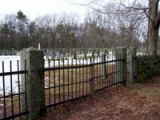
Mount Vernon Cemetery, Boxford, Essex, Massachusetts

Elizabeth Stafford
My 15th great-grandmother was married to a duke who treated her very badly. She was involved with court intrigue during the reign of Henry VIII.
Elizabeth Stafford was the daughter of Edward, 3rd duke of Buckingham (February 3,1478-May 17,1521) and Eleanor Percy (1470-1530). Robert Hutchinson’s House of Treason gives alternate life dates as 1493-September 4, 1558. Elizabeth was to have married one of her father’s wards, Ralph Neville, earl of Westmorland, at Christmas 1512, but shortly before that she acquired a new suitor in the person of the recently widowed Thomas Howard, earl of Surrey (1473-August 25,1554).
Buckingham offered his other daughters to Sussex, but the earl was determined to have Elizabeth, described by Jessie Childs in Henry VIII’s Last Victim: The Life and Times of Henry Howard, Earl of Surrey as “…passably pretty, with soft features, light colouring and a distinguished forehead….”
Early in 1513, Elizabeth married Surrey, bringing with her a dowry of 2,000 marks. They had five children:
Henry (1517-x.January 19,1547),
Mary (1519-December 9,1557),
Charles (d.yng),
Thomas (1528-1582), and a fifth child who died young and may have been named Muriel.
Elizabeth was often at court and became close friends with Catherine of Aragon. She carried Princess Mary to the font at the princess’s christening in 1516 and was a patron of the poet John Skelton, who describes Elizabeth and her ladies making a chapelet in the poem “A Goodly Garlande or Chapelet of Laurell.” When the earl of Surrey was appointed Lord Lieutenant of Ireland in 1520, he was ordered to take his entire family with him.
There they were exposed to war, disease, crowded conditions, and severe shortages of just about everything. To make matters worse, during their sojourn in Ireland, Elizabeth’s father was accused of treason and beheaded. In 1524, with the death of her father-in-law, Elizabeth became duchess of Norfolk. She continued to serve as a lady-in-waiting to the queen, at court for months at a time, but with the king’s growing determination to obtain a divorce, her role changed.
By 1530, Elizabeth was spying on her own husband, on the lookout for any information that would help Queen Catherine. By then, there were also problems in Elizabeth’s marriage. In 1526, Norfolk took Bess Holland, daughter of his chief steward, as his mistress, a long-term relationship which he did not trouble to keep secret from his wife.
Elizabeth continued to be vocal in her support of Catherine of Aragon. Norfolk, and most of the Howard family, favored the king’s plan to marry Anne Boleyn, whose mother was a Howard. Elizabeth went so far as to refuse to bear Anne’s train at her investiture as Marchioness of Pembroke and was conspicuously absent from both Anne’s coronation and the christening of Princess Elizabeth. In May,1533, Norfolk wrote to Elizabeth’s brother, Henry Stafford, asking him to take her in. Stafford refused, expressing the fear that “…her accustomed wild language…” would place him and his family in danger if he did so.
The matter came to a head on Tuesday of Passion Week, 1534. Norfolk arrived at Kenninghall, his principal residence, to find his wife in a rage because he was still keeping Bess Holland as his mistress. Norfolk’s response was to lock Elizabeth in her chamber, then banish her to Redbourne, a manor in Hertfordshire. Elizabeth referred to this as imprisonment, even though she had twenty servants and an allowance of three hundred marks per annum.
Legally Norfolk was within his rights to do as he wished with her. She tried three times for a reconciliation, but to no avail. Norfolk was not about to forgive some of the claims she had made, including one that he had assaulted her when she was pregnant with their daughter in 1519. Some of the charges may indeed have been “false and abominable lies,” but Norfolk was known to have a temper, too. In 1541, Elizabeth was still trying to regain freedom of movement, as well as a bigger allowance.
Her children, to her distress, sided with their father. Indeed, most people did. Wives were expected to put up with their husbands’ infidelities, not make a fuss about them. Upon Mary Tudor’s accession, Elizabeth returned to court and there was reunited with her husband, who had been in the Tower of London since 1547. He died at Kenninghall the following August.
Although both Elizabeth and Norfolk appear in effigy on the same monument in Framlingham, completed in 1559, only he is buried there. She was interred in the Howard Chapel in St. Mary’s Church, Lambeth, in December 1558. The epitaph written by her brother lauds her kindness and says she was to him “a mother, sister, a friend most dear.”
Biography:
“Marriage Sixteenth-Century Style: Elizabeth Stafford and the Third Duke of Norfolk” by Barbara J. Harris in Journal of Social History, 15/3 (1982).
Source– A WHO’S WHO OF TUDOR WOMEN: Stafford
Elizabeth Dutchess Norfolk Stafford Howard (1497 – 1558)
is my 15th great grandmother
Lady Katherine Howard Duchess Bridgewater (1495 – 1554)
daughter of Elizabeth Dutchess Norfolk Stafford Howard
William ApRhys (1522 – 1588)
son of Lady Katherine Howard Duchess Bridgewater
Henry Rice (1555 – 1621)
son of William ApRhys
Edmund Rice (1594 – 1663)
son of Henry Rice
Edward Rice (1622 – 1712)
son of Edmund Rice
Lydia Rice (1649 – 1723)
daughter of Edward Rice
Lydia Woods (1672 – 1738)
daughter of Lydia Rice
Lydia Eager (1696 – 1735)
daughter of Lydia Woods
Mary Thomas (1729 – 1801)
daughter of Lydia Eager
Joseph Morse III (1756 – 1835)
son of Mary Thomas
John Henry Morse (1775 – 1864)
son of Joseph Morse III
Abner Morse (1808 – 1838)
son of John Henry Morse
Daniel Rowland Morse (1838 – 1910)
son of Abner Morse
Jason A Morse (1862 – 1932)
son of Daniel Rowland Morse
Ernest Abner Morse (1890 – 1965)
son of Jason A Morse
Richard Arden Morse (1920 – 2004)
son of Ernest Abner Morse
Pamela Morse
I am the daughter of Richard Arden Morse
Elizabeth Howard (nee Stafford) (1494- 30 November1558) was the daughter of Edward Stafford, 3rd Duke of Buckingham and the wife of Thomas Howard, 3rd Duke of Norfolk.
Elizabeth was born in 1494, the eldest daughter of Edward Stafford, 3rd Duke of Buckingham (3 September1478-1521 and Eleanor Percy. Her paternal grandparents were Henry Stafford, 2nd Duke of Buckingham and Catherine Woodville. Her maternal ancestors were Henry Percy, 4th Earl of Northumberland and Maud Herbert. Her grandfather, the Duke of Buckingham, was executed in 1483 by King Richard III for treason, and in 1521, her own father suffered the same fate when he was beheaded on Tower Hill for treason against his king, Henry VIII. Elizabeth had two sisters, Mary, Lady Bergavenny and Catherine, Countess Westmoreland, and a brother, Henry Stafford, 1st Baron Stafford.
On 8 January1513, Elizabeth married Thomas Howard, earl of Surrey, who in 1524, would become the 3rd Duke of Norfolk. The marriage was his second. His first wife had been Anne of York, the daughter of Edward IV, but none of their children had lived beyond early infancy. Elizabeth bore her husband four surviving children but their marriage was unhappy and violent. He had taken as his mistress Bess Holland, who was her own laundress, and when Elizabeth protested, calling her “a churl’s daughter who was but a washer in my nursery for eight years” Howard savagely beat her. She later accused his mistress of striking her. They separated in 1533, the year Howard’s niece, Anne Boleyn, was crowned Queen of England. Elizabeth did not like Anne and was staunchly partisan in favour of Catherine of Aragon. In 1530, Elizabeth smuggled letters received from Italy to Catherine concealed in oranges Elizabeth also later told the Spanish Ambassador, Eustace Chapuys, that Howard had confided in her that “Anne would be the ruin of all her family”.. Anne, however, managed to win the favour of Elizabeth by arranging brilliant matches for the Howard children. Henry was married to the daughter of the Earl of Oxford, while Mary married the King’s illegitimate son, Henry FitzRoy, 1st Duke of Richmond and Somerset. Appeased, Elizabeth stopped plotting against Anne and returned to Court. She died on 30 November 1558 in Lambeth, London at the age of sixty-four. Elizabeth was the Dowager Duchess of Norfolk at the time of her death, her estranged husband, the Duke, having died four years earlier. She was buried on 7 December 1558 in Lambeth.
Elizabeth was often at court and became close friends with Catherine of Aragon. She carried Princess Mary to the font at the princess’s christening in 1516.
Elizabeth Stafford, Duchess of Norfolk, wife of Anne Boleyn’s uncle Thomas Howard, Duke of Norfolk

Elizabeth Stafford


My 10th great-grandfather made the trip from England to America in 1639, establishing himself before sending for his wife and children. He was one of the first settlers in Barnstable, MA, where he and his wife are buried.
James Hamlin (Hamblen) was living in London, England, in 1623. He came to New England and settled in Barnstable, Massachusetts, where he was a proprietor. He was admitted a freeman March 1, 1641-1642 and was on the list of those able to bear arms in 1643. He was a town officer.
James arrived at Barnstable in 1639. (Source: Virkus, “Abridged Compendium”). HAMBLEN, or HAMLIN, came from London. He first came to America without his family, in 1639, and they came later. It is believed that he was obliged to flee England due to religious persecution. He was a Puritan, and member of Rev. Lothrop’s church in Barnstable. He became a Freeman 1 MAR 1641-42. He was appointed constable soon after. He and his wife were members of the church in Barnstable at the settlement of Mr. Jonathon Russell in 1683.
James Hamblen (1606 – 1690)
is my 10th great grandfather
Eleazer Hamblen (1648 – 1698)
son of James Hamblen
Isaac Hamblin (1676 – 1710)
son of Eleazer Hamblen
Eleazer Hamblin (1699 – 1771)
son of Isaac Hamblin
Sarah Hamblin (1721 – 1814)
daughter of Eleazer Hamblin
Mercy Hazen (1747 – 1819)
daughter of Sarah Hamblin
Martha Mead (1784 – 1860)
daughter of Mercy Hazen
Abner Morse (1808 – 1838)
son of Martha Mead
Daniel Rowland Morse (1838 – 1910)
son of Abner Morse
Jason A Morse (1862 – 1932)
son of Daniel Rowland Morse
Ernest Abner Morse (1890 – 1965)
son of Jason A Morse
Richard Arden Morse (1920 – 2004)
son of Ernest Abner Morse
Pamela Morse
I am the daughter of Richard Arden Morse
James Hamblen, so far as has been ascertained, was the first of the name who settled in America. He came from London and settled in Barnstable, Massachusetts, in the Spring of 1639. Of his earlier life very little has been learned; records exist, however, from which some traces of him are supposed to have been discovered. The name of Hamblen appears frequently in th records of Plymouth Colony. The first mention is “March 1, 1741-2. James Hamblen was propounded for Freeman.”March 15, 1657, James Hamblen served on inquest on the body of a child, Simeon Davis.June 3, 1657, James Hamblen was sick and could not serve on the Grand Enquest.The name of James Hamblen appears in the list of Freemen of Barnstable in 1658.June 7, 1670, James Hamblen served on Grand Enquest; same day he was member of a trial jury.May 29, 1670, James Hamblen, Juni, and James Hamblen Seni, in list of Freeman.March 6, 1671, James Hamblen served on a jury.June 3, 1679, James Hamblen served on a jury in the case betgween Capt. John Williams and Edward Jenkins.July 7, 1681, James Hamblen served on juries.July 6, 1682, James Hamblen summoned to serve on a jury, and served.In the list of Freemen of Barnstable for 1689, among others appear the names of James Hamblen, James Hamblen, Jr., John Hamblen, Eleazar Hamblen. From Genealogy of James Hamblen and His Descendents and The Hamlin Family
As nearly all the first settlers of Barnstable came from London and the County of Kent, it is probable that James Hamblen,the ancestor, came from that city, as stated by Mr. David Hamblenin the New England Historic and Genealogical Journal. Ofhis early history, little is known. He appears to have been anearly member of Mr. Lothrop’s Church,’ though the date, is notfound on tie record. His son Bartholemew was baptized April24, 1642, but the baptism of his older children, James and Hannah,do not appear on the record. It is probable that they wereborn in England, and that neither they nor their mother cameover so early as the father. This was a common occurrence inearly times. The father came over, and when he had provided ahome sent for his family.He was one of the earliest settlers, and was in Barnstable inthe spring of 1639. His houselot, containing eight acres, was at Coggin’s Pond, and was one of those that I presume were laid outunder the authority of Mr. Collicut. It was bounded northerlyby the lot of Gov. Hinckley, easterly by the Commons, (now the ancient graveyard) southerly by the Commons, and westerly by the highway, which at that time after crossing the hill on the westturned to the north on the borders of the pond to Gov. Hinckley’sold house, which stood near the pond, and thence turnedeasterly, joining the present road at the head of Calve’s PastureLane. In 1686 the present road was laid out through Hamblen’s lot, and leaving a triangular shaped portion of it on the north ofthe road. Afterwards, in 1693, the location of the road havingbeen changed, the Hamblens were allowed to enclose that part of the old road situate between their land and the pond, and adjoining to Gov. Hinckley’s. The westerly portion of the roadwhich was discontinued, opposite the south end of the pond, wasreserved as a public watering-place, and is so occupied to thisday.His other lands were six shares and six acres of upland in$he Calves Pasture, twenty acres of upland, and the meadow onthe north, bounded easterly by the land of Henry Bourne, andwesterly by the land of Dea. John Cooper. His great lot of fifty acres was bounded south-westerly by the great Indian Pond, southerly by the lot of Thomas Lothrop, and northerly by theCommons. It was the most northerly of the Indian Pond lots,and his son John built a house thereon. The Hamblens were among the first settlers in that part of the town, and that region of country is now known as Hamblen’s Plain.In 1686 James Hamblen, Senior’s, house is described as standingon his twenty acre lot, on the north side of the highway, between the houses of Mr. Russell (known in modern times as Brick John Hinckley’s) and Dea. John Cooper’s, now owned by Mr.William Hinckley and others. In the year 1653 this land is calledon the records Mr. Groom’s land, but in the following year, 1654,Goodman Hamblen’s.James Hamblen, Sen’r, died in 1690. In his will dated Jan.23, 1683-4, he names his wile Anne and all his children. To Jame she gave £10, to Bartholemew, £5, and to his daughter Hannah,”according to ye desire of my mother,” £5. All the rest of his esta-te he gave to his wife during her natural life, and after her deathto be divided equally among his children He had a large real estate.His personal estate was appraised at £19,17.3.Goodman Hamblen was not much in public life. He was anhonest man, a, good neighbor, and a sincere christian. He was industriousand prudent in his habits, and, brought up his children to walk in his footsteps. His descendants have, with few exceptions,inherited the good qualities pf their ancestor. The Hon. HannibalHamlin, Vice President of the United States, is the only one amongthem who has been eminent in public life. To give a full genealogyof the family would require a volume. I cannot use all the materialI have collected without transcending the limits of a newspaper article.Several of this name came over early. Capt. Giles Hamlin, ofMiddletown, was a shipmaster, an,d a man of note in his time.There was a Clement Hamlin of Boston, in 1776,. James, of Barnstable,is supposed to have been a brother of Giles, but I have seen no evidence that renders it probable. Capt. Giles wrote his name Hamblin; James Hamblin. This is not conclusive evidence ; but if they were brothers the probability is they would have written their names in the same manner. On the Colony Records, except in two instances, his name is written, Hamlen. The exceptions are aninstrument to which he affixed his own signature, and, an exemptipnin 1657 from serving on the grand jury in consequence of sickness.His sons wrote their name Hamblen, Rev. Mr. Lothrop wrote the name uniformly, Hamling; Rev. Mr. Russell Hamblin. In 1642 James Hamlin ws admitted a freeman of the Colony, and in 1643 was constable of the town of Barnstable. The usual spelling is Hamblin, but the descendants of James are not uniform. Eleazer,the great-grandfather of Vice President Hamlin, dropped the b as a useless letter, and his descendants have continued to do so.
Family of James Hamblen.
His son James and daughter Hannah were probably born in England, his other children in Barnstable.I. JamesII, HannahIII. Bartholemew, 11th April, 1642, bap. April 24IV. John, 26th June, 1644, bap. June 30V. Sarah, 7th Nov. 1647, bap. same dayVI. Eleazer, 17th March, 1649-50, bap. same dayVII. Israel, 25th June, 1652, bap. same day This record shows that Goodman Hamblen was very exact in the performance of what he believed to be a religious duty, that none of his children should die unbaptised.
sources:
U.S., New England Marriages Prior to 1700
The Hamlin family : a genealogy of James Hamlin of Barnstable, Massachusetts, eldest son of James Hamlin, the immigrant
Geneological and Personal History of the Allegheny Valley, Pennsylvania. By John Woolf Jordan. Lewis Historical Pub. Co., 1913 – 1162 pages.
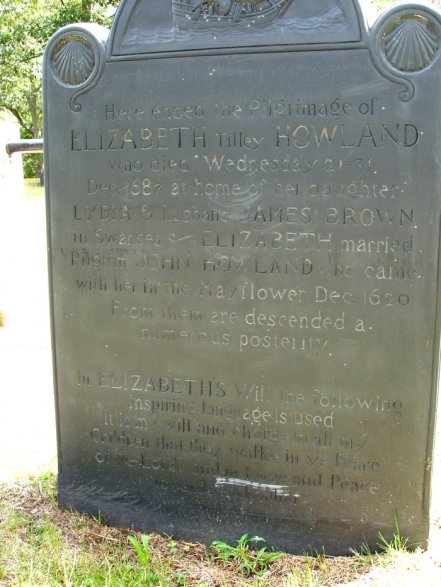
End Of Elizabeth’s pilgrimage
Elizabeth Tilley was born Aug. 30, 1607 in Henlow,Bedfordshire, England. She died Dec. 21, 1687 in
Swansea, Bristol County,Massachusetts. Elizabeth came to the new world with her parents on the Mayflower. Her parents did not survive the first winter at Plimouth Colony, leaving her an orphan.
For 15 years—or almost 20 percent of her life—Elizabeth Tilley Howland was a widow. She never remarried after her husband and fellow Mayflower passenger died on Feb. 23, 1672/3 and instead played the useful role of grandma while living with her daughter Lydia Brown in Swansea. Elizabeth was 65 when John died, probably still vivacious and attractive enough to say “yes” to a second husband, but she preferred to remain a widow until she died on Dec. 22, 1687. The Brown household was ideal for a grandma. When Elizabeth was widowed, the Brown children included James who was 17 years old, Dorothy who was six, and Jabez who was a lively five. Daughter Lydia was born in 1633 so she was 39 when her father died. Elizabeth had barely settled in at the Brown home when King Phillip’s War erupted in 1673. She was forced to flee as Swansea became the storm center of the war. At one point the little community founded only a few years before was almost deserted as residents scurried to safer places such as Barnstable which boasted a population of 3000 compared with 2600 for Plymouth.Three of Elizabeth’s children—Desire, John and Hope—lived in Barnstable when the Widow Howland moved there. Not far away in Plymouth were three other offspring of the Mayflower couple—Isaac lived in nearby Middleborough and Hannah made her home in Swansea, but Elizabeth had gone to far-away Oyster Bay, Long Island.There were many other Howlands in Barnstable, including scores of grandchildren who kept Elizabeth busy with her grandmother duties. Desire Howland was born in Plymouth about 1625, married to John Gorham about 1643 and moved to Barnstable after 1652. Gorham owned a grist mill and tannery there. He was a captain in the militia during King Philip’s War and died in 1676 as a result of war wounds. Five of the Gorham children were born in Barnstable—Jabez, Mercy, Lydia, Hannah and Shubael.John Howland, second child of John and Elizabeth, was born in 1627 and in 1651 he wed Mary, daughter of Robert Lee of Barnstable. Of their 10 children, the last eight were Barnstable babies. They were Isaac, Hannah, Mercy, Lydia, Experience, Anne, Shubael and John. Both John Howland Jr. and his wife Mary Lee died in the cape town.Hope Howland, who was born in 1629, married when she was about 17. Her husband was John Chipman who came in 1630 from Barnstaple, Devonshire, England. (Note that the English spelled Barnstaple with a P while the Americans spelled it with a B.)All of the 11 children probably were born in Barnstable. They were Elizabeth, Hope, Lydia, John (he lived only about 15 months), Hannah, Samuel, Ruth, Bethia, Mercy, John and Desire.So many grandchildren must have taxed Elizabeth’s memory for there were three Lydias, three Hannahs, three Mercys, three Johns, two Isaacs and two with the name Shubael. How could she keep them all straight?And just imagine Grandma Howland baking birthday cakes with magic candles for all these grandchildren. Elizabeth’s son-in-law, James Brown, was one of the most prominent of the early settlers in Swansea. He was a leader in the war against Philip, serving as a major. He also was one of the original members of the Swansea church and was fined five pounds for setting up a Baptist church in Rehoboth.He tried his best to bring peace to Plymouth Colony and went twice to see the Indian leader but found Philip “very high and not p’suadable to peace.”Large families usually have their tragedies and the Howlands had theirs. Three of Elizabeth’s children—Desire Gorham, Hope Chipman and Ruth Cushman—died before she did.The war didn’t last any great length of time and in the end Philip lost his head. The Indian chief was shot by another Indian and his head cut off. The bloody skull was taken in triumph to Plymouth where it was mounted on a pike. It remained there for 20 years, a souvenir of savagery. Birds make it a favorite resting place and finally the Rev. Increase Mather too the jawbone.With fighting over, Elizabeth returned to Swansea where she kept busy helping with the cooking, sewing, cleaning, gardening—caring for family members.Everyone dies once in a lifetime and for Elizabeth death came on Dec. 22, 1687. She was buried in Little Neck Cemetery in what is now east Providence, Rhode Island. The monument and grave are maintained by the Pilgrim John Howland Society. In her final will Elizabeth Tilley Howland gave her possessions to her children and grandchildren and expressed her deep religious faith: “And first being penitent & sorry from ye bottom of my heart for all my sins past most humbly desiring forgiveness for ye same I give & commit my soule unto Almighty God my Savior & Redeemer in whome & by ye merits of Jesus Christ I trust & believe assuedly to be saved & to have full remission & forgiveness of all my sins & that my Soule wt my Body at the generall day of resurrection shall rise againe wt Joy & through meritts of Christ’s Death & passion possesse & inherit ye Kingdome of Heaven…” She concluded:“It is my Will & Charge to all my Children that they walke in ye Feare of ye Lord, and in Love and peace towards each other…”
U.S., Sons of the American Revolution Membership Applications, 1889-1970
Elizabeth Tilley (1607 – 1687)
is my 10th great grandmother
Joseph Howland (1640 – 1703)
son of Elizabeth Tilley
Elizabeth Howland (1673 – 1724)
daughter of Joseph Howland
Eleazer Hamblin (1699 – 1771)
son of Elizabeth Howland
Sarah Hamblin (1721 – 1814)
daughter of Eleazer Hamblin
Mercy Hazen (1747 – 1819)
daughter of Sarah Hamblin
Martha Mead (1784 – 1860)
daughter of Mercy Hazen
Abner Morse (1808 – 1838)
son of Martha Mead
Daniel Rowland Morse (1838 – 1910)
son of Abner Morse
Jason A Morse (1862 – 1932)
son of Daniel Rowland Morse
Ernest Abner Morse (1890 – 1965)
son of Jason A Morse
Richard Arden Morse (1920 – 2004)
son of Ernest Abner Morse
Pamela Morse
I am the daughter of Richard Arden Morse
Her will is recorded:
Elizabeth Tilley Howland Will
Elizabeth Tilley Howland Will http://www.mayflowerfamilies.com/wills/elizabeth_howland_will.htm [MD 3:54+] Elizabeth (Tilley) Howland, widow of John Howland and daughter of John Tilley, died at Swansea on Wednesday, 21/31 December, 1687, at the house of her daughter Lydia, the wife of James Brown. Her will is recorded in the Bristol County, Mass., Probate Records, Volume 1, pages 13 and 14. No inventory is on record and the original will has disappeared from the files.In ye Name of God Amen I Elizabeth Howland of Swanzey in ye County of Bristoll in ye Collony of Plymouth in New Engld being Seventy nine yeares of Age but of good & perfect memory thanks be to Allmighty God & calling to Remembrance ye uncertain Estate of this transitory Life & that all flesh must Yeild unto Death when it shall please God to call Doe make constitute & ordaine & Declare This my last Will & Testament, in manner & forme following Revoking and Anulling by these prsents all & every Testamt & Testamts Will & Wills heretofore by me made & declared either by Word or Writing And this to be taken only for my last Will & Testament & none other. “And first being penitent & sorry from ye bottom of my heart for all my sinns past most humbly desiring forgivenesse for ye same I give & Comitt my soule unto Allmighty God my Saviour & Redeemer in whome & by ye meritts of Jesus Christ I trust & believe assuredly to be saved & to have full remission & forgivenesse of all my sins & that my Soule wt my Body at the generall Day of Resurrection shall rise againe wt Joy & through ye meritts of Christs Death & passion possesse & inheritt ye Kingdome of heaven prepared for his Elect & Chosen & my Body to be buryed in such place where it shall please my Executrs hereafter named to appoint And now for ye settling my temporall Estate & such goodes Chattells & Debts as it hath pleased God far above my Deserts to bestow upon me I Do Dispose order & give ye same in manner & forme following (That is to say) First that after my funerall Expences & Debts paid wc I owe either of right or in Conscience to any manner of person or persons whatsoever in Convenient tyme after my Decease by my Execrs hereafter named I Give & bequeath unto my Eldest Son John Howland ye sum of five pounds to be paid out of my Estate & my booke called Mr Tindale’s Workes & also one pair of sheetes & one prof pillowbeeres & one pr of Bedblanketts, Item I give unto my son Joseph Howland my Stillyards & also one pr of sheetes & one pt of pillobeeres Item I give unto my son Jabez Howland my ffetherbed & boulster yt is in his Custody & also one Rugg & two Blanketts yt belongeth to ye said Bed & also my great Iron pott & potthookes Item I give unto my son Isaack Howland my Booke called Willson on ye Romanes & one pr of sheetes & one paire of pillowbeeres & also my great Brasse Kettle already in his possession Item I give unto my Son in Law Mr James Browne my great Bible Item I give & bequeath unto my Daughter Lidia Browne my best ffeatherbed & Boulster two pillowes & three Blanketts & a green Rugg & my small Cupboard one pr of AndyIrons & my lesser brasse Kettle & my small Bible & my booke of mr Robbinsons Workes called Observations Divine & Morrall & allso my finest pr of Sheetes & my holland pillowbeeres, Item I give unto my Daughter Elisabeth Dickenson one pr of Sheetes & one pr of pillowbeeres & one Chest Item give unto my Daughter Hannah Bosworth one pr of sheets & one pr of pillowbeeres, Item I give unto my Grand Daughter Elizabeth Bursley one paire of sheets and one paire of Pillowbeeres Item I give & bequeath unto my Grandson Nathanael Howland (the son ofJoseph Howland) and to the heires of his owne Body lawfully begotten for ever all that my Lott of Land with ye Meadow thereunto adjoyning & belonging lying in the Township of Duxbury neare Jones River bridge, Item I give unto my Grandson James Browne One Iron barr and on Iron Trammell now in his possession, Item I give unto my Grandson Jabez Browne one Chest Item I give unto my Grand Daughter Dorothy Browne My best Chest & my Warming pan Item I give unto my Grand Daughter Desire Cushman four Sheep, Item I give & bequeath my wearing clothes linnen and Woollen and all the rest of my Estate in mony Debts linnen or of what kind or nature or sort soever it may be unto my three Daughters Elisabeth Dickenson, Lidia Browne and Hannah Bosworth to be equally Devided amongst them, Item I make constitute and ordaine my loving Son in Law James Browne and my loving son Jabez Howland Executors of this my last Will and Testament, Item it is my Will & Charge to all my Children that they walke in ye Feare of ye Lord, and in Love and peace towards each other and endeavour the true performance of this my last Will & Testament In Witnesse whereof I the said Elisabeth Howland have hereunto sett my hand & seale this seventeenth Day of December Anno Dm one thousand six hundred Eighty & six.The mark of Elisabeth E H Howland (sigittu)Signed Sealed & Delivd in ye prsence of Us WittnessesHugh ColeSamuel VyallJohn BrowneKnow all men that on ye tenth Day of Janry Anno Dm 1687/8 Before me Nathanl Byfield Esqr Judge of his Majties Inferiour Court of Plea’s for ye County of Bristoll, present Jno Walley Esqr one of ye Members of his Majties Councill in New England & Capt Benjam Church Justice of Peace The abovewritten Will of Elizabeth Howland was proved approved & allowed And ye Administracon of all & singuler ye goodes Rights and Creditts of ye said Deced was Committed unto James Browne & Jabez Howland Execrs in ye same Will named well & truly to Administer ye same according to the Will of ye Deced In Testimony whereof I have hereunto Sett ye Seale of ye Office for Probate of Wills & granting Lettrs of Admincon ye yeare & Day by me abovewritten(Sigittu officij) Nathanael ByfieldThus Entred & ingrossed this 26: of Janry Anno Dm
Elizabeth Tilley Howland Birth: Aug. 30, 1607HenlowBedfordshire, EnglandDeath: Dec. 21, 1687SwanseaBristol CountyMassachusetts, USAOriginal Mayflower Passenger. Wife of Mayflower Passenger John Howland. Elizabeth was orphaned in the New World, at the age of thirteen, after her parents died the first winter in Plymouth. (bio by: Thomas Mick) Family links: Parents: John Tilley (1571 – 1621) Joan Hurst Tilley (1568 – 1621) Spouse: John Howland (1591 – 1673) Children: Desire Howland Gorham (1623 – 1683)* John Howland (1627 – ____)* Hope Howland Chipman (1629 – 1683)* Elizabeth Howland Hicks Dickinson (1631 – 1692)* Lydia Howland Brown (1633 – ____)* Hannah Howland Bosworth (1637 – 1705)* Joseph Howland (1640 – 1704)* Jabez Howland (1644 – ____)* Ruth Howland Cushman (1646 – 1679)* Isaac Howland (1649 – 1723)* *Calculated relationship Burial: Ancient Little Neck Cemetery East ProvidenceProvidence CountyRhode Island, USAPlot: Brown family plot Maintained by: Find A GraveOriginally Created by: Ronald KeyesRecord added: Sep 15, 2007 Find A Grave Memorial# 21561583

During the exciting and educational April #NaPoWriMo I managed to kick out 30 poems in 30 days. I will follow the poets I met because they make my days richer with only short bursts of time invested. I can read a poem for a minute or two and ponder it forever. I love the community that develops around the special poetry writing month and plan to keep my connection to it. I have learned that the process of writing poems is therapeutic . While engaged in poetic efforts I happened to digitally meet new people who are as interesting to me as the poets. Much to my surprise, my niche geek group, family history freaks, is alive and meeting regularly to share data and support.
This new group found me, or I found it on Facebook. New England Family Genealogy and History is a special interest group for those of us who study these subjects. I am delighted to find people as obsessed with history as I am. Some of them still carry the Mayflower pilgrim family names. There have been wonderful pictures and stories posted in which I have identified members as having common ancestors. This is a full time party of like minded genealogy freaks I can join on line any time. Be still my heart! People who have much more direct information and verification are there to help anyone with inquiries. The first ancestor I found I had in common with other members was my famous poet, Ann Dudley Bradstreet, who may be my favorite ancestor of all. In a few weeks I have met others with whom I share different progenitors. A recent discussion revealed that others share perhaps Native ancestry. Like me, few can definitively prove a connection to a tribe.
Some of the active participants are professional genealogists or family archivists of large collections. Plenty are DAR and Mayflower Society members. Many live in New England now and are connected to local societies for the preservation of everything under the sun. I enjoy learning about some of the old buildings that have stayed in family hands for hundreds of years. I feel a tinge of jealousy when they go off to Providence to a genealogy convention for the weekend. Then I remember that to live in New England one must endure snow and other unpleasantries. I may return to Cape Cod and Rhode Island on a history hunt one day. For now I am very pleased to be in touch with history fans who share interest, passion, and loads of information about New England and the people who have lived there. I can digitally visit every day. You can too if New England History is an interest of yours.
This week I want to invite you to use the transporter cloaks to travel back in time to Edgefield, South Carolina in 1798. I want you to help me solve a history mystery. My 2nd great grandfather, John Samuel Taylor, was born May 1, 1798 in Edgefield County, South Carolina. He died Mar.11, 1873 in Edgefield County, South Carolina. The town was founded in 1785, and I imagine John’s parents could have been involved. I have not found solid evidence of his birth or his parents, so I am here to find out exactly what happened. Having the name John Taylor is a serious problem in research because there were so many other people with the same name. I might despair of ever finding the truth about which John Taylor’s parents are mine but for a lucky break. Fortunately Edgefield has taken the historical heritage of the area very seriously and probably has the answer.
My life as an ancestry detective was rudely interrupted this week by a claim by my first cousin. Some of you know I do research all the time to learn about my family tree. I have found errors in the past which have caused me to start over from that point. This is painful, like tearing out your knitting. The funny part about it is the attachment I have to these people. For a while after removing some phantom limbs in the past I have missed those people terribly in addition to being vexed at having spent so much time on the wrong trail of data. I had an idea of who they were and how my DNA was built, but I was wrong, all wrong. If my cousin is right, and all the rest of the people on Ancestry.com are mistaken I have done a massive amount of research based on specious evidence. She thinks that John Taylor has a different set of parents than I do. She has no proof, but I don’t either. One of us is correct, and I just have to know which one.
The Southern Studies Showcase is an event that celebrates the history of the town. Prohibition is the theme for the next Showcase in September, and will feature moonshiners, model A cars, and period costuming. The genealogical society is the largest in the state, and prides itself on keeping excellent records. I would have a very good time dressing up in a flapper dress I already own and going to a big history party, so I think I can kill two birds with one stone in September, 2015. I can discover just who the parents of my John Taylor are, and visit a historically significant place that cherishes it’s past. I went to the Somerset, PA Historical Society to do research. I even bought a membership. When I arrived in person I was shunned. Nobody would help me and I had never been in an archive like that, so I found nothing. I had paid them to do some research for me, but that never happened either. I don’t think that will happen in the deep South. I think a trip to The Gateway to Southern History would be highly educational as well as enjoyable. I can solve this ancestry mystery and party at the same time.
The timing for me is intriguing because I recently went to a performance by the Steep Canyon Rangers here in Tucson. They play modern bluegrass music. I became very homesick for North Carolina hearing it. I lived there when I was young, and had a very good time. I bought a couple of their albums and have binged on bluegrass for weeks now. Now I have a really good reason to go to the source. So I hope you will enjoy this visit to the historical South where they do have coffee, tea, lemonade, and RC Cola ( Moon Pies and more). I am going to suggest that this week, since it is digital, we all just pass this jar of moonshine around the table while we sit and tell our tales. I am interested to hear about your week, gentle reader. I sincerely hope you have not discovered possible flaws in your research. If so, not to fret..tomorrow is another day.

#Weekendcoffeeshare

Carolina Moonshine


My 20th great-grandfather was given a castle to marry my 20th great-grandmother. Sir James LeBotiller Butler, 1st Earl of Ormond was born in 1305 in Arklow, County Wicklow, Ireland. He died Jan. 6, 1338 in Gowran, County Kilkenny, Ireland. In his short life he had three children and founded a Franciscan friary. He had some fabulous wigs, it seems.
James Butler, 1st Earl of Ormond. Knight of the Garter, Knight of Knocktopher, Kilkeney, Nenah and Thurles, Tipperary, Aylesbury, Grewt Lindford and Rotherfield Peppard, Buckinghamshire. Of Sopley, Hampshire, of LaVacherie and Shere, Surrey, of Weeton, Lancashire. Hereditary Chief Butler of Ireland, Lieutenant of Ireland.
Son and heir of Sir Edmund Butler, Earl of Carrick, Justiciar of Ireland and Joan FitzThomas.
First husband of Eleanor de Bohun, 2nd surviving daughter of Humphrey de Bohun and Elizabeth of England. They had two sons and one daughter: John, James, Pernel.
He was only three when he served as a hostage for his father, held in Dublin Castle in 1317. His father’s will was dated 1321, and death the same year, listed James, who would be the 7th Chief Butler of Ireland, from long line of ancestors named FitzWalter, adopting the surname of Butler. He received protection (permission) to cross to Ireland in 1326. In 1327, Eleanor was offered to James with an arrangement of the castle and manor of Kilpeck, Herefordshire for life.
King Edward III created him the first Earl of Ormond by patent, bearing date 2 November 1328 at Salisbury with the creation fee of £10 a year. At the same time, the king created Roger Mortimer as the 1st Earl of March.
In 1336 he founded the friary of Carrick-Begg for Franciscan Friars. On 3 June of that year, he gave the friars his castle and estate of Carrick, of which they took possession on Sunday the feast of SS. Peter and Paul.
James died 06 Jan 1338 and was buried at Gowran. His widow would remarry to Sir Thomas de Dagworth.

Sir James LeBotiller Butler, 1st Earl of Ormond
Sir James LeBotiller Butler, 1st Earl of Ormond (1304 – 1338)
is your 20th great grandfather
Sir James “The Noble Earl” Butler, 2nd Earl of Ormond, Lord Justice of Ireland (1331 – 1382)
son of Sir James LeBotiller Butler, 1st Earl of Ormond
James Butler (1361 – 1405)
son of Sir James “The Noble Earl” Butler, 2nd Earl of Ormond, Lord Justice of Ireland
James Butler (1392 – 1452)
son of James Butler
Elizabeth Butler (1420 – 1473)
daughter of James Butler
Isabel Talbot (1444 – 1531)
daughter of Elizabeth Butler
Sir Richard Ashton (1460 – 1549)
son of Isabel Talbot
Sir Christopher Ashton (1493 – 1519)
son of Sir Richard Ashton
Lady Elizabeth Ashton (1524 – 1588)
daughter of Sir Christopher Ashton
Capt Roger Dudley (1535 – 1585)
son of Lady Elizabeth Ashton
Gov Thomas Dudley (1576 – 1653)
son of Capt Roger Dudley
Anne Dudley (1612 – 1672)
daughter of Gov Thomas Dudley
John Bradstreet (1652 – 1718)
son of Anne Dudley
Mercy Bradstreet (1689 – 1725)
daughter of John Bradstreet
Caleb Hazen (1720 – 1777)
son of Mercy Bradstreet
Mercy Hazen (1747 – 1819)
daughter of Caleb Hazen
Martha Mead (1784 – 1860)
daughter of Mercy Hazen
Abner Morse (1808 – 1838)
son of Martha Mead
Daniel Rowland Morse (1838 – 1910)
son of Abner Morse
Jason A Morse (1862 – 1932)
son of Daniel Rowland Morse
Ernest Abner Morse (1890 – 1965)
son of Jason A Morse
Richard Arden Morse (1920 – 2004)
son of Ernest Abner Morse
Pamela Morse
I am the daughter of Richard Arden Morse

LeBotiller coat of arms
 mermaidcamp