mermaidcamp
Keeping current in wellness, in and out of the water
You can scroll the shelf using ← and → keys
You can scroll the shelf using ← and → keys

King’s Colors
My 10th great-grandmother was a midwife who outlived two husbands before she arrived in America. I am a descendant of her first husband, John Potter who died in England. Her immigration to America was tragic, and she survived to the age of 75. The reason the colonists gave her the land belonging to her dead husband was her profession as a midwife. Since they needed her services they wanted her to stay.
John BEECHER was born on 28 Mar 1594 in Kent, England. He died in 1637/38 in New Haven, Connecticut. He immigrated on 26 Jun 1637 to Boston Harbor. Arrived April 26, 1637 from Steldhurst County, Kent, England. In Governor Eaton’s Company. The first Beecher to reach New England was John Beecher, who came from Kent, England in 1637. He was in the company led by Rev. John Davenport and Theophilus Eaton who had been the Ambassador to Denmark and Deputy-Governor of India. The company crossed the ocean on the “Hector” and another sister-ship. These two ships, after a two month voyage, dropped anchor in Boston harbor. The company consisted of 50 men and 200 women and children and was the most prosperous that ever arrived in New England. Unfortunately, they landed in the midst of a quarrel about Anne Hutchinson who had set herself up as a preacher, irregardless of her sex. Not wishing to become involved, they sent out a scouting party to find another location to settle. They decided upon Quinnipiack on the Long Island Sound, the site of present day New Haven, Conn. The party built a hut and left seven of their men to hold the post for the winter and to prepare for the arrival of the rest of the company in the spring. John Beecher was one of the seven and he failed to survive the winter. Hannah arrived in the spring with her son Isaac and found her husband in an unmarked grave. Since she was the only midwife among them, and thus relied upon by the others in the company, she was given her husband’s allotment of land for herself and her son Isaac. One hundred and twelve years later, in 1750, when David Beecher was a boy of twelve, workmen who were digging a cellar for a house at the corner of George and Meadow Streets in New Haven came upon human bones, believed to be those of John Beecher. Hannah Mead was born in 1600 in Spaldhurt, Kent, England. She died on 5 Apr 1658/59 in New Haven, Connecticut.
Hannah Beecher sailed from England with her son Isaac and was a widow at the time she left England. Husband John Beecher, one of the seven whom Eaton sent to New Haven in advance of the colony ,died before the colony arrived. He did not survive the first winter. It is established that this ship load of people was rather wealthy landowners from Steldhurst County, Kent, England. Since the company was rather young, it was felt that Hannah’s services of midwife would be greatly needed. She therefore was offered her husband’s land right in the new world if she would agree to go and fulfill this need, which she did.
The will of Hannah Beecher was proved April 5, 1659 and is recorded in first part, vol i., p 80 of New Haven Probate Records as follows: “I Hannah Beecher of New Haven, expectying my great change do make this my last will and testament, I bequeath my soul unto the hands of my Lord Jesus Christ by whose meritt I hope to be saved and my body to be burried at the discretion of my Son William Potter my Executor. And for my worldly goods I give unto John Potter my Grand child twenty shillings and to Hannah Blackly, my Grand child twenty shillings to be paid to them within three months after my decease. And for the rest of my estate I give one third part to my son Isaac Beecher and two thirds to my eldest son William Potter, making him my Executor, desiring him to be as a father to his younger brother and his children. And in dividing my goods my will is that my son William should have my feather bed with that belongeth to it, unto his part and that the rest be divided at the discretion of my Overseers with the assistance of Sister Wakeman and sister Rutherford and I desire my loving friends Mr Mathew Gilbert and Job Wakeman to be overseers of this my last will whereunto I have set my hand this 13th day of June, Anno 1657. Witnesses, the mark of Mathew Gilbert, Hannah Becher John Wakeman, Sarah Rutherford. This source also indicates that the inventory of Hannah’s estate following her death in 1659 amounted to 55 pounds, 5 shillings, and 6d.
Hannah (Potter) Beecher appears in early New Haven as a widow with sons: John Potter, William Potter, and Isaac Beecher. She has been considered to be the mother of Isaac Beecher, for she calls him her son in her will and gave him one third of her property, but recent investigations (source unproven ) suggest that Isaac was a step son, the son of her second husband by a former wife.
Note: There was in New Haven, says G.F. Tuttle, as early as 1641, a widow Hannah Potter, known as widow Potter the midwife. In 1643 she had two persons in the family, thirty pounds estate and twenty and one quarter acres of land. She is called “sister Potter the midwife,” in seating the meeting house in 1646. She is supposed to have been akin to the other Potters, but there is no record to show it. She has often been confounded with the widow Hannah Beecher, but the records clearly show that they were two different persons. -Per “Families of Ancient New Haven”
Hannah Mead (1584 – 1659)
is my 10th great grandmother
William Potter (1608 – 1684)
son of Hannah Mead
Hannah Potter (1636 – 1700)
daughter of William Potter
Benjamin Daniel Mead (1667 – 1746)
son of Hannah Potter
Mary Mead (1724 – 1787)
daughter of Benjamin Daniel Mead
Abner Mead (1749 – 1810)
son of Mary Mead
Martha Mead (1784 – 1860)
daughter of Abner Mead
Abner Morse (1808 – 1838)
son of Martha Mead
Daniel Rowland Morse (1838 – 1910)
son of Abner Morse
Jason A Morse (1862 – 1932)
son of Daniel Rowland Morse
Ernest Abner Morse (1890 – 1965)
son of Jason A Morse
Richard Arden Morse (1920 – 2004)
son of Ernest Abner Morse
Pamela Morse
I am the daughter of Richard Arden Morse
I am descended from Hannah two different ways. She is also my 11th great-grandmother. Two of her second great grandsons, Ebenezer and Benjamin Daniel, have contributed to my DNA.
Hannah Mead (1582 – 1659)
is my 11th great grandmother
William POTTER (1608 – 1684)
son of Hannah Mead
Hannah Potter (1636 – 1700)
daughter of William POTTER
Ebenezer Mead (1663 – 1728)
son of Hannah Potter
Ebenezer Mead (1692 – 1775)
son of Ebenezer Mead
Amos Mead (1730 – 1807)
son of Ebenezer Mead
Abner Mead (1749 – 1810)
son of Amos Mead
Martha Mead (1784 – 1860)
daughter of Abner Mead
Abner Morse (1808 – 1838)
son of Martha Mead
Daniel Rowland Morse (1838 – 1910)
son of Abner Morse
Jason A Morse (1862 – 1932)
son of Daniel Rowland Morse
Ernest Abner Morse (1890 – 1965)
son of Jason A Morse
Richard Arden Morse (1920 – 2004)
son of Ernest Abner Morse
Pamela Morse
I am the daughter of Richard Arden Morse
This is always tricky and requires a lot of switching and updating to make the tree accurate. The Meads and the Potters married each other, and so did the Meads and the Meads. It is too late now to worry about inbreeding. This happens more than once in my ancestry.

Ebenezer Mead II
Ebenezer Mead II was the son of Ebenezer I, who ran a tavern and served as justice of the peace in Fairfield County during his lifetime. He did military service and stepped into his father’s shoes as justice of the peace. His political career also included holding the office of deputy to the assembly. He is buried in the Union Cemetery in Greenwich, Connecticut next to many of his family members, and some of my ancestors. He lived a very long life. He married a young wife to spend his last 16 years with him. I bet she was surprised he made it to the age of 83. He died the year before the Declaration of Independence. I really wonder what his politics were, since all his service had been to the crown of England in a technical sense. His son Amos was a soldier in the Revolutionary War.
Ebenezer Mead (1692 – 1775)
is my 8th great grandfather
Amos Mead (1730 – 1807)
son of Ebenezer Mead
Abner Mead (1749 – 1810)
son of Amos Mead
Martha Mead (1784 – 1860)
daughter of Abner Mead
Abner Morse (1808 – 1838)
son of Martha Mead
Daniel Rowland Morse (1838 – 1910)
son of Abner Morse
Jason A Morse (1862 – 1932)
son of Daniel Rowland Morse
Ernest Abner Morse (1890 – 1965)
son of Jason A Morse
Richard Arden Morse (1920 – 2004)
son of Ernest Abner Morse
Pamela Morse
I am the daughter of Richard Arden Morse
Ebenezer Mead II was born in Greenwich on October 25, 1692, the eldest son of Ebenezer Mead and Sarah Knapp. He was married on December 12, 1717, to Hannah Brown, the daughter of Peter Brown of Rye NY, and they had Ebenezer, Silas, Abraham, Jonas, Solomon, Deliverance, Amos, Edmund, Hannah, Jabez, Jared and Abraham.
On May 9, 1728, Ebenezer was commissioned a Lieutenant of the East Company, or Train-band, at Horseneck. On May 11, 1738, he was commissioned a Captain of the same company.
He was a Justice of the Peace for Fairfield County from 1733 to 1758, and was a deputy to the assembly in 1733, 1734, 1737 and 1738.
Late in life, in 1759, when he was approaching 70, he was married for a second time, this time to Naomi Weed, the daughter of Abraham Weed. She was about twenty years old at the time. Ebenezer Mead’s will was dated June 3, 1772, and probated June 15, 1775. In it he mentions his wife Naomi and children Deliverance, Jared, Silas, Jonas, Solomon, Amos, Abraham, Jr.; his grandson Enoch Mead, granddaughter Hannah, and grandson Ebenezer, the children of his son Ebenezer, who had predeceased him. His executor was his son Jared. The witnesses were Daniel Smith, Joshua Smith, and Jesse Parsons.


My 19th great-grandfather was Speaker of the House of Commons, and asked the king to excuse him from that duty. Richard II refused to excuse him. He is buried on the north side of the parish church St. Mary at Bures in Essex. These Waldegraves must be added to the buried in church tour of Europe I need to make someday.
Sir Richard II Lord Bures De Waldegrave (1335 – 1401)
is my 19th great grandfather
Sir Richard III Lord Bures Silveste DeWALDEGRAVE (1370 – 1434)
son of Sir Richard II Lord Bures De Waldegrave
Sir John William deWaldegrave (1397 – 1454)
son of Sir Richard III Lord Bures Silveste DeWALDEGRAVE
Lady Anne De Waldegrave (1429 – 1454)
daughter of Sir John William deWaldegrave
Knight Edmond Bedingfield (1450 – 1496)
son of Lady Anne De Waldegrave
Edmund Bedingfield (1483 – 1552)
son of Knight Edmond Bedingfield
Henry Bedingfield (1509 – 1583)
son of Edmund Bedingfield
Edmund Bedingfield (1534 – 1585)
son of Henry Bedingfield
Nazareth Bedingfeld (1561 – 1622)
daughter of Edmund Bedingfield
Elishua Miller Yelverton (1592 – 1688)
daughter of Nazareth Bedingfeld
Yelverton Crowell (1621 – 1683)
son of Elishua Miller Yelverton
Elishua Crowell (1643 – 1708)
daughter of Yelverton Crowell
Yelverton Gifford (1676 – 1772)
son of Elishua Crowell
Ann Gifford (1715 – 1795)
daughter of Yelverton Gifford
Frances Congdon (1738 – 1755)
daughter of Ann Gifford
Thomas Sweet (1759 – 1844)
son of Frances Congdon
Valentine Sweet (1791 – 1858)
son of Thomas Sweet
Sarah LaVina Sweet (1840 – 1923)
daughter of Valentine Sweet
Jason A Morse (1862 – 1932)
son of Sarah LaVina Sweet
Ernest Abner Morse (1890 – 1965)
son of Jason A Morse
Richard Arden Morse (1920 – 2004)
son of Ernest Abner Morse
Pamela Morse
I am the daughter of Richard Arden Morse
Sir Richard Waldegrave (died 2 May 1401) was a member of Parliament for Lincolnshire in 1376, and Speaker of the House of Commons from 1381 to 1382, during the reign of King Richard II.
Life
His father Sir Richard Waldegrave was returned to parliament in 1335 for Lincolnshire. Richard the son resided at Smallbridge in Suffolk, and was returned to parliament as a knight of the shire in the parliament of February 1376. He was elected to the first and second parliaments of Richard II and to that of 1381. In 1381 he was elected speaker of the House of Commons, and prayed the king to discharge him from the office; the first instance, according to James Alexander Manning, of a speaker desiring to be excused. The king, however, insisted on his fulfilling his duties.
During his speakership parliament was chiefly occupied with the revocation of the charters granted to the villeins by Richard during Wat Tyler’s rebellion. It was dissolved in February 1382. Waldegrave represented Suffolk in the two parliaments of 1382, in those of 1383, in that of 1386, in those of 1388, and in that of January 1389–90.
He died at Smallbridge on 2 May 1402, and was buried on the north side of the parish church of St. Mary at Bures in Essex. He married Joan Silvester of Bures, by whom he had a son, Sir Richard Waldegrave.
Referenc es
” Waldegrave, Richard”. Dictionary of National Biography, 1885–1900. London: Smith, Elder & Co.
Attribution
This article incorporates text from a publication now in the public domain: “Waldegrave, Richard”. Dictionary of National Biography, 1885–1900. London: Smith, Elder & Co.

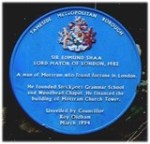
My 13th great-grandfather was Lord Mayor of London and a wealthy, influential goldsmith. My mother was always crazy about gold and jewelry. She would have been pretty excited to learn one of her ancestor’s healing rings is in the British Museum. I am excited myself.
Edmund Shaw (1434 – 1487)
is my 13th great grandfather
Elizabeth Shaw (1460 – 1493)
daughter of Edmund Shaw
Thomas Poyntz (1480 – 1562)
son of Elizabeth Shaw
Lady Susanna Elizabeth Poyntz (1528 – 1613)
daughter of Thomas Poyntz
Elizabeth Saltonstall (1557 – 1621)
daughter of Lady Susanna Elizabeth Poyntz
Henry Wyche (1604 – 1678)
son of Elizabeth Saltonstall
Henry Wyche (1648 – 1714)
son of Henry Wyche
George Wyche (1685 – 1757)
son of Henry Wyche
Peter Wyche (1712 – 1757)
son of George Wyche
Drury Wyche (1741 – 1784)
son of Peter Wyche
Mary Polly Wyche (1774 – 1852)
daughter of Drury Wyche
John Samuel Taylor (1798 – 1873)
son of Mary Polly Wyche
William Ellison Taylor (1839 – 1918)
son of John Samuel Taylor
George Harvey Taylor (1884 – 1941)
son of William Ellison Taylor
Ruby Lee Taylor (1922 – 2008)
daughter of George Harvey Taylor
Pamela Morse
I am the daughter of Ruby Lee Taylor
Dictionary of National Biography, 1885-1900, Volume 51Shaw, Edmund
by Charles Welch
SHAW or SHAA, Sir EDMUND (d 1487?), lord mayor of London, was the son of John Shaa of Dunkerfield in Cheshire. He was a wealthy goldsmith and prominent member of the Goldsmiths’ Company, of which he served the office of master. He was elected sheriff in 1474, and on his presentation the members of his company escorted him to Westminster (Herbert, Twelve Great Livery Companies, ii. 219). Shaa became alderman, and in 1485 migrated to the ward of Cheap, on the death of Sir Thomas Hill through the ‘sweating sickness.’ He was elected mayor in 1482, and towards the close of his mayoralty he took an active part in influencing the succession to the crown on the death of Edward IV. Shaa probably had financial dealings with the crown, and his intimacy with Edward IV appears from a bequest in his will for an obit for the soul of that ‘excellent prince’ and his sister, the Duchess of Exeter. He became nevertheless a strong supporter of Richard III, who made him a privy councillor, and whose claims to the throne he and his brother (see below) were doubtless largely instrumental in inducing the citizens to adopt. Shaa appears to have resided in Foster Lane, where, and in the neighbouring West Chepe, the goldsmiths kept their shops. He possessed, and probably occupied, the great mansion, with its adjoining tenements, in Foster Lane, in which Sir Bartholomew Reid had lived (ib. ii. 253).
He died about 1487, and was buried in the church of St. Thomas of Acon, where he founded a chantry for the souls of his wife Juliana (who died in 1493), his son Hugh, and others (Sharpe, Calendar of Husting Wills, ii. 612). This trust, with many singular injunctions attached, he placed under the charge of the Mercers’ Company (Watney, Account of the Hospital of St. Thomas of Acon, pp. 51–3). His will, dated 20 March 1487, was proved in the P. C. C. (Milles 12). Full effect was given to his intentions under the will of Stephen Kelk, goldsmith, who administered Shaa’s bequest under an agreement with his executors (Watney, p. 53; Prideaux, Goldsmiths’ Company, i. 33–4). One of these executors, John Shaa, goldsmith, may have been the Sir John Shaa (knighted on Bosworth Field and made a banneret by Henry VII) who was lord mayor in 1501, or a near relative. By another will, not enrolled, Shaa left four hundred marks for rebuilding Cripplegate, which was carried out by his executors in 1491. He also left property in charge of the Goldsmiths’ Company, producing an annual sum of 17l., to found a school ‘for all boys of the town of Stockport and its neighbourhood,’ in which place his parents were buried. This school was considerably developed and its advantages extended by the Goldsmiths’ Company (Herbert, ii. 252–3). Shaa also directed by his will that sixteen gold rings should be made as amulets or charms against disease, chiefly cramp. One of these rings, found in 1895 during excavations in Daubeney Road, Hackney, is now in the British Museum. On the outside are figures of the crucifixion, the Madonna, and St. John, with a mystical inscription in English; the inside contains another mystical inscription in Latin.
The lord mayor’s brother, Ralph or John Shaw (d. 1484), styled John by More and Holinshed, and Raffe by Hall and Fabyan, may without much doubt be identified with Ralph Shaw, S. T. B., who was appointed prebendary of Cadington Minor in the diocese of London on 14 March 1476–7, and was esteemed a man of learning and ability. He was chosen by the Protector (afterwards Richard III) to preach a sermon at St. Paul’s Cross on 22 June 1483, when he impugned the validity of Edward IV’s marriage with Elizabeth Woodville, and even asserted, according to More, that Edward IV and his brother Clarence were bastards. Fabyan states that he ‘lived in little prosperity afterwards,’ and died before 21 Aug. 1484 (Gairdner, Life of Richard III, 1878, pp. 100–4; FFabyan, Chronicle, 1811, p. 669; More, Life of Richard III, ed. Lumby, pp. 57, 70; Holinshed, Chronicles, ed. Hooker, iii. 725, 729; Hall, Chronicle, 1809, p. 365; Le Neve, Fasti Ecclesiæ Anglicanæ, ii. 372).
[Orridge’s Citizens of London and their Rulers, pp. 116–20; Sharpe’s London and the Kingdom, i. 320–2; Price’s Historical Account of the Guildhall, p. 186; Watney’s Hospital of St. Thomas of Acon, pp. 51–3; Sharpe’s Calendar of Husting Wills, ii. 612–17; Prideaux’s Memorials of the Goldsmiths’ Company, 1896, passim; Notes and Queries, 8th ser. xii. 345.]

Sir Thomas
My 20th great-grandfather was a member of the Order of the Garter. He was a military commander and member of Parliament. The Hundred Years’ War was a huge drag because it lasted for 100 years. He fought in Flanders and in France for Britain.
Sir Thomas de Holand Wake Kent (1314 – 1360)
is my 20th great grandfather
Sir Thomas Holand Knight deHolland (1350 – 1397)
son of Sir Thomas de Holand Wake Kent
Margaret DeHoland (1385 – 1439)
daughter of Sir Thomas Holand Knight deHolland
Joan Beaufort (1407 – 1445)
daughter of Margaret DeHoland
Joan Stewart (1428 – 1486)
daughter of Joan Beaufort
John Gordon (1450 – 1517)
son of Joan Stewart
Robert Lord Gordon (1475 – 1525)
son of John Gordon
Catherine Gordon (1497 – 1537)
daughter of Robert Lord Gordon
Lady Elizabeth Ashton (1524 – 1588)
daughter of Catherine Gordon
Capt Roger Dudley (1535 – 1585)
son of Lady Elizabeth Ashton
Gov Thomas Dudley (1576 – 1653)
son of Capt Roger Dudley
Anne Dudley (1612 – 1672)
daughter of Gov Thomas Dudley
John Bradstreet (1652 – 1718)
son of Anne Dudley
Mercy Bradstreet (1689 – 1725)
daughter of John Bradstreet
Caleb Hazen (1720 – 1777)
son of Mercy Bradstreet
Mercy Hazen (1747 – 1819)
daughter of Caleb Hazen
Martha Mead (1784 – 1860)
daughter of Mercy Hazen
Abner Morse (1808 – 1838)
son of Martha Mead
Daniel Rowland Morse (1838 – 1910)
son of Abner Morse
Jason A Morse (1862 – 1932)
son of Daniel Rowland Morse
Ernest Abner Morse (1890 – 1965)
son of Jason A Morse
Richard Arden Morse (1920 – 2004)
son of Ernest Abner Morse
Pamela Morse
I am the daughter of Richard Arden Morse
Thomas Holland, 1st Earl of Kent, 1st Baron Holand, KG (c. 1314 – 26 December 1360) was an English nobleman and military commander during the Hundred Years’ War.
He was from a gentry family in Upholland, Lancashire. He was a son of Robert de Holland, 1st Baron Holand and Maud la Zouche. One of his brothers was Otho Holand, who was also made a Knight of the Garter.Military Career
In his early military career, he fought in Flanders. He was engaged, in 1340, in the English expedition into Flanders and sent, two years later, with Sir John D’Artevelle to Bayonne, to defend the Gascon frontier against the French. In 1343, he was again on service in France. In 1346, he attended King Edward III into Normandy in the immediate retinue of the Earl of Warwick; and, at the taking of Caen, the Count of Eu and Guînes, Constable of France, and the Count De Tancarville surrendered themselves to him as prisoners. At the Battle of Crécy, he was one of the principal commanders in the van under the Prince of Wales and he, afterwards, served at the Siege of Calais in 1346-7. In 1348 he was invested as one of the founders and 13th Knight of the new Order of the Garter.
Around the same time as, or before, his first expedition, he secretly married the 12-year-old Joan of Kent, daughter of Edmund of Woodstock, 1st Earl of Kent and Margaret Wake, granddaughter of Edward I and Margaret of France. However, during his absence on foreign service, Joan, under pressure from her family, contracted another marriage with William Montacute, 2nd Earl of Salisbury (of whose household Holland had been seneschal). This second marriage was annulled in 1349, when Joan’s previous marriage with Holland was proved to the satisfaction of the papal commissioners. Joan was ordered by the Pope to return to her husband and live with him as his lawful wife; this she did, thus producing 4 children by him.
Between 1353 and 1356 he was summoned to Parliament as Baron de Holland.
In 1354 Holland was the king’s lieutenant in Brittany during the minority of the Duke of Brittany, and in 1359 co-captain-general for all the English continental possessions.
His brother-in-law John, Earl of Kent, died in 1352, and Holland became Earl of Kent in right of his wife.
He was succeeded as baron by his son Thomas, the earldom still being held by his wife (though the son later became Earl in his own right). Another son, John became Earl of Huntingdon and Duke of Exeter.
Children
Thomas and Joan of Kent had four children:
Thomas Holland, 2nd Earl of Kent
John Holland, 1st Duke of Exeter
Joan Holland, who married John V, Duke of Brittany
Maud Holland, married Waleran III of Luxembourg, Count of Ligny

La Scala
My 21st great grandfather was Lord of Verona. His father was a wool dealer with political connections that helped him gain power and wealth. His family became influential. Alberto’s great grand daughter married into the ruling family of Milan, and her descendant married into the Habsburg dynasty. Influence and power followed them all the days of their lives.
Alberto I DeScala (1241 – 1301)
is my 21st great grandfather
Alboino De La Scala Lord (1284 – 1311)
son of Alberto I DeScala
Mastino Della Scala (1300 – 1351)
son of Alboino De La Scala Lord
Regina Beatrice Della Scala (1321 – 1384)
daughter of Mastino Della Scala
Veridis Duchess Austria Visconti (1352 – 1414)
daughter of Regina Beatrice Della Scala
Ernst I “Ironside” Archduke of Austria Habsburg (1377 – 1424)
son of Veridis Duchess Austria Visconti
Katharina Archduchess Austria Von Habsburg (1420 – 1493)
daughter of Ernst I “Ironside” Archduke of Austria Habsburg
Christof I VanBaden (1453 – 1527)
son of Katharina Archduchess Austria Von Habsburg
Beatrix Zahringen (1492 – 1535)
daughter of Christof I VanBaden
Sabine Grafin VonSimmern (1528 – 1578)
daughter of Beatrix Zahringen
Marie L Egmond (1564 – 1584)
daughter of Sabine Grafin VonSimmern
Richard Sears (1590 – 1676)
son of Marie L Egmond
Silas Sears (1638 – 1697)
son of Richard Sears
Silas Sears (1661 – 1732)
son of Silas Sears
Sarah Sears (1697 – 1785)
daughter of Silas Sears
Sarah Hamblin (1721 – 1814)
daughter of Sarah Sears
Mercy Hazen (1747 – 1819)
daughter of Sarah Hamblin
Martha Mead (1784 – 1860)
daughter of Mercy Hazen
Abner Morse (1808 – 1838)
son of Martha Mead
Daniel Rowland Morse (1838 – 1910)
son of Abner Morse
Jason A Morse (1862 – 1932)
son of Daniel Rowland Morse
Ernest Abner Morse (1890 – 1965)
son of Jason A Morse
Richard Arden Morse (1920 – 2004)
son of Ernest Abner Morse
Pamela Morse
I am the daughter of Richard Arden Morse
Alberto I della Scala (died September 3, 1301) was lord of Verona from 1277, a member of the Scaliger family.
The son of Jacopino della Scala, he was podestà of Mantua in 1272 and 1275. In 1277, after the assassination of his brother Mastino, inherited the seigniory of Verona.
Alberto died in Verona in 1301. His son Bartolomeo succeeded him. His other sons Alboino and Francesco (Cangrande) were also lord of Verona from 1304 and 1312, respectively.
Sources
Carrara, M. (1966). Gli Scaligeri. Varese: Dell’Oglio.
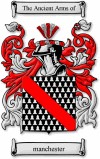
Manchester coat of arms
My 8th great grandfather was part of an unusual settlement in New Haven, Connecticut. He probably arrived in 1638 with a group of Puritans from England:
On April 24, 1638, a company of five-hundred English Puritans led by the Reverend John Davenport and Theophilus Eaton, a wealthy London merchant, sailed into the harbor. They soon discovered that the Quinnipiacks and other local tribes were much distressed by raiding bands of Pequots and Mohawks from surrounding areas. It was for this reason that Momauguin, the sachem of the Quinnipiacks, and other tribe members agreed to sell the tribe’s land to the Puritans. In return, the settlers pledged to protect the natives and to allow them the use of the lands on the east side of the harborNew Haven’s founders not only hoped to create a Christian utopia, they also saw in New Haven’s spacious harbor an opportunity to establish a commercial empire that would control Long Island Sound and possibly the coastline as far south as Delaware Bay. By 1640 a complete government had been established and the settlement, originally called Quinnipiac, was renamed Newhaven. The town plan was based on a grid of nine squares. In accordance with old English custom, the central square, now the Green, was designated a public common. By 1641 New Haven had grown into a community of approximately 800.
Over the next few years, however, the flow of newcomers began to weaken and trade with the outside world shifted more and more to Boston. In an attempt to establish direct trade with England, the settlers managed to assemble enough produce to fill a vessel which would become known as the “Great Shippe.” However, after setting sail in January, 1646, the ship and its crew were never heard from again. This disaster ended the dream of creating an economic empire and over the years New Haven became overshadowed by New Amsterdam and Boston.
from: http://www.cityofnewhaven.com/Mayor/History_New_Haven.asp
Thomas Manchester, the Manchester immigrant ancestor, was born in England, and was a resident of New Haven, Connecticut, in 1639, in the year following the planting of the colony. Afterward, however, he settled at Portsmouth, Rhode Island, where he is first mentioned in the land records, January 25, 1655, when he and his wife sold to Thomas Wood twelve acres of land. He married Margaret, daughter of John Wood.
In the settlement of her father’s estate, it was ordered March 17, 1655, that the son John pay his sister, Margaret Manchester, eight pounds. Eight acres of land were granted at Portsmouth to Thomas Manchester, December 10, 1657, and he sold to Richard Sisson one-three-hundredth right in Canonicut and Dutch Islands. In 1680 he was taxed four shillings. He and his wife testified, June 7, 1686, that they heard and saw Ichabod Sheffield married by William Paulstone. He deeded to his son John. July 9, 1691, his mansion house and lands at Portsmouth, except the place at the lower end of the ground, in possession of his son Thomas, one-half to be his at the death of grantor and the other after the death of grantor’s wife,mother of grantee, provided he pay to the sons Thomas, William and Stephen, ten shillings each, to Job twenty shillings and daughters Mary and Elizabeth ten shillings each. He also gave to John his personal property, including cattle, tools, etc.
Thomas Manchester died in 1691; his wife in 1693. Children: Thomas, born about 1650; William, 1654; John, died in 1708; George, admitted freeman in 1680; Stephen, mentioned in his own biography; Job, died 1713; Mary; Elizabeth.
Source:
New England families, genealogical and memorial
By William Richard Cutter (pgs. 853-854)
Thomas Manchester (1620 – 1691)
is my 8th great grandfather
Elizabeth Manchester (1667 – 1727)
daughter of Thomas Manchester
Dr. James Sweet (1686 – 1751)
son of Elizabeth Manchester
Thomas Sweet (1732 – 1813)
son of Dr. James Sweet
Thomas Sweet (1759 – 1844)
son of Thomas Sweet
Valentine Sweet (1791 – 1858)
son of Thomas Sweet
Sarah LaVina Sweet (1840 – 1923)
daughter of Valentine Sweet
Jason A Morse (1862 – 1932)
son of Sarah LaVina Sweet
Ernest Abner Morse (1890 – 1965)
son of Jason A Morse
Richard Arden Morse (1920 – 2004)
son of Ernest Abner Morse
Pamela Morse
I am the daughter of Richard Arden Morse
Thomas Manchester was born in England about 1620, and died at Portsmouth, R.I., about 1691. He was an early pioneer of Quinnipiac, called New Haven after 1640, in the Plantation of Connecticut: since he is found there in 1639, it would seem probable that he was of the company of Yorkshire settlers who in 1638 came to America with Ezekiel Rogers, the famous non-conformist minister, with the view of joining the Quinnipiac Plantation, although many of them eventually settled elsewhere.
The New Haven colony differed very much from other colonies. Many of the colonists put up large houses. As an explanation why this style of building was so general, it may be said that the founders of New Haven were mainly gentlemen and merchants, used to living in superior houses in London and other parts of England. For a period,Thomas continued at Quinnipiac, but removed to Portsmouth, R.I, before 1642.
On February 25/1642 he was appointed to serve on the next jury. From 1674 till his death, he was Town Sergeant. He became a considerable landed proprietor. Prior to 1655 he acquired land on the island of Aquidneck, and on January 25/1655, he made a deed of a tract of 12 acres there to Thomas Wood.
On December 10/1657, he shared in the land division and received eight acres at Portsmouth. He also had sharein Dutch Island and Quononoquet Island, and conveyed his interest in 1/300th right therein to Richard Sisson on July 6/1658. His mansion and homestead was built on his Portsmouth land.
On July 9/1691, Thomas deeded to his son John, his mansion house and all lands at Portsmouth, except the piece at the lower end, which had been theretofore deeded to his son Thomas. According to the deed, half was to be John’s on hisbrother Thomas’ death, and the remaining half upon the death of his Mother, conditioned always that pay to his brothers Thomas, William and Stephen, 10 shillings each, to Job 20/-, and to his sisters Mary and Elizabeth, ten shillings each. John also received from his father his personal property, cattle, chattels, implements, bonds, sums of money, and whatever belonged to him at the time of his death.
Thomas Manchester married, prior to 1650, Margaret Wood, who died about 1693, daughter of John Wood of Portsmouth, R.I., who bequeathed to his daughter Margaret the sum of œ8.
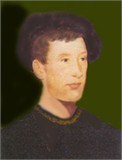
Thomas DeHoland
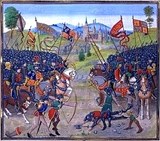
Battle of Najera
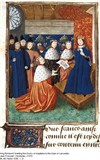
Richard II deeding Aquitaine to Lancaster
Thomas Deholand is my ancestor on both sides of my family. My maternal line looks like this:
Thomas DeHoland (1350 – 1397)
is my maternal 18th great grandfather
Edmund Holland (1383 – 1408)
son of Thomas DeHoland
Eleanor DeHoland (1405 – 1452)
daughter of Edmund Holland
Ann Touchet (1441 – 1503)
daughter of Eleanor DeHoland
Anna Dutton (1449 – 1520)
daughter of Ann Touchet
Lawrence Castellan of Liverpool Mollenaux (1490 – 1550)
son of Anna Dutton
John Mollenax (1542 – 1583)
son of Lawrence Castellan of Liverpool Mollenaux
Mary Mollenax (1559 – 1575)
daughter of John Mollenax
Francis Gabriell Holland (1596 – 1660)
son of Mary Mollenax
John Holland (1628 – 1710)
son of Francis Gabriell Holland
Mary Elizabeth Holland (1620 – 1681)
daughter of John Holland
Richard Dearden (1645 – 1747)
son of Mary Elizabeth Holland
George Dearden (1705 – 1749)
son of Richard Dearden
George Darden (1734 – 1807)
son of George Dearden
David Darden (1770 – 1820)
son of George Darden
Minerva Truly Darden (1806 – 1837)
daughter of David Darden
Sarah E Hughes (1829 – 1911)
daughter of Minerva Truly Darden
Lucinda Jane Armer (1847 – 1939)
daughter of Sarah E Hughes
George Harvey Taylor (1884 – 1941)
son of Lucinda Jane Armer
Ruby Lee Taylor (1922 – 2008)
daughter of George Harvey Taylor
Pamela Morse
I am the daughter of Ruby Lee Taylor
Thomas Holland, 2nd Earl of Kent (1350–April 25, 1397) was an English nobleman and a councillor of his half-brother Richard II.Thomas was the son of Thomas Holland, 1st Earl of Kent and Joan of Kent. His mother was a daughter of Edmund of Woodstock, 1st Earl of Kent and Margaret Wake. Edmund was in turn a son of Edward I of England and his second Queen consort Marguerite of France, and thus a younger half-brother of Edward II of England.
When his father died in 1360 Thomas became Baron Holand. His mother was still Countess of Kent in her own right. At sixteen, in 1366, Holland was appointed captain of the English forces in Aquitaine. He fought in various campaigns over the following years, and was made a Knight of the Garter in 1375.
Richard II became king in 1377, and soon Holland acquired great influence over his younger half-brother, which he used for his own enrichment. In 1381 he was created Earl of Kent.
Marriage and issue
Holland married Alice FitzAlan, daughter of Richard FitzAlan, 10th Earl of Arundel, and Eleanor of Lancaster. They had eight children:
Thomas Holland, 1st Duke of Surrey, who succeeded him
Edmund Holland, 4th Earl of Kent, married Constance of York
John Holland
Joan Holland, married Edmund of Langley, 1st Duke of York
Alianore Holland, married first Roger Mortimer, 4th Earl of March and second Edward Cherleton, 5th Baron Cherleton
Margaret Holland, married first John Beaufort, 1st Earl of Somerset and second Thomas of Lancaster, 1st Duke of Clarence
Elizabeth Holland, married Sir John Neville (eldest son of Ralph Neville, 1st Earl of Westmoreland)
Eleanor Holland, married Thomas Montacute, 4th Earl of Salisbury
Through the marriages of his daughters, he became the ancestor of many of the prominent figures in the Wars of the Roses, including Richard Plantagenet, 3rd Duke of York and Warwick the Kingmaker
Military career
At sixteen, in 1366, Holland was appointed captain of the English forces in Aquitaine. Over the next decade he fought in various campaigns, including the Battle of Nájera, under the command of his stepfather Edward, the Black Prince. He was made a Knight of the Garter in 1375.
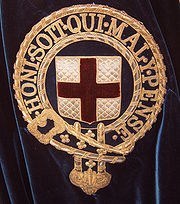
Order of the Garter
The Battle of Nájera, a k a the Battle of Navarrete, 3 April 1367
Fo ught between an Anglo-Gascon army and Franco- Castilian forces near Nájera, in the province of La Rioja, Castile. The English were led by Edward, the Black Prince, and John of Gaunt, Duke of Lancaster, allied with Peter of Castile (sometimes called “Peter the Cruel”) against his brother Henry of Trastámara (Spanish: Enrique II).
Peter and Henry had been in armed conflict, the Castilian Civil War, for some time before the intervention of foreign powers was sought. Peter begged assistance from the Black Prince in Bordeaux to restore him to his throne. James IV of Majorca also agreed to support Peter.
History
With 24,000 men, the Anglo-Gascon army marched south from Aquitaine and crossed the river Ebro at Logroño. They took control of the fortified village of Navarrete and continued towards Nájera to face Henry’s Franco-Castilian army, the latter’s strength being 60,000. Despite the large size of his army, Henry’s commander, Bertrand du Guesclin was later reported to have been reluctant to face the English in a pitched battle, but he was overruled.
The battle began with the English longbowmen gaining dominance over the French archers. Then, the English vanguard, led by Sir John Chandos and the Duke of Lancaster, attacked the French mercenaries commanded by Du Guesclin and Arnoul D’Audrehem. The chronicler Froissart gives detailed information about the participants in the battle.
Under the pennon of St. George, and attached to the banner of Sir John Chandos, were the free companies, who had in the whole twelve hundred streamers. Among them were good and hardy knights and squires, whose courage was proof; namely, Sir Robert Cheney, Sir Perducas d’Albret, Robert Briquet, Sir Garsis du Chastel, Sir Gaillard Viguier, Sir John Charnels, Nandon de Bagerant, Aymemon d’Ortige, Perrot de Savoye, le bourg Camus, le bourg de l’Esparre, le bourg de Breteuil, Espiote, and several others.
Th e Castilian cavalry, under heavy arrow fire from the English longbowmen, fled early, leaving Henry’s battle exposed to attack from the mounted English rearguard. The Franco-Castilian army disintegrated and retreated, pursued by the English, back to the bank of the river Najerilla. Du Guesclin was captured, but Henry escaped and fled.
Peter and the English completely routed Henry and the French, inflicting heavy losses. Unlike at other battles of the Hundred Years’ War, at Nájera it was the English who were attacking dismounted French troops. As with many other battles of the period, the English longbow proved a significant advantage, probably for the first time in the Iberian Peninsula. However, the battle was of dubious long-term significance as Peter and the Black Prince fell out over money, and Peter was not able to maintain his rule for long without foreign support.
References
Sir John Froissart; Translated from the French by Thomas Johnes. Chronicles of England, France and Spain and the Surrounding Countries. London 1808
My paternal connection to Sir Thomas looks like this:
Sir Thomas Holand Knight deHolland (1350 – 1397)
Jakob I
My 16th great-grandfather was from Baden-Baden, Germany. I have been to Baden by Vienna and Baden by Zurich, both fabulous historical hot springs. I have not visited the fancy German double Baden, but have always wanted to go. Now I have all the more reason:
Jacob I of Baden (15 March 1407, Hachberg–13 October 1453, Mühlburg), was Margrave of Baden-Baden from 1431 to 1453.
He was the elder son of Bernard I, Margrave of Baden-Baden and Anna von Oettingen. Jacob I was a man of deep religious beliefs, well-known as a founder of churches. He founded the monastery at Fremersberg and was a major benefactor of the Stiftskirche at Baden-Baden.
According his father’s precepts, only two of his sons were to be considered heirs of the margravate. Therefore only Karl and Bernhard received a secular education; the other children had a strict religious upbringing. Georg, after making a religious profession in his youth, returned briefly to the world, but in 1454 reverted to holy orders and later became Bishop of Metz.
Jacob I was the opposite of his father; Enea Silvio de Piccolomini (Pope Pius II) characterized him as famous among the Germans for his justice and intelligence.
In his early years he was ruler of the family possessions in Hohenberg, until at the age of 24 he succeeded to the government of Baden. He was described as a pugnacious knight and a frugal father of the state and was popular among the princes as a mediator. Both Emperor Sigismund and Emperor Frederick III, under whom he served, thought highly of him.
When as the result of a miscarriage his sister Agnes fled in the middle of a conflict about inheritance, the Margrave lost his claim to the Duchy of Schleswig. He was so angry that he confined Agnes for the rest of her life in the castle of Alt-Eberstein. (The incident is remembered as the “Double Disaster of Gottorf”).
When in 1427 the Treaty of Sponheim came into force, he gained possessions on the Moselle. In 1442 he bought for 30,000 guilders from the descendants of Walter von Geroldseck half the lordship of Lahr and Mahlberg.
Family and children
He married 25 July 1422 Catherine of Lorraine, daughter of Charles II, Duke of Lorraine and Margaret of the Palatinate. They had the following children:
Charles I, Margrave of Baden-Baden (d. 24 February 1475, Pforzheim).
Bernard II, Margrave of Baden-Baden (later beatified) (1428–12 July 1458, Moncalieri).
Johann (1430–9 February 1503, Ehrenbreitstein), Archbishop of Trier.
George (1433–11 February 1484, Moyen), Bishop of Metz.
Markus (1434–1 September 1478), abbot in Liège.
Margarete (1431–24 October 1457, Ansbach), married 1446 to Albert III, Margrave of Brandenburg.
Matilde (d. 1485), Abbess of Trier.
He also had an illegitimate son, Rudolf of Baden.
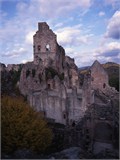
castle of birth
Jakob I Von Baden (1407 – 1453)
is my 16th great grandfather
Karl I Von Baden (1424 – 1475)
son of Jakob I Von Baden
Christof I VanBaden (1453 – 1527)
son of Karl I Von Baden
Beatrix Zahringen (1492 – 1535)
daughter of Christof I VanBaden
Sabine Grafin VonSimmern (1528 – 1578)
daughter of Beatrix Zahringen
Marie L Egmond (1564 – 1584)
daughter of Sabine Grafin VonSimmern
Richard Sears (1590 – 1676)
son of Marie L Egmond
Silas Sears (1638 – 1697)
son of Richard Sears
Silas Sears (1661 – 1732)
son of Silas Sears
Sarah Sears (1697 – 1785)
daughter of Silas Sears
Sarah Hamblin (1721 – 1814)
daughter of Sarah Sears
Mercy Hazen (1747 – 1819)
daughter of Sarah Hamblin
Martha Mead (1784 – 1860)
daughter of Mercy Hazen
Abner Morse (1808 – 1838)
son of Martha Mead
Daniel Rowland Morse (1838 – 1910)
son of Abner Morse
Jason A Morse (1862 – 1932)
son of Daniel Rowland Morse
Ernest Abner Morse (1890 – 1965)
son of Jason A Morse
Richard Arden Morse (1920 – 2004)
son of Ernest Abner Morse
Pamela Morse
I am the daughter of Richard Arden Morse
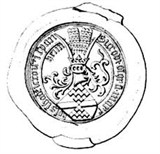
seal of Jakob I

Sulgrave Manor

Sulgrave Manor
George Washington and I share some common ancestors. Robert Washington was the 4th great-grandfather of George Washington, first President of the United States. He sounds like a heavy duty brute, having torn down his local village and church for pasture land. They were friends with Henry VIII, who was quite the brute himself. I notice that Elizabeth Washington, my ancestor, marries into the Lanier family, a family of musicians from Henry’s court. I wonder if they had any knowledge of each other’s ancestors back in England. Since that was very important for status, my guess is that they did.
ROBERT WASHINGTON (1544 – 1623)
ROBERT WASHINGTON, the eldest son of Lawrence the builder and Amy nee Pargiter, born in 1544, died 1620 aged 76. Inherited Sulgrave Manor when his father died in 1584 with about 1250 acres at Sulgrave, Stuchbury, Woodford, Cotton, Hardingstone, Blakesley, Patishall, Ascote, Eastcote, Lower Boddington, Radway, Horley and Hornton in Oxon.
Married twice, firstly, in 1565 to Elizabeth, daughter and heiress of Walter Light (Lyte) of Radway Grange, Warwickshire, and a descendant of the Villiers family. The marriage is recorded in the original glass panel dating from about 1580 in the Great Chamber window where the W arms are impaled with the Lyte arms:As part of the marriage settlement Lawrence created an estate from two messuages (holdings) in Pattishill for his own, (L’s) use while Robert lived and after his death for the use of Elizabeth for life as her jointure. Use in this context usually means taking the revenue from rather than living in.
From Elizabeth acquired Radway Grange and title to the manors of Horley and Hornton Oxon.
Six sons and three daughters by Elizabeth. Eldest son Lawrence II born in 1565. Daughter Amye married Alban Wakelyn of Eydon, N’hants. 3rd son Walter granted Radway Grange by deed Nov 30th 1592 for peppercorn rent for 40 years after the death of Walter Light ; his marriage to Alice daughter of John Murden of Ratley is arranged in the following year and secondly, sometime before 1599, to Anne Fisher of Hanslope Bucks Clifford Smith says 3 more sons and 3 more daughters by her.
Together with Sir John Spencer was appointed a royal commissioner in Northants in 1598. Robert is usually called “esquire” in contemporary documents, a higher rank that that accorded to his father (gentleman).
In 1600, Robert bought the manor of Nether Boddington from his son-in-law, Albert Wakelyn. There was no house on the Nether Boddington manor.
Stuchbury was exploited for sheep – Robert apparently pulled down the parish church, parsonage along with “all or the most part of the said town and parish houses” before 1606.
In 1606 Robert Washington figured in an interesting exchequer case1. Robert Washington, -the patron of the rectory of Stuchbury, together with his two cousins, Robert Pargiter and George Mole (who also had an interest in the advowson), had instituted no clergyman to the living “by the space of three score years or thereabouts.” On the contrary, – they had pulled down “not only the parsonage house . . . and all or the most part of the said town and parish houses of Stuttesbury aforesaid, but also the parish church itself,” and had used the lands “for pasture for kine and sheep, to the great depopulation of the commonwealth and country thereabout.”2
Although he continued to live at Sulgrave, he made a settlement upon his eldest son Lawrence in May 1601, possibly as a result of his second marriage – to protect the interests of his first family – of the entailed portion of the estate i.e. manor of Sulgrave and manor and rectory of Stuchbury. Lawrence sold the Sulgrave manor demesne lands to Thomas Atkins, of Over Winchcombe, Buckinghamshire, on 20 August, 1605, retaining only the house and seven acres of land. With the consent of his father. Lawrence sold the reversion of the remainder on 1 March, 1610 to his cousin Lawrence Makepeace, son of Robert’s sister Mary and Abel Makepeace. Robert (and his heirs) retained the manor and rectory of Stuchbury until 1646, Nether Boddington to 1636 and Radway to 1654.
Robert died in 1619 and his will requests burial in Sulgrave Church. His second wife, Anne Fisher, continued to live at Sulgrave Manor house until 1625. She was buried at East Haddon, Northamptonshire, on 16 March. 1652. Robert was succeeded by his grandson, John, his son Lawrence having predeceased him in 1616.
Lawrence, Robert’s brother, born probably 1546, (possibly 56), became Registrar of the Court of Chancery and married firstly, in 1593 Mary Argall (nee Scott), widow of Richard Argall, who had died in 1588, leaving five sons and six daughters living. One of the sons was Sir Samuel Argall, who emigrated and was Deputy-Governor of Virginia in 1617-19. On Mary’s death in 1605, Lawrence married Martha Nuse. He died in 1619 aged either 63 or 73 (Ixxiii on his memorial) and is buried at Maidstone. Their son, another Lawrence, was knighted and, like his father, became Registrar of the Court of Chancery. He was the owner of Stonehenge. died in 1643 aged 64, and is buried at Garsdon. Wiltshire. Their daughter Mary married William Horspoole, a cousin of Sir Thomas Smythe, Treasurer Virginia Company (VMHB 90, 1982, Samuel Argall’s family, James D Alsop) and is buried at Maldon, near Cliveden.
Elizabeth
Anne married Edmond Foster of Hanslop co Bucks
Frances married John Tompson of Sulgrave
Magdalyn
BarbaraMary married Abel Makepeace of Chipping Wardon N’hants, parents of Lawrence Makepeace who purchased rights to Sulgrave from his uncle Lawrence II in 1610
Margaret married to Gerrard Hawtayne Esq second son of Edward Hawtayne of co Oxon
1.
Abstract printed by Mr. Ernest G. Atkinson in The Times 22 September, 1894,
2.
William Barcocke, clerk, versus Robert Washington and two others: Bills and Answers, Northants., Easter, 4 James I.
 mermaidcamp