mermaidcamp
Keeping current in wellness, in and out of the water
You can scroll the shelf using ← and → keys
You can scroll the shelf using ← and → keys
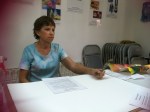


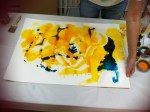
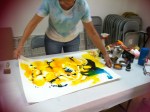
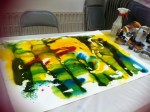

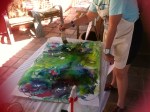
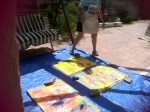
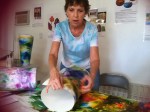


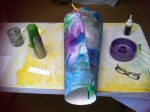
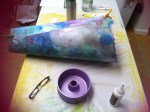
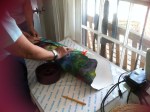


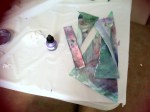


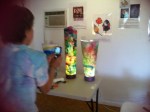

Yesterday I enjoyed making art in a new way with Jeanne Fellow at Blue Raven Art School. I had visited her studio and purchased a couple of her beautiful pieces and learned about the LumenArt class. My classmate Jeannie Gentry had done exactly the same thing. We both were very excited to try our hand at making one of these very special lamps. Our 5 hour class went by very quickly. Everything was set up for us on the shaded patio. Each of us had our own work table and basic tools. After a thorough demonstration of the basic techniques we chose colors and started our own experiment in color mixing. Some of the inks are iridescent, but those also block the light from within when it is a finished LumenArt. The fun of it all is that you don’t know how it will really look until you light it. Jeanne encouraged us to feel free and confident to play around. Both students created three possible candidates for lighting. The class materials include two sheets of incredible paper that allows all kinds of layering and special techniques without tearing. We each bought one extra sheet because we had enough time and were seriously into it. When dry we selected one to become our lamp. Choosing color for the base and tearing the final design we had supervision and plenty of encouragement from our teacher. This project is practically impossible to do badly. The materials guarantee that the finished product will be thrilling. She teaches a class in using these techniques on fabrics that will also be fun. If you are an experienced artist/craftperson you will love this class. If you think you are not creative and have no talent for art you will be blown away by your own amazing abilities when Jeanne shows you how to release them. My LumenArt is now making me very happy and proud in my living room at home. I also have two other fabulous pieces of art that I made. I even love my scraps. I would encourage anyone to investigate creativity and find your own inner light in one of Jeanne’s classes. She rules.
In Shakespeare’s Othello the protagonist Moor is a military commander and the action takes place during a time of war. The twists and turns of the story are typical of a tragedy written by The Bard. There is much misunderstanding and treachery leading to the deeply tragic ending. The play has been performed in all kinds of settings and time frames because it has eternal themes that work well for any time or place in history. Racism, betrayal, jealousy, and war are always in style, sadly enough. It has been adapted into movie and opera in the past, and now it is being presented as a modern fusion of the latest technology possible combined with an ancient story.
The star and creator in this new production is from Salvador do Bahia, Brazil and has deep cultural and artistic roots in that city. He has been fascinated with this play for many years. Elisio Pitta wanted to use his talent and experience as a dancer and artist to produce a sharp protest against domestic violence, a worldwide problem. He created a working collaboration of the most artistically gifted people he knew for this project. Working as a team, they focused on the ideas they wanted to portray. This new version of Othello has been merged with the cultural treasures and foundations of Bahia. Slavery, racism, liberation, and natural magic are strong themes in the artistic backgrounds of these artists. They intentionally explored the similarities and dramatic meaning present in Shakespeare’s drama, and adapted it to their own time and place to send a message and make an emphatic statement. They worked on it for over 3 years, and were ironically interrupted during rehearsal when Mr Pitta was badly injured in an incident of violence last August in his home city. Elisio is a master martial artist in capoeira, but 10 large young angry men were more than he could handle. This attack only strengthened his resolve to present his artistic response to violence, which is too common today. In this show, since it is based on modern issues, Othello kills himself in the end with a gun rather than a sword. It is fortunate for everyone that the young punks who beat him up did not have guns during that fight.
Now the show has opened in Brazil to sold out theaters and will be opening next week in Liverpool, England for an engagement. A giant celebration is planned all year for the 450th anniversary of the birth of the most famous poet of all time. I believe that William Shakespeare will be impressed with all the creative energy honoring his work and keeping it alive. If you want to know more the largest festival ever honoring him, check out The Year of Shakespeare. You can follow it on twitter and like it on Facebook to read and write reviews all year. Enjoy!
The artist reaches just beyond the normal senses to bring creation into being. There is strong motivation and emotion driving the artist to produce. The medium is not as important as full artistic expression. Some of us are not making any money from art, but still live our lives involved with creating. Cooking, gardening, and all normal day to day tasks can be done in artful ways. Art truly is in the eye of the beholder; A strong desire to design and deliver creativity to the world is all that is needed to be an artist.
Making a living at art is risky, and yet rewarding. The starving artist and the crazed genius artist are examples of the shadow aspect of this archetype. I used to make my living as a potter. I worked at a school mixing glazes and firing the kiln. I was paid in clay, glazes and firing; I had to turn that into money by selling my work. I was very good at being a starving artist and never starved at all. I remember that time as an extremely abundant phase, full of friends, travel, and unlimited creative freedom. Clay is a fast medium initially. Throwing a pot on a wheel is pure zen. It must be centered and formed quickly so the clay body does not get too wet and collapse. The pot must be dried slowly to avoid cracking. The glaze firing is an alchemical process that has slightly different results each time it is done. From the first time you touch the clay you know that some of your pots will not make it. If you are lucky the problem occurs when the clay has not been fired, so you can just turn it into wet clay and try it again. I used to take finished pots I thought were too ugly to sell out to the desert and shoot them with a 22 pistol to destroy the evidence. I used to joke that anthropologists in the future will wonder what kind of civilization felt the need to shoot pottery. I am glad I still have a few pieces I made that have survived, and equally glad I shot the ugly ones.
I have been hearing a lot about the Maker House downtown, so today I dropped off some of my old Christmas decorations and took a tour of the space with Lisa. What a fabulous space!!!! I plan to go back over the weekend for the tree trimming party. I want to learn how to use the programmed sewing machines and the 3D printers. This is exactly the kind of development that will make downtown vibrant and economically sustainable. I enjoyed a very tasty cappuccino before I left, then came right home and joined on line. I think this is just what the fun doctor ordered. I always like old and well designed buildings. It is great that this one has opened to the public.
PSO at Heinz Hall
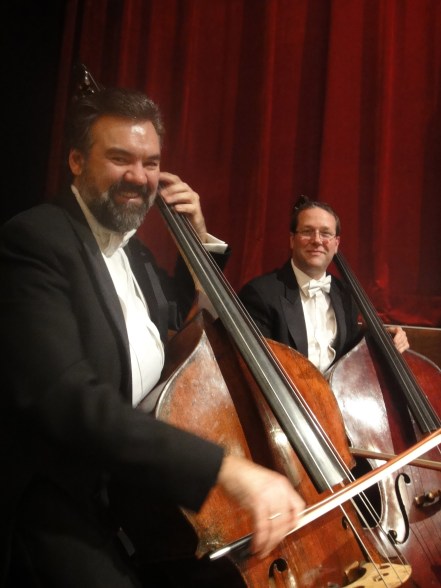
Last year I was very lucky to see the Pittsburgh Symphony Orchestra perform Handel’s Messiah as a fully staged opera. Everything about it was remarkable, even the serendipity of finding an excellent seat the day of the performance by just noticing the box office while I was on a walk. I grew up in Pittsburgh, but the Heinz Hall was new to me. Syria Mosque where I saw them in the 1960’s was gone like Forbes Field. In the lobby there was a great display about the life of Handel and the composition of the Messiah. He signed it SDG, in other words, he gave full credit to God for the music. I had seen this phrase before. It was written in German (those incredibly fancy letters you can’t read) on the outside of the school in Langweis, Switzerland, a small alpine village where my friend Steffi Burger lives. I love all that writing on the outside of old Swiss buildings, including hex signs to protect the contents of the buildings. They declare their faith and ask for protection in bold ( but hard to read) statements. I had some trouble with the reading, but was sure God was involved (most of them are about God and work) so I asked my friend, who also could not read it. We asked Walter Engle, whose family had crossed the Davos pass with their cows to settle the area centuries ago. He informed us that it said all glory to God (SDG).

School in Langweis
The protestant reformation was very into this idea and that is why it landed on the wall of the school. I relate it to the Niyama, or internal practice, of surrender to God as it is written in Sanskrit, Ishvara-Pranidhana. Apparently Handel went into a kind of trance and did speed composition under the heavy influence of spirit when he wrote the Messiah, signed it SDG and everyone knew what he meant. Bach was into this also. In yoga practice Ishvara is about trusting the divine flow, not so different from thy will be done. I wonder if by being a big student of linguistics I have stumbled upon the lowest common denominator of all religions. Surrender to God.

scarecrow
What are the personal services you use in daily life? You may not be aware of all of them. If you buy prepared foods, that preparation has been done for you. You know if you hire a child care helper or manicurist that you are buying personal services. It is hard to find all the ways others contribute skill and time to our daily lives. Compared to primitive self reliance our modern lifestyle is comprised of paying more for labor and transportation than we pay for goods. Many have lost the skills needed to make anything from scratch. Farming in the US is a prime example. We are running out of people who know how to grow food as this profession declines rapidly in young people. If we don’t train or import some people to do the service of farming we will face serious problems.
My grandparents owned a farm when I knew them so I was exposed to the milk cow, the beef cows, the pigs, the gardens, and even to the butter churn. I lived in the city of Tulsa but considered the grandparents spread in Arkansas where was assistant farmer on the weekends to be extremely romantic. I rode a mule and shot a rifle. I thought of myself as very Annie Oakley when I was about 5. My parents had grown up without modern 1950’s conveniences and liked the idea of jet setting rather than farming. They enjoyed the country club and the University Club, and garden club, and host of other urban activities that Tulsa and Pittsburgh offered them. They did not seem lazy to me, but they certainly had a different style when it came to personal services than my grandparents had. There was no way they would ever own a mule or live next to a barn. They were over all of that. They were urban, upwardly mobile, and believed themselves to be super liberated. I suppose they were.
Every generation acquires some new skills and drops others that no longer serve the moment. It is a great idea to stay abreast of technology, move with the times, and accept the reality of now. In some phases of life, however, it is healthy, good, and indeed necessary to play a creative skillful part in carefully designing reality. If one chops no wood and carries no water the disconnection from source becomes disabling. The spirit has no dwelling in a world that offers only convenience. The soul requires art, and the spirit creates those artful moments that last in memory. One’s own self realization can’t be purchased, downloaded or installed. There is no service that can impart the satisfaction derived from self expression. Once practiced, polished and realized each one of us has a gift of powerful personal charism to offer to all the sentient beings. We can only hope that some young Americans find a vocation in farming.
 mermaidcamp