mermaidcamp
Keeping current in wellness, in and out of the water
You can scroll the shelf using ← and → keys
You can scroll the shelf using ← and → keys

Pickens Coat of Arms
My 8th great-grandfather was born in 1644 in France. He died in 1700 in
County Limerick, Ireland. He was a Protestant who fled from religious persecution in France.
Robert Andrew Pickens (1644 – 1699)
is my 8th great grandfather
William Henry Pickens (1670 – 1735)
son of Robert Andrew Pickens
Andrew Sr Pickens (1699 – 1756)
son of William Henry Pickens
Jean Pickens (1738 – 1824)
daughter of Andrew Sr Pickens
Margaret Miller (1771 – 1853)
daughter of Jean Pickens
Philip Oscar Hughes (1798 – 1845)
son of Margaret Miller
Sarah E Hughes (1829 – 1911)
daughter of Philip Oscar Hughes
Lucinda Jane Armer (1847 – 1939)
daughter of Sarah E Hughes
George Harvey Taylor (1884 – 1941)
son of Lucinda Jane Armer
Ruby Lee Taylor (1922 – 2008)
daughter of George Harvey Taylor
Pamela Morse
I am the daughter of Ruby Lee Taylor
The following information was compiled by Mrs. Wendell Pickens, Costa Mesa, California.
The old, old story of Robert Pickens I, handed down to us by tradition, tells us that in the last half of the seventeenth century there was a man in France, probably of Scottish birth, by the name of Robert Pickens, who, it is said, held an official position as Chief Justice of the Court, and who was probably a Protestant of the Presbyterian Church. In this account of the Pickens family, he will be known to us as Robert Pickens I.
The name of his wife has been handed down to us as Esther Jane Bonneau, who, it is said, was a widow, possessing unusual beauty and was of the Huguenot faith.
When the Edict of Nantes was unwisely and unjustly revoked 22 October 1685, the persecution of the Protestants in France became so intense that large numbers of useful, as well as rich inhabitants of France, were forced to leave their native land and seek a place of safety in other countries where their industry, wealth and skill found a hearty reception. Robert Pickens I and his wife, with a large number of other refugees, fled to Scotland leaving France by way of La Rochelle, a fortified city of about eighteen thousand people, on the west coast of France.
We do not know how long Robert Pickens I lived in Scotland; but, after a time, we find his living at Limerick, Ireland, where he was living at the end of the seventeenth century.
We have no record of how many children Robert Pickens I had; but tradition tells us that at least three sons came to America to seek their fortunes in the New World, which at that time was being settled.
The names of the three sons of Robert Pickens I, who, we were told came to America, were: Andrew Pickens, John Pickens, Robert Pickens. We do not know the dates of birth of Andrew and John Pickens, but Robert Pickens was born at Limerick, Ireland, in 1697. It is known that these three brothers came to America; but is believed they did not come at the same time, because they did not settle at the same place in the New World. Robert Pickens I and his wife, it is said, were buried at Limerick, Ireland.
A son of Andrew [aka Andre’ Picon] and Isobell (Matthisone) Picken(s), Robert [aka Rob’ert Andre’ Picon] married widow Lady Ester Jeanne (le Benoit) le Bonneau in 1665 in La Rochelle, Charente-Maritime, France.
Known child:
1) William Henry Picken(s) (1669-1735), m: Margaret Pike.
NOTE: This ancestor is still being researched. Available sources have some conflicting information, but the facts seem to hold up that the Pickens family was originally from Ireland by way of Scotland. At some point, some family members fled to France and records show a French spelling of the name; i.e. Henri’ Picon. Some members were actually born in France during this time period, which most likely caused the confusion of ancestral roots.
Excerpt from General Andrew Pickens (1739-1817) letter to General Lee in 1811:
“There seems to be some support for the claim that one ROBERT PICON, a Scotchman or Briton at the court of France was a Protestant who fled from Scotland in 1661 to avoid persecution of Charles II. In France he is said to have married Madam Jean Bonneau, also a Protestant. They fled France after the revocation of the Edict of Nantes by King Louis XIV in 1685. Tradition continues that they went to Scotland, later to North Ireland.”
Miss Eliza Pickens, a gr-granddaughter of General Andrew Pickens, in a paper prepared for D.A.R., said: “General Andrew Pickens’ first home was in Bucks Co PA. The Pickens were French Huguenots and left France after the revocation of the Edict of Nantes by King Louis XIV in 1685. General Pickens’ gr-grandfather, Robert Pickens held a good position in France and with every inducement to remain, but he refused to live under Roman Catholic rule. He married an accomplished young widow, Madam Bonneau.”

Pam and the Fam on the farm
I study my ancestry and family history. This fascinating subject consumes as much of my time as I allot to it. I have spent six years on Ancestry.com working on my tree. I am more skeptical now than I was in the beginning because I have been burned by specious data. It is painful to discover an error in one’s research, yet it is better to know sooner than later. I once had a magical surprise experience in Rhode Island at a very special private family home from the 1600’s. I was treated to a tour of the home and grounds since I announced that I was a Carr descendent. I was given instructions to find the family graves by my long-lost “cousin” who still lives on the property. I was in heaven. It turns out I was also delusional about my connection to that family because I had made a mistake a couple of generations earlier in my research. I discovered this error after I had returned home from my trip, and had to laugh about it. I also had to start again to retrace the lineage. That correction was easy because I had some good documentation to verify the facts. Other problems I have discovered or had pointed out to me have left me with a dead-end when I removed the phantom limb.
The odd phantom feeling after chopping off limbs and branches is caused my the attachment formed while studying them. There are several very common names in my tree including Scott. When I began my sturdy I started with notes written by my maternal great-grandmother about her knowledge of the family. She stated that my 2nd great-grandfather, Thomas Scott, was a soldier in the Union army during the Civil War. Even though we know his full name, Thomas Ewing Scott, born in 1842 in Ohio, I can find no decisive record of his military service. There are too many Thomas Scotts from Ohio for me to be sure. My maternal 2nd great-grandfather was, indeed, a soldier for the Confederacy. I am positive about that because I have a copy of his service record as well as his Confederate pension application that he made late in his life in Texas. After his death his wife also applied for a pension as a surviving spouse. I have her application documenting her husband’s service also.
If you find written documents of a private source they may or may not be accurate. Only when you can back up your story with official documents do you have a solid case. I have learned the hard way to verify all the connections fully before jumping back to another generation. There are many trees on the Ancestry.com site that have unverified connections. Copying the work of others without making sure of it can lead to bigger and longer errors. This is not even as safe as the cold war when we trusted by verified. Don’t trust until you verify. This practice may save you many hours of wasted time. After I have recovered from the vexation of discovering I had been wrong I still had certain affection for those people who turned out not to be related to me. My philosophy now is that I learned about history while I was out on the wrong limbs, and I have never claimed to be a professional genealogist. I am more of a time traveller. Do you know any of your family history, gentle reader? How did you learn about it?


Rhode Island native
My 5th great-grandfather was born in Rhode Island. He was a blacksmith by trade, which is fascinating to me because items he made may still be buried in Rhode Island and New York. We will never know. He was in the militia during the Revolution, but his son served in his place for most of his time. He sold his shop and moved to upstate New York in 1779, where his granddaughter would meet and marry Daniel Rowland Morse. The rest is history.
Thomas Sweet (1732 – 1813)
is my 5th great grandfather
Thomas Sweet (1765 – 1844)
son of Thomas Sweet
Valentine Sweet (1791 – 1858)
son of Samuel Thomas Sweet
Sarah LaVina Sweet (1840 – 1923)
daughter of Valentine Sweet
Jason A Morse (1862 – 1932)
son of Sarah LaVina Sweet
Ernest Abner Morse (1890 – 1965)
son of Jason A Morse
Richard Arden Morse (1920 – 2004)
son of Ernest Abner Morse
Pamela Morse
I am the daughter of Richard Arden Morse
Thomas Sweet, son of James and Mary Sweet was a blacksmith, born in North Kingston, RI.
South Kingston, RI Deed Book 5 p. 639 dated 4-21-1757 states Daniel Stedman yeoman of S. Kingston for 160 pounds in bill of old tenor deeded 2 acres of land in So. Kingston to Thomas Sweet, blacksmith. April 1766 Thomas Sweet freeman of So. Kingston, RI Book 6 p. 383 Indenture 6-19-1766 between Thomas sweet blacksmith of S. Kingston and John Robinson for 150 pounds paid by Robinson – mortgages land in So. Kingston which dwelling house, blacksmith shop and Cole house. Paid in full, signed by John Robinson in 1769.
In 1779 Thomas Sweet sold the land, house and blacksmith shop to Thomas Champlin, Jr. for 1050 pounds. He moved to Albany Co. NY which became Rensselaer County. “Thomas Sweet, a Blacksmith, settled early at South Berlin” and “A blacksmith shop was opened by Thomas Sweet on the east side of the road, a short distance north of Sweet’s Corners”.
He was in the Militia of Rhode Island during the Revolutionary War period, but his son William substituted for him in all but one month in Newport, when William stated in his pension application that his father went for himself. His service is accepted by the DAR, my application approved, A819
Thomas served as a Corporal from RI in the Militia, under Capt. Samuel Potter. RI State Archives Index of Mil. & Nav. Recs. He resided in South Kingston, Washington Co., RI during the war.
He married first possibly Hannah Congdon by 1757, had one child, Thomas Jr., prior to his marriage to Frances Congdon in 1760, in RI.
He died in Rensselaer Co., NY March 26, 1813, in an accident by a falling tree in Little Hoosick, NY.
References:
Declaration of service for Revolutionary War of his son William Sweet.
Compendium of American Genealogy Vol. Vii p. 508
1790 US Census; NY; Albany Co;, StephenTown; p. 286; 1 male over age 16 in household
1800 Census NY, Rensselaer Co., Hoosick p. 16A
History of Rensselaer Co., town of Berlin
DAR Patriot Index Centennial Edition p. 2867.


My 10th great-grandfather made the trip from England to America in 1639, establishing himself before sending for his wife and children. He was one of the first settlers in Barnstable, MA, where he and his wife are buried.
James Hamlin (Hamblen) was living in London, England, in 1623. He came to New England and settled in Barnstable, Massachusetts, where he was a proprietor. He was admitted a freeman March 1, 1641-1642 and was on the list of those able to bear arms in 1643. He was a town officer.
James arrived at Barnstable in 1639. (Source: Virkus, “Abridged Compendium”). HAMBLEN, or HAMLIN, came from London. He first came to America without his family, in 1639, and they came later. It is believed that he was obliged to flee England due to religious persecution. He was a Puritan, and member of Rev. Lothrop’s church in Barnstable. He became a Freeman 1 MAR 1641-42. He was appointed constable soon after. He and his wife were members of the church in Barnstable at the settlement of Mr. Jonathon Russell in 1683.
James Hamblen (1606 – 1690)
is my 10th great grandfather
Eleazer Hamblen (1648 – 1698)
son of James Hamblen
Isaac Hamblin (1676 – 1710)
son of Eleazer Hamblen
Eleazer Hamblin (1699 – 1771)
son of Isaac Hamblin
Sarah Hamblin (1721 – 1814)
daughter of Eleazer Hamblin
Mercy Hazen (1747 – 1819)
daughter of Sarah Hamblin
Martha Mead (1784 – 1860)
daughter of Mercy Hazen
Abner Morse (1808 – 1838)
son of Martha Mead
Daniel Rowland Morse (1838 – 1910)
son of Abner Morse
Jason A Morse (1862 – 1932)
son of Daniel Rowland Morse
Ernest Abner Morse (1890 – 1965)
son of Jason A Morse
Richard Arden Morse (1920 – 2004)
son of Ernest Abner Morse
Pamela Morse
I am the daughter of Richard Arden Morse
James Hamblen, so far as has been ascertained, was the first of the name who settled in America. He came from London and settled in Barnstable, Massachusetts, in the Spring of 1639. Of his earlier life very little has been learned; records exist, however, from which some traces of him are supposed to have been discovered. The name of Hamblen appears frequently in th records of Plymouth Colony. The first mention is “March 1, 1741-2. James Hamblen was propounded for Freeman.”March 15, 1657, James Hamblen served on inquest on the body of a child, Simeon Davis.June 3, 1657, James Hamblen was sick and could not serve on the Grand Enquest.The name of James Hamblen appears in the list of Freemen of Barnstable in 1658.June 7, 1670, James Hamblen served on Grand Enquest; same day he was member of a trial jury.May 29, 1670, James Hamblen, Juni, and James Hamblen Seni, in list of Freeman.March 6, 1671, James Hamblen served on a jury.June 3, 1679, James Hamblen served on a jury in the case betgween Capt. John Williams and Edward Jenkins.July 7, 1681, James Hamblen served on juries.July 6, 1682, James Hamblen summoned to serve on a jury, and served.In the list of Freemen of Barnstable for 1689, among others appear the names of James Hamblen, James Hamblen, Jr., John Hamblen, Eleazar Hamblen. From Genealogy of James Hamblen and His Descendents and The Hamlin Family
As nearly all the first settlers of Barnstable came from London and the County of Kent, it is probable that James Hamblen,the ancestor, came from that city, as stated by Mr. David Hamblenin the New England Historic and Genealogical Journal. Ofhis early history, little is known. He appears to have been anearly member of Mr. Lothrop’s Church,’ though the date, is notfound on tie record. His son Bartholemew was baptized April24, 1642, but the baptism of his older children, James and Hannah,do not appear on the record. It is probable that they wereborn in England, and that neither they nor their mother cameover so early as the father. This was a common occurrence inearly times. The father came over, and when he had provided ahome sent for his family.He was one of the earliest settlers, and was in Barnstable inthe spring of 1639. His houselot, containing eight acres, was at Coggin’s Pond, and was one of those that I presume were laid outunder the authority of Mr. Collicut. It was bounded northerlyby the lot of Gov. Hinckley, easterly by the Commons, (now the ancient graveyard) southerly by the Commons, and westerly by the highway, which at that time after crossing the hill on the westturned to the north on the borders of the pond to Gov. Hinckley’sold house, which stood near the pond, and thence turnedeasterly, joining the present road at the head of Calve’s PastureLane. In 1686 the present road was laid out through Hamblen’s lot, and leaving a triangular shaped portion of it on the north ofthe road. Afterwards, in 1693, the location of the road havingbeen changed, the Hamblens were allowed to enclose that part of the old road situate between their land and the pond, and adjoining to Gov. Hinckley’s. The westerly portion of the roadwhich was discontinued, opposite the south end of the pond, wasreserved as a public watering-place, and is so occupied to thisday.His other lands were six shares and six acres of upland in$he Calves Pasture, twenty acres of upland, and the meadow onthe north, bounded easterly by the land of Henry Bourne, andwesterly by the land of Dea. John Cooper. His great lot of fifty acres was bounded south-westerly by the great Indian Pond, southerly by the lot of Thomas Lothrop, and northerly by theCommons. It was the most northerly of the Indian Pond lots,and his son John built a house thereon. The Hamblens were among the first settlers in that part of the town, and that region of country is now known as Hamblen’s Plain.In 1686 James Hamblen, Senior’s, house is described as standingon his twenty acre lot, on the north side of the highway, between the houses of Mr. Russell (known in modern times as Brick John Hinckley’s) and Dea. John Cooper’s, now owned by Mr.William Hinckley and others. In the year 1653 this land is calledon the records Mr. Groom’s land, but in the following year, 1654,Goodman Hamblen’s.James Hamblen, Sen’r, died in 1690. In his will dated Jan.23, 1683-4, he names his wile Anne and all his children. To Jame she gave £10, to Bartholemew, £5, and to his daughter Hannah,”according to ye desire of my mother,” £5. All the rest of his esta-te he gave to his wife during her natural life, and after her deathto be divided equally among his children He had a large real estate.His personal estate was appraised at £19,17.3.Goodman Hamblen was not much in public life. He was anhonest man, a, good neighbor, and a sincere christian. He was industriousand prudent in his habits, and, brought up his children to walk in his footsteps. His descendants have, with few exceptions,inherited the good qualities pf their ancestor. The Hon. HannibalHamlin, Vice President of the United States, is the only one amongthem who has been eminent in public life. To give a full genealogyof the family would require a volume. I cannot use all the materialI have collected without transcending the limits of a newspaper article.Several of this name came over early. Capt. Giles Hamlin, ofMiddletown, was a shipmaster, an,d a man of note in his time.There was a Clement Hamlin of Boston, in 1776,. James, of Barnstable,is supposed to have been a brother of Giles, but I have seen no evidence that renders it probable. Capt. Giles wrote his name Hamblin; James Hamblin. This is not conclusive evidence ; but if they were brothers the probability is they would have written their names in the same manner. On the Colony Records, except in two instances, his name is written, Hamlen. The exceptions are aninstrument to which he affixed his own signature, and, an exemptipnin 1657 from serving on the grand jury in consequence of sickness.His sons wrote their name Hamblen, Rev. Mr. Lothrop wrote the name uniformly, Hamling; Rev. Mr. Russell Hamblin. In 1642 James Hamlin ws admitted a freeman of the Colony, and in 1643 was constable of the town of Barnstable. The usual spelling is Hamblin, but the descendants of James are not uniform. Eleazer,the great-grandfather of Vice President Hamlin, dropped the b as a useless letter, and his descendants have continued to do so.
Family of James Hamblen.
His son James and daughter Hannah were probably born in England, his other children in Barnstable.I. JamesII, HannahIII. Bartholemew, 11th April, 1642, bap. April 24IV. John, 26th June, 1644, bap. June 30V. Sarah, 7th Nov. 1647, bap. same dayVI. Eleazer, 17th March, 1649-50, bap. same dayVII. Israel, 25th June, 1652, bap. same day This record shows that Goodman Hamblen was very exact in the performance of what he believed to be a religious duty, that none of his children should die unbaptised.
sources:
U.S., New England Marriages Prior to 1700
The Hamlin family : a genealogy of James Hamlin of Barnstable, Massachusetts, eldest son of James Hamlin, the immigrant
Geneological and Personal History of the Allegheny Valley, Pennsylvania. By John Woolf Jordan. Lewis Historical Pub. Co., 1913 – 1162 pages.
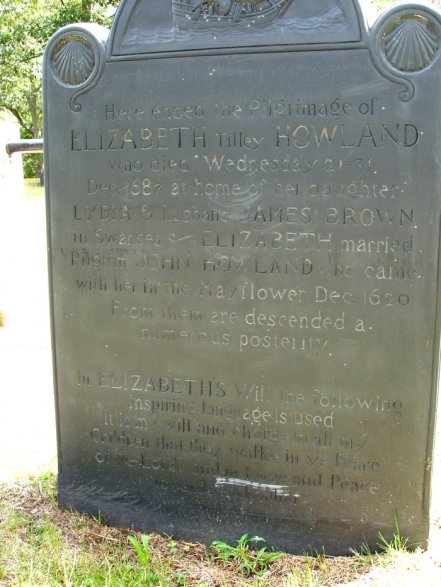
End Of Elizabeth’s pilgrimage
Elizabeth Tilley was born Aug. 30, 1607 in Henlow,Bedfordshire, England. She died Dec. 21, 1687 in
Swansea, Bristol County,Massachusetts. Elizabeth came to the new world with her parents on the Mayflower. Her parents did not survive the first winter at Plimouth Colony, leaving her an orphan.
For 15 years—or almost 20 percent of her life—Elizabeth Tilley Howland was a widow. She never remarried after her husband and fellow Mayflower passenger died on Feb. 23, 1672/3 and instead played the useful role of grandma while living with her daughter Lydia Brown in Swansea. Elizabeth was 65 when John died, probably still vivacious and attractive enough to say “yes” to a second husband, but she preferred to remain a widow until she died on Dec. 22, 1687. The Brown household was ideal for a grandma. When Elizabeth was widowed, the Brown children included James who was 17 years old, Dorothy who was six, and Jabez who was a lively five. Daughter Lydia was born in 1633 so she was 39 when her father died. Elizabeth had barely settled in at the Brown home when King Phillip’s War erupted in 1673. She was forced to flee as Swansea became the storm center of the war. At one point the little community founded only a few years before was almost deserted as residents scurried to safer places such as Barnstable which boasted a population of 3000 compared with 2600 for Plymouth.Three of Elizabeth’s children—Desire, John and Hope—lived in Barnstable when the Widow Howland moved there. Not far away in Plymouth were three other offspring of the Mayflower couple—Isaac lived in nearby Middleborough and Hannah made her home in Swansea, but Elizabeth had gone to far-away Oyster Bay, Long Island.There were many other Howlands in Barnstable, including scores of grandchildren who kept Elizabeth busy with her grandmother duties. Desire Howland was born in Plymouth about 1625, married to John Gorham about 1643 and moved to Barnstable after 1652. Gorham owned a grist mill and tannery there. He was a captain in the militia during King Philip’s War and died in 1676 as a result of war wounds. Five of the Gorham children were born in Barnstable—Jabez, Mercy, Lydia, Hannah and Shubael.John Howland, second child of John and Elizabeth, was born in 1627 and in 1651 he wed Mary, daughter of Robert Lee of Barnstable. Of their 10 children, the last eight were Barnstable babies. They were Isaac, Hannah, Mercy, Lydia, Experience, Anne, Shubael and John. Both John Howland Jr. and his wife Mary Lee died in the cape town.Hope Howland, who was born in 1629, married when she was about 17. Her husband was John Chipman who came in 1630 from Barnstaple, Devonshire, England. (Note that the English spelled Barnstaple with a P while the Americans spelled it with a B.)All of the 11 children probably were born in Barnstable. They were Elizabeth, Hope, Lydia, John (he lived only about 15 months), Hannah, Samuel, Ruth, Bethia, Mercy, John and Desire.So many grandchildren must have taxed Elizabeth’s memory for there were three Lydias, three Hannahs, three Mercys, three Johns, two Isaacs and two with the name Shubael. How could she keep them all straight?And just imagine Grandma Howland baking birthday cakes with magic candles for all these grandchildren. Elizabeth’s son-in-law, James Brown, was one of the most prominent of the early settlers in Swansea. He was a leader in the war against Philip, serving as a major. He also was one of the original members of the Swansea church and was fined five pounds for setting up a Baptist church in Rehoboth.He tried his best to bring peace to Plymouth Colony and went twice to see the Indian leader but found Philip “very high and not p’suadable to peace.”Large families usually have their tragedies and the Howlands had theirs. Three of Elizabeth’s children—Desire Gorham, Hope Chipman and Ruth Cushman—died before she did.The war didn’t last any great length of time and in the end Philip lost his head. The Indian chief was shot by another Indian and his head cut off. The bloody skull was taken in triumph to Plymouth where it was mounted on a pike. It remained there for 20 years, a souvenir of savagery. Birds make it a favorite resting place and finally the Rev. Increase Mather too the jawbone.With fighting over, Elizabeth returned to Swansea where she kept busy helping with the cooking, sewing, cleaning, gardening—caring for family members.Everyone dies once in a lifetime and for Elizabeth death came on Dec. 22, 1687. She was buried in Little Neck Cemetery in what is now east Providence, Rhode Island. The monument and grave are maintained by the Pilgrim John Howland Society. In her final will Elizabeth Tilley Howland gave her possessions to her children and grandchildren and expressed her deep religious faith: “And first being penitent & sorry from ye bottom of my heart for all my sins past most humbly desiring forgiveness for ye same I give & commit my soule unto Almighty God my Savior & Redeemer in whome & by ye merits of Jesus Christ I trust & believe assuedly to be saved & to have full remission & forgiveness of all my sins & that my Soule wt my Body at the generall day of resurrection shall rise againe wt Joy & through meritts of Christ’s Death & passion possesse & inherit ye Kingdome of Heaven…” She concluded:“It is my Will & Charge to all my Children that they walke in ye Feare of ye Lord, and in Love and peace towards each other…”
U.S., Sons of the American Revolution Membership Applications, 1889-1970
Elizabeth Tilley (1607 – 1687)
is my 10th great grandmother
Joseph Howland (1640 – 1703)
son of Elizabeth Tilley
Elizabeth Howland (1673 – 1724)
daughter of Joseph Howland
Eleazer Hamblin (1699 – 1771)
son of Elizabeth Howland
Sarah Hamblin (1721 – 1814)
daughter of Eleazer Hamblin
Mercy Hazen (1747 – 1819)
daughter of Sarah Hamblin
Martha Mead (1784 – 1860)
daughter of Mercy Hazen
Abner Morse (1808 – 1838)
son of Martha Mead
Daniel Rowland Morse (1838 – 1910)
son of Abner Morse
Jason A Morse (1862 – 1932)
son of Daniel Rowland Morse
Ernest Abner Morse (1890 – 1965)
son of Jason A Morse
Richard Arden Morse (1920 – 2004)
son of Ernest Abner Morse
Pamela Morse
I am the daughter of Richard Arden Morse
Her will is recorded:
Elizabeth Tilley Howland Will
Elizabeth Tilley Howland Will http://www.mayflowerfamilies.com/wills/elizabeth_howland_will.htm [MD 3:54+] Elizabeth (Tilley) Howland, widow of John Howland and daughter of John Tilley, died at Swansea on Wednesday, 21/31 December, 1687, at the house of her daughter Lydia, the wife of James Brown. Her will is recorded in the Bristol County, Mass., Probate Records, Volume 1, pages 13 and 14. No inventory is on record and the original will has disappeared from the files.In ye Name of God Amen I Elizabeth Howland of Swanzey in ye County of Bristoll in ye Collony of Plymouth in New Engld being Seventy nine yeares of Age but of good & perfect memory thanks be to Allmighty God & calling to Remembrance ye uncertain Estate of this transitory Life & that all flesh must Yeild unto Death when it shall please God to call Doe make constitute & ordaine & Declare This my last Will & Testament, in manner & forme following Revoking and Anulling by these prsents all & every Testamt & Testamts Will & Wills heretofore by me made & declared either by Word or Writing And this to be taken only for my last Will & Testament & none other. “And first being penitent & sorry from ye bottom of my heart for all my sinns past most humbly desiring forgivenesse for ye same I give & Comitt my soule unto Allmighty God my Saviour & Redeemer in whome & by ye meritts of Jesus Christ I trust & believe assuredly to be saved & to have full remission & forgivenesse of all my sins & that my Soule wt my Body at the generall Day of Resurrection shall rise againe wt Joy & through ye meritts of Christs Death & passion possesse & inheritt ye Kingdome of heaven prepared for his Elect & Chosen & my Body to be buryed in such place where it shall please my Executrs hereafter named to appoint And now for ye settling my temporall Estate & such goodes Chattells & Debts as it hath pleased God far above my Deserts to bestow upon me I Do Dispose order & give ye same in manner & forme following (That is to say) First that after my funerall Expences & Debts paid wc I owe either of right or in Conscience to any manner of person or persons whatsoever in Convenient tyme after my Decease by my Execrs hereafter named I Give & bequeath unto my Eldest Son John Howland ye sum of five pounds to be paid out of my Estate & my booke called Mr Tindale’s Workes & also one pair of sheetes & one prof pillowbeeres & one pr of Bedblanketts, Item I give unto my son Joseph Howland my Stillyards & also one pr of sheetes & one pt of pillobeeres Item I give unto my son Jabez Howland my ffetherbed & boulster yt is in his Custody & also one Rugg & two Blanketts yt belongeth to ye said Bed & also my great Iron pott & potthookes Item I give unto my son Isaack Howland my Booke called Willson on ye Romanes & one pr of sheetes & one paire of pillowbeeres & also my great Brasse Kettle already in his possession Item I give unto my Son in Law Mr James Browne my great Bible Item I give & bequeath unto my Daughter Lidia Browne my best ffeatherbed & Boulster two pillowes & three Blanketts & a green Rugg & my small Cupboard one pr of AndyIrons & my lesser brasse Kettle & my small Bible & my booke of mr Robbinsons Workes called Observations Divine & Morrall & allso my finest pr of Sheetes & my holland pillowbeeres, Item I give unto my Daughter Elisabeth Dickenson one pr of Sheetes & one pr of pillowbeeres & one Chest Item give unto my Daughter Hannah Bosworth one pr of sheets & one pr of pillowbeeres, Item I give unto my Grand Daughter Elizabeth Bursley one paire of sheets and one paire of Pillowbeeres Item I give & bequeath unto my Grandson Nathanael Howland (the son ofJoseph Howland) and to the heires of his owne Body lawfully begotten for ever all that my Lott of Land with ye Meadow thereunto adjoyning & belonging lying in the Township of Duxbury neare Jones River bridge, Item I give unto my Grandson James Browne One Iron barr and on Iron Trammell now in his possession, Item I give unto my Grandson Jabez Browne one Chest Item I give unto my Grand Daughter Dorothy Browne My best Chest & my Warming pan Item I give unto my Grand Daughter Desire Cushman four Sheep, Item I give & bequeath my wearing clothes linnen and Woollen and all the rest of my Estate in mony Debts linnen or of what kind or nature or sort soever it may be unto my three Daughters Elisabeth Dickenson, Lidia Browne and Hannah Bosworth to be equally Devided amongst them, Item I make constitute and ordaine my loving Son in Law James Browne and my loving son Jabez Howland Executors of this my last Will and Testament, Item it is my Will & Charge to all my Children that they walke in ye Feare of ye Lord, and in Love and peace towards each other and endeavour the true performance of this my last Will & Testament In Witnesse whereof I the said Elisabeth Howland have hereunto sett my hand & seale this seventeenth Day of December Anno Dm one thousand six hundred Eighty & six.The mark of Elisabeth E H Howland (sigittu)Signed Sealed & Delivd in ye prsence of Us WittnessesHugh ColeSamuel VyallJohn BrowneKnow all men that on ye tenth Day of Janry Anno Dm 1687/8 Before me Nathanl Byfield Esqr Judge of his Majties Inferiour Court of Plea’s for ye County of Bristoll, present Jno Walley Esqr one of ye Members of his Majties Councill in New England & Capt Benjam Church Justice of Peace The abovewritten Will of Elizabeth Howland was proved approved & allowed And ye Administracon of all & singuler ye goodes Rights and Creditts of ye said Deced was Committed unto James Browne & Jabez Howland Execrs in ye same Will named well & truly to Administer ye same according to the Will of ye Deced In Testimony whereof I have hereunto Sett ye Seale of ye Office for Probate of Wills & granting Lettrs of Admincon ye yeare & Day by me abovewritten(Sigittu officij) Nathanael ByfieldThus Entred & ingrossed this 26: of Janry Anno Dm
Elizabeth Tilley Howland Birth: Aug. 30, 1607HenlowBedfordshire, EnglandDeath: Dec. 21, 1687SwanseaBristol CountyMassachusetts, USAOriginal Mayflower Passenger. Wife of Mayflower Passenger John Howland. Elizabeth was orphaned in the New World, at the age of thirteen, after her parents died the first winter in Plymouth. (bio by: Thomas Mick) Family links: Parents: John Tilley (1571 – 1621) Joan Hurst Tilley (1568 – 1621) Spouse: John Howland (1591 – 1673) Children: Desire Howland Gorham (1623 – 1683)* John Howland (1627 – ____)* Hope Howland Chipman (1629 – 1683)* Elizabeth Howland Hicks Dickinson (1631 – 1692)* Lydia Howland Brown (1633 – ____)* Hannah Howland Bosworth (1637 – 1705)* Joseph Howland (1640 – 1704)* Jabez Howland (1644 – ____)* Ruth Howland Cushman (1646 – 1679)* Isaac Howland (1649 – 1723)* *Calculated relationship Burial: Ancient Little Neck Cemetery East ProvidenceProvidence CountyRhode Island, USAPlot: Brown family plot Maintained by: Find A GraveOriginally Created by: Ronald KeyesRecord added: Sep 15, 2007 Find A Grave Memorial# 21561583

tatted doilie
My grandmother did tatting, a lace work done with a tiny plastic shuttle which produced doilies. I have a large variegated doilie that she made but it is in the closet. In my house it would be a big dust collector. When I was young I did crochet, embroidery and some knitting. I taught myself to sew at boarding school when I was 14. When I was 17 I learned to weave on a loom. I like the art and enjoyment of crafting things for my own fashion purposes. My mother was an advanced self styler creating matching hats, shoes and belts to go with her dresses. All of these activities are so satisfying until…..you make a mistake. Then you find there is only one way out of your predicament..rip it out and start again. The entire time you are ripping it out you must take care not to damage the materials, which requires that you not enter rip out rage too deeply. This was agony to me, so I became a potter. If you blow your creation before firing you simply quickly turn it back into mud. If my pots were ugly and I did not want them to live I put them in a bush in the desert and shot them with a 22 pistol. There was no ripping and remorse. A different kind of patience is required to make pots. You just accept that a certain percentage will fail and that is fine.
Last week I opened a message on Ancestry.com from a common descendant of Swain Smith. I am always happy to hear from my fam on Ancestry because they bring extra data and sometimes have documents and pictures to share. This cousin pointed out to me that I had an obvious error in my tree. Swain’s father married twice, and I had listed his mother as the second wife. Since he had been born before the second marriage my mistake was easy to spot. I have revised my tree, and now have no clue about the pedigree of Swain’s real mother. I can only rip out the branches of the tree that I built on a specious assumption and start again. I am so totally back in crochet world. I have to go back to the place where I skipped the loop of my 4th great-grandmother, Sarah Archer, born in New Jersey in 1787. She is my new mystery woman.
 mermaidcamp