mermaidcamp
Keeping current in wellness, in and out of the water
You can scroll the shelf using ← and → keys
You can scroll the shelf using ← and → keys


My 20th great-grandfather was given a castle to marry my 20th great-grandmother. Sir James LeBotiller Butler, 1st Earl of Ormond was born in 1305 in Arklow, County Wicklow, Ireland. He died Jan. 6, 1338 in Gowran, County Kilkenny, Ireland. In his short life he had three children and founded a Franciscan friary. He had some fabulous wigs, it seems.
James Butler, 1st Earl of Ormond. Knight of the Garter, Knight of Knocktopher, Kilkeney, Nenah and Thurles, Tipperary, Aylesbury, Grewt Lindford and Rotherfield Peppard, Buckinghamshire. Of Sopley, Hampshire, of LaVacherie and Shere, Surrey, of Weeton, Lancashire. Hereditary Chief Butler of Ireland, Lieutenant of Ireland.
Son and heir of Sir Edmund Butler, Earl of Carrick, Justiciar of Ireland and Joan FitzThomas.
First husband of Eleanor de Bohun, 2nd surviving daughter of Humphrey de Bohun and Elizabeth of England. They had two sons and one daughter: John, James, Pernel.
He was only three when he served as a hostage for his father, held in Dublin Castle in 1317. His father’s will was dated 1321, and death the same year, listed James, who would be the 7th Chief Butler of Ireland, from long line of ancestors named FitzWalter, adopting the surname of Butler. He received protection (permission) to cross to Ireland in 1326. In 1327, Eleanor was offered to James with an arrangement of the castle and manor of Kilpeck, Herefordshire for life.
King Edward III created him the first Earl of Ormond by patent, bearing date 2 November 1328 at Salisbury with the creation fee of £10 a year. At the same time, the king created Roger Mortimer as the 1st Earl of March.
In 1336 he founded the friary of Carrick-Begg for Franciscan Friars. On 3 June of that year, he gave the friars his castle and estate of Carrick, of which they took possession on Sunday the feast of SS. Peter and Paul.
James died 06 Jan 1338 and was buried at Gowran. His widow would remarry to Sir Thomas de Dagworth.

Sir James LeBotiller Butler, 1st Earl of Ormond
Sir James LeBotiller Butler, 1st Earl of Ormond (1304 – 1338)
is your 20th great grandfather
Sir James “The Noble Earl” Butler, 2nd Earl of Ormond, Lord Justice of Ireland (1331 – 1382)
son of Sir James LeBotiller Butler, 1st Earl of Ormond
James Butler (1361 – 1405)
son of Sir James “The Noble Earl” Butler, 2nd Earl of Ormond, Lord Justice of Ireland
James Butler (1392 – 1452)
son of James Butler
Elizabeth Butler (1420 – 1473)
daughter of James Butler
Isabel Talbot (1444 – 1531)
daughter of Elizabeth Butler
Sir Richard Ashton (1460 – 1549)
son of Isabel Talbot
Sir Christopher Ashton (1493 – 1519)
son of Sir Richard Ashton
Lady Elizabeth Ashton (1524 – 1588)
daughter of Sir Christopher Ashton
Capt Roger Dudley (1535 – 1585)
son of Lady Elizabeth Ashton
Gov Thomas Dudley (1576 – 1653)
son of Capt Roger Dudley
Anne Dudley (1612 – 1672)
daughter of Gov Thomas Dudley
John Bradstreet (1652 – 1718)
son of Anne Dudley
Mercy Bradstreet (1689 – 1725)
daughter of John Bradstreet
Caleb Hazen (1720 – 1777)
son of Mercy Bradstreet
Mercy Hazen (1747 – 1819)
daughter of Caleb Hazen
Martha Mead (1784 – 1860)
daughter of Mercy Hazen
Abner Morse (1808 – 1838)
son of Martha Mead
Daniel Rowland Morse (1838 – 1910)
son of Abner Morse
Jason A Morse (1862 – 1932)
son of Daniel Rowland Morse
Ernest Abner Morse (1890 – 1965)
son of Jason A Morse
Richard Arden Morse (1920 – 2004)
son of Ernest Abner Morse
Pamela Morse
I am the daughter of Richard Arden Morse

LeBotiller coat of arms

Theobald at rest
My 21st heat-grandfather was the first butler in Ireland. This position granted him the prisage of wines. His father had been the hereditary butler of England before him. He lost his butler position for a couple of years because of irregularities as a sheriff. He seems to be descended from William the Conqueror, which brings us to the Doomsday book, but there is much to investigate to know if that is true conclusively. For one thing Henry II had so many oral bastards that he is the all time champ of British monarchs, I believe.
The ancestry of Theobald FitzWalter, the first Butler of Ireland, has been a fruitful theme for genealogists. No fewer than eight versions have been advanced at various times, including one that his mother was a sister of St. Thomas à Becket. This claim was put forward by the 4th Earl of Ormonde in 1444, when he procured an Act of Parliament declaring his descent from the martyred Archbishop. Despite this legislative authority, doubt has been cast on the claim by irreverent modern genealogists, who have pointed out that if the legend were true, the Butler ancestress would have been a grandmother at the age of eight! But while the descent from Agnes à Becket must be rejected, there is reason to believe that she was closely connected by marriage to Theobald FitzWalter, which may have given rise to the family tradition.
In 1937, the Hon. Patrick Butler (now lord Dunboyne) wrote a monograph in which he summarised the various versions of the early ancestry of the Butler family. This was followed in 1939 by Mr. T. Blake Butler’s Origin of the Butlers of Ireland. In this erudite and well-documented paper, Mr. Butler, showed that Theobald FitzWalter’s father, Hervey Walter (with whom the Ormonde pedigree commences in Burke’s Peerage) was grandson of Walter, who is mentioned in Doomsday Book as holding 27 manors in Norfolk and Suffolk, and who, Mr. Butler surmised, was connected with the Malet family. Further researchers made by him have confirmed this conjecture, and established that the above-mentioned Walter was in fact Walter de Caen, whom genealogists identify as a brother of William Malet, the great East Anglian landowner who fought at Hastings, and is said to have been the only companion of the Conqueror who was half English. It was perhaps for this reason that he was entrusted by William with the task of burying the body of King Harold on the seashore after the battle. As a result of Mr. Blake Butler’s researches, the house takes its place among the very few families in the Peerage who can trace their ancestry in the male line to the Norman Conquest.
L’envoi“The history of the illustrious house of Butler of Ormonde”, wrote Sir Bernard Burke, “is in point of fact, the history of Ireland from the time of the Anglo-Norman invasion. At the head of the great nobility of that country have ever stood the Butlers and the Geraldines, rivals in power and equals in renown.”
The families who are the subject of this memoir were cadet branches of that famous house, and they are not of course comparable in historical importance to the main line of the Ormonde earls. But the story unfolded in these pages shows that they too, played a part in historic events in Ireland which should not be lost in oblivion.
Theobald I FitzWalter, 1st Chief Butler of Eng & Ire, de Butler (Boteler) (1170 – 1206)
Theobald Walter or Theobald Butler or Theobald Walter le Boteler was the first Baron Butler and the first Chief Butler of Ireland. He also held the office of Butler of England and was the High Sheriff of Lancashire for 1194.[1] Theobald was the ancestor of the Butler family of Ireland. He was involved in the Irish campaigns of King Henry II of England and John of England. His eldest brother Hubert Walter became the Archbishop of Canterbury and justiciar and Lord Chancellor of England.
Family
Theobald was the son of Hervey Walter and his wife Maud de Valoignes, who was one of the daughters of Theobald de Valoignes.[2] Their children were Theobald, Hubert – future Chief Justiciar and Archbishop of Canterbury, Walter, Roger and Hamon. Theobald Walter and his brother Hubert were brought up their uncle Ranulf de Glanvill, the great justiciar of Henry II of England who had married his mother’s sister Bertha.
Career
On 25 April 1185, Prince John, in his new capacity as “Lord of Ireland” landed at Waterford and around this time granted the hereditory office of butler of Ireland to Theobald. Theobald’s father had been the hereditary holder of the office of butler of England. Some time after, King Henry II of England granted him the prisage of wines, to enable him, and his heirs, the better to support the dignity of that office. By this grant, he had two tons of wine out of every ship, which broke bulk in any trading port of Ireland, and was loaded with 20 tons of that commodity, and one ton from 9 to 20.[3] Theobald accompanied John on his progress through Munster and Leinster. At this time he was also granted a large section of the north-eastern part of the Kingdom of Limerick. The grant of five and a half cantreds was bounded by:
“…the borough of Killaloe and the half cantred of Trucheked Maleth in which it lay, and the cantreds of Elykarval, Elyochgardi, Euermond, Aros and Wedene, and Woedeneoccadelon and Wodeneoidernan.”
These are the modern baronies of Tullough (in County Clare), Clonlisk and Ballybritt (in County Offaly), Eliogarty, Ormond Upper, Ormond Lower, Owney and Arra (in North Tipperary), Owneybeg, Clanwilliam and Coonagh (in County Limerick).[
Theobald was active in the war that took place when Ruaidrí Ua Conchobair attempted to regain his throne after retiring to the monastery of Cong, as Theobald’s men were involved in the death of Donal Mór na Corra Mac Carthaigh during a parley in 1185 near Cork. In 1194 Theobald supported his brother during Hubert’s actions against Prince John, with Theobald receiving the surrender of John’s supporters in Lancaster. Theobald was rewarded with the office of sheriff of Lancaster, which he held until Christmas of 1198. He was again sheriff after John took the throne in 1199.
In early 1200, however, John deprived Theobald of all his offices and lands because of his irregularities as sheriff. His lands were not restored until January 1202.[9] A manuscript in the National Library of Ireland points to William de Braose, 4th Lord of Bramber as the agent of his restoration:
“Grant by William de Braosa, (senior) to Theobald Walter (le Botiller) the burgh of Kildelon (Killaloe) … the cantred of Elykaruel (the baronies of Clonlisk and Ballybrit, Co. Offaly), Eliogarty, Ormond, Ara and Oioney, etc. 1201.”
“Elykaruel” refers to the Gaelic tuath of “Ely O’Carroll”, which straddled the southern part of County Offaly and the northern part of Tipperary (at Ikerrin). The other cantreds named are probably the modern baronies of Eliogarty, Ormond Upper, Ormond Lower and Owney and Arra in North Tipperary.
Theobald founded the Abbey of Woney,[11] in the townland of Abington (Irish: Mainistir Uaithne, meaning “the monastery of Uaithne”), of which nothing now remains,[12] near the modern village of Murroe in County Limerick Ireland around 1200.[11] He also founded the Cockersand Abbey in Lancaster, Abbey of Nenagh in County Tipperary, and a monastic house at Arklow in County Wicklow.
Issue
Theobald married Maud le Vavasour, heiress of Robert le Vavasour, a baron of Yorkshire,[2] John Lodge in the Peerage of Ireland in 1789 gave the year as 1189, but on no apparent authority, as no other author follows him on this. He died between 4 August 1205 and 14 February 1206, and was buried at Owney abbey. Their children were Theobald le Botiller, 2nd Chief Butler of Ireland and a daughter Maud who married Gerard de Prendergast who had an only daughter who married John de Cogan.

O’Byrne COA
Recorded as O’ Byrne but more usually as Byrne, this is an Irish surname of great antiquity. Claiming descent from Bran, the king of Leinster, who died in 1052, this great clan originated in County Kildare where they held extensive territory until the Anglo-Norman invasion of Ireland in 1169 – 1170, when they migrated to Wicklow where they occupied the country between Rathdrum and Shillelagh. Their name in Irish is properly O’ Broin, meaning the male descendant of Bron, the raven. The O’ Broins, like their neighbours the O’ Tooles, were particularly noteworthy for their resistance to foreign aggression, and they continued to inaugurate native chiefs up to the end of the 16th Century. The seat of their chiefs was at Ballinacor, County Wicklow, and the territory over which they held sway was known as Crioch Branach. The celebrated “Leabhar Branach” or “Book of the O’ Byrnes” deals with the exploits of the clan in these times. Alderman Alfred Byrne (1882 – 1956), a distinguished recent member of the clan, was ten times Lord Mayor of Dublin. The Byrne coat of arms has the blazon of a red shield charged with a chevron between three silver dexter hands couped at the wrist, the Crest being a mermaid with comb and mirror proper. The first recorded spelling of the family name may be that of Fiacha Mac Hugh O’Byrne, the military leader. This was dated 1544 – 1595, in the Historical Records of Dublin, during the reign of Queen Elizabeth 1st of England, 1558 – 1603.
Patrick O’Byrne (1817 – 1890)

Grandmothers
The lady on the far right, Emiline P Nichols, was born in Pennsylvania in 1837, moved to Ohio, and then to Kansas. Her daughter, Harriet Peterson (to her left) married an Irishman, James Oscar Byrne, of County Meath. James died the year his daughter, Sarah Helena Byrne (big lady in the middle) was born. He is buried in a Catholic graveyard in Kansas. Without the hardship and adventure endured by James O’Byrne I would not have the luck of the Irish, so I am eternally grateful.
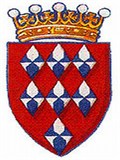
De Burgh Coat of Arms
My 20th great grandmother was born in Ulster, and died in Kildare, Ireland. Her father,Richard Og, was Earl of Ulster and a very powerful man:
Richard Og de Burgh, 2nd earl of Ulster (1259 – July 29, 1326), called The Red Earl, was one of the most powerful Irish nobles of the late 13th and early 14th centuries, a son of Walter de Burgh, the 1st Earl of Ulster (of the second creation) and Lord of Connacht.[1] His name, “Richard Og”, meant Richard the Young, probably a reference to his youth when he became earl in 1271, or to differentiate him from his grandfather, Richard Mor. He was also known as the Red Earl.
Richard Og was the most powerful of the de Burgh Earls of Ulster, succeeding his father in Ulster and Connacht upon reaching his majority in 1280.[1] He was a friend of King Edward I of England, and ranked first among the Earls of Ireland. Richard’s wife Marguerite de Guînes was the cousin of King Edward’s queen. He pursued expansionist policies that often left him at odds with fellow Anglo-Irish lords.
His daughter Elizabeth was to become the second wife of King Robert the Bruce of Scotland. However, this did not stop him leading his forces from Ireland to support England’s King Edward I in his Scottish campaigns and when the forces of Edward Bruce invaded Ulster in 1315, the Earl led a force against him, but was beaten at Connor in Antrim. The invasion of Bruce and the uprising of Felim O’Connor in Connacht left him virtually without authority in his lands, but O’Connor was killed in 1316 at the Second Battle of Athenry, and he was able to recover Ulster after the defeat of Bruce at Faughart.[1]
He died July 29, 1326 at Athassel Priory, near Cashel, County Tipperary.
Children and family
Lady Joan De Burgh, Baroness Darcy (1290 – 1359)
Lady Joan de Burgh was the daughter of Richard de Burgh, 2nd Earl of Ulster and Margaret.1 She married, firstly, Thomas FitzJohn FitzGerald, 2nd Earl of Kildare, son of John FitzThomas FitzGerald, 1st Earl of Kildare and Blanche de la Roche, on 16 August 1312 at Greencastle, County Down, Ireland.2 She married, secondly, Sir John Darcy, 1st Lord Darcy de Knayth, son of Sir Roger Darcy and Isabel d’Aton, on 3 July 1329.3 She died on 23 April 1359.1 From 16 August 1312, her married name became FitzGerald.1 As a result of her marriage, Lady Joan de Burgh was styled as Countess of Kildare on 12 September 1316. From 3 July 1329, her married name became Darcy.3
Children of Lady Joan de Burgh and Thomas FitzJohn FitzGerald, 2nd Earl of Kildare
· John FitzGerald2 b. 1314, d. 1323
· Maurice FitzThomas FitzGerald, 4th Earl of Kildare+1 b. 1318, d. 15 Aug 1390
· Richard FitzGerald, 3rd Earl of Kildare2 b. c 1319, d. 7 Jul 1333
Children of Lady Joan de Burgh and Sir John Darcy, 1st Lord Darcy de Knayth
· Elizabeth Darcy+3
· Aymer Darcy3
· Roger Darcy3
· Sir William D’Arcy+3 b. 1330
Citations
1. G.E. Cokayne; with Vicary Gibbs, H.A. Doubleday, Geoffrey H. White, Duncan Warrand and Lord Howard de Walden, editors, The Complete Peerage of England, Scotland, Ireland, Great Britain and the United Kingdom, Extant, Extinct or Dormant, new ed., 13 volumes in 14 (1910-1959; reprint in 6 volumes, Gloucester, U.K.: Alan Sutton Publishing, 2000), volume VII, page 222. Hereinafter cited as The Complete Peerage.
2. Charles Mosley, editor, Burke’s Peerage, Baronetage & Knightage, 107th edition, 3 volumes (Wilmington, Delaware, U.S.A.: Burke’s Peerage (Genealogical Books) Ltd, 2003), volume 2, page 2298. Hereinafter cited as Burke’s Peerage and Baronetage, 107th edition.
3. Charles Mosley, Burke’s Peerage and Baronetage, 107th edition, volume 1, page 1027.

Elizabeth Darcy
My 19th great grandmother came from County Meath, Ireland, just like the O’Byrnes of the potato famine on my father’s side. She was a fancy lady with very famous ancestors herself. She was described by an historian as a wise and honorable lady.
Elizabeth Darcy (1331 – 1390)
is my 19th great grandmother
Johanna Hertforth (1345 – 1428)
Daughter of Elizabeth
Ellen Urswick (1364 – 1459)
Daughter of Johanna
Richard Molyneux (1386 – 1460)
Son of Ellen
Sir Richard Earl Sefton Molyneux (1422 – 1459)
Son of Richard
Thomas Sir 8th Earl of Sefton Molyneux (1445 – 1483)
Son of Sir Richard Earl Sefton
Lawrence Castellan of Liverpool Mollenaux (1490 – 1550)
Son of Thomas Sir 8th Earl of Sefton
John Mollenax (1542 – 1583)
Son of Lawrence Castellan of Liverpool
Mary Mollenax (1559 – 1575)
Daughter of John
Francis Gabriell Holland (1596 – 1660)
Son of Mary
John Holland (1628 – 1710)
Son of Francis Gabriell
Elizabeth Holland (1652 – 1737)
Daughter of John
Richard Dearden (1645 – 1747)
Son of Elizabeth
George Dearden (1705 – 1749)
Son of Richard
George Darden (1734 – 1807)
Son of George
David Darden (1770 – 1820)
Son of George
Minerva Truly Darden (1806 – )
Daughter of David
Sarah E Hughes (1829 – 1911)
Daughter of Minerva Truly
Lucinda Jane Armer (1847 – 1939)
Daughter of Sarah E
George Harvey Taylor (1884 – 1941)
Son of Lucinda Jane
Ruby Lee Taylor (1922 – 2008)
Daughter of George Harvey
Pamela Morse
I am the daughter of Ruby Lee
Elizabeth Darcy
Elizabeth Darcy, Countess of Ormond (3 April 1332- 24 March 1390), was the wife of James Butler, 2nd Earl of Ormond, and the mother of his six children, including James Butler, 3rd Earl of Ormond.
Family and lineageElizabeth Darcy was born on 3 April 1332 at Platten, County Meath, Ireland, the daughter of Sir John Darcy, 1st Baron Darcy of Knaith, Justiciar of Ireland, and his second wife Joan de Burgh. Sir John was a veteran of the Battle of Crecy. He held the offices of Constable of Nottingham Castle, Constable of the Tower of London, and Sheriff of Lancashire. From 1341- 1346, he was Chamberlain to King Edward III. Elizabeth had a brother Sir William Darcy, who married Catherine FitzGerald, by whom he had issue. She also had numerous half-siblings from her parents’ previous marriages. Her father’s first wife was Emeline Heron, by whom he had eight children, including his heir, John Darcy, 2nd Baron Darcy of Knaith. Elizabeth’s mother’s first husband had been Thomas FitzGerald, 2nd Earl of Kildare, by whom she had three sons, John FitzGerald, Richard FitzGerald, 3rd Earl of Kildare, and Maurice FitzGerald, 4th Earl of Kildare.Elizabeth’s paternal grandparents were Roger Darcy and Isabel d’Aton. Her maternal grandparents were Richard de Burgh, 2nd Earl of Ulster and Margaret de Burgh, daughter of Sir John de Burgh and Hawise of Lanvaley.One of her maternal aunts was Elizabeth de Burgh, wife of Robert the Bruce.Marriages and childrenOn 15 May 1346 in Ormond, Ireland, when Elizabeth was fourteen, she married her first husband James Butler, 2nd Earl of Ormond (4 October 1331- 18 October 1382), the son of James Butler, 1st Earl of Ormond and Lady Eleanor de Bohun. He was Lord Justice of Ireland in 1359, 1364, and 1376. He was also Constable of Dublin Castle in 1349. He was known as the Noble Earl, however, the Irish called him The Chaste.Upon her marriage to the Earl, Elizabeth assumed the title of Countess of Ormond.James and Elizabeth had six children: 1. Ralph Butler 2. Eleanor Butler (died 1392), married Gerald FitzMaurice FitzGerald, 3rd Earl of Desmond, by whom she had issue, including the 4th and 6th Earls of Desmond. 3. James Butler, 3rd Earl of Ormond (died 6 September 1405), before 17 June 1386, married firstly, Anne Welles, Countess of Ormond, daughter of John Welles, 4th Lord Welles and Maud de Ros, by whom he had issue, including James Butler, 4th Earl of Ormond. He married secondly, Katherine FitzGerald of Desmond, by whom he had further issue. In 1391, he purchased Kilkenny Castle. 4. Thomas Butler 5. Catherine Butler (born 1361), married firstly, Thomas Reade, by whom she had one son, Richard, and secondly, Thomas Fleming of Slane. 6. Joan Butler, married Tiege O’ Carroll
James Butler, 2nd Earl of Ormond, died on 18 October 1382 in Knocktopher and was buried in Gowran Church, Co. Kilkenny. Elizabeth married secondly, Sir Robert de Hereford, Seneschal of the Liberty of Tipperary, between 28 December 1383 and 30 March 1384.
DeathElizabeth Darcy died on 24 March 1390. She was not quite fifty-eight years old.
References 1. ^ Douglas Richardson, Kimball G. Everingham,Magna Carta Ancestry: A Study in Colonial and Medieval Families. p.161 2. ^ Charles Cawley, Medieval Lands, Earls of Ormond * http://www.Tudorplace.com.ar/DARCY.htm * http://www.Tudorplace.com.ar/BUTLER.htm * Charles Cawley, Medieval Lands, Earls of Ormond * Elizabeth Darcy at ThePeerage.com
 mermaidcamp