mermaidcamp
Keeping current in wellness, in and out of the water
You can scroll the shelf using ← and → keys
You can scroll the shelf using ← and → keys
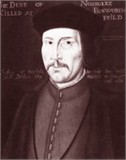
John Howard
My 16th great-grandfather died in battle in the War of the Roses:
John Howard, 1st Duke of Norfolk, 12th Baron Segrave, 11th Baron Mowbray, Earl Marshal (1421 – 22 August 1485) was an English nobleman, soldier, and the first Howard duke of Norfolk. He was a close friend and loyal supporter of King Richard III of England, with whom he died in combat at the Battle of Bosworth.
The Battle of Bosworth Field was the penultimate battle of the Wars of the Roses, the civil war between the House of Lancaster and the House of York that raged across England in the latter half of the 15th century. Fought on 22 August 1485, the battle was won by the Lancastrians. Their leader Henry Tudor, Earl of Richmond, became the first English monarch of the Tudor dynasty by his victory and subsequent marriage to a Yorkist princess. His opponent Richard III, the last king of the House of York, was killed in the battle. Historians consider Bosworth Field to mark the end of the Plantagenet dynasty, making it one of the defining moments of English history.http://en.wikipedia.org/wiki/Battle_of_Bosworth_Field
Retrieved on 7 May 2010 from:http://en.wikipedia.org/wiki/Battle_of_Bosworth_Field,http://en.wikipedia.org/wiki/John_Howard, _1st_Duke_of_Norfolk

Battle of Bosworth Field
John Howard (1421 – 1485)
is my 16th great grandfather
Lord Thomas HOWARD (1443 – 1524)
son of John Howard
Lady Katherine Howard Duchess Bridgewater (1495 – 1554)
daughter of Lord Thomas HOWARD
William ApRhys (1522 – 1588)
son of Lady Katherine Howard Duchess Bridgewater
Henry Rice (1555 – 1621)
son of William ApRhys
Edmund Rice (1594 – 1663)
son of Henry Rice
Edward Rice (1622 – 1712)
son of Edmund Rice
Lydia Rice (1649 – 1723)
daughter of Edward Rice
Lydia Woods (1672 – 1738)
daughter of Lydia Rice
Lydia Eager (1696 – 1735)
daughter of Lydia Woods
Mary Thomas (1729 – 1801)
daughter of Lydia Eager
Joseph Morse III (1752 – 1835)
son of Mary Thomas
John Henry Morse (1775 – 1864)
son of Joseph Morse III
Abner Morse (1808 – 1838)
son of John Henry Morse
Daniel Rowland Morse (1838 – 1910)
son of Abner Morse
Jason A Morse (1862 – 1932)
son of Daniel Rowland Morse
Ernest Abner Morse (1890 – 1965)
son of Jason A Morse
Richard Arden Morse (1920 – 2004)
son of Ernest Abner Morse
Pamela Morse
I am the daughter of Richard Arden Morse
Born around 1420, John Howard was the son and heir of Sir Robert Howard andMargaret, daughter of Thomas Mowbray, Duke of Norfolk. Through his mother and her female line, he was descended from Edward I, thus making him the premier Duke and heir to the title of Earl Marshall. Nothing is known of his childhood.
His first recorded service was in 1451, when he followed Lord L’Isle to Guienne. He was also present at the Battle of Chatillon in Jul two years later. It was at this time that he entered the service of John Mowbray, Duke of Norfolk.
On the first accession of Edward IV, Howard was knighted and appointed Constable of Colchester Castle, Sheriff of Norfolk and Suffolk. He was also one of the King’s Carvers.
Howard took an active part in John Mowbray’s quarrel with John Paston. In Aug 1461, he was involved in a violent brawl with Paston and used his influence withEdward IV against Paston. In Nov of the same year, Howard was imprisoned after giving offence at the election of Paston, causing many complaints against him.
The following year, he was appointed Constable of Norwich Castle and received grants of several manors forfeited by the Earl of Wiltshire. He was joined byWilliam Neville, Baron Fauconberg and Lord Clinton to “keep the seas“, taking Croquet and the Isle of Rhe. Later in the year, he was sent to help the Richard Neville, Earl of Warwick at Warkworth.
In the Spring of 1464, Howard helped Norfolk secure Wales for Edward IV. He bought the reversion of Bamburgh Castle in Jun of the same year and was withEdward IV and his court at Reading by the year’s end.
Howard was appointed Vice Admiral for Norfolk and Suffolk in 1466, and was charged with conveying envoys from England to France and the Duke of Burgundy. He remained in Calais from 15 May to 27 Sep.
He was elected Knight of the Shire for Suffolk in Apr 1467, having been elected Knight of the Shire for Norfolk in 1455. Nov 1467 saw him as an appointed Envoy to France as well as Treasurer to the Household, a post which he held until 1474. The following Jun (1468) he attended Margaret of York to Flanders for her marriage to Charles, Duke of Burgundy.
On the restoration of Henry VI, he was created Baron de Howard (15 Oct 1470). However, when Edward IV landed back in England in Mar 1471, after living in exile in Bruges, Howard proclaimed Edward to be King.
The following Jun, he was appointed Deputy Governor of Calais. When Edward IVinvaded France in Jul 1474, he was accompanied by John Howard, who was one of the commissioners who made a truce at Amiens. Howard received a pension from Louis XI and remained in France, briefly, as a hostage after Edward’s departure. On Howard’s return to England, he was granted manors in Suffolk and Oxfordshire forfeited by John de Vere, Earl of Oxford.
John Howard was also sent by Edward to treat with France on several occasions – Jul 1477, Mar 1478, and Jan 1479. Also, in 1479, he was put in charge of the fleet which was sent to Scotland.
At Edward IV’s funeral in Apr 1483, he carried Edward’s Banner. He then attached himself to Richard III. On 13 May 1483, he was appointed High Steward of the Duchy of Lancaster and was made a Privy Councillor. A month later, John Howard was created Duke of Norfolk and Earl Marshall.
He persuaded Elizabeth Woodville to let the young Duke of York join his brother Edward V in the Tower. He was possibly involved in the murder of the two princes in the Tower of London. At Richard III’s coronation, Howard performed many functions – he acted as High Steward, bore the crown, and, as Earl Marshall, was the King’s Champion. Shortly afterwards, he was created Admiral of England, Ireland, and Aquitaine, and was appointed Chief of Commissioners to negotiate with James III of Scotland on 12 Sep 1484 at Nottingham.
In Aug 1485, he summoned his retainers to Bury St. Edmunds and commanded the vanguard at the Battle of Bosworth, where he was killed. Howard was attainted at Henry VII’s first Parliament. Warned in the following distich: “Jockey of Norfolk be not too bold,/ For Dickon thy master is bought and sold“. He was buried in the conventual church at Thetford, Norfolk.
 mermaidcamp