mermaidcamp
Keeping current in wellness, in and out of the water
You can scroll the shelf using ← and → keys
You can scroll the shelf using ← and → keys
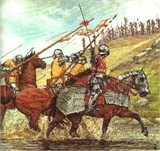
Battle of Blore Heath
My 15th great grandfather was a knight involved with Brit royalty. He lost his life defending it in a battle called Blore Heath. They were fighting about roses (red and white, although I am still not sure what the symbols meant) and the right to the throne. They were royals. They were angry. Things got bloody nasty:
The Battle of Blore Heath
September 23, 1459
After four years of uneasy peace the King presided over a wasting realm. No parliament had been summoned for three years, the country was sadly divided and distressed. The Yorkists were armed, armies were marching across all England. Lord Audley had recently raised a Lancastrian army centered round Market Drayton, and the Queen -through whom the King ruled- sent him orders to intercept Lord Salisbury, who was marching from Yorkshire to join the Duke of York at Ludlow. The two armies met head on two and a half miles east of Market Drayton at a place called Blore Heath. Salisbury, with 3,000 troops, was outnumbered by more than two to one, but could not avoid giving battle.
Audley took up a position just west of a little stream that crossed the Market Drayton-Newcastle-under-Lyme road, and Salisbury’s men were drawn up about 150 yards east of the present Audley Cross, which marks the spot where Lord Audley fell. The Yorkist left rested upon the boggy edge of a wood, but their right was in the air, and Salisbury made a laager of his wagons to protect this flank. Whether Salisbury feigned retreat in order to draw Audley on is not certain, but the Lancastrian commander was definitely the one to attack. Two cavalry charges were repulsed, the first with heavy loss to the Lancastrians, and then they mounted an infantry attack up the hill to the Yorkist position. But this too failed; there was no support from the cavalry, Lord Audley had already fallen and 500 Lancastrians chose this moment to desert to the enemy. Salisbury’s victory was complete and in the pursuit, which continued for two miles, the slaughter was very heavy. Possibly 2,000 Lancastrians perished in this battle, but fewer than 200 Yorkists fell.
For more information on the Battle of Blore Heath, contact Blore Heath 1459 online at http://www.bloreheath.org
YORKISTS LANCASTRIANS
Sir Christopher Conyers of Sokebourne, Durham
Sir Henry Bromflete, Wymington, Bedford
Sir John Conyers of Hornby, Yorkshire
Sir Robert del Booth of Wilmslow, Cheshire (killed in battle)
Sir Walter Devereux of Weobley, Herefordshire (killed in battle)
Sir John Bourchier of West Horsley, Surrey
Sir Richard Grey of Powis, Powis
Sir Hugh Calveley of the Lea, Cheshire (killed in battle)
Sir Richard Hamerton of Hamerton, Yorkshire
Sir William Catesby (Sr.) of Ashby St. Legers, Northamptonshire
Sir Thomas Harrington, Lancashire
Sir John Dawne of Cheshire
Sir Roger Kynaston of Hordley, Shropshire
Sir Jerkin Done of Wickington, Cheshire (killed in battle)
Sir Thomas Lumley of Lumley, Durham
Sir Robert Downes of Shrigley, (killed in battle)
Thomas Meering of Tong
Sir Thomas Dutton of Dutton, Cheshire (killed in battle)
Sir James Metcalfe of Nappa, Yorkshire
Sir John Dwnn of Cheshire, killed in battle
Sir John Middleton of Belsay Castle, Northumberland
Sir John Egerton of Egerton, Cheshire (killed in battle)
Sir Thomas Mountford of Hackforth, Yorkshire
Sir Nicholas of Eyton of Eyton, Shropshire
Sir Richard Neville (Earl of Salisbury) of Middleham, Yorkshire (fled to Calais)
Sir Richard Fitton of Gawsforth, Cheshire
Sir Richard Neville (Earl of Warwick) of Middleham, Yorkshire (fled to Calais)
Thomas Fitton, fate unknown
Sir Thomas Neville of Thornton Bridge, Durham
Sir John Haigh, killed in battle
Sir Robert Ogle of Ogle, Northumberland
Sir Edmund Hampden of Hampden, Buckinghamshire
Sir Thomas Parr of Kendal, Westmoreland
Sir Thomas Hesketh of Rufford, Lancashire
Richard Plantagenet, Duke of York, fled to Ireland
Sir Henry Holland of Darlington, Devon
Sir William Pudsey of Selaby, Durham
Sir John Legh of Booths, Cheshire (killed in battle)
Sir James Strangeways of Whorlton, Yorkshire
Sir Philip Maunsell of Scrurlage, Glamorgan
Sir Walter Strickland of Sizergh, Westmoreland
Sir Richard Molyneux of Sefton, Lancashire (killed in battle)
Sir John Wandesford of Kirklington, Yorkshire
Sir John Neville of Raby, Durham
Sir John Wenlock of Wenlock, Shropshire
Sir Ralph Shirley of Shirley, Sussex
Sir Walter Wrottesley of Wrottesley, Shropshire
Sir John Skidmore of Mochas, Herefordshire
Sir John Stanley of Pipe, Staffordshire
Sir Edmund Sutton of Dudley, Westmoreland
Sir John Sutton of Dudley, Westmoreland
Sir William Troutbeck of Dunham-on-the-Hill, killed in battle
James Touchet (Lord Audley) of Markeaton, Derbyshire (killed in battle)
Sir Hugh Venables of Kinderton (killed in battle)
©The Richard III Foundation, Inc.
Sir Richard Earl Sefton Molyneux (1422 – 1459)
is my 15th great grandfather
Thomas Sir 8th Earl of Sefton Molyneux (1445 – 1483)
Son of Sir Richard Earl Sefton
Lawrence Castellan of Liverpool Mollenaux (1490 – 1550)
Son of Thomas Sir 8th Earl of Sefton
John Mollenax (1542 – 1583)
Son of Lawrence Castellan of Liverpool
Mary Mollenax (1559 – 1575)
Daughter of John
Francis Gabriell Holland (1596 – 1660)
Son of Mary
John Holland (1628 – 1710)
Son of Francis Gabriell
Elizabeth Holland (1652 – 1737)
Daughter of John
Richard Dearden (1645 – 1747)
Son of Elizabeth
George Dearden (1705 – 1749)
Son of Richard
George Darden (1734 – 1807)
Son of George
David Darden (1770 – 1820)
Son of George
Minerva Truly Darden (1806 – )
Daughter of David
Sarah E Hughes (1829 – 1911)
Daughter of Minerva Truly
Lucinda Jane Armer (1847 – 1939)
Daughter of Sarah E
George Harvey Taylor (1884 – 1941)
Son of Lucinda Jane
Ruby Lee Taylor (1922 – 2008)
Daughter of George Harvey
Pamela Morse
I am the daughter of Ruby Lee
the red and white roses symbolised two adjoining counties in England, Lancashire and Yorkshire.! Google war of the roses:)
LikeLike

Mine all seem to be Lancashires..
LikeLike
wow.. that’s quite an interesting time period
LikeLike


 mermaidcamp