mermaidcamp
Keeping current in wellness, in and out of the water
You can scroll the shelf using ← and → keys
You can scroll the shelf using ← and → keys

burial place

coat of arms
William Walker received a grant of land in 1639 in Hingham, Massachusetts and was among the first settlers there. He was with Richard, James, and Sarah Walker when they came to New England in the “Elizabeth” in April 1635. He later removed to Eastham where he was admitted to freedom June 3, 1656.
William Walker was born in 1620 at England. He immigrated in 1635. He immigrated in 1643 to Plymouth, MA. He married Sarah Snow, daughter of Nicholas Snow and Constance Hopkins, on 25 February 1654 at Eastham, MA (25 Jan 1655 per #494). William Walker’s name is on the list of those able to bear arms in 1643 and he was admitted as a freeman 8 June 1656 at Eastham, Barnstable, MA. He was in COURT/CIVIL on 3 March 1663 at Plymouth Colony: Ralph Smith of Eastham, fined 3s, 4p for breaking the peace in striking William Walker. He was in COURT/CIVIL on 5 June 1671 at Plymouth: William Walker was charged with stealing cloth from Thomas Clark, “of Boston” and was sentenced to pay double for the cloth and for telling a lie about it, was fined 10 Pounds. He died in 1703.

Richard landing with Pilgrims
Oct. 1665, John Cooke and his Brother-In-Law Nathaniel Warren, were appointed by Plymouth Colony to “treat with Philip the Sagamore about the sale of such lands as are to be sold by him, and to purchase them in the behalf of the country.” Philip the Sagamore, sometimes called Metacom, was the son or grandson of Massasoit, and leader of the Wampanoag Indians. He would later be dubbed “King Philip” during the Wampanoag’s war he led against the English in 1676.
His prepared his will in 1661 to resolve disputes over his father’s estate.
From the book “Mayflower Families Through Five Generations” Richard Warren, Volume Eighteen Part 1 – Third Edition by the General Society of Mayflower Descendants 2004
On June 11 1653 Jane Collyare (Collier) on behalf of her grandchild Sara, the wife of Nathaniel Warren. Elizabeth Warren and Nathaniel Warren agreed to let the court resolve their differences over certain lands of Mr. richard Warren deceased.
Nathaniel Warren became a Freeman 3 June 1657. On 1 June 1658 he was a Deputy from Plymouth, a position he frequently held.
On 15 oct 1661 Nathaniell Warren “aged thirty seaven yeares or thereabouts” made a deposition. NOTE: spelling in the ( )’s are exactly the way it was written back in 1661.
The will of Nathaniel Warren Sr. of Plymouth, dated 29 June 1667, codicil dated 16 July 1667, names wife Sarah; dau. Hope who is lame; other children (not named); the codicil mentions mother Elizabeth Warren; brother Joseph Warren; sisters Mary Bartlett, Sr., Ann Little, Sarah Cooke, Elizabeth Church and Abigail Snow. The inventory was taken 21 Oct 1667, sworn by widow Sarah Warren who was granted administration 30 Oct 1667.
On 9 Jan. 1689/90, Sarah Warren sold land in Plymouth to her son James Warren. On 9 Jan. 1689/90, the other heirs of Nathaniel Warren consented to the sale, they were: Richard Warren; Nathaniel Warren; Jabiz Warren; Elizabeth Green; Sarah Blackwell; Thomas Gibbs and wife Alice; Jonathan Delano and wife Mercy Delano.
On 19 Sept. 1694 Jabiz Warren of Plymouth, yeoman, sold to John Gibbs land in Middleboro which was bought by his father Nathaniel Warren.
My 9th great grandmother was the first woman poet to be published in America:
Anne Bradstreet (1612-1672) is one of the most important figures in the history of American Literature. She is considered by many to be the first American poet, and her first collection of poems, “The Tenth Muse Lately Sprung Up in America, By a Gentlewoman of Those Parts”, doesn’t contain any of her best known poems, it was the first book written by a woman to be published in the United States. Mrs. Bradstreet’s work also serves as a document of the struggles of a Puritan wife against the hardships of New England colonial life, and in some way is a testament to plight of the women of the age. Anne’s life was a constant struggle, from her difficult adaptation to the rigors of the new land, to her constant battle with illness.
It is clear to see that Anne’s faith was exemplary, and so was her love for children and her husband, Governor Simon Bradstreet. Anne’s poems were written mainly during the long periods of loneliness while Simon was away on political errands. Anne, who was a well educated woman, also spent much time with her children, reading to them and teaching them as her father had taught her when she was young. While it is rather easy for us to view Puritan ideology in a bad light because of it’s attitude towards women and strict moral code, her indifference to material wealth, her humility and her spirituality, regardless of religion, made her into a positive, inspirational role model for any of us.
Another one of Anne’s most important qualities was her strong intuition, although only subtly hinted at in her work, probably for fear of reprisal from the deeply religious Puritan community, one cannot help but feel her constant fascination with the human mind, and spirit, and inner guidance.
Her style is deceptively simple, yet speaks of a woman of high intelligence and ideals who was very much in love, and had unconditional faith. While it was difficult for women to air their views in the 17th Century, Anne Bradstreet did so with ease, as her rich vocabulary and polyvalent knowledge brought a lyrical, yet logical quality to her work which made it pleasant for anyone to read.
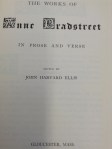

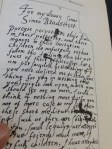
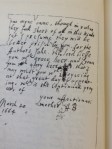







Anne Dudley Bradstreet was protected by her father and husband at a time when women were not supposed to think, let alone write poetry. She wrote history as she lived it as an Englishwoman in New England. I visited the University of Arizona Poetry Center this week to see the word shrine for the dead. I was very happy to also find a big blue book by Anne Bradstreet on the shelves. I enjoyed the wonderful space and visited with my ancestor by reading her works for about an hour. I had seen some of the work before, but since I was thinking of ancestry I really enjoyed the note she wrote to her son Simon (brother of my own ancestor). There is a copy preserved in her own hand, which I love to see. It gives me some intuition into her soul’s journey. Being a Pilgrim was not easy, but if your father and husband were governors you had some obvious advantages.
It is a wonderment of synchronicity to find my ancestor’s work preserved at the Poetry Center very near my home where I can go visit and read her any time.
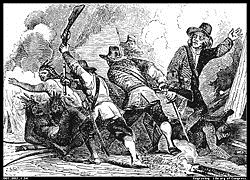
Pequot War 1637-1638
Thomas Redding was an early settler of Maine. He and his wife left a five year old child in the care of another man and never returned for him. The court awarded custody of the boy to the guardian since the promised upkeep for the child was never paid.
RESIDENCE: 1644: Scituate, Ma [BRLp10, quoting Plymouth Colony Court Records relating to their leaving their 5y old son in the care of Mr Gowan White, & failing to return to pay for his keep. The court awarded custody of the child to Mr White, unless the parents returned and paid for arrears in support]
1653: Took oath of allegiance to Massachusettes at Wells, Me as being of Saco, Me. and relocated at Three Islands, Cape Porpoise Harbor, Me (being as “Thomas Redding who hailed from New Plymouth”); he lived on the Great Island (which was known as “Redding Island” into the 1800’s) and managed the fishing Trade there until he returned to Saco about 1653/7. [BRLp11, quoting, Wilbur D. Spencer’s 1930 “Pioneers on Maine Rivers”].
1665: rem. Westcustego (the Indian name for what we call Yarmouth) [BRLp11, quoting, Wilbur D. Spencer’s 1930 “Pioneers on Maine Rivers”].
NOTE: Cape Porpoise River is now [ca.1920] known as Mousam River.
1666: “Living near the Lane family … who were living on the ‘Cousin’s Place'” [by this do we infer what is today known as “Cousin’s Island”?]BIOGRAPHY:
Quoted from: “The Redding Family and Its Relatives” by Billie Redding Lewis, Donated by the author April 1983 to (and on file at) the General Society of Mayflower Descendants Library, Plymouth, Mass.:
“No evidence has been found to connect Thomas Redding, the progenitor of the author’s family to the Thaddeus Riddan with whom Thomas is often confused. Most researchers believe all early Reddings, regardless of spelling, both in New England and the Virginia colonies, to be related.
“Banks [17] has Thomas Redding entering New England about 1635 but unfortunately, has found no ship nor English origin listed.
“One researching descendant states that Thomas came from Barbados to New England as did “John and James Saunders, Thomas Lane, John Spencer, John Manwaring, John and Thomas Hill, and others, who are found as Mr. Redding’s neighbors in what is now the state of Maine.” [18].
“Thomas Redding’s name does appear on a list of those who in 1635-8 [19] owned ten or more acres in Barbados but there is no documented proof that the Thomas Redding of Barbados is the same Thomas Redding of New England. It is quite probable, on the other hand, since Thomas, in 1639, married the sister of William Pennoyer, a wealthy London merchant, who was not only a cloth merchant but also a prosperous sea-merchant owning a number of vessels and some sugar planatations in Barbados.
“In 1637, Thomas Redding is found in “New Plymouth” as a fisherman and a volunteer for service in the Pequot War [20].
“On 20 July, 1639, Thomas Redding married Ellinor Pennoyer, who is recorded in Plymouth Colony records as Elinor “Penny”. Thomas’s name is not found again in Plymouth records until 1644 when he and Ellinor are in Scituate, Mass. where it is thought they lived less than a year & left their five year old son to be cared for by Gowan White. On 4 June, 1 645, the Plymouth Court Records state. [23]” ‘Whereas Thomas Riddings, about ayear since, came to Scituate and depted (departed) thence, leaueing a man child about fiv yeares of age with Gowen White, pmiseing him to pay xviij d p weeke for his keepeing & dyetting of him, but hath hitherto payd him nothing; and the said Gowen White hath since found him meate, drinke, and cloathes at his own charge; the court doth order and appoynt that the said shalbe wth the said Gowen White vntill he shall accomplish the age tweny and foure yeares; but if his father shall come and desire to take him away before the end of the said terme, that then he shall pay he said Gowen White for the keeping of him for such tyme as he shall haue beene wth him; and so also if bee shalbe placed wth another man.’.
“Thomas’s leaving his son is still puzzling to genealogists. The child was probably Thomas and Ellinor’s first-born since he was five years old at the time, making him born in 1640, a year after their marriage. Why was he left? Did the parents go to Barbados but did not want to change the child’s environment, or is this the period of time in which they moved to Maine and possibly did not want to subject their son to the lifestyle that would be rougher than that in Plymouth County? If they moved to Maine, why then was there no contact with Gowen White? True, travelling was not easy in those days, but the pioneers did not seem to allow obstacles to impede them completely.
“This writer could find no record of Thomas between the time he left his son in 1645 and when he took his Oath of Allegiance to Massachusetts Colony in what is now Maine, on 5 July, 1653. [25]”
[17] Charles Edward Banks, “Tophgraphical Dictionary of 2885 Emigrants”, p.234 … Baltimore.
[18] Fred E. Crowell, “Redding -Miller”, Boston “Transcript”, 1929
[19] NHGS Register, Vol. 39, taken from “Memoirs of the First Settlers of the Island of Barbados” …
[20] Winslow’s “Journal”, and Plymouth Colony Records
[23] Plymouth Colony Records; Book 2, Page 86 [25] James Savage, “A Genealogical Dictionary of the First Settlers of New England”, Vol. 4, Boston,
Thomas Redding (1607 – 1673)
is my 9th great grandfather
Martha Redding (1633 – 1702)
daughter of Thomas Redding
Abigail Taylor (1663 – 1730)
daughter of Martha Redding
Martha Goodwin (1693 – 1769)
daughter of Abigail Taylor
Grace Raiford (1725 – 1778)
daughter of Martha Goodwin
Sarah Hirons (1751 – 1817)
daughter of Grace Raiford
John Nimrod Taylor (1770 – 1816)
son of Sarah Hirons
John Samuel Taylor (1798 – 1873)
son of John Nimrod Taylor
William Ellison Taylor (1839 – 1918)
son of John Samuel Taylor
George Harvey Taylor (1884 – 1941)
son of William Ellison Taylor
Ruby Lee Taylor (1922 – 2008)
daughter of George Harvey Taylor
Pamela Morse
I am the daughter of Ruby Lee Taylor

oldest Veteran’s memorial in the US
My 9th great grandfather was killed by my 11th great uncle. King Philip’s War was fought between the Wampanoag people and the colonists of Plymouth. This is the first, but not the last, war on American soil in which I had ancestors on both sides of the conflict. The memorial that commemorates this event is in preset day Providence, RI. It is the oldest Veterans memorial in the US. The vanquished native people were sent to the West Indies and sold into slavery. Nobody knows where the graves of my Wampanoag ancestors are.
Captain Michael Pierce was born in 1615 and died in1676. He and his descendants form the first American generation of Pierces in our family tree. Michael Pierce immigrated to the New World in the early 1640s from Higham, Kent, England to Scituate, in what later became Massachusetts. The ten year period from 1630 to 1640 is know as The Great Migration. During this period, 16,000 people, immigrated to the East Coast of North America.
Brother of famous Colonial Sea Captain, William Pierce. Captain Michael Pierce was the brother of the famous Colonial sea captain, William Pierce, who helped settle Plymouth Colony. Captain Michael Pierce played a significant role in the Great Migration. Historical records show that this one sea captain crossed the Atlantic, bringing settlers and provisions to the New World more frequently than any other. He had homes in London, the Bahamas and Rhode Island. He played a central role in the government of the early colonies. He was killed at Providence, one of the Bahama Islands, in 1641.
There were actually four Pierce brothers who made their mark on the New World: John Pierce (the Patentee), Robert Pierce, Captain William Pierce, and Captain Michael Pierce. All were grandsons of Anteress Pierce, and sons of Azrika Pierce and his wife Martha.
Marries Persis Eames. In 1643, Michael Pierce married Persis Eames of Charleston Massachusetts. His wife was born in Fordington, Dorsetshire England 28 October 1621. She was the daughter of Anthony Eames and Margery Pierce.
Pierce Family Moves to Scituate. Michael and Persis Pierce’s first child, a daughter, was born in 1645 and named Persis in honor of her mother. Unfortunately, their first child died in 1646 at one year of age. The new family settled first in Higham, but moved in 1676 to Scituate, where the Pierce family continued to reside for most of the next century. Scituate is located some 10 miles north of the original Plymouth colony. It was settled as early as 1628 by a group of men from Kent, England.
In 1646, Benjamin Pierce, their second child, a son and heir, was born. This son, Benjamin Pierce, fathered the second Pierce generation in this family tree. Twelve other children were born over the coming years: Ephraim, Elizabeth, Deborah, Sarah, Mary, Abigail, Anna, Abiah, John, Ruth and Peirsis.
Erected First Saw-Mill. Michael Pierce resided on a beautiful plain near the north river and not far form Herring brook. He assisted in erecting the first saw-mill. The mill was the first one erected in the colony. It is believed that Samuel Woodworth (1784-1842) wrote the song, “The Old Oaken Bucket,” concerning this river and mill in Scituate. Samuel Woodworth’s grandfather, Benjamine Woodworth, witnessed the signing of Captain Michael Pierce’s will, on January 1675. The lyrics to this classic American folk tune are given below:
How dear to this heart are the scenes of my childhood, When fond recollection presents them to view, The orchard, the meadow, the deep tangled wildwood, And ev’ry lov’d spot which my infancy knew. The wide spreading stream, the mill that stood near it, The bridge and the rock where the cataract fell. The cot of my father, the dairy house by it, And e’en the rude bucket that hung in the well. The old oaken bucket, the ironbound bucket, The moss-covered bucket that hung in the well. The moss-covered bucket I hail as a treasure, For often at noon when returned from the field, I found it the source of an exquisite pleasure, The purest and sweetest that nature can yield. How ardent I seized it with hands that were glowing, And quick to the white pebbled bottom it fell. Then soon with the emblem of truth overflowing, And dripping with coolness it rose from the well. The old oaken bucket, the ironbound bucket, The moss-covered bucket that hung in the well. How soon from the green mossy rim to receive it, As poised on the curb it reclined to my lips, Not a full flowing goblet could tempt me to leave it, Tho’ filled with the nectar that Jupiter sips. And now far removed from the loved situation, The tear of regret will intrusively swell. As fancy reverts to my father’s plantation, And sighs for the bucket that hung in the well. The old oaken bucket, the ironbound bucket, The moss-covered bucket that hung in the well.
Captain in the Local Militia Fighting the Indians. Unlike his famous brother, Captain William Pierce, Michael Pierce was not a sea captain. He attained the title, Captain, from the Colony court in 1669. Historical records show that he was first given the rank of Ensign under Captain Miles Standish, then later, in 1669, he was made Captain. These titles reflects his role as a leader in the local militia formed to protect the colony from the Indians.
Honored for Heroism in King Phillip’s War. Captain Michael Pierce’s memory is well-documented in American history. He is honored for the brave manner in which he died in defense of his country. The exact manner in which he died is repeated in more than 20 books and letters detailing the military history of the King Phillip’s War. This war took place between 1675 and 1676, and remains one of the bloodiest conflicts in American history. It was also a pivotal point in early American history. Although the English colonists were ultimately victorious over the Indians, it took the colonies over 100 years to recover from the economic and political catastrophy brought about by this conflict.
The battle in which Captain Michael Pierce lost his life is detailed in Drakes Indian Chronicles (pp. 220-222) as follows:
“Sunday the 26th of March, 1676, was sadly remarkable to us for the tidings of a very deplorable disaster brought into Boston about five o’clock that afternoon, by a post from Dedham, viz., that Captain Pierce of Scituate in Plymouth Colony, having intelligence in his garrison at Seaconicke, that a party of the enemy lay near Mr. Blackstorne’s, went forth with sixty-three English and twenty of the Cape Indians (who had all along continued faithful, and joyned with them), and upon their march discovered rambling in an obscure woody place, four or five Indians, who, in getting away from us halted as if they had been lame or wounded. But our men had pursued them but a little way into the woods before they found them to be only decoys to draw them into their ambuscade; for on a sudden, they discovered about five hundred Indians, who in very good order, furiously attacked them, being as readily received by ours; so that the fight began to be very fierce and dubious, and our men had made the enemy begin to retreat, but so slowly that it scarce deserved the name, when a fresh company of about four hundred Indians came in; so that the English and their few Indian friends were quite surrounded and beset on every side. Yet they made a brave resistance for about two hours; during which time they did great execution upon their enemy, who they kept at a distance and themselves in order. For Captain Pierce cast his sixty-three English and twenty Indians into a ring, and six fought back to back, and were double – double distance all in one ring, whilst the Indians were as thick as they could stand, thirty deep. Overpowered with whose numbers, the said Captain and fifty-five of his English and ten of their Indian friends were slain upon the place, which in such a cause and upon such disadvantages may certainly be titled “The Bed of Honor.” However, they sold their worthy lives at a gallant rate, it being affirmed by those few that not without wonderful difficulty and many wounds made their escape, that the Indians lost as many fighting men in this engagement as were killed in the battle in the swamp near Narragansett, mentioned in our last letter, which were generally computed to be above three hundred.”
Today, in Scituate, there is a Captain Pierce Road.
In Cumberland, Rhode Island, there is a monument called Nine Men’s Misery. A tablet near the monument reads:
NINE MEN’S MISERYON THIS SPOT WHERE
THEY WERE SLAIN
BY THE INDIANS
WERE BURIED
THE NINE SOLDIERS
CAPTURED IN
PIERCE’S FIGHT
MARCH 26, 1676
The monument is located in a dark, place in the woods, near a former monastery. The monastery is now a public library. The monument consists of little more than a pile of stones cemented together by a monk and marked with a plaque. However, this site is of major historical significance because it is concidered to be the oldest monument to veterans in the United States.
1. Captain Michael Pierce born 1615; died 3/26/1676.
married Persis Eames, 1643 (born. Oct. 28, 1621; died Dec. 31,1662). Micheal Pierce and Persis Eames had these 13 children:
2. Persis Pierce, born 1645. Persis died 1646 at 1 year of age. 3. >>>Benjamin Pierce, born 1646. 4. Ephraim Pierce, born 1647. Ephraim died 1719 at 72 years of age. 5. Elizabeth Pierce, born 1649. She married a Holbrook and gave birth to Captain Michael Pierce’s only two grandchildren at the time of his death who are mentioned in his will: Elizabeth Holbrook and Abigail Holbrook. 6. Deborah Pierce, born 1650. 7. Sarah Pierce, born 1652. 8. Mary Pierce, born 1654. She married Samuel Holbrook, 23 June 1675. Samuel was born in Weymouth, Mass 1650. Samuel was the son of William Holbrook and Elizabeth Pitts. Samuel died 29 October 1712 at 62 years of age. Mary Pierce and Samuel Holbrook had the following six children: Persis, Elizabeth, Bethiah, Samuel, Elizabeth, and Mary. 9.Abigail Pierce, born 1656. Abigail died 1723 at 67 years of age. 10. Anna Pierce, born 1657. 11. Abiah Pierce, born 1659. She married Andrew Ford. 12. John Pierce, born 1660. John died 28 June 1738 at 77 years of age. He married Patience Dodson 12 December 1683. 13. Ruth Pierce, born 1661. 14. Peirsis Pierce, born 1662. Persis 3 December 1695. She married Richard Garrett, 3rd, who was born in 1659. They lived in Scituate, Mass. and had three children: John (born 1706), Anna, and Deborah.
married Mrs. Annah James sometime soon after 1662. They had no children. Captain Michael Pierce remained married to Annah Pierce until his death. Annah Pierce is well provided for in his will.
Michael Pierce (1615 – 1676)
is my 9th great grandfather
Ann Pierce (1640 – 1655)
daughter of Michael Captain Pierce
Sarah Kinchen (1655 – 1724)
daughter of Ann Pierce
Philip Raiford (1689 – 1752)
son of Sarah Kinchen
Grace Raiford (1725 – 1778)
daughter of Philip Raiford
Sarah Hirons (1751 – 1817)
daughter of Grace Raiford
John Nimrod Taylor (1770 – 1816)
son of Sarah Hirons
John Samuel Taylor (1798 – 1873)
son of John Nimrod Taylor
William Ellison Taylor (1839 – 1918)
son of John Samuel Taylor
George Harvey Taylor (1884 – 1941)
son of William Ellison Taylor
Ruby Lee Taylor (1922 – 2008)
daughter of George Harvey Taylor
Pamela Morse
I am the daughter of Ruby Lee Taylor
When I read that he’d died during the Great Swamp Fight, it peaked my interest so I bought a book called King Philip’s War The History and Legacy of America’s Forgotten Conflict, by Eric B. Schultz and Michael J. Tougias. The following is an excerpt from the book describing Michael Pierce’s involvement in the conflict.
KING PHILIP’S WAR
PIERCE’S FIGHT, CENTRAL FALLS, RHODE ISLAND
The ambush of Captain Michael Pierce and his Plymouth Colony soldiers
occurred on Sunday, March 26, 1676, in the present-day city of Central
Falls, Rhode Island. Sometimes attributed to the Narragansett sachem
Canonchet, this ambush was in many respects a textbook military operation.
Several friendly natives escaped the engagement, but only nine English
survived, and these nine men were later discovered dead several miles
north of Central Falls in present-day Cumbedand, Rhode Island, a site now
known as Nine Men’s Misery. Not only was the ambush deadly for Pierce
and his men, but it was devastating to the morale of the colonies which, on
the very same day, witnessed the murder of settlers in Longmeadow, Massachusetts,
the burning of Marlboro, Massachusetts, and the destruction of
Simsbury, Connecticut.
Pierce, a resident of Scituate, Massachusetts, had gathered in Plymouth
a force of Englishmen from Scituate, Marshfield, Duxbury, Eastham, and
Yarmouth, supported by twenty friendly natives from Cape Cod. Together,
this band marched to Taunton, then along the Old Seacuncke Road
(Tremont Street) to Rehoboth (now East Providence, Rhode Island).
There, they were joined by several men from Rehoboth, expanding their total
number to sixty-three English and twenty friendly natives.
Reports indicated that a large group of the enemy had gathered in the
area of Pawtucket Falls, an ideal location from which to catch alewives,
salmon, and shad, and a natural fording spot in the river.149Pierce and his
men set out in pursuit. On Saturday, March 25, they skirmished with the
Narragansett, perhaps north of the falls, where, historian Leonard Bliss
concludes, Pierce “met with no loss, but judged he had occasioned considerable
to the enemy.”
It is not unreasonable to think that Pierce had skirmished with a small
patrol sent intentionally to meet and test the English-an exercise broken
off by the natives once they had gathered information on the size and”
strength of their opponent. In any event, Pierce met no other natives and returned
for the night to the garrison at Old Rehoboth. Meanwhile, armed
with information from the skirmish, native leaders undoubtedly set to work
devising a trap for the English troops.
On Sunday, March 26, Pierce and his troops returned to the field, probably
marching from present-day East Providence, north along the Seekonk
River (which becomes the Blackstone River), back toward Pawtucket Falls.
It is said that as they marched, they were watched by Narragansett from
Dexter’s Ledge, now the site of Cogswell Tower in Jenks Park, Central Falls
(rough distance and heavily wooded terrain made this questionable).
Somewhere close to the Blackstone, perhaps near a fording spot where
Roosevelt Avenue now crosses the river, in what Bliss describes as an
“obscure woody place,” they spotted four or five Narragansett fleeing as
if wounded or hurt. Had a more experienced commander witnessed this
show, he might have immediately fallen back. However, Pierce and his
troops charged after the bait, suddenly finding themselves surrounded by
“about 500 Indians, who, in very good order, furiously attacked them.”
Pierce apparently met the ambush on the eastern side of the Blackstone,
but crossed to the western side, where the natives were engaged in force. A
contemporary account of the battle by an anonymous Boston merchant,
paraphrased by Bliss, made the English out to be as heroic as possible, but
the devastation was complete:
Our men had made the enemy retreat, but so slowly, that it scarce deserved
the name; when a fresh company of about 400 Indians came in,
so that the English and their few Indian friends, were quite surrounded
and beset on every side. Yet they made a brave resistance for above two
hours, during all which time they did great execution upon the enemy,
whom they kept at a distance, and themselves in order. For Captain
Pierce cast his 63 English and 20 Indians into a ring and fought back to
back, and were double-double distance all in one ring, whilst the Indians
were as thick as they could stand thirty deep: overpowered with
whose numbers, the said captain, and 55 of his English, and 10 of their
Indian friends were slain upon the place; which, in such cause, and
upon such disadvantages, may certainly be styled the bed of honour.
It is unlikely, of course, that nine hundred natives participated in the ambush.
Nor does it seem logical that eighty-three men, disadvantaged by surprise,
terrain, and numbers, would have much chance of forcing even four
hundred warriors to retreat. (Contemporary writers reported that Pierce
and his men killed 140 of their enemy, a figure undoubtedly inflated.)
However, if Pierce and his troops crossed the Blackstone near present-day
Roosevelt Avenue, the battle may have moved northward along the river to
a spot near present-day Macomber Field on High Street, where a commemorative
marker was placed in 1907. The marker reads:
PIERCE’S FIGHT
NEAR THIS SPOT
CAPTAIN MICHAEL PIERCE
AND HIS COMPANY OF
PLYMOUTH COLONISTS
AMBUSHED AND OUTNUMBERED WERE
ALMOST ANNIHILATED
By THE INDIANS
MARCH 26 1676
ERECTED By THE STATE OF RHODE ISLAND
IN 1907
A visit to this site today places the traveler in a heavily industrialized area
surrounded by factories and baseball fields. It is worth remembering, however,
that Central Falls was once the “North Woods” of Providence and
remained only sparsely settled throughout the eighteenth century.
Marching along, Pierce would have seen a wooded land of oak, walnut,
chestnut, and birch trees with three falls (Pawtucket to the south, Valley to
the north, and Central near the crossing at Roosevelt Avenue) supplying the
Narragansett with rich fishing grounds. ’59Bycontrast, present-day Central
Falls is so densely built that the Blackstone River is all but invisible from
nearby Cogswell Tower.
Not all of Pierce’s troops died in the ambush. Several of the friendly natives
devised ingenious means of escape. One blackened his face with powder
like the enemy and passed through their lines without incident.16oAnother
pretended to chase his comrade with a tomahawk, the two running past
their enemies and on to safety.161It appears also that nine English soldiers
escaped death during the ambush, though the details of their story are conjecture
only. One tradition holds that they had gone ahead of the main body
of troops and were chased into present-day Cumberland, where they made
their stand against a large rock and all perished.161
A more plausible explanation is that these nine survived the ambush,
were taken prisoner, and were marched northward about three miles to a
piece of upland surrounded by swamp known as Camp Swamp. Here, upon
a large rock, they were executed. It was several weeks before their bodies
were found, scalped and uncovered, on this rock. The men were buried
some seventy yards northeast of the rock in a common grave. Above this
grave a heap of small stones was used to construct a fourteen-foot-Iong
stone wall, some three feet high and one foot wide at the base. To this
day, residents know this place as Nine Men’s Misery.
In the early twentieth century a cairn of stones (since damaged) was
placed over the spot, and in 1928 a granite marker was set by the Rhode Island
Historical Society. The marker reads:
NINE MEN’S MISERY
ON THIS SPOT
WHERE THEY WERE SLAIN BY
THE INDIANS
WERE BURIED THE NINE SOLDIERS
CAPTURED IN PIERCE’S FIGHT
MARCH 26, 1676
The cairn and marker can be found near the former Cistercian Monastery
on Diamond Hill Road, about six-tenths of a mile south of Route 295 in
Cumberland. (These grounds are now home to the Hayden Library, the
Northern Rhode Island Collaborative School, the Cumberland Senior Citizens
Department, and other city services.) A dirt road, heading northnortheast
from the northeast corner of the grounds, leads directly to the
site, which requires about a quarter-mile walk. (Many residents walk and
jog in this area and are able to point a visitor in the right direction.)
Around the time of the American Revolution a physician dug up remains
from the grave, identifying one skeleton as that of Benjamin Buckland
of Rehoboth by its large frame and double set of teeth.r65 When the
Catholic Order of Monks purchased the land, remains of the men killed at
Nine Men’s Misery were dug up and given to the Rhode Island Historical
Society. During the 1976 bicentennial celebration, after the land had been
turned over to the town of Cumberland for its use, the bones were reburied
at their original site.


Most of the colonial British families settling in Barnstable, MA came from London. My 10th great-grandfather arrived in 1639, and is buried there. H probably left England because of religious persecution, the usual. He survived to a very ripe old age in his new country, and his grave can be located today.
James Hamblen, so far as has been ascertained, was the first of the name who settled in America. He came from London and settled in Barnstable, Massachusetts, in the Spring of 1639. Of his earlier life very little has been learned; records exist, however, from which some traces of him are supposed to have been discovered.The name of Hamblen appears frequently in th records of Plymouth Colony. The first mention is “March 1, 1741-2. James Hamblen was propounded for Freeman.”March 15, 1657, James Hamblen served on inquest on the body of a child, Simeon Davis.June 3, 1657, James Hamblen was sick and could not serve on the Grand Enquest.The name of James Hamblen appears in the list of Freemen of Barnstable in 1658.June 7, 1670, James Hamblen served on Grand Enquest; same day he was member of a trial jury.May 29, 1670, James Hamblen, Juni, and James Hamblen Seni, in list of Freeman.March 6, 1671, James Hamblen served on a jury.June 3, 1679, James Hamblen served on a jury in the case betgween Capt. John Williams and Edward Jenkins.July 7, 1681, James Hamblen served on juries.July 6, 1682, James Hamblen summoned to serve on a jury, and served.In the list of Freemen of Barnstable for 1689, among others appear the names of James Hamblen, James Hamblen, Jr., John Hamblen, Eleazar Hamblen.
James Hamblen (1606 – 1690)
From: Geneological and Personal History of the Allegheny Valley, Pennsylvania. By John Woolf Jordan. Lewis Historical Pub. Co., 1913 – 1162 pages:
James Hamlin (Hamblen) was living in London, England, in 1623. He came to New England and settled in Barnstable, Massachusetts, where he was a proprietor. He was admitted a freeman March 1, 1641-1642 and was on the list of those able to bear arms in 1643. He was a town officer. He married Ann.
GENEALOGICAL NOTES OF BARNSTABLE FAMILIES. James Hamlen was admitted a freeman of the Colony, and in 1643 was constable of the town of Barnstable. The usual spelling is Hamblin, but the descendants of James are not uniform. Eleazer, the great-grandfather of Vice President Hamlin, dropped the e as a useless letter, and his descendants have continued to do so. Family of James Hamblen. His son James and daughter Hannah were probably born in England, his other children in Barnstable. James.Hannah. Bartholemew, 11th April, 1642, bap. April 24. John, 26th June, 1644, bap. June 30. Sarah, 7th Nov. 1647, bap. same day. Eleazer, 17th March, 1649-50, bap. same day.Israel, 25th June, 1652, bap. same day. This record shows that Goodman Hamblen was very exact in the performance of what he believed to be a religious duty, that none of his children should die unbaptized.
My single Wampanoag ancestor, Quadequina is the only true American in my tribe. My DNA tests out at 96% from the British Isles. My pedigree is what is known in the US as blue blooded. My ancestors almost all left Europe in the early 1600’s to colonize America. They had a religious problem with the locals who were freaking out all over Europe in different religious ways. Suffice it to say the move to Plymouth or Jamestown was done with more than a little religious arrogance. The locals here had a perfectly adequate religious practice, but the Pilgrims and Virginians were bound to convert and enslave them in an exciting new monotheistic way. The God who sailed over with the Pilgrims was that angry, vengeful ,all by himself God who just had no patience or tolerance for the beliefs of others. This God provided for the English on American soil by making sure the king back home had power to scare the beJesus out of any non-believer.
Imagine the dismay of the locals in Massachusetts when they learned that the colonists not only sucked down their erstwhile property and hunting rights, but planned to take more of the same. King Philip , AKA my great uncle, planned and executed a revolution against the colonists, which is when things got ugly quickly and forever. When I visited Mashpee, the land that was given by the English to the tribe, by arrangement with the King in 1655, I thought I would see the graves of the elders who started Thanksgiving. I was mighty upset with my Pilgrim ancestors, even though one of them married into the tribe, the group in general was highly rude and creepy. I saw the graves of the Mayflower passengers, and their church….but not a clue as to the location of Quadequina’s resting place. Bury my heart at Mashpee.
I learned much about the way American history has been reconstructed, but I also got to meet some young Wampanoag people who have great pride and are reviving the language. I became very angry again when I found out the wampum belts that document this history are in England…and the tribe asked them to return the property to Mashpee. Wampum is a shell currency used to create agreements and make purchases. The belt was a form of contract used to define, for instance, real estate deals made with Brits. The state of Rhode Island was purchased with wampum. I have no power to get the wampum artifacts returned, or change the facts of history. I just wear the wampum I got on Cape Cod as a reminder of by beloved American tribe. On behalf of 96% of my blood, I apologize.

Sears family graveyard
My 10th great grandmother married a Mayflower Pilgrim, Richard Sears. Dorothy Jones was born about 1603, daughter of George and Agnes (_____) Jones of Dinder, Somerset. She married Richard Sears of Plymouth Colony by 1637. “Cady [i.e., Goody] Seares was buried the 19th of March [16]78[/9]” at Yarmouth.Their 3 children: i PAUL, b. about 1637 (d. Yarmouth 20 February 1707/8 in 70th year [gravestone]); m. by 1659 Deborah (eldest child aged thirteen on 3 July 1672, said to be daughter of George Willard. ii DEBORAH, b. about 1639 (d. Yarmouth 17 August 1732 “within about one month of 93 years of age;” m. by 1661 Zachariah Paddock (eldest child aged seventeen on 2 February 1678. iii SILAS, b. say 1641; m. by about 1665 Anna, probably daughter of James Bursell of Yarmouth
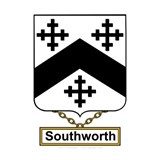
Southworth Coat of Arms

Plimouth Colony
My 9th great-grandmother was born and died in Plymouth Colony. She married Joseph Howland, who was also born in Plymouth.
Joseph Howland [Parents] was born about 1637 in Plymouth, Mass.. He died in Jan
1703 in Plymouth, Mass.. He married Elizabeth Southworth on 7 Dec 1664 in
Plymouth, Ma..
  NOTE: Hubert Kinney Shaw, Families Of The Pilgrims; ; Massachusetts Society of
  Mayflower Descendants; pg. 6; ;
  MARRIAGE:Hubert Kinney Shaw, Families Of The Pilgrims; ; Massachusetts
  Society of Mayflower Descendants; pg. 6; ;
Elizabeth Southworth [Parents] was born in 1645. She died in Mar 1717 in
Plymouth, Ma.. She married Joseph Howland on 7 Dec 1664 in Plymouth, Ma..
  NOTE: Hubert Kinney Shaw, Families Of The Pilgrims; ; Massachusetts Society of
  Mayflower Descendants; pg. 6; ;
  MARRIAGE:Hubert Kinney Shaw, Families Of The Pilgrims; ; Massachusetts
  Society of Mayflower Descendants; pg. 6; ;
They had the following children:
         MiThomas Howland
         MiiJames Howland
         FiiiSarah Howland was born in 1673 in Plymouth, Ma.. She died on 23 Dec
        1703 in Plymouth, Ma..
         FivLydia Howland
         FvElizabeth Howland
         FviMercy Howland
         MviiNathaniel Howland
         MviiiBenjamin Howland was born on 7 Sep 1689 in Plymouth, Ma.. He died
        on 7 Sep 1689 in Plymouth, Ma..
         MixJoseph Howland was born on 8 Jul 1689 in Barnstable, Ma.. He died on
        8 Jul 1689 in Barnstable, Ma..
         FxMary Howland
         FxiElizabeth Howland was born in 1665 in Plymouth, Ma.. She died on 15
        Feb 1723.
Elizabeth Southworth (1645 – 1716)
is my 9th great grandmother
Elizabeth Howland (1673 – 1724)
daughter of Elizabeth Southworth
Eleazer Hamblin (1699 – 1771)
son of Elizabeth Howland
Sarah Hamblin (1721 – 1814)
daughter of Eleazer Hamblin
Mercy Hazen (1747 – 1819)
daughter of Sarah Hamblin
Martha Mead (1784 – 1860)
daughter of Mercy Hazen
Abner Morse (1808 – 1838)
son of Martha Mead
Daniel Rowland Morse (1838 – 1910)
son of Abner Morse
Jason A Morse (1862 – 1932)
son of Daniel Rowland Morse
Ernest Abner Morse (1890 – 1965)
son of Jason A Morse
Richard Arden Morse (1920 – 2004)
son of Ernest Abner Morse
Pamela Morse
I am the daughter of Richard Arden Morse
We see that she is a progenitor of Teddy Roosevelt, and that her roots are Plantagenetial:
1. Theodore Delano Roosevelt 1882-1945 32nd United States President
2. James Roosevelt 1828-1900
3. Mary Rebecca Aspinwall 1809-1886
4. Susan Howland 1779-1852
5. Joseph Howland 1749-1836
6. Nathaniel Howland 1705-1766
7. Nathaniel Howland 1671-1746
8. Elizabeth Southworth 1645-1717
9. Thomas Southworth 1616-1669
10. Edward Southworth 1590-1621
11. Thomas Southworth 1548-1616
12. Sir John Southworth 1526-1595
13. Margarey Boteler 1500-1546
14. Sir Thomas Boteler 1461-1522
15. Margaret Stanley 1433-1481
16. Joan Goushill 1404-1460
17. Elizabeth Fitzalan 1366-1385
18. Elizabeth De Bohun 1350-1385
19. William De Bohun 1312-1360
20. Elizabeth Plantagenet 1282-1316
21. Edward I Longshanks King of Enlgand, Plantagenet 1239-1397
22. Henry III King of England, Plantagenet 1207-1272
23. John of Lackland King of England, Plantagenet 1167-1216
24. Henry II King of England, Plantagenet 1132-1189
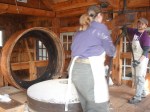
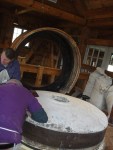

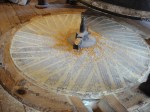


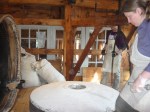


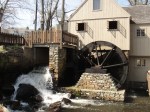
One of the most fascinating displays maintained by Plimouth Plantation is the grist mill. A recent acquisition, the mill grinds corn to show visitors how water powered mills made life possible in the colonies. Because the space is intimate the employees can be very helpful and informative. I learned a lot from my brief visit, and was given some good references to lean more. They employees are very well trained and seem to enjoy working with the visiting public.
 mermaidcamp