mermaidcamp
Keeping current in wellness, in and out of the water
You can scroll the shelf using ← and → keys
You can scroll the shelf using ← and → keys

Glückschwien
The tradition of eating black eyed peas on New Year’s Day is common in the south. Strict traditionalists eat collard greens and pork with the peas (in a dish known as Hoppin’ John)to symbolize wealth, folding money and coins. The use of black eyed peas in a ceremonial meal to assure good fortune and fertility dates back to Sephardic Jews who have eaten them at Rosh Hashanah for centuries. The Sephardic tribes believe that eating symbolic foods like pomegranate, squash, and dates on the new year will usher in good fortune and abundance for the year. The black eyed pea has been cultivated for over 5,000 years. They arrived in America with African slaves and were grown in the new world as food for slaves and animals. Eventually they made it onto the master’s table.
Some say that the symbolic meal eaten on New Year’s Day is the one eaten by emancipated slaves on January 1, 1863. There are many variations on the proper way to serve and eat this fortune enhancing meal. Some say that the peas eaten without pork and greens will backfire and ruin your year. I hope this is not true because I am a nice vegetarian girl who will always skip the pig part. There are other cultures where pigs are symbols good luck and abundance. In Germany a traditional gift of a Glückschwein or marzipan pig is gifted and eaten on the new year to keep the money flowing. Some say this is because a pig roots forward. Some folks think the eating chicken or lobster on New Year’s Day will bring ill fortune due to the fact that these animals scratch or feed going backwards. Why take a chance? If you really feel like lobster or chicken you can wait for January 2nd. Lobsters aren’r kosher anyhow.
There are a few specific beliefs which may take the superstition too far:
I don’t eat the greens or count the beans, but I do like to make Texas caviar for the occasion. My mother was from Texas and this was the dish she used to make. I think she put bacon in it. It is served cold, and does go well with cornbread, another good luck food. Cornbread represents gold. You can choose the tradition that suits your tastebuds and your beliefs. Just skip the chicken and lobster for a day, gentle readers. You never know..

Texas Caviar
I am excited about this excellent promotion to share compassionate meals. The idea of going vegan has spread like wildfire for many good reasons. I agree with all the reasons, including the animal cruelty problem, but I still eat some dairy and eggs. Many folks are trying it for weight loss and finding it to be effective for that purpose. Once they embark on a meatless diet they feel lighter and usually are cured of a few chronic healthy issues.
I personally know how very unpopular it is to tell other people what to eat. Nobody wants to hear someone else control their diet unless they have paid a nutritionalist to do so. It is my opinion that the best way to convert the meat eaters to my way of thinking is to introduce them to foods that are delicious and easy to prepare. If they like the way it tastes they will be motivated to make it and eat it frequently. If it does not suit their tastebuds it will be difficult to stay on any prescribed eating regime. I never try to change anyone’s food choices, but do work on expanding them. I relate because when I became a vegetarian at the age of 19 my own diet was “American teen” minus the meat. I ate fries, potato chips, Dr Pepper, biscuits, bread, hush puppies, and a few vegetables. I did like spinach, but my palette was very immature and limited. It was a nutritional nightmare, but I learned to prepare a wider variety of dishes, and my horizons expanded. I think we can all benefit from learning to make healthy foods, and try new ones available on the market. I like ethnic restaurants a lot for this purpose. If I find something good I knock it off at home.
I like this challenge out of all the bazillion challenges being thrown down at the end of the year because it is about sharing. The sharing is intended to convert, but it starts as sharing. When I invite friends out to eat I choose places with good vegetarian food that I really like, for obvious reasons. This often results in new discoveries for my dining companions whether they order a vegetarian meal or not. They see what I order and how much bang one gets for a buck compared to a meat based cuisine.
I plan to participate in this challenge often because I will also learn from the other participants. If you have any resolutions or aspirations to lean into a more vegan style of eating this is an excellent way to find out how to do it. It is probably easier and tastier than you might imagine. You can follow the action on twitter at CompassionateMeals or search using the hashtag #compassionatemeal to find out what others are eating and sharing. Like #MeatlessMonday, it will have an endless treat of good ideas and recipes, no doubt. Get behind this delicious campaign, gentle readers.

spring rolls to share

Bryshnikov speaks
I was at the Metropolitan Opera on the 4th of July, 1986, the day after Misha became an American citizen. He danced in the ballet Giselle, and leapt into the air with what appeared to be the greatest of ease, but was the result of a lifetime of training. He was young and stunningly talented. American Ballet Theater gave the people an outstanding show, starring the rock star, movie star, ballet star who came to us as a gift from Russia “with love”. The crowd went wild and threw hundreds of roses while giving a standing ovation after the performance. The audience showed how deeply his presence, and now his citizenship, was appreciated in New York. It was an exquisite moment in history to witness. He made his stage debut at the Mariinsky Theatre in 1967, featuring in a production of Giselle. He was born in Riga, present day Latvia. He was trained in ballet in Riga and St. Petersburg in his youth. He defected from the Soviet Union in 1974 after a performance of the Kirov Ballet in Toronto. He moved to New York and became the director of American Ballet Theater.
I was also lucky enough to see him on stage in Paris in the 1990’s when he was dancing to his own choreography in the White Oak Project. His leaping had been somewhat subdued, but he chose younger dancers for his company who could still hit the very high leaps. His own style had only mellowed and perfected itself then dancing his own creations. He has performed around the world with many different troupes. His talents and achievements are legendary. His training by and defection from the former Soviet Union made his gift even sweeter. Now his birth land of Latvia is voting to confer Latvian citizenship on their famous son. He has applied for it and the parliament is scheduled to take it under consideration. It would be ironic and odd if he were to need to defect to Latvia once his dual citizenship has been conferred.
Last week it was Prince Charles of the British monarchy warning us that he feels a 1930’s vibe. Now Misha tells us he is feeling a cold war. We should take heed, gentle readers. Experience and history are talking to us.
The Latin phrase a posteriori refers to the process of inductive reasoning. It means “from what comes after” or a proposition based on experience. A close relative, also used in philosophical arguments, is a priori, which is knowledge based on previous understanding of the concept. It means literally from what comes before. A priori can be a mathematical equation, or any other agreed upon fact deriving from the agreement. It would be correct to call the statement “It is cloudy outside.” a posteriori because I looked outside and can see the fact that it is cloudy now. The statement, “Cumulous clouds are the harbinger of rain.” is an assumption based on scientific agreement, and therefore is a priori. We agree on the definition of cumulous clouds without the need to experience them directly. “That bow is red” is another a priori belief. We all have agreed on what red is (except the colorblind).
A posteriori is based on empirical evidence, direct contact with the facts. A priori is based on logic previously accepted as sound. On the surface it might seem that a posteriori is the only valid way to defend a position. I have learned from my studies of ancestry and history that both methods can fail miserably. My grandmother thought she knew her birth year, but there was no certificate. Later in life she forgot, and then nobody really knew, or bothered to look it up because it did not matter. She had no way to remember her own birth, so her a priori birthday was a year off the real date. Many “facts” in records from the past have been recorded incorrectly. Census records that list step mothers as natural parents, step children as children, and other errors can throw a wrench in the works for investigators trying to follow a lineage.
Be careful, gentle reader. Logic and truth are tricky subjects. Check your logic, and double-check your data before you make any big conclusions. Caveat emptor.

red
My 9th great-grandfather was a baker who arrived in Connecticut in 1638. He was an original settler in that colony. He landed in Massachusetts then moved to New Haven. He signed the New Haven Plantation Covenant on June 4, 1639.
“The Story of the Early Settlers of Stamford, Connecticut, 1641 – 1700” by Jeanne Majdalany (including genealogies comp. with Edith M. Wicks), page 152: “Peter Brown was born 1610, died 1658, married 1 Elizabeth Smith(d1657); m2 1658 Unice/Unica Buxton…Peter Brown was of Concord, MA in 1632 and of New Haven in 1639 where he was a baker. In 1647 he was in Stamford. He probably was a brother of Francis. He lived on the west side of “River Street”.

Brown Coat of Arms
Peter Brown (1610 – 1658)
9th great-grandfather
Deliverance Brown (1656 – 1727)
son of Peter Brown
Rachel Brown (1700 – 1716)
daughter of Deliverance Brown
Mary Mead (1724 – 1787)
daughter of Rachel Brown
Abner Mead (1749 – 1810)
son of Mary Mead
Martha Mead (1784 – 1860)
daughter of Abner Mead
Abner Morse (1808 – 1838)
son of Martha Mead
Daniel Rowland Morse (1838 – 1910)
son of Abner Morse
Jason A Morse (1862 – 1932)
son of Daniel Rowland Morse
Ernest Abner Morse (1890 – 1965)
son of Jason A Morse
Richard Arden Morse (1920 – 2004)
son of Ernest Abner Morse
Pamela Morse
You are the daughter of Richard Arden Morse
Peter Brown was one of the Governor Theophilus Eaton and Rev. John Davenport Company, that made a settlement at New Haven in the spring of 1638. This company was partly from the City of London, where Rev. John Davenport had been a celebrated minister, and partly from the counties of York, Hertford, Kent, Surry and Sussex, and sailed from London, England, in the ship Hector, which arrived at Boston on the twenty-sixth day of June, 1637. Peter Brown signed the compact appertaining to the government of the New Haven Colony, in 1639. He sold out in 1647, and removed to Stamford, Connecticut, where his wife, Elizabeth, died Sept. 21, 1657, and his son, Ebenezer, Aug. 19, 1658. He married again at Stamford, May 25, 1658, Unity, widow of Clement Buxton, and died there Aug. 22, 1658. His widow afterwards married, March 9, 1659, Nicholas Knapp.
From the book One Life at a Time: A New World Narrative by R. Thomas Collins, Joseph Wood
Peter Brown was born 1610 in Hastings, England. A baker, Peter was a member of the immigrant company organized by London merchant Theophilus Eaton and the Puritan divine, Rev. John Davenport. Peter Brown was one of the signatories of the New Haven Plantation Covenant on June 4, 1639.
Peter Brown was one of the many townsmen to seek opportunity elsewhere after the failure of the Great Shippe. In 1647, Peter moved to Stamford. Peter, who died in 1648, and his first wife had at least one son, Hackaliah (#51). Peter’s second wife, Unity, widowed, later married Nicholas Knapp (#2) in Stamford.

There are many more gastronomically interesting options available at Christmas time, but I’m still always drawn to the reassuringly traditional sage and onion stuffing. Nowadays, in addition to stuffing poultry, sage is most commonly used to flavour other meat dishes (particularly sausages in British cuisine). However, its scientific name, Salvia officinalis, shows its heritage as a […]
via #AdventBotany – Getting stuffed at Christmas: Sage — Herbology Manchester

Veridis Duchess Austria Visconti
My 17th great-grandmother was born into a noble family in trouble with the papacy. Veridis ( sometimes spelled Viridis) was born in Milan in 1352. Her father was excommunicated 1363 for opposing the Pope in Rome. She is buried at the Cistercian monastery in Sittich ,Obcina, Ljubljana, in modern and Slovenia. Her husband, the duke, died in Lucerne Switzerland, leaving her a widow at the age of 34.

Veridis Duchess Austria Visconti
Veridis Duchess Austria Visconti (1352 – 1414)
17th great-grandmother
Ernst I “Ironside” Archduke of Austria Habsburg (1377 – 1424)
son of Veridis Duchess Austria Visconti
Katharina Archduchess Austria Von Habsburg (1420 – 1493)
daughter of Ernst I “Ironside” Archduke of Austria Habsburg
Christof I VanBaden (1453 – 1527)
son of Katharina Archduchess Austria Von Habsburg
Beatrix Zahringen (1492 – 1535)
daughter of Christof I VanBaden
Sabine Grafin VonSimmern (1528 – 1578)
daughter of Beatrix Zahringen
Marie L Egmond (1564 – 1678)
daughter of Sabine Grafin VonSimmern
Richard Sears (1590 – 1676)
son of Marie L Egmond
Silas Sears (1638 – 1697)
son of Richard Sears
Silas Sears (1661 – 1732)
son of Silas Sears
Sarah Sears (1697 – 1785)
daughter of Silas Sears
Sarah Hamblin (1721 – 1814)
daughter of Sarah Sears
Mercy Hazen (1747 – 1819)
daughter of Sarah Hamblin
Martha Mead (1784 – 1860)
daughter of Mercy Hazen
Abner Morse (1808 – 1838)
son of Martha Mead
Daniel Rowland Morse (1838 – 1910)
son of Abner Morse
Jason A Morse (1862 – 1932)
son of Daniel Rowland Morse
Ernest Abner Morse (1890 – 1965)
son of Jason A Morse
Richard Arden Morse (1920 – 2004)
son of Ernest Abner Morse
Pamela Morse
You are the daughter of Richard Arden Morse
Viridis Visconti (1352–1414) was an Italian noblewoman, a daughter of Bernabò Visconti and his wife Beatrice Regina della Scala. By her marriage to Leopold III, Duke of Austria, Viridis was Duchess consort of Austria, Styria and Carinthia, she was also Countess consort of Tyrol.
Viridis was born in Milan, Italy and was the second of seventeen children.
Her sister, Taddea Visconti married Stephen III, Duke of Bavaria and was mother of Isabeau of Bavaria, wife of Charles VI of France. Viridis and the rest of her sisters secured politically-advantageous marriages.
Her maternal grandparents were Mastino II della Scala and his wife Taddea da Carrara. Her paternal grandparents were Stefano Visconti and his wife Valentina Doria.
Viridis’ father, Bernabò was described as a cruel and ruthless despot. He was also an implacable enemy of the Church. He seized the papal city of Bologna, rejected the Pope and his authority, confiscated ecclesiastical property, and forbade any of his subjects to have any dealings with the Curia. He was excommunicated as a heretic in 1363 by Pope Urban V, who preached crusade against him. When Bernabò was in one of his frequent rages, only the children’s mother, Beatrice Regina was able to approach him.
Viridis married Leopold III, Duke of Austria, son of Albert II, Duke of Austria and his wife Johanna of Pfirt. The couple had six children:
William
Leopold
Ernest the Iron
Frederick
Elisabeth (1378–1392)
Katharina (1385–?) Abbess of St. Klara in Vienna
Viridis was widowed in 1386 and so their eldest son, William became Duke of Austria.
William was engaged to Jadwiga of Hungary, youngest daughter of the neighboring king, was one of the first attempts of the House of Habsburg to extend their sphere of influence in Eastern Central Europe by marrying heiresses, a practice that gave rise to the phrase Bella gerant alii: tu felix Austria nube (Let others make war: thou happy Austria, marry). The wedding was broken off.
Viridis died in 1 March 1414 and out-lived at least three of six children, since her younger daughter, Katherine’s date of death is unknown. Viridis is buried in Sittich in Lower Carniola.
Source, Wikipedia
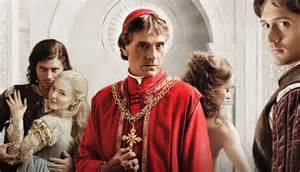
The Borgias
The Latin phrase qui bono means as benefit to whom? In legal cases it is used to determine who might be responsible for criminal acts. I have been watching the series on Showtime, The Borgias, an accurate portrayal of the family and history of Italy. The key figure in the drama is Rodrigo Borgia, who reigned as Pope of Rome Alexander VI. He was Pope from 11 August 1492 until his death on 18 August 1503. He was a highly controversial figure who ruled the Roman Catholic Church with an iron fist and very little respect for church doctrine. His personal excesses were epic, and his bastard children were all lavished with money and power.
The politics of Italy were complex and treacherous, with the Vatican serving as king maker and power broker. Alliances and secret plots were rampant. They Borgias made enemies of many of the families, the most prominent of which was the Sforza clan. First the Pope’s daughter Lucrezia is wed to a Sforza, but obtains annulment from her father a few months into the marriage. Her husband is later murdered by her brother Cesare. Castles are placed under siege and bloody battles are fought between the Sforzas and the papal army. Intrigue inside and outside the Vatican was rampant. The Borgias were known to be masters of the art of lethal poison. A plot nearly succeeds to kill Rodrigo with a glass of wine, but his daughter administers charcoal and saves his life. It was a wild game of liar’s poker.
As I watch the crazy politics unfold in 15th Century Rome and the church I can’t help but be reminded of present day politics. Spies, traitors and terrorists determined the outcome of Borgia power struggles. It appears we are wrapped in a double or triple plot in real time with much subterfuge and mystery clouding our election results. When enemies of enemies betray friends we need to ask a basic question: “Who benefits from this?” This concept was alive in ancient Rome because it points to the cause rather than to the red herrings intended to confuse.
If 400 pound hackers, of Russian or other origin, can change the election results in the United States the question is “Qui bono?” What do you think, gentle reader?

Qui bono

Kirk Douglas
Kirk Douglas celebrates his 100th birthday today. He is not only a piece of cinema history, but has portrayed historical roles, the most famous of which was Spartacus. He wrote a warning recently to the American people. He shared the wisdom of his perspective as a boy who joined the navy after Pearl Harbor to fight. He is married to a woman who was born in Belgium. They have both been shocked by the rhetoric of the recent election and the resulting prevailing unrest and distrust. They have direct experience with the dangers of extremism and hate based politics. He opposed the Hollywood blacklists, and lived to tell about it.
I urge you to read his entire statement. Here is an excerpt to tempt you to do so:
“Until now, I believed I had finally seen everything under the sun. But this was the kind of fear-mongering I have never before witnessed from a major U.S. presidential candidate in my lifetime.
I have lived a long, good life. I will not be here to see the consequences if this evil takes root in our country. But your children and mine will be. And their children. And their children’s children.
All of us still yearn to remain free. It is what we stand for as a country. I have always been deeply proud to be an American. In the time I have left, I pray that will never change. In our democracy, the decision to remain free is ours to make.
My 100th birthday is exactly one month and one day after the next presidential election. I’d like to celebrate it by blowing out the candles on my cake, then whistling “Happy Days Are Here Again.”
As my beloved friend Lauren Bacall once said, “You know how to whistle don’t you? You just put your lips together and blow.”
I wish Kirk and his friends a very festive day. His doctor promised him a shot of vodka if he made it to 100 years. He plans to take the offer at an afternoon party for 150 or so of his closest friends. Cheers to a happy birthday! Twitter is all a twee with #IamSpartacus today in tribute.

movie star

memorial
My 8th great-grandfather was born in Virginia Colony in 1643. His parents were both killed in the Jamestown Massacre when he was an infant.
Godfrey Ragsdale I was the first generation emigrant to America. He came sometime before 1641. He and his wife were killed in an Indian massacre on April 18, 1644. Their baby, Godfrey II, was spared. He evidently came at his own expense with intent to inhabit the land, for no grant has been found to him, but there is a record of a purchase of 300 acres of land by deed from John Butler, 25 Feb 1642. This land lay on the north side of the Appomatox River in Henrico Co. Virginia. Source: “Godfrey Ragsdale From England to Henrico Co. Virginia” by Caroline Nabors Skelton; 1969; and Henrico Co. Records; Bk. 6; p. 21.
Godfrey Ragsdale II (1643 – 1703)
8th great-grandfather
Ann Wragsdale (1659 – 1724)
daughter of Godfrey Ragsdale II
Benjamin Abraham Vesser (1740 – 1779)
son of Ann Wragsdale
Samuel Harris Vassar (1757 – 1846)
son of Benjamin Abraham Vesser
Mary Vessor (1801 – 1836)
daughter of Samuel Harris Vassar
Margaret Mathews (1831 – 1867)
daughter of Mary Vessor
Julia McConnell (1854 – 1879)
daughter of Margaret Mathews
Minnie M Smith (1872 – 1893)
daughter of Julia McConnell
Ernest Abner Morse (1890 – 1965)
son of Minnie M Smith
Richard Arden Morse (1920 – 2004)
son of Ernest Abner Morse
Pamela Morse
I am the daughter of Richard Arden Morse
The Ragsdale family name is said to come from Ragdale, England, meaning either “valley at the pass” or “dweller in the valley where the lichen grows.” Henry Ragsdale was born in Leicestershire, England about 1450, his son Robert was born about 1485 in Ragsdale, Leicestershire, England. He died about 1559 and some of his children were Henry, Thomas R. and John R. Henry was born about 1510; he married Elizabeth Oglethorpe about 1532 , and their children were William, Dorothy, Elizabeth, Margaret, Owen and Catherine. Henry died in 1559. William was born in 1575; he married a woman named Heathcote, about 1615; they had a son, Godfrey I, who married Lady Mary Cookney and they both came to America.
Godfrey Ragsdale I and his wife, Lady Mary Cookney arrived in Virginia some time late in the summer of 1638. They were some of the first Ragsdales to come to America. Godfrey Ragsdale I ands his wife, Lady Mary Cookney lived in Henrico County Virginia on a 300 acre plantation on February 25, 1642, upon the north side of the Appomattox River.
On April 18, 1644 afterwards known as “Opechancanough Day” the Pamunkee Indians and several tribes in the Indian Federation went on a rampage. There was a carnage that was greater than the one in the Norfolk area in 1622. The Indians slaughtered no less than 500 Englishman. This massacre fell almost entirely upon the frontier Counties at the head of the great rivers, and upon the plantations on the south side of the James River. Both Godfrey I and his wife Lady Mary were killed and scalped.
From documents we know that Godfrey and Lady Mary had a son named Godfrey Ragsdale II, who was born in 1644. Because his mother and father had been killed in the “Jamestown Massacre”, Godfrey II’s next door neighbors raised him and later became his in-laws. Historians say that most Ragsdales in America came from Godfrey II.

Ragsdales in Virginia
 mermaidcamp