mermaidcamp
Keeping current in wellness, in and out of the water
You can scroll the shelf using ← and → keys
You can scroll the shelf using ← and → keys

Saturn
The Roman god of agriculture, Saturn, rules Saturday. This is the only day that retains the original Latin in the English name today. For many it is a day of rest, and for some it has religious context. The golden age on earth which is celebrated at Saturnalia was a time when Cronos, the Greek Titan, escaped and ruled from Rome for a time. Cronos ate his own children, and was eventually defeated and expelled from Olympus by his son Zeus. Saturn and Cronos represent the same energy, and modern father time is symbolic of both of them. He frequently has a sickle in his left hand and wheat in his right to show his mastery of planting and harvest. He is said to have brought a golden age to Italy by showing the previously wild population how to grow food.
The holiday Saturnalia began 17 December and lasted for a week. All businesses were closed and slaves were served by the masters during this symbolic restoration of the Alchemy of Consciousness, the golden age. Good will and gifting, banquets and gatherings, all resembled the December festivities of now. Saturn is the judge as well as the treasurer. Saturn bestows wealth and has the ability to dissolve social hierarchy. His powers pertain to limitations. Time is a seriously limiting force, and Saturn reminds us of that fact. When Saturday rolls around every week we are another week older, and accounting is in order for all of us. What have we grown this week? What will be the harvest?
Saturn wants us to build on success with full awareness of all of our limitations.
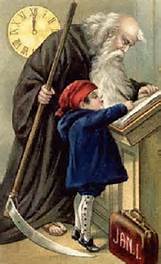
father time

Third Haven Meeting House
My 9th great-grandfather sailed to America with his parents in 1685. His family may have been fleeing religious persecution, common for Quakers in England. He seems to have prospered in his new home in Maryland.
Jeffrey was called a planter as were most of the early English immigrants; they were here to plant a new nation. Jeffrey and Elizabeth were in Easton, Maryland in 1685, and were of the Nicholite pursuasion (sometimes called Quakers or reffered to as Friends.) Jeffrey Horney assisted in Erecting the Friends Meeting House in 1685, the Third Haven Friends Meeting.
Jeffrey owned land in Kent (now Queen Anns) Co., Maryland on the north side of Chester River and on the west side of Unicorn Branch of Willmore’s Fork, which was called “Dixon’s Gift.” A tract of 900 acres known as “cottingham” was purchased from Isaac Abrams 20 Nov 1712. Other Maryland land records show him with 200 acres, “the Freshes”, surveyed 15 May 1681. Talbot Co. records show “… the provisiions for workmen to be pressed at Jeffrey Horney’s July 25, 1685.”
Jeffrey Horney (1675 – 1738)
is my 9th great-grandfather
Jeffrey Horney (1723 – 1779)
son of Jeffrey Horney
Mary Horney (1741 – 1775)
daughter of Jeffrey Horney
Esther Harris (1764 – 1838)
daughter of Mary Horney
John H Wright (1803 – 1850)
son of Esther Harris
Mary Wright (1816 – 1873)
daughter of John H Wright
Emiline P Nicholls (1837 – )
daughter of Mary Wright
Harriet Peterson (1856 – 1933)
daughter of Emiline P Nicholls
Sarah Helena Byrne (1878 – 1962)
daughter of Harriet Peterson
Olga Fern Scott (1897 – 1968)
daughter of Sarah Helena Byrne
Richard Arden Morse (1920 – 2004)
son of Olga Fern Scott
Pamela Morse
I am the daughter of Richard Arden Morse
Jeffrey Horney I was born. circa 1675, in England. He was the son of Geoffrey Horney and Juliana . Jeffrey Horney I emigrated in 1685 from England. He married Elizabeth Harwood, daughter of Elizabeth Garey, circa 1696 at Talbot, Maryland. Jeffrey Horney I died before 27 March 1738 at Talbot, Maryland.8
Family
Elizabeth Harwood b. c 1680, d. b Jan 1737/38
Children
William Horney b. 1718
Jeffery Horney II+ b. 1720, d. b 8 Jun 1779
Phillip Horney b. c 1723
James Horney b. c 1725
Prisillia Horney b. c 1726
Jane Horney b. c 1728
Liddy Horney b. c 1728
Ann Horney b. c 1729
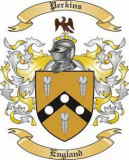
Perkins COA
My 10th great-grandmother was born in England and died in Massachusetts. She sailed to the new world with her parents and settled in Ipswich. She probably met her husband there. They moved to Newbury and then to Amesbury, MA, where they laid down some very litigious history in the records of the courts of that town. It seems her husband was the more litigious of the two, but I am grateful for the records, so we know something about them today.
Elizabeth came to America with her family aboard the Lyon, William Pierce, master on 1 December 1630 for its first trip to the New World. They embarked in Bristol, England and arrived in Nantasket, Suffolk co., MA on 5 February 1631.
The Sargent family were some of the original settlers of the Agawam section of Ipswich, Essex co., MA, with William receiving 12 acres in the 1634 Ipswich Land Grant. The family later moved to Newbury, Essex co., MA; Hampton, Rockingham co., NH; Salisbury, Essex co., MA and finally Amesbury, Essex co., MA. Remember that NH & ME were all part of MA at the time. The family moved from Newbury to Hampton because “…’Willli[am] Sergant’ was amongst the list of petitioners mostly Newbury men who were headed by Stephen Bachiler, who were on 6 September 1638 granted ‘liberty to begin a plantation at Winnacunnet [what is now Hampton, Rockingham co., NH]..” And “Will[iam] Sargent” is listed as one of the married men in the list of first comers to Hampton.
The Sargents found themselves in court over disputes with their neighbors on many occasions. Given the fact that this pattern of contentiousness continued after Eliabeth’s death, I contend that William was the fractious party in the area. On 26 December 1643, William “Sargeant” sued Mr. William Hook of Salisbury for 56s. in corn[67,68]. William acknowledged the court’s judgment in favor of Mr. Jonathan Wade on 26 September 1648. Michael Spencer sued him for detaining corn and other goods on 2 January 1650.
But the biggest battles were reserved for their near neighbors, the Martins. Either William or his namesake son was sued for slander on 13 April 1669, because the Sargent in question had called Martin’s wife “a witch”. The bad blood transcended generations, for Martin later sued William’s son Thomas Sargent “…for saying that his son George Martin was a bastard and that Richard Martin was Goodwife Martin’s imp…”
In 1672, William Sargent and Joanna his second wife sued Christopher Osgood for debt due part of the estate of Joanna’s late husband, Valentine Rowell. However, Joanna was curiously not mentioned in his will, although she had married him a few months earlier. To contemporary credible researchers, this strongly suggests that there was a pre-nuptial agreement between them which left Joanna nothing.
Elizabeth Judith Perkins (1611 – 1670)
is my 10th great-grandmother
Mary Sargent (1634 – 1716)
daughter of Elizabeth Judith Perkins
John Challis (1655 – 1741)
son of Mary Sargent
Mary Challis (1699 – 1739)
daughter of John Challis
Amos Nicholls (1740 – )
son of Mary Challis
Amos Nicholls (1780 – )
son of Amos Nicholls
Amos Nicholls (1808 – 1868)
son of Amos Nicholls
Emiline P Nicholls (1837 – )
daughter of Amos Nicholls
Harriet Peterson (1856 – 1933)
daughter of Emiline P Nicholls
Sarah Helena Byrne (1878 – 1962)
daughter of Harriet Peterson
Olga Fern Scott (1897 – 1968)
daughter of Sarah Helena Byrne
Richard Arden Morse (1920 – 2004)
son of Olga Fern Scott
Pamela Morse
I am the daughter of Richard Arden Morse
Elizabeth PERKINS was christened/baptized on 3 MAR 1611 in Hillmorton, Warwickshire, England. She immigrated on 1 DEC 1630 from England to America. She died on 18 SEP 1670 at Amesbury, Essex County, Massachusetts. She has Ancestral File Number 7TTF-7J. Elizabeth’s father came from England in the ship “Lyon” with Roger Williams, in 1631; lived in Boston two years; settled in Ipswich in 1633;
Sailed on the “LYON”, William Peirce, Master, from Bristol December 1, 1630, and arrived February 5, 1631, with about twenty passengers and two hundred tons of goods.
SOURCE: 1. Ancestral File (TM), data as of 2 January 1996, Family History Library, 35 North West Temple, Salt Lake City, Utah 84150
2. Perkins Family in Ye Olden Times. p 78-79 (B11C27)
3. Old Families of Salisbury & Amesbury, Mass by Hoyt, p 281 (Mass S&)
4. Dawes & Allied Families by Mary Walton Ferre, p 484-85 (B12F12)
5. Planters of the Commonwealth, Charles E. Banks 1930
6. Hoyt’s “Old Families of Salisbury and Amesbury” page 281/282 (John Perkins #12)

questions answered

paleo snacks

bone broth explained

kraut fans

kraut fans
My latest craze is making sauerkraut. I discovered Garden Goddess Ferments products at a farmer’s market in Scottsdale a couple of weeks ago. We returned to Phoenix the following weekend to buy more sauerkraut and attend a workshop about making fermented foods. Suzette Smith of Garden Goddess Ferments organized an expo with break out learning sessions at the Office Pile. The space was perfect for the event, and many interested patrons turned out to learn more about eating healthy food. Healthy snacks, bone broth, personal chef services, and health coaching tables greeted guests, and classes were held both upstairs and in a conference room.
The fermented food class Suzette taught was so basic, simple, and informative that anyone could leave and go make kraut after attending. She told us about the benefits of the natural probiotic cultures and how she created her own delicious line of small batch artisanal krauts which she sells to the public. She also has for sale hand made crocks and cabbage shredders for the home fermenter. She forgot to bring the tool with which she had planned to mash the cabbage, so while she gave her informative lecture she pounded the cabbage with her fist until it yielded enough liquid to submerge itself. It really drove home the primitive, and as Suzette stressed in the class, forgiving nature of this process. If you have a glass or stainless steel vessel, a cabbage, a small amount of salt and a fist you can preserve food like our ancient ancestors. The mixture was rubbing up immediately, demonstrating the basic chemistry involved. This is the most natural way to preserve food and keep it alive.
It is so simple I can’t believe we are not all doing it all the time. I am hooked. I had both succeeded and failed in the past with large batch kraut in a ceramic crock. After seeing the class I understood that I had used too much salt and left it in the crock too long. Other students reported the same thing. This is what we got for following directions. This is one of those hands on experiences, like bread baking, that can be best learned by personal observation. Suzette is enthusiastic about the healthy possibilities and has developed a range of zesty flavorful krauts containing very healthy ingredients such as ginger, garlic and turmeric. The difference between her products and commercial krauts is the living probiotic culture present in the home made version. Bubbbie’s is the only live sauerkraut I know on the market, but she does not have anything like the range of flavors Garden Goddess offers. Suzette also creates seasonal varietals. Right now at home I have Kowboy Kraut, finished with cumin, Kristmas Kraut with some apple and my favorite, Power Kraut, made with red cabbage, garlic, ginger, and turmeric. She is constantly creating new and exciting combinations. If you live in the Phoenix area I urge you to run right out and buy some Garden Goddess kraut. Your digestion will thank you for it.
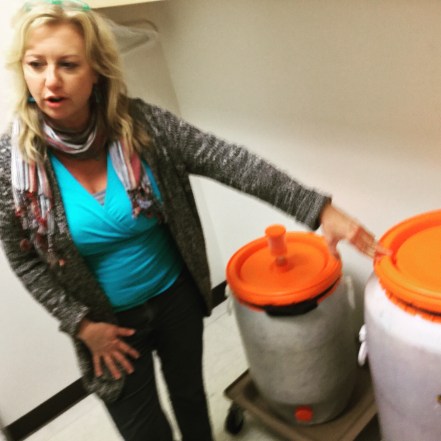
Suzette in her kitchen
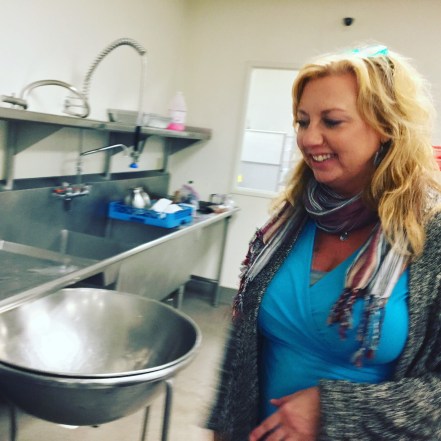
Suzette in her kitchen

The Garden Goddess

St. David’s Church, Radnor, Pa.
My 8th great grandfather was born in Wales and died in Maryland. He came to Pennsylvania on a mission for the Anglican church. He wrote his own epitaph in Latin which is telling about his beliefs. He was harsh on himself.
Rev. Henry Nicholls, B.A., 1703 & M.A., 1715, Jesus College, Oxford, Wales. He was sent to Pennsylvania, 1702-1708, during the reign of King James II. He ministered at Chester, Pennsylvania. The Chester Church is described as of good brick fabric, one of the neatest on the continent, furnished with handsome furniture and pews. He also served St. David’s Church, Radnor, Pa. and at Concord and Montgomery, Pa. Later, he was transferred to St. Michael’s Parish, Talbot Co., Maryland where he served, 1708-1749, (41 years).
From William King and Virginia Watkins – Their Ancestors and Descendents compiled by Maellen King Ford
Henry Nichols was the first residential missionary to Pennsylvania for the “Society for Propagation of the Gospel in Foreign Parts“, arriving in 1703. His churches were located in Chester, Concord, Radnor, and Montgomery. The members were regular and constant in divine worship, and they contributed 60 pounds a year toward their pastor’s support. The Radnor Church is still in excellent preservation, known as St. David’s Church and has been in use since 1708. Rev Nichols requested a transfer in 1708 and became rector at St. Michael’s Parish Church. Talbot Co., MD – a post he occupied until his death. For years, all records of his life were lost. The early church books had disappeared! Until June 1878 when workmen, employed to demolish the old church building, found his tomb under the Chancel in good preservation.
The following is a translation of the Latin inscription found on the slab over his tomb: “Here lies the remains of Henry Nicols, M. A., formerly a Fellow of Jesus College, Oxford, England, and a pastor of this church for 41 years – most unworthy. Born April 1st, 1678; died Feb. 12, 1748. Save his soul, O Christ for Thy own merits. Tread upon salt without savor.” (Henry has ordered these works to be inscribed before his death.) A number of his descendents still worship at St. Michael’s Church. They placed a tablet there to his memory where he ministered for so long. (From the Historical Magazine of the Protestant Episcopal Church, 1943, by Mary Clement, M. A., Principal of the Girls County School Board, Bridgend, Glamorganshire, Wales.)
Rev. Henry Nichols (1678 – 1748)
is my 8th great grandfather
William Nicholls (1709 – 1776)
son of Rev. Henry Nichols
Amos Nicholls (1740 – )
son of William Nicholls
Amos Nicholls (1780 – )
son of Amos Nicholls
Amos Nicholls (1808 – 1868)
son of Amos Nicholls
Emiline P Nicholls (1837 – )
daughter of Amos Nicholls
Harriet Peterson (1856 – 1933)
daughter of Emiline P Nicholls
Sarah Helena Byrne (1878 – 1962)
daughter of Harriet Peterson
Olga Fern Scott (1897 – 1968)
daughter of Sarah Helena Byrne
Richard Arden Morse (1920 – 2004)
son of Olga Fern Scott
Pamela Morse
I am the daughter of Richard Arden Morse
“That until the philosophy which holds one race superior and another inferior is finally and permanently discredited and abandoned: That until there are no longer first-class and second class citizens of any nation; That until the color of a man’s skin is of no more significance than the color of his eyes; That until the basic human rights are equally guaranteed to all without regard to race; That until that day, the dream of lasting peace and world citizenship and the rule of international morality will remain but a fleeting illusion, to be pursued but never attained; And until the ignoble and unhappy regimes that hold our brothers in Angola, in Mozambique and in South Africa in subhuman bondage have been toppled and destroyed; Until bigotry and prejudice and malicious and inhuman self-interest have been replaced by understanding and tolerance and good-will; Until all Africans stand and speak as free beings, equal in the eyes of all men, as they are in the eyes of Heaven; Until that day, the African continent will not know peace. We Africans will fight, if necessary, and we know that we shall win, as we are confident in the victory of good over evil.”
Haile Selassie address to United Nations Oct 6, 1963
Many music fans may think that Bob Marley wrote the lyrics to the popular song War. The song was created to immortalize a speech given at the UN in 1963. We are farther from the dream of lasting peace around the world than we were in 1963 because technology has served good and evil with equal measure. Now war moves faster and can potentially do much more damage quickly. I always loved this song and the idea that a tiny man from Africa delivered this truth, eloquence, and enlightenment to the United Nations. It was prophetic.
It has always made me feel uplifted because as I sing along I get louder and more committed as we arrive at the part about the victory of good over evil…right over wrong, yeah. I am one of those who fiercely believes in that victory in the long run. At this time I am having problems envisioning how the good is going to mange this conquest. Most people in history were dragged into war, forced to fight, because it is insane to take these violent risks. The ease with which the youth now is being convinced to start and end a private suicide war shows how far out of control this war/peace balance is. We must find ways to support compassion and fairness on earth because our futures depend on it. Jah, Ras Tafari, gentle reader. Keep the faith, baby.
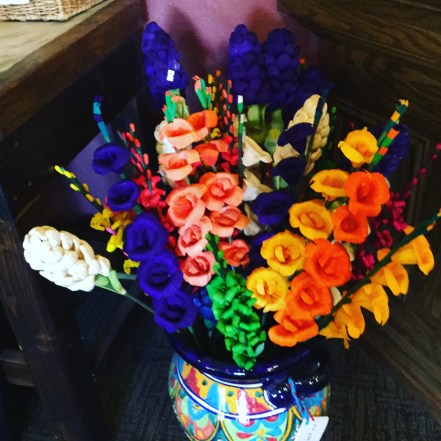
Day of the Dead
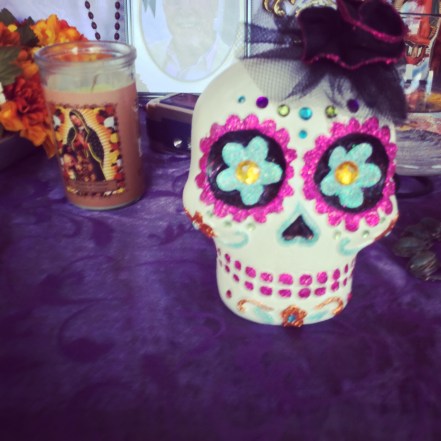
Day of the Dead
Beliefs about death and afterlife vary, but we all share the knowledge that we will die. If you have helped anyone with end of life issues you know each departure is unique. If you are close to anyone who has departed you have had the experience of some eternal bond that is not broken by that exit. Some essential part of your relationship remains and feels alive. I started to study my ancestry after both of my parents were dead. I had a few brief conversations with them about their families in history, but they had little information. My dad said he was Scotch Irish, which is true. My mother thought she was a relative of Zachary Taylor, which does not seem to be a fact. I believe they would have been very fascinated to learn about their ancestors, but maybe now they are one with all our relations.
My dad died in a a hospital setting, but my other died in her own home. She had severe dementia at the end of her life. We had excellent help from hospice for the last months of her existence. The hospice nurses know all about death since it is their specialty. They let us know that it is common to have visitations like my mother did before she passed. Some people have brief encounters but my mother had large crowds of visitors for months. It was clear that she was in touch with other beings, and sometimes we had the sensation of feeling their presence also. They were not ghosts, but were the ones who had come to accompany her across the bridge. She was able to die peacefully in her bed after all the interaction.
This week celebrations mark the remembrance of the dead. As we in the northern hemisphere journey deeper into winter and darkness the departed are free of time. Neither global warming nor the stock market has power over them. They are in an eternal state we will know someday.

Day of the Dead
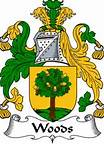
Woods Coat of Arms
My tenth great-grandfather was born Feb. 6, 1610, in England. He died July 10, 1678, Marlborough, MA.
John WOODS, a pin-maker by trade, arrived in America at age 26 in 1635 aboard the ‘Hopewell,’ and first settled at Salem, MA, but removed to Sudbury, MA by 1638, becoming a proprietor there in 1639. He was admitted freeman on May 10, 1642, and received several Sudbury land grants through 1655. After Marlborough was formed in 1660, John sold his property at Sudbury and relocated to Marlborough, where he had been granted land and served in various town offices. On Apr. 4, 1664, he deposed that he was about age 54. His will, dated Nov. 26, 1677 and proved Oct. 1, 1678, names his wife Mary, his three sons, daughter Katherine, son-in-law John BELLOWS, and grandchild Hannah LEVINS. The inventory of his estate, on Jul. 19, 1678 at £303.03.07, mentions son-in-law Joseph NEWTON. Married about 1633.
John Woods (1610 – 1678)
is my 10th great grandfather
John Woods (1641 – 1716)
son of John Woods
Lydia Woods (1672 – 1738)
daughter of John Woods
Lydia Eager (1696 – 1735)
daughter of Lydia Woods
Mary Thomas (1729 – 1801)
daughter of Lydia Eager
Joseph Morse III (1756 – 1835)
son of Mary Thomas
John Henry Morse (1775 – 1864)
son of Joseph Morse III
Abner Morse (1808 – 1838)
son of John Henry Morse
Daniel Rowland Morse (1838 – 1910)
son of Abner Morse
Jason A Morse (1862 – 1932)
son of Daniel Rowland Morse
Ernest Abner Morse (1890 – 1965)
son of Jason A Morse
Richard Arden Morse (1920 – 2004)
son of Ernest Abner Morse
Pamela Morse
I am the daughter of Richard Arden Morse
My 7th great-grandfather was born on May 7, 1667 in Greenwich, Fairfield County,Connecticut and died Feb. 22, 1746 in Greenwich. He is buried in the Old Burying Ground there.

Benjamin Mead was an officer in the local militia and served a term as Surveyor for Fairfield County. Reports of his action in the French and Indian War are misleading, as he died before the Seven Years’ War war started. That said, that global war was only part of an ongoing conflict in Europe from 1689-1763 that had combat ramifications in North America on at least 4 occasions when wars were officially declared. In addition to having names these wars also had numbers under the rubrique of “Intercolonial Wars,” much as we have numbered “World Wars”– since the individual wars had different names in Britain than on the Continent, the numbering system helped keep things (somewhat) straight. Finally, the Intercolonial Wars, as they were called in Europe, were called the French And Indian Wars in North America.
Benjamin Mead was old enough to have fought in any of the first three of these, King William’s War or War of the League of Augsburg (1st Intercolonial) and Queen Anne’s War or War of the Spanish Succession (2nd Intercontinental) being the most likely. So in this sense, any action he saw during those wars makes him a veteran of the French and Indian Wars.
Spouses:
Sarah Waterbury Mead (1677 – 1745)*
Rachel Brown Mead (1680 – ____)*
Children:
Benjamin Mead (1701 – 1783)*
Eliphelet Mead (1704 – 1796)*
Elizabeth Mead Peck (1705 – 1783)*
Keziah Mead Howe (1707 – 1808)*
Obadiah Mead (1719 – 1759)*
Nehemiah Mead (1721 – 1791)*
Hannah Mead Mead (1726 – 1815)*
Siblings:
Ebenezer Mead (1663 – 1728)*
Hannah Mead Scofield (1664 – 1728)*
Jonathan Mead (1665 – 1712)*
Benjamin Daniel Mead (1667 – 1746)
Benjamin Daniel Mead (1667 – 1746)
is my 7th great grandfather
Mary Mead (1724 – 1787)
daughter of Benjamin Daniel Mead
Abner Mead (1749 – 1810)
son of Mary Mead
Martha Mead (1784 – 1860)
daughter of Abner Mead
Abner Morse (1808 – 1838)
son of Martha Mead
Daniel Rowland Morse (1838 – 1910)
son of Abner Morse
Jason A Morse (1862 – 1932)
son of Daniel Rowland Morse
Ernest Abner Morse (1890 – 1965)
son of Jason A Morse
Richard Arden Morse (1920 – 2004)
son of Ernest Abner Morse
Pamela Morse
I am the daughter of Richard Arden Morse
We know what has happened to his house in Greenwich:
Benjamin Mead, the son of John Mead, one of the 15 proprietors, inherited from his father 15 acres of property in Cos Cob in 1696. The will describes the inheritance as “five acres of land at Stickling brock (Strickland Brook) as it is lyd out to mee, and all my lands & meadow lying & and being at that place commonly cauled Coscob, as it is Layd out to mee & ten acres of upland above ye road aded now to ye five”.
In 1697, Benjamin built a house on the land, a two room saltbox with center chimney. A rear lean-to, including a kitchen ell was added in 1732 according to an architectural field study by the Greenwich Historical Society.
Obadiah Mead bought the Bible Street land and house from his father Benjamin Mead in 1746 (1756) for 200 pounds New York money. In that same year Obadiah married Lois Todd daughter of the Reverend Abraham Todd minister of the Second Congregational Society in Greenwich. The couple had 2 daughters, Mary Mead b.Aug 10 1757, d.2/14/1815 and Phoebe. Obadiah died in 1759 while the girls were young.
When the girls came of age the land was divided between them with a Dower lot for their mother. Mary eventually married Michael Cox Timpany b. abt 1755, d. 10/25/1811. Mary eventually inherited her sister and mothers shares to the land.
John Timpany, son of Mary and Michael, bought the house from his mother in 1813. In 1841 he sold the house to 3 of his daughters; Elvira, Hannah and Adelice (Delia) with the provision that they care for him the rest of his life. John died 11/15/1855.
Elvira Moshier never married and held the house until she died in 1880 willing her land to Sarah Ann Moshier Olmstead, wife of Henry Olmstead and the daughter of her sister Lois and James Moshier who were farmers on Cognewaug Road.
Sarahann held on to the house until she died and it was the purchased by her younger brothers Samuel Augustus Moshier, who ran a grocery on Greenwich Avenue, and Franklin Pierce Moshier who ran a livery / stable / early car dealership on Lewis Street.
Sam and Frank held onto the house until the early 1930’s, renting it out to family member (such as John Timpany Moshier who was waked in the Parlor November 1927).
I believe the house left the family due to losses incurred by Franklin and Augustus Moshier with the stock crash of 1929.
Since then the hous has turned over many, many times.
Very recently, a new owner, claiming the house was leaning, renovated the house. It now looks like a “new” old house….
The hedonist archetype is both admired and disrespected in our society. We receive mixed messages about fun, enjoyment, and merchandise. “How much is too much?”, is a question we are in the process of answering. During our holiday season excess is encouraged in all things. We see images of over decorating, over eating, over indulging in sweets and alcohol as mandates to celebrate with certain products. If we give in to the marketing engines we will let our health and finances go in order to buy holiday goods. There is a fine line between genuine appreciation that brings joy and repetitive addictive habits that have flatlined. The solution is not to give up pleasure or fine things in life. To find balance we each need to find our own specific definitions of pleasure. We also need to monitor exactly how much pleasure is still left in long standing habits. We may be fooling ourselves sometimes.
Since I am a hedonist in the first house it is important for me to evaluate and stay aware of the ways in which I indulge myself. I am attached to sensuality and leisure which could easily lead to lack of discernment. In order to stay healthy I must stay clear about how much time, money and effort I spend to feel good. A feeling of wellbeing and good energy is the reward for putting health first. The shadow hedonist is like the cartoon red devil sitting on a shoulder acting as the conscience. This little delusion devil is persuasive. The dark side of hedonism is ironically anhedonia. The pursuit of pleasure to one’s detriment eventually results in a complete inability to experience pleasure. Addictions that require treatment are common now in America. What starts as a good time ends frequently in heartache.
When you think of the hedonist does someone you know come to mind? Do you recognize a hedonist in yourself? Calibrate the Fun-O-Meter to make sure you are still having some.
 mermaidcamp