mermaidcamp
Keeping current in wellness, in and out of the water
You can scroll the shelf using ← and → keys
You can scroll the shelf using ← and → keys
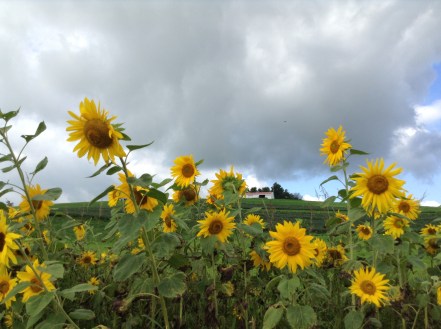
field of sunflowers
Early years fill with nursery rhymes, stories designed to teach
Suspended between fictional characters dialog is made to preach
Current popular opinion, political outrage hidden between the lines
The villain and the hero match wits whilst the wicked witch opines
These morality plays change very little with the passage of time
Forces of good conquer evil and the story is set to rhyme
When you meet a character who comes straight from Mother Goose
You have discovered archetypal imagery that will help you to deduce
If you are the victim or the hero, the popular victor or the slimy creep
We all have parts to play, ego hiding under shadowy cover of sleep

field of sunflowers

NaPoWriMo 2015
The poetry train has almost arrived at the destination…May. Hop aboard for a poetic ride here.
 Ruby and Her Sisters
The Taylor sisters of Humble, Texas met tragedy early in life
Their mother died in childbirth leaving ten children in grief and strife
Their father rode a black horse around the oil field reading gauges
Recording the data from each well in production for very low wages
When their father killed himself at home he was discovered by his son
Who was only 5 years old. The deed could never be undone.
They had no preparation or reserves for this sudden change
Suicide had swept away home and security, memories forever stained
NaPoWriMo 2015
Poetry is the sport of the month in April. Please indulge yourself in all kinds of poetry here.

Thorny issues
The candidates align on left and right with eager well lit faces
Chirping sound bites with sincere well tested spinning phrases
They will sprawl all over the airwaves, call your home and send mail
Proclaiming vague tattered arguments that strike everyone as stale
We will resume campaigns for presidential power through bribery
Lavish spending on election shenanigans supports the corrupt dynasty
To protect yourself from Republicans and Democrats you must be firm
Political parties spend like sailors spreading untruths to make you squirm
As they trot out their make up and their speeches, reject the fallacious
Look at the images they are projecting and recognize the mendacious
After the spending and insincere rhetoric we elect the same jerks
As if nobody has been paying attention to the way this all works
NaPoWriMo 2015
Enjoy poetry this month here. Take time to read and write some poems in April.

Snapdragon
On stage alone declaring how holy is everything
Drama and grit in bohemian glory, unafraid, uncensored
Blazing through the living backwoods of words, bongos,
Coffeehouse in some village overflowing with reform
Of letters, of institutions, of all the powers who regulate
On fat asses that be in charge of declinations that articulate
Judgements for society not listening, nor daring to perform
Shocking truthful rage behind the masks worn as uniforms
Marching single file, lost in the mass shuffle of minds in thought
Keep the beat, a tribute to those poets who knew not what they taught
NaPoWriMo 2015
Ride the poetry train in April by boarding here. Enjoy reading writing and listening to diverse poets and beatnik bards.

thorny issues
Renew belief in daily magic and mystical retreat
Throw caution over the cliff into the turgid water far below
If time waits and your ideals simmer on low heat for too long
Regret and confiscated creativity will overshadow your talents
Hourglass of weakening resolve spills multi colored sands
Through the narrow opening, sliding down toward eternity
With clear, smooth and unequivocably final gravitas
NaPoWriMo 2015
Find poetry fun all month here.
ROW80
Our 80 day writing exercise has flown by quickly for me. I planned to write a poem every day, but have managed to do so about half the time. I am not at all discouraged by this result because I have also managed to expand my repertoire of subjects and formats in my poetry. Last April I wrote daily and all of my poems were inspired by works of art, ekphrastic in nature. This was fun because I visited artist friends and took photos to use as the subjects. When I began this challenge all of my poems were ekphrastic, but I created the art myself rather than finding it. First I tired making the art followed by the words, then I tried it in reverse. It does not seem to matter which way I do it now, which is sort of silly to me. If you are inspired by it, it seems like it should exist before you write…but I am practicing both ways, trying them both to monitor results.
Lately I am happy because I attempted very unusual subjects and did some slightly representational drawing about them. I wrote about a lady who was ditched by her Euro-spy boyfriend in a restaurant. She was presented with a giant plate of raw meat, steak tartare, and a note saying her boyfriend had never existed. Now this might seem macabre or in bad taste, and perhaps it is. What is interesting is that I finally put a character and plot into a poem. My first attempt at this involved a swarm of ladybugs around a cabin. These might not have come up if I had not been following my fiction writing friends who work on plot and character all the time. My desire to make poems from historical figures and history itself lends itself to this practice. If I want to turn my dead ancestors into epic poems I need to employ some of the devices used to flesh out characters and thicken the plot. Since I endeavor to bring dream images into my poetry my technique will now expand to outlining plots and characters, then working on lucid dreaming to give me some vivid imagery with which to work. I can embellish the true stories of my family in my dreams and use the impressions to create poetic versions of historical events.
As the solar eclipse tomorrow brings us a dramatic illustration of light and shadow, I see a metaphor for the known and the unknown. What is obscured from view is often the most important part of the plot, and revealing it is the point of the story. What I do not know about my ancestors leaves room for invention and fancy. Here are some of the real people I think can become interesting poems:
I also have a true contemporary story I want the public to hear and remember. The Emperor’s New Neighborhood Watch is a rap poem about city government running amok. If I do this with rhyme and humor it will be more impactful. A good (digital) friend of mine told me this week that hexameter was the form used by Homer in his classic epics, not because it was great language, but so the actors could easily remember it. I have written about just the facts in this case for years, but what this story needs is some memorable rhyming truth. After the solar eclipse I will start outlining these stories for Poetry Month in April. It is a fun new way for me to paint with words. I am grateful to my fellow writers for teaching my some of their process. Check out the diversity of this group here. There is a lot of talent in this creative group of people. Thanks for sharing these 80 days with a beginner. Your support has been very inspirational. I aspire to be like you.

reaching higher
ROW80
We have no idea what tomorrow will bring, but today is overflowing with potential.
Allan Lokos
Through the Flames
This quote by Mr Lokos perfectly describes my current position on my poetic future. By starting to investigate life and learning through poetry I have opened a vast area of artistic and intellectual study that I am just beginning to understand. Turning my attention to it has automatically turned some poets’ attention to me. One or two people post poems on my Facebook wall every day, which adds a social element to the mix. I don’t believe these writers have read any of my poems, but they have decided to share theirs directly to/with me. I follow more poets all the time who blog. Calligraphy with word significance has also come to my attention. This is a wonderful way to make words larger than life and more colorful than just typing. I have not tried it myself but am thinking of doing some writing by hand instead of always on a keyboard. It may stimulate something new.
I have thought about working with my ancestors as characters to create epic poems or stories, and have done a little work in that direction. People work with notes and written outlines, but I have yet to put these to work for me. I still contemplate images in my head for a while before I begin, but think I can benefit from a notebook with handwritten notes and drawings. When this 80 days has come to a full circle I plan to start a notebook and handwriting practice. I want to see if random idea trapping and tracking will help me kill my darlings and move on to deeper subjects. If I start pages for different times in history or branches of my family tree I think I can develop some themes from which to write fiction or poetry. I like mind mapping, but have not employed it to the task of writing. I believe it can unlock a boat load of potential material using this method. I have no idea what I may do with it, but it will be fun to find it.
Allan Lokos was in a plane that crashed and burned leaving him injured. His book was written to help others find compassion and patience in the face of challenging circumstances. His attitude about potential is key because every day is full of potential. Many of our lives contain too much repetition, little true bliss, and a lack of compassion. We are all recovering from something, although normally nothing so severe as an airplane crash. Honoring potential today by writing is a tribute to collective creativity. Rarely do plans for tomorrow work out exactly as we imagined. Writing creates a trail of breadcrumbs for the soul to trace its’ way. Poetry celebrates the way each of us is gifted with our own set of talents and perspectives. Leaving our stories and thoughts recorded for others to read may turn out to be uplifting or helpful to someone. This journey has contributed greatly to my ability to tap into the overflowing potential all around us. I appreciate the chance to interact with magic, words, and power. Cheers, gentle readers!

cocktail that wants to be a poem
This week I want to invite you to use the transporter cloaks to travel back in time to Edgefield, South Carolina in 1798. I want you to help me solve a history mystery. My 2nd great grandfather, John Samuel Taylor, was born May 1, 1798 in Edgefield County, South Carolina. He died Mar.11, 1873 in Edgefield County, South Carolina. The town was founded in 1785, and I imagine John’s parents could have been involved. I have not found solid evidence of his birth or his parents, so I am here to find out exactly what happened. Having the name John Taylor is a serious problem in research because there were so many other people with the same name. I might despair of ever finding the truth about which John Taylor’s parents are mine but for a lucky break. Fortunately Edgefield has taken the historical heritage of the area very seriously and probably has the answer.
My life as an ancestry detective was rudely interrupted this week by a claim by my first cousin. Some of you know I do research all the time to learn about my family tree. I have found errors in the past which have caused me to start over from that point. This is painful, like tearing out your knitting. The funny part about it is the attachment I have to these people. For a while after removing some phantom limbs in the past I have missed those people terribly in addition to being vexed at having spent so much time on the wrong trail of data. I had an idea of who they were and how my DNA was built, but I was wrong, all wrong. If my cousin is right, and all the rest of the people on Ancestry.com are mistaken I have done a massive amount of research based on specious evidence. She thinks that John Taylor has a different set of parents than I do. She has no proof, but I don’t either. One of us is correct, and I just have to know which one.
The Southern Studies Showcase is an event that celebrates the history of the town. Prohibition is the theme for the next Showcase in September, and will feature moonshiners, model A cars, and period costuming. The genealogical society is the largest in the state, and prides itself on keeping excellent records. I would have a very good time dressing up in a flapper dress I already own and going to a big history party, so I think I can kill two birds with one stone in September, 2015. I can discover just who the parents of my John Taylor are, and visit a historically significant place that cherishes it’s past. I went to the Somerset, PA Historical Society to do research. I even bought a membership. When I arrived in person I was shunned. Nobody would help me and I had never been in an archive like that, so I found nothing. I had paid them to do some research for me, but that never happened either. I don’t think that will happen in the deep South. I think a trip to The Gateway to Southern History would be highly educational as well as enjoyable. I can solve this ancestry mystery and party at the same time.
The timing for me is intriguing because I recently went to a performance by the Steep Canyon Rangers here in Tucson. They play modern bluegrass music. I became very homesick for North Carolina hearing it. I lived there when I was young, and had a very good time. I bought a couple of their albums and have binged on bluegrass for weeks now. Now I have a really good reason to go to the source. So I hope you will enjoy this visit to the historical South where they do have coffee, tea, lemonade, and RC Cola ( Moon Pies and more). I am going to suggest that this week, since it is digital, we all just pass this jar of moonshine around the table while we sit and tell our tales. I am interested to hear about your week, gentle reader. I sincerely hope you have not discovered possible flaws in your research. If so, not to fret..tomorrow is another day.

#Weekendcoffeeshare

Carolina Moonshine
This weekend the transporter cloaks are outfitted with time travel capabilities. We are able to zoom through both space and time at will now. I figured once we had warmed up,why not go on an excellent adventure with these cloaks? I spend a lot of time studying my family tree. It is a fascination of mine that teaches me history as well as how my own family members were acting at various times. I have started to think beyond what I know, beyond the facts that have been recorded, in each of the personal dramas of my ancestors. I have been thinking about the role that Selma, Alabama played in my mother’s ancestry. Her ancestors lived there and some fought for the Confederacy in the Civil War. They were a religious group who founded a Baptist church in Texas after the war. I keep contemplating how religious people could believe in slavery. I can come up with no logic for that situation. If we were having coffee this weekend I am afraid we would have to take up some heavy subjects like racism and liberation.
I grew up in Pittsburgh and was living in Venezuela when the first march on Selma took place 50 years ago. My own exposure to racism and class divisions was played out in the petroleum camp where I lived in South America. I lived a privileged life of an imperialistic overlord, and was enthusiastically in favor of it because I was 13 years old. I now believe that immature societies take advantage of weakness and corruption rather than building up the core strength of the population. Dictators and now terrorists make it a goal to dominate, control, and torture others. I am not sure if this is relatively new, or if people have always used power to harm others.
I invite you for coffee in 1865 in Selma, Alabama at Elizabeth Langley, my 3rd great-grandmother’s house. Maybe she can answer some of the questions many of us must have about slavery and emancipation. I hope she will help us make sense of the seeming contradiction between Christian faith and the Confederacy. I want to ask her about the day 100 years before the 1965 march with Dr. Martin Luther King, when General James Wilson was followed by the liberated slaves on the exact same route followed in 1965. I want her to tell us what it was like to hear about black men marching behind the army that freed them. I am sure Elizabeth will whip up a mean batch of biscuits for all who are hungry. Her southern hospitality will not fail to make us feel at home, I am sure. There will be rocking chairs out on the porch for rest and conversation before we cloak back to this century. I look forward to hearing about your week and your take on life in 1865. Thanks, as always, for your company.
#Weekendcoffeeshare


My 20th great-grandfather was given a castle to marry my 20th great-grandmother. Sir James LeBotiller Butler, 1st Earl of Ormond was born in 1305 in Arklow, County Wicklow, Ireland. He died Jan. 6, 1338 in Gowran, County Kilkenny, Ireland. In his short life he had three children and founded a Franciscan friary. He had some fabulous wigs, it seems.
James Butler, 1st Earl of Ormond. Knight of the Garter, Knight of Knocktopher, Kilkeney, Nenah and Thurles, Tipperary, Aylesbury, Grewt Lindford and Rotherfield Peppard, Buckinghamshire. Of Sopley, Hampshire, of LaVacherie and Shere, Surrey, of Weeton, Lancashire. Hereditary Chief Butler of Ireland, Lieutenant of Ireland.
Son and heir of Sir Edmund Butler, Earl of Carrick, Justiciar of Ireland and Joan FitzThomas.
First husband of Eleanor de Bohun, 2nd surviving daughter of Humphrey de Bohun and Elizabeth of England. They had two sons and one daughter: John, James, Pernel.
He was only three when he served as a hostage for his father, held in Dublin Castle in 1317. His father’s will was dated 1321, and death the same year, listed James, who would be the 7th Chief Butler of Ireland, from long line of ancestors named FitzWalter, adopting the surname of Butler. He received protection (permission) to cross to Ireland in 1326. In 1327, Eleanor was offered to James with an arrangement of the castle and manor of Kilpeck, Herefordshire for life.
King Edward III created him the first Earl of Ormond by patent, bearing date 2 November 1328 at Salisbury with the creation fee of £10 a year. At the same time, the king created Roger Mortimer as the 1st Earl of March.
In 1336 he founded the friary of Carrick-Begg for Franciscan Friars. On 3 June of that year, he gave the friars his castle and estate of Carrick, of which they took possession on Sunday the feast of SS. Peter and Paul.
James died 06 Jan 1338 and was buried at Gowran. His widow would remarry to Sir Thomas de Dagworth.

Sir James LeBotiller Butler, 1st Earl of Ormond
Sir James LeBotiller Butler, 1st Earl of Ormond (1304 – 1338)
is your 20th great grandfather
Sir James “The Noble Earl” Butler, 2nd Earl of Ormond, Lord Justice of Ireland (1331 – 1382)
son of Sir James LeBotiller Butler, 1st Earl of Ormond
James Butler (1361 – 1405)
son of Sir James “The Noble Earl” Butler, 2nd Earl of Ormond, Lord Justice of Ireland
James Butler (1392 – 1452)
son of James Butler
Elizabeth Butler (1420 – 1473)
daughter of James Butler
Isabel Talbot (1444 – 1531)
daughter of Elizabeth Butler
Sir Richard Ashton (1460 – 1549)
son of Isabel Talbot
Sir Christopher Ashton (1493 – 1519)
son of Sir Richard Ashton
Lady Elizabeth Ashton (1524 – 1588)
daughter of Sir Christopher Ashton
Capt Roger Dudley (1535 – 1585)
son of Lady Elizabeth Ashton
Gov Thomas Dudley (1576 – 1653)
son of Capt Roger Dudley
Anne Dudley (1612 – 1672)
daughter of Gov Thomas Dudley
John Bradstreet (1652 – 1718)
son of Anne Dudley
Mercy Bradstreet (1689 – 1725)
daughter of John Bradstreet
Caleb Hazen (1720 – 1777)
son of Mercy Bradstreet
Mercy Hazen (1747 – 1819)
daughter of Caleb Hazen
Martha Mead (1784 – 1860)
daughter of Mercy Hazen
Abner Morse (1808 – 1838)
son of Martha Mead
Daniel Rowland Morse (1838 – 1910)
son of Abner Morse
Jason A Morse (1862 – 1932)
son of Daniel Rowland Morse
Ernest Abner Morse (1890 – 1965)
son of Jason A Morse
Richard Arden Morse (1920 – 2004)
son of Ernest Abner Morse
Pamela Morse
I am the daughter of Richard Arden Morse

LeBotiller coat of arms
 mermaidcamp