mermaidcamp
Keeping current in wellness, in and out of the water
You can scroll the shelf using ← and → keys
You can scroll the shelf using ← and → keys
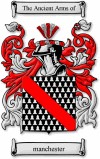
Manchester coat of arms
My 8th great grandfather was part of an unusual settlement in New Haven, Connecticut. He probably arrived in 1638 with a group of Puritans from England:
On April 24, 1638, a company of five-hundred English Puritans led by the Reverend John Davenport and Theophilus Eaton, a wealthy London merchant, sailed into the harbor. They soon discovered that the Quinnipiacks and other local tribes were much distressed by raiding bands of Pequots and Mohawks from surrounding areas. It was for this reason that Momauguin, the sachem of the Quinnipiacks, and other tribe members agreed to sell the tribe’s land to the Puritans. In return, the settlers pledged to protect the natives and to allow them the use of the lands on the east side of the harborNew Haven’s founders not only hoped to create a Christian utopia, they also saw in New Haven’s spacious harbor an opportunity to establish a commercial empire that would control Long Island Sound and possibly the coastline as far south as Delaware Bay. By 1640 a complete government had been established and the settlement, originally called Quinnipiac, was renamed Newhaven. The town plan was based on a grid of nine squares. In accordance with old English custom, the central square, now the Green, was designated a public common. By 1641 New Haven had grown into a community of approximately 800.
Over the next few years, however, the flow of newcomers began to weaken and trade with the outside world shifted more and more to Boston. In an attempt to establish direct trade with England, the settlers managed to assemble enough produce to fill a vessel which would become known as the “Great Shippe.” However, after setting sail in January, 1646, the ship and its crew were never heard from again. This disaster ended the dream of creating an economic empire and over the years New Haven became overshadowed by New Amsterdam and Boston.
from: http://www.cityofnewhaven.com/Mayor/History_New_Haven.asp
Thomas Manchester, the Manchester immigrant ancestor, was born in England, and was a resident of New Haven, Connecticut, in 1639, in the year following the planting of the colony. Afterward, however, he settled at Portsmouth, Rhode Island, where he is first mentioned in the land records, January 25, 1655, when he and his wife sold to Thomas Wood twelve acres of land. He married Margaret, daughter of John Wood.
In the settlement of her father’s estate, it was ordered March 17, 1655, that the son John pay his sister, Margaret Manchester, eight pounds. Eight acres of land were granted at Portsmouth to Thomas Manchester, December 10, 1657, and he sold to Richard Sisson one-three-hundredth right in Canonicut and Dutch Islands. In 1680 he was taxed four shillings. He and his wife testified, June 7, 1686, that they heard and saw Ichabod Sheffield married by William Paulstone. He deeded to his son John. July 9, 1691, his mansion house and lands at Portsmouth, except the place at the lower end of the ground, in possession of his son Thomas, one-half to be his at the death of grantor and the other after the death of grantor’s wife,mother of grantee, provided he pay to the sons Thomas, William and Stephen, ten shillings each, to Job twenty shillings and daughters Mary and Elizabeth ten shillings each. He also gave to John his personal property, including cattle, tools, etc.
Thomas Manchester died in 1691; his wife in 1693. Children: Thomas, born about 1650; William, 1654; John, died in 1708; George, admitted freeman in 1680; Stephen, mentioned in his own biography; Job, died 1713; Mary; Elizabeth.
Source:
New England families, genealogical and memorial
By William Richard Cutter (pgs. 853-854)
Thomas Manchester (1620 – 1691)
is my 8th great grandfather
Elizabeth Manchester (1667 – 1727)
daughter of Thomas Manchester
Dr. James Sweet (1686 – 1751)
son of Elizabeth Manchester
Thomas Sweet (1732 – 1813)
son of Dr. James Sweet
Thomas Sweet (1759 – 1844)
son of Thomas Sweet
Valentine Sweet (1791 – 1858)
son of Thomas Sweet
Sarah LaVina Sweet (1840 – 1923)
daughter of Valentine Sweet
Jason A Morse (1862 – 1932)
son of Sarah LaVina Sweet
Ernest Abner Morse (1890 – 1965)
son of Jason A Morse
Richard Arden Morse (1920 – 2004)
son of Ernest Abner Morse
Pamela Morse
I am the daughter of Richard Arden Morse
Thomas Manchester was born in England about 1620, and died at Portsmouth, R.I., about 1691. He was an early pioneer of Quinnipiac, called New Haven after 1640, in the Plantation of Connecticut: since he is found there in 1639, it would seem probable that he was of the company of Yorkshire settlers who in 1638 came to America with Ezekiel Rogers, the famous non-conformist minister, with the view of joining the Quinnipiac Plantation, although many of them eventually settled elsewhere.
The New Haven colony differed very much from other colonies. Many of the colonists put up large houses. As an explanation why this style of building was so general, it may be said that the founders of New Haven were mainly gentlemen and merchants, used to living in superior houses in London and other parts of England. For a period,Thomas continued at Quinnipiac, but removed to Portsmouth, R.I, before 1642.
On February 25/1642 he was appointed to serve on the next jury. From 1674 till his death, he was Town Sergeant. He became a considerable landed proprietor. Prior to 1655 he acquired land on the island of Aquidneck, and on January 25/1655, he made a deed of a tract of 12 acres there to Thomas Wood.
On December 10/1657, he shared in the land division and received eight acres at Portsmouth. He also had sharein Dutch Island and Quononoquet Island, and conveyed his interest in 1/300th right therein to Richard Sisson on July 6/1658. His mansion and homestead was built on his Portsmouth land.
On July 9/1691, Thomas deeded to his son John, his mansion house and all lands at Portsmouth, except the piece at the lower end, which had been theretofore deeded to his son Thomas. According to the deed, half was to be John’s on hisbrother Thomas’ death, and the remaining half upon the death of his Mother, conditioned always that pay to his brothers Thomas, William and Stephen, 10 shillings each, to Job 20/-, and to his sisters Mary and Elizabeth, ten shillings each. John also received from his father his personal property, cattle, chattels, implements, bonds, sums of money, and whatever belonged to him at the time of his death.
Thomas Manchester married, prior to 1650, Margaret Wood, who died about 1693, daughter of John Wood of Portsmouth, R.I., who bequeathed to his daughter Margaret the sum of œ8.
Ryan Redcorn, an Osage entrepreneur, has produced this video of smiling Indians. It is dedicated to Edward Curtis whose Native American images dominate the web and the memory. Just yesterday I was at the Arizona State Museum viewing some Curtis photos shot in Arizona, and all were new to me. His seemingly endless portfolio was shot in the first decades of the 20th century. The work has become controversial. Mr. Redcorn believes in producing yourself, which inspired him to create this video as a counterpoint to Curtis.
I was in Pawhuska, Oklahoma a few years ago on an ancestry hunt. My cousin and I were trying to sort out a story that our great-grandmother as Cherokee. We never found any evidence pro or con, but we went to the tribal headquarters of both the Osage and Cherokee tribes to seek answers. My cousin (like many Americans) was stuck on the romantic notion that we are Cherokee. When I saw the tiny museum in Pawhuska and talked to the curators I wanted to be Osage. They were always distinct among the 5 civilized tribes. They got rich from oil and spent much of their wealth buying products from France, especially elaborate fashion items. My father told me when he was a kid the Osage used to drive around in Cadillacs with goats in the back seat. I am probably not descended from the Osage tribe, but I do really admire the way they are. I loved the art, the history, and their sense of humor on my visit with them. Now I also love Ryan Redcorn who has a sense of humor and a bigger sense of justice.
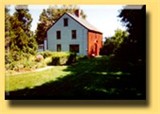
Philip Sherman’s house
My 8th great grandfather moved to Rhode Island as many of my ancestors did. He became a Quaker and the first secretary of Rhode Island Colony.
Philip Sherman (1610 – 1687)
is my 8th great grandfather
Eber Sherman (1634 – 1706)
son of Philip Sherman
Mary Sherman (1688 – 1751)
daughter of Eber Sherman
Thomas Sweet (1732 – 1813)
son of Mary Sherman
Thomas Sweet (1759 – 1844)
son of Thomas Sweet
Valentine Sweet (1791 – 1858)
son of Thomas Sweet
Sarah LaVina Sweet (1840 – 1923)
daughter of Valentine Sweet
Jason A Morse (1862 – 1932)
son of Sarah LaVina Sweet
Ernest Abner Morse (1890 – 1965)
son of Jason A Morse
Richard Arden Morse (1920 – 2004)
son of Ernest Abner Morse
Pamela Morse
I am the daughter of Richard Arden Morse
THE HON. PHILIP SHERMAN, WAS THE SON OF SAMUEL SHERMAN AND PHILIPPA WARD. HE MARRIED SARAH ODDING; THE DAUGHTER OF WILLIAM GEORGE ODDING AND MARGARET POTTER OF BRAINTREE, ESSEX CT, ENGLAND IN (1633/XX/XX),HE WAS A MAN OF MELANCOLY TEMPER WHO CAME TO BOSTON IN (1633/XX/XX) AND UPON A JUST CALLING HE WENT BACK TO ENGLAND AND RETURNED BETWEEN (1636-1637) WITH A BLESSING, IN (1637) BECAUSE OF HIS RELIGIOUS FEELINGS HE WAS BANISHED ALONG WITH JOHN COGGESHALL AND HENRY BULL FROM THE ROXBURY BAY COLONY, BOSTON, MASS, USA. LEAVING FOR RHODES ISLANDS WERE ALL BECAME RULING OFFICIALS CHOSEN TWONE CLERKE (JUNE 1649-1656), TOWNE MAGISTRATE (1656-1679), LAYER OUT OF HIGHWAYS (1683), MEMBER OF COMM. ADJUICATION (1684-1687), AND WAS THE FIRST SECRETARY AND RECORDER OF THE COLONY OF RHODES ISLANDS.
In Bertha L. Stratton’s book, “Sherman and Other Families,” she made the statement that Philip Sherman intended to settle in New Hampshre, but the climate proved too severe and so the lands there were abandoned. Upon discussion with Roger Williams at Providence, Rhode Island, the other people from Massachusetts bought Aquidneck Island in Narraganset Bay. Nineteen men signed the compact for the town in 1638. Upon leaving the church in Roxbury, Philip joined with the Friends. The Massachusetts Court ordered Philip to appear before them on 12 Mar 1638, he did not go. But he continued as a prominent figure in Rhode Island; he was the General Recorder in 1648-1652 & the Deputy to the Assembly in 1665-1667. Tradition says he was a “devout and determined man, and he was also a “neat and expert penman & an educated man,” and his Last Will & Testament “shows that he was wealthy for those times.”
Philip Sherman immigrated to Roxbury, MA and married Sarah Odding shortly after his arrival. He might have felt pressured to marry quickly, because bachelors especially of such an advanced age as 23 were looked upon with suspicion, and their single state could even effect business opportunities and social acceptance.
According to Representative Men of Old Families of Southeastern Massachussets, by J. H. Beers & Company, in a biographical entry of one of Philip’s descendants, Philip Sherman “took the side of Anne Hutchinson,” a brave woman in Salem, MA who maintained that women should be allowed to hold prayer meetings as well as men, and proceeded to hold such meetings in her home in defiance of the rules of the time and demands that she quit. She, with some members of her family including young grandchildren, were driven out of Salem into the wilderness of Rhode Island. Families in sympathy for her or in fear of retaliation for their past support and/or defense of her beliefs soon followed to Rhode Island, and Philip Sherman and his family were among the group that left Salem following her ouster.
In Providence, Philip met Roger Williams, founder of Rhode Island promising religious freedom to it’s citizens. Williams advised Philip andthe members of his party to purchase Aquidneck from the Indians, which they did on 1 Jul 1639. They created their own government with Coddington chosen to be the first governor of Rhode Island, and Philip chosen to be secretary.
Some historians believe that the death of Anne Hutchinson with most of her family during an attack of native Americans was the first act in several that led to the end of the Puritan Church. Members of the communities in all the colonies were horrified that she was banished for her beliefs and suffered so. Many felt banished themselves from England when their Puritan faith had been banned, and her treatment forced them to recognize their own harshness.
Philip left what is now called “the Congressional Church” and joined the Society of Friends, or Quakers.
He was the father of 13 children, and many of his descendants served America as congressmen and soldiers.
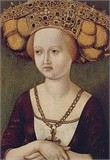
Cymburgis Masovia
My 16th great grandmother was Polish, and was the mother of a Holy Roman Emperor. My ancestor, her daughter, Katharina, was Archduchess of Austria:
Cymburgis Masovia (1391 – 1429)
is my 16th great grandmother
Katharina Archduchess Austria Von Habsburg (1420 – 1493)
daughter of Cymburgis Masovia
Christof I VanBaden (1453 – 1527)
son of Katharina Archduchess Austria Von Habsburg
Beatrix Zahringen (1492 – 1535)
daughter of Christof I VanBaden
Sabine Grafin VonSimmern (1528 – 1578)
daughter of Beatrix Zahringen
Marie L Egmond (1564 – 1584)
daughter of Sabine Grafin VonSimmern
Richard Sears (1590 – 1676)
son of Marie L Egmond
Silas Sears (1638 – 1697)
son of Richard Sears
Silas Sears (1661 – 1732)
son of Silas Sears
Sarah Sears (1697 – 1785)
daughter of Silas Sears
Sarah Hamblin (1721 – 1814)
daughter of Sarah Sears
Mercy Hazen (1747 – 1819)
daughter of Sarah Hamblin
Martha Mead (1784 – 1860)
daughter of Mercy Hazen
Abner Morse (1808 – 1838)
son of Martha Mead
Daniel Rowland Morse (1838 – 1910)
son of Abner Morse
Jason A Morse (1862 – 1932)
son of Daniel Rowland Morse
Ernest Abner Morse (1890 – 1965)
son of Jason A Morse
Richard Arden Morse (1920 – 2004)
son of Ernest Abner Morse
Pamela Morse
I am the daughter of Richard Arden Morse

Cymburgis Masovia
She was born in Warsaw and died in Lower Austria at an Abbey. It is said she contributed the protruding lower lip of the Habsburgs.
Cymburgis (also Cimburgis, Zimburgis or Cimburga) of Masovia (Polish: Cymbarka mazowiecka) (1394 or 1397 – September 28, 1429) in January 1412 became the second wife of the Habsburg Duke Ernest the Iron of Austria (since 1414 Archduke) and thus a Duchess/Archduchess of the Inner Austrian line in Styria, Carinthia and Carniola.
Cimburgis was born at Warsaw in the Duchy of Masovia to Duke Siemovit IV of the Masovian Piast dynasty and his wife Alexandra of Lithuania, daughter of Grand Duke Algirdas, a scion of the Gediminid dynasty, and sister of Władysław II Jagiełło, King of Poland.
Though his elder brother William’s engagement with the Polish princess Jadwiga had mortifyingly failed, Ernest after the death of his first wife Margaret of Pomerania proceeded to Kraków to court Cymburgis. Though not approved by the Habsburg family, the marriage turned out to be a happy one. As the mother of the later Emperor Frederick III, Cymburgis, after Gertrude of Hohenburg, became the second female ancestor of all later Habsburgs, as only his branch of the family survived in the male line. Although controversial, it has been claimed (since at least by Robert Burton in 1621) that she brought the distinctive protruding lower lip (progenism) into the family, a particular physical characteristic of most members of the family for many generations until the 18th century.[2] It can even be recognized in some of her distant descendants today (though not as markedly). Cymburgis’ statue in the Innsbruck Hofkirche church however does not show this feature.
Tradition has it that she was also known for her exceptional strength, which, for example, she showed by driving nails into the wall with her bare hands and cracking nuts between her fingers. Strength also distinguished one of her descendants, Augustus II the Strong, who allegedly broke a horseshoe bare fisted. Cymburgis outlived her husband and died at Türnitz in present-day Lower Austria. She is buried at Lilienfeld Abbey.
Descendants
5 children died at young age
Frederick III, Holy Roman Emperor (1415–1493)
Margaret, wife of Frederick II, Elector of Saxony
Albert VI, Archduke of Austria (1418–1463)
Catherine (1420–1493), wife of Charles I, Margrave of Baden-Baden
Cymburgis Masovia
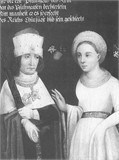
Otto and Agnes
Agnes Countess Of Rhein (1202 – 1267)
is my 21st great grandmother
Elisabeth Wittelsbach Duchess Bavaria (1227 – 1273)
daughter of Agnes Countess Of Rhein
Consort Elisabeth the Romans Carinthia (1263 – 1313)
daughter of Elisabeth Wittelsbach Duchess Bavaria
Albrecht Albert II ‘The Wise’ Duke of Austria Habsburg (1298 – 1358)
son of Consort Elisabeth the Romans Carinthia
Leopold III “Duke of Austria” Habsburg (1351 – 1386)
son of Albrecht Albert II ‘The Wise’ Duke of Austria Habsburg
Ernst I “Ironside” Archduke of Austria Habsburg (1377 – 1424)
son of Leopold III “Duke of Austria” Habsburg
Katharina Archduchess Austria Von Habsburg (1420 – 1493)
daughter of Ernst I “Ironside” Archduke of Austria Habsburg
Christof I VanBaden (1453 – 1527)
son of Katharina Archduchess Austria Von Habsburg
Beatrix Zahringen (1492 – 1535)
daughter of Christof I VanBaden
Sabine Grafin VonSimmern (1528 – 1578)
daughter of Beatrix Zahringen
Marie L Egmond (1564 – 1584)
daughter of Sabine Grafin VonSimmern
Richard Sears (1590 – 1676)
son of Marie L Egmond
Silas Sears (1638 – 1697)
son of Richard Sears
Silas Sears (1661 – 1732)
son of Silas Sears
Sarah Sears (1697 – 1785)
daughter of Silas Sears
Sarah Hamblin (1721 – 1814)
daughter of Sarah Sears
Mercy Hazen (1747 – 1819)
daughter of Sarah Hamblin
Martha Mead (1784 – 1860)
daughter of Mercy Hazen
Abner Morse (1808 – 1838)
son of Martha Mead
Daniel Rowland Morse (1838 – 1910)
son of Abner Morse
Jason A Morse (1862 – 1932)
son of Daniel Rowland Morse
Ernest Abner Morse (1890 – 1965)
son of Jason A Morse
Richard Arden Morse (1920 – 2004)
son of Ernest Abner Morse
Pamela Morse
I am the daughter of Richard Arden Morse
AGNES ([1201]-16 Nov 1267, bur Scheyern). The Notæ Sancti Emeranni record the marriage of “Otto dux Bawarie” and “filiam Heinrici palatine Rheni”. The Altahenses Annales name “Agnes ducissa Bawarie” when recording the birth of her son Ludwig.
m (Worms May 1222) OTTO von Bayern, son of LUDWIG I Duke of Bavaria, Pfalzgraf bei Rhein & his wife Ludmila of Bohemia (Kelheim 1206-Landshut 29 Nov 1253, bur Scheyern). Pfalzgraf bei Rhein 1228. He succeeded his father in 1231 as OTTO II “der Erlauchte” Duke of Bavaria.

Bayern COA
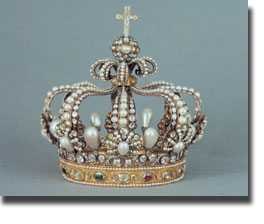
German Queen’s crown
Elisabeth of Bavaria, Queen of Germany was married to Conrad IV in her hometown of Landshut, Bavaria in 1246. Her husband the king was at war with the pope which lead to his early demise in 1254. Her second husband, Duke of Carinthia, is my ancestor. She is one of the only royal ladies in my tree who managed to avoid the monastic life.
Elisabeth of Bavaria, Queen of Germany (Landshut, c. 1227 – 9 October 1273) was the Queen consort of Conrad IV of Germany.
She was the eldest daughter of Otto II Wittelsbach, Duke of Bavaria and Agnes of the Rhine. Her maternal grandparents were Henry V, Count Palatine of the Rhine and Agnes von Staufer.
The elder Agnes was a daughter of Conrad of Hohenstaufen and Irmingard of Henneberg.
Marriages and children
Her father Otto II had become a supporter of Frederick II, Holy Roman Emperor in 1241, following initial conflict between them. Their political alliance would lead to the marriage of the elder daughter of the Wittelsbach and the elder son of the Hohenstaufen. Said son was Conrad IV of Germany, son and heir of Frederick II. Their marriage took place on 1 September 1246, in her native Landshut.
Elisabeth and Conrad would only have one son:
Her father-in-law Frederick II died on 13 December 1250. He was still involved in a war against Pope Innocent IV and his allies at the time of his death. Conrad IV would continue the war until his own death of malaria at Lavello, Basilicata on 21 May 1254.
Elisabeth remained a widow for five years. She married her second husband Meinhard, Duke of Carinthia in 1259. They had six children:
Elisabeth Wittelsbach Duchess Bavaria (1227 – 1273)
is my 20th great grandmother
Consort Elisabeth the Romans Carinthia (1263 – 1313)
daughter of Elisabeth Wittelsbach Duchess Bavaria
Albrecht Albert II ‘The Wise’ Duke of Austria Habsburg (1298 – 1358)
son of Consort Elisabeth the Romans Carinthia
Leopold III “Duke of Austria” Habsburg (1351 – 1386)
son of Albrecht Albert II ‘The Wise’ Duke of Austria Habsburg
Ernst I “Ironside” Archduke of Austria Habsburg (1377 – 1424)
son of Leopold III “Duke of Austria” Habsburg
Katharina Archduchess Austria Von Habsburg (1420 – 1493)
daughter of Ernst I “Ironside” Archduke of Austria Habsburg
Christof I VanBaden (1453 – 1527)
son of Katharina Archduchess Austria Von Habsburg
Beatrix Zahringen (1492 – 1535)
daughter of Christof I VanBaden
Sabine Grafin VonSimmern (1528 – 1578)
daughter of Beatrix Zahringen
Marie L Egmond (1564 – 1584)
daughter of Sabine Grafin VonSimmern
Richard Sears (1590 – 1676)
son of Marie L Egmond
Silas Sears (1638 – 1697)
son of Richard Sears
Silas Sears (1661 – 1732)
son of Silas Sears
Sarah Sears (1697 – 1785)
daughter of Silas Sears
Sarah Hamblin (1721 – 1814)
daughter of Sarah Sears
Mercy Hazen (1747 – 1819)
daughter of Sarah Hamblin
Martha Mead (1784 – 1860)
daughter of Mercy Hazen
Abner Morse (1808 – 1838)
son of Martha Mead
Daniel Rowland Morse (1838 – 1910)
son of Abner Morse
Jason A Morse (1862 – 1932)
son of Daniel Rowland Morse
Ernest Abner Morse (1890 – 1965)
son of Jason A Morse
Richard Arden Morse (1920 – 2004)
son of Ernest Abner Morse
Pamela Morse
I am the daughter of Richard Arden Morse
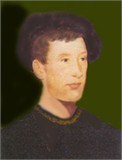
Thomas DeHoland
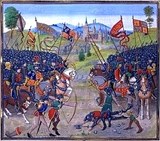
Battle of Najera
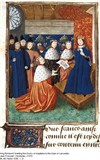
Richard II deeding Aquitaine to Lancaster
Thomas Deholand is my ancestor on both sides of my family. My maternal line looks like this:
Thomas DeHoland (1350 – 1397)
is my maternal 18th great grandfather
Edmund Holland (1383 – 1408)
son of Thomas DeHoland
Eleanor DeHoland (1405 – 1452)
daughter of Edmund Holland
Ann Touchet (1441 – 1503)
daughter of Eleanor DeHoland
Anna Dutton (1449 – 1520)
daughter of Ann Touchet
Lawrence Castellan of Liverpool Mollenaux (1490 – 1550)
son of Anna Dutton
John Mollenax (1542 – 1583)
son of Lawrence Castellan of Liverpool Mollenaux
Mary Mollenax (1559 – 1575)
daughter of John Mollenax
Francis Gabriell Holland (1596 – 1660)
son of Mary Mollenax
John Holland (1628 – 1710)
son of Francis Gabriell Holland
Mary Elizabeth Holland (1620 – 1681)
daughter of John Holland
Richard Dearden (1645 – 1747)
son of Mary Elizabeth Holland
George Dearden (1705 – 1749)
son of Richard Dearden
George Darden (1734 – 1807)
son of George Dearden
David Darden (1770 – 1820)
son of George Darden
Minerva Truly Darden (1806 – 1837)
daughter of David Darden
Sarah E Hughes (1829 – 1911)
daughter of Minerva Truly Darden
Lucinda Jane Armer (1847 – 1939)
daughter of Sarah E Hughes
George Harvey Taylor (1884 – 1941)
son of Lucinda Jane Armer
Ruby Lee Taylor (1922 – 2008)
daughter of George Harvey Taylor
Pamela Morse
I am the daughter of Ruby Lee Taylor
Thomas Holland, 2nd Earl of Kent (1350–April 25, 1397) was an English nobleman and a councillor of his half-brother Richard II.Thomas was the son of Thomas Holland, 1st Earl of Kent and Joan of Kent. His mother was a daughter of Edmund of Woodstock, 1st Earl of Kent and Margaret Wake. Edmund was in turn a son of Edward I of England and his second Queen consort Marguerite of France, and thus a younger half-brother of Edward II of England.
When his father died in 1360 Thomas became Baron Holand. His mother was still Countess of Kent in her own right. At sixteen, in 1366, Holland was appointed captain of the English forces in Aquitaine. He fought in various campaigns over the following years, and was made a Knight of the Garter in 1375.
Richard II became king in 1377, and soon Holland acquired great influence over his younger half-brother, which he used for his own enrichment. In 1381 he was created Earl of Kent.
Marriage and issue
Holland married Alice FitzAlan, daughter of Richard FitzAlan, 10th Earl of Arundel, and Eleanor of Lancaster. They had eight children:
Thomas Holland, 1st Duke of Surrey, who succeeded him
Edmund Holland, 4th Earl of Kent, married Constance of York
John Holland
Joan Holland, married Edmund of Langley, 1st Duke of York
Alianore Holland, married first Roger Mortimer, 4th Earl of March and second Edward Cherleton, 5th Baron Cherleton
Margaret Holland, married first John Beaufort, 1st Earl of Somerset and second Thomas of Lancaster, 1st Duke of Clarence
Elizabeth Holland, married Sir John Neville (eldest son of Ralph Neville, 1st Earl of Westmoreland)
Eleanor Holland, married Thomas Montacute, 4th Earl of Salisbury
Through the marriages of his daughters, he became the ancestor of many of the prominent figures in the Wars of the Roses, including Richard Plantagenet, 3rd Duke of York and Warwick the Kingmaker
Military career
At sixteen, in 1366, Holland was appointed captain of the English forces in Aquitaine. Over the next decade he fought in various campaigns, including the Battle of Nájera, under the command of his stepfather Edward, the Black Prince. He was made a Knight of the Garter in 1375.
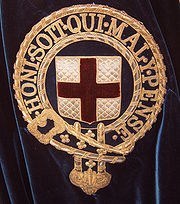
Order of the Garter
The Battle of Nájera, a k a the Battle of Navarrete, 3 April 1367
Fo ught between an Anglo-Gascon army and Franco- Castilian forces near Nájera, in the province of La Rioja, Castile. The English were led by Edward, the Black Prince, and John of Gaunt, Duke of Lancaster, allied with Peter of Castile (sometimes called “Peter the Cruel”) against his brother Henry of Trastámara (Spanish: Enrique II).
Peter and Henry had been in armed conflict, the Castilian Civil War, for some time before the intervention of foreign powers was sought. Peter begged assistance from the Black Prince in Bordeaux to restore him to his throne. James IV of Majorca also agreed to support Peter.
History
With 24,000 men, the Anglo-Gascon army marched south from Aquitaine and crossed the river Ebro at Logroño. They took control of the fortified village of Navarrete and continued towards Nájera to face Henry’s Franco-Castilian army, the latter’s strength being 60,000. Despite the large size of his army, Henry’s commander, Bertrand du Guesclin was later reported to have been reluctant to face the English in a pitched battle, but he was overruled.
The battle began with the English longbowmen gaining dominance over the French archers. Then, the English vanguard, led by Sir John Chandos and the Duke of Lancaster, attacked the French mercenaries commanded by Du Guesclin and Arnoul D’Audrehem. The chronicler Froissart gives detailed information about the participants in the battle.
Under the pennon of St. George, and attached to the banner of Sir John Chandos, were the free companies, who had in the whole twelve hundred streamers. Among them were good and hardy knights and squires, whose courage was proof; namely, Sir Robert Cheney, Sir Perducas d’Albret, Robert Briquet, Sir Garsis du Chastel, Sir Gaillard Viguier, Sir John Charnels, Nandon de Bagerant, Aymemon d’Ortige, Perrot de Savoye, le bourg Camus, le bourg de l’Esparre, le bourg de Breteuil, Espiote, and several others.
Th e Castilian cavalry, under heavy arrow fire from the English longbowmen, fled early, leaving Henry’s battle exposed to attack from the mounted English rearguard. The Franco-Castilian army disintegrated and retreated, pursued by the English, back to the bank of the river Najerilla. Du Guesclin was captured, but Henry escaped and fled.
Peter and the English completely routed Henry and the French, inflicting heavy losses. Unlike at other battles of the Hundred Years’ War, at Nájera it was the English who were attacking dismounted French troops. As with many other battles of the period, the English longbow proved a significant advantage, probably for the first time in the Iberian Peninsula. However, the battle was of dubious long-term significance as Peter and the Black Prince fell out over money, and Peter was not able to maintain his rule for long without foreign support.
References
Sir John Froissart; Translated from the French by Thomas Johnes. Chronicles of England, France and Spain and the Surrounding Countries. London 1808
My paternal connection to Sir Thomas looks like this:
Sir Thomas Holand Knight deHolland (1350 – 1397)
Sibilla Anjou
My 25th great grandmother was from the House of Anjou (like the pear) . Her father, Fulk, was a crusader who is buried at the Church of the Holy Sepulchre in Jerusalem, as King of Jerusalem, which is a very big deal, and pretty creepy. I have been there but did not think to look for my ancestors at the time. The Anjous are Plantagenets in that way that royal Euros had lots of different names and houses. The crusade thing is equally confusing. This is how the Anjous took over the English throne:
The Plantagenets are also called Angevins, because their immediate paternal progenitors were Counts of Anjou, an autonomous county in northern France. They descend in the male line from from the Counts of Gatinais, one of whom had married an heiress to the county, her Anjou ancestors deriving from an obscure 9th century nobleman named Ingelger. It is due to this lineage that the Plantagenets are sometimes referred to as the First House of Anjou. One of the more notable Counts was Fulk, a crusader who became King of Jerusalem. It was his son, Geoffrey, nicknamed Plantagenet, who gave his name to the dynasty, and Fulk’s grandson, Henry, was the first of the family to rule England.
Henry’ s claim to the English throne came through his mother, the Empress Matilda, who had claimed the crown as the daughter of Henry I of England. Empress Matilda’s brother William Adelin had died in the wreck of the White Ship, leaving Matilda her father’s only surviving legitimate child. However, on Henry’s death in 1135, Matilda’s cousin Stephen of Blois was supported by much of the Anglo-Norman nobility, and was able to have himself crowned instead. A tightly fought civil war known as The Anarchy ensued, with Matilda gaining support from her illegitimate half-brother, Robert, 1st Earl of Gloucester. The balance swayed both ways during the war, Matilda gained control at one point and carried the title “Lady of the English” before Stephen forced her out to Anjou. Unrest and instability continued throughout Stephen’s reign, while on the continent, Geoffrey managed to take control of the Duchy of Normandy for the Angevins in 1141 but seemingly showed no interest in campaigning across the Channel.
Sibilla went to Jerusalem where her father married the queen. Later she became a nun, like lots of my royal female ancestors:
Sibylla of Anjou (c. 1112-1165) was a daughter of Fulk V of Anjou and Ermengarde of Maine, and wife of William Clito and Thierry, Count of Flanders.
In 1123 Sibylla married to William Clito, son of the Norman Robert Curthose and future Count of Flanders. Sibylla brought the County of Maine to this marriage, which was annulled in 1124 on grounds of consanguinity. The annulment was made by Pope Honorius II upon request from Henry I of England, William’s uncle; Fulk opposed it and did not consent until Honorius excommunicated him and placed an interdict over Anjou. Sibylla then accompanied her widower father to the crusader Kingdom of Jerusalem, where he married Melisende, the heiress of the kingdom, and became king himself in 1131. In 1139 she married Thierry, Count of Flanders, who had arrived on his first pilgrimage to the Holy Land.
She returned to Flanders with her new husband, and during his absence on the Second Crusade the pregnant Sibylla acted as regent of the county. Baldwin IV, Count of Hainaut took the opportunity to attack Flanders, but Sibylla led a counter-attack and pillaged Hainaut. In response Baldwin ravaged Artois. The archbishop of Reims intervened and a truce was signed, but Thierry took vengeance on Baldwin when he returned in 1149.
In 1157 she travelled with Thierry on his third pilgrimage, but after arriving in Jerusalem she separated from her husband and refused to return home with him. She became a nun at the convent of St. Lazarus in Bethany, where her step-aunt, Ioveta of Bethany, was abbess. Ioveta and Sibylla supported Queen Melisende and held some influence over the church, and supported the election of Amalric of Nesle as Latin Patriarch of Jerusalem over a number of other candidates. Sibylla died in Bethany in 1165.
With Thierry she had six children:
Sibilla d’Anjou born about 1105 Anjou, France died 1165/67
father: *Foulques V “le Jeune” Count of Anjou & King of Jerusalemborn 1092 Anjou, France
died 10 November 1143 Jerusalem, Holy Landburied Church Of Holy Sepulchre, Jerusalem, Holy Land
mother: *Ermengarde (Ermentrude) du Maineborn about 1096 Maine, France
died 1126 Maine, Francemarried 11 July 1110 France
siblings:
*Geoffrey V “le Bon” Plantagenet born 24 August 1113 Anjou, France; died 7 September 1151 Chateau, France
Mathilde d’Anjou born about 1104 Angers, Maine-et-Loire, France; died 1154 Fontevrault Abbey, Fontevrault, Maine-et-Loire, France
Elias d’Anjou born about 1111 Anjou, France; died 15 January 1151 St Serge Abbey, Angers, Anjou, France buried L’Abbey des Sergela, Angers, France
spouse: *Dietrich (Thierry) d’ Alsaceborn about 1099 Alsace, France
died 17 January 1168married 1134
children:
*Marguerite de Lorraine born about 1135 Alsace, France died 15 November 1194
*Matthieu d’ Alsace born about 1137 Flanders, Belgium died 1214 buried St. Judoc, Ponthieu, France

Isabelle de Hainault
queen consort of France
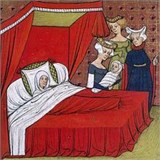
Isabelle gives birth
Isabella of Hainault (Valenciennes, 5 April 1170 – 15 March 1190, Paris) was queen consort of France as the first wife of King Philip II of France.
Early life
Isabella was born in Valenciennes on 5 April 1170, the daughter of Baldwin V, Count of Hainaut, and Margaret I, Countess of Flanders. At the age of one, her father had her betrothed to Henry, the future Count of Champagne. He was the nephew of Adèle of Champagne, who was Queen of France. In 1179, both their fathers swore that they would proceed with the marriage, but her father later agreed to her marrying Philip II of France.
Queen of France
She married King Philip on 28 April 1180 at Bapaume and brought as her dowry the county of Artois. The marriage was arranged by her maternal uncle Philip, Count of Flanders, who was advisor to the King.
Isabella was crowned Queen of France at Saint Denis on 28 May 1180. As Baldwin V rightly claimed to be a descendant of Charlemagne, the chroniclers of the time saw in this marriage a union of the Carolingian and Capetian dynasties.
The wedding did not please the queen mother, since it had meant the rejection of her nephew and the lessing of influence for her kinsmen. Though she received extravagant praise from certain annalists, she failed to win the affections of Philip due to her inability to provide him with an heir; although she was only 14 years old at the time. Meanwhile, King Philip in 1184, was waging war against Flanders, and angered at seeing Baldwin support his enemies, he called a council at Sens for the purpose of repudiating her. According to Gislebert of Mons, Isabella then appeared barefooted and dressed as a penitent in the town’s churches and thus gained the sympathy of the people. Her appeals angered them so much that they went to the palace and started shouting loud enough to be heard inside.
Robert, the king’s uncle, successfully interposed and no repudiation followed as repudiating her would also have meant the loss of Artois to the French crown.
Finally, on 5 September 1187, she gave birth to the needed heir, the future King Louis VIII of France.
Death
Her second pregnancy was extremely difficult; on 14 March 1190, Isabella gave birth to twin boys named Robert and Philip. Due to complications in childbirth, Isabella died the next day, and was buried in the cathedral of Notre Dame in Paris. She was not quite 20 years old and was mourned for greatly in the capital, since she had been a popular queen.
The twins lived only four days, both having died on 18 March 1190. Her son Louis succeeded her as Count of Artois. Isabella’s dowry of Artois eventually returned to the French Crown following the death of King Philip, when her son Louis became king.
Isabelle De Hainault (1170 – 1190)
The Declaration of Independence is often quoted saying:
“We hold these truths to be self-evident, that all men are created equal, that they are endowed by their Creator with certain unalienable Rights, that among these are Life, Liberty and the pursuit of Happiness.”
I believe that our short-sighted system that rewards politicians for serving special interests of all kinds is dishonest. Lobbyists and lawyers write the laws that favor their patrons. Our lawmakers just pass them with little revision or thought. This is not what the taxpayers intended when we paid our taxes. I wrote both a senator and a congressman about serious issues in the last year. The senator has not responded at all. The congressman never answered my concern but sent me an e-mail asking me to rate the quality of the help I had received from his office. I replied that there had been none, so it was not applicable. There has still been no response. I give it an F.
Education is the way out of this hole in which we find American democracy. It seems that the people who know who government works are abusing the systems, while the majority are not well served by the results. iCivics is addressing the problem of a large undereducated population that does not participate in elections. In the future we can hope educated people will make the bureaucracy responsive to all citizens. Learning how the government is intended to work is the first step toward making it work.
 mermaidcamp