mermaidcamp
Keeping current in wellness, in and out of the water
You can scroll the shelf using ← and → keys
You can scroll the shelf using ← and → keys
My strong love of reading has compelled me to do many things, including restricting my book consumption on a 3 book diet last year. My consumer weakness it is for art and books. I never seem to have enough of either one, even though I have more than I can store in my present circumstances. The Kindle has helped me to reduce the space I dedicate to books, but the passion to read everything all the time was not diminished by the diet. If anything I am rebounding since November when I allowed myself to buy books once more. I have loaded up on both print and Kindle books, plus I had a big backlog from the book diet year that I had acquired and not opened. I am back in full force as crazy reading woman, proving once and for all that diets just do not work.
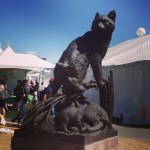
Attending the Tucson Festival of books for the first time was amazing to me. The super well-organized event takes place on the U of A campus in buildings and in various tents set up for the weekend. Windy weather did not deter the visitors or participants from having wonderful time. Presentations for readers as well as writers are given all day both Saturday and Sunday. A giant food court assures that spending the day there will require no sacrifice. I did not eat or attend a session, but I thoroughly enjoyed all the tents I visited. Volunteers make sure the crowd is informed. Families with kids can participate in several ongoing demonstrations, book give aways, and photo ops with favorite characters from children’s literature . I bought some great cookbooks, two of historical significance, from the Assistance League tent and a book of memoirs from an Albuquerque lawyer, Laws and Loves Part I, Real Stories of the Rattlesnake Lawyer. I am a sucker for books that contain the word rattlesnake in the title. I am also planning to attend a free introductory class by the Writer’s Studio in Tucson. I have some desire to write poetry, and this group offers workshops that are convenient and well priced. Who knows, gentle readers, where this may go. Maybe all this reading will help me learn to write. Stay tuned; the plot may thicken.








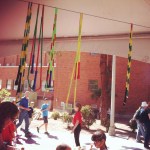

Our society is experimenting with self sustaining living. In recent decades focus has changed from local production of food and goods to a transportation heavy supply chain. We now pay little to produce our goods in countries with lax labor laws and spend fortunes shipping those goods around the globe. The skills of preserving food, and even growing food have been lost to a great extent, but there is new interest in reviving local farming and local cuisines. Popular classes and books are teaching:
These alternative practices offer students ways to save money and become more creative. Learning new skills can reap big benefits for society as well as individuals. The future will be shaped by the habits we develop now. Communities focused on improving local, self-sustaining economies are becoming more common. The trend is strong and, in my opinion, will grow in the future. Have you made any changes in your own life to create a more self sustenance?
While hanging out in the steam room at my health club I noticed a man wearing a lot of silver jewelry and thought it must be hot on his skin. After a few steam room conversations I discovered that he is a metal sculptor who had worked in a shop in Tucson that I had later used as a pottery studio in the distant past. I have not worked with clay for a long time, but Jerry has evolved from making simple objects to producing very artful and complicated mixed media art. He worked as a ferrier. He played polo in Colorado. He bought the Village Blacksmith shop 30 years ago from another blacksmith. His art today is centered around birds in action. His knowledge about anatomy of birds has grown deeper as he has worked in this specialty field. I was very lucky to have a personal tour of the shop and sculpture on display. He participates in the Pima Arts Council open studio tours. Since there was no fire during my visit I thought my gentle readers would also enjoy watching the tools and Jerry in action:
Fashion follows function. In the 1950’s a model had limited options. She could be a junior or a high fashion model, a field that was evolving. Jean Patchett was a Mad Man’s dream, a fashion model married to a New York banker. She set style, but was not drawing any revenue from the rip off of her iconic eye and mouth printed on pairs of pajamas. She was in the vanguard of personal branding, but not the beneficiary of it. This interview with Edward R Murrow is a trip to a more sexist time. Jean’s famous eye had become an icon, but she had no creative control over it. She was happy just to be an icon with a famous eye, and her banker husband is happy for the same reasons.
She left us with some stunning images of her beautiful self in some amazing fashion. We will never know how liberated she was. She was able to live a life full of more travel opportunities than many had in that time, and the photos reflect her world travel. Her decision to be serious rather than smile in her shots is what made her a “high fashion” model. She was a ground breaker. She perfected the genre.
The Declaration of Independence is often quoted saying:
“We hold these truths to be self-evident, that all men are created equal, that they are endowed by their Creator with certain unalienable Rights, that among these are Life, Liberty and the pursuit of Happiness.”
I believe that our short-sighted system that rewards politicians for serving special interests of all kinds is dishonest. Lobbyists and lawyers write the laws that favor their patrons. Our lawmakers just pass them with little revision or thought. This is not what the taxpayers intended when we paid our taxes. I wrote both a senator and a congressman about serious issues in the last year. The senator has not responded at all. The congressman never answered my concern but sent me an e-mail asking me to rate the quality of the help I had received from his office. I replied that there had been none, so it was not applicable. There has still been no response. I give it an F.
Education is the way out of this hole in which we find American democracy. It seems that the people who know who government works are abusing the systems, while the majority are not well served by the results. iCivics is addressing the problem of a large undereducated population that does not participate in elections. In the future we can hope educated people will make the bureaucracy responsive to all citizens. Learning how the government is intended to work is the first step toward making it work.
Americans have started to rebound from the culture of excess. The Tiny House Movement is a valid reaction to the waste and lack of awareness of the past. It is a growing trend with new options sprouting up all the time. There are rolling versions that replace the old trailer model of mobile home. There are plans to build your own as well as contractors who specialize in this kind of construction. The biggest advantage I can see is the tiny amount of time it would require to keep it clean. It would be impossible to leave any clutter I should imagine, since you have to see it constantly if you are not organized. I am so far from being able to contain myself like this. I own a barn and have an entire extra lot in which to garden. I do think it is an admirable goal, so I have started to think about what it would take for me to get tiny. I must start by selling many of my treasures that I no longer treasure. How hard would it be for you to go tiny?
The medicinal use of gin to prevent kidney problems in the tropics was made popular by the British. It was invented in the 17th century by Dutch medical professor Dr Franciscus Sylvius who called it Genever. It was pure alcohol flavored with juniper berries. The medicinal qualities of the berries treated the expatriate Dutch kidney complaints, since juniper is a diuretic. William of Orange made it popular in the UK. For almost the entirety of the eighteenth century half the population of England was guzzling gin. The cheapness and availability made it the curse of lower class London.
Gin and tonic also came about for medicinal treatment, for malaria. Quinine in tonic water was effective in prevention of malaria for the Brits in tropical parts of the Empire. One of the greatest fans of this medicinal drink was a medical doctor himself. Graham Chapman of Monty Python stayed drunk with Keith Moon of the Who for the decade of the 1970’s in an homage to the eighteenth century, I suppose. Dr. Chapman calculated how much gin and tonic would kill a person, and consumed just short of that amount each day. That is a scientific view of self destruction that is unusual. It took a toll. Now for Python lovers there will be a revival called One Down Five to Go in London.
Most luxury goods from ice cream to cars are marketed as being self-indulgent. The idea that we deserve some luxury is a tried and true method used to sell overpriced goods. Obviously luxury has to mean different things to each one of us, and our fortunes limit what we include in our worldly possessions. We do have to choose and over time our choices change. We move into a new phase or environment or hobby and find that what was a big treat in the past is not even interesting now. We may own something we thought we needed and wanted that now we no longer like. This is natural.
I am in favor of self-indulgence if it is done in a true spirit of enhancing the self. Self care and self-awareness are valid and necessary for a healthy balanced personality. To make good long-term investments in self ask yourself:
There may be another element to consider when finding a reward for yourself that will reap future dividends. Would I enjoy this time/money/thing more if I gave it away or shared it with others in some other way? I personally can think of at least a million things I would rather own than the yacht A, and a million people who could make good use of a more reasonable boat. Everything is relative. To each her own. Choose wisely, gentle reader.
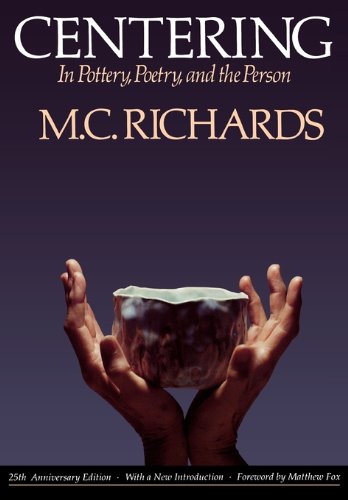
Centering by Mary Richards
I made pottery on the wheel when I was young. Two books were read by almost all the potters I knew in those days, Clay and Glazes for the Potter by Daniel Rhodes, and Centering by MC Richards. The first technical manual often called simply Rhodes gave formulas and facts needed to produce pottery. The centering book was all about zen and becoming one with the clay in the middle of the wheel. I used to think the centering book was too silly, but now I think it is brilliant. I have not thrown pots for at least 30 years, but the practice did make a difference in my philosophy. To center the clay one must be centered. All work is exactly like that. If you are not centered, balanced, able to focus, your clay will be hard to manage. Your vision will not quite be achieved because of distraction. With clay it is possible to endlessly recycle it if it has not been fired. However, if one works for too long on a thrown piece it is very likely to collapse. Brevity and self assurance are the essence of throwing pots.
Centering was taken from an inspirational speech given to fellow craftsmen. Mary Richards was asked to elaborate on that talk in a book. The 25th anniversary edition is out so I have zapped it into my Kindle. In her introduction Ms Richards states, “The imagery of centering is archetypal. To feel the whole in every part.” Chapter one begins, “CENTERING: that act which precedes all others on the potter’s wheel.” This seems obvious, but the metaphors are many. Whatever raw materials we have must be treated as a whole to make the most of them. Many mediums are not as forgiving as clay. Once wood or fabric has been cut it can’t be thrown into a slip barrel and become new. An unfired pot that does not meet standards can begin as a new lump of clay. Sensitivity and refined touch are the main skills needed to center and throw pots. Porcelain has different feel and qualities to stoneware. Each clay body has potential and personality. Each will take glazes differently. The chemical process of fusing glaze to pot happens at high heat and must be cooled slowly to avoid cracking and crazing. There is technical accuracy, just as in distillation. One follows a recipe and keeps a firing log in order to attain exact desired results on a regular basis. There will sometimes be pots that are ruined in the kiln, and this is a fact that must be accepted. Not every pot will survive.
Mary Richards quotes Emerson who said the law is: “Do the thing, and you shall have the power. But they who do not the thing, have not the powers.” When I read this book about centering today I know that being a potter early in my life gave me an appreciation for practice and balanced design in all things. I enjoy making my own clothes, growing my own food, and designing my own life. The concept of centering means connecting from my center to the center of others, touching the core. That is the essence of life. Stay centered, my friend.
The extraordinary power of the people’s evidence locker, YouTube, is changing the world at a rapid pace. The police in Rialto, CA are using shoulder mounted cameras to improve their service to the community. They also have tools for predictive policing. Since this technology exists and helps reduce waste in the law enforcement budget why are we not outfitting all the cops in the country with these cameras and these crime maps? Criminals today are tech savvy and steal up to and including people’s identities without even physically looking at them. Let us act smarter with our law enforcement resources.
 mermaidcamp