mermaidcamp
Keeping current in wellness, in and out of the water
You can scroll the shelf using ← and → keys
You can scroll the shelf using ← and → keys
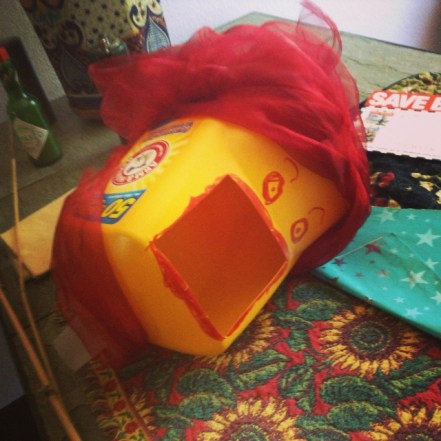
message for dog owners

practical design
Our midtown Tucson neighborhood has pride of ownership issues. The landlords are not prone to take care of rental properties and the residents have become used to a very low level of environmental pride. Tagging of gang signs is chronic and dog owners leave waste behind everywhere. Doolen-Fruitvale Neighborhood, or DooFru for short, has an elementary school, an art college, and a Boys and Girls Club all adjacent to each other. I am asking the kids interested in art and design to enter a competition. The DooFru Design Derby will be an annual competition to design the best small enhancement to our neighborhood environment. We want to create a positive artful outlet that says we care about the space in which we live. We don’t have a place for mural art or sculpture, but we can do small, individual projects that make a difference.
This year we are designing dog doo bag dispensers out of used plastic containers. When filled with plastic bags, they not only remind dog owners to do the right thing, but provide the means with which to do it. Some other neighborhoods have employed the bag dispensers with great success. I walk my dog in one of these adjoining areas and have noticed a big improvement in the waste problem since they put up the bag dispensers. We hope by involving kids and art we will have an even bigger impact to create a cleaner and more well cared for environment. The kids from Boys and Girls Club have joined in many neighborhood clean up efforts, only to see the same trashy behavior arise. I believe they can have a bigger influence than adults if they sincerely take on the #DooFrudumpsdogdoo initiative. They can shame the adults and set a standard of awareness simply by making art for the good of the neighborhood. My own design is designed to give the idea to the kids, but definitely not to win the derby. My #DooFrudumpsdogdoo lady is a neighborhood spokesperson in need of kids’ art.
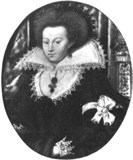
Elizabeth Whitbread
My 11th great-grandmother married into the Spencer family. Her son Gerard went to America.
Gerard Spencer, baptized at Stotfold, co. Bedford, 20 May 1576, died before 1646; married at Upper Gravenhurst, co., Alice Whitbread or Whitbred, who belonged to a family of some prominence. It seems quite possible that Gerard and his family moved from Stotfold some years before the emigration of his sons to New England; perhaps to London, where his brother Richard had become a prosperous haberdasher.
The English surname of “Spencer” derives from the Latin word dispensator, which means a storekeeper or shopkeeper. In medieval times, a feudal lord would employ a dispensator to have charge of his possessions and to oversee distribution and sale of supplies to the serfs, peasants, and tenant farmers who worked his land. In essence, a dispensator was something like a steward. This Latin term gave rise to the occupational family names of “Dispenser,” “Spencer,” “Spenser,” “Spence,” “Spens,” “Spender,” etc. Since there must have been thousands of dispensatori, there are naturally a large number of unrelated Spencer families. Even though he was the servant of a feudal lord or a king, a dispensator often himself would be of noble or knightly rank. The two best known medieval English families bearing a form of this surname were the Dispensers, Earls of Winchester, and the Spencers of Althorp, Northamptonshire, ancestors of the present Earls Spencer, who were the family of the late Diana, Princess of Wales, formerly known as Lady Diana Spencer. The Earls Spencer are also closely related to the Spencer-Churchill family, which includes the famous British Prime Minister Sir Winston Spencer-Churchill. During the Renaissance, an unscrupulous herald manufactured a spurious genealogy tracing the Spencers of Althorp back to the Dispensers of Winchester, but that fictitious genealogy was long ago debunked — there is no proof nor any reason to believe that the Spencers of Althorp had anything to do with the old Earls of Winchester.
Elizabeth Whitbread (1538 – 1599)
is my 11th great grandmother
Thomas Spencer (1571 – 1631)
son of Elizabeth Whitbread
Thomas Spencer (1596 – 1681)
son of Thomas Spencer
Margaret SPENCER (1633 – 1670)
daughter of Thomas Spencer
Moses Goodwin (1660 – 1726)
son of Margaret SPENCER
Martha Goodwin (1693 – 1769)
daughter of Moses Goodwin
Grace Raiford (1725 – 1778)
daughter of Martha Goodwin
Sarah Hirons (1751 – 1817)
daughter of Grace Raiford
John Nimrod Taylor (1770 – 1816)
son of Sarah Hirons
John Samuel Taylor (1798 – 1873)
son of John Nimrod Taylor
William Ellison Taylor (1839 – 1918)
son of John Samuel Taylor
George Harvey Taylor (1884 – 1941)
son of William Ellison Taylor
Ruby Lee Taylor (1922 – 2008)
daughter of George Harvey Taylor
Pamela Morse
I am the daughter of Ruby Lee Taylor
6. Gerald Spencer 3 (Michael S.2, John1) was baptized on 20 Apr 1576 in Stotfold, Bedfordshire, Eng 3 and died before May 1646 in Stotfold, Bedfordshire, Eng 1.
Documented events in his life were:
1. Mention in Will, Inv. or Prob.; 17 Mar 1644/45; London, Eng 3. Cited as the father of Jarrard, Thomas, Michaell Spencer who each received �50 in the will of their uncle Richard Spencer. Also father of William Spencer, deceased, with the legacy going to William’s children.
Gerald married Alice Whitebread 1 5, daughter of John Lawrence Whitebread and Eleanor Radcliffe, in Upper Gravenhurst, Bedford, England 1. (Alice Whitebread was born between 1578-1583 in Bedfordshire, Eng 1 5 and died about 1646 in Stotfold, Bedfordshire, Eng 1.)
Children from this marriage were:
+ 15 M i. Ensign Gerard Spencer 1 2 3 was baptized on 25 Apr 1614 in Stotfold, Bedfordshire, Eng 3 and died on 29 Jun 1685 in East Haddam, Middlesex Co., CT 1.
16 M ii. William Spencer 1 3 was baptized on 11 Oct 1601 in Stotfold, Bedfordshire, Eng 3 and died on 4 May 1640 in Hartford, Hartford Co., CT 1.
Documented events in his life were:
1. Mention in Will, Inv. or Prob.; Bef 20 Nov 1628; Upper Gravenhurst, Bedford, England 5. Received legacy in the will of his grandmother Eleanor (Radcliffe) Whitebread.
2. Residence; Bef 7 Jan 1632/33; Cambridge, Suffolk Co., MA 6. William Spencer is listed as an Inhabitant � no date given. but probably before the 7 Jan 1632 date given to items on p 4
3. Lands Recorded – Granted; 7 Jan 1632/33; Cambridge, Suffolk Co., MA 7. Common Pales devided as ffollo:– William Spencer 12 Rod
4. Lands Recorded – Granted; 2 Mar 1632/33; Cambridge, Suffolk Co., MA 8. Granted William Spencer the fwampe on the other fide the Creeke.
5. Oath of Freemanship/Allegiance; 4 Mar 1632/33; Massachusetts Bay Colony, MA 9.
6. Lands Recorded – Granted; 5 Aug 1633; Cambridge, Suffolk Co., MA 10. Lotts granted for Cowyardes:– William Spencer 3 Roods
7. Town Office; 3 Feb 1633/34; Cambridge, Suffolk Co., MA 11. James Olmfted & William Spencer chosen as two of the five men to order business for the town.
8. Town Service; 1 Sep 1634; Cambridge, Suffolk Co., MA 12. ffurther it is ordered that George St^ [ ] William Spencer fhall measuer out al^ [ ] ^ranted by the Towne and have IIId the Ac^ [ ] [ ] fame.
9. Lands Recorded – Granted; 1 Dec 1634; Cambridge, Suffolk Co., MA 13. Granted William Spencer that Corner of ground by Jofeph Myats between the Swamps to bee fett out by John Haynes Efqr.
10. Town Service; 3 Feb 1634/35; Cambridge, Suffolk Co., MA 14. chosen to survey town lands: James Olmfted & William Spencer [plus 3 others]
11. Town Service; 8 Feb 1634/35; Cambridge, Suffolk Co., MA 15. Townsmen present at the town meeting:– William Spencer.
12. Town Service; 20 Aug 1635; Cambridge, Suffolk Co., MA 16. It was ordered that William Spencer and George Steele fould meafuer all the meaddow ground and undeuided belonging to the Newtowne: and when it is Meafuered and deuided to euery man his proportcion there are to: meafuer every mans feuerally and Caufe ftakes to bee fett at each end and to haue three pence the Acker for the fame and whofoever fhall not pay for the meafueringe within one yeare then the ground to returne to them for meafueringe.
13. Lands Recorded – Granted; 20 Aug 1635; Cambridge, Suffolk Co., MA 16. ffurrther it is ordered that the fame [the meaddow ground and undeuided belonging to the Newtowne] fhalbee deuided acordinge to every mans seuerall proporcion herevnder written vntell it bee all difpoffed of viz:– William Andrews 2�
14. Town Office; 23 Nov 1635; Cambridge, Suffolk Co., MA 17. William Spencer chosen one of the nine men to �order busffiness of the whole Towne for the year following� also ordered that the Towne booke fhalbee at William Spencers house.
15. Town Service; 7 Dec 1635; Cambridge, Suffolk Co., MA 18. Townsmen present at the town meeting:– William Spencer. William Spencer & Mr. Bambrigg to view the fence about the ground between the swamps [to be erected by land holders] and decide if it is sufficient.
16. Town Service; 4 Jan 1635/36; Cambridge, Suffolk Co., MA 19. Townsmen present at the town meeting:– William Spencer. William Spencer & Thomas Hofmer charged with seeing that a foot bridge is built over the Creek at the end of Spring street
17. Lands Recorded; 8 Feb 1635/36; Cambridge, Suffolk Co., MA20. The Names of Thofe men who haue houfes in the Towne at this prefent as onely are to be acconted as houfes of the Towne:– William Spencer – 2; also in the Weftend:– William Spencer – 2
18. Mention in Will, Inv. or Prob.; 17 Mar 1644/45; London, Eng 3. His children received a legacy in the will of his uncle Richard Spencer of London, England.
19. Probate; 24 Jun 1650; Hartford, Hartford Co., CT 21. This Courte taking into Consideracon the estate of William Spencer deceased with the Information of the ourseers In the presence of Thomas Spencer Brother to the said William, iwth the Consent of the wife of William Edwards: the doe Judge that 30� is as much as the estate heere will bare to be sequestred for the use of the Children, wch is to bee paid to them according tot he will of the said William Spencer, provided that suffitient security bee giuen in to the Satisfaction of the ourseers for the payment of the debts of the said William Spencer, and the aforesaid Sum of 30� to the said Children as aforesaid: And prouided allso that whatsoeuer Shall bee paid heere or in England of any Estate due to the wife of the said William Spencer while Shee was the wife of William Spencer, or that Shall Come from Concord: two thirds thereof Shall be and remaine to the propper vse of the Children aforesaid.

#Pumpkin
Those who do not use the blue bird for communication often say some amusing things about twitter. What is funnier is reading twitter streams to feel the pulse of the twittaverse. I recommend @Pontifex to any twitter beginner just to get the feel of the thing. I tweet less than I did when I first began to explore the possibilities of twitter. I have not joined a chat for months, but leave that option open for the future. I do still enjoy joking and being silly with other silly tweeps, but spend less time engaged in #sillyhashtagfun. I recently tried to explain the use of hashtags to my neighbor but I failed miserably. Now I will be able to send her this video clip so she can understand fully the grave importance of #hashtagging and tweeting itself.
The trickster is a character popular in many ancient mythical stories. This archetype pranks us and fools us in various ways. Like all of the Sacred Contracts, our interactions with this particular role will continue until we finally recognize the trick. The joke may be on us, or we may be the joker in the case. Good natured pranking can be done in a kind spirit; Often the dark side of the trickster misleads and harms the easily duped. When the joke is recognized as a dark misdeed the trickster is usually nowhere to be found.
I can see a pattern in my life of believing in financial tricksters. I did not carefully identify or assess risk to my own finances in my youth. I was a hedonist on a roll with no fear of failure. Even now when I believe I have done careful due diligence and consideration I am too lenient and trusting of others. While I don’t think anyone has been out to get me financially, I could have been surrounded with more trustworthy and helpful folks in my early years. The very good news is that I have become more cautious. I investigate potential partnerships and investments with much more vigor than I did in the past. I have some residual financial damage that keeps me vigilant today for any possible tricksters at work in my life. I hope I am all done with them. I can’t afford to be around them. If you have been tricked by tricksters were they stealing love, money, security, or all of the above?

memorial
My 10th great-grandfather was a carpenter who agreed to go to Maine in 1634 to stay for 5 years. He agreed to build a sawmill, a gristmill, and tenement houses for his employer, John Mason.
As extracted from Everett S. Stackpole’s “The First Permanent Settlement in Maine’
In 1634 there was an important development of the colony. Carpenters and millwrights were sent over from England in the Pied Cow, led by William Chadbourne, to build a sawmill and a “stamping mill” at the upper falls. This was the first grist-mill in New England to run by water, though Boston had a wind-mill to grind corn, and Piscataqua sent a small shipload there to be ground, James Wall was one of the carpenters and he made a deposition the 21st of the third month, 1652.
William CHADBOURNE (1582 – 1652)
is my 10th great grandfather
Patience Chadbourne (1612 – 1683)
daughter of William CHADBOURNE
Margaret SPENCER (1633 – 1670)
daughter of Patience Chadbourne
Moses Goodwin (1660 – 1726)
son of Margaret SPENCER
Martha Goodwin (1693 – 1769)
daughter of Moses Goodwin
Grace Raiford (1725 – 1778)
daughter of Martha Goodwin
Sarah Hirons (1751 – 1817)
daughter of Grace Raiford
John Nimrod Taylor (1770 – 1816)
son of Sarah Hirons
John Samuel Taylor (1798 – 1873)
son of John Nimrod Taylor
William Ellison Taylor (1839 – 1918)
son of John Samuel Taylor
George Harvey Taylor (1884 – 1941)
son of William Ellison Taylor
Ruby Lee Taylor (1922 – 2008)
daughter of George Harvey Taylor
Pamela Morse
I am the daughter of Ruby Lee Taylor
1. WILLIAM1 CHADBOURNE (RobertA), baptized Church of St Editha, Tamworth, Warwickshire, England 30 Mar 1582 (Tamworth parish register); died after his last appearance in Maine 16 Nov 1652 (qv); married Tamworth 8 Oct 1609 (ibid)ELIZABETH SPARRY, born perhaps about 1589, died after 1 Jun 1623 (birth of her last known child, Tamworth parish register). Her parentage has not been discovered; however, her surname is common in Staffordshire. William was the son of Robert and Margery or Margaret (Dooley) Chadbourne of Preston, Lancashire, and Tamworth, Warwickshire, England.
William arrived in New England aboard the Pied Cow 8 Jul 1634 (vide post) with James Wall and John Goddard. The three were under contract with Capt John Mason of London’s Laconia Company, a joint-stock company seeking profits in the new world. The purpose of the contract, dated 16 Mar 1633/4, was to build mills in Berwick. William was referred to as a housewright or master carpenter. The men began to build the first water-powered saw mill and grist mill in New England on 22 Jul 1634.
James Wall, carpenter and millwright, deposed on 21 May 1652 that about the year 1634 he and his partners William Chadbourne and John Goddard, carpenters, came over to Mason’s land on his account and their own, that Mr [Henry] Joslyn, Mason’s agent, brought them to certain lands at Asbenbedick Falls, as the Indians called the place, later the Great Works River in Berwick, where they carried on a sawmill and a stamping mill for corn three or four years. Wall built a house there and Chadbourne built another (Pope, The Pioneers of Maine and New Hampshire, 1623 to 1660, 218-19).
The house William built may be the one said by Stackpole in 1926 to be the oldest house in Maine. Part of its foundation is under the present house on the northwest corner of Brattle and Vine Streets on the road from the Lower Landing (Hamilton House) to the original mill site at Asbenbedick (later Great Works) Falls. William Chadbourne deeded the home to his son-in-law, Thomas Spencer, and a nice picture of it appeared in the Boston Evening Transcript of 25 Jun 1938. Other accounts suggest that the property occupied by Spencer was actually a second, later house, and that the early home stood in the northwesterly angle of the intersection of Brattle Street leading to the mouth of the Great Works River and the highway to Eliot.
The Asbenbedick Great Works was the site of a mill with nineteen saws built by the Leader brothers in the 1650s. The river was called Chadbournes River by many before and after, due to the Chadbourne dam and mill erected downstream in the late 1630s.
A copy of the Mason contract referred to above survives in the MA Archives 3:437. It stipulates that they were to stay five years and receive three fourths of the profits from the mills and own three fourths of the houses, which Mason was to furnish. At the termination of the contract they were to have fifty acres on lease for the term of “three lives” at the annual rent of three bushels of corn.
The articles brought on the vessel, which were taken from the company’s store were: one great iron kettle, for which Thomas Spencer was responsible, Irish blankets, one Kilkenny rug, one pair of sheets, one pentado coverlet, one brass kettle and seven spoons.
It is not clear when other members of William’s family arrived. His daughter Patience may have preceded him, since her husband Thomas Spencer came four years earlier and they may have had children between 1630 and 1634. Mason’s list of stewards and workmen sent contains the names “William Chadborn, William Chadborn, jun., and Humphry Chadborn,” but also indicates twenty-two women who are unnamed. It is known that the Pied Cow had made at least one crossing in 1631 and that the bark Warwick had made several early crossings, all for Capt Mason, but it is unlikely that William came on any of these trips, given the phrasing of Wall’s deposition which implies that he came in about 1634 (NEHGR 21:223-4).
Elizabeth is mentioned only in the couple’s marriage record. It is not known when or where she died. She may have come to Maine, for there is no burial record for her in Tamworth; however, no account of her has been found in the New World. Some have conjectured that William may have returned to England after deeding his Berwick homestead to son-in-law Thomas Spencer. No record of William’s death has been located in England or Maine.
In 1640, he and his sons were listed as NH residents (NHPP, Vol 1) before purchasing land in Kittery in those regions now called S Berwick and Eliot. Both William Sr and William Jr were in Boston in 1643 (LND, 134).
The Chadbournes, like the other people brought to ME by Mason, were not dissenters from the Church of England, emigrating for religious freedom, as was the case with most of the settlers in New England in this period. William’s father Robert, raised Catholic, professed to fear God as his reason for not attending the Church of England; but William’s family were members of the Church of England who perhaps intended to return to England after the terms of Mason’s contract were fulfilled. Indeed, that may be what William and Elizabeth Chadbourne did.
William Chadbourne, as a respected master carpenter and housewright, may have been contracted to build the so-called Great House at Strawbery Banke (now Portsmouth NH) used to house the Laconia Company’s stores and serve as a dwelling for the company workmen. The site of this building has recently been found, near the present Stawbery Banke village historic site. Claims have been made in published sources that the Great House was built by William’s son Humphrey circa 1631. Humphrey was said to have come on the Warwick in 1631, and no evidence has been found of William’s arrival before 1634. An error could have occurred because of a poorly-written paragraph in James Sullivan’s book, The History of the District of Maine , published in Boston MA in 1795, where William1, who built the Great House, and Humprhey2, who purchased land fromMr Rowles, are rolled into one. If Humphrey was baptized as an infant in 1615 he would have been sixteen at the time the Great House was built. He may very well have worked on it, although it is more likely that his father was given the contract for its building. The contract hasn’t survived and which of the Chadbournes was responsible for the building remains conjecture.
One William Chadbourne was admitted an inhabitant to the town of Portsmouth RI 25 February 1642[/3] (The Early Records of the Town of Portsmouth, Providence RI: The RI Historical Society, 1901, 19). He was granted land there in 1642 (ibid, 11), but the grant was not finalized, and it is doubtful he ever resided there. He was certainly gone by 28 Sep 1647 (ibid, 36). This may have been another William Chadbourne who is known to have come from Winchcombe (see discussion on this man in the Appendix).
On 3 Mar 1650/1, William and his sons, with others, were accused by Mrs Ann (Green) Mason, widow of Capt John Mason, of embezzling her husband’s estate. The claim was based on a contract which was not honored by either party because of the death of Capt Mason, and also based on the first recorded Indian deed in ME in 1643. The Chadbourne claim was upheld by the selectmen of Kittery and the Government of the Massachusetts Bay in New England.
On 4 May 1652, William Chadbourne was one of the chosen men assigned to a Kittery committee to pick a lot and build a meeting house. He was the first signer of the Kittery Act of Submission, 16 November 1652. We have no certain record of William after this date.
I am afraid of the mix of media and social media consumed by the population in 2013. There are distractions of all shapes and sizes. Being over busy overbooked and overly self centered is a modern sign of success. Emotional wellbeing of average people has been sinking while stability slips out of sight. The youth will use technology in ways that are modeled by the adults they see. When parents and other adults lead the way to digital detox younger people may also consider life outside the smartphone.
I think the point Louis C.K. makes in this video about emotional range of motion is key. His claim that smartphone distraction is avoidance of fully feeling sadness or happiness in favor of a phone buzz strikes me as a valid observation. It is impossible to be engaged in meditation and smart phone love at the same time. Some feel the attachment to the full time companion, Phoney, is destroying social skills. I agree, but the strongest argument for limiting time and energy with Phoney is productivity. Phoney is there to procrastinate with you, to deny reality and to take you away from all the pending doom. It can never make you feel truly happy, but it does kill time.
Digital detox has entered the dictionary and folks are in treatment for FOMO ( fear of missing out). This is perhaps the most ironic of all conditions…to abandon real life with no fear of missing reality in favor of never missing out on the ability to respond to a phone. Do you know anyone who is in need of intervention for this tragic ailment? I do, but would not know where or how to begin.

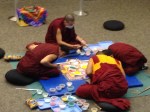

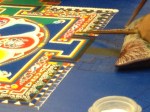




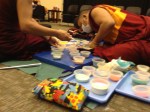
We are lucky to have a tradition of sand mandala making at the U of Arizona Bookstore. Monks have been visiting to draw them on the floor in the basement for years. This is the third one I have been lucky enough to witness. This time they are making the Buddha of Compassion. After they create the image the sweep up the sand and dispose of some of it in water, in a ritual representing the cosmos. This demonstration of attachment and enlightenment is illustrated clearly when the sand is swept and the American viewers rush in to get a bag of the magical sand to take home and keep. The monks don’t need to do that; they are off to draw and destroy many more mandalas all over the world. They do it to show the futility of attachment. It is a beautiful way to illustrate the point.
On September 21 the ancient Greek feast celebrating life, beauty, death, and rebirth began. The Rites of Eleusis resembled All Saints/Thanksgiving/Christmas is some obvious ways. Harvest celebrations started on the equinox and continued until the end of September, with ritual and a secret sacred mystery school. The drama of Demeter and Persephone was reenacted to symbolize the descent of the queen of the underworld every fall, and her rebirth every spring. These celebrations were well attended by people from all over Europe who came to participate in a secret initiation. Rituals celebrating goddess power continued day and night until September 30 when the last of the initiations were performed, deep in caves of the temple.
The British occultist Aleister Crowley produced his own version in 1910 in London, which later seems to have become a rock opera:
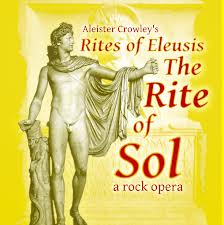
Rites of Eleusis
How do you celebrate the end of summer and the return of darkness? Octoberfest?



At the end of summer when I teach kids to swim I like to hold a show off party so they can impress themselves and others. I had two students this year who worked hard, and came to lessons almost every weekend day all summer. The mermaid blue belt was awarded and the official last call for swimmers to enjoy a dip took place. Conquering fear of water is a metaphor for all new environments that will face these young ladies for the rest of their lives. Being safe and cooperative are the key elements of water fun. Performance skills are not as important as the news that practice works and changes everything. They are in the deep end with appropriate safety measures having a good time, which was not possible in June when they began.

oldest Veteran’s memorial in the US
My 9th great grandfather was killed by my 11th great uncle. King Philip’s War was fought between the Wampanoag people and the colonists of Plymouth. This is the first, but not the last, war on American soil in which I had ancestors on both sides of the conflict. The memorial that commemorates this event is in preset day Providence, RI. It is the oldest Veterans memorial in the US. The vanquished native people were sent to the West Indies and sold into slavery. Nobody knows where the graves of my Wampanoag ancestors are.
Captain Michael Pierce was born in 1615 and died in1676. He and his descendants form the first American generation of Pierces in our family tree. Michael Pierce immigrated to the New World in the early 1640s from Higham, Kent, England to Scituate, in what later became Massachusetts. The ten year period from 1630 to 1640 is know as The Great Migration. During this period, 16,000 people, immigrated to the East Coast of North America.
Brother of famous Colonial Sea Captain, William Pierce. Captain Michael Pierce was the brother of the famous Colonial sea captain, William Pierce, who helped settle Plymouth Colony. Captain Michael Pierce played a significant role in the Great Migration. Historical records show that this one sea captain crossed the Atlantic, bringing settlers and provisions to the New World more frequently than any other. He had homes in London, the Bahamas and Rhode Island. He played a central role in the government of the early colonies. He was killed at Providence, one of the Bahama Islands, in 1641.
There were actually four Pierce brothers who made their mark on the New World: John Pierce (the Patentee), Robert Pierce, Captain William Pierce, and Captain Michael Pierce. All were grandsons of Anteress Pierce, and sons of Azrika Pierce and his wife Martha.
Marries Persis Eames. In 1643, Michael Pierce married Persis Eames of Charleston Massachusetts. His wife was born in Fordington, Dorsetshire England 28 October 1621. She was the daughter of Anthony Eames and Margery Pierce.
Pierce Family Moves to Scituate. Michael and Persis Pierce’s first child, a daughter, was born in 1645 and named Persis in honor of her mother. Unfortunately, their first child died in 1646 at one year of age. The new family settled first in Higham, but moved in 1676 to Scituate, where the Pierce family continued to reside for most of the next century. Scituate is located some 10 miles north of the original Plymouth colony. It was settled as early as 1628 by a group of men from Kent, England.
In 1646, Benjamin Pierce, their second child, a son and heir, was born. This son, Benjamin Pierce, fathered the second Pierce generation in this family tree. Twelve other children were born over the coming years: Ephraim, Elizabeth, Deborah, Sarah, Mary, Abigail, Anna, Abiah, John, Ruth and Peirsis.
Erected First Saw-Mill. Michael Pierce resided on a beautiful plain near the north river and not far form Herring brook. He assisted in erecting the first saw-mill. The mill was the first one erected in the colony. It is believed that Samuel Woodworth (1784-1842) wrote the song, “The Old Oaken Bucket,” concerning this river and mill in Scituate. Samuel Woodworth’s grandfather, Benjamine Woodworth, witnessed the signing of Captain Michael Pierce’s will, on January 1675. The lyrics to this classic American folk tune are given below:
How dear to this heart are the scenes of my childhood, When fond recollection presents them to view, The orchard, the meadow, the deep tangled wildwood, And ev’ry lov’d spot which my infancy knew. The wide spreading stream, the mill that stood near it, The bridge and the rock where the cataract fell. The cot of my father, the dairy house by it, And e’en the rude bucket that hung in the well. The old oaken bucket, the ironbound bucket, The moss-covered bucket that hung in the well. The moss-covered bucket I hail as a treasure, For often at noon when returned from the field, I found it the source of an exquisite pleasure, The purest and sweetest that nature can yield. How ardent I seized it with hands that were glowing, And quick to the white pebbled bottom it fell. Then soon with the emblem of truth overflowing, And dripping with coolness it rose from the well. The old oaken bucket, the ironbound bucket, The moss-covered bucket that hung in the well. How soon from the green mossy rim to receive it, As poised on the curb it reclined to my lips, Not a full flowing goblet could tempt me to leave it, Tho’ filled with the nectar that Jupiter sips. And now far removed from the loved situation, The tear of regret will intrusively swell. As fancy reverts to my father’s plantation, And sighs for the bucket that hung in the well. The old oaken bucket, the ironbound bucket, The moss-covered bucket that hung in the well.
Captain in the Local Militia Fighting the Indians. Unlike his famous brother, Captain William Pierce, Michael Pierce was not a sea captain. He attained the title, Captain, from the Colony court in 1669. Historical records show that he was first given the rank of Ensign under Captain Miles Standish, then later, in 1669, he was made Captain. These titles reflects his role as a leader in the local militia formed to protect the colony from the Indians.
Honored for Heroism in King Phillip’s War. Captain Michael Pierce’s memory is well-documented in American history. He is honored for the brave manner in which he died in defense of his country. The exact manner in which he died is repeated in more than 20 books and letters detailing the military history of the King Phillip’s War. This war took place between 1675 and 1676, and remains one of the bloodiest conflicts in American history. It was also a pivotal point in early American history. Although the English colonists were ultimately victorious over the Indians, it took the colonies over 100 years to recover from the economic and political catastrophy brought about by this conflict.
The battle in which Captain Michael Pierce lost his life is detailed in Drakes Indian Chronicles (pp. 220-222) as follows:
“Sunday the 26th of March, 1676, was sadly remarkable to us for the tidings of a very deplorable disaster brought into Boston about five o’clock that afternoon, by a post from Dedham, viz., that Captain Pierce of Scituate in Plymouth Colony, having intelligence in his garrison at Seaconicke, that a party of the enemy lay near Mr. Blackstorne’s, went forth with sixty-three English and twenty of the Cape Indians (who had all along continued faithful, and joyned with them), and upon their march discovered rambling in an obscure woody place, four or five Indians, who, in getting away from us halted as if they had been lame or wounded. But our men had pursued them but a little way into the woods before they found them to be only decoys to draw them into their ambuscade; for on a sudden, they discovered about five hundred Indians, who in very good order, furiously attacked them, being as readily received by ours; so that the fight began to be very fierce and dubious, and our men had made the enemy begin to retreat, but so slowly that it scarce deserved the name, when a fresh company of about four hundred Indians came in; so that the English and their few Indian friends were quite surrounded and beset on every side. Yet they made a brave resistance for about two hours; during which time they did great execution upon their enemy, who they kept at a distance and themselves in order. For Captain Pierce cast his sixty-three English and twenty Indians into a ring, and six fought back to back, and were double – double distance all in one ring, whilst the Indians were as thick as they could stand, thirty deep. Overpowered with whose numbers, the said Captain and fifty-five of his English and ten of their Indian friends were slain upon the place, which in such a cause and upon such disadvantages may certainly be titled “The Bed of Honor.” However, they sold their worthy lives at a gallant rate, it being affirmed by those few that not without wonderful difficulty and many wounds made their escape, that the Indians lost as many fighting men in this engagement as were killed in the battle in the swamp near Narragansett, mentioned in our last letter, which were generally computed to be above three hundred.”
Today, in Scituate, there is a Captain Pierce Road.
In Cumberland, Rhode Island, there is a monument called Nine Men’s Misery. A tablet near the monument reads:
NINE MEN’S MISERYON THIS SPOT WHERE
THEY WERE SLAIN
BY THE INDIANS
WERE BURIED
THE NINE SOLDIERS
CAPTURED IN
PIERCE’S FIGHT
MARCH 26, 1676
The monument is located in a dark, place in the woods, near a former monastery. The monastery is now a public library. The monument consists of little more than a pile of stones cemented together by a monk and marked with a plaque. However, this site is of major historical significance because it is concidered to be the oldest monument to veterans in the United States.
1. Captain Michael Pierce born 1615; died 3/26/1676.
married Persis Eames, 1643 (born. Oct. 28, 1621; died Dec. 31,1662). Micheal Pierce and Persis Eames had these 13 children:
2. Persis Pierce, born 1645. Persis died 1646 at 1 year of age. 3. >>>Benjamin Pierce, born 1646. 4. Ephraim Pierce, born 1647. Ephraim died 1719 at 72 years of age. 5. Elizabeth Pierce, born 1649. She married a Holbrook and gave birth to Captain Michael Pierce’s only two grandchildren at the time of his death who are mentioned in his will: Elizabeth Holbrook and Abigail Holbrook. 6. Deborah Pierce, born 1650. 7. Sarah Pierce, born 1652. 8. Mary Pierce, born 1654. She married Samuel Holbrook, 23 June 1675. Samuel was born in Weymouth, Mass 1650. Samuel was the son of William Holbrook and Elizabeth Pitts. Samuel died 29 October 1712 at 62 years of age. Mary Pierce and Samuel Holbrook had the following six children: Persis, Elizabeth, Bethiah, Samuel, Elizabeth, and Mary. 9.Abigail Pierce, born 1656. Abigail died 1723 at 67 years of age. 10. Anna Pierce, born 1657. 11. Abiah Pierce, born 1659. She married Andrew Ford. 12. John Pierce, born 1660. John died 28 June 1738 at 77 years of age. He married Patience Dodson 12 December 1683. 13. Ruth Pierce, born 1661. 14. Peirsis Pierce, born 1662. Persis 3 December 1695. She married Richard Garrett, 3rd, who was born in 1659. They lived in Scituate, Mass. and had three children: John (born 1706), Anna, and Deborah.
married Mrs. Annah James sometime soon after 1662. They had no children. Captain Michael Pierce remained married to Annah Pierce until his death. Annah Pierce is well provided for in his will.
Michael Pierce (1615 – 1676)
is my 9th great grandfather
Ann Pierce (1640 – 1655)
daughter of Michael Captain Pierce
Sarah Kinchen (1655 – 1724)
daughter of Ann Pierce
Philip Raiford (1689 – 1752)
son of Sarah Kinchen
Grace Raiford (1725 – 1778)
daughter of Philip Raiford
Sarah Hirons (1751 – 1817)
daughter of Grace Raiford
John Nimrod Taylor (1770 – 1816)
son of Sarah Hirons
John Samuel Taylor (1798 – 1873)
son of John Nimrod Taylor
William Ellison Taylor (1839 – 1918)
son of John Samuel Taylor
George Harvey Taylor (1884 – 1941)
son of William Ellison Taylor
Ruby Lee Taylor (1922 – 2008)
daughter of George Harvey Taylor
Pamela Morse
I am the daughter of Ruby Lee Taylor
When I read that he’d died during the Great Swamp Fight, it peaked my interest so I bought a book called King Philip’s War The History and Legacy of America’s Forgotten Conflict, by Eric B. Schultz and Michael J. Tougias. The following is an excerpt from the book describing Michael Pierce’s involvement in the conflict.
KING PHILIP’S WAR
PIERCE’S FIGHT, CENTRAL FALLS, RHODE ISLAND
The ambush of Captain Michael Pierce and his Plymouth Colony soldiers
occurred on Sunday, March 26, 1676, in the present-day city of Central
Falls, Rhode Island. Sometimes attributed to the Narragansett sachem
Canonchet, this ambush was in many respects a textbook military operation.
Several friendly natives escaped the engagement, but only nine English
survived, and these nine men were later discovered dead several miles
north of Central Falls in present-day Cumbedand, Rhode Island, a site now
known as Nine Men’s Misery. Not only was the ambush deadly for Pierce
and his men, but it was devastating to the morale of the colonies which, on
the very same day, witnessed the murder of settlers in Longmeadow, Massachusetts,
the burning of Marlboro, Massachusetts, and the destruction of
Simsbury, Connecticut.
Pierce, a resident of Scituate, Massachusetts, had gathered in Plymouth
a force of Englishmen from Scituate, Marshfield, Duxbury, Eastham, and
Yarmouth, supported by twenty friendly natives from Cape Cod. Together,
this band marched to Taunton, then along the Old Seacuncke Road
(Tremont Street) to Rehoboth (now East Providence, Rhode Island).
There, they were joined by several men from Rehoboth, expanding their total
number to sixty-three English and twenty friendly natives.
Reports indicated that a large group of the enemy had gathered in the
area of Pawtucket Falls, an ideal location from which to catch alewives,
salmon, and shad, and a natural fording spot in the river.149Pierce and his
men set out in pursuit. On Saturday, March 25, they skirmished with the
Narragansett, perhaps north of the falls, where, historian Leonard Bliss
concludes, Pierce “met with no loss, but judged he had occasioned considerable
to the enemy.”
It is not unreasonable to think that Pierce had skirmished with a small
patrol sent intentionally to meet and test the English-an exercise broken
off by the natives once they had gathered information on the size and”
strength of their opponent. In any event, Pierce met no other natives and returned
for the night to the garrison at Old Rehoboth. Meanwhile, armed
with information from the skirmish, native leaders undoubtedly set to work
devising a trap for the English troops.
On Sunday, March 26, Pierce and his troops returned to the field, probably
marching from present-day East Providence, north along the Seekonk
River (which becomes the Blackstone River), back toward Pawtucket Falls.
It is said that as they marched, they were watched by Narragansett from
Dexter’s Ledge, now the site of Cogswell Tower in Jenks Park, Central Falls
(rough distance and heavily wooded terrain made this questionable).
Somewhere close to the Blackstone, perhaps near a fording spot where
Roosevelt Avenue now crosses the river, in what Bliss describes as an
“obscure woody place,” they spotted four or five Narragansett fleeing as
if wounded or hurt. Had a more experienced commander witnessed this
show, he might have immediately fallen back. However, Pierce and his
troops charged after the bait, suddenly finding themselves surrounded by
“about 500 Indians, who, in very good order, furiously attacked them.”
Pierce apparently met the ambush on the eastern side of the Blackstone,
but crossed to the western side, where the natives were engaged in force. A
contemporary account of the battle by an anonymous Boston merchant,
paraphrased by Bliss, made the English out to be as heroic as possible, but
the devastation was complete:
Our men had made the enemy retreat, but so slowly, that it scarce deserved
the name; when a fresh company of about 400 Indians came in,
so that the English and their few Indian friends, were quite surrounded
and beset on every side. Yet they made a brave resistance for above two
hours, during all which time they did great execution upon the enemy,
whom they kept at a distance, and themselves in order. For Captain
Pierce cast his 63 English and 20 Indians into a ring and fought back to
back, and were double-double distance all in one ring, whilst the Indians
were as thick as they could stand thirty deep: overpowered with
whose numbers, the said captain, and 55 of his English, and 10 of their
Indian friends were slain upon the place; which, in such cause, and
upon such disadvantages, may certainly be styled the bed of honour.
It is unlikely, of course, that nine hundred natives participated in the ambush.
Nor does it seem logical that eighty-three men, disadvantaged by surprise,
terrain, and numbers, would have much chance of forcing even four
hundred warriors to retreat. (Contemporary writers reported that Pierce
and his men killed 140 of their enemy, a figure undoubtedly inflated.)
However, if Pierce and his troops crossed the Blackstone near present-day
Roosevelt Avenue, the battle may have moved northward along the river to
a spot near present-day Macomber Field on High Street, where a commemorative
marker was placed in 1907. The marker reads:
PIERCE’S FIGHT
NEAR THIS SPOT
CAPTAIN MICHAEL PIERCE
AND HIS COMPANY OF
PLYMOUTH COLONISTS
AMBUSHED AND OUTNUMBERED WERE
ALMOST ANNIHILATED
By THE INDIANS
MARCH 26 1676
ERECTED By THE STATE OF RHODE ISLAND
IN 1907
A visit to this site today places the traveler in a heavily industrialized area
surrounded by factories and baseball fields. It is worth remembering, however,
that Central Falls was once the “North Woods” of Providence and
remained only sparsely settled throughout the eighteenth century.
Marching along, Pierce would have seen a wooded land of oak, walnut,
chestnut, and birch trees with three falls (Pawtucket to the south, Valley to
the north, and Central near the crossing at Roosevelt Avenue) supplying the
Narragansett with rich fishing grounds. ’59Bycontrast, present-day Central
Falls is so densely built that the Blackstone River is all but invisible from
nearby Cogswell Tower.
Not all of Pierce’s troops died in the ambush. Several of the friendly natives
devised ingenious means of escape. One blackened his face with powder
like the enemy and passed through their lines without incident.16oAnother
pretended to chase his comrade with a tomahawk, the two running past
their enemies and on to safety.161It appears also that nine English soldiers
escaped death during the ambush, though the details of their story are conjecture
only. One tradition holds that they had gone ahead of the main body
of troops and were chased into present-day Cumberland, where they made
their stand against a large rock and all perished.161
A more plausible explanation is that these nine survived the ambush,
were taken prisoner, and were marched northward about three miles to a
piece of upland surrounded by swamp known as Camp Swamp. Here, upon
a large rock, they were executed. It was several weeks before their bodies
were found, scalped and uncovered, on this rock. The men were buried
some seventy yards northeast of the rock in a common grave. Above this
grave a heap of small stones was used to construct a fourteen-foot-Iong
stone wall, some three feet high and one foot wide at the base. To this
day, residents know this place as Nine Men’s Misery.
In the early twentieth century a cairn of stones (since damaged) was
placed over the spot, and in 1928 a granite marker was set by the Rhode Island
Historical Society. The marker reads:
NINE MEN’S MISERY
ON THIS SPOT
WHERE THEY WERE SLAIN BY
THE INDIANS
WERE BURIED THE NINE SOLDIERS
CAPTURED IN PIERCE’S FIGHT
MARCH 26, 1676
The cairn and marker can be found near the former Cistercian Monastery
on Diamond Hill Road, about six-tenths of a mile south of Route 295 in
Cumberland. (These grounds are now home to the Hayden Library, the
Northern Rhode Island Collaborative School, the Cumberland Senior Citizens
Department, and other city services.) A dirt road, heading northnortheast
from the northeast corner of the grounds, leads directly to the
site, which requires about a quarter-mile walk. (Many residents walk and
jog in this area and are able to point a visitor in the right direction.)
Around the time of the American Revolution a physician dug up remains
from the grave, identifying one skeleton as that of Benjamin Buckland
of Rehoboth by its large frame and double set of teeth.r65 When the
Catholic Order of Monks purchased the land, remains of the men killed at
Nine Men’s Misery were dug up and given to the Rhode Island Historical
Society. During the 1976 bicentennial celebration, after the land had been
turned over to the town of Cumberland for its use, the bones were reburied
at their original site.
 mermaidcamp