mermaidcamp
Keeping current in wellness, in and out of the water
You can scroll the shelf using ← and → keys
You can scroll the shelf using ← and → keys
We may not have had formal training in meditation as children, but we probably had profound spiritual experiences as a natural part of childhood. Contemplation is a normal activity. When life is undisturbed we contemplate our surroundings, our connection to the universe, and more. If you scan your past for times during which you felt connected, in a state of grace, or full of bliss you will find them. By bringing back the feeling of spontaneous enlightening experiences we might be able to recreate that magic today. Our conscious minds often cling to our problems, our challenges, and our individual specialty suffering, keeping these wounds close to the surface. Through practice we can train the mind to hold on to the positive, unexplained flashes of light and insight, treating them as our natural state. Bringing contemplation and spacious states of mind into our practice is liberating. The long term benefits can be compared to physical strength or agility in the body. We don’t know what demands the future will put on that preparation. We can only learn when an event challenges that strength. We know we will encounter stressful situations and loss in our lives. A meditative state of mind is the very best investment/tool to cope with adversity that can be acquired.
There are many forms of meditation. A qualified teacher is not always available, but can show the student how to create the transition into mindfulness. If you believe that you have never meditated, let your memory go over the special times of youth that stand out in your memory today. You will probably be able to identify a few enchanted, enlightened times that brought you a glimpse into eternity. That lightness is a state that is available to you always. What is required is a steady practice. Walking, chanting, sitting….the style does not matter as long as it suits the user. The pure state of bliss meditation brings the practitioner is the armor that protects the mind from stress and worry. It is the true fountain of youth.
Wisdom springs from meditation;
without meditation wisdom wanes.
Having known these two paths of progress and decline,
let one so conduct oneself that one’s wisdom may increase.
Dhammapada 20.282
The Buddha
Do you know places, people, or even things that have a healthy, restorative feeling for you? Some spots have been used as healing centers for centuries, acquiring a reputation and a following. Sometimes a professional office space or treatment room can resonate with peace and calm. Waterfalls are typical places that we imagine when we are seeking a retreat from stress and pain in daily life. Some of us reserve space in our homes dedicated to meditation, contemplation, or exercise. Altars at home are reminders of practice, devotion, and connections to spiritual beliefs. I have always been a big fan of visiting hot mineral springs to center my attention on nature and soul. Submersion is both literal and symbolic in healing waters.
I have gone to great lengths and spent a pretty penny to be in healing waters, treated by gifted therapists, relaxing in spectacular places in nature. The concept of healing travel, or wellness retreat must involve a capture of that serenity or wholeness to bring back to the daily practice. Perhaps in calm circumstances one can master a new meditation technique or discover new ways to practice. Maybe while the agenda is clean and clear one can let go of emotional and physical clutter that has daily life fully jammed. Travel to a different location does not guarantee a retreat or a lifestyle change. It is possible, and maybe even preferable, to turn normal living into a health reforming adventure. Finding calm, creating depth, and mastering the art of stress reduction can be practices we include in our routine.
To enter a new lifestyle, a healthier diet plan, a new willingness to live happily, we need to feel confidence. What are ways you establish a meditative, healthy, confident mood? Here are some ways I have tried that work for me:
Don’t wait for your vacation days to move into your personal health retreat mansion. Pick up the keys and live in your own healing presence. Build your confidence while you enhance your surroundings for a healthier, happier outlook.
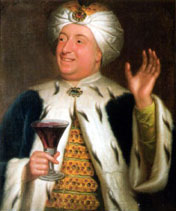
Sir Francis Dashwood
The word dilettante is derived from the Latin word delectare, to delight. The English word came to us from Italy, and originally had no negative connotation. Any person who loves art, sports, or cooking, for example, can launch a happy career as a dilettante. Amateur is a word that indicates love for a subject. I have no problem embracing the novice in myself. One does not need professional training or certificates to be delighted with a pursuit. This archetype seems to be blooming today with all the new ways to share our art work, recipes, or other accomplishments. I am comfortable with this surge in creativity. The shadow characteristic of the dilettante is a tendency to be superficial and shallow. We have all met this person who pretends to know, or sets themselves up as a master without foundation.
I think the meaning was turned on it’s head by the Dilettante Society, a club formed in London in 1734. Initially the society had a mission to transform public taste by supporting and importing arts from Greece and Italy. All of the original members had been on the Grand Tour and were wealthy. Sir Francis Dashwood was the first leader of the club, and an all around prankster. These rich Brits were the embodiment of the shadow of this archetype. They did a lot of boozing while they traveled and launched art and architecture studies. The Dilettantes of today are working to revive respect for those who dabble. After all, if you don’t attempt new things as an amateur how will you find out if you have talent for them? In support of this new wave I plan to show up for pickleball practice, a team sport at which I will, no doubt, suck. I have not been a team sport player since whiffle ball in the yard in elementary school. If I can’t cut the mustard on the court, I can always be a cheerleader.
I saw a doctor and a veteran on the national news who said the way to solve the VA problem is to dissolve it. I agree completely. I volunteered at the VA because I still believed I could raise the standard of care when I did it. Not only was it impossible to raise the standard of care for just one person to whom I was assigned, the entire institution is unethical and scary as hell. The electronic medical records system is abused constantly, as are the patients. As a taxpayer I was shocked and upset at the use of funds to do nothing for the patients. Money is used liberally, but the outcomes and the patients are the least of the agency’s concern. As featured in the recent Phoenix scandal, the employees at the VA are shooting for big bonuses rather than improving the lives of the Vets. They are so far off course that it can’t be remedied. There is a culture of extreme abuse and fraud. Those Veterans can just go to doctors of their choice and we can run it like the congressional health care system. We don’t need to institutionalize abuse any more than we already have.
I was assigned to visit patients at home. My fist dude lived at home with his wife. After he died I was assigned to my second patient who lived in a care home. Both of them mentioned problems with health care and thought I could help them. I thought so too, until I tried. The premise was that we would report unsafe of undesirable conditions, which the VA could fix. The problem was that no matter how much money was spent they never addressed the issues. They simply did something, with no consideration of the needs of the patient. It was a waste-o-rama. When I met my second patient I could hear the feedback from his hearing aid across the room. He asked if I might be able to help him get hearing aids that did not screech. That seemed simple enough, but after more than a year and several long hard visits to the hospital his hearing aid was still loud enough for me to hear it from across the room. He was suicidal and talked frequently about it, but after a few attempts at helping him with other VA problems I knew it was a mistake to tell them anything that would make them torture him any more. I finally threw in the VA towel when they directed me to leave him as I found him one day, unconscious and unresponsive in his care home. I had called a nurse, who looked at him for about a minute and left. I was instructed by the VA not to call 911 or take any action to save his life. I had to quit my official position and visited him myself without doing any reports to the VA. His health was in severe decline and he was not able to wake up most of the time, so I eventually stopped visiting him because it was emotionally draining and frustrating. Nothing he or I asked the VA to do for him was done, but plenty of people received salaries milling around pretending to care for him. I called the local senior care advocate to help him get out of some of his problems, which did work. The VA told me that was a conflict of interest, and I was never to seek real help for him from other institutions. I was working against my own beliefs by representing the VA, so I had to end that.
Being left on a waiting list for care is unacceptable, but sadly, so is the care given when they finally manage to give it. I have heard of those who have had good experiences with VA health care, but nothing recent. There is no reason to have a separate, corrupt and highly unregulated system that does not serve the patents well. If we can reform health care, we can eliminate the waste and abuse that the VA contains. Those who have risked everything deserve the best. Taxpayers deserve to know we are giving them the best care available. This situation is highly symbolic to me of the disrespect government frequently displays for the citizens who pay for it. I am a pacifist, so my concern for the soldiers is moral and ethical. I did not want to send them off to war, but since it has happened I sincerely believe we need to honor that sacrifice they made.
The liberator serves others in political and sometimes military capacities. Freeing others from injustice and adverse conditions is the role played by the archetype. The words terrorist and liberty have been used and diluted to the point that we are weary as well as wary of news of political freedom. Shadow liberation is often substitution of one violent group for another equally intolerant one. The kidnapping of the school girls in Nigeria has galvanized world opinion on the need for urgent action to find and free them. Jesus, Muhammad, and Buddha were liberators in their places and times in history. The goddess Tara is known as the swift liberator because her nature is to answer very quickly when she is called.
Mantra is a way to meditate and call on Tara to teach us to be free of the 8 fears. Green Tara is pictured with her right foot in front of her because she is symbolically ready to hurry to those who call her. If sound meditation is new to you, the power of it may come as a surprise. We need the swift and sure guidance of Tara to reach the girls and bring them to safety. The mantra above is easy to learn, but even if you simply listen with the idea of freeing the kidnappers as well as the girls from the situation, it is positive. Please join us, gentle reader, to #BringBackOurGirls. Let us create a worldwide mantra of liberation that will reach into the African jungle to bring them home.

Flagon and Trencher Society
My 11th great-grandfather was a tailor who sailed to America with his family in 1639. He was a tavern keeper and a deacon in Sudbury, MA. His tavern, licensed in 1653, was operated continuously as the Parmenter Tavern until 1880:
John PARMENTER Dea. was born about 1588 in England. In a publication (ParmenterStory) by Roland A Dahir, at the 400th birthday of Dea. John Parmenter he writes that, according to a Parmenter descendant, Marjorie J Parmenter and George M Parmenter, Dea. John was born in Sible Hedingham County Essex, England on 12 Jan 1588; he m Bridget in Little Yeldham on 12 Jun 1609; she was born at Bures St. Mary, Country Essex on 12 Feb 1589. He was buried on 1 May 1671 in Roxbury, Suffolk, MA.2,15
John and both children are mentioned in his father (William) Will in 1613, but he inherited no lands or tenements from his father. Following his father’s death in 1617 John moved to about eight miles from Little Yeldham into Bures St. Mary. John’s connection to Bures St. Mary can be seen in his association with Philemon Whale and Herbert Pelham, residents of Bures St. Mary who emigrated to Sudbury [The Puritan village, Sumner Chilton Powell, Appendix I, Wesleyan Univ. Press, 1963] A comparison of the signature of John Parminter as a witness in the original will of Henry Loker of Bures St. Mary with an autograph signature of Dea. John Parmenter as a commissioner of Sudbury, MA, 6 Jan 1639/40 shows that the two signatures were made by the same hand. [Suffolk Co. Court files, Boston, NO.162004]
In 1639 John Parmenter emigrated to New England with his wife Bridget and children Mary and John Jr; in his party were the widow Elizabeth Loker and her children. The name of the ship or port of departure is not known. John Parmenter was one of the original proprietors of Sudbury, and was assigned lands May 1640 by the General Court of the Massachusetts Bay colony [Suffolk court files, vol. I, No. 304, microfilm #A360, Univ MA, Amherst]. John was chosen early as a Selectman; then Deacon, and Commissioner; he desired to be made Freeman 13 May 1640 [NEHGS Reg. Vol 13, 261], and made freeman 10 May 1643.
Following the death of his first wife, he married Annis (Bayford)(Chandler) Dane and relocated to Roxbury where he died on 1 May 1671; his will was dated 25 Mar 1671, and proved 25 Jul 1671.
John PARMENTER Dea. and Bridget were married about 1609 in England.2,3 Bridget was born before 1599 in England. 2,3
Found on http://www.parmenter-fam-assn.org/PPA2%20Cln%20090105.PDF
John Parmenter (1588 – 1671)
is my 11th great grandfather
Mary Parmenter (1610 – 1690)
daughter of John Parmenter
John Woods (1641 – 1716)
son of Mary Parmenter
Lydia Woods (1672 – 1738)
daughter of John Woods
Lydia Eager (1696 – 1735)
daughter of Lydia Woods
Mary Thomas (1729 – 1801)
daughter of Lydia Eager
Joseph Morse III (1752 – 1835)
son of Mary Thomas
John Henry Morse (1775 – 1864)
son of Joseph Morse III
Abner Morse (1808 – 1838)
son of John Henry Morse
Daniel Rowland Morse (1838 – 1910)
son of Abner Morse
Jason A Morse (1862 – 1932)
son of Daniel Rowland Morse
Ernest Abner Morse (1890 – 1965)
son of Jason A Morse
Richard Arden Morse (1920 – 2004)
son of Ernest Abner Morse
Pamela Morse
I am the daughter of Richard Arden Morse
John and Bridget Parmenter
John – b. about 1588, probably at Little Yeldham, Essex, England; d. June 1, 1671, Roxbury, MA. Son of William PARMENTER and Margery. John, a tailor by trade, arrived with his family in New England from Great Yarmouth in 1639. He became freeman May 13, 1640 and served as a deacon and selectman of Sudbury, MA. By 1654, John PARMENTER was authorized by the town of Sudbury “to keep a house of common entertainment and that the court shall be moved on his behalf to grant a license to him” (Colonial Tavernrkeepers, Vol. 5, edited by Harriet Stryker-Rodda, 1982, page 19). His will, dated Mar. 25, 1671 and proved Jul. 25, 1671, names his second wife, son-in-law John WOOD, grandson John PARMENTER, and cousins CHEEVERS and John STIBBINS. John married second Aug. 9, 1660 at Roxbury, MA, Annis BAYFORD (d. Mar. 15, 1682/3, Roxbury, MA; bur. there Mar. 17, 1682/3), widow of William CHANDLER and John DANE. John and Bridget were married about 1609, probably at Bures St. Mary, Suffolk, England.
Bridget – b. probably at Bures St. Mary, Suffolk, England; d. Aug. 6, 1660, Sudbury, MA. She was probably the sister of Elizabeth, wife of Henry LOKER. Bridget and Elizabeth may have been daughters of William PERRY or of John SIMPSON, who both had daughters with their names baptized at Bures St. Mary between 1585 and 1593.
Children of John and Bridget Parmenter
Mary – b. about 1610, probably at Bures St. Mary, Suffolk, England; d. Aug. 17, 1690, Marlborough, MA. Married John WOODS.
John – b. about 1611, probably at Bures St. Mary, Suffolk, England; d. Apr. 12, 1666, Sudbury, MA. Married about 1638 in England to Amy. Son: John married Anna CUTLER.
Isis is the mother goddess from Egypt. She rules intuition, magic, and medicine. In our celebration of Mother’s Day let us give thanks for our second sense. Knowing without the reason to know is a gift that can be developed and fine tuned. Notice that certain places, people or objects grab your attention and keep it. Other people and things can come and go without striking up much meaning or memory. The unconscious mind absorbs energy and makes primal instinctive responses. Our emotions are part observation and part deep underground images that are brought to light in various ways. In dreams we only see faces we have seen during our lives. We may not recognize them as we dream, but they represent a symbol, an image, or a story that has meaning for us. The symbols and images we find in dreams and synchronous encounters are encrypted messages from the unconscious.
A centered person has a rich inner sense of spirit, grounded by soul. A balance between rational and intuitive mind is important for emotional wellbeing. As we grow older we may find that more psychic experiences become natural to us. The environment in which we live will determine how freely we can express ourselves on these matters. I think some cases of modern depression result from a tension and polarity between reason and intuition. Our psychic abilities, such as they are, may be a surprise gift. This year for Mother (human or Mother Earth) be grateful for all the gut feelings and saving graces you have had in your life. Be open to more instant insight and enlightenment.
Our own characters often resemble mythological beings in classic stories. Do we portray one myth more than any other? Are we stuck in a certain drama until we finally understand the meaning of it? The study of archetypes is a study of mythology. Metaphor and symbolism create stories that resonate with meaning in our lives. The admirable goddess qualities include wisdom, physical grace and strength, sensuality, beauty, and guidance. In our world today there are many shadow goddesses. The overly indulged celebrities can reflect the shadow goddess. There is commercial pressure to imitate the unhealthy, perfectionist, unkind diva. It may be helpful to learn more about the positive myths.
Do you know the stories of any of these goddesses?
The associations with female power and myth have been twisted in some modern contexts. Some study and meditation on the energy of these female figures in mythology can bring us closer to understanding our lives. Our relationship with Mother Earth could use some work. Do you bring the goddess concept into your meditations, gentle reader? Do you have a favorite goddess?
Sports fans and all Americans need to be ashamed that this much institutionalized racism can exist in professional sports. When I was a child I was a Pittsburgh Pirates fan, with special emphasis on my love for Roberto Clemente. I went in person to many games at Forbes Field, and listed to the others on my transistor radio. I hold a big grudge against my dad for an incident that took place when I was about 10. We went to lunch at The University Club before games, then walked to the field. One such day Roberto himself was eating in the dining room at the University Club before a game. I wanted to get his autograph, naturally. My dad was very strict and gave a lecture about treating everyone with respect. Of course this was the first black person I had seen eating in that dining room, and it may have been many years before there was another. Richard Arden Morse was a bit of a racist in some ways, but he was firm about not disturbing Roberto to indulge me. I was angry (and still am, if truth be told), but I will always remember the point. It had to do with dignity, and making sure his visit to our snooty club was treated as a natural event. I loved Roberto for his athleticism, and was unaware until later in life of his fight to attain equality as a black baseball player. He is still me favorite athlete of all time.
This rings in my mind when I see this Sterling guy still living some horrible stereotype lifestyle that belongs in the distant past. The nasty truth about this story must be exposed. In no uncertain terms we must reject his behavior. Each of us has some part to play in this, if only by voicing an opinion. I am with Magic in thinking he needs to say he does not want to own a team now. What do you think, gentle reader? Does this freak you out?



Stealing is a way of life. Sometimes we are the victims and other times we are the thief. Laverna is the goddess of darkness and criminal intent. She is the patron goddess of thieves and robbers. She teaches a very strong lesson about mortality. If we value that which can be stolen we will be too involved in a world that has no meaning. If we, instead, focus our efforts to create lasting creative work that benefits others it will be impossible to steal those benefits. Dishonest tradesman pray to her for the power to deceive and persuade. She is con woman herself who uses trickery to gain advantage over humans.
None of us will go through life without being tricked or robbed. Frequently these losses are caused by people we know. Financial ignorance is an aspect of Laverna. Allowing others to steal energy, time or valuable assets is submission to her power. The lesson of what is valuable and can never be taken from you is the wisdom she can bestow. Looking back at your life you will be able to find times when you felt significantly cheated or robbed. It is also possible to identify yourself in the role of con artist. Young children often deceive their parents and siblings, for instance. Taking a realistic look at the past, what has treachery and robbery taught you, gentle reader? Have you found that which you own that nobody can steal? Have you ever caught yourself stealing from yourself?
 mermaidcamp