mermaidcamp
Keeping current in wellness, in and out of the water
You can scroll the shelf using ← and → keys
You can scroll the shelf using ← and → keys
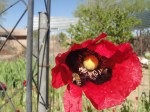
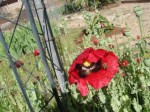
Poppies have been cultivated since ancient times. Poppy seeds are used in magic as well as in cooking. They are associated with rest and remembrance. It was mythically created by Ceres while she was in search of Persephone, as a symbol of grief. Death and pleasure are symbolized by red poppies. The bees are very active on them, although red flowers are typically pollinated by hummingbirds. I think they are being sedated.





Last night was the first food and wine tasting presented by Slow Food in Tucson. I would call it a complete success.


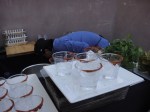


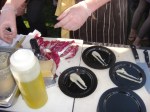

We attended with our friend Sara, who enjoys a tasty bite as much as we do. We arrived early, and set out with a really outstanding Bloody Mary served by Pasco kitchen and lounge. Their urban farm cuisine is totally amazing. We plan to go to brunch there this weekend for more. We tasted our way through the most innovative dishes and drinks put together in one place by the Slow Food people. The live band and the lively crowd of foodists made this a party to treasure in the tastebuds of the mind. I started out to be very precise and document all the flavors and happy moments, and then happiness took over. We ran into old friends and I abandoned the picture taking to just have fun. I am not, gentle reader, a real reporter. I am an enthusiastic and opinionated blogger who loves to taste. I had more wine than beer, but am still of the opinion that the beer is better in Arizona than the wine. The beverages were all worth trying and complimented the food nicely. I came away liking a beer from Dragoon Brewery as my fave new discovery. It is Stronghold Session Ale, with a dark and festive flavor.
The chefs all made amazing bites, and were willing to serve me the plate without meat when it was easy. Chef Ryan Clark, the host chef of the event, served green posole, vegetarian, with the option to add pork. I loved him for that, and think the posole should go on his menu because it is epic. Doug Levy from Feast made mesquite biscuit mini sandwiches that drove me and the whole crowd wild. Everyone was talking about those. He did not mind that we were all snatching more than one. The radishes with mozzarella foam butter from Zona 78 were incredible, as was the grilled radicchio. They brought their farmers with them which was very cute. Acacia served me a plate minus the meat which was fabulous. There was no bad food at all. From my own taste perspective I gave Nancy Taylor, a woman who wrote a book and supports Slow Food with it the best dish award. She served prickly pear. Nopales, prickly pear cactus pads, are delicious, lower the blood sugar of those who eat them, and are virtually free to anyone who wants to go pick cactus. I adore nopales, and have a never ending search for the best recipe featuring them on earth. At the moment Ms Taylor is in first place with her tepary been, chiltepin salad. I will knock this off in my kitchen very soon. The contest will continue, however. Don’t hesitate to contact me, gentle readers, if you have a recipe for nopal. I am open to learning them all.
We discussed our discoveries on the way home in the car. Bob, Sara and all have all discovered new restaurants we want to visit, and been reminded that we are surrounded by talented, caring, creative chefs. This is all very good news.
Today (April 16) in 1881 In Dodge City, Kansas, Bat Masterson fights his last gun battle. He is fined $8:00.
Guns and power are the entire subject of the cowboy and Indian movie genre. In my youth the entertainment was all about John Wayne and his ilk being in WWII with explosives, guns, and drama, or being in the Wild Wild West with the same scenario. My dad grew up in rural Kansas and Oklahoma, where guns were used for hunting, but he did not hunt because he had poor eyesight. He developed a love for fishing, which did not require keen sight. I personally learned to shoot a rifle when I was about 4 and my parents left me for a stay in Arkansas at my grandparents’ farm. I remember being very fond of it and liking it when my grandpa called me Annie Oakley. I thought target pracice was romantic and cool.
There were no guns in my house, so after my early youth I rarely saw anyone use guns anywhere. The first night I slept in Caracas when I was 13 I saw a murder from my hotel room on about the 10th floor of the Tamanaco. I freaked out entirely because there was lots of blood on the white shirt of the victim. The following day we learned that two hotel guards had shot each other, and that was the whole thing. Armed guards patrolled the petroleum company compound where I lived in rural Venezuela, which kind of resembled a military base. I thought nothing of it. Although I lived in Texas during high school, I still knew nobody who owned or shot guns.
The gun violence debate in the country is alien to my thinking. I am not comforted by the presence of guns. I don’t care to own or shoot one. The citizens who feel so strongly one way or the other about guns are starting to go haywire. The debate itself is getting scary.
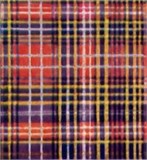
Clan Ogilvy tartan
Sir Walter was a sheriff who died in a battle. This was more or less natural life in Scotland in the middle ages. They had a very bellicose existence.
SIR WALTER OGILVY OF AUCHTERHOUSE, Knight, Sheriff of Angus. He is designed ‘Walter of Ogylwy miles’ in a charter by Thomas Sybald of Moneythin to Andrew Petcary of the lands of Monethin about 1368. On 24 October 1385 he had a grant from KingRobert II. of an annualrent out of the lands of Kyngaltny.
He was Sheriff of Angus before 1380. Douglas and Crawford state that he obtained the office by his marriage with Isabel Ramsay, daughter and heiress of Sir Malcolm Ramsay, Lord of Auchterhouse, but give no authority for their statement, and some doubt is cast upon it by a confirmation by King James III., 18 February 1482-3, of a charter by the late Alexander of Ogilvy, Sheriff of Forfar, of the lands of Balkery to his sister Matilda of Ramsay, relict of William of Fenton: the date of the original charter is therein stated to be at Auchterhouse, 21 August 1488, which is impossible, and is most probably a mistranscription of 1388, one of the witnesses being Sir David Lindesay of Glenesk, who was created Earl of Crawford in 1398.
Sir Walter Ogilvy’s mother’s name is unknown. Sir Walter of Lichtoun, who was killed along with him, is called his uterine brother. He was killed at the battle of Glenbrierachan or Glasklune in 1392 repelling an inroad of Highlandmen, and is celebrated by the chronicler Wyntoun as ‘stout and manfull, bauld and wycht,’ and as ‘Godlike, wis, and wertuous.
Sir Walter of Auchterhouse Ogilvy (1347 – 1391)
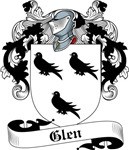
Glen Coat of Arms
My 20th great grandfather married the illegitimate daughter of Robert the Bruce, Margaret. His legitimate daughter Marjorie is also my ancestor. This is the kind of thing that gets the branches of your tree tangled. I wonder if he really accompanied the heart of Robert the Bruce to the holy land. What a totally bizarre mission. There is some confusion, but we know a lot, considering that he was born in 1303.
Robert, son of John de le Glen, married Margaret, illegitimate daughter of Robert Bruce Robert de Glen and ” Margaret Bruce the King’s sister,” his spouse, had a grant from David II., undated, of Nether Pitedye, Kinghorn, Fife (adjoining Balmuto) Robertson notes three other charters from David to this Robert de Glen, of the lands of Glasgow Forest, thanedom of Kintore, Aberdeen. Wood gives Margaret as legitimate, and says that she married, secondly, William, Earl of Sutherland. The latter did marry as his second wife, Margaret Bruce; but it is impossible that she was the widow of Glen, and an authority points out that the arms quartered by Glen, and attributed to the co-heiress of Abernethy, were not the Abernethy arms, but those of Scotland with the Scottish mark of illegitimacy, which agrees with a tradition preserved in several branches of the family, and is conclusive. Another tradition, traceable for four centuries, insists that Robert de Glen was one of those who accompanied the heart of Bruce to the Holy Land, and the Linlithgow line used two crests, one a martlet; the other an arm, the hand grasping a heart, in commemoration of that event. Moreover, the Glens of Bar possessed the sword of Bruce, which a descendant carried to Ireland, in 1606, where it was seen a few years since, the inscription on the blade leaving no doubt as to its original ownership.
Robert Glen (1303 – 1345)
is my 20th great grandfather
John Glen (1349 – 1419)
son of Robert Glen
Isabel Glen (1380 – 1421)
daughter of John Glen
Isabel Ogilvie (1406 – 1484)
daughter of Isabel Glen
Elizabeth Kennedy (1434 – 1475)
daughter of Isabel Ogilvie
Isabella Vaus (1451 – 1510)
daughter of Elizabeth Kennedy
Marion Accarson (1478 – 1538)
daughter of Isabella Vaus
Catherine Gordon (1497 – 1537)
daughter of Marion Accarson
Lady Elizabeth Ashton (1524 – 1588)
daughter of CATHERINE GORDON
Capt Roger Dudley (1535 – 1585)
son of Lady Elizabeth Ashton
Gov Thomas Dudley (1576 – 1653)
son of Capt Roger Dudley
Anne Dudley (1612 – 1672)
daughter of Gov Thomas Dudley
John Bradstreet (1652 – 1718)
son of Anne Dudley
Mercy Bradstreet (1689 – 1725)
daughter of John Bradstreet
Caleb Hazen (1720 – 1777)
son of Mercy Bradstreet
Mercy Hazen (1747 – 1819)
daughter of Caleb Hazen
Martha Mead (1784 – 1860)
daughter of Mercy Hazen
Abner Morse (1808 – 1838)
son of Martha Mead
Daniel Rowland Morse (1838 – 1910)
son of Abner Morse
Jason A Morse (1862 – 1932)
son of Daniel Rowland Morse
Ernest Abner Morse (1890 – 1965)
son of Jason A Morse
Richard Arden Morse (1920 – 2004)
son of Ernest Abner Morse
Pamela Morse
I am the daughter of Richard Arden Morse

Anne Devereux
Anne’s father Walter was a big Yorkist knight in the War of the Roses. She married a knight who was mixed up in this royal Lancaster/York mess as well. Her husband, William Herbert, was lord of a giant castle, Raglan. She had nice digs in Wales at this castle while the Brits were embroiled in their Rose thing. I am still having trouble sorting out the royal roses and why the people of Wales would care, but they got into it too.
Anne Devereux is the daughter of Sir Walter Devereux and Elizabeth Merbury. 2 She married William Herbert, 1st Earl of Pembroke, son of Sir William ap Thomas. Her married name became Herbert.
Children of Anne Devereux and William Herbert , 1st Earl of Pembroke
Lady Catherine Herbert + 3 d. b 8 May 1504
Lady Maud Herbert + 1 b. 1448, d. a 1485
Citations
[1] Richard Glanville-Brown, online , Richard Glanville-Brown (RR 2, Milton, Ontario, Canada), downloaded 17 August 2005.
[2] Tim Boyle, “re: Boyle Family,” e-mail message to Darryl Roger Lundy, 16 September 2006. Hereinafter cited as “re: Boyle Family.”
[3] G.E. Cokayne; with Vicary Gibbs, H.A. Doubleday, Geoffrey H. White, Duncan Warrand and Lord Howard de Walden, editors, The Complete Peerage of England, Scotland, Ireland, Great Britain and the United Kingdom, Extant, Extinct or Dormant, new ed., 13 volumes in 14 (1910-1959; reprint in 6 volumes, Gloucester, U.K.: Alan Sutton Publishing, 2000), volume VII, page 167. Hereinafter cited as The Complete Peerage.
Known far and wide for her ability to upstage or even handbag opposition, Margaret Thatcher was nobody’s feminist. She was a power broker who knew where and how to use her influence to the greatest potential. While the feminist movement was bootstrapping Mrs. Thatcher was where she had always been, right in the middle of the good old Tory boys. Her breaking not only of the glass ceiling but of the snooty Tory party preference for aristocratic leaders showed command of political power matched by very few others in history.
She went from a grocery store apartment to Oxford on scholarship. Initiative was her middle name. She created the science of spin doctoring, but not as it is used now. She refined her image to make sure her clear core values were expressed with precision. She was a political Amazon with a mission to reform her chaotic nation. There was no stopping Mrs. Thatcher.
As time passes feminism will have to give Margaret Thatcher her due for proactively advancing the possibilities for women. Like QE II, she had that purse on her arm wherever she went. She was known for being over prepared at all times. The handbag frequently contained notes and political updates that might be on a twitter stream today. Everyone feared what might be contained in it at any given time. The Brits also have a verb handbagging, which is exactly what you think it is…..some old lady beating you into submission with that square hard-sided, short handled purse used as nunchucks. She did not think of herself as man or woman, but as a ninja of politics. After her retirement she was working on striking matches with her nunchuck purse, but it was never the same after Henry Kissinger stopped holding the matches. She will be remembered as a Brick House, as we say in America, with a very strong handbag.

grave of Elizabeth Henchman
Elizabeth Henchman has a birthplace on file of Plymouth, MA. I doubt this is true, since in 1612 the Mayflower had not yet landed. She came from England with her parents, I believe. She married my 10th great grandfather in Plymouth in 1634. Her second husband, Richard Hildreth, was prominent in Cambridge, MA. They married in Cambridge in 1645. Her grave can still be located in Malden, MA.
The origin of the name is really from being a royal henchmen in history:
ENGLISH ORIGINS
The origin, genealogy, history, and traditions of the Henchman, Hensman, Hinchman, and Hincksman families are known to many family members today, because of the research and dedication of Robert Hinchman, Jr. (1921-1996), of Dallas, Texas, the founder and first president of the Hinchman Heritage Society. It is from this beginning in England that we may someday find connections to The Hinchman Family in America. The following two paragraphs were written by Robert for the October 1992 Hinchman Heritage Week in England.
“Legend has it that Thomas Crosborough of Magna Doddington, Northamptonshire, saved the life of King Henry VII during a hunt. Upon being rescued from the tusks of a wild boar the King said to him: “Truly, thou art my veritable henchman.” Thomas thereupon, changed his name to Henchman, and thus, the family began. His great grandson, Thomas, was apprenticed at the age of 12 to William Cokayne, Master of the Skinners’ Guild, and subsequently became a prominent merchant and Freeman of the City of London during the latter part of the reign of Elizabeth I. Thomas was the father of Humfry who was instrumental in aiding Charles II escape to France during the English Civil War. Thus, two Henchmans have helped save the lives of two English kings.”
“The scions of Thomas Crosborough Henchman are the progenitors of the Henchman/Hinchman and Hensman Families of today. The variations in spellings began to stabilize during the reign of James I and by the time of the restoration of Charles II in 1660, the orthography had become almost set .. but as a Hinchman, you well know that confusion still exists. The family began its migration to New England in 1637, to Maryland in 1664, and to Australia in the 1860’s. And, of course, English members continued down to this day. Our generation, wherever we live, are descendants of Thomas Crosborough Henchman, his sons and grandsons. It is an adventure for each of us to discover our particular origins.”
Elizabeth Henchman (1612 – 1693)
is my 10th great grandmother
Mercy Vaughn (1630 – 1675)
daughter of Elizabeth Henchman
Sarah Carr (1682 – 1765)
daughter of Mercy Vaughn
John Hammett (1705 – 1752)
son of Sarah Carr
MARGARET HAMMETT (1721 – 1753)
daughter of John Hammett
Benjamin Sweet (1722 – 1789)
son of MARGARET HAMMETT
Paul Sweet (1762 – 1836)
son of Benjamin Sweet
Valentine Sweet (1791 – 1858)
son of Paul Sweet
Sarah LaVina Sweet (1840 – 1923)
daughter of Valentine Sweet
Jason A Morse (1862 – 1932)
son of Sarah LaVina Sweet
Ernest Abner Morse (1890 – 1965)
son of Jason A Morse
Richard Arden Morse (1920 – 2004)
son of Ernest Abner Morse
Pamela Morse
I am the daughter of Richard Arden Morse
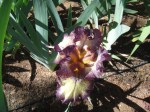
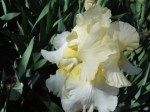



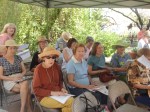



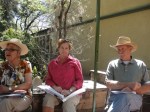

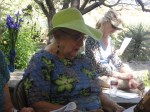
New this year at the Tucson Botanical Gardens is a collaboration with the U of A Poetry Center, bringing poetry to the gardens. I attended the class next to the iris garden yesterday and was surprised at the depth and education they packed into the experience. We learned about the Poetry Center’s history and the very good luck we have to live in a city with a center such as this. We learned about the botanical gardens and the history and meaning of the iris plant. An enthusiastic docent from the Tucson Botanical Gardens opened the readings with a poem of her own about iris and the field of everyday glory we can find in nature. We then read together a selection of poems, all in some way referring to the iris. Our favorite reader was dressed like an iris and has a British accent that enhanced her interpretation. It was an exceptional experience on all levels for me. I enjoyed the crowd, and had time after the class to get some technical growing advise from the lady who represented the Iris Society. Poetry and gardens do go together very well. Next month the group will meet by the cactus garden….a thorny subject. I am encouraged to use my poetic voice more often, and listen for stunning stories to tell.
Refinement of all the senses leads to a full and more interesting life. Leonardo da Vinci was a student of all phenomena. His seven guiding principals for living were at the heart of all his work. They are his core values, upon which his reputation rests. By reading his notebooks and studying his drawings we can see that his constant eagle eye was at work observing nature. Sensazione, or the development of all the senses, was a big reason Leonardo became as productive as he did. He felt that by making notes and drawings of his sensual observations he grasped more of the meaning around him. He used his notebooks to create, invent, and make beautiful art.
He gives advise on keeping a listener engaged by carefully noting his posture, body language, and facial expressions. By focus and intent to see clearly sight can be developed into insight. The training of all the senses to be more apt, more receptive, and more able to understand reality was a lifetime practice of the master. Vision, hearing, smell, taste, touch and synesthesia (the ability to describe one sense in terms of another) were all parts of this whole. Sight became the best developed of his abilities, which contributed to his artistic talent.
How do you use your senses to take in the world? Have you ever tried to improve on what you have in the sense department? I was a potter for many years, so my sense of touch was developed beyond the others during that time. I had to feel the center of the wheel, and the thickness of the clay with precision or….no pot was made…back to mud. Taste and smell may be my most developed senses now. I cook, bake, and experiment as a cocktail creator. I like making a variety of teas and baths with my garden herbs. Do you have one particular sense that is your strongest? We know what Leonardo would do. He would forever practice to refine them all.
 mermaidcamp