mermaidcamp
Keeping current in wellness, in and out of the water
You can scroll the shelf using ← and → keys
You can scroll the shelf using ← and → keys
We may not have had formal training in meditation as children, but we probably had profound spiritual experiences as a natural part of childhood. Contemplation is a normal activity. When life is undisturbed we contemplate our surroundings, our connection to the universe, and more. If you scan your past for times during which you felt connected, in a state of grace, or full of bliss you will find them. By bringing back the feeling of spontaneous enlightening experiences we might be able to recreate that magic today. Our conscious minds often cling to our problems, our challenges, and our individual specialty suffering, keeping these wounds close to the surface. Through practice we can train the mind to hold on to the positive, unexplained flashes of light and insight, treating them as our natural state. Bringing contemplation and spacious states of mind into our practice is liberating. The long term benefits can be compared to physical strength or agility in the body. We don’t know what demands the future will put on that preparation. We can only learn when an event challenges that strength. We know we will encounter stressful situations and loss in our lives. A meditative state of mind is the very best investment/tool to cope with adversity that can be acquired.
There are many forms of meditation. A qualified teacher is not always available, but can show the student how to create the transition into mindfulness. If you believe that you have never meditated, let your memory go over the special times of youth that stand out in your memory today. You will probably be able to identify a few enchanted, enlightened times that brought you a glimpse into eternity. That lightness is a state that is available to you always. What is required is a steady practice. Walking, chanting, sitting….the style does not matter as long as it suits the user. The pure state of bliss meditation brings the practitioner is the armor that protects the mind from stress and worry. It is the true fountain of youth.
Wisdom springs from meditation;
without meditation wisdom wanes.
Having known these two paths of progress and decline,
let one so conduct oneself that one’s wisdom may increase.
Dhammapada 20.282
The Buddha
Do you know places, people, or even things that have a healthy, restorative feeling for you? Some spots have been used as healing centers for centuries, acquiring a reputation and a following. Sometimes a professional office space or treatment room can resonate with peace and calm. Waterfalls are typical places that we imagine when we are seeking a retreat from stress and pain in daily life. Some of us reserve space in our homes dedicated to meditation, contemplation, or exercise. Altars at home are reminders of practice, devotion, and connections to spiritual beliefs. I have always been a big fan of visiting hot mineral springs to center my attention on nature and soul. Submersion is both literal and symbolic in healing waters.
I have gone to great lengths and spent a pretty penny to be in healing waters, treated by gifted therapists, relaxing in spectacular places in nature. The concept of healing travel, or wellness retreat must involve a capture of that serenity or wholeness to bring back to the daily practice. Perhaps in calm circumstances one can master a new meditation technique or discover new ways to practice. Maybe while the agenda is clean and clear one can let go of emotional and physical clutter that has daily life fully jammed. Travel to a different location does not guarantee a retreat or a lifestyle change. It is possible, and maybe even preferable, to turn normal living into a health reforming adventure. Finding calm, creating depth, and mastering the art of stress reduction can be practices we include in our routine.
To enter a new lifestyle, a healthier diet plan, a new willingness to live happily, we need to feel confidence. What are ways you establish a meditative, healthy, confident mood? Here are some ways I have tried that work for me:
Don’t wait for your vacation days to move into your personal health retreat mansion. Pick up the keys and live in your own healing presence. Build your confidence while you enhance your surroundings for a healthier, happier outlook.
The liberator serves others in political and sometimes military capacities. Freeing others from injustice and adverse conditions is the role played by the archetype. The words terrorist and liberty have been used and diluted to the point that we are weary as well as wary of news of political freedom. Shadow liberation is often substitution of one violent group for another equally intolerant one. The kidnapping of the school girls in Nigeria has galvanized world opinion on the need for urgent action to find and free them. Jesus, Muhammad, and Buddha were liberators in their places and times in history. The goddess Tara is known as the swift liberator because her nature is to answer very quickly when she is called.
Mantra is a way to meditate and call on Tara to teach us to be free of the 8 fears. Green Tara is pictured with her right foot in front of her because she is symbolically ready to hurry to those who call her. If sound meditation is new to you, the power of it may come as a surprise. We need the swift and sure guidance of Tara to reach the girls and bring them to safety. The mantra above is easy to learn, but even if you simply listen with the idea of freeing the kidnappers as well as the girls from the situation, it is positive. Please join us, gentle reader, to #BringBackOurGirls. Let us create a worldwide mantra of liberation that will reach into the African jungle to bring them home.
Our own characters often resemble mythological beings in classic stories. Do we portray one myth more than any other? Are we stuck in a certain drama until we finally understand the meaning of it? The study of archetypes is a study of mythology. Metaphor and symbolism create stories that resonate with meaning in our lives. The admirable goddess qualities include wisdom, physical grace and strength, sensuality, beauty, and guidance. In our world today there are many shadow goddesses. The overly indulged celebrities can reflect the shadow goddess. There is commercial pressure to imitate the unhealthy, perfectionist, unkind diva. It may be helpful to learn more about the positive myths.
Do you know the stories of any of these goddesses?
The associations with female power and myth have been twisted in some modern contexts. Some study and meditation on the energy of these female figures in mythology can bring us closer to understanding our lives. Our relationship with Mother Earth could use some work. Do you bring the goddess concept into your meditations, gentle reader? Do you have a favorite goddess?
Do you have enough stuff? What kind of stuff do you lack? Do you have goals that do not involve material stuff? My parents were heavily into possessions, and at the end of their lives it seemed that those things they loved so much robbed them of any kind of peace. They struggled to keep objects and wealth long after they even knew what any of the objects were. They wanted to keep an image of themselves in society, and other transitory status rather than seeking truth. There was nothing I could do to help them with that.
I am doing a meditative practice about abundance now. I have special feelings about one of the biblical phrases used in this practice. “All things that the Father hath are mine.” John 16:15. This is talking about the Father with a big F, not my dad. If I have all that my dad had I would be filled with greed, alcoholism, and relative anger at all times. If I concentrate on the Father, as in spirit, I can feel the difference. We inherit objects as well as traits from our parents. The kingdom of heaven is ours if we tune into it. How about you, gentle reader? Do you stand to inherit the earth?
Sports fans and all Americans need to be ashamed that this much institutionalized racism can exist in professional sports. When I was a child I was a Pittsburgh Pirates fan, with special emphasis on my love for Roberto Clemente. I went in person to many games at Forbes Field, and listed to the others on my transistor radio. I hold a big grudge against my dad for an incident that took place when I was about 10. We went to lunch at The University Club before games, then walked to the field. One such day Roberto himself was eating in the dining room at the University Club before a game. I wanted to get his autograph, naturally. My dad was very strict and gave a lecture about treating everyone with respect. Of course this was the first black person I had seen eating in that dining room, and it may have been many years before there was another. Richard Arden Morse was a bit of a racist in some ways, but he was firm about not disturbing Roberto to indulge me. I was angry (and still am, if truth be told), but I will always remember the point. It had to do with dignity, and making sure his visit to our snooty club was treated as a natural event. I loved Roberto for his athleticism, and was unaware until later in life of his fight to attain equality as a black baseball player. He is still me favorite athlete of all time.
This rings in my mind when I see this Sterling guy still living some horrible stereotype lifestyle that belongs in the distant past. The nasty truth about this story must be exposed. In no uncertain terms we must reject his behavior. Each of us has some part to play in this, if only by voicing an opinion. I am with Magic in thinking he needs to say he does not want to own a team now. What do you think, gentle reader? Does this freak you out?

Bayern COA
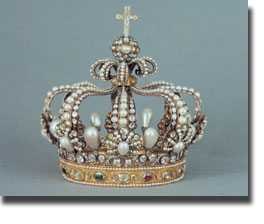
German Queen’s crown
Elisabeth of Bavaria, Queen of Germany was married to Conrad IV in her hometown of Landshut, Bavaria in 1246. Her husband the king was at war with the pope which lead to his early demise in 1254. Her second husband, Duke of Carinthia, is my ancestor. She is one of the only royal ladies in my tree who managed to avoid the monastic life.
Elisabeth of Bavaria, Queen of Germany (Landshut, c. 1227 – 9 October 1273) was the Queen consort of Conrad IV of Germany.
She was the eldest daughter of Otto II Wittelsbach, Duke of Bavaria and Agnes of the Rhine. Her maternal grandparents were Henry V, Count Palatine of the Rhine and Agnes von Staufer.
The elder Agnes was a daughter of Conrad of Hohenstaufen and Irmingard of Henneberg.
Marriages and children
Her father Otto II had become a supporter of Frederick II, Holy Roman Emperor in 1241, following initial conflict between them. Their political alliance would lead to the marriage of the elder daughter of the Wittelsbach and the elder son of the Hohenstaufen. Said son was Conrad IV of Germany, son and heir of Frederick II. Their marriage took place on 1 September 1246, in her native Landshut.
Elisabeth and Conrad would only have one son:
Her father-in-law Frederick II died on 13 December 1250. He was still involved in a war against Pope Innocent IV and his allies at the time of his death. Conrad IV would continue the war until his own death of malaria at Lavello, Basilicata on 21 May 1254.
Elisabeth remained a widow for five years. She married her second husband Meinhard, Duke of Carinthia in 1259. They had six children:
Elisabeth Wittelsbach Duchess Bavaria (1227 – 1273)
is my 20th great grandmother
Consort Elisabeth the Romans Carinthia (1263 – 1313)
daughter of Elisabeth Wittelsbach Duchess Bavaria
Albrecht Albert II ‘The Wise’ Duke of Austria Habsburg (1298 – 1358)
son of Consort Elisabeth the Romans Carinthia
Leopold III “Duke of Austria” Habsburg (1351 – 1386)
son of Albrecht Albert II ‘The Wise’ Duke of Austria Habsburg
Ernst I “Ironside” Archduke of Austria Habsburg (1377 – 1424)
son of Leopold III “Duke of Austria” Habsburg
Katharina Archduchess Austria Von Habsburg (1420 – 1493)
daughter of Ernst I “Ironside” Archduke of Austria Habsburg
Christof I VanBaden (1453 – 1527)
son of Katharina Archduchess Austria Von Habsburg
Beatrix Zahringen (1492 – 1535)
daughter of Christof I VanBaden
Sabine Grafin VonSimmern (1528 – 1578)
daughter of Beatrix Zahringen
Marie L Egmond (1564 – 1584)
daughter of Sabine Grafin VonSimmern
Richard Sears (1590 – 1676)
son of Marie L Egmond
Silas Sears (1638 – 1697)
son of Richard Sears
Silas Sears (1661 – 1732)
son of Silas Sears
Sarah Sears (1697 – 1785)
daughter of Silas Sears
Sarah Hamblin (1721 – 1814)
daughter of Sarah Sears
Mercy Hazen (1747 – 1819)
daughter of Sarah Hamblin
Martha Mead (1784 – 1860)
daughter of Mercy Hazen
Abner Morse (1808 – 1838)
son of Martha Mead
Daniel Rowland Morse (1838 – 1910)
son of Abner Morse
Jason A Morse (1862 – 1932)
son of Daniel Rowland Morse
Ernest Abner Morse (1890 – 1965)
son of Jason A Morse
Richard Arden Morse (1920 – 2004)
son of Ernest Abner Morse
Pamela Morse
I am the daughter of Richard Arden Morse
Sacrifice is presented as desirable in some circles. Women in particular are lead to believe that sacrifice will be rewarded, even when the reward is not in sight. While we can’t go through life without any instances of victimhood, making a habit of it is a very bad idea. Feminism had a lot to do with rejecting victim status, and yet women today are wrapped up in a number of delusional mindsets that rob happiness. Perfection will not be attained for more than a few seconds in any arena, so expectations must be matched to that reality. Striving for more of everything without stopping to enjoy what we have will lead us in a downward cycle. There is no amount of money or status that can change the need to wallow in the role of the victim. Sore winners abound, and wining does not make them happy. Suffering is a matter of perspective and is not absolute.
I have been studying and meditating on Thomas Moore’s new book, A Religion of One’s Own, which I am enjoying. When I heard him talk about the book he said many of his patient’s in his counseling practice were treated too harshly in childhood. Since this heavy discipline was sometimes associated with religion, these adults suffer today from combinations of guilt and inappropriate self punishment. Mixed messages from our youth of spirituality and sacrifice can create havoc in the soul. Take good care of yourself, gentle reader.
Most luxury goods from ice cream to cars are marketed as being self-indulgent. The idea that we deserve some luxury is a tried and true method used to sell overpriced goods. Obviously luxury has to mean different things to each one of us, and our fortunes limit what we include in our worldly possessions. We do have to choose and over time our choices change. We move into a new phase or environment or hobby and find that what was a big treat in the past is not even interesting now. We may own something we thought we needed and wanted that now we no longer like. This is natural.
I am in favor of self-indulgence if it is done in a true spirit of enhancing the self. Self care and self-awareness are valid and necessary for a healthy balanced personality. To make good long-term investments in self ask yourself:
There may be another element to consider when finding a reward for yourself that will reap future dividends. Would I enjoy this time/money/thing more if I gave it away or shared it with others in some other way? I personally can think of at least a million things I would rather own than the yacht A, and a million people who could make good use of a more reasonable boat. Everything is relative. To each her own. Choose wisely, gentle reader.
The coolest monk on earth has opened an instagram account. His Holiness the Dalai Lama of Tibet is now updating his travels with photos. This is so much more exciting that Pope Francis’ twitter streams, although I do applaud @Pontifex for multi-lingual tweeting to anyone who wants to stay in touch with him. If you have been in the presence of His Holiness (I have had the very good fortune of doing so in 3 different teachings) you never forget the way he laughs and smiles. He is infectious and inspires this adoration instantly by giggling. I have seen him teach in Tibetan, and even in the middle of serious rituals he jokes and giggles with his students. By the time we had our translations in our earbuds the Tibetans were laughing at his jokes. He connects on all levels with all people. Those who understand and practice the fine points of Buddhism learn deeply and some probably glimpse enlightenment in his presence. Those of us who come in relative ignorance to his teachings may come away with less refined ideas, but we are also subject to instant enlightenment in his presence. The ancient texts he uses for study require lifetimes of study and meditation to do them justice. When he flashes a smile from that cute baby monk face he touches everyone in exactly the same way. Now we can all follow his smile around the world as he keeps us updated.
He enjoys a hobby in horology, and since his youth has taken watches apart to rebuild them. I believe he is a geeky monk who appreciates technology and wants to understand and use it to the max. What ever his reason may be, I am following him, and suggest that the gentle readers might want to check out his account. He is changing the world with his smile.
 mermaidcamp