mermaidcamp
Keeping current in wellness, in and out of the water
You can scroll the shelf using ← and → keys
You can scroll the shelf using ← and → keys

Driving down the 101 we stopped to buy driving gloves in Florence, Oregon. While his dad shopped, Charlie and I took a stroll around the vicinity. The Homegrown sign attracted our attention so we stopped by to see it. As we left Denise, the server, greeted us and lavished attention on Charlie. I inquired about vegan food to learn that many fine options were on offer for us, and also a dog menu was available. The decision to eat lunch was made because I never expected to find a dog menu and thought the chance might never come again.


Our lunch at this nano brewery was superb. We enjoyed a veggie burger and vegan tacos with excellent salad and crispy fries. I drank amber beer, which was a perfect compliment to the food. All dishes were homemade. Charlie enjoyed his meatloaf with gusto. I suggested he slow down to savor it, but he is a dog.

We were joined on the patio by other dog parents. Wouldn’t you know that the dachshund sits at the table munching human menu items? Denise gives outstanding service to humans and dogs. The food was innovative, made with fresh ingredients, and presented artfully. Our lunch at Homegrown Public House Brewery was delicious for all of us. Highly recommended.
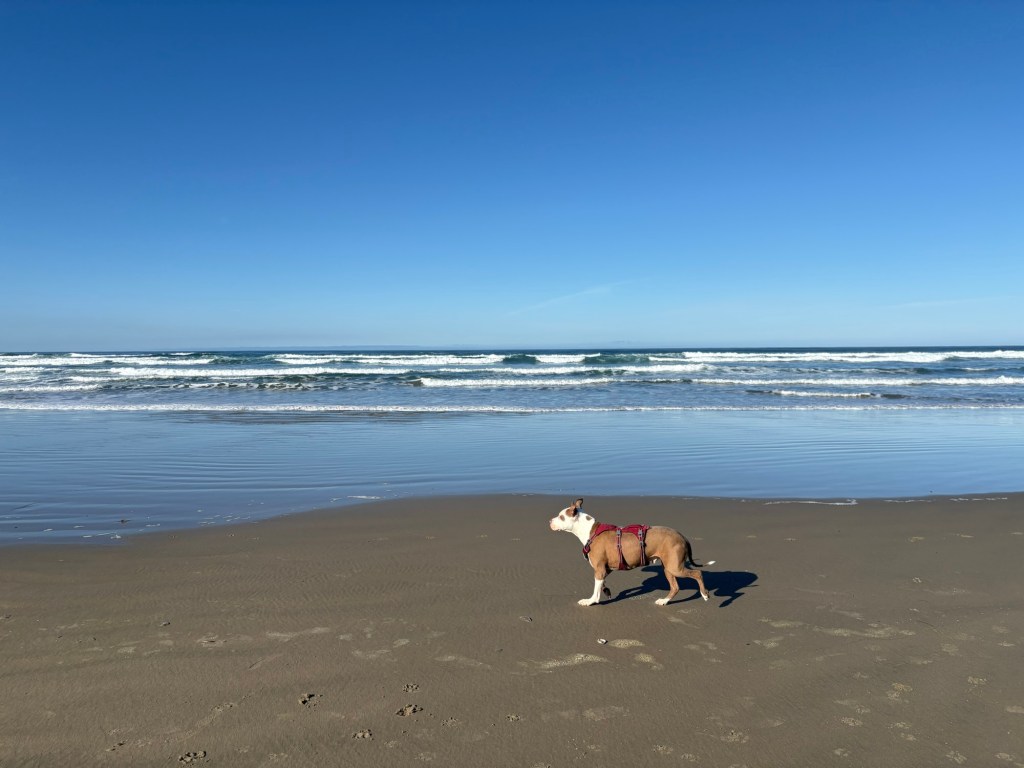
In Oregon the beach belongs to the state and cannot be private. Dogs are allowed to go off leash with reasonable behavior expected. Our dog Charlie is a huge fan of beach trips, feeling the need to greet all humans as well as canine visitors. He’s allowed to play with mutually consenting dogs. Today he met a one year old female dog from Texas who made him ecstatic. She is a great athlete who loves running as much as he does. His parents bring him here to run at the beach, all the way from Ft. Worth. She was his dream date.
In Lebanon, Oregon an exceptionally stunning Japanese garden grows that has been designed for healing. Arranged around a koi pond with fountains and waterfalls are rocks, trees, and floral gardens that provide privacy in serene beauty for those seeking healthier lives. The garden is connected to a hotel and conference center on a medical campus, Best Western Boulder Falls Inn. It’s popular for weddings and other special occasions as well as giving guests who are at the hospital for care a place to heal. It’s a brilliant idea and an unforgettable experience. We spent one night on our way out of Oregon. Enjoying the garden and koi pond was a superb way to begin our journey. The staff is courteous and professional, and the hotel is comfortable and well designed. The garden is what sets it apart from all other hotels. The dog loved it there.
We are on the road with our dog, looking for a good time. We found it at Minto-Brown Island off leash dog park in Salem, Oregon . I frequent dog parks as a pet sitter so I have visited a wide range of facilities designed for dogs. Never have I seen such an elaborate space for canine contentment. Charlie agrees. This place is the total bomb. Old orchards of apple, walnut, cherry, and chestnuts surround a giant field of grass. Pathways through this forest are part of the off leash privileges. It’s very exciting to the dogs to be free in this setting. He met many fun and friendly people and dogs, who ran with him until he was exhausted.
I cannot recommend this park highly enough. Charlie woofs in hearty agreement.

The oldest hotel in Portland, Oregon is known now as Kimpton Vintage. When it opened in 1894 it was called the Imperial Hotel. Its history includes expansion and contraction through changes in ownership. I particularly enjoy the architecture of that period, which was built when the city was riding high. I have stayed in other Kimpton properties, which I admire for the reform and restoration of historic structures. Kimpton Vintage Portland is a shining example of artful design that creates an atmosphere of elegance and hospitality.


We had a wonderful visit in an elegant corner room before a long train journey. The front desk agent, Ben, convinced us to return at the end of our trip. We asked him what was happening on the 9th floor on the balconies. He told us about the jacuzzi suites available, then booked one for us.
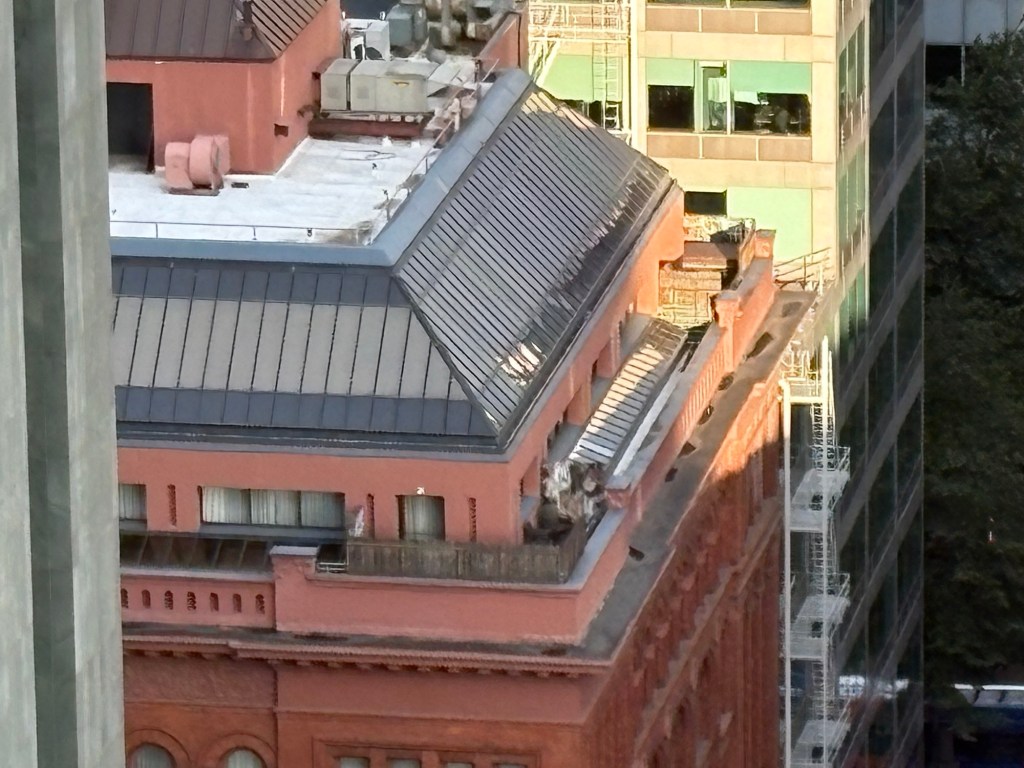


This was a perfect grand finale to our trip. The hotel has a daily complimentary wine happy hour with excellent local wines. The convivial lobby event gives guests a cozy way to meet each other. We met a fellow guest who had borrowed the free bike the hotel offers to ride across the bridge to survey the city.
Too many superb options exist for dining within walking distance of the hotel. We only had time to visit a couple old favorites on our stay.

I love staying downtown Portland to experience history in a modern context. I have now found the perfect place to enjoy that. It’s a short walk to the waterfront, my fave place to stroll. Public transportation is super convenient and efficient. Cosmopolitan living at its finest is available for visitors to the Rose City. Dogs are welcome.

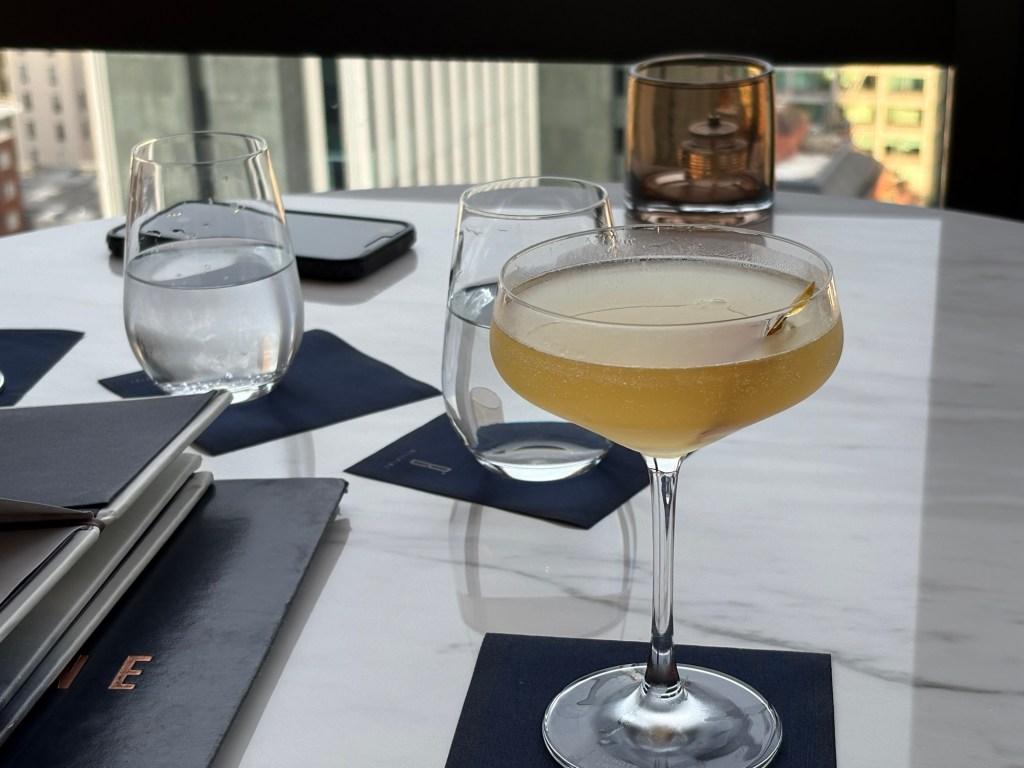
To answer the question “How far can one elevate a cocktail experience?”, we turned to the Bellpine Bar high atop downtown Portland, Oregon. On the 20th floor of the Ritz-Carlton the bar delivers views, innovative drinks and snacks with the service that makes the Ritz so ritzy.
My husband had two delicious mocktails and I had a Pear With Me cocktail. Flavorful, garnished with a dried pear slice covered in sugar. I decided to eat the candied pear as a first course rather than sweeten my drink. It was crisp like candy apple. I sipped the complex mixture as we enjoyed the snack selection. Intense flavors paired well and peared well… A delicious treat with a stunning view.


The little log cabin built of French fried potatoes came with a delicate gravy lightly seasoned with truffles. The wontons contained spinach and peppers. The entire delightful evening was delivered with grace by our attentive server, Katrina.
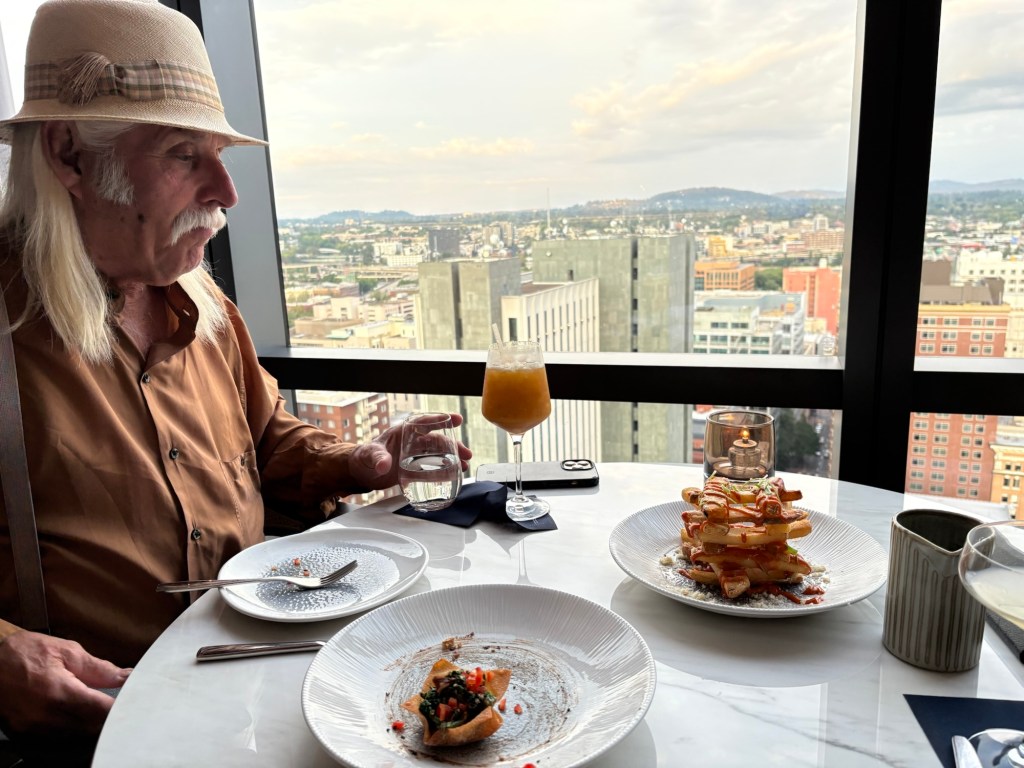
10/10 highly recommended! Just don’t go there to save money.


My eighth great-grandfather was born in Glamorganshire, Wales in 1678. Rev. Henry Nicholls received a B.A.in 1703 and an M.A. in 1705 from Jesus College, Oxford, Wales. He was sent to Pennsylvania, 1702-1708, during the reign of King James II. In 1707 he married my eighth great-grandmother, Elizabeth Gatchell of Chester, Pennsylvania.
Henry Nichols was the first residential missionary to Pennsylvannia for the “Society for Propagation of the Gospel in Foreign Parts”, arriving in 1703. His churches were located in Chester, Concord, Radnor, and Montgomery. The Chester Church is described as of good brick fabric, one of the neatest on the continent, furnished with handsome furniture and rews. The members were regular and constant in divine worship, and they contributed 60 pounds a year toward their pastor’s support. The Radnor Church is still in excellent preservation, known as St. David’s Church and has been in use since 1708. Rev Nichols requested a transfer in 1708 and became rector at St. Michael’s Parish Church. Talbot Co., MD – a post he occupied until his death. For years, all records of his life were lost. The early church books had disappeared! Until June 1878 when workmen, employed to demolish the old church building, found his tomb under the Chancel in good preservation.
The following is a translation of the Latin inscription found on the slab over his tomb: “Here lies the remains of Henry Nicols, M. A., formerly a Fellow of Jesus College, Oxford, England, and a pastor of this church for 41 years – most unworthy. Born April 1st, 1678; died Feb. 12, 1748. Save his soul, O Christ for Thy own merits. Tread upon salt without savor.” (Henry has ordered these works to be inscribed before his death.) A number of his descendents still worship at St. Michael’s Church. They placed a tablet there to his memory where he ministered for so long. (From the Historical Magazine of the Protestant Episcopal Church, 1943, by Mary Clement, M. A., Principal of the Girls County School Board, Bridgend, Glamorganshire, Wales.)
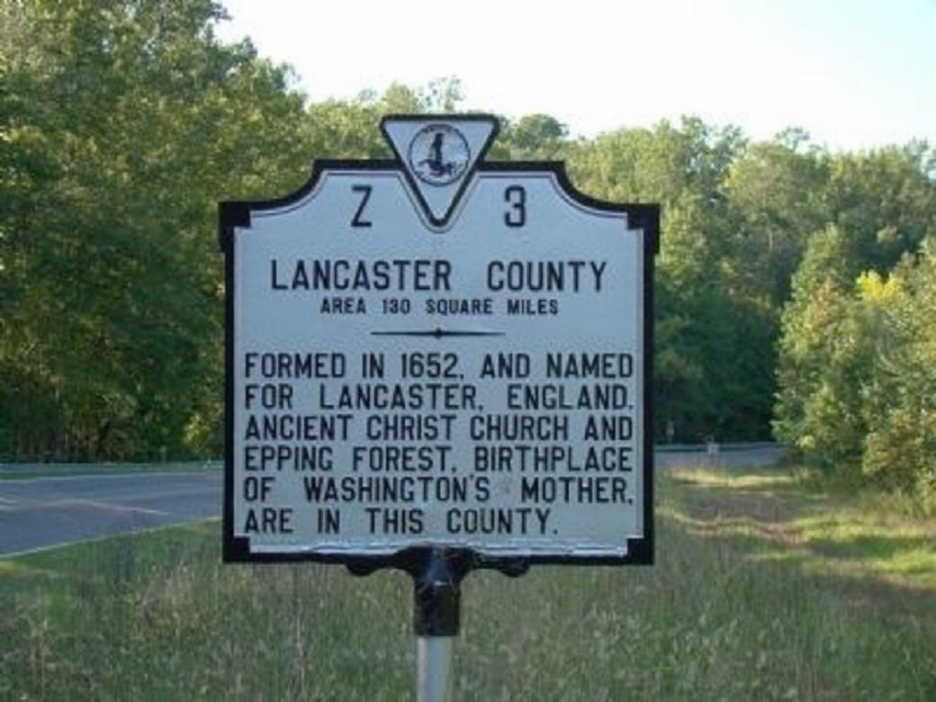
Landcaster County
Garton Bible records show Capt. William Garton’s father to be John Garton born 1615 and died 1698. He may be the son of a John Garton of Kingston-Upon-Hull (a wealthy merchant) who married Ann Hobson in 1614,
This Bible has an unbroken chain of possession in the same family. Captain William Garton was a planter, residing in Lancaster County, where he bought land in 1673. He is the oldest proven Garton in the line.
Will Of Captain William Garton, Will Book 10, pages 63-66, rec’d 8 Feb 1710.
“In the name of God, Amen, I Will Garton, of the parish of Christ Church in the County of Lancaster in Virginia, being sick, but in perfect memory, God be praised, I do make this my last will and testament, in manner and form following.
First – I bequeath my soul to Almighty God that made it, hoping to be saved by the meritorious death and resurrection of our Saviour Jesus Christ, my redeemer.
Item – to my son URIAH GARTON I bequeath a parcel of land beginning at a Pine tree at the head of the first long branch issuing out of Nanty Poyson Creek, running northeast to a corner tree at the first little branch that issues out of Deuber Cove.
Item – to my son JAMES GARTON I bequeath a parcel of land beginning in Black Sows Neck near Carel’s line so running up Carel’s line to a corner Maple northeast upon a marked line to a corner Red Oak thence northeast to the head of Deuber Cove concluding all within the said lines aforesaid.
Item- to my son ANTHONY GARTON I bequeath a parcel of land beginning at a corner Red Oak from thence to a corner stone in Tark [or Tarll].
Item – to my daughter KATHERINE GARTON I bequeath a parcel of land beginning at a Red Oak at the head of the spring branch issuing out of Tab’s Creek, all concluding within the aforesaid courses and corner line.
Item – All my land bequeathed to my sons and daughter aforementioned I bequeath to them and their heirs forever.
Item – It is my will that my three negroes shall tarry upon the plantation I now live upon, till my debts is paid and then to be equally divided along with my personal estate among my sons and daughters MARGARET and KATHERINE GARTON.
Item – to ESTHER MUGG, I bequeath a full share of my personal estate with my sons and daughters aforementioned if she comes.
I do appoint my sons and daughters aforementioned to see this my last will and testament performed.
Witness my hand and soul this twentieth day of December One Thousand Seven Hundred and Nine.
his
Will [+] Garton
Witnesses mark –
Murler [+] Noulin
William Buttery
Katherine (+) Buttery
Elizabeth [+] Rebelow
Item – To my sons and daughters I bequeath all bounds of Thomas Thompson’s patent lying between Tab’s Creek and Nanty Poyson Creek.
Item – To my son-in-law, Will Cutter, I bequeath more ______ which is on my plantation.
When I graduated from high school in Texas I went to work for the summer in an outdoor drama called “Unto These Hills” produced in Cherokee, North Carolina. I was a singer in the chorus and a costumer. It was my first job, and I enjoyed it very much. I was 17 years old, the youngest and the lowest paid member of the company. I learned about the history of the Cherokee people, since the play was all about that. I can still sing the eagle dance in Cherokee language, if required (but usually when it is neither required nor requested). I spent a lot of time and money chasing clues about my father’s Cherokee heritage, which has no legs. My grandfather lived on the Cherokee res in Oklahoma in 1900, but our ancestors on my father’s side did not marry Native Americans. Now I am discovering that my mother’s side descends from the east coast Cherokee people, before the trail of tears forced them to Oklahoma Indian Territory. I was born in Tulsa. People tell me I look like a Native American–just as many tell me I look like a Russian. I always liked the idea of Native ancestors. Now, thanks to DNA clues I received from ancestry.com about common lineage, I am happy to say I found some.
This Englishman who sailed to Jamestown and married my eleventh great-grandmother was trained to be a water witch!!!! His progeny inherited the skill to find water. I LOVE that. I think it is wonderfully ironic that his grave is a few miles from the place I worked when I was 17. I can also recite the 23rd psalm in Cherokee, which now seems perfectly apt. It pays to study your ancestors.
Thomas Pasmere “Corn Planter” Carpenter (1607 – 1675)
12th great-grandfather
Trader Tom Amatoya Carpenter Moytoy (1635 – 1693)
son of Thomas Pasmere “Corn Planter” Carpenter
Aganonitsi Quatsy Woman Wolf ClanTellico Cherokee Tellico (1650 – 1692)
daughter of Trader Tom Amatoya Carpenter Moytoy
Delaware Indian Fivekiller (1674 – 1741)
son of Aganonitsi Quatsy Woman Wolf ClanTellico Cherokee Tellico
Solomon John Cherokee Kimborough (1665 – 1720)
son of Delaware Indian Fivekiller
Mourning Kimbrough (1689 – 1756)
daughter of Solomon John Cherokee Kimborough
Jane Jeanette Little (1713 – 1764)
daughter of Mourning Kimbrough
Andrew Armour (1740 – 1801)
son of Jane Jeanette Little
William Armor (1775 – 1852)
son of Andrew Armour
William Armer (1790 – 1837)
son of William Armor
Thomas Armer (1825 – 1900)
son of William Armer
Lucinda Jane Armer (1847 – 1939)
daughter of Thomas Armer
George Harvey Taylor (1884 – 1941)
son of Lucinda Jane Armer
Ruby Lee Taylor (1922 – 2008)
daughter of George Harvey Taylor
Pamela Morse
I am the daughter of Ruby Lee Taylor
Thomas Pasmere Carpenter was descended from the noble Anglo-Norman family of Vicomte Guillaume de Melun le Carpentier. Thus, Moytoy’s European lineage can be traced to the Frankish Duke Ansegisel of Metz Meroving, Peppin II, and Charles Martel. This ancestry also makes the Cherokee Moytoys cousins to the Carpenter Earl of Tyrconnell, and thus related to the current British royal family.
The Carpenter family of Devonshire & Plymouth England were small sailing ship owners, many of which were leased out to the East India Trading Company, an affiliation dating to the formation of that company December 31, 1600. Documented ownership of fifteen different ships owned by the Carpenter family, those of which were involved with moving furs between the Gulf Ports & Glasgow, or Dublin, and trade goods for North America. These ships usually made stops both directions at Barbados where the family had banking connections set up. These ships were small and fast, often able to make the crossing from Scotland and Ireland in less than thirty days. They were shallow draft ships, capable of handling shallow water ports with ease. The first documented trip made by Thomas Pasmere Carpenter occurred April 1640, sailing from Maryland to Barbados aboard the Hopewell, and returning on the Crispian in September 1640. He made another trip in March 1659 departing Charleston South Carolina aboard the Barbados Merchant, returning on the Concord in August 1659.
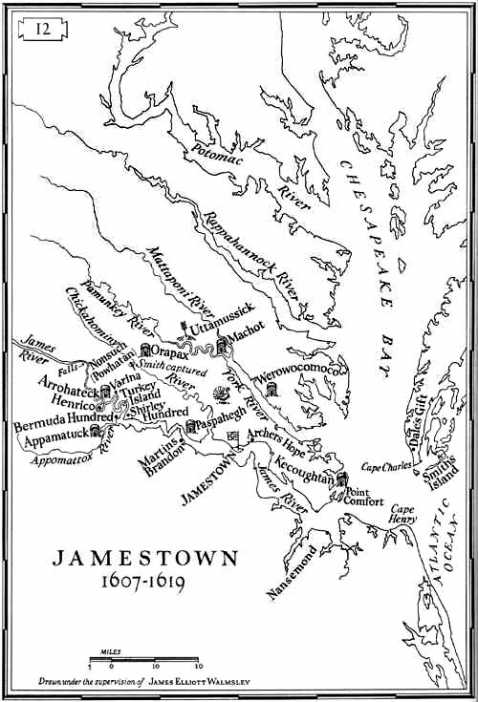
Twenty year old Thomas Pasmere Carpenter came to Jamestown, Virginia from England in 1627, living in a cave near the Shawnee. Thomas was called “Cornplanter” by the Shawnee, derived from their sign language that matched as near as possible to the work of a carpenter. He married a Shawnee woman named “Pride” and bore a son around 1635 named Trader Carpenter.
Trader was taught to “witch” for water with a willow stick by the Shawnee. He married a Shawnee named Locha in 1658 and the clan grew quickly. In 1660, they were driven south by the Iroquois. They moved along the Tennessee River, starting the villages of Running Water (where Thomas died in 1675), Nickajack, Lookout Mountain, Crowtown and Chota. He was Chief of Chota, which was created as a merging place of refuge for people of all tribes, history or color. It became similar to a capital for the Cherokee nation. These villages grew to about 2000 people by 1670 when the Carpenter clan moved to Talikwa (Great Tellico) where the Tellico River emerges from the Appalachian Mountains. Here Trader married a Cherokee, Quatsy of the Wolf Clan in 1680. He had become so adept at water witching that the Cherokee called him “water conjurer” or Ama Matai (Ama is Cherokee for water). Ama Matai eventually became pronounced as Amatoya. It was later shortened to “Moytoy”, so he is known as Moytoy I.
In 1730, his son, Trader-Tom (Moytoy II) took over as Chief, receiving what was described as the “Crown of Tannassy”. Tanasi was where the previous Chief resided and the traditional headdress was passed on to him. The fur trading Carpenter family owned many ships. Though he served as Cherokee Chief, Thomas made several trips to Barbados over the years where the Carpenters did banking, and even to Scotland and Ireland. On occasion he took Trader, and Trader Tom with him. They traded furs and healing herbs brought from America.
Cherokee traded furs for cloth. The cloth was not only used for clothing, but also to pay the Shamans for treatment. Though the medicine men did not charge for medical practice, they required a form of payment for performing love charms, hunting ceremonials, and other conjures. Beads were used in many instances, which the patient was required not only to furnish the beads, but also a certain quantity of new cloth upon which to place them. At the close of the ceremony the medicine man would roll up the cloth, beads and all, and take it with him. Custom required that he not use the cloth, but had to be sold. The practice was sometimes repeated over a period of days, each time requiring new cloth. Some Shamans would sell the required cloth to the patient himself, then take the used cloth with him.
The Cherokee, Shawnee and other Shamans (medicine men) traded secrets when they met. These were passed on orally before the Sequoya method of writing was developed. According to archeologist James Mooney “It was the practice when one shaman met another whom he thought might give him some valuable information, would say to him, “Let us sit down together.” This was understood by the other to mean, “Let us tell each other our secrets.” It was necessary to cultivate a long memory, as none were repeated more than once for his benefit. It was considered that one who failed to remember after the first hearing was not worthy to be accounted a shaman.”[1] When illness struck the white settlers and traditional methods of healing failed, they sometimes turned to friendly Cherokee nearby. This also provided the medicine men with new opportunities to obtain cloth and other goods from them in return. These methods were soon incorporated into the beliefs the settlers brought with them from Europe.
The Cherokee believed in at least two types of witches. The “Night Goer” or “sûnnâ’yï edâ’hï “ came at night to bring to the home. Alternatively, what might be called a good witch, “u’ya igawa’stï “ saturated the medicine given by the medicine man and by counteracting the spell, killed the Night Goer.[2] The settlers absorbed these ideas into their lives to the point that even milk that soured could be caused by the “evil eye” or the look of a witch. Soured milk came to be called “blinked milk”.
The settlers combined elements of their own witchcraft traditions with those of the native Cherokee. Some witches in this tradition specialized in dowsing, or healing and midwifery.
The isolation of mountain communities protected the traditions of Appalachian Granny Magic from alteration or persecution from outside. The people of the Appalachians lived a farming life that changed little from the 1700s to the 1900s, and their close connection to the earth kept Appalachian Granny Magic relevant throughout this time.
Beliefs and Traditions
The Scottish and Irish settlers believed that their fairy folk and leprechauns followed them to the new country. In addition, the Cherokee had little neighbors of their own who were called “Yunwi Tsunsdi,” meaning “The Little People.” The Appalachian Mountain Witches give offerings to the wee people daily. A granny woman will make offerings by leaving a bowl of cream at the back door. She will throw a bit of cornbread cake out of her window before serving the rest to her family. The Appalachian Witches also believe in spirits of the dead and seek out the guidance of ancestral spirits. One type of ancestral spirit that is feared are the angry “Haints”. One spell that protects a home against haints requires that its doors be painted Haint Blue, which is a baby blue color with a slight tint of periwinkle.
Many of the older Granny Magic spells are sung and danced; clogging is one of the forms of dance. Appalachian spells are also known to have chants, gigs, and lullabies. During Samhain and funerals the song “Auld Lang Syne” is sung. It is also sung during the secular new year.
Divination is popular with Granny Witches. Appalachian Granny Witches read tea leaves, tarot cards and regular playing cards, and clouds. They will also use bowls of dirt, sand, or water for scrying. Rods made from dogwood or other types of flowering tree such as an apple or peach tree are used for water dowsing, and metal rods are used for energy dowsing. A cauldron is usually preferred over a chalice by an Appalachian Witch. A cauldron displayed in a granny witch’s front yard lets people know that her services are available. Brooms, pottery, candles, mirrors and baskets, all made by hand in the home, are other tools used in this tradition. Appalachian witches have usually considered ritual clothing to be impractical, but some modern Appalachian Witches have begun to use ritual clothing in order to preserve their way of life and religion for future Appalachian Granny Witches.
^ Sacred Forumulas of the Cherokee Shamans by James Mooney. Cherokee Heritage Documentation Center (2008). Retrieved on 2008-06-22.
^ Sacred Formulas of the Cherokees by James Mooney. Cherokee Heritage Documentation Center (2008). Retrieved on 2008-06-22.
Retrieved from “http://en.wikipedia.org/wiki/Appalachian_Granny_Magic”
Cleopatra married Opechancanough who was her father’s adopted brother and her adopted uncle
Matachanna traveled to England to be with her half-sister, Pocohontas, before she died. Matachanna went back to Virginia where she lived and died.
Cleopatra Powhatan the Shawano was born in 1590, near Jamestown colony, and died in 1680
Cleopatra Powhatan was half sister of Pocahontas
Going back to the era of John Smith . . . In the late 1500s/early 1600s a Powatan chief name Wahunsunacock [one of numerous variant spellings] had united some 30 Alonquian tribes into a powerful confederation. He had created the empire through conquest and alliances. He actually ruled as an emperor, not just a tribal chief. When the Jamestown colonists arrived, Wahunsunacock’s domain encompassed the entire region that was to become Virginia. Wahunsunacock did not use a title other than chief of the Powhatans. The colonists referred to him as simply “The Powhatan”, denoting his position as emperor over numerous tribal chiefs of the Powhatan nation. The Powhatan was not friendly toward the colonists, seeing them as encroachers.
Wahunsunacock’s younger brother, or half-brother, Opechanacanough, was the tribal chief who captured John Smith. He immediately took the captive Smith to Emperor Wahunsunacock who imposed the death sentence. Tradition holds that Wahunsunacock’s daughter Matoaka “LIttle Snow Feather”, nicknamed Pocahantas or “Playful One”, pleaded for her father to spare John Smith’s life. Pocahantas became an emissary between her father and the colonists and as such was instrumental in providing the food which saved them during the hard winter. The colonists, in turn, showed their appreciation by capturing and holding Pocahantas for ransom. After they had extracted the full ransom from Wahunsunacock, then they forged an alliance with him by marrying Pocahantas to John Wolfe, a planter in the Jamestown colony who is credited with introducing tobacco as a cash crop.
That much is familiar history. Then comes the chapter that is really relevant to our family. At the death of the elderly Wahunsunacock, his younger brother [it’s uncertain if he was a brother or a half-brother] Opchanacanough became successor to Wahunsunacock as emperor. As such, he is frequently also called The Powhatan. To distinguish between the two men I have chosen to use the technically accurate term “Emperor” for Wahunsunacock and “Chief” for Opechanacanough, since Opechanacanough was promoted from a “chief” to succeed Wahunsunacock who had forged the “empire”. In reading other histories, however, it is necessary to note that some writers use the term Powhatan for both brothers interchangeably which is unnecessarily confusing and actually incorrect. Sometimes I get the impression that some genealogy researchers do not grasp that they are two different men.
Emperor Wahunsunacock perhaps had hundreds of wives and children. Several of them are noted in historical documents, but none so well as Pocahantas and, to our benefit, her sister Cleopatra. Not only was Cleopatra a daughter of the Emperor, she was wife to the successor Chief/Emperor Opechanacanough. Now if you were paying attention and recall that Opehanacanough and Wahusunacock were brothers/half-brothers, you might realize that she was also Opechanacanough’s niece [or half-niece as the case may be]. They were a royal dynasty and keep in mind that the family lineage was preserved by most Native Americans, as they still do now, through the matriarchal line.
The relationship of Cleopatra and Pocahantas as full sisters is fully documented. After the death of Pocahantas, Pcahantas’ son had to apply for rights to get to visit his Indian relatives and in his written legal request specifically asks to visit his “mother’s sister Cleopatra” by name. Cleopatra obviously was not her Indian name, but rather what she was called by the colonists because since her husband was the successor ruling Chief/Emperor she was in fact Queen. The title seemed especially apropos to the colonists since not only was she Queen, but her exotic dark looks and elaborate trappings also seemed very regal, and reminiscent of the Egyptian queen.
Only I and probably 30 million other people descend from this royal hierarchy. While everyone is eager to prove their ancestry to Pocahantas because of her fame, Cleopatra was the only one to ascend to actual Queen. Pocahantas, for all her fame, was a mere Princess. The modern day Native American line of this family adapted the surname Powhatan from very early times.
Jamestown
 mermaidcamp