mermaidcamp
Keeping current in wellness, in and out of the water
You can scroll the shelf using ← and → keys
You can scroll the shelf using ← and → keys
This is how steel is turned into feathers. Jerry W Harris is a sculptor in Tucson Arizona with a special affinity for birds. His realistic aviary is not only anatomically correct, but also portrays action and interrelationship in every piece. He is working on a sculpture in which one quail will be taking off to fly. It is fascinating to see the process of making the heavy metal appear to be as light as feathers. It requires awesome skill, and as he explains, some knowledge of worthy shortcuts. He has perfected his realism by study of bird anatomy. He is serious about details, including realistic behavior. I think it is fun to watch the detail as it takes shape.
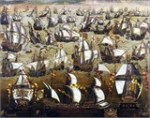
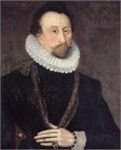
My 13th great-grandfather has the shameful distinction of being a very early English slave trader. Interestingly enough he was an early Puritan, when that title meant you hated Spain and the Pope and little else. To put this in context the Puritans, to whom we attribute belief in religious tolerance, were ruthless and greedy. These were the ancestor privateers who spread slavery to the western hemisphere. He did some expeditions with Sir Francis Drake, his cousin:
Sir John Hawkins
Born: 1532
Birthplace: Plymouth, Devon, England
Died: 12-Nov- 1595
Location of death: Caribbean Sea, near Puerto Rico
Cause of death: unspecified
Gender: Male
Race or Ethnicity: White
Sexual orientation: Straight
Occupation: Military
Nationality: England
Executive summary: British admiral, slave trader
Sir John Hawkins, or Hawkyns, British admiral, was born at Plymouth in 1532, and belonged to a family of Devonshire shipowners and skippers — occupations then more closely connected than is now usual. His father, William Hawkins, was a prosperous freeman of Plymouth, who thrice represented that town in parliament, and is described by Richard Hakluyt as one of the principal sea-captains in the west parts of England; his elder brother, also called William, was closely associated with him in his Spanish expeditions, and took an active part in fitting out ships to meet the Armada; and his nephew, the eldest son of the last named and of the same name, sailed with Sir Francis Drake to the South Sea in 1577, and served as lieutenant under Edward Fenton in the expedition which started for the East Indies and China in 1582. His son, Sir Richard Hawkins, was also a British admiral and explorer.
Sir John Hawkins was bred to the sea in the ships of his family. When the great epoch of Elizabethan maritime adventure began, he took an active part by sailing to the Guinea coast, where he robbed the Portuguese slavers, and then smuggled the negroes he had captured into the Spanish possessions in the New World. After a first successful voyage in 1562-63, two vessels which he had rashly sent to Seville were confiscated by the Spanish government. With the help of friends, and the open approval of the queen, who hired one of her vessels to him, he sailed again in 1564, and repeated his voyage with success, trading with the Creoles by force when the officials of the king endeavored to prevent him. These two voyages brought him reputation, and he was granted a coat of arms with a demi-Moor, or negro, chained, as his crest. The rivalry with Spain was now becoming very acute, and when Hawkins sailed for the third time in 1567, he went in fact, though not technically, on a national venture. Again he kidnapped negroes, and forced his goods on the Spanish colonies. Encouraged by his discovery that these settlements were small and unfortified, he on this occasion ventured to enter Vera Cruz, the port of Mexico, after capturing some Spaniards at sea to be held as hostages. He alleged that he had been driven in by bad weather. The falsity of the story was glaring, but the Spanish officers on the spot were too weak to offer resistance. Hawkins was allowed to enter the harbor, and to refit at the small rocky island of San Juan de Ulloa by which it is formed. Unfortunately for him, and for a French corsair whom he had in his company, a strong Spanish force arrived, bringing the new viceroy. The Spaniards, who were no more scrupulous of the truth than himself, pretended to accept the arrangement made before their arrival, and then when they thought he was off his guard attacked him on the 24th of September. Only two vessels escaped, his own, the “Minion”, and the “Judith”, a small vessel belonging to his cousin Francis Drake. The voyage home was miserable, and the sufferings of all were great.
For some years Hawkins did not return to the sea, though he continued to be interested in privateering voyages as a capitalist. In the course of 1572 he recovered part of his loss by pretending to betray the queen for a bribe to Spain. He acted with the knowledge of Lord Burleigh. In 1573 he became treasurer of the navy in succession to his father-in-law Benjamin Gonson. The office of comptroller was conferred on him soon after, and for the rest of his life he remained the principal administrative officer of the navy. Burleigh noted that he was suspected of fraud in his office, but the queen’s ships were kept by him in good condition. In 1588 he served as rear-admiral against the Spanish Armada and was knighted. In 1590 he was sent to the coast of Portugal to intercept the Spanish treasure fleet, but did not meet it. In giving an account of his failure to the queen he quoted the text “Paul doth plant, Apollo doth water, but God giveth the increase”, which exhibition of piety is said to have provoked the queen into exclaiming, “God’s death! This fool went out a soldier, and has come home a divine.” In 1595 he accompanied Drake on another treasure hunting voyage to the West Indies, which was even less successful, and he died at sea off Puerto Rico on the 12th of November 1595.
Hawkins was twice married, first to Katharine Gonson and then to Margaret Vaughan. He was counted a puritan when puritanism meant little beyond hatred of Spain and popery, and when these principles were an ever-ready excuse for voyages in search of slaves and plunder. In the course of one of his voyages, when he was becalmed and his negroes were dying, he consoled himself by the reflection that God would not suffer His elect to perish. Contemporary evidence can be produced to show that he was greedy, unscrupulous and rude. But if he had been a more delicate man he would not have risked the gallows by making piratical attacks on the Portuguese and by appearing in the West Indies as an armed smuggler; and in that case he would not have played an important part in history by setting the example of breaking down the pretension of the Spaniards to exclude all corners from the New World. His morality was that of the average stirring man of his time, whether in England or elsewhere.
Father: William Hawkins (sea captain, d. 1553)
Brother: William (d. 1589)
Wife: Katharine Gonson
Son: Sir Richard Hawkins
Wife: Margaret Vaughan
Knighthood 1588
Admiral Sir John Hawkins Knight (1520 – 1595)
is my 13th great grandfather
Elizabeth Hawkins (1530 – 1595)
daughter of Admiral Sir John Hawkins Knight
John Bouchier Sears (1561 – 1629)
son of Elizabeth Hawkins
Richard Sears (1590 – 1676)
son of John Bouchier Sears
Silas Sears (1638 – 1697)
son of Richard Sears
Silas Sears (1661 – 1732)
son of Silas Sears
Sarah Sears (1697 – 1785)
daughter of Silas Sears
Sarah Hamblin (1721 – 1814)
daughter of Sarah Sears
Mercy Hazen (1747 – 1819)
daughter of Sarah Hamblin
Martha Mead (1784 – 1860)
daughter of Mercy Hazen
Abner Morse (1808 – 1838)
son of Martha Mead
Daniel Rowland Morse (1838 – 1910)
son of Abner Morse
Jason A Morse (1862 – 1932)
son of Daniel Rowland Morse
Ernest Abner Morse (1890 – 1965)
son of Jason A Morse
Richard Arden Morse (1920 – 2004)
son of Ernest Abner Morse
Pamela Morse
I am the daughter of Richard Arden Morse
Admiral Sir John Hawkins (1532-1595)
John Hawkins was born in Plymouth in 1532, the son of William Hawkins, a wealthy captain, shop-owner and merchant. William also happened to be Mayor of Plymouth that year, too. John’s mother was Joan Trelawney, from an equally rich and well-known Cornish Family. It is therefore no surprise that he should have become a seaman and adventurer in his own right. A suggestion that the trade received Royal sanction.
In 1559 John Hawkins married Katharine Gonson, the daughter of Benjamin Gonson, who was Treasurer of the Navy. Hawkins made his first such voyage in 1562, taking Negroes he had captured in West Africa to barter with the Spaniards in the West Indies for precious metals, pearls and bullion. A second voyage was made in 1564. In 1567 he sailed with his kinsman, Francis Drake, on an attempt to open up legitimate trade with the Spanish and Portuguese. This expedition had the support of Queen Elizabeth.
Naturally, the King of Spain was against that idea. At San Juan de Ulua (now known as Vera Cruz), the English fleet was attacked while at anchor and destroyed. Drake and Hawkins escaped and Drake returned to Plymouth on January 20, 1569 aboard the “Judith.” However, John Hawkins was in a big of a predicament. Having abandoned the “Jesus”, he had a larger than usual crew on board the “Minion” and he was unable to take on fresh victuals or water and he felt that the vessel could not safety sail home across the Atlantic in this situation. He decided the only option was to leave some of the men on the Mexican coast but they would have no provisions and they would be a the mercy of both the natives and the Spaniards. A hundred men volunteered to stay behind and Hawkins promised to return to collect them as soon as possible, if he himself reached England safely. But safely return he did and on January 25, 1569 a farm labourer working in a field above Mount’s Bay in Cornwall saw the ship anchor and send a boat ashore. Upon hearing the situation, the labourer hurried to Plymouth to tell John’s brother, William, and he sent a fresh crew to Mount’s Bay to take the ship to Plymouth.
Hawkins did honour his pledge to get those left in Mexico back home but it took him three years. Some of the men had been handed over to the Spanish Inquisition and slung into prison. In order to get them released, John Hawkins entered into a strange tale of intrigue. He laid a bait for the Spanish ambassador by letting him hear some very seditious remarks about Queen Elizabeth. He gradually expanded upon this by introducing incidents that would suggest he was embittered by her treatment of him. He hinted that he might transfer his allegiance to King Philip of Spain. Fortunately, Hawkins had never made a great play of his support for the Protestants, so he was easily able to convince King Philip that he was a Catholic at heart. He following this up with an offer of his private fleet for the use of the King and he even managed to get a letter from the imprisoned Mary, Queen of Scots, in which she vouched for his honestly and begged the King to release the captured seamen. This was duly achieved and the seamen were even given five Spanish gold crowns and a free passage home to England.
John Hawkins was appointed joint Treasurer of the Navy with his father-in-law in about 1572, but Benjamin Gonson died soon afterwards and Hawkins inherited the post full-time. As the most important figure on the Navy Board, for the next few years he devoted his attentions to building up the fleet and removing inefficiencies and abuses within the service. He changed the design of English warships, building them lower and faster and able to carry more powerful cannons. This turned out to be of great advantage in the forthcoming battle with the Spanish Armada.
In October 1573 Hawkins suffered an assassination attempt. He was riding down the Strand in London with Sir William Wynter when one Peter Burchett, a fanatic, attacked and stabbed him after mistakenly thinking he was Sir Christopher Hatton. For several days his life was in dangerand the Queen even sent her own physicians to attend him but he survived to fight another day.
Hawkins commanded the rear squadron at Plymouth when the approach of the Armada was spotted and for his action against the ill-fated fleet he was knighted by the Lord Admiral, Lord Howard of Effingham, aboard the “Ark Royal”.” After that great victory, Hawkins spent a considerable amount of energy obtaining assistance and pensions for the wounded seamen involved, many of whom were unable to work again.
In 1593 Sir John resigned from the Navy Board and shortly afterwards he set sail on what was to be his last expedition. It was to go in search of his son, Richard, who he believed had been captured by the Spanish off the South American coast. He was appointed as a joint commander with Sir Francis Drake but this proved to be a bad arrangement. They had very different temperaments. Drake was dashing and casual, whereas Sir John was steady, slow and methodical. For example, while Hawkins made careful arrangements for the provisioning of his ships, Sir Francis just sailed off with insufficient stores on board his ships. Drake’s casualactions meant that they were required to stop off at the Canary Islands on their way, whichunfortunately destroyed the element of surprise. But the situation got even worse. Sir JohnHawkins fell seriously ill and when the fleet dropped anchor off Porto Rico on November 12,1595, he died. Sir Francis Drake was to die shortly afterwards

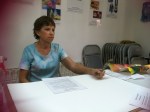


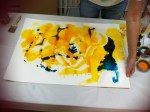
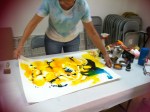
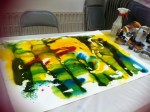

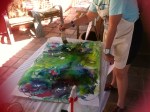
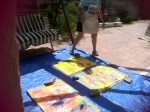
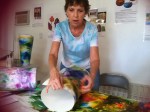


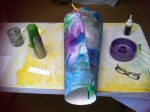
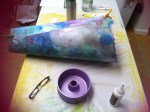


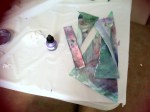




Yesterday I enjoyed making art in a new way with Jeanne Fellow at Blue Raven Art School. I had visited her studio and purchased a couple of her beautiful pieces and learned about the LumenArt class. My classmate Jeannie Gentry had done exactly the same thing. We both were very excited to try our hand at making one of these very special lamps. Our 5 hour class went by very quickly. Everything was set up for us on the shaded patio. Each of us had our own work table and basic tools. After a thorough demonstration of the basic techniques we chose colors and started our own experiment in color mixing. Some of the inks are iridescent, but those also block the light from within when it is a finished LumenArt. The fun of it all is that you don’t know how it will really look until you light it. Jeanne encouraged us to feel free and confident to play around. Both students created three possible candidates for lighting. The class materials include two sheets of incredible paper that allows all kinds of layering and special techniques without tearing. We each bought one extra sheet because we had enough time and were seriously into it. When dry we selected one to become our lamp. Choosing color for the base and tearing the final design we had supervision and plenty of encouragement from our teacher. This project is practically impossible to do badly. The materials guarantee that the finished product will be thrilling. She teaches a class in using these techniques on fabrics that will also be fun. If you are an experienced artist/craftperson you will love this class. If you think you are not creative and have no talent for art you will be blown away by your own amazing abilities when Jeanne shows you how to release them. My LumenArt is now making me very happy and proud in my living room at home. I also have two other fabulous pieces of art that I made. I even love my scraps. I would encourage anyone to investigate creativity and find your own inner light in one of Jeanne’s classes. She rules.
I will visit Austin, TX in the middle of the summer. I look forward to spending time downtown where I have rented a fabulous vintage Airstream from Air BnB as my abode. I will attend a reunion party for which I will need a car, but I am investigating the choices and prices I have while I am in the city. Car rental at the airport for the entire time would cost about $1000. Since I like being driven more than I like to drive, especially in a city, I am trying Lyft as a way to buy one ride at a time. My Airstream home is near public bus lines, and I can rent a bike for $10 a day. I like to go on foot to see the detail around me when I visit a new area. I know Austin has a system of bike taxis that are fun to use, especially when traffic is jammed for cars. When we went to Austin City Limits Music Festival we made use of the bike taxis, water taxis, and took a sunset party cruise on a well equipped floating live music bar. Considering all these choices renting a car and finding parking for it wherever I go sounds less appealing than biking, floating or being driven.
During my career as a travel agent I was always grateful and happy to stay in hotels and use suppliers on the commercial market. I made extra effort to rent private flats when I traveled. Now that the market has changed drastically I am pleased to be able to rent with assurance from Air BnB, and now ride with assurance provided by Lyft, Uber, and probably other apps I have yet to discover. I just joined Lyft and have received a message that the first ride is on the company as my gift for being a Lyft pioneer. What is not to like? We plan to go out this weekend, so I will give that free ride a trial when we want to come home after happy hour. I will find out if they are active in Tucson and test the service. I prefer the free ride home to any chocolate bunny. Thanks, Lyft.




Athena is often mentioned as a war goddess because she was never defeated. She is also the goddess of wisdom and crafts. Her protection is important in firing the kiln. The ceramic demons that destroy a firing can take over without her blessing:
Homer’s Epigrams Fragment 14 (trans. Evelyn-White) (Greek epic C8th or C7th B.C.) :
“Potters, if you give me a reward, I will sing for you. Come, then, Athena [goddess of pottery], with hand upraised over the kiln. Let the pots and all the dishes turn out well and be well fired: let them fetch good prices and be sold in plenty in the market. Grant that the potters may get great gain and grant me so to sing to them. But if you turn shameless and make false promises, then I call together the destroyers of kilns, Suntribos (Shatter) and Smaragon (Smash) and Asbetos (Charr) and Sabaktes (Crash) and Omodamos (Crudebake) who can work this craft much mischief. Come all of you and sack the kiln-yard and the buildings: let the whole kiln be shaken up to the potter’s loud lament. As a horse’s jaw grinds, so let the kiln grind to powder all the pots inside.”
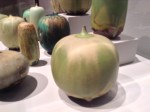
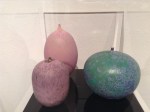
It is obvious to me that Rose Cabat made friends with Athena long ago in order to achieve such masterful results in the kiln. Her work is unique because her special glazes create a silky feel that is her secret weapon. The pots are vivid and beautifully shaped, inviting touch. The soft surface she creates is like no other. She calls the pots feelies, and has become famous for these special touchable forms. Her many collectors are happy to pay $400 and up for a tiny feelie because they only go up in value over time. Rose is still making pots from her wheel chair at age 100, and continues to be in very good standing with Athena. She has a show now at the Tucson Museum of Art featuring her work over her long career. It is incredible to see in person. I have seen her work over the years, but there are so many in one place that it delights the eye..and makes us wish we could feel them. There are some for sale in the Museum shop if you want your own to have and to hold.


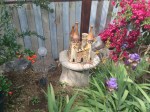









I recently reread the book Centering by Mary C Richards, a potter. In it she waxes very poetic about the subject of pottery. When I was covered with mud I considered Ms Richards to be fluffy and woo woo. About 35 years later I see how centering clay on a wheel is sheer poetry. I also notice my own approach to centering, which has never left me. I now like to center my body from the core in deep water, using tubular units for balance. This month as I attempt to write a poem a day I searched my memory for inspiration. Janet Burner, queen of all alchemists and artist of great skill and talent, popped into my mind. She has awesome technical skills and an alliance with fire like nobody I have ever seen. I like fire myself and enjoyed my time as a kiln queen. Janet has perfected various styles of firing to add variety and excitement to her work. She has always been famous for her raku. Now she has evolved other techniques, both modern and ancient, to bring her work to life.
In the kiln the pot is actually born. Just like an animal at birth, it also has a chance of dying. Potters must accept that some work will crack or be ruined in the firing. They must also accept that pottery is breakable, and glazes can only be controlled to a certain extent. Intimate knowledge and wisdom of the firing process results from practice and experimentation. I think of Janet Burner as the ultimate goddess of the fire. We talked about how ironic it is that her last name is Burner, both because of fire and because one of the oldest techniques used in finished ceramics is called burnishing. Her work today is created in a wonderful studio full of light, love, and art that she built herself. The artful courtyard garden serves as a gallery to display her work. She continues to teach at the Tucson Museum of Art School and grace our community with her participation in the Pima Arts Council Open Studio Tours. Next weekend you can visit artists and see their studios all over Tucson. This is an excellent way to find art and artists.
I grew up in the 1950’s watching You Bet Your Life on our big black and white TV. When I see this episode I am shocked that Chiricahua Apache Chief, Niño Cochise was a contestant on the show. The jokes made at his expense by Groucho were equalled later in the show with his comments to an overweight woman in the contest. Our prejudices may have remained active, but nobody would publicly joke in such racist and chauvinist ways in 2014. Niño Cochise used sit at the Wilcox visitor center and to greet tourists when I moved to Arizona in the 1970’s. He is buried in Tombstone in the old cemetery. It is odd to see him in a business suit answering quiz questions while he is the Chief of the tribe. Times have changed.
April is for poets, and we are all poets. There are many ways to celebrate. I have taken the challenge to write a poem each day in April. My approach is zen. The weekend workshop on ekphrastic poetry helped me find a place to begin. By responding to art, the ekphrastic poet reflects, or echoes the artist by interpreting the artwork. Memorizing a poem is another way to participate in the fun this month. My father could recite almost all of the Cremation of Sam McGee by Robert W Service, which was always impressive. Stories told in rhyme stay in the mind’s eye.
Poets.org has a poetry party happening right now. You can make a commonbook with quotes and poems using resources on the site. If you are lucky enough to live in Tucson you can visit our Poetry Center to experience space completely dedicated to poetry. Docents there are happy to give tours of the rare books and more if you call for an appointment. Today in Tucson the 31st annual Poetry Festival invites the public for free readings and activities all weekend. Fluency and artistry enhance the lives of those who listen. Tune in this month to hear what you may have been missing.
Next Saturday, 5 April, 2014 will be a big day in Dragoon, Arizona. The first run in Texas Canyon is organized to coincide with a food festival, a wine and brew fest, and a spring fling. Dragoon is just about an hour’s drive away from Tucson on I-10. The Amerind Foundation Museum is primo Native art displayed perfectly. The collections are impressive, and the galleries designed with the greatest of care. If you have not visited the museum next Saturday is a great day to do it. Admission will be free for the day, and the festivals will round out the activities. Runners should register early if they want to compete in the trail run.
Ryan Redcorn, an Osage entrepreneur, has produced this video of smiling Indians. It is dedicated to Edward Curtis whose Native American images dominate the web and the memory. Just yesterday I was at the Arizona State Museum viewing some Curtis photos shot in Arizona, and all were new to me. His seemingly endless portfolio was shot in the first decades of the 20th century. The work has become controversial. Mr. Redcorn believes in producing yourself, which inspired him to create this video as a counterpoint to Curtis.
I was in Pawhuska, Oklahoma a few years ago on an ancestry hunt. My cousin and I were trying to sort out a story that our great-grandmother as Cherokee. We never found any evidence pro or con, but we went to the tribal headquarters of both the Osage and Cherokee tribes to seek answers. My cousin (like many Americans) was stuck on the romantic notion that we are Cherokee. When I saw the tiny museum in Pawhuska and talked to the curators I wanted to be Osage. They were always distinct among the 5 civilized tribes. They got rich from oil and spent much of their wealth buying products from France, especially elaborate fashion items. My father told me when he was a kid the Osage used to drive around in Cadillacs with goats in the back seat. I am probably not descended from the Osage tribe, but I do really admire the way they are. I loved the art, the history, and their sense of humor on my visit with them. Now I also love Ryan Redcorn who has a sense of humor and a bigger sense of justice.
 mermaidcamp